





NVIDIA CloudXR Streaming from Cloud to Transform Gaming and Enterprise AR/VR Experience

3295
Of your peers have already read this article.
3:00 Minutes
The most insightful time you'll spend today!
The Opportunity for Streamed AR/VR Content
What if you could get a high quality AR/VR experience without a dedicated physical computer—or even without a physical tether?
In the past, interacting with VR required a dedicated, high-end workstation and, depending on the headset, wall-mounted sensors and a dedicated physical space. Complex tasks in VR can push the limits of sensor reach, cable-length, and spatial boundaries, entangling the artist and restricting their movement. This solution was not scalable beyond a handful of advanced use cases.
Recently, tetherless VR headsets from manufacturers such as HTC and Oculus have emerged that free the user from these odious restrictions, enabling a new freedom to experience VR and AR from just about anywhere. The enhanced portability and reduced cost has led to substantially increased adoption among consumers and opened up many new exploratory use cases in enterprise.
However, while these headsets are more accessible and portable, a tradeoff in compute power was required in order to achieve these goals. The limited on-device compute power of this new generation of Head Mounted Displays (HMDs) is acceptable for many consumer applications such as casual gaming. However, advanced enterprise workloads with heavy graphics, compute, or memory requirements can be difficult or even impossible to run on these lightweight devices.
By combining NVIDIA CloudXR with their powerful GPUs running NVIDIA RTX Virtual Workstations (vWS) in Google Cloud data centers, you can experience high-fidelity VR and AR applications from just about anywhere with a good internet connection. The heavy computations are performed in the cloud on a GPU-attached VM and the content streams to any CloudXR compatible headset.
The combination of Google Cloud’s private fiber optic network — the same network we built for global delivery of YouTube content — and CloudXR’s QoS technologies provides the user with the highest possible quality of service. In fact, the streaming experience is comparable to that of a headset tethered to a powerful physical workstation, but without the friction of hardware and cables.
This combination of power and portability sets the stage to unlock the potential of high-quality gaming and enterprise AR/VR experiences anywhere on Earth.
Case Study: Creating a Masterpiece
Digital character creation is a core skill for many 3D artists today. One of the preferred methods of 3D character creation is digital sculpting, which lets artists create both hard-surface and organic shapes with high levels of accuracy and control.
Sculpting is one of the many tasks in the character designer’s skillset. Artists must also master the texturing, rigging, and posing of characters as part of the digital character creation pipeline.
Mastering all these tasks can be challenging, and often, the technology gets in the way; working in multiple applications requires switching contexts and workflows, breaking the artist’s creative flow. The traditional user experience can also be unintuitive, forcing the creator to translate what they want to do with their hands and head into mouse movement and keyboard presses.
Masterpiece Studio Pro revolutionizes this character creation workflow by giving artists the first fully immersive 3D creation pipeline. Artists work in VR, giving them a far more intuitive and seamless way to work which combines the best of the digital and physical worlds.
In Masterpiece Studio Pro, the artist can work on the character or object at any scale, using familiar tools and hand gestures to sculpt a model, much as they would a real clay figure. Performing other tasks such as skeleton creation is simple, allowing the artist to work directly with the limbs of a character to place and adjust the joints.
Bringing It All Together
NVIDIA CloudXR streaming from the cloud provides tremendous opportunities for new creative use cases within gaming and across the enterprise. This solution joins Virtual Studio for Gaming as the latest in our series to help developers build better games.
The Masterpiece Studio use case is a powerful demonstration of new modalities for content creation and collaboration. To try CloudXR with NVIDIA RTX vWS on Google Cloud for yourself, see this tutorial. Masterpiece Studio Pro also offers extensive learning materials and a free trial.
4892
Of your peers have already watched this video.
1:30 Minutes
The most insightful time you'll spend today!
Accelerate Your Digital Transformation Through a Modern Infrastructure
Learn about the latest advancements to Google Cloud Platform’s unique infrastructure to accelerate enterprise workloads and build planet scalable solutions. Hear how Google Cloud’s infrastructure enables you to solve problems faster, more securely, and at greater scale.
See how Google Cloud is accelerating the support for enterprise workloads like SAP, VMware, and Windows and augmenting new capabilities to better protect and secure your workloads. Discover how Google Cloud enables businesses to build high-scale applications with global scale and reach.
IDC Survey: Why 95% of CEOs Have a Digital-first Strategy

2930
Of your peers have already read this article.
3:00 Minutes
The most insightful time you'll spend today!
When IDC recently asked CEOs what single word most reflects what their organization needs to thrive in 2022, the overwhelming response was “technology.” CEOs want to acquire greater digital know-how as they recognize that technology will underpin the business model of the future.
Digital transformation, already well underway, is becoming digital first.
In fact, an astonishing 95% of CEOs see the need to adopt a digital-first strategy, according to IDC, and the majority of organizations are down the path of executing their plans. Currently, they report that about 30% of their organization’s revenue comes from digital products, services and experiences, a figure that will reach past 40% by 2027.
But what will power this digital-first enterprise? Successful large-scale digital transformations are executed by a diverse set of partners and vendors—including a cloud partner, valuable channel partners and resellers, independent software vendors (commonly called ISVs), and services partners; multiple cloud partners are even becoming quite common.
These networks of experts are increasingly the driver behind enterprise transformation. They help companies and organizations to establish an actively managed and governed cloud ecosystem that integrates native and third-party solutions, which can create shared value for all partners from the latest digital technologies. In fact, 85% of CEOs told IDC that actively participating in digital ecosystems is important to their revenue growth.
The new digital agenda is built on cloud ecosystems
Recently, I sat down with the author of the IDC CEO survey, Philip Carter. He’s the group vice president, European chief analyst, and worldwide C-suite tech research lead at IDC, and I wanted to better understand from him how executives are approaching their digital-first mission.
He explained that CEOs are turning to cloud platforms as a primary partner to put in place new, industry-specific digital business models. These platforms are at the center of “industry value networks” that accelerate time to value and benefit from cloud architecture’s ability to deliver scale, extensibility, and AI-driven experiences to create new revenue streams.
At Google Cloud, we have made building such industry value networks a priority, comprising of:
- Google Cloud, which provides the infrastructure and develops industry-specific data and analytics capabilities using artificial intelligence.
- Broader Google product areas like Google Shopping, Ads, Maps, Pay, Assistant, Android and Chrome.
- Independent software vendors (ISVs) relevant to a specific industry, who co-innovate with Google to provide end-to-end solutions to industry problems.
- System integrators (SIs) with deep industry knowledge who build the strategy and implement the business transformation for customers.
As an example, Google Cloud customers across multiple industries are looking for digital transformation to reinvent their core functions, such as supply chain. They might be identifying new distribution channels or restructuring their inventory. Google Cloud understands how to link the enterprise ecosystem with the consumer ecosystem. We can help enterprises access this broader ecosystem while leveraging AI-driven insights from data to help inform decisions in real time, at the point of engagement.
Google Cloud’s partner ecosystem can help achieve multiple items on the C-suite tech agenda such as improving customer experience, powering enterprise intelligence, building trust, supporting a distributed workplace, driving innovation, and streamlining operations.
According to IDC, 75% of all organizations will be completely digitally transformed by 2030. Google Cloud has been working hard with our partners to create an extensive ecosystem that can help your organization achieve its digital transformation ahead of competitors. This includes co-developing and co-innovating industry-specific solutions with a host of partners in key areas such as operations, enterprise intelligence, customer experience, workplace productivity, innovation, security, and trust.
And over the next few years, Google Cloud will double its investment in its partner ecosystem with increased co-innovation resources, more incentives, and co-marketing campaigns and funding. We’ll also offer greater integration into the Google Cloud Marketplace and a larger commitment to training and enablement.
For more insights on the C-suite “Future of Enterprise” agenda, you can watch my full IDC interview. You might also download our ebook featuring IDC data on the future of enterprise with ecosystem examples from partners like AMD, Confluent, Fortinet, Genesys, Informatica, and Workspot.
Our goal is to provide comprehensive best-in-class support for our mutual customers’ digital transformations. As we look toward that goal, one thing is for sure: Our ecosystem of partners will continue to grow, adding solutions to meet the needs of digital-first enterprises. Care to join us on that journey?

5430
Of your peers have already downloaded this article
4:30 Minutes
The most insightful time you'll spend today!
Security is often a deciding factor when choosing a public cloud provider. At Google Cloud, security is of the utmost importance and the security strategy encompass authentication, integrity, and encryption, for both data at rest and in transit.
Hence, Google Cloud encrypts and authenticates all data in transit at one or more network layers when data moves outside physical boundaries not controlled by Google or on behalf of Google. Data in transit inside a physical boundary controlled by or on behalf of Google is generally authenticated but not necessarily encrypted.
In addition, Google works actively with the industry to help bring encryption in transit to everyone, everywhere. It has several open-source projects that encourage the use of encryption in transit and data security on the Internet at large including Certificate Transparency, Chrome APIs, and secure SMTP.
Download this whitepaper and understand Google’s approach to the encryption of data in transit, where it is applied, and why Google is the industry leader in encryption in transit.
A Pro’s Tip on Choosing the Right Google Cloud Compute Options

5735
Of your peers have already read this article.
2:00 Minutes
The most insightful time you'll spend today!
Where should you run your workload? It depends…Choosing the right infrastructure options to run your application is critical, both for the success of your application and for the team that is managing and developing it. This post breaks down some of the most important factors that you need to consider when deciding where you should run your stuff!
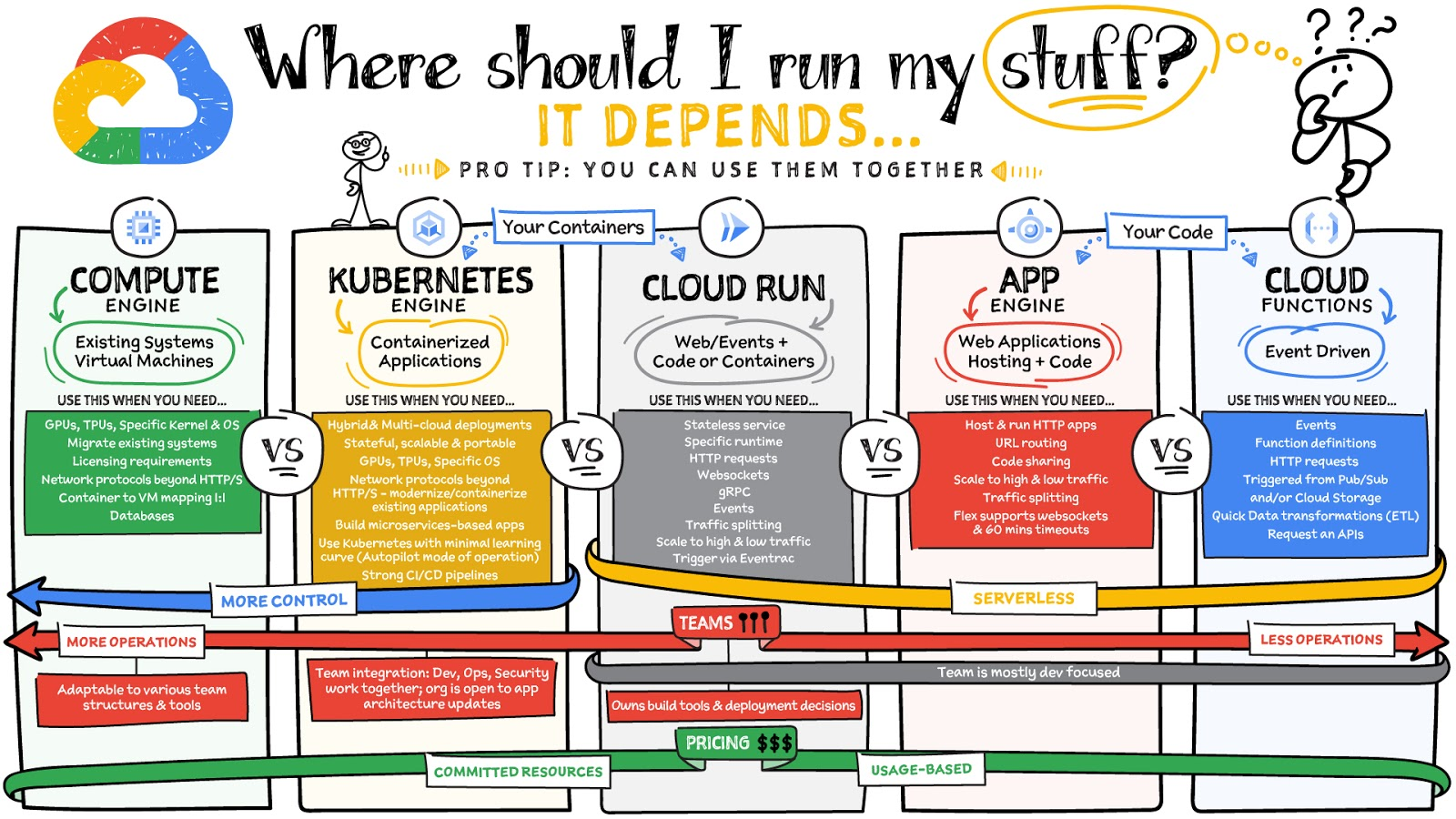
What are these services?
- Compute Engine – Virtual machines. You reserve a configuration of CPU, memory, disk, and GPUs, and decide what OS and additional software to run.
- Kubernetes Engine – Managed Kubernetes clusters. Kubernetes is an open-source system for automating deployment, scaling, and management of containerized applications. You create a cluster and configure which containers to run; Kubernetes keeps them running and manages scaling, updates and connectivity.
- Cloud Run – A fully managed serverless platform that runs individual containers. You give code or a container to Cloud Run, and it hosts and auto scales as needed to respond to web and other events.
- App Engine – A fully managed serverless platform for complete web applications. App Engine handles the networking, application scaling, and database scaling. You write a web application in one of the supported languages, deploy to App Engine, and it handles scaling, updating versions, and so on.
- Cloud Functions – Event-driven serverless functions. You write individual function code and Cloud Functions calls your function when events happen (for example, HTTP, Pub/Sub, and Cloud Storage changes, among others).
What level of abstraction do you need?
- If you need more control over the underlying infrastructure (for example, the operating system, disk images, CPU, RAM, and disk) then it makes sense to use Compute Engine. This is a typical path for legacy application migrations and existing systems that require a specific OS.
- Containers provide a way to virtualize an OS so that multiple workloads can run on a single OS instance. They are fast and lightweight, and they provide portability. If your applications are containerized then you have two main options.
- You can use Google Kubernetes Engine, or GKE, which gives you full control over the container down to the nodes with specific OS, CPU, GPU, disk, memory, and networking. GKE also offers Autopilot, when you need the flexibility and control but have limited ops and engineering support.
- If, on the other hand, you are just looking to run your application in containers without having to worry about scaling the infrastructure, then Cloud Run is the best option. You can just write your application code, package it into a container, and deploy it.
- If you just want to code up your HTTP-based application and leave the scalability and deployment of the app to Google Cloud then App Engine — a serverless, fully-managed option that is designed for hosting and running web applications — is a good option for you.
- If your code is a function and just performs an action based on an event/trigger, then deploying it with Cloud Functions makes sense.
What is your use case?
- Use Compute Engine if you are migrating a legacy application with specific licensing, OS, kernel, or networking requirements. Examples: Windows-based applications, genomics processing, SAP HANA.
- Use GKE if your application needs a specific OS or network protocols beyond HTTP/s. When you use GKE, you are using Kubernetes, which makes it easy to deploy and expand into hybrid and multi-cloud environments. Anthos is a platform specifically designed for hybrid and multi-cloud deployments. It provides single-pane-of-glass visibility across all clusters from infrastructure through to application performance and topology. Example: Microservices-based applications.
- Use Cloud Run if you just need to deploy a containerized application in a programming language of your choice with HTTP/s and websocket support. Examples: websites, APIs, data processing apps, webhooks.
- Use App Engine if you want to deploy and host a web based application (HTTP/s) in a serverless platform. Examples: web applications, mobile app backends
- Use Cloud Functions if your code is a function and just performs an action based on an event/trigger from Pub/Sub or Cloud Storage. Example: Kick off a video transcoding function as soon as a video is saved in your Cloud Storage bucket.
Need portability with open source?
If your requirement is based on portability and open-source support take a look at GKE, Cloud Run, and Cloud Functions. They are all based on open-source frameworks that help you avoid vendor lock-in and give you the freedom to expand your infrastructure into hybrid and multi-cloud environments. GKE clusters are powered by the Kubernetes open-source cluster management system, which provides the mechanisms through which you interact with your cluster. Cloud Run for Anthos is powered by Knative, an open-source project that supports serverless workloads on Kubernetes. Cloud Functions use an open-source FaaS (function as a service) framework to run functions across multiple environments.
What are your team dynamics like?
If you have a small team of developers and you want their attention focused on the code, then a serverless option such as Cloud Run or App Engine is a good choice because you won’t have to have a team managing the infrastructure, scale, and operations. If you have bigger teams, along with your own tools and processes, then Compute Engine or GKE makes more sense because it enables you to define your own process for CI/CD, security, scale, and operations.
What type of billing model do you prefer?
Compute Engine and GKE billing models are based on resources, which means you pay for the instances you have provisioned, independent of usage. You can also take advantage of sustained and committed use discounts.
Cloud Run, App Engine, and Cloud Functions are billed per request, which means you pay as you go.
Conclusion
It’s important to consider all the relevant factors that play a role in picking appropriate compute options for your application. Remember that no decision is necessarily final; you can always move from one option to another.
To explore these points in more detail, please take a look at the “Where Should I Run My Stuff?” video.
For more #GCPSketchnote, follow the GitHub repo & thecloudgirl.dev. For similar cloud content follow us on Twitter at @pvergadia and @briandorsey
Digital Maturity in Higher Ed Tied to Improvements in Students’ Journey: Study

5138
Of your peers have already read this article.
3:00 Minutes
The most insightful time you'll spend today!
Why Higher Ed Needs to Go All-in on Digital
In the wake of the COVID-19 pandemic, the majority of students within the 18-24-year-old demographic now expect hybrid learning environments–even once we are beyond the pandemic. And a vast number of adult learners are seeking options that accommodate their work and family lives now that it’s clear that effective learning can indeed occur virtually. Implementing cloud technologies and achieving digital maturity within higher education will enable institutions to be innovative and responsive to evolving student preferences, while being prepared for future disruptions.
The state of digital maturity
In February and March 2021, Boston Consulting Group (BCG), in partnership with Google, surveyed U.S. higher education leaders on their views of the state of digital maturity in the higher education sector. This survey found that institutional and technology leaders strongly agreed that moving legacy IT systems to the cloud, centralizing and integrating data, and increasing the use of advanced analytics is necessary to make a successful digital transformation, and ultimately achieve digital maturity.
But what is digital maturity? Digital maturity—a measure of an organization’s ability to create value through digital delivery—focuses on three areas of technological advancement that drive large-scale innovation:
- Using cloud infrastructure
- Expanding access to data
- Using that data to improve processes through advanced analytics, such as Artificial Intelligence and Machine Learning (AI/ML)
Although university leaders agree on prioritizing digital maturity, more than 55% said they considered their schools to be “digital performers” or “digital leaders.” However, only 25% of tech leaders at these universities stated that their schools regularly use data analytics. As with corporations and governments, higher education institutions face barriers to technological innovation, such as:
- Competing priorities to meet step-change goals and decentralized decision making
- Budget constraints
- Cultural resistance to change
- Tech staff skillset gaps
Still, leaders understand that the way to overcome institutional inertia is with a strong, goal-oriented vision of what is best for the institution overall. Although only a handful of schools have reached digital maturity as we define it, others can learn a great deal from their examples. Here are the top takeaways from higher education leaders who successfully transformed their institutions:
Digital solutions can improve the student journey in many ways
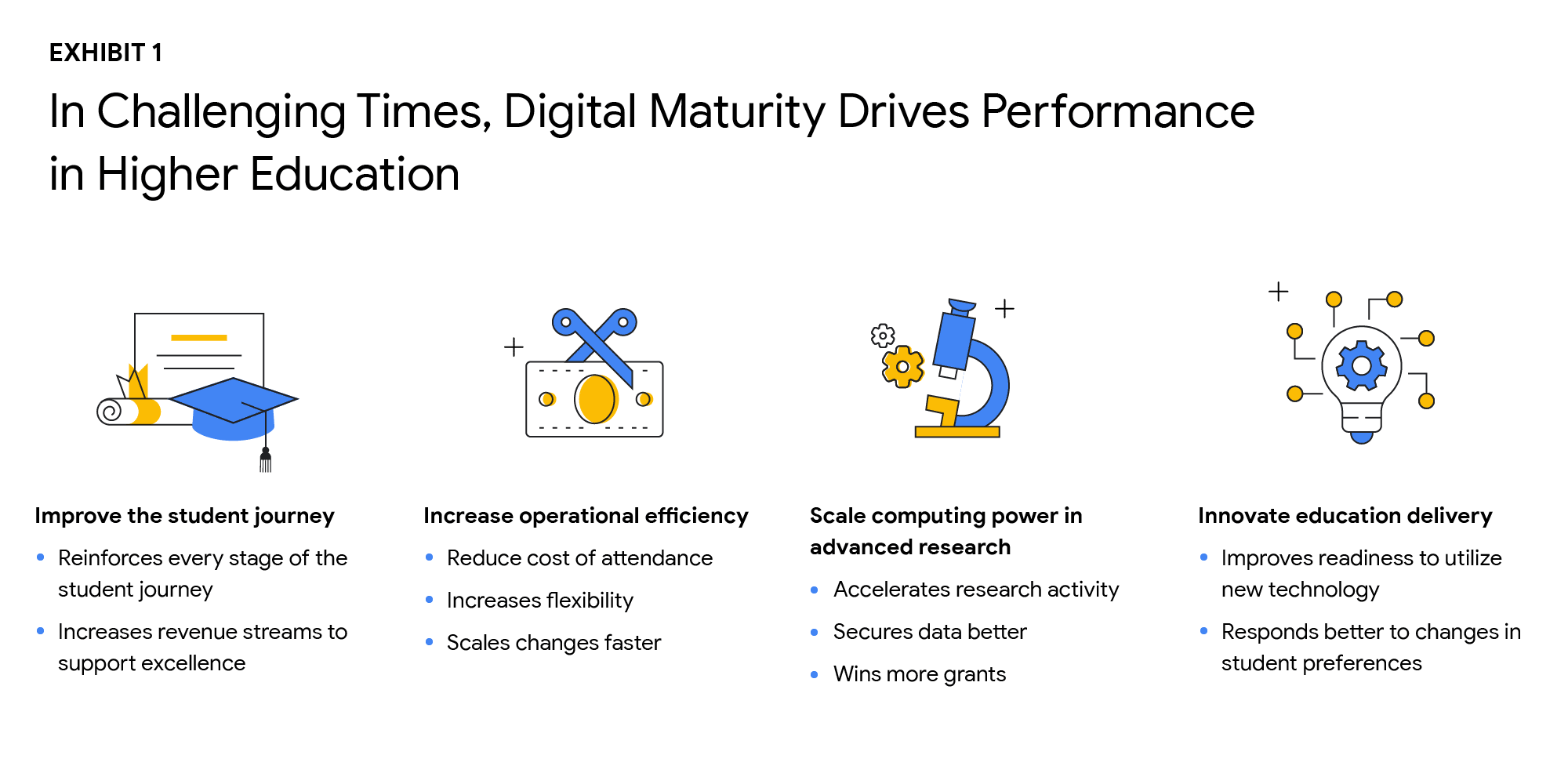
As digital capabilities hold the key to dealing effectively with declining enrollment and rising costs, higher ed leaders identified four goals that are critical to improving performance:
- Improve the student journey
- Increase operational efficiency
- Scale computing power in advanced research
- Innovate education delivery
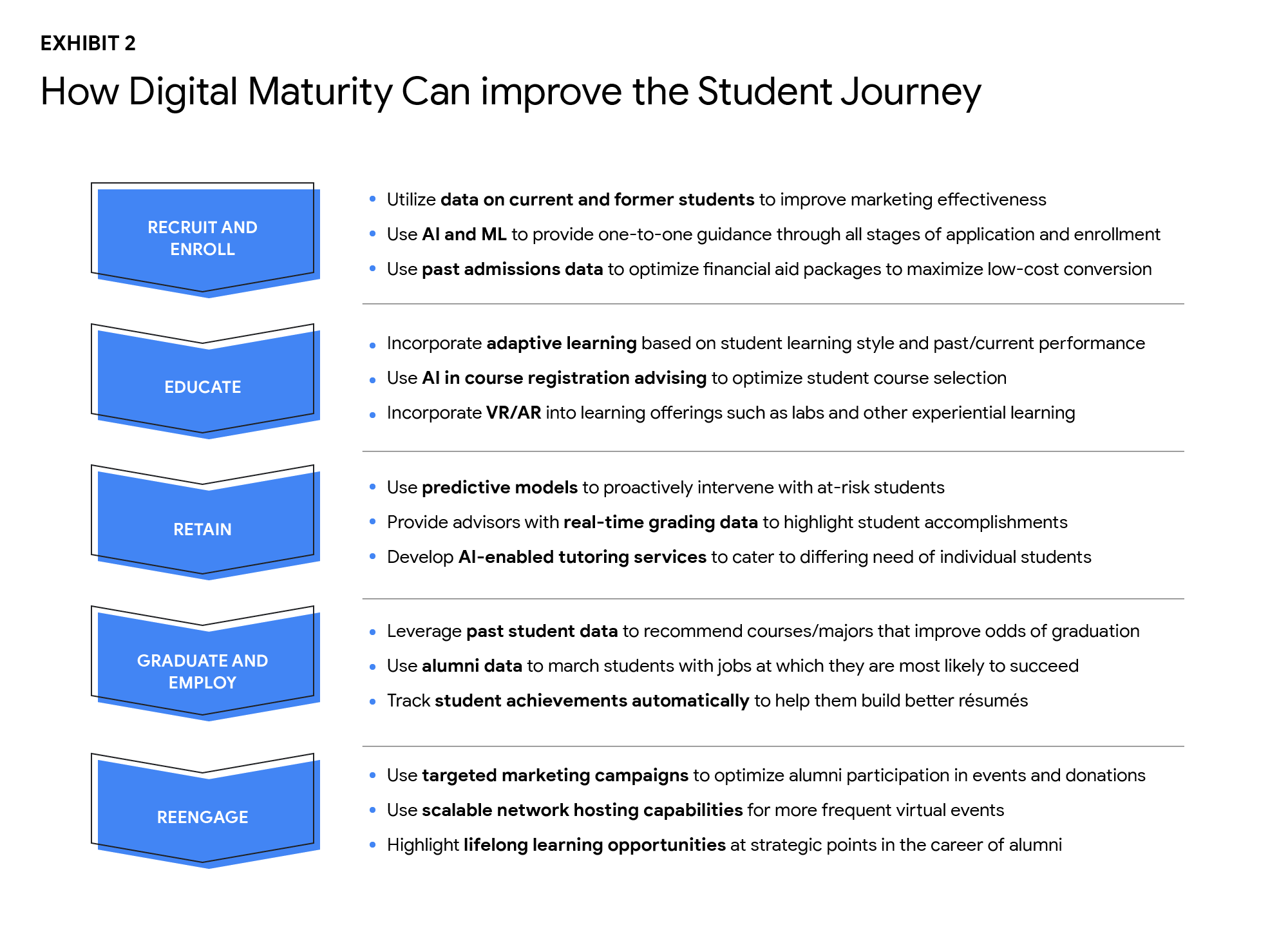
The research found that technology investments can help enhance the student journey in the recruiting and retention of students, improving digital education delivery, government funding, and donations from alumni. Digital maturity can make institutions more agile and efficient in delivering education that aligns with the changing societal norms, evolving student preferences, and future disruptions. Survey participants shared that they plan to increase the use of the cloud by more than 50% over the next three years. By shifting legacy IT systems to the cloud, institutions can increase scalability, lower the cost of ownership, and improve operational agility, while offering a more secure, long-term data storage solution.
Cloud-native software-as-a-service (SaaS) solutions provide an excellent platform for centralizing data. However, institutions that attempt to “lift and shift” their legacy systems to the cloud may encounter challenges to achieving measurable improvements in data integration and cost reduction. Higher ed leaders must realize that centralizing data and transitioning to the cloud do not happen simultaneously.
Leaders who are able to articulate a strong vision and commitment will experience a more successful technology transformation. By linking their vision to specific needs, such as more effective recruiting, leaders will find their technology investments will have a more substantial return. University presidents should base their decisions about which systems to move, when, and how on desired performance outcomes.
Big visions become a reality with small steps. Small pilot projects are an excellent way to start the journey toward digital maturity. Small steps toward a significant transformation can reduce resistance to change, build positive momentum, and produce better student outcomes. Read the full report here. If you’d like to talk to a Google Cloud expert, get in touch.
More Relevant Stories for Your Company

What Swiggy and You Can Learn From This Company’s Use of ML to Engage Customers
The app economy has enabled a huge range of unique business models to flourish. One such model is online food ordering and delivery services, in which apps leverage geo-location data to aggregate local food choices and offer personalized options to consumers. A leading company in this space is Just Eat.

Google Products Helps HMH’s Healthcare Staff Work from Anywhere Efficiently and Securely!
Hackensack Meridian Health (HMH) executive Mark Eimer explains how an ambitiously-timed rollout of a comprehensive suite of Google products helped the entire organization—from doctors to IT staff—achieve better security, cultivate a more equitable work environment, and ultimately, improve patient outcomes. How does a recently merged, 17-hospital healthcare system fast-track a platform migration

Lending DocAI Shortens Borrowers’ Journey on Roostify
The home lending journey entails processing an immense number of documents daily from hundreds of thousands of borrowers. Currently, home lending document processing relies on some outdated digital models and a high dependency on manual labor, resulting in slow processing times and higher origination costs. Scaling a business that sorts

Cloud on Europe’s Terms: How Google Sets to Deliver Cloud Services for Driving Digital Sovereignty
Cloud computing is globally recognized as the single most effective, agile and scalable path to digitally transform and drive value creation. It has been a critical catalyst for growth, allowing private organizations and governments to support consumers and citizens alike, delivering services quickly without prohibitive capital investment. European organizations—in both
