





3110
Of your peers have already watched this video.
23:30 Minutes
The most insightful time you'll spend today!
Pytorch at Scale on Cloud TPUs
Cloud TPU Pods are machine learning supercomputers that enable enterprises to train large machine learning models at a scale otherwise difficult or sometimes impossible.
They deliver business value through solving many machine learning problems including image search, neural architecture search and large-scale language models both for Google and Google Cloud customers.
However, until a few months ago TPU devices and pods were limited to Tensorflow models. Much awaited support for Pytorch was announced in Pytorch conference 2019.
In this session, Vaibhav Singh, ML Specialist, Cloud Customer Engineer, Google Cloud and Taylan Bilal, Software Engineer, Google Cloud demystify the art and science of training your Pytorch models on TPUs. They take you through a step-by-step walkthrough using an example, then explain how it works, and finally how to scale up Pytorch training with Cloud TPU Pods.
5710
Of your peers have already watched this video.
2:00 Minutes
The most insightful time you'll spend today!
Metro Consolidates 100 SAP Instances on Google Cloud
German retailer Metro, with operations in 25 countries across Europe and Asia and employing over 150,000 people, decided to consolidate its 100 SAP instances into one SAP S/4HANA system running on the Google Cloud Platform.
This helped the company lower costs, increase efficiency, and improve customer experience. In addition, the company is using Google BigQuery and advanced analytics to increase its sales.
Watch Timo Salzsieder, Metro CIO/CSO, explain the company’s journey with SAP on Google Cloud.
How Vertex AI NAS is Suitable for Most Advanced ML Workloads

4462
Of your peers have already read this article.
3:00 Minutes
The most insightful time you'll spend today!
Vertex AI launched with the premise “one AI platform, every ML tool you need.” Let’s talk about how Vertex AI streamlines modeling universally for a broad range of use cases.
The overall purpose of Vertex AI is to simplify modeling so that enterprises can fast track their innovation, accelerate time to market, and ultimately increase return on ML investments. Vertex AI facilitates this in several ways. Features like Vertex AI Workbench, for example, speed up training and deployment of models by five times compared to traditional notebooks. Vertex AI Workbench’s native integration with BigQuery and Spark means that users without data science expertise can more easily perform machine learning work. Tools integrated into the unified Vertex AI platform, such as state of the art pre-trained APIs and AutoML, make it easier for data scientists to build models in less time. And for modeling work that lends itself best to custom modeling, Vertex AI’s custom model tooling supports advanced ML coding, with nearly 80% fewer lines of code required (compared to competitive platforms) to train a model with custom libraries. Vertex AI delivers all this while maintaining a strong focus on Explainable AI.
Yet organizations with the largest investments in AI and machine learning, with teams of ML experts, require extremely advanced toolsets to deliver on their most complex problems. Simplified ML modeling isn’t relegated to simple use cases only.
Let’s look at Vertex AI Neural Architecture Search (NAS), for instance.
Vertex AI NAS enables ML experts at the highest level to perform their most complex tasks with higher accuracy, lower latency, and low power requirements. Vertex AI NAS originates from the deep experience Alphabet has with building advanced AI at scale. In 2017, the Google Brain team recognized we need a better way to scale AI modeling, so they developed Neural Architecture Search technology to create an AI that generates other neural networks, trained to optimize their performance in a specific task the user provides. To the astonishment of many in the field, these AI-optimized models were able to beat a number of state of the art benchmarks, such as ImageNet and SOTA mobilenets, setting a new standard for many of the applications we see in use today, including many Google-internal products. Google Cloud saw the potential of such a technology and shipped in less than a year a productized version of the technique (under the brand AutoML). Vertex AI NAS is the newest and most powerful version of this idea, using the most sophisticated innovation that has emerged since the initial research.
Customer organizations are already implementing Vertex AI NAS for their most advanced workloads. Autonomous vehicle company Nuro is using Vertex AI NAS, and Jack Guo, Head of Autonomy Platform at the company, states, “Nuro’s perception team has accelerated their AI model development with Vertex AI NAS. Vertex AI NAS have enabled us to innovate AI models to achieve good accuracy and optimize memory and latency for the target hardware. Overall, this has increased our team’s productivity for developing and deploying perception AI models.”
And our partner ecosystem is growing for Vertex AI NAS. Google Cloud and Qualcomm Technologies have collaborated to bring Vertex AI NAS to the Qualcomm Technologies Neural Processing SDK, optimized for Snapdragon 8. This will bring AI to different device types and use cases, such as those involving IoT, mixed reality, automobiles, and mobile.
Google Cloud’s commitments to making machine learning more accessible and useful for data users, from the novice to the expert, and to increasing the efficacy of machine learning for enterprises are at the core of everything we do. With the suite of unified machine learning tools within Vertex AI, organizations can take advantage of every ML tool they need on one AI platform.
Ready to start ML modeling with Vertex AI? Start building for free. Want to know how Vertex AI Platform can help your enterprise increase return on ML investments? Contact us.
Discover Latest Resources on Google Cloud’s Datasets Solution

6319
Of your peers have already read this article.
3:00 Minutes
The most insightful time you'll spend today!
Editor’s note: With Google Cloud’s datasets solution, you can access an ever-expanding resource of the newest datasets to support and empower your analyses and ML models, as well as frequently updated best practices on how to get the most out of any of our datasets. We will be regularly updating this blog with new datasets and announcements, so be sure to bookmark this link and check back often.
August 2021
New dataset: Google Cloud Release Notes
- Looking for a new way to access Google Cloud Release Notes besides the docs, the XML feed, and Cloud Console? Check out the Google Cloud Release Notes dataset. With up-to-date release notes for all generally available Google Cloud products, this dataset allows you to use BigQuery to programmatically analyze release notes across all products, exploring security bulletin updates, fixes, changes, and the latest feature releases.
- Access the dataset

July 2021
Best practice: Use Google Trends data for common business needs
- The Google Trends dataset represents the first time we’re adding Google-owned Search data into Datasets for Google Cloud. The Trends data allows users to measure interest in a particular topic or search term across Google Search, from around the United States, down to the city-level. You can learn more about the dataset here, and check out the Looker dashboard here! These tables are super valuable in their own right, but when you blend them with other actionable data you can unlock whole new areas of opportunity for your team. To learn how to make informed decisions with Google Trends data, keep reading.
- Access the dataset
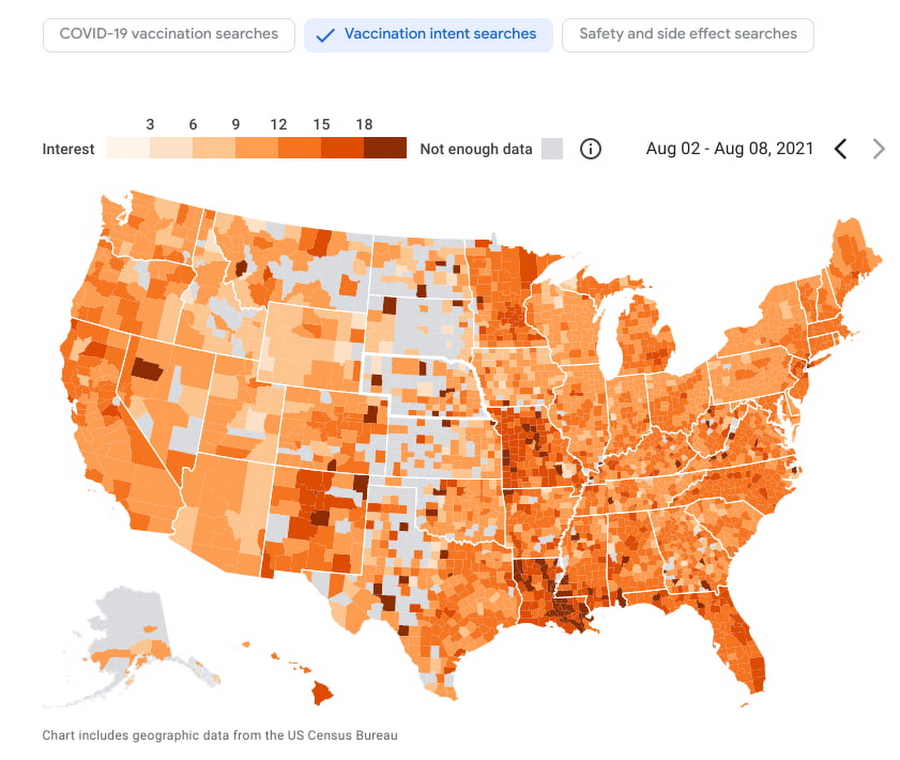
New dataset: COVID-19 Vaccination Search Insights
- With COVID-19 vaccinations being a topic of interest around the United States, this dataset shows aggregated, anonymized trends in searches related to COVID-19 vaccination and is intended to help public health officials design, target, and evaluate public education campaigns. Check out this interactive dashboard to explore searches for COVID-19 vaccination topics by region.
- Access the dataset
June 2021
New dataset: Google Diversity Annual Report 2021
- Since 2014, Google has disclosed data on the diversity of its workforce in an effort to bring candid transparency to the challenges technology companies like Google face in recruitment and retention of underrepresented communities. In an effort to make this data more accessible and useful, we’ve loaded it into BigQuery for the first time ever. To view Google’s Diversity Annual Report and learn more, check it out.
- Access the dataset
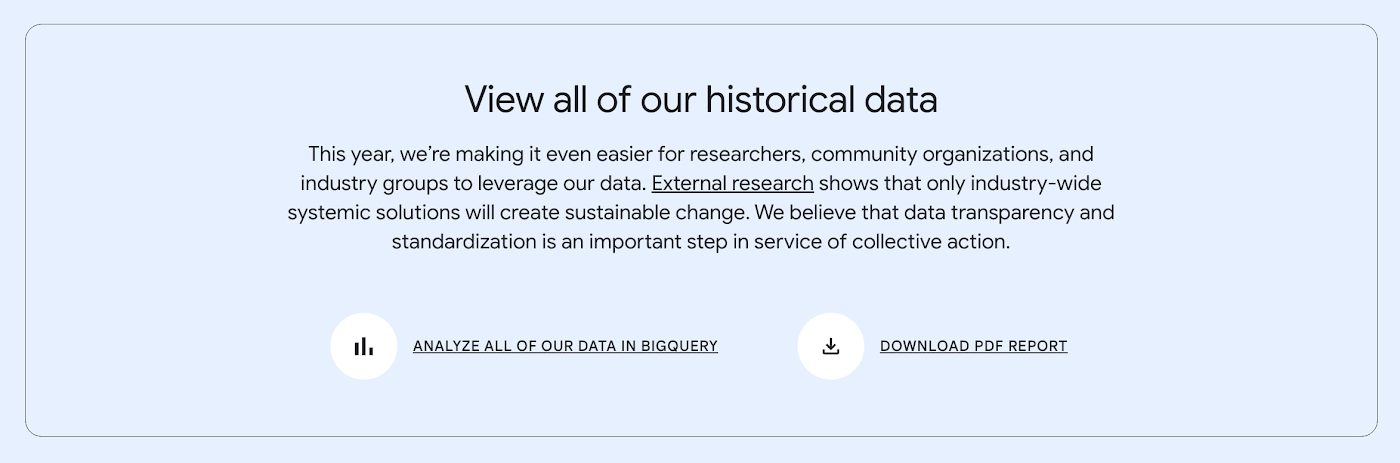
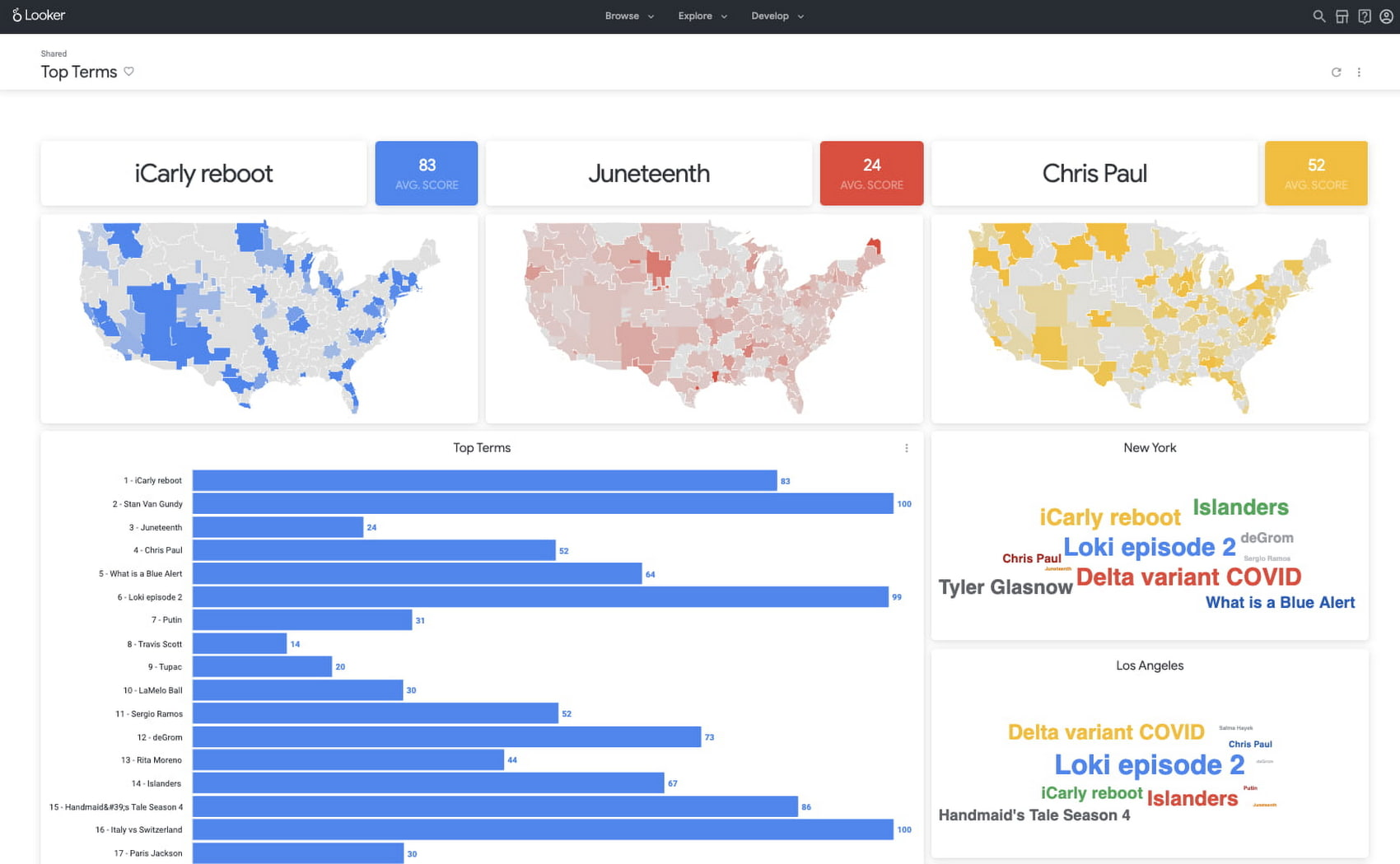
New dataset: Google Trends Top 25 Search terms
- The most popular and surging Google Search terms are now available in BigQuery as a public dataset. View the Top 25 and Top 25 rising queries from Google Trends from the past 30-days, including 5 years of historical data across the 210 Designated Market Areas (DMAs) in the US. Keep reading.
- Access the dataset
New dataset: COVID-19 Vaccination Access
- With metrics quantifying travel times to COVID-19 vaccination sites, this dataset is intended to help Public Health officials, researchers, and Healthcare Providers to identify areas with insufficient access, deploy interventions, and research these issues. Check out how this data is being used in a number of new tools.
- Access the dataset
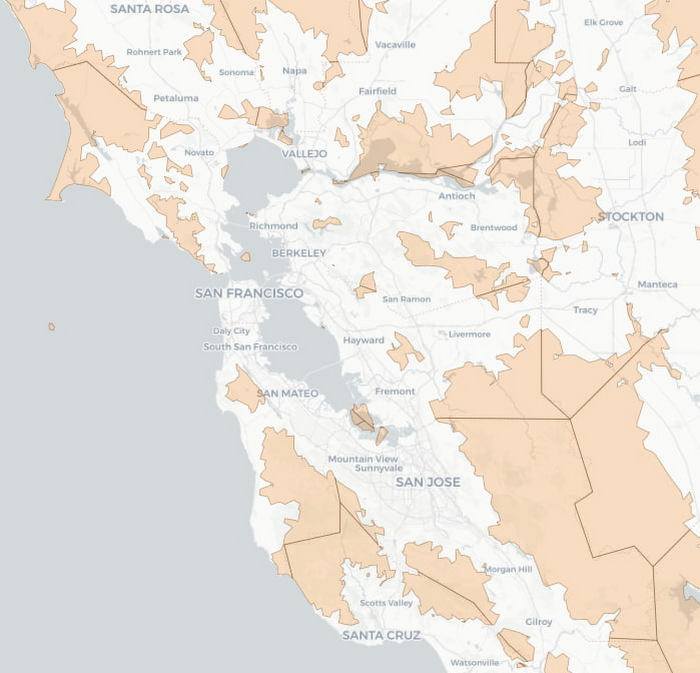

Best practice: Leveraging BigQuery Public Boundaries datasets for geospatial analytics
- Geospatial data is a critical component for a comprehensive analytics strategy. Whether you are trying to visualize data using geospatial parameters or do deeper analysis or modeling on customer distribution or proximity, most organizations have some type of geospatial data they would like to use – whether it be customer zipcodes, store locations, or shipping addresses. However, converting geographic data into the correct format for analysis and aggregation at different levels can be difficult. In this post, we’ll walk through some examples of how you can leverage the Google Cloud platform alongside Google Cloud Public Datasets to perform robust analytics on geographic data. Keep reading.
- Access the dataset

Get the metadata and try BigQuery sandbox
When you’ve learned about many of our datasets and pre-built solutions from across Google, you may be ready to start querying them. Check out the full dataset directory and read all the metadata at g.co/cloud/marketplace-datasets, then dig into the data with our free-to-use BigQuery sandbox account, or $300 in credits with our Google Cloud free trial.
Revolutionizing Cloud Computing: Introducing G2 VMs with NVIDIA L4 GPUs

1546
Of your peers have already read this article.
2:30 Minutes
The most insightful time you'll spend today!
Organizations across industries are looking to AI to turn troves of data into intelligence, powered by the latest advances in generative AI. Yet for many organizations, there is a barrier to adopting the latest models because they can be costly to train or serve. A new class of cloud GPUs is needed to lower the cost of entry for businesses that want to tap the power of AI.
Today, we’re introducing G2, the newest addition to the Compute Engine GPU family in Google Cloud. G2 is the industry’s first cloud VM powered by the newly announced NVIDIA L4 Tensor Core GPU, and is purpose-built for large inference AI workloads like generative AI. G2 delivers cutting-edge performance-per-dollar for AI inference workloads that run on GPUs in the cloud. By switching from NVIDIA A10G GPUs to G2 instances with L4 GPUs, organizations can lower their production infrastructure costs up to 40%. We also found that customers switching from NVIDIA T4 GPUs to L4 GPUs can achieve 2x-4x better performance. As a universal GPU offering, G2 instances also help accelerate other workloads, offering significant performance improvements on HPC, graphics, and video transcoding. Currently in private preview, G2 VMs are both powerful and flexible, and scale easily from one up to eight GPUs.
Currently organizations require end-to-end enterprise ready infrastructure that will future proof their AI and HPC initiatives for a new era. G2s will be ready to be deployed on Vertex AI, GKE, and GCE, giving customers the freedom to architect their own custom software stack to meet their performance requirements and budget. With optimized Vertex AI support for G2 VMs, AI users can tap the latest generative AI models and technologies. With an easy to use UI and automated workflows, customers can access, tune and serve modern models for video, text, images, and audio without the toil of manual optimizations. The combination of these services with the power of G2 will help customers harness the power of complex machine models for their business.
NVIDIA L4 GPUs with Ada Lovelace Architecture
G2 machine families enable machine learning customers to run their production infrastructure in the cloud for a variety of applications such as language models, image classification, object detection, automated speech recognition, and language translation. Built on the Ada Lovelace architecture with fourth-generation Tensor Cores, the NVIDIA L4 GPU provides up to 30 TFLOPS of performance for FP32, and 242 TFLOPs for FP16. Newly added FP8 support, on top of existing INT8, BFLOAT16 and TF32 capabilities, makes the L4 ideal for ML inference.
With the latest third-generation RT Cores and DLSS 3.0 technology, G2 instances are also great for graphics-intensive workloads such as rendering and remote workstations when paired with NVIDIA RTX Virtual Workstation. NVIDIA L4 provides 3x video encoding and decoding performance, and adds new AV1 hardware-encoding capabilities. For example, G2 can enable gaming customers running game engines such as Unreal and Unity with modern graphics cards to run real-time applications. Likewise, media and entertainment customers that need GPU-enabled virtual workstations can use the L4 to create photo-realistic, high-resolution 3D content for movies, games, and AR/VR experiences using applications such as Autodesk Maya or 3D Studio Max.
What customers are saying
A handful of early customers have been testing G2 and have seen great results in real-world applications. Here are what some of them have to say about the benefits that G2 with NVIDIA L4 GPUs bring:

AppLovin
AppLovin enables developers and marketers to grow with market leading technologies. Businesses rely on AppLovin to solve their mission-critical functions with a powerful, full stack solution including user acquisition, retention, monetization and measurement.
“AppLovin serves billions of AI powered recommendations per day, so scalability and value are essential to our business,” said Omer Hasan, Vice President, Operations at AppLovin. “With Google Cloud’s G2 we’re seeing that NVIDIA L4 GPUs offer a significant increase in the scalability of our business, giving us the power to grow faster than ever before.”

WOMBO
WOMBO aims to unleash everyone’s creativity through the magic of AI, transforming the way content is created, consumed, and distributed.
“WOMBO relies upon the latest AI technology for people to create immersive digital artwork from users’ prompts, letting them create high-quality, realistic art in any style with just an idea,” said Ben-Zion Benkhin, Co-Founder and CEO of WOMBO. “Google Cloud’s G2 instances powered by NVIDIA’s L4 GPUs will enable us to offer a better, more efficient image-generation experience for users seeking to create and share unique artwork.”

Descript
Descript’s AI-powered features and intuitive interface fuel YouTube and TikTok channels, top podcasts, and businesses using video for marketing, sales, and internal training and collaboration. Descript aims to make video a staple of every communicator’s toolkit, alongside docs and slides.
“G2 with L4’s AI Video capabilities allow us to deploy new features augmented by natural-language processing and generative AI to create studio-quality media with excellent performance and energy efficiency” said Kundan Kumar, Head of Artificial Intelligence at Descript.

Workspot
Workspot believes that the software-as-a-service (SaaS) model is the most secure, accessible and cost-effective way to deliver an enterprise desktop and should be central to accelerating the digital transformation of the modern enterprise.
“The Workspot team looks forward to continuing to evolve our partnership with Google Cloud and NVIDIA. Our customers have been seeing incredible performance leveraging NVIDIA’s T4 GPUs. The new G2 instances with L4 GPUS through Workspot’s remote Cloud PC workstations provide 2x and higher frame rates at 1280×711 and higher resolutions” said Jimmy Chang, Chief Product Officer at Workspot.
Pricing and availability
G2 instances are currently in private preview in the following regions: us-central1, asia-southeast1 and europe-west4. Submit your request here to join the private preview, or to receive a notification as when the public preview begins. Support will be coming to Google Kubernetes Engine (GKE), Vertex AI, and other Google Cloud services as well. We’ll share G2 public availability and pricing information later in the year.
Data to Business Outcomes with Google’s Data Analytics Design Pattern

6724
Of your peers have already read this article.
1:30 Minutes
The most insightful time you'll spend today!
Companies today are inundated with vast amounts of data from various sources. This overwhelming amount of data is meant to benefit the company, but often leaves data teams feeling overwhelmed, which can create data bottlenecks and result in a slow time to value. In fact, only twenty seven percent of companies agree that data and analytics projects produce insights and recommendations that are highly actionable (Accenture). This means that nearly 3 in 4 companies are not unlocking value in their data, which poses a huge challenge for organizations trying to move the needle and drive real business results. We at Google Cloud, however, saw opportunity in this challenge, which is why we created Data Analytics Design Patterns: cross-product technical solutions designed to accelerate a customer’s path to value realization with their data. These industry solutions bring together product capabilities alongside design methodology, open source deployable code, data models, and reference architectures to accelerate your business outcomes.

With Data Analytics Design Patterns, you get access to more than 30 ready-to-deploy data analytics solutions. Design patterns leverage the best of Google and our rich partner ecosystem, including Technology Partners & System Integrators. In this blog, we will cover 3 examples on how a design pattern can be applied to unlock the value of data:
- Improve mobile app experience with Unified App Analytics
- Maximize digital shop’s revenue with Price Optimization
- Protect internal systems from security and malware threat with Anomaly Detection
Unified App Analytics
If mobile apps are part of your go-to-market strategy, you have several data sources that can provide invaluable customer insights. In addition to tools such as CRM (e.g. Salesforce) and customer care (e.g. Zendesk), you likely use Google Analytics to log app events and Firebase Crashlytics to gather data about app errors. But can you easily combine back-end server data with app front-end data to unlock customer insights?
The Unified App Analytics design pattern makes it easy to plug all the disparate data sources into a single warehouse (BigQuery) and start analyzing it with a Business Intelligence tool (Looker). Once you have a complete and real time view of your customer experience with your app, you can take action. For example, if you notice an increase in app errors, you can quickly combine your Crashlytics data with your CRM data to narrow down the crashes with the highest revenue impact and prioritize their resolution. Further, you can automate your issue resolution workflow by creating a rule for any future crash that impacts a subset of VIP customers.

With the Unified App Analytics design pattern, you’ll gain access to valuable insights about your user experience with your app so you can inform your future app strategy. For example, NPR, an American media company, increased user engagement by showing content that better mapped to listener interests and behaviors.
Price Optimization
In a competitive and hectic global marketplace, strategic pricing matters more than ever, but often projects are consumed by the tedium of standardizing, cleaning, and preparing data—from transactions, inventory, demand, among other sources.
Price Optimization solution allows retailers to build a data driven pricing model. The solution consists of three main components:
- Dataprep by Trifacta: integrates different data sources into a single Common Data Model (CDM). Dataprep is an intelligent data service for visually exploring, cleaning, and preparing structured and unstructured data for analysis, reporting, and machine learning.
- BigQuery: allows you to create and store pricing models in a consistent and scalable way as a serverless Cloud Data Warehouse service
- Looker dashboards: surface insights and enable business teams to take action with enterprise ready BI platform
With the Price Optimization design pattern from Google Cloud and our partner Trifacta, you’ll be able to rapidly unify multiple data sources and create a real-time and ML-powered analysis, leveraging predictive models to estimate future sales. For example, PDPAOLA, an online jewelry company, doubled sales with dynamic pricing adjustments enabled by a single data view.

Anomaly Detection
Organizations need to anticipate and act on risks and opportunities to stay competitive in a digitally transforming society. Anomaly detection helps organizations identify and respond to data points and data trends in high velocity, high volume data sets that deviate from historical standards and expected behaviors, allowing them to take action on changing user needs, mitigate malicious actors and behaviors, and prevent unnecessary costs and monetary losses.
The Anomaly Detection design pattern uses Google Pub/Sub, BigQuery, Dataflow, and Looker to:
- Stream events in real time
- Process the events, extract useful data points, train the detection algorithm of choice
- Apply the detection algorithm in near-real time to the events to detect anomalies
- Update dashboards and/or send alerts
The challenge of finding the important insights and anomalies in vast amounts of data applies to organizations across all industries and lines of business, but is especially important to protecting the security of an organization. For example, TELUS, a national communications company, modernized their security analytics platform leveraging this pattern, allowing them to detect anomalies in near real time to detect and mitigate suspicious activity.
Get started
Turn your data into business outcomes with Google Cloud and our broad partner ecosystem by deploying Data Analytics Design Patterns at your organization. There are more than 30 Data Analytics Design Patterns ready for you to use. We have more than 200+ more ideas in the pipeline, so be sure to check in regularly as new patterns will be added soon.
To dive deeper and find out more about how Data Analytics Design Patterns can help your organization accelerate use cases and create faster time to value, check out this video.
More Relevant Stories for Your Company

Experts’ Guideline for Personalizing Platforms with the Right Recommendation System on Google Cloud
Over the past two decades, consumers have become accustomed to receiving personalized recommendations in all facets of their online life. Whether that be recommended products while shopping on Amazon, a curated list of apps in the Google Play store, or relevant videos to watch next on YouTube. In fact, in

Predict Protein Structures with AlphaFold on Vertex AI
Today, to accelerate research in the bio-pharma space, from the creation of treatments for diseases to the production of new synthetic biomaterials, we are announcing a new Vertex AI solution that demonstrates how to use Vertex AI Pipelines to run DeepMind’s AlphaFold protein structure predictions at scale. Once a protein’s

Google and Fervo Agreement to Shape-up Plans for 24/7 Carbon-free Energy by 2030
When Google announced our plan to go beyond purchasing renewable power for 100% of our energy usage and operate on 24/7 carbon-free energy by 2030, we noted that achieving this goal will require new transaction structures, advancements in clean energy policy, and innovative new technologies. Today, we’re pleased to announce that one of

Special Identity Parsers in Document AI eases Customer Verification and KYC Processes
If you’ve opened an account at a bank, applied for a government benefit, or provided a proof of age document on an ecommerce website, chances are you’ve had to share a physical or digital copy of a Driver’s License or a passport as proof of your identity. For businesses or
