





Special Identity Parsers in Document AI eases Customer Verification and KYC Processes

2968
Of your peers have already read this article.
2:00 Minutes
The most insightful time you'll spend today!
If you’ve opened an account at a bank, applied for a government benefit, or provided a proof of age document on an ecommerce website, chances are you’ve had to share a physical or digital copy of a Driver’s License or a passport as proof of your identity. For businesses or public sector organizations that need this information to provide services, processing images of identity documents has long been a time- and resource-intensive process that requires extensive human intervention. Solutions exist to help digitally capture the data, but they require extensive human intervention that impacts the speed and cost of processing and ultimately the time to service customers.
The Google Cloud Document AI family of solutions has been designed to help solve some of the hardest problems for data capture at scale by extracting structured data from unstructured documents to help reduce processing costs and improve business speed and efficiency. Today, we’re announcing the general availability of identity parsers that bring the power of Document AI to customer verification, KYC, and other identity-based workflows.
With Document AI for Identity, businesses can leverage automation to extract information from identity documents with a high degree of accuracy, without having to bear the cost and turnaround time of manual tasks by a service provider. Document AI for Identity leverages artificial Intelligence to provide a set of pre-trained models that can parse identity and supports US driver’s licenses (generally available), US passports (generally available), French driver’s licenses (preview) and French National ID cards (preview), with more documents to be added from around the world over the coming months.
When our customers process high-volume workloads or complex workflows, they need a high degree of accuracy, since getting the first step wrong can derail the entire workflow. The introduction of special parsers for Identity processing can help solve one of the most commonly required document processing needs that our financial services and public sector customers face.
Along with the identity parsers, Google Cloud is also offering its “Human in the Loop” service, in which verification for a subset of identity documents can be automatically assigned to a pool of humans (internal or external) for manual review, based on confidence scores.
While there are multiple industries and applications that could benefit from Document AI for Identity, we’ve seen two main kinds of applications being adopted during the solution’s preview. One is around processing ID cards uploaded as unstructured images at scale, so that enterprises can have IDs on file. The second use case is to perform advanced checks on identity documents to validate their authenticity and / or to detect fraud. Google Cloud’s fraud detector API (which is currently in preview) can complement Document AI for Identity and apply an extra layer of normalization to help validate the identity as a government-issued ID by checking for suspicious words, image manipulation, and other common issues with forged identity documents. With new versions of driver’s licenses being frequently released, Document AI for identity uses specialized models and constantly-updated training data to help make sure the parsers can offer a high degree of accuracy. For all use cases, Document AI does not retain any customer data after completing the processing request (successfully or with an error).
Check out this demo and visit the Document AI for Identity landing page for more information on how Document AI can help solve your identity processing needs, and ask your Google Cloud account team to help you integrate Identity Document AI into your workflows.
For practitioners who’re interested in trying out Identity DocAI, check out our companion practitioner blog for step by step instructions on how to get started.
5701
Of your peers have already watched this video.
22:00 Minutes
The most insightful time you'll spend today!
Chronicle Security Analytics: Key to Address Security Data Overload
Google Cloud’s Chronicle is a security analytics platform built for modern use cases to combat modern threats. In today’s world, enterprises have undergone significant changes in all aspects, and must adapt to their security needs to counter threats and attacks. Watch the video to learn Google Cloud’s initiative to help businesses improve their security by 10x to catch up with the way the world is changing and how Chronicle Security Analytics is poised to help address data security challenges.
4639
Of your peers have already watched this video.
46:44 Minutes
The most insightful time you'll spend today!
Breaking Down AI for IT Leaders: The No-Nonsense Guide
What is machine learning and, critically, what kinds of problems can it solve? It’s an important question, one that forms the fundamental basis of any AI initiative.
Here’s how the Google Cloud thinks about machine learning: It’s about logic, rather than just data.
Valliappa Lakshmanan, Big Data and Machine Learning, Google Cloud Platform, describes why such a framing is useful when it comes to devising new applications for ML and how to utilize it to expand the capabilities of your business.
From Lakshmanan perspective watching many companies in many industries leverage machine learning, he observes how abstraction levels of machine learning are increasing, how data comprehensiveness is becoming more important than data size and why systems can often build on top of preexisting models.
Lakshmanan also speaks about how your IT infrastructure has to change to enable you to take full advantage of machine learning and achieve tremendous business impact and personalization.
Wayfair: Carving the path towards MLOps excellence with Vertex AI

2805
Of your peers have already read this article.
1:30 Minutes
The most insightful time you'll spend today!
Editor’s note: In part one of this blog, Wayfair shared how it supports each of its 30 million active customers using machine learning (ML). Wayfair’s Vinay Narayana, Head of ML Engineering, Bas Geerdink, Lead ML Engineer, and Christian Rehm, Senior Machine Learning Engineer, take us on a deeper dive into the ways Wayfair’s data scientists are using Vertex AI to improve model productionization, serving, and operational readiness velocity. The authors would like to thank Hasan Khan, Principal Architect, Google for contributions to this blog.
When Google announced its Vertex AI platform in 2021, the timing coincided perfectly with our search for a comprehensive and reliable AI Platform. Although we’d been working on our migration to Google Cloud over the previous couple of years, we knew that our work wouldn’t be complete once we were in the cloud. We’d simply be ready to take one more step in our workload modernization efforts, and move away from deploying and serving our ML models using legacy infrastructure components that struggle with stability and operational overhead. This has been a crucial part of our journey towards MLOps excellence, in which Vertex AI has proved to be of great support.
Carving the path towards MLOps excellence
Our MLOps vision at Wayfair is to deliver tools that support the collaboration between our internal teams, and enable data scientists to access reliable data while automating data processing, model training, evaluation and validation. Data scientists need autonomy to productionize their models for batch or online serving, and to continuously monitor their data and models in production. Our aim with Vertex AI is to empower data scientists to productionize models and easily monitor and evolve them without depending on engineers. Vertex AI gives us the infrastructure to do this with tools for training, validating, and deploying ML models and pipelines.
Previously, our lack of a comprehensive AI platform resulted in every data science team having to build their own unique model productionization processes on legacy infrastructure components. We also lacked a centralized feature store, which could benefit all ML projects at Wayfair. With this in mind, we chose to focus our initial adoption of the Vertex AI platform on its Feature Store component.
An initial POC confirmed that data scientists can easily get features from the Feature Store for training models, and that it makes it very easy to serve the models for batch or online inference with a single line of code. The Feature Store also automatically manages performance for batch and online requests. These results encouraged us to evaluate the adoption of Vertex AI Pipelines next, as the existing tech for workflow orchestration at Wayfair slowed us down greatly. As it turns out, both of these services are fundamental to several models we build and serve at Wayfair today.
Empowering data scientists to focus on building world-class ML models
Since adopting Vertex AI Feature Store and AI Pipelines, we’ve added a couple of capabilities at Wayfair to significantly improve our user experience and lower the bar to entry for data scientists to leverage Vertex AI and all it has to offer:
- Building a CI/CD and scheduling pipeline
Working with the Google team, we built an efficient CI/CD and scheduling pipeline based on the common tools and best practices at Wayfair and Google. This enables us to release Vertex AI Pipelines to our test and production environments, leveraging cloud-native services.
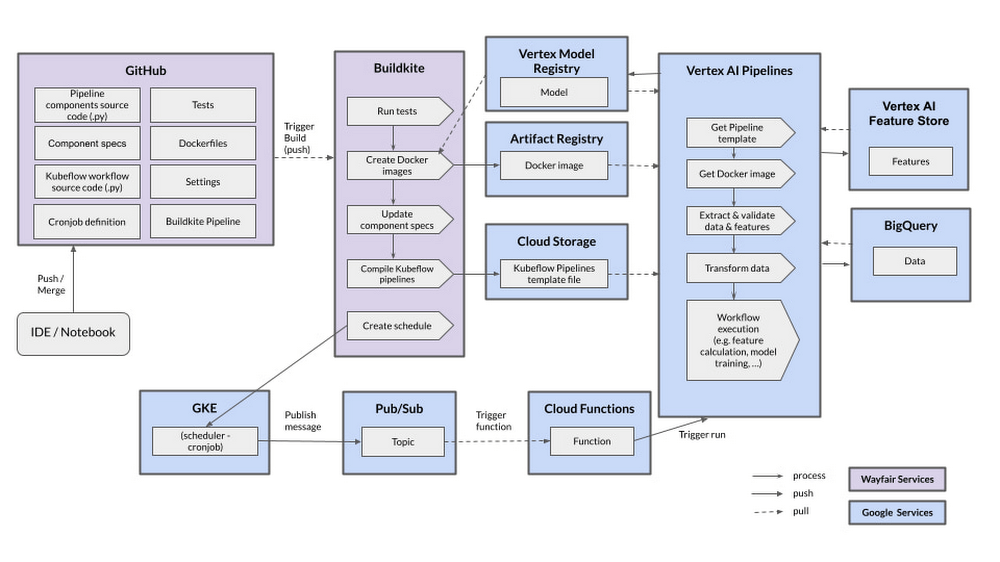
Keeping in mind that all our code is managed in GitHub Enterprise, we have dedicated repositories for Vertex AI Pipelines where the Kubeflow code and definitions of the Docker images are stored. If a change is pushed to a branch, a build starts in the Buildkite tool automatically. The build contains several steps, including unit and integration tests, code linting, documentation generation and automated deployment. The most important artifacts that are released at the end of the build are the Docker image and the compiled Kubeflow template. The Docker image is released to the Google Cloud Artifact Registry and we store the Kubeflow template in a dedicated Google Cloud Storage Bucket, fully versioned and secured. This way, all the components we need to run a Vertex AI Pipeline are available once we run a pipeline (manually or scheduled).
To schedule pipelines, we developed a dedicated Cloud Function that has the permissions to run the pipeline. This Function listens to a Pub/Sub topic where we can publish messages with a defined schema that indicates which pipeline to run with which parameters. These messages are published from a simple cron job that runs according to a set schedule on Google Kubernetes Engine. This way, we have a decoupled and secure environment for scheduling pipelines, using fully-supported and managed infrastructure.
Abstracting Vertex AI services with a shared library
We abstracted the relevant Vertex AI services currently in use with a thin shared Python library to support the teams that develop new software or migrate to Vertex AI. This library, called wf-vertex, contains helper methods, examples, and documentation for working with Vertex AI, as well as guidelines for Vertex AI Feature Store, Pipelines, and Artifact Registry.
One example is the run_pipeline method, which publishes a message with the correct schema to the Pub/Sub topic so that a Vertex AI pipeline is executed. When scheduling a pipeline, the developer only needs to call this method without having to worry about security or infrastructure configuration:
@cli.command()
def trigger_pipeline() -> None:
    from wf_vertex.pipelines.pipeline_runner import run_pipeline

    run_pipeline(
       template_bucket= f"wf-vertex-pipelines-{env}/{TEAM}",  # this is the location of the template, where the CI/CD has written the compiled templates to
       template_filename="sample_pipeline.json",  # this is the filename of the pipeline template to run
       parameter_values= {"import_date": today()}  # it’s possible to add pipeline parameters
)
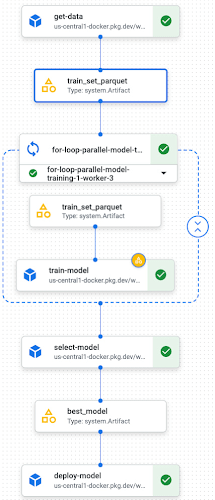
Most notable is the establishment of a documented best practice for enabling hyperparameter tuning in Vertex AI Pipelines, which speeds up hyperparameter tuning times for our data scientists from two weeks to under one hour.
Because it is not yet possible to combine the outputs of parallel steps (components) in Kubeflow, we designed a mechanism to enable this. It entails defining parameters at runtime and executing the resulting steps in parallel via the Kubeflow parallel-for operator. Finally, we created a step to combine the results of these parallel steps and interpret the results. In turn, this mechanism allows us to select the best model in terms of accuracy from a set of candidates that are trained in parallel:
Our CI/CD, scheduling pipelines, and shared library have reduced the effort of model productionization from more than three months to about four weeks. As we continue to build the shared library, and as our team members continue to gain expertise in using Vertex AI, we expect to further reduce this time to two weeks by the end of 2022.
Looking forward to more MLOps capabilities
Looking ahead, our goal is to fully leverage all the Vertex AI features to continue modernizing our MLOps stack to a point where data scientists are fully autonomous from engineers for any of their model productionization efforts. Next on our radar are Vertex AI Model Registry and Vertex ML Metadata alongside making more use of AutoML capabilities. We’re experimenting with Vertex AI for AutoML models and endpoints to benefit some use cases at Wayfair next to the custom models that we’re currently serving in production.
We’re confident that our MLOps transformation will introduce several capabilities to our team, including: automated data and model monitoring steps to the pipeline, as well as metadata management, and architectural patterns in support of real-time models requiring access to Wayfair’s network. We also look forward to performing continuous training of models by fully automating the ML pipeline that allows us to achieve continuous integration, delivery, and deployment of model prediction services.
We’ll continue to collaborate and invest in building a robust Wayfair-focused Vertex AI shared library. The aim is to eventually migrate 100% of our batch models to Vertex AI. Great things to look forward to on our journey towards MLOps excellence.

5336
Of your peers have already downloaded this article
7:30 Minutes
The most insightful time you'll spend today!
Sure, machine learning is becoming a business imperative, but how does it work in practice—and what are the benefits for IT managers?
That’s the subject of a new step-by-step guide to solving business and IT problems with artificial intelligence and ML, based on insights gathered by IDG Research Services.
Its publication comes at a time when technology departments face growing pressure to embrace these emerging technologies, yet many have questions about how to get started.
It has real-life examples such as the health services company that used ML to reduce support ticket-resolution time from 48 minutes to six.
In another section, a financial services VP explains that cloud-based ML services enable his company to avoid spending money on computing resources that sit idle.
The guide also includes concrete tips for new ML adopters. For example, a real-estate CIO recommends the use of third-party tools that rely on AI and ML technologies, while a financial services VP highlights the challenge and potential of incorporating unstructured data into ML initiatives.
Download the guide now!
4 Methods How AI/ML Boosts Innovation and Reduces Costs

2935
Of your peers have already read this article.
2:30 Minutes
The most insightful time you'll spend today!
“Cloud Wisdom Weekly: for tech companies and startups” is a new blog series we’re running this fall to answer common questions our tech and startup customers ask us about how to build apps faster, smarter, and cheaper. In this installment, we explore how to leverage artificial intelligence (AI) and machine learning (ML) for faster innovation and efficient operational growth.
Whether they’re trying to extract insights from data, create faster and more efficient workflows via intelligent automation, or build innovative customer experiences, leaders at today’s tech companies and startups know that proficiency in AI and ML is more important than ever.
AI and ML technologies are often expensive and time-consuming to develop, and the demand for AI and ML experts still largely outpaces the existing talent pool. These factors put pressure on tech companies and startups to allocate resources carefully when considering bringing AI/ML into their business strategy. In this article, we’ll explore four tips to help tech companies and startups accelerate innovation and reduce costs with AI and ML.
4 tips to accelerate innovation and reduces costs with AI and ML
Many of today’s most innovative companies are creating services or products that couldn’t exist without AI—but that doesn’t mean they’re building their AI and ML infrastructure and pipelines from scratch. Even for startups whose businesses don’t directly revolve around AI, injecting AI into operational processes can help manage costs as the company grows. By relying on a cloud provider for AI services, organizations can unlock opportunities to energize development, automate processes, and reduce costs.
1. Leverage pre-trained ML APIs to jumpstart product development
Tech companies and startups want their technical talent focused on proprietary projects that will make a difference to the business. This often involves the development of new applications for an AI technology, but not necessarily the development of the AI technology itself. In such scenarios, pre-trained APIs help organizations quickly and cost-effectively establish a foundation on which higher-value, more differentiated work can be layered.
For example, many companies building conversational AI into their products and services leverage Google Cloud APIs such as Speech-to-Text and Natural Language. With these APIs, developers can easily integrate capabilities like transcription, sentiment analysis, content classification, profanity filtering, speaker diarization, and more. These powerful technologies help organizations focus on creating products rather than having to build the base technologies.
See this article for examples of why tech companies and startups have chosen Google Cloud’s Speech APIs for use cases that range from deriving customer insights to giving robots empathetic personalities. For an even deeper dive, see
- our AI product page to explore other APIs, including Translation, Vision, and more;
- and the Google Cloud Skills Boost for ML APIs.
2. Use managed services to scale ML development and accelerate deployment of models to production
Pre-trained models are extremely useful, but in many cases, tech companies and startups need to create custom models to either derive insights from their own data or to apply new use cases to public data. Regardless of whether they’re building data-driven products or generating forecasting models from customer data, companies need ways to accelerate the building and deployment of models into their production environments.
A data scientist typically starts a new ML project in a notebook, experimenting with data stored on the local machine. Moving these efforts into a production environment requires additional tooling and resources, including more complicated infrastructure management. This is one reason many organizations struggle to bring models into production and burn through time and resources without moving the revenue needle.
Managed cloud platforms can help organizations transition from projects to automated experimentation at scale or the routine deployment and retraining of production models. Strong platforms offer flexible frameworks, fewer lines of code required for model training, unified environments across tools and datasets, and user-friendly infrastructure management and deployment pipelines.
At Google Cloud, we’ve seen customers with these needs embrace Vertex AI, our platform for accelerating ML development, in increasing numbers since it launched last year. Accelerating time to production by up to 80% compared to competing approaches, Vertex AI provides advanced end-to-end ML Ops capabilities so that data scientists, ML engineers, and developers can contribute to ML acceleration. It includes low-code features, like AutoML, that make it possible to train high performing models without ML expertise.
Over the first half of 2022, our performance tests found that the number of customers utilizing AI Workbench increased by 25x. It’s exciting to see the impact and value customers are gaining with Vertex AI Workbench, including seeing it help companies speed up large model training jobs by 10x and helping data science teams improve modeling precision from the 70-80% range to 98%.
If you are new to Vertex AI, check out this video series to learn how to take models from prototype to production. For deeper dives, see
- this article about Vertex AI’s role in an ambitious project to measure climate change with AI;
- BigQuery has built-in Machine Learning (ML) and Analytics that you can use to create no-code predictions using just SQL queries.
- this blog about how Vertex AI and BigQuery work together to make data analysis easier and more powerful;
- and this blog about Example-based explanations, one of our most recent updates to make model iteration more intuitive and efficient.
3. Harness the cloud to match hardware to use cases while minimizing costs and management overhead
ML infrastructure is generally expensive to build, and depending on the use case, specific hardware requirements and software integrations can make projects costly and complicated at scale. To solve for this, many tech companies and startups look to cloud services for compute and storage needs, attracted by the ability to pay only for resources they use while scaling up and down according to changing business needs.
At Google Cloud, customers share that they need the ability to optimize around a variety of infrastructure approaches for diverse ML workloads. Some use Central Processing Units (CPUs) for flexible prototyping. Others leverage our support for NVIDIA Graphics Processing Units (GPUs) for image-oriented projects and larger models, especially those with custom TensorFlow operations that must run partially on CPUs. Some choose to run on the same custom ML processors that power Google applications—Tensor Processing Units (TPUs). And many use different combinations of all of the preceding.
Beyond matching use cases to the right hardware and benefiting from the scale and operational simplicity of a managed service, tech companies and startups should explore configuration features that help further control costs. For example, Google Cloud features like time-sharing and multi-instance capabilities for GPUs — as well as features like Vertex AI Training Reduction Server — are built to optimize GPU costs and usage.
Vertex AI Workbench also integrates with the NVIDIA NGC catalog for deploying frameworks, software development kits and Jupyter Notebooks with a single click—another feature that, like Reduction Server, speaks to the ways organizations can make AI more efficient and less costly via managed services.
4. Implement AI for operations
Besides using pre-trained APIs and ML model development to develop and deliver products, startup and tech companies can improve operational efficiency, especially as they scale, by leveraging AI solutions built for specific business and operational needs, like contract processing or customer service.
Google Cloud’s DocumentAI products, for instance, apply ML to text for use cases ranging from contract lifecycle management to mortgage processing. For businesses whose customer support needs are growing, there’s Contact Center AI, which helps organizations build intelligent virtual agents, facilitate handoffs as appropriate between virtual agents and human agents, and generate insights from call center interactions. By leveraging AI to help manage operational processes, startups and tech companies can allocate more resources to innovation and growth.
Next steps toward an intelligent future
The tips in this article can help any tech company or startup find ways to save money and boost efficiency with AI and ML. You can learn more about these topics by registering for Google Cloud Next, kicking off October 11, where you’ll hear Google Cloud’s latest AI news, discussions, and perspectives—in the meantime, you can also dive into our Vertex AI quickstarts and BigQuery ML tutorials. And for the latest on our work with tech companies and startups, be sure to visit our Startups page.
More Relevant Stories for Your Company

Revolutionizing Finance: Google Cloud’s Role in Auditoria.AI’s Success
Be it marketing, sales, or even security, most departments in large organizations today have a range of SaaS tools at their disposal to help make their work more efficient. But people in corporate finance and accounting have been underserved in that respect. Their days are still spent on routine, mundane




Breakthrough Insights Across the Life Sciences Value Chain
New science and patient centricity require increasing reliance on data and deeper insights. Accenture’s life sciences customers have been demanding answers to this need, and want a solution with an open platform. Enter INTIENT, Accenture’s life sciences platform that is powered by Google Cloud. INTIENT generates insights throughout the life

Google’s Record-breaking Performance Tops the MLPerf Benchmark Results
The latest round of MLPerf benchmark results have been released, and Google's TPU v4 supercomputers demonstrated record-breaking performance at scale. This is a timely milestone since large-scale machine learning training has enabled many of the recent breakthroughs in AI, with the latest models encompassing billions or even trillions of parameters

Pay-as-you-go AI Management Platform Available on Google Cloud Marketplace
Editor’s note: Prevision.io has built the first ever pay-as-you-go AI management platform that simplifies the machine learning project lifecycle while offering powerful analytics capabilities. Now available exclusively on Google Cloud Marketplace, users can experiment, build, deploy, and manage AI projects in the cloud in weeks—without having extensive data science knowledge.
