





4400
Of your peers have already watched this video.
32:00 Minutes
The most insightful time you'll spend today!
On-Demand Webinar: How APIs Help Walgreens Merge Physical and Digital Retail
APIs are how modern businesses rapidly expand into new contexts—making it possible for companies like Walgreens to transform from brick-and-mortar businesses into omnichannel organizations that serve customers in innovative ways.
Headquartered in Deerfield, Illinois, Walgreens is the second-largest pharmacy store chain in the United States. It specializes in filling prescriptions, health and wellness products, health information, and photo services. The company has more than 8,000 stores and operates in 50 states, the District of Columbia, Puerto Rico, and the US Virgin Islands.
Walgreens has built a thriving API program that lets software developers plug into its retail and pharmacy business. As a result, the company now fills one prescription per second via mobile devices.
More than 100 photography apps offer Walgreens photo printing and same-day pickup at 8,000+ locations. Perhaps best of all, Walgreens has found that users who use its mobile app spend more than those who don’t.
Watch Erin Neus-Cheong from Walgreens and Alicia Paterson from Google Cloud explore why treating APIs as products—not projects—can help companies tap into the value of APIs as business accelerators and open up new channels of opportunity.
4401
Of your peers have already watched this video.
32:00 Minutes
The most insightful time you'll spend today!
On-Demand Webinar: How APIs Help Walgreens Merge Physical and Digital Retail
APIs are how modern businesses rapidly expand into new contexts—making it possible for companies like Walgreens to transform from brick-and-mortar businesses into omnichannel organizations that serve customers in innovative ways.
Headquartered in Deerfield, Illinois, Walgreens is the second-largest pharmacy store chain in the United States. It specializes in filling prescriptions, health and wellness products, health information, and photo services. The company has more than 8,000 stores and operates in 50 states, the District of Columbia, Puerto Rico, and the US Virgin Islands.
Walgreens has built a thriving API program that lets software developers plug into its retail and pharmacy business. As a result, the company now fills one prescription per second via mobile devices.
More than 100 photography apps offer Walgreens photo printing and same-day pickup at 8,000+ locations. Perhaps best of all, Walgreens has found that users who use its mobile app spend more than those who don’t.
Watch Erin Neus-Cheong from Walgreens and Alicia Paterson from Google Cloud explore why treating APIs as products—not projects—can help companies tap into the value of APIs as business accelerators and open up new channels of opportunity.
Streamlining Business Processes with Google Cloud’s Application Integration

886
Of your peers have already read this article.
3:30 Minutes
The most insightful time you'll spend today!
According to a recent Accenture report, large businesses deploy an average of 500 different applications. This trend shows no signs of slowing down, with the majority of respondents signaling plans to acquire even more applications. No surprise, all these applications present a number of integration challenges, which the impending wave of generative AI in software development only promises to further intensify.
Two years ago, we introduced Apigee Integration as an add-on capability to Apigee API Management. From conversations with customers, it’s become clear that you want to access these capabilities directly from the Google Cloud console. Today, we’re announcing the general availability of Application Integration, a standalone Integration Platform as a Service (IPaaS) designed to help you connect your applications visually, with no code. Best of all, you can now get started with Application Integration with no upfront financial commitment, even if you’re not an existing Apigee customer.
What is Application Integration?
As a cloud-native product, Application Integration helps you automate business processes by connecting any application — both home-grown and third-party SaaS — with simple point-and-click configurations, so you can quickly and easily construct, maintain, and scale your integrations. Application Integration offers the following features:
Visual integration designer: An Intuitive drag-and-drop interface allows anyone to build workflows with no complex coding or manual processes. With the visual integration designer, anyone can simply drag-and-drop individual control elements (such as edges, forks, and joins) to build custom integration patterns of any complexity.

Plug-and-play connectors: A library of 75+ pre-built connectors makes it easy to connect to a number of Google Cloud services (e.g., BigQuery, Pub/Sub) and many third-party applications, including Salesforce, MongoDB, and NetSuite.

Automated triggers and transformations: With built-in triggers, you can execute integrations on an API call, Cloud Pub/Sub event, Salesforce events, or using Cloud Scheduler. An intuitive data mapping editor and comprehensive mapping functions enable you to address complex data transformation requirements in no time.

Unified platform: Whether you’re building APIs in Apigee, ingesting data using Pub/Sub, receiving events from Cloud Storage using EventArc, or something else, Application Integration works seamlessly with other integration services to provide comprehensive capabilities for your use case.
Customer praise for Application Integration
In the enterprise, different teams adopt applications to support a task in their business processes. However, the need for information exchange among these teams can spawn complex integrations that require a lot of arduous planning.
Application Integration abstracts these development complexities, so customers can focus on building value. OVO Energy uses Application Integration to automate communications in their critical business processes. “We were looking for an integration solution that was very low-code yet configurable, robust, and scalable,” said Chris Parker, Product Manager at OVO Energy. “We needed a simple solution that allowed us to get data from multiple parts of the company, supplement an existing data point with relevant information and funnel it to the Salesforce Marketing Cloud,” added Graham Vosper, Technology lead at OVO Energy.
But changes in business processes are inevitable, forcing continuous shifts to existing integrations – sometimes even rendering them obsolete. “Using Application Integration was very simple. With just a couple of clicks, our team quickly adapted to this new product and became productive,” said Graham.
A growing library of connectors in Application Integration makes it easy to connect to new applications and ensures any changes in connecting to the end application is automatically supported. OVO Energy has taken notice. “Configurability and traceability in Application Integration allows our developers to build and maintain our integrations without in-depth skills. We now have much better visibility into our information flow and failure rates,” said Graham.
Get started today
Today’s integration problems require a comprehensive approach that spans applications, systems, and data. Application Integration is part of Google Cloud’s Integration Services portfolio, designed to address your end-to-end integration needs. The portfolio covers a wide range of use cases like data integration, API Management, and event-driven architectures. You can get started with Application Integration with no financial commitment by using the free tier. Learn more, explore a sample e-commerce integration, or jumpstart your development with quickstart tutorials.
Can Your Company Use Video AI? You’d Be Surprised at the Answer

5740
Of your peers have already read this article.
4:30 Minutes
The most insightful time you'll spend today!
Video AI is a powerful way to enable content discovery and engaging video experiences.
Here, try it out right now!
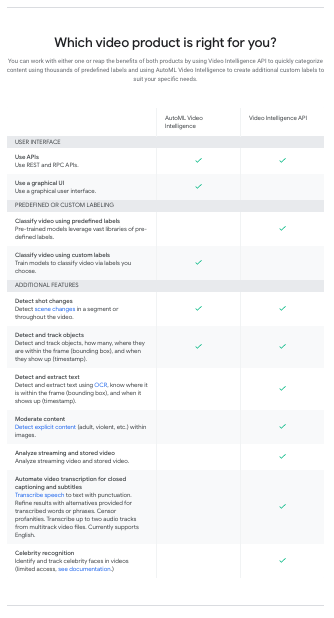
Google Cloud’s easy-to-access video AI solutions can accomplish a bunch of things. Here are a few:
Precise video analysis: Video Intelligence API automatically recognizes more than 20,000 objects, places, and actions in stored and streaming video. It also distinguishes scene changes and extracts rich metadata at the video, shot, or frame level. Use in combination with AutoML Video Intelligence to create your own custom entity labels to categorize content. Imagine being able to categorise hundreds of videos of customer interactions quickly to improve service training!
Recommended content: Build a content recommendation engine with labels generated by Video Intelligence API and a user’s viewing history and preferences. This will simplify content discovery for your users and guide them to the most relevant content that they want.
Simplify media management: Find value in vast archives by making media easily searchable and discoverable. Easily search your video catalog the same way you search text documents. Extract metadata that can be used to index, organize, and search your video content, as well as control and filter content for what’s most relevant.Imagine being able to locate insight in hundreds of enterprise videos to improve productivity and customer experience!
Easily create intelligent video apps: Gain insights from video in near real time using the Video Intelligence Streaming Video APIs, and trigger events based on objects detected. Build engaging customer experiences with highlight reels, recommendations, interactive videos, and more. Marketers, imagine being able to trigger a customer workflow, in real time, based on a live customer interactions.
Automate expensive workflows: Reduce time and costs associated with transcribing videos and generating closed captions, as well as flagging and filtering inappropriate content.
Content moderation: Identify when inappropriate content is being shown in a given video. You can instantly conduct content moderation across petabytes of data and more quickly and efficiently filter your content or user-generated content.
What can your organisation do with video AI?
3886
Of your peers have already watched this video.
3:20 Minutes
The most insightful time you'll spend today!
Leveraging APIs to Deliver Connected Customer Experiences
What does the connected customer experience even mean? It’s not just about a checklist of assets like website and mobile but how those channels seamlessly work together with the physical world to give your customer great experiences with your brand.
Modern APIs enable companies to mask back-end complexities behind a predictable developer-friendly interface. These APIs create ways for developers to easily and securely connect legacy systems with all kinds of applications and devices. Well managed APIs give businesses the flexibility to adapt to changing the environment and bring new user experiences to the market easily.
Watch how APIs can help make this happen in this 3-minute video.
A Run-through of an Innovative 2021 with Apigee

3400
Of your peers have already read this article.
1:30 Minutes
The most insightful time you'll spend today!
Apigee is committed to continually innovating new capabilities and solutions for our customers, and 2021 saw new product launches, partnerships, and best practices for managing your expanding range of business-critical use cases. Here are some of our favorite stories from 2021.
Spotting the trends in APIs
Our State of API Economy 2021 Report surveyed over 700 IT leaders globally and identified five key API trends that emerged post-COVID. SaaS and hybrid cloud-based API deployments are increasing with half of all respondents reporting increases in these areas, and AI- and ML-powered API management is also gaining traction, with usage growing 230% year-over-year among Apigee customers. Business metrics like Net Promoter Score (NPS) and speed-to-market are API users’ preferred way to measure success, and API ecosystems are increasingly innovation drivers, with high-maturity organizations much more likely to focus on building a developer ecosystem or B2B partner ecosystem around their API. Finally, API security and governance is more important than ever, as research showed that increased investment in security and governance was a high priority. Check out the blog to explore these five trends in more detail.
Launching new capabilities with Apigee X
We announced Apigee X, our next-generation platform that brings the powerful scale of Google technologies to Apigee API Management and allows enterprises to power API programs for enhanced scale, security, and automation. Apigee X customers can harness the capabilities of Cloud CDN to maximize the availability and performance of APIs across the globe, deploying across more than two dozen Google Cloud regions and enhancing caching at over 100 locations. Apigee X customers can apply solutions like Cloud Armor web application firewall for enhanced API security and Cloud Identity and Access Management (IAM) for authenticating and authorizing access to the Apigee platform. Apigee X also enhances automation by applying Google Cloud’s AI and ML capabilities to historical API metadata to detect anomalies, predict traffic, and ensure compliance. To read more about these features, check out our blogs on Apigee X and Cloud Armor, Apigee X and Cloud CDN, and Apigee X and AI.
Making new connections with Apigee Integration
Apigee brought our successful API-first approach to integration this year with the release of Apigee Integration. This silo-busting solution lets customers connect existing data and applications, and surface them as easily accessible APIs. Apigee Integration brings together the best of API management and integration into one unified platform so IT teams can scale their operations, improve developer productivity, and increase the speed to market. The platform comes with built-in connectors to Salesforce, Cloud SQL (MySQL, PostgreSQL), Cloud Pub/Sub and BigQuery, with connectors for additional third-party applications and databases on their way. Advanced integration patterns also serve our customers with even more use cases. Check out our launch blog and our Next session video for more details.
Managing GraphQL APIs with Apigee
The exponential rise in digital services adoption among enterprises now generates petabytes of data every minute. You can harness the power of this data with query languages like GraphQL, accessing the data your app needs with one single request. The growing popularity of GraphQL APIs and their business-critical use cases mean it’s important to manage them with full life cycle capabilities, much like you manage your REST APIs. Last year we compared REST and GraphQL and introduced best practices for managing GraphQL APIs. You can also read our blog announcing Apigee’s support for the management of GraphQL APIs, and our partnership with StepZen to deliver these capabilities. To dive deeper into building GraphQL APIs, check out our Next session video.
Looking back at the year’s top stories
2021 was the year of the customer, and we published the following stories to show how API management helps enterprises modernize their applications, build digital ecosystems, and generate value for their customers and their own organizations:
- Telco:
- Retail:
- Financial services:
- Energy:
That’s a wrap for 2021! We hope you have a safe and happy holiday season, and we can’t wait to see what the new year brings for us. Stay tuned in 2022 for product launch announcements, partnerships, tips, and stories of how organizations like yours are innovating with Apigee.
More Relevant Stories for Your Company

A 100-year Old Business’ Digital Evolution with Apigee API Management
Editor’s note: James Fairweather, chief innovation officer at Pitney Bowes, has played a key role in modernizing the product offerings at this century-old global provider of innovative shipping solutions for businesses of all sizes. In today’s post, he discusses some key challenges the Pitney Bowes team overcame during its digital transformation,

A Year of Connecting Brand and Consumers with Google’s Business Messages
Last June, in the early months of the pandemic, we expanded Business Messages to support all kinds of businesses, from pharmacies and grocery stores to airlines and luxury brands. Then, in December, we announced the ability for small businesses to use the Google Maps app to message with their customers. We knew people would

How to Modernize Your Apps with Migrate to Anthos
In a perfect cloud world, you would host all your applications in containers running on Kubernetes and Istio, benefitting from the portability and improved resource utilization of containers, plus a robust orchestration platform with advanced application management, networking, and security functionality. This is easy to do if you’re developing a

How Eventrac and Workflows Integration Helps Implement Hybrid Architecture in Google Cloud
I previously talked about Eventarc for choreographed (event-driven) Cloud Run services and introduced Workflows for orchestrated services. Eventarc and Workflows are very useful in strictly choreographed or orchestrated architectures. However, you sometimes need a hybrid architecture that combines choreography and orchestration. For example, imagine a use case where a message to a Pub/Sub topic
