





5170
Of your peers have already watched this video.
24:40 Minutes
The most insightful time you'll spend today!
Case Study: How Texas’ Largest Grocery Chain Successfully Modernized its Legacy Mainframes
H-E-B, like many enterprises, is moving away from legacy mainframes in favor of microservices and public cloud infrastructure. With hundreds of applications powering their 100+ year-old grocery business (with more than 400 stores in Texas and Mexico), H-E-B needs to be confident that the platform they are building will provide them the agility and security to continue to innovate for their customers.
In this session, the H-E-B engineering team provides details on how they’ve started breaking down their Curbside and Home Delivery monoliths into microservices, why they chose to make Kubernetes a first-class citizen, and why they’re leveraging Anthos as a hybrid cloud platform.
The grocer began to map out a two- to four-year modernization plan in 2017. Initially, the enterprise signed on with Google Cloud and used GKE to move toward a container-first approach to app delivery. Later, it decided to adopt Anthos. Today, Anthos gives H-E-B tighter control over compliance and better proximity to its retail data.
Join the discussion with Joe Rodriguez, Platform Engineering Manager for H-E-B, and. Justin Turner, Sr. Software Engineering Manager for Curbside and Delivery Fulfillment at H-E-B, to learn about the lessons that led to the company’s successful transformation. Find out how Anthos, when deployed on-premises, will expedite their journey to microservices. Learn about the challenges that come with adopting a hybrid modernization strategy and how Anthos plays a critical role in their success in this session.
How Experian Transformed its Business by Using APIs

3746
Of your peers have already read this article.
3:00 Minutes
The most insightful time you'll spend today!
Chances are, when you think of Experian you think of a traditional credit bureau that provides credit reports. But Experian has transformed into a true technology and software provider. We gather, analyze, and process data in ways that other companies just can’t. Businesses use this data to make smarter decisions about credit and lending, as well as to prevent identity fraud and crime. We’re also able to use this data to help individuals take financial control of their own lives and access all kinds of financial services with products like Experian Boost.
Transforming data delivery, transforming the enterprise
A big part of our digital transformation has been based on our API program. We approached APIs with a concrete goal in mind. We knew exactly how we wanted to transform the business, and we had a set plan to achieve that. For us, this meant establishing an API center of excellence as a first step. It’s sole purpose was to enable the business units to create their APIs quickly and correctly, then apply them properly. We then went out to the business units one by one so that we could train them to build their APIs in a customer-friendly way. We taught them the entire API process of building, giving access to developers internally and externally.
This approach is fundamentally different from previous ones. As far back as the 1990s, our customers connected to us via software applications installed on their systems. As technologies evolved, our services to customers evolved, and we began supporting XML-based transactions and custom integrations with our partners. Some of these integrations actually included VPNs rather than going through HTTP connections. We did custom database schemas, one-off processes, and all kinds of custom development.
This meant that we had a team just for our IT system processes. This team kept growing as Experian continued to acquire new companies. Each acquisition brought a new way of doing integrations and business. We had a real challenge in standardizing development practices, which led to a lot of isolated environments inside the company. We had disparate data repositories and non-standard client conductivity, which hampered innovation.
Responding to customer demand for APIs
When we first started, we had some concrete goals. We wanted to grow our ecosystem, develop a massive reach for transaction and content distribution, power a new business model, and drive innovation. Basically, we wanted to use APIs to transform our business into a platform, and we wanted to build an ecosystem that leveraged this API platform to develop new solutions.
Our leadership also understood the importance of delivering information to our customers in the way they wanted to consume it. Our customers had told us that they didn’t want software, they just wanted access to the data—and APIs are the easiest, most secure way to grant that access.
The Apigee API management platform as an enterprise solution
We knew we needed an API management platform to enable this step forward. In addition to the documentation and discoverability, we also wanted a place to create APIs fast, and where we could get visibility into usage and other metrics. The Apigee API management platform from Google Cloud offered all of this, and more. From the robust feature set to advanced security to the developer portal to analytics – Apigee provides us everything we need to run an enterprise-class API program.
Now that we have our API program up and running, integrations no longer take months. In some cases, it’s just a matter of minutes or seconds. Customers can simply look at our documentation on how to invoke APIs and begin consuming data in seconds. We started with this new model in our three largest markets: North America, the United Kingdom and Brazil. Later, we rolled it out to Singapore and Australia, while deploying an on-premises platform for some of our North American business units that needed to provide their APIs internally only. Next, we went to EMEA. At this point, we’ve deployed Apigee company-wide, giving us a flexible deployment model that maintains a centralized platform and processes.
We continue to evangelize the program today, and we recently conducted a workshop with the Apigee team to train our EMEA business unit and get them onboarded to the platform. They were able to start developing API proxies right away, and they’re set to go into production with as many as nine of them. We also went live with three developer portals, which we call API hubs, in North America, the United Kingdom, and Brazil.
As we expand, we don’t want to keep building up different developer portals for each region because then we’re going to have too many. Alternatively, we plan to combine them into a single global developer portal that will allow users to select geographies of interest where they’ll be presented with relevant information.
Experian continues to evolve the types of products and services we offer. Thanks to Apigee, we have the flexibility, security, and technology to keep innovating and providing value to our business and our customers.
APIs to Power the Future of Retail: Study Confirms

3550
Of your peers have already read this article.
1:30 Minutes
The most insightful time you'll spend today!
Today, retail customers have more digital-first, convenient ways of shopping than ever before. And APIs are one of the critical pieces of technology that have made this possible by giving retailers the ability to transform their systems and processes in an efficient and quick way.
APIs have allowed retailers to be more accessible to their remote customers with services such as order online and pick up in-store, curbside pickup, fulfilment of orders through delivery partners, and personalized recommendations while shopping online etc. These capabilities have been especially important over the last year, as the world has changed at a rapid pace. With many changes to customer interactions yet to come, APIs will continue to play a pivotal role in helping retailers to further personalize digital experiences and streamline their operations.
In Google Cloud’s State of API Economy 2021 report, 32% of organizations reported increasing their digital transformation investments, while 16% stated they would completely change their strategies to become digital-first companies. Moreover, by early 2021, online sales had already reached levels previously predicted for 2022, and APIs will become the foundation for business resilience and growth in retail over the next five years.
APIs are at the forefront of retail innovation
Retailers leverage APIs to experiment and connect teams for faster collaboration, helping them to use data for revolutionary experiences that increase customer engagement.
They allow retailers to innovate in new ways internally, externally, and across market borders. Modern digital experiences are built from a variety of data and functionality, throughout the entire supply chain, across multiple systems, and often belonging to a variety of services across distribution channels. APIs are the digital nervous system connecting everything together. They help retailers enhance internal efficiency, partner at scale, and leverage cutting-edge services such as machine learning—all because they make various kinds of technological value interoperable and easy for developers to access and reuse. In our research, 52% of retailers said APIs accelerate innovation by enabling partners to leverage digital assets at scale while 36% say they see APIs as strategic assets for creating business value.
Let’s take a look at some retail use cases and real world examples that are powered by APIs.
Deliver personalized customer experiences
Retailers are using APIs to create interactive and predictive personalized experiences.These range from “magic” mirrors that reflect personalized clothing, accessory, and even makeup suggestions; to smartphone alerts that encourage shoppers to check out special items while they’re browsing in the store; offers of coupons; and more. Behind the scenes APIs interconnect between the store and consumer data, business intelligence, and application security to bring these innovative experiences to life.
Streamline retail operations
APIs can help any retail business to operate more efficiently, from human resources, customer service, and distribution, to invoicing, marketing, and compliance. For example, APIs make it super easy and simple to onboard, manage and train employees and contractors. They can help connect various internal and external third-party systems for use cases like tracking real-time package status and gathering consumer shopping insights.
Conrad Electronic, German retailer of electronic products, demonstrates how API management can lead to enhanced efficiency. They used Apigee to build a tool that provides store employees and visitors with product, service, and warranty information on their mobile devices. The company was able to not only use data to enhance offers and services to their customers, but also streamline operations because more than 60% of their customers were using the API-enabled tool.
Power the future of retail with APIs
APIs are key to driving innovation across all areas of retail. They are enabling retailers to not only implement continuous digital transformation but also develop tools that navigate disruptions as they occur.
Retailers are already harnessing the power of APIs to prepare for:
- Borderless channels across markets that allow for the free flow of products and shopping experiences in the way consumers want them.
- Interactive and intelligent merchandising that evolves in realtime to predict consumer needs and bolsters buying decisions.
- Autonomous and virtual shopping experiences that develop deeper consumer interactions and product insights.
To learn more about how APIs can help drive innovation, download our latest eBook. In this eBook, you’ll find more retail-specific API use cases, detailed real world examples and insights into how APIs are shaping the future of retail.
Manage APIs effectively
As you grow your API program, and start powering business-critical applications and front-end experiences with APIs, you need an effective way to manage and scale them. This is where Google Cloud’s Apigee API management platform can help. Top retailers across the globe use Apigee to gain control over and insights into their APIs and enables them to manage end-to-end API lifecycle. Click here to learn more about Apigee.
How APIs Help Financial Services Firms Enhance Digital CX and Increase Revenue

3467
Of your peers have already read this article.
2:00 Minutes
The most insightful time you'll spend today!
Faced with changing customer behaviors and demands, tightening margins, and increasing threat from digital competitors, financial services institutions (FSIs) will need to meet customers where they are, open up their services, and establish new ways to monetize their products. Doing so will also enable them to build a better profile of their customers, and deliver more personalized user experiences and fast, convenient banking and payment services. Cloud technology plays a big role in this shift toward digital FSIs.
In Asia, bank branches now account for just 12% to 21% of monthly transactions in the region, with customers turning to digital channels for routine transactions such as peer-to-peer transfers and bill payments, according to McKinsey&Company. Overall customer engagement has climbed from an average 12.7 to 14.9 transactions a month in Asia’s developed markets, and from 6 to 8.1 in emerging markets.1
Fueled by growing smartphone adoption, the evolving customer behavior and momentum toward digital platforms have enabled digital-first players to snag a growing piece of the banking pie.
McKinsey estimates that digital banking penetration has grown an average of 97% in Asia’s developed markets, and 52% in emerging markets, with between 30% and 50% of those that have yet to use digital banking likely to do so.
Consumers now are more than ready to make the switch to neobanks, or digital banks. In Singapore, 63% are open to banking with digital-only players, according to a Visa study. On what will entice them to do so, 63% point to bill payments while 56% will use neobank services to make payments at retail outlets. Furthermore, 54% prefer digital banks for the convenience they offer while 52% like the faster service.
Among those who are open to digital banks, 60% will move some services from their current bank to these new players even if the latter have no prior banking experience. One in five of respondents say they are willing to switch all services to a neobank.
The same is true for small and midsize businesses (SMBs) in Singapore. According to a separate survey by Visa, 88% of these companies will consider moving some services to digital banks.
Driven to do so by their frustration over a lack of quality corporate products and control of their banking experience, 55% of SMBs believe neobanks will help bring down overall banking costs. Another 54% say digital banks offer greater convenience, while 53% point to greater ease in paying bills online.
These stats should worry even established FSIs, especially those that have not done quite enough to open up their service ecosystems and drive innovation through APIs.
An API toward new revenue
While most banks have active APIs, the services that some of them currently provide are just functional; they’re the means to an end for partners to obtain their targeted products and services. Without knowing, consumers use these types of APIs indirectly by using their favorite applications every day—a payment processing API will enable them to purchase their lunch, while a loan application API will get them that dream home.
But while banks do not always own the customer journey, they still can find opportunities to sell their products via partners. Many leading banks are leveraging key technologies, such as API management, artificial intelligence (AI), and data analytics to embed digital banking into consumers’ everyday lives, including groceries, travel, entertainment, healthcare, and food delivery.
When traditional banks open up their APIs to third parties offering broader services that pull in unique services into their own apps, they then become plugged into the broader customer journey. This helps boost usage of their services and embeds them in the overall customer experience. It also provides aggregated data that will help banks build richer consumer profiles, and deliver more personalized products and services.
APIs also create equal opportunities for smaller participants to be involved in the financial services ecosystem, potentially creating micro-segments that previously may not have existed. With insufficient demand within a closed system, to justify the provision of such services, some customers in these micro-segments have previously been left unserved. The APIs, which facilitate collaboration between the different micro-segments so they can be commercially viable, help assuage this problem.
Some banks are also opening up APIs to allow access to datasets that enable businesses to trigger automated workflows and enhance their operational efficiencies. Others, such as Bank Rakyat Indonesia (Bank BRI) have generated new revenue by leveraging Google Cloud’s Apigee to manage their API lifecycle and identify new revenue opportunities.
Apigee’s monetization feature has helped Bank BRI realize $50 million in revenue and enabled the bank to define its pricing based on API calls and automatically bill based on usage.
In addition, the Indonesian bank uses the data analysis alongside Google Maps Platform to score its customer base of 75.5 million, and identify those who can be recruited as BRILink agents for underbanked areas. These agents are customers who maintain a minimum balance of $800 USD and score high on reliability.
The appointment of branchless agents via the Agent BRILink app has pushed the loan volume from the bank’s branchless business to $26 billion in 2018, up from $15 billion the year before.
How banks can get started with APIs
Clearly, there are new revenue opportunities for banks to leverage the data they already have. Here are some tips to help FSIs kickstart their API journey:
- Align with internal leadership growth initiatives. Leverage executive key performance indicators around growth and cost savings to foster a culture that offers APIs to micro-segmented markets with an eye on cultivating a healthy financial services ecosystem.
- Productize APIs with a strong value proposition. Starting with an API-first approach, stock the shelves of your API shop with new services and a strong inventory of APIs that will entice third parties (i.e., retailers, telcos, etc.) to start using them. This customer-first, outside-in approach will serve as a strong base to build on and enable the addition of more APIs as adoption grows.
- Actively nurture a developer community. A properly trained API manager will ensure constant contact with the developer community, and that partners are provided with case studies to help them identify viable use cases for your APIs.
- Leverage security as a strategic enabler. Security is a key enabler of the API economy, and most API security postures are defensive. By leveraging deep security tooling together with strong identification of developers, banks can better track information and data usage offensively.
FSIs also need to avoid some common pitfalls, such as overlooking the need to continuously improve their APIs. If no one is using it, the API clearly is failing to provide any real value to third-party developers.
In addition, efforts should be made to market the APIs and let developers know what is available. A common mistake FSIs make is assuming their work is done once their APIs are released and neglecting the need to carry out community outreach and marketing to generate awareness about the APIs.
If you are interested in learning more about this topic, don’t miss our session at the Google Cloud Financial Services Summit on Embedded Finance: The Future of Banking.
1. McKinsey & Company. “Asia’s digital banking race: Giving customers what they want.” Global Banking Practice. April 2018.
Container Platforms on Google Cloud Maximize Developer Efficiency, Speed-up Time to Market and Eliminate IT Overhead!

3373
Of your peers have already read this article.
2:30 Minutes
The most insightful time you'll spend today!
Every tech company and growing startup faces pressure to make efficient use of technical talent. Increasingly, this means determining if and how the cloud can help this talent focus on things like product development instead of IT overhead. These challenges are the starting place for our new whitepaper “The future of infrastructure will be containerized,” which is informed by our work with tech companies and startups who’ve chosen Google Cloud across a range of industries, from healthcare and manufacturing to software, fintech and e-commerce.
For example, if your tech company or startup is in the cloud but spends lots of resources on custom tooling and maintenance, you’re almost certainly under-leveraging what the cloud can do. You might also be locking yourself into an architecture that won’t let you easily adapt or change things as your needs evolve.
The whitepaper examines these challenges to growth and explains how tech companies and startups can use managed container platforms in the cloud to maximize developer efficiency, accelerate time to market, and eliminate IT management that doesn’t help differentiate the business. In this blog post, we’ll explore one element of this discussion: infrastructure management. Be sure to check out the full whitepaper for all the details.
The case for containers and Kubernetes
Compared to previous virtualization technologies, containers are more lightweight, faster, more portable, and easier to manage—and a managed container platform like Kubernetes can extend these advantages even further. That’s why we’re seeing a massive shift to containers and Kubernetes.
Simply put, infrastructure and technical debt can slow down tech companies and startups. Traditional virtual machines (VMs) are neither simple to manage nor likely to maximize your workloads. Maximizing the cloud isn’t just about renting cheap resources—it’s about embracing modern, more efficient ways of operating that let businesses spend more time serving customers.
VMs virtualize at the hardware level and thus require higher degrees of management, less portability, and less consistent and efficient scaling. Containers, in contrast, virtualize further up the stack, at the OS level, meaning they contain the libraries and dependencies needed to run apps and services but are significantly more lightweight, easier to manage, and can accommodate modern operating models. VMs aren’t built for the speed at which today’s tech companies and startups need to move, but with a robust container orchestration like Kubernetes, startups can leverage proven patterns for running reliable, secure infrastructure at scale.
Kubernetes is open source and platform-agnostic, offering all the common tooling out of the box to secure and speed up each stage of the build-and-deploy life cycle. Everything is automated, with the complexity abstracted away—the vast majority of infrastructure-as-code is eliminated as the platform shifts to infrastructure-as-data, with users able to tell Kubernetes what they want rather than writing code to tell it what to do. In terms of both time saved in the present and flexibility preserved for the future, Kubernetes can be vastly more valuable than proprietary tech stacks or even a management-heavy implementation of VMs running in the cloud.
Kuberetes also lets tech companies and startups reduce management overhead according to their needs, with many different approaches available for different workloads:
- Kubernetes gives traditional workloads the benefits of a modern platform by letting organizations separate apps from VMs and put them in containers.
- Managed computing platforms turn cloud services into platforms-as-a-service, giving tech companies and startups the power and flexibility of containers and the convenience of serverless. There’s no server, no cluster configuration, and no maintenance, which means organizations can dramatically reduce overhead labor without compromising control.
- For workloads that don’t require much control over cluster configuration, tech companies and startups can use Google Kubernetes Engine (GKE) in Autopilot mode to provision clusters, while paying for only the workload, not the cluster. In this way, they can eliminate cluster administration while optimizing security and saving potentially substantial amounts of money.
- For more cloud-native applications, serverless options like Cloud Run, eliminate underlying infrastructure and serve as the end-to-end host for applications, data, and even analysis. A serverless platform lets organizations start running containers with minimal complexity in a fully-managed environment with security, performance, scalability, and best practices baked in.
Accelerating time to market while preserving future freedom
Tech company and startup leaders should also consider the value of the Kubernetes community and its surrounding ecosystem, as its stable innovation defines today’s industry standards and best practices. The technology benefits in terms of speed, complexity, and labor are clear when it comes to containers, but as an open-source platform with many active contributors, it is also an onramp to future architecture innovations. Being cutting-edge and developer-oriented, Kubernetes can also help organizations to attract top technical talent, in addition to letting them empower developers they already employ. And not to be neglected, because Kubernetes is open source, it offers transparency in proprietary solutions, limiting the risks of lockin. Top to bottom, it provides a framework for tech companies and startups to bring innovations to their customers, faster. To learn more, read the full whitepaper or visit the Google Cloud for startups and tech companies page.
New Map Customization Features for Enhanced User Experiences

5554
Of your peers have already read this article.
1:30 Minutes
The most insightful time you'll spend today!
A customized map can be key to delivering a frictionless experience that engages users and sets you apart in users’ minds–whether you’re a real estate company fine-tuning points of interest (POIs) on a map to help buyers decide where to live, or a regional pharmacy styling a map to ensure your locations stand out from the competition. That’s why we’ve focused on empowering you with these capabilities through features like POI density and POI filtering controls, zoom level customization, and even industry-optimized map styles. But we’re not done helping you take your map to the next level. Today, we’re making two updates generally available—a new Maps SDK for Android and the extension of Cloud-based maps styling features to our Android and iOS SDKs. Together they enhance the native mobile map experience and make it easier for you to deliver consistent, optimized maps across all your platforms. We’ll also give you an early look at additional features that we’re working on.
Update your Maps SDKs for Android for an enhanced user experience
Developers around the world depend on the Maps SDK for Android to power critical experiences like helping drivers make a delivery or helping retailers visually confirm an order’s shipping address. With consumers spending an increasing amount of time in apps, it’s more important than ever that mobile experiences meet the high consumer expectations that come with essential, everyday use.
Today we released version 18.0.0 of the Maps SDK for Android, which delivers an enhanced map experience to app users, thanks to a new renderer. The new renderer introduces optimizations to our tile serving and rendering architecture, reducing payload size. This can help to reduce network load, on-device processing, and memory consumption for a more stable and smoother end-user experience. You’ll also see specific improvements with map labels. Now more fluid and clearly positioned, they pave the way for future marker management features. We’ve also enhanced overall gesture handling for better animations and smoother panning and zooming.
Because the Maps SDK for Android continues to be distributed as part of the Google Play services SDK, you can upgrade to v18.0.0 along with all its improvements with no increase to your APK size.
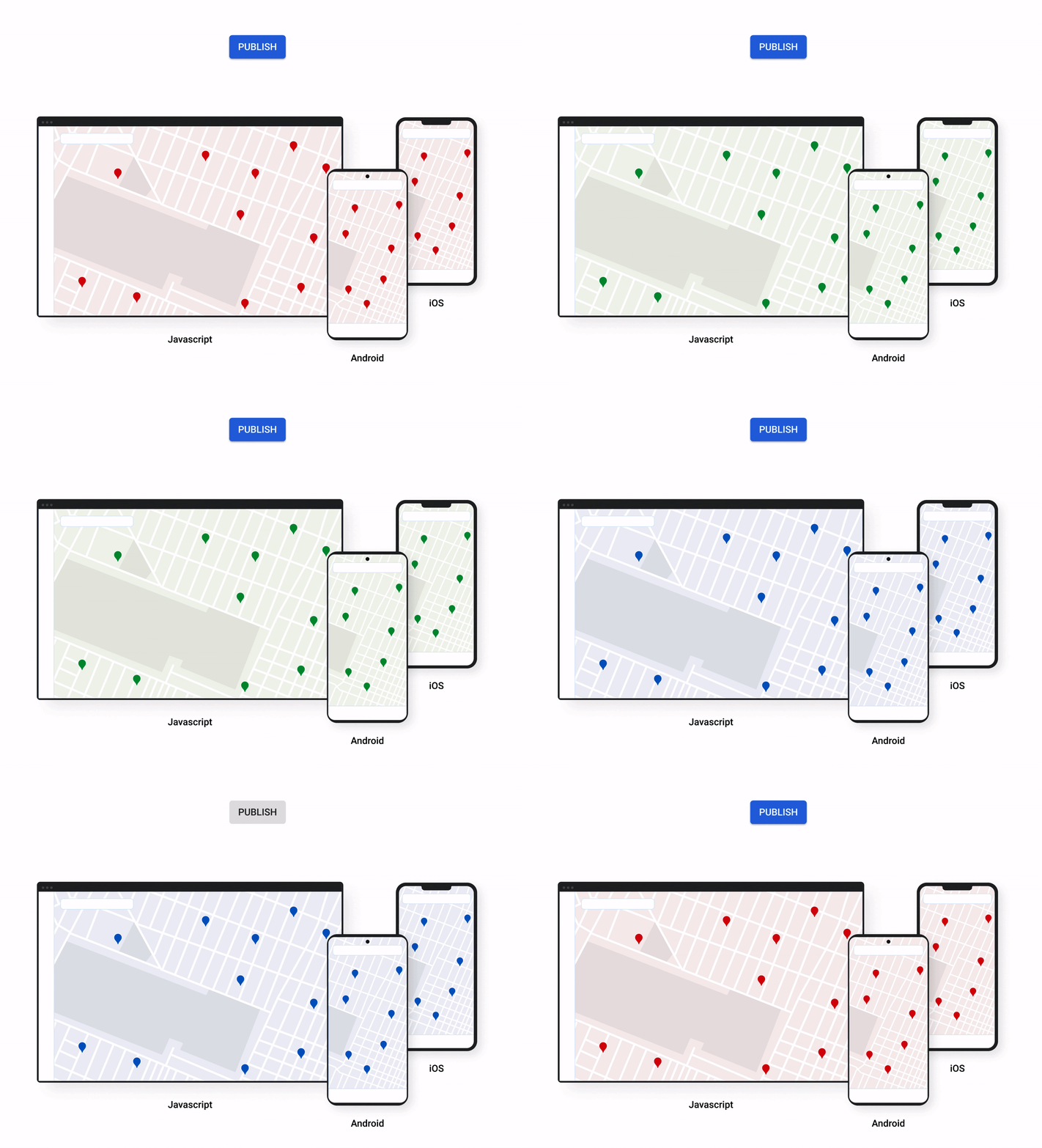
A consistent cross-platform maps experience with Cloud-based maps styling for mobile
Earlier this year at Google I/O, we announced the general availability of Cloud-based maps styling for JavaScript. Since then customers have used the richer customization capabilities and efficient cloud-enhanced deployment workflow to power millions of mapping experiences, from a curated interactive map of Munich to fun virtual Easter egg hunts hosted by Cadbury. Starting today, Cloud-based maps styling features are supported in the GA versions of our Maps SDK for Android (v18+) and Maps SDK for iOS (V5.0+).
Cloud-based maps styling moves map customization code off the client and into the cloud–where it can be easily modified to use new features or test new configurations. This decoupling of client code and customization code makes it easy to manage a single branded and optimized style across any number of apps across all supported platforms. It also makes it possible to simultaneously publish changes to a map style across platforms and install bases with the click of a button. Cloud-based maps styling is the foundation for a growing set of new customization features including POI filtering and POI boosting, zoom level customization, landmarks, and commercial corridor styling.

Mobile developers can now take advantage of Cloud-based maps styling features and simple cross-platform customizations for their Dynamic Maps by creating a MapID in Google Cloud Console and using it within their Maps SDK for Android or Maps SDK for iOS. Dynamic maps loaded with a Map ID via our Maps SDK for Android or Maps SDK for iOS will be billed to the same SKU as Maps JavaScript API (Dynamic Maps) and covered under the same $200 monthly credit and volume pricing. Developers can upgrade to the new Maps SDK for Android and continue using client-styled maps for no charge as they always have.
Additional capabilities we’re working on¹
We know you have a range of map customization needs to engage your users with differentiated experiences. We’re working on developing more Cloud-based maps styling features–focused on marker capabilities, map elements, and data-driven styling–to help you do just that. We’re working on a new set of markers capabilities, easier pin customizations, marker collision management, performance optimizations, and the ability to build custom marker elements that you can use to quickly deploy deeply customized, highly optimized marker-driven experiences. For those seeking greater detail in their maps, we’re working on expanding the availability and customization of detailed street maps to even more cities. We’re also working on features to make it easier to programmatically style map elements by exposing new APIs to enable things like the simple creation of choropleths by styling Google geographical boundaries based on your data.
This is just a peek into what we’re excited to be building for our developer community. While we’re working hard to bring these additional features to life, visit our website to learn more and our developer documentation to start customizing and enhancing your mobile maps.
¹Product capabilities, timeframes, and features are subject to change.
More Relevant Stories for Your Company




Why Apigee: Customers Explain How this API Platform Boosts their Business
Apigee customers Expedia, Equinix, Morningstar, Swisscom, Vantiv, Telstra, Fox Broadcasting company, Laterooms.com and partners, SAP and Accenture share why they joined forces with the intelligent API management platform company. Apigee is helping customers execute businesses commerce with other partners, securely expose assets to external developer communities, secure APIs throughout the

Elevating SAP Operations: Cardinal Health Implements Google Cloud Bare Metal Solution
Over the past few years, Google Cloud has become the platform of choice for a growing number of SAP enterprise customers. That's especially true for companies looking to migrate large and challenging SAP workloads, including those moving to S/4HANA systems as part of a cloud modernization strategy. Google Cloud's Bare Metal Solution

Google Cloud’s Transfer Services Helps Move Nuro’s Petabytes of Data from Edge to the Cloud
Engineers that build last-mile delivery services belong to an elite order, a hallowed subcategory. Delivery customers are incredibly demanding when it comes to speed and convenience, and the services they use must take variables like increased traffic, road conditions, human error, and even driver availability into account every day. Nuro

Swiggy: Delivering Local Food Within 40 Minutes
Founded in 2014, Swiggy started small, delivering food to a few neighborhoods in Bengaluru, India. As the company grew, the team wanted a mapping technology that could help expand the service throughout India. Swiggy needed a scalable mapping platform that covered a wide geographic area and offered tools to help
