





4366
Of your peers have already watched this video.
7:00 Minutes
The most insightful time you'll spend today!
Baking Gets Sweeter: Build ML Models that Help Predict the Best Recipe!
Baking recipes and ML models have one thing in common—they follow a pattern. Machine Learning is all about finding pattern in data sets, you can predict what you are baking based on the core ingredients and their respective amounts! Bread, cake or cookies, watch the video to make you make your baking experiences and learning with ML sweeter.
AutoML Tables, a no-code Google Cloud tool for ML models analyzes data from the databases and spreadsheets to help creates an automatic stats and dashboard with lists of ingredients and their values to predict a new recipe. Watch more episodes from Making with Machine Learning.
Siemens: What Smarter New Age Recruiting Looks Like

3173
Of your peers have already read this article.
4:30 Minutes
The most insightful time you'll spend today!
Siemens aims to shape the future—and has the scale, culture, and know-how to realize its ambitions. The Germany-headquartered industrial manufacturing business operates in more than 120 countries and focuses on electrification, automation, and digitalization. Siemens’ extensive portfolio includes industrial production digitalization and automation technologies, diagnostic and therapeutic imaging for healthcare, and building automation and management technologies.
“All our solutions are united by the fact they impact the way people live their lives,” says Stephanie Morton, Siemens’ Global Talent Acquisition Manager: Strategy, Technology & Talent Relationship Management.
“‘Engineered for life’ is one of our brand claims.”
Hiring “future makers”
Hiring thinkers, dreamers, and doers hungry to transform businesses, industries, and lives is key to Siemens’ success. The business calls its people “future makers” and employs more than 370,000 of them worldwide.
Recruiting for a workforce this size is no easy task. Siemens’ global jobs and careers website has about 5,000 open positions at any one time, and the organization receives 2 million applications to fill 35,000 positions per year.
However, by 2017, the website was experiencing problems that hampered the talent acquisition team’s efforts to fill roles promptly with the right candidates. Its standard keyword matching technology could not optimize the results provided to job seekers, frustrating potential candidates and increasing the workload for recruiters.
“With Cloud Talent Solution, we saw a 30 percent uplift in candidate conversions from search to application.”
—Stephanie Morton, Global Talent Acquisition Manager: Strategy, Technology & Talent Relationship Management, Siemens
“We found the language we used about our jobs internally was often not the same language job seekers used,” explains Morton. “For example, we may have an engineering position open for our MindSphere cloud-based IoT operating system. We would post this on our jobs and careers website as ‘MindSphere engineer.’ Unfortunately, a job seeker using more general terms such as ‘IoT engineer’ may miss this advertisement.”
In addition, without intelligence and context, the keyword matching technology could not determine job seeker search intentions from misspelled terms. This became more of a problem as job seekers increasingly used mobile devices to conduct searches.
With keyword searches also generating pages and pages of results, job seekers often succumbed to the temptation to apply for every position returned. This left the talent acquisition team drowning in messages and applications.
“We experienced issues around seniority as well—for example, people looking for senior legal roles were receiving irrelevant results for internships or junior roles,” says Morton.
Change needed
These problems could not persist for a team charged with continuously improving candidate experiences. The team opened discussions with Jibe, a recruitment platform provider that operated Siemens’ external career websites. Jibe had collaborated with Google to integrate Cloud Talent Solution—a solution that uses machine learning to better understand job content and job seeker intent—into its platform.” Jibe offered the integrated solution to Siemens as one of its most forward-thinking customers,” says Morton.
Morton’s team reviewed Cloud Talent Solution and was immediately excited by its potential to quickly make a profound difference in its recruitment activities—without requiring recruiters and other team members to invest considerable time and effort. Cloud Talent Solution could enable the website to understand the broad intent of a job seeker—including synonymous positions—and deliver considerably more relevant results.
“We can authoritatively say Cloud Talent Solution is improving the experience for job seekers; they are conducting more searches, those searches are more effective, and more of them are converting to job applications.”
—Stephanie Morton, Global Talent Acquisition Manager: Strategy, Technology & Talent Relationship Management, Siemens
After Cloud Talent Solution expanded to encompass more than 100 languages—enabling Siemens to offer a consistent experience to candidates from a range of countries and backgrounds—Morton’s team gave Jibe and Google the green light to proceed.
“We had two key issues to address during the implementation,” says Morton. “The first was to make sure Google Cloud was aware of any Siemens-specific recruitment terms. For example, we have German-language posts that include terms commonly used internally regarding internships and junior positions. We worked closely with our partners to make sure these terms were represented in the algorithm to complement the vast constellation of already-mapped job titles in Cloud Talent Solution.”
Siemens also needed to quantify Cloud Talent Solution benefits to sell the service internally within the business and win support to proceed beyond a pilot. “Because Cloud Talent Solution was effectively an invisible layer behind our website, we had to test its impact,” says Morton.
A 30 percent uplift
Working with Jibe, Siemens conducted A/B testing. Five percent of candidates in the test group used the keyword-based search experience and 95 percent of candidates the search experience powered by Cloud Talent Solution. The testing accommodated changes in candidate queries over time and context.
“With Cloud Talent Solution, we saw a 30 percent uplift in conversions from search to application,” says Morton.
“We can authoritatively say Cloud Talent Solution is improving the experience for job seekers; they are conducting more searches, those searches are more effective, and more of them are converting to job applications,” she adds. “Anecdotally, recruiters are seeing fewer applications from job seekers who have applied to long lists of positions returned from search queries.”
“Partnering with market-leading providers like Google Cloud can help us stay one step ahead of the competition over the journey.”
—Stephanie Morton, Global Talent Acquisition Manager: Strategy, Technology & Talent Relationship Management, Siemens
In the longer term, Siemens plans to monitor the impact of Cloud Talent Solution on metrics such as candidate retention rates and manager satisfaction.
With Cloud Talent Solution well established within the business, Siemens is now working with Google Cloud to add new features—including voice assistants—to enhance the candidate experience. “Helping candidates laser in on the right positions and make successful connections is something we’re doing everything we can to make happen,” says Morton.
More broadly, Cloud Talent Solution and Jibe are helping Siemens’ talent acquisition and the rest of its human resources function build its reputation and execute its strategy. “We are becoming a function driven by delivering amazing technology-based solutions to our employees and our candidates,” says Morton. “People within Siemens are very impressed to see human resources leading the way in working with Google Cloud to deliver a solution like this at a global scale.”
“The more light-touch exercises like this we can do, the fewer big, expensive, time-consuming initiatives we need to take,” she says. “Furthermore, partnering with market-leading providers like Google Cloud can help us stay one step ahead of the competition over the journey.”
OCR Engine Upgrade: Document AI Introduces 3 New Capabilities

2496
Of your peers have already read this article.
2:30 Minutes
The most insightful time you'll spend today!
Documents are indispensable parts of our professional and personal lives. They give us crucial insights that help us become more efficient, that organize and optimize information, and that even help us to stay competitive. But as documents become increasingly complex, and as the variety of document types continues to expand, it has become increasingly challenging for people and businesses to sift through the ocean of bits and bytes in order to extract actionable insights.
This is where Google Cloud’s Document AI comes in. It is a unified, AI-powered suite for understanding and organizing documents. Document AI consists of Document AI Workbench (state-of-the-art custom ML platform), Document AI Warehouse (managed service with document storage and analytics capabilities), and a rich set of pre-trained document processors. Underpinning these services is the ability to extract text accurately from various types of documents with a world-class Document Optical Character Recognition (OCR) engine.
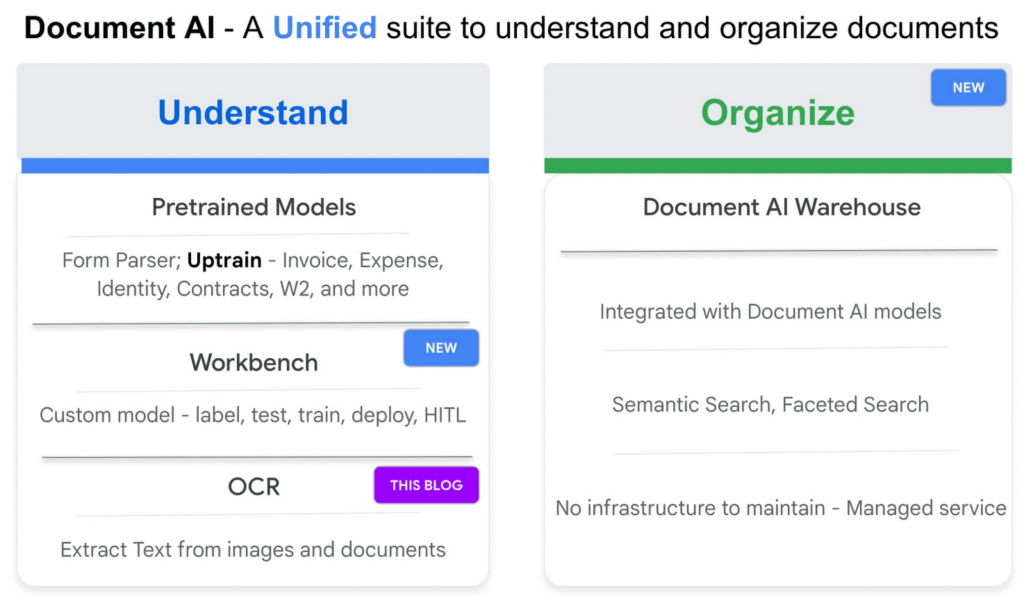
Google Cloud’s Document AI OCR takes an unstructured document as input and extracts text and layout (e.g., paragraphs, lines, etc.) from the document. Covering over 200 languages, Document AI OCR is powered by state-of-the-art machine learning models developed by Google Cloud and Google Research teams.
Today, we are pleased to announce three new OCR features in Public Preview that can further enhance your document processing workflows.
1. Assess page-level quality of documents with Intelligent Document Quality (IDQ)
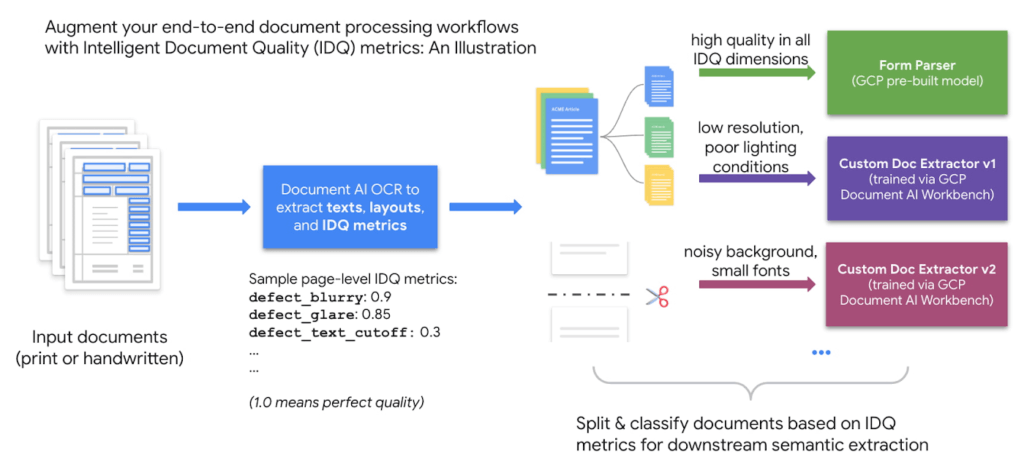
With Document AI OCR, Google Cloud customers and partners can programmatically extract key document characteristics – word frequency distributions, relative positioning of line items, dominant language of the input document, etc. – as critical inputs to their downstream business logic. Today, we are adding another important document assessment signal to this toolbox: Intelligent Document Quality (IDQ) scores.
IDQ provides page-level quality metrics in the following eight dimensions:
- Blurriness
- Level of optical noise
- Darkness
- Faintness
- Presence of smaller-than-usual fonts
- Document getting cut off
- Text spans getting cut off
- Glares due to lighting conditions
Being able to discern the optical quality of documents helps assess which documents must be processed differently based on their quality, making the overall document processing pipeline more efficient. For example, Gary Lewis, Managing Director of lending and deposit solutions at Jack Henry, noted, “Google’s Document AI technology, enriched with Intelligent Document Quality (IDQ) signals, will help businesses to automate the data capture of invoices and payments when sending to our factoring customers for purchasing. This creates internal efficiencies, reduces risk for the factor/lender, and gets financing into the hands of cash-constrained businesses quickly.”
Overall, document quality metrics pave the way for more intelligent routing of documents for downstream analytics. The reference workflow below uses document quality scores to split and classify documents before sending them to either the pre-built Form Parser (in the case of high document quality) or a Custom Document Extractor trained specifically on lower-quality datasets.
2. Process digital PDF documents with confidence with built-in digital PDF support
The PDF format is popular in various business applications such as procurement (invoices, purchase orders), lending (W-2 forms, paystubs), and contracts (leasing or mortgage agreements). PDF documents can be image-based (e.g., a scanned driver’s license) or digital, where you can hover over, highlight, and copy/paste embedded text in a PDF document the same way as you interact with a text file such as Google Doc or Microsoft Word.
We are happy to announce digital PDF support in Document AI OCR. The digital PDF feature extracts text and symbols exactly as they appear in the source documents, therefore making our OCR engine highly performant in complex visual scenarios such as rotated texts, extreme font sizes and/or styles, or partially hidden text.
Discussing the importance and prevalence of PDF documents in banking and finance (e.g., bank statements, mortgage agreements, etc.), Ritesh Biswas, Director, Google Cloud Practice at PwC, said, “The Document AI OCR solution from Google Cloud, especially its support for digital PDF input formats, has enabled PwC to bring digital transformation to the global financial services industry.”
3. “Freeze” model characteristics with OCR versioning
As a fully managed cloud-based service, Document AI OCR regularly upgrades the underlying AI/ML models to maintain its world-class accuracy across over 200 languages and scripts. These model upgrades, while providing new features and enhancements, may occasionally lead to changes in OCR behavior compared to an earlier version.
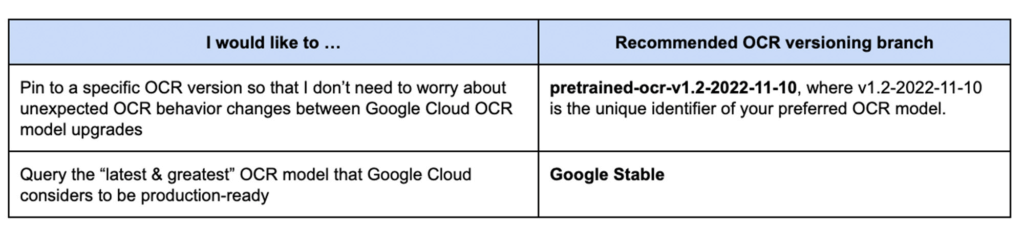
Today, we are launching OCR versioning, which enables users to pin to a historical OCR model behavior. The “frozen” model versions, in turn, give our customers and partners peace of mind, ensuring consistent OCR behavior. For industries with rigorous compliance requirements, this update also helps maintain the same model version, thus minimizing the need and effort to recertify stacks between releases. According to Jaga Kathirvel, Senior Principal Architect at Mr. Cooper, “Having consistent OCR behavior is mission-critical to our business workflows. We value Google Cloud’s OCR versioning capability that enables our products to pin to a specific OCR version for an extended period of time.”
With OCR versioning, you have the full flexibility to select the versioning option that best fits your business needs.
Getting Started on Document AI OCR
Learn more about the new OCR features and tutorials in the Document AI Documentation or try it directly in your browser (no coding required). For more details on what’s new with Document AI, don’t forget to check out our breakout session from Google Cloud Next 2022.

Upgrade Your Contact Center with Knowlarity’s AI-powered Speech Analytics for Higher CX
DOWNLOAD E-BOOK6222
Of your peers have already downloaded this article
7:00 Minutes
The most insightful time you'll spend today!
Did you know, everyday about 56 million hours worth of phone conversations, equalling to 420 billion spoken words are handled by contact centers? Knowlarity, a renowned cloud business communication service provider with nearly 6,000 customers and over a million virtual users, leverages AI-powered speech analytics that offer insights to gauge customer preferences and emotions, campaign performance, agent’s effectiveness and much more. Knowlarity’s programmatic speech analytics platform is built with Google Cloud to optimize contact center performance by transcribing and analyzing millions of calls to impact savings, operations, CX, customer loyalty and retention, and revenue generation.
Download the e-Book to learn more about Knowlarity’s speech analytics for your business’ contact centers and elevate your agents’ performance by leveraging ML, natural language processing (NLP) and AI capabilities.
How AI and ML Helps Interpret Baseball Fandom during this MLB Season

4556
Of your peers have already read this article.
1:30 Minutes
The most insightful time you'll spend today!
The game of baseball has no shortage of statistics — from batting average to exit velocity, strikeouts to wins above replacement. Among all sports, Major League Baseball (MLB) arguably contains the most analytical and data-driven participants and fan base. Subconsciously or viscerally, players and managers on the field and those following from anywhere are constantly assessing and making decisions based off of game play trends and expectations — whether a batter will come through with a hit in an important situation, when a pitcher should be pulled. Less analyzed, however, is what leads fans to become engaged with certain players or teams, and what factors drive their love of the game. This is the motivation behind the problem being posed by Major League Baseball in their Kaggle competition for Player Digital Engagement Forecasting. Can you use machine learning to deconstruct baseball fandom?
This competition asks you to predict measures of digital engagement for each active player on a daily basis during the MLB season. So, how large was the surge in fan interest after Joe Musgrove threw the first no-hitter in Padres history? Is Shohei Ohtani’s engagement higher when he pitches well, when he hits a monster home run…or when he does both? You’re provided a wealth of game, team and player information – detailed stats, awards, rosters, and transaction information – as well as social and digital engagement data as your inputs. Data scientists will recognize this as an exciting forecasting problem with both traditional regression and time series components, where having this input data just prior to the prediction date is critical to determining which players will receive the most engagement.
With so many variables in the game, there are an endless number of vectors which could possibly influence fan engagement. Eleven-time All-Star Miguel Cabrera delighted fans by hitting the first home run of the season – in the snow! Occasionally a lesser-known player like Musgrove or Carlos Rodón “wins the day” with an unlikely no-hitter. And sometimes just getting traded to an iconic franchise like the Yankees generates a ton of fan interest, like it did for Rougned Odor in early April.
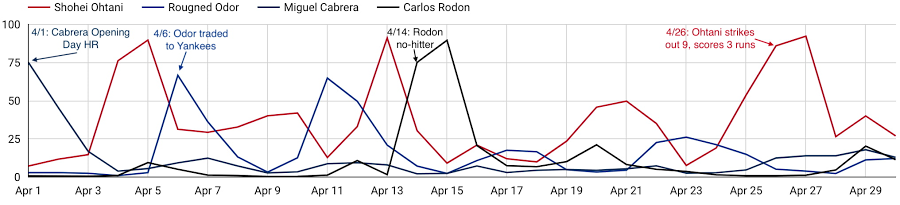
As these examples show, a player’s digital engagement can be pretty dynamic during the season, with many different potential contributors to who is “trending” on a given day. How can you use data to uncover which factors are the most influential of engagement with each player’s digital content?
Ready to play ball? Check out the competition on Kaggle for all the details. $50,000 in prizes is up for grabs in two prize categories. The code competition puts your machine learning skills to the test, to see who can build the most accurate forecasting models to predict daily digital engagement for every active player. You’ll have until July 31st to build your models and then be evaluated on a future time frame, which will determine the winners. For data visualization and exploration experts out there, the explainability prizes give you an opportunity to analyze more broadly which factors, even those outside of what we’re providing directly, most influence digital engagement. You’ll be evaluated on how well you can use what the data is telling you to support your findings.
And if you’re looking to get started, we’ve provided an introductory video and some notebook tutorials, including a starting point for harnessing the power of Vertex AI through tools including Cloud Notebooks, Explainable AI, and Vizier.
With the second half of the season upon us, it’s an exciting time to be an MLB fan. With this Kaggle competition, it’s also a perfect opportunity to use data science to help understand baseball fandom and potentially earn some of your own accolades in the process. Step up to the plate!
Major League Baseball trademarks and copyrights are used with permission of Major League Baseball. Visit MLB.com.
3308
Of your peers have already watched this video.
16:30 Minutes
The most insightful time you'll spend today!
Engage and Translate: Text and Audio Chat in 100+ Languages
As users worldwide connect to the internet and work remotely, it’s more important than ever to make interactive applications chat in many languages.
But when users speak 100s of languages, this quickly can get challenging. Where to start? If you are new to translation, Sarah Weldon, the Product Manager for Cloud Translation, and Dale Markowitz, an Applied AI Engineer and Developer Advocate touch on a couple of simple starters, then provide examples of how you could advance your translations once you have gone further along the learning curve.
They also share how the Translation API can quickly globalize an app, with no multilingual expertise required. Increasing language coverage can drastically increase engagement, even for internal applications. For example, when Mercy Corps integrated Translation API in their internal hub, traffic volume increased 70%. Learn about integrating the Google Cloud Translation API Advanced with a chatbot client, using the machine translation glossary feature to control a set of terms for more relevant translation.
More Relevant Stories for Your Company
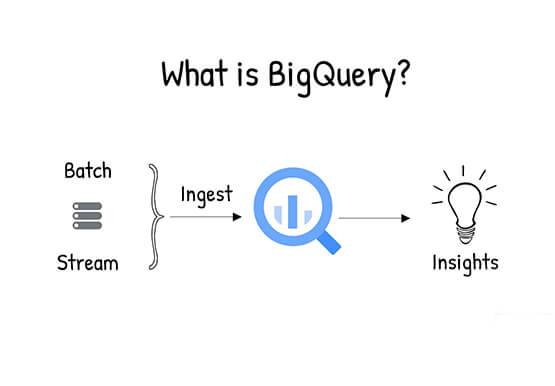
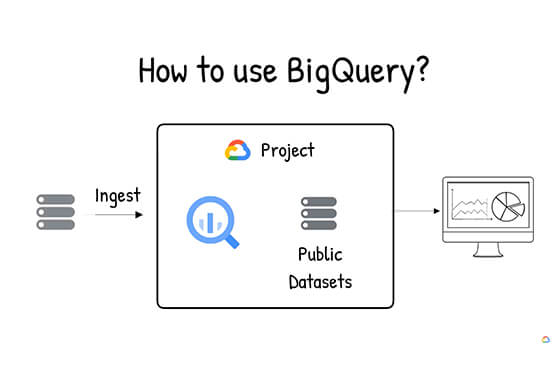

What is BigQuery?
BigQuery is Google Cloud's enterprise data warehouse designed to help you ingest, store, analyze, and visualize big data with ease. Organizations rely on data warehouses to aggregate data from disparate sources, process it, and make it readily available for data analysis that supports their strategic decision-making. You can ingest data

Volkswagen + Google Cloud: Using Machine Learning to Drive Smarter with Energy Efficient Cars
Volkswagen strives to design beautiful, performant, and energy efficient vehicles. This entails an iterative process where designers go through many design drafts, evaluating each, integrating the feedback, and refining. For example, a vehicle’s drag coefficient—its resistance to air—is one of the most important factors of energy efficiency. Thus, getting estimates

The 40 Most Astounding Stories of Tech-Enabled Innovation
These business and technology innovators are leveraging cloud computing, machine learning, APIs, collaborative platforms, among others to advance healthcare, financial services, retail, media and entertainment, manufacturing, and government. They include some of the biggest brands in the world, as well as some you've probably never heard of. But they all



Satellites Can Help Map Carbon Emissions By Looking at Images of Power Plants!
Did you know that Satellites can now help track power plants and determine if they are on or off? And did also know that compute processing that classifies over 59 trillion bytes of data from over 11,000 sensors from 300 satellites is done on on Google Cloud? Google Cloud's sustainability
