





5383
Of your peers have already watched this video.
4:00 Minutes
The most insightful time you'll spend today!
AppSheet is Useful for Schools & Universities to Custom-build Apps
AppSheet, Google Cloud’s no-code platform that eases application development and automation process without writing even a line of code. In the education space, AppSheet can come in handy easily as a unified platform to build custom applications that also integrates seamlessly with Workspace, allowing schools and universities to save on time and resources on updating IT infrastructure.
From updating sheets, sharing documents and study material over drive to scheduling events on Calendar, organizing lectures and team meets over Meets, AppSheet allows easy collaboration and access. Watch the video to build apps that are best for your University or school using Google Cloud’s AppSheet!
YoungCapital CIO: Why I Moved to Google Cloud and G Suite to Grow Our Business

7308
Of your peers have already read this article.
4:30 Minutes
The most insightful time you'll spend today!
When your business is rapidly adding new employees, expanding to new countries, and always focused on staying ahead of the competition, you have to take a hard look at the tools that are slowing you down—and swap them out for better ones that can keep pace with the company. We’re expanding YoungCapital in Germany, which means more offices, more people, and more technology to make the business run smoothly.
As we scale, Google Cloud tools like Chromebooks and G Suite help us grow our business efficiently. They free us up from sluggish, time-intensive technology that’s hard to maintain and repair, and give us the freedom to work together in faster, smarter ways.
Free from hours of device setup. Some months, there are as many as 40 new employees starting at YoungCapital—and as we continue to expand that number will continue to rise, especially now that we’ve opened three new offices in Germany. With our old Windows desktops, setting up new computers could take up to an hour per employee (which can add up to about 40 hours a month for IT). Today, using Chrome Enterprise tools, it takes about five minutes to get an Acer Spin or Pixelbook ready to hand off to a new hire—saving us more than three months per year of device setup time.
Free from VPNs. Our previous Windows machines required a complicated virtual private network (VPN) for accessing corporate files outside of the office. Using a VPN was complicated for our employees because the software wasn’t intuitive; if an employee had trouble signing into the VPN while at home or traveling, they could not log in and work as quickly as they needed to. With Chromebooks, all you need is an online connection to sign into G Suite to access files and work from anywhere.
From our perspective, Chromebooks are resistant to threats like ransomware and phishing attacks, giving us confidence that our data can stay secure. With Chrome Enterprise Upgrade, our IT admins can strengthen security even further: for example, by enabling advanced security features that help block vulnerabilities, locking down lost or stolen devices right away, and setting device security policies in the cloud so devices everywhere are safer.
Free from infrastructure. We used to have to invest in servers, and then add more time and money to keep them running. Now we don’t have to run the business on infrastructure or hire people to maintain it—we can just use Google’s cloud. NextNovate is helping us make the most of Google Cloud Platform, like integrating some of our proprietary applications with G Suite and building our own add-ons. For example, we created a button for Gmail that connects to our job candidate database; when candidates email us, we can click on the button and see their profiles and work experience.
Free from multiple passwords and logins. Chrome Browser and G Suite with single sign-provider SAML are the portal to all the productivity apps our employees need. Once people log in to G Suite, they don’t have to remember a bunch of other user names and passwords. The IT team loves it too, because we don’t have to spend hours zeroing out passwords and creating new ones.
Free to manage cross-country devices easily in the cloud. Our four-person IT support team, which keeps our systems humming, hasn’t grown, even though we’ve doubled the number of employees. When we were on Windows devices, we fielded roughly 1,800 IT support requests every month. Now we get about 1,300 requests a month, from a much bigger employee base. This translates to nearly 30% fewer requests for our lean support team, which reduces their workload significantly even though we have roughly 20% more employees—all made possible with Chrome Enterprise.
Being free of slow, high-maintenance technology doesn’t just make the IT department happy—people are actually changing how they work. They no longer send files to each other by email or struggle to keep track of versions; they store everything in Google Drive and work together in Google Docs on a single document at the same time. And instead of traveling to other offices, connecting with each other in video conferences on Hangouts Meet has become a completely natural way to do business.
With Chromebooks and G Suite, we’re ready for anything: more new markets, more employees, and more-flexible ways to work together and shake up the staffing industry.
How to sustainably transform while minimizing risk

942
Of your peers have already read this article.
3:30 Minutes
The most insightful time you'll spend today!
In previous blog posts, we’ve discussed the benefits that organizations can reap by measuring and then optimizing their overall ESG impact. In this post, we’ll look at the endgame: sustainable transformation into an organization that continually adapts to maximize its resilience while reducing risk. Where will my customers be with the evolving global community landscape? How can I design communities and products with sustainability in mind? Are my assets exposed to physical climate risk — drought, flood, wildfire? Adaptation and resilience are the board and legislative focus areas that the ambition loops created by Google Cloud Ready – Sustainability seek to accelerate.
This is especially important due to the scrutiny of governments and financial institutions as they evaluate the viability of physical asset investments. These organizations want assurances that their investments will not be under undue environmental risk. Similarly, companies embarking on net-zero transitions can realize interest expense savings by providing the measurable, accountable assurances their financiers demand.
Leveraging analytics for climate and business resilience
We’ve said it before, but it bears repeating: The Google Cloud Ready – Sustainability program challenges the notion that sustainability is just a nice-to-have or merely good PR. Rather, we designed the program to help organizations adapt to a net-zero future with solutions that reduce risk, support growth, provide competitive advantages, and positively impact the bottom line. The following partners provide data and analytics that offer deep insights into the environment, natural resources, and social trends that point the way toward sustainable, profitable growth.
Atlas AI has built a geospatial artificial intelligence platform that helps every organization anticipate changing societal conditions — where people live, where wealth and poverty are concentrated, how the physical makeup of communities is evolving, and more — to determine where to invest today to prepare for the world of tomorrow. Atlas AI customers, which range from the World Bank and global NGOs to multinational corporations, use the platform to accelerate growth, future-proof supply chains, target resources to vulnerable populations, and build greater resilience to climate change.
Climate Engine’s SpatiaFi solution, powered by Google Cloud, helps financial services organizations connect economic assets to the world of Earth observation data supporting regulatory reporting, climate risk reduction, and new innovative sustainable finance offerings. Combining billions of planetary observations with peer-reviewed scientific methods, SpatiaFi is connecting Earth science to operational systems offering new levels of accuracy, transparency, scalability, and trust in climate and sustainability data in the context of financial decision-making.
Kumi Analytics‘ KACSAT solution was approved by OxCarbon as a methodology for the calculation and verification of voluntary carbon offsets in support of nature-based solutions. KACSAT leverages multiple satellite platforms and Google Earth Engine‘s state-of-the-art processing tools to enable science-based carbon assessment aligned to the Oxford Offsetting Principles of environmental integrity, additionality, permanence, and achieving net-zero emissions. Environmental organizations, financial institutions, and corporations can now offset their carbon footprints through the reforestation and conservation of millions of hectares of forests — something that was previously limited due to the cost and time of validating high-quality forest projects.
Tensorflight revolutionizes property underwriting with AI. Its cutting-edge tool provides underwriters and insurers with access to rich and highly accurate datasets for commercial and residential properties, enabling them to create superior insurance products. As pioneers of the first property-inspection platform based on convolutional neural networks, Tensorflight’s advanced technology connects seamlessly via API and utilizes ground-level imagery, satellite, and aerial data. This unique approach enables the company to generate precise replacement costs and conduct more comprehensive risk assessments. By automating property inspections and enhancing underwriting accuracy, Tensorflight empowers insurance providers to plan for the future with pragmatic decision-making. With Tensorflight, the future of property underwriting is transformed, offering unparalleled insights, efficiency, and sustainability.
Are you ready for sustainability transformation?
Transforming into a net-zero organization means much more than building resilience to climate change, as important as that is. It also means finding the customers of the future, achieving ongoing energy savings, more sustainable resource usage, and improved transparency to regulatory institutions and consumers. Google Cloud Ready – Sustainability partners offer certified solutions that can help organizations get there.
Look for Google Cloud Ready – Sustainability validated solutions on the Google Cloud Partner Directory Listing, Google Cloud Ready Sustainability Partner Advantage page, and — if applicable — via the Google Cloud Marketplace. We hope to help customers better understand how these technologies can help them meet their ESG goals, find the right solutions for their particular challenges, and implement solutions faster.
Learn more about the Google Cloud Ready – Sustainability validation initiative and explore all our partners in sustainability transformation.

Customer Voices: How Firms from Across Industries Leverage Google Cloud
DOWNLOAD CASE STUDY14118
Of your peers have already downloaded this article
1:30 Minutes
The most insightful time you'll spend today!
From powering everyday operations and accelerating application innovation, to providing tools for specific business needs and executing on big ideas, to advancing the security of technology solutions, companies from across industries have leveraged Google Cloud for business benefits.
Companies from across industries have turned to Google Cloud for transforming their business, modernizing their infrastructure, and gleaning intelligence from data. For instance:
- Johnson & Johnson achieved a 41% increase in search results from high-quality job applicants, significantly improving the company’s ability to quickly hire top talent.
- Sony Network Communications now processes 10 billion monthly queries faster, which advances data analysis.
- University College Dublin saw significant 6-figure savings by eliminating legacy hardware, software, and maintenance.
And there are many such examples. Read the collection of case studies to find out how companies from across industries and geographies leveraged Google Cloud for measurable business benefits and for solving complex problems.
How This Sri Lankan Bank is Striving to Make Banking Accessible to All

4646
Of your peers have already read this article.
1:30 Minutes
The most insightful time you'll spend today!
Headquartered in the Sri Lankan capital of Colombo, Cargills Bank is not short on ambition or vision: it plans to make banking services accessible to all Sri Lankans and become a financial services leader at home and internationally. Founded in 2014 and licensed by the Central Bank of Sri Lanka to provide domestic and offshore banking services, Cargills Bank provides Retail, Credit and Debit Cards, Corporate, SME, Agri, Micro Finance, Treasury, and Trade banking products to customers.
The bank delivers these products from a network that includes 19 branches, the internet, mobile applications, and a partnership with supermarket chain Cargills Food City that enables customers to transact at more than 370 service points across Sri Lanka.
Cargills Bank initially deployed productivity and communications applications running in an on-premises data center. However, these applications could not support the bank’s growing need to operate as an agile, collaborative, technology-enabled institution. “We wanted to minimize the time and resources dedicated to administration and give our employees the ability to engage and collaborate more effectively. This naturally led us to the cloud and to G Suite,” says Indika Fernando, Senior Manager IT, Applications and Development, Cargills Bank.
Accelerating workflows
The bank also wanted to use scripts to accelerate and automate workflows that incorporated its productivity applications. “The limitations of our previous platform meant it took us three weeks to complete a simple workflow. We wanted to accelerate this process for simple and complex workflows,” explains Fernando.
A technology review by the Cargills Bank IT team found G Suite could meet all of the company’s business and technical requirements. “Employees could meet using voice and video connections from their desktops, mobile devices, and meeting rooms, and collaborate in real time on documents,” says Fernando.
This was a considerable improvement compared to the previous platform that required each stakeholder to wait until other people provided their input, or people providing input into different copies of the same document, forcing a document author to spend time consolidating all feedback into a final version.
“With G Suite, we can be sure that all stakeholders provide detailed and timely input into the documents we rely on to make critical business decisions,” says Fernando.
Augmenting G Suite
G Suite also supported an initiative by Cargills Bank to provide single sign-on for all business applications, while cost effectively giving workers access to cloud-based spreadsheet, document, slide, information collection, web, and wiki creation tools. Furthermore, Apps Script enables the bank’s developers to perform tasks including building add-ons for G Suite products such as Sheets, Docs, Slides, and Forms; writing custom functions for Sheets; publishing web apps embedded in Google Sites; and interacting with services such as AdSense, Analytics, Calendar, Drive, Gmail, and Maps.
Cargills Bank completed migrating its workforce to G Suite a couple of years ago. To help ensure the project was completed on time, within budget, and delivered access to the full range of G Suite tools, the bank engaged Google Partner Finetech Consultancy, which is also headquartered in Colombo.
“The partner oversaw creation of our architecture and undertook training and change management,” says Fernando. “It provided expert consultancy and troubleshooting throughout the three-month deployment and played an integral role in enabling us to launch on schedule.”
The bank has established a Google based social network to create and run internal communities and give its employees the freedom to create communities. “The communities effectively operate as internal social networks that our departments and staff can use to disseminate day-to-day information and announcements,” says Fernando. “For example, leaders of a training and development community use the forum to publish details of upcoming training programs and celebrate people who have completed training exercises.”
Cargills Bank has also established Hangouts Meet as a key communication tool. Employees use voice, video, and chat services to collaborate, with an audit trail that is a requirement in a regulated industry.
Using Apps Script to increase the power of G Suite has delivered a range of benefits to Cargills Bank and enabled the institution to pass on valuable insights to the Sri Lankan Google user community. “Our work with Google has made us a source of expert knowledge that can be accessed by the wider business community” says Fernando.
Workflows increased from 25 to 40
With G Suite and Apps Script, Cargills Bank teams are working more efficiently and the number of streamlined processes has increased from 25 to 40. The bank is using Forms to support simple applications, and a combination of Forms, Apps Script, and HTML code to run complex workflows encompassing validation, documentation, and authorization, and that require sandboxes for code testing and experimentation.
Key workflows supported by Forms and Apps Script include credit card and bank account applications. These workflows automate the process of helping ensure relevant teams review and accept or reject customer applications based on KYC rules. For example, when a customer applies for a new account, a bank employee will scan the request document and supporting information, which is then sent electronically to another team for verification. That team may reject, request more information, or approve the application for escalation to another team for authorization. The authorization team can then approve, reject, or request more information. Each step is automated and associated documentation stored on Drive.
For a credit card application, the Cargills Bank risk department uses a Forms and Apps Script powered workflow to evaluate risk factors such as an applicant’s age, credit history, income, and assets.
Other workflows powered by G Suite manage vehicle reservations, loan origination, customer complaints, incident management, system access requests, lead generation, and e-learning.
“All requests and requirements for vehicles for occasions such as official visits are submitted and authorized through a process supported by Apps Script,” says Fernando. “An approved reservation is sent to the calendar of the person who made the request and pops up in a person’s mobile phone or computer when it is scheduled. This is much simpler than our previous system that required us to send text messages to people to advise them their vehicles were ready.”
E-learning a key process
E-learning is a particularly important activity Cargills Bank has implemented using G Suite. Employees complete learning modules online that help them perform their roles effectively and to pass exams set either by the bank or based on content regulated by the Central Bank of Sri Lanka. Most of the learning material is created in Forms, while Google workflows and dashboards enable managers to track when employees have completed various e-learning modules.
Automation through Google has enabled Cargills Bank to complete backend processes associated with workflows from two days to just two minutes. Uptime is over 99 percent, helping ensure the bank can meet regulatory and internal business requirements.
With workflows powered by G Suite and Apps Script well established within the bank, the institution is continuing to invest in Google Cloud Platform services. A Cloud SQL database manages retail and housing loan information captured and used by Cargills Bank’s loan origination system and workflows. The bank has also started using Google Data Studio to create dashboards that enable it to visualize critical information.
Furthermore, Fernando and his team are exploring the potential of Google machine learning services to help develop chatbots. “Whenever our development team sees a powerful new product from Google, we conduct a deep dive to determine what application it may have for the bank,” Fernando says.
Upgraded G Suite and added new workflows
In January 2019, Cargills Bank elected to upgrade to G Suite Business to take advantage of features such as unlimited storage to archive all its files in digital formats on Drive.
The institution had also used Apps Script to develop complex new workflows across several modules to automate and streamline credit risk scoring, and track and audit hardware movement. In addition, Cargills Bank has developed and deployed new applications using App Maker, available through G Suite Business, and connected them to Cloud SQL to enhance the security of workflow data.
Cargills Bank is now using Google Data Studio, through connectivity to Sheets, to create dashboards for its previously-developed workflow applications.
The institution has also stepped up its collaboration activities through the use of the Jamboard digital whiteboard, available through G Suite. Initially used to exchange ideas between members of the Cargills Bank technology department, the service is due to launch to all users in the coming months.
Reduced friction
Cargills Bank Chief Operating Officer Rohan Muttiah welcomes the role G Suite plays in enabling the business to realize its objectives. “Cloud-based productivity tools such as G Suite reduce friction within our business processes, enabling us to operate more efficiently and effectively in bringing banking to the people of Sri Lanka,” he says.
“Deploying G Suite has given us an agile, dynamic platform to achieve growth based on increased use of fintech and digital technologies,” Fernando says. “Ultimately we want all Sri Lankans to access financial services wherever and whenever they need to and we see G Suite as providing many of the capabilities that enable us to do that.”
3855
Of your peers have already watched this video.
21:30 Minutes
The most insightful time you'll spend today!
The future of meetings in G Suite: Vision and roadmap
A study from MIT Sloan school in early April showed that 47% of US workers were already working from home. Compare that to just 13% before the pandemic. And these numbers are likely to be even greater today.
Video meetings help us connect in a human way, whether it’s for work, a personal commitment, or for education. We have seen Meet’s day-over-day growth surpass 60%. Meet daily usage is more than 30 times what it was in January 2020. And we have been able to scale to this demand easily. Scalability, security, reliability, come naturally to Google Cloud and are in-built into all our services. Our customers have been reaching out to tell us how much this has helped them shift to remote work rapidly during the pandemic.
G Suite continues to innovate on how teams communicate effectively, regardless of whether they are located in the same office or thousands of miles apart. In this video, we share our vision for the future of meetings, small and large, and how these innovations will help build human connections in a video-first world. We’ll also provide a sneak peek into what we’re doing to transform the overall life cycle of a meeting, from scheduling to follow-up.
More Relevant Stories for Your Company

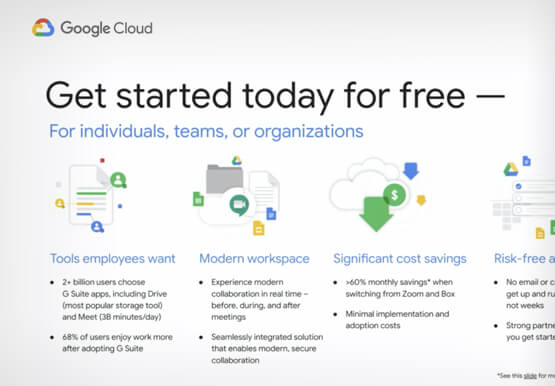
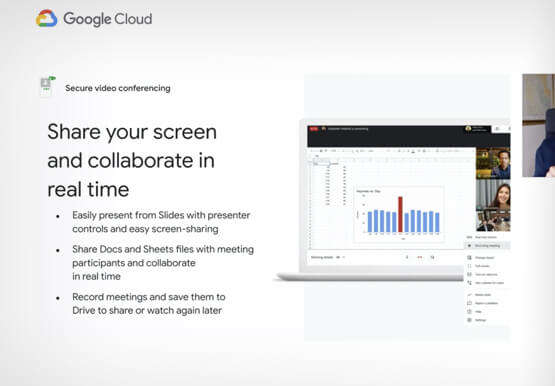

Introducing G Suite Essentials: The simplest way for teams to securely work together from anywhere
With millions of employees forced to work from home, it has become clear that the existing tools many have in place were not cutting it. The Google Cloud team stepped in and accelerated production timelines to launch a new offering. G Suite Essentials is Google's integrated set of tools designed



Workspace: Embedding Inclusion and Equity throughout Product Design and Development
Google's products are built for everyone! Watch the video to hear what the experts at Google say about embedding inclusion throughout the design to product development process, and how Google Workspace is built on product equity principles that takes into consideration the challenges and requirements of users across demographics.

Reactive Programming on Google Maps Platform: Watch Video to Learn
The Google Maps Platform Android SDK supports extensions for reactive programming, which helps you write code to handle asynchronous operations. Write reactive and responsive mapping applications with Google Maps Platform In mobile apps, asynchronous events can happen at any point in time: user touch events, waiting for network calls to complete, or

Taking Maps Further: New Website Experience for Product Discovery, Budgeting and Access to Dev Documentation
For more than 15 years, developers have used Google Maps Platform to deliver location-based experiences to their end users and used location intelligence to optimize their businesses. Along this journey, we’ve made a variety of changes to better support our community as needs have changed and new industries and technologies
