





7475
Of your peers have already watched this video.
1:15 Minutes
The most insightful time you'll spend today!
An Indian Example of How to Really Up Your Customer Experience Game and Increase Conversion Rates With AI
How about selfie analysis of users to recommend them the right lipstick color?
That’s just one of the many ideas folks at Purplle.com came up with to improve the buying experience of Indian consumers.
And without the power of Google Cloud, it would probably have remained just that…an idea.
But today, thanks to Google Cloud, “Nothing seems impossible,” says Suyash Katyayani, CTO, Purplle.
Purplle.com is an online e-commerce company in India and one of the pioneers in creating a digitally-native beauty brands in India.
“The beauty industry is so data intensive that we needed to have a strong data strategy and we were looking out for solutions which would enable us to have a strong data pipeline and a strong data warehousing solution,” says Katyayani.
That’s when it turned to Google Cloud.
Additionally, Purplle.com, says Katyayani, does not have to worry about at what scale the company operates at because they have access to state-of-the-art infrastructure from Google Cloud available to them so that their developers can run experiments.
“The biggest plus point for us has been the agility that Google Cloud has added,” says Katyayani.
Google Cloud & Optiva Partnership Cements the Future of Telecom for Driving Strong Customer Experience

3180
Of your peers have already read this article.
3:00 Minutes
The most insightful time you'll spend today!
Editor’s note: Coming out of Mobile World Congress 2022, we are excited to share key learnings from our partner ecosystem on how to leverage advancements in 5G technologies to power customer experiences that seamlessly blend our physical and virtual world into one. The original version of this blog was published by Optiva, Inc. Please enjoy this updated entry from our partner.
Telecom operators and communications service providers (CSPs) are elevating customer experiences (CX) across the customer lifecycle. Today’s digital customers’ expectations, needs, usage behaviors and choices are growing and evolving exponentially. Therefore, it is critical to deliver superior and personalized digital customer experiences at each customer lifecycle touchpoint.
To succeed, you need to deliver a dynamic customer experience. Operators are embracing the mantra — next-level CX is the new currency — from onboarding and instant offer provisioning to delivering enhanced self service and supporting subscription renewals, queries and billing actions, and in-session improved experiences. There are commercial benefits to adapting to this paradigm, too, as key customer segments may see added value in enhanced experiences. With 5G, the Ericsson “5G consumer potential” report found that half of early adopters would be willing to pay 32% more for 5G services. Consider the advanced experiences that 5G is able to support, such as:
- Low-latency connectivity and real-time network slicing capabilities, delivering an immersive yet reliable augmented and virtual reality (AR/VR) experience. Imagine a soccer match with a rich 360-degree stadium experience from the customer’s choice of location that immerses a fan in the game excitement.
- AI-driven insights enabling operators to predict customer behavior patterns in real time and leveraging available network capacity to provide customers with personalized, just-in-time discounts and offers that can increase ARPU, enhance the customer experience and reduce churn.
- Proactive action, such as instantly optimizing 5G connectivity network slice bandwidth when the quality of service does not meet its promised level. This could include delivering assured, lag-free network performance to an online gamer for next-level gaming intensity or it could be about providing proactive, transparent reimbursements to end customers on the fly, preventing dissatisfaction complaints. Further, 5G with dedicated network slices also enables business applications that exceed an end-to-end SLA essential to a business-to-business (B2B) subscriber.
- Enabling immersive experiences across all services and touchpoints by redefining how consumers interact with offerings from anywhere, whether that’s a smartphone or tablet. What’s more, it’s about feeding intelligence gleaned from those customer interactions into a single view across all ecosystems in real time to gain a full picture of the customer.
How cloud shapes the future of telecom customer experience
Through cloud technology and cloud-native architectures, telecom operators and service providers have the opportunity to deliver such 5G use cases and differentiated offerings. Cloud maximizes the benefits and enables delivery, thereby dramatically improving and reimagining the possibilities for CX. This includes how customers connect, consume and buy services, and it strengthens customer affinity and loyalty.
Cloud and the technologies it maximizes, such as 5G, also present a wide range of innovative monetization opportunities beyond traditional telecom revenue streams and beyond connectivity. Thus, the highest priority for telecom must be on effectively and efficiently harnessing the potential capabilities for launching personalized service offerings for consumer and enterprise at a high velocity. As a result, the new customer engagement model requires agility, responsiveness and reliability to deliver these services across all touchpoints of the customer’s journey.
As such, Optiva and Google Cloud are engaging in a multi-year partnership to help CSPs enable faster time to innovation, flexible 5G monetization and operational cost savings, while driving strong customer experience. Leveraging the Google Cloud platform enabled by Anthos, which supports the deployment and operation of business support system (BSS) applications across public clouds, on-premises data centers and at the network edge, Optiva’s distributed solution deployment offers telecom operators new ways to monetize 5G networks through use cases such as private 5G, IoT and ultra-low latency edge solutions.
Gaining a competitive edge on the new playing field
The solution to these new BSS and monetization requirements lies in the cloud’s unique advantages. For example, to achieve agility, an essential cloud tool, the sandbox, allows operators to accelerate iterations to find optimal solutions. The sandbox shortens product cycles to a fraction of traditional timelines and empowers operators to reinvent their functionalities and service capabilities — lowering business risk and driving dramatic cost savings.
As a result, operators can increasingly explore, experiment, learn, launch and relaunch rapidly. This allows for the fast introduction of new and differentiated offerings, increased service velocity and cost-effective go-to-market opportunities. For that reason, a new competitive playing field is emerging and making the days of traditional and full digital transformations a thing of the past.
Instead, by leveraging cloud technologies, customer lifecycle opportunities and possibilities are born, such as:
- End-to-end digital onboarding experiences: Hassle-free digital customer onboarding in little time by leveraging next-gen BSS with embedded automation across the different modules. This digitizes the customer registration and ordering process, including customer verification, SIM allocation, and the selection and activation of a user’s choice of plans and more.
- Real-time offer optimization based on customer insights: On-the-fly optimization of offers based on AI-driven real-time insights to predict usage behavior.
- Handling ultra-low latency service quality with distributed systems: Delivering and charging for ultra-fast services from the edge rather than sending and processing them at a central cloud. This enables new business opportunities by leveraging new private 5G offerings.
- Assured service quality and complaint reduction through automated real-time network configuration: By consistently monitoring the network quality and application and taking corrective actions to match the SLA requirements, we can boost the user experience (e.g., if a user subscribes to an 8K video plan). Thus, if the bandwidth level drops below the agreed-upon resolution level, the service can push an update to the user and potentially offer them a complimentary added data bundle leveraging analytics, churn prediction models and insights.
- Maintaining a real-time single source of truth for customer data: Having a single, distributed repository of real-time updated customer data allows CSPs to deliver customer services more smoothly across all touchpoints.
- Expanding product catalog with a partner ecosystem: Leveraging open APIs to build and expand partner ecosystems to launch new products and services that enable CSPs to expand the services they provide customers and help increase their market relevance.
Cloud momentum accelerates, enabling revolutionized BSS and revenue models
Service providers are forging their paths and investing in and adopting cloud technologies. Cloud empowers operators beyond connectivity and volume offerings on data, text and voice. The technology offers more and unlocks the operator’s ability to meet specific user segment experience requirements in real time and differentiate offerings based on latency, capacity, throughput, speed and device type.
As a result, operators can shift to new product-driven monetization capabilities, allowing them to configure their BSS without heavy customizations or necessitating the expertise of their IT teams. Instead, they can now empower, for example, marketing teams — with minimal steps and product-specific expertise needed — to optimize rate plans in real time based on usage and experience analytics, roll out promotions and satisfy customer demand for a delightful experience.
The new currency across the customer lifecycle — next-level telecom BSS and CX
Operators need the capability to learn fast, fail fast, launch, and relaunch in quick cycles. This capability is growing more critical as Capex and Opex become challenged and protecting ARPU and increasing subscribers becomes harder in a cloud economy. Telecom operators are picking up speed for cloudification and reimagining the potential of their BSS systems. And with 5G, innovation driven by cloud-native capabilities and automation via machine learning, operators have a genuine opportunity to revolutionize customer engagement and deliver a next-level hyper-personalized CX — the new currency of 5G cloud.

5499
Of your peers have already downloaded this article
1:30 Minutes
The most insightful time you'll spend today!
IDC recently examined the benefits of implementing BigQuery for SAP data. The findings reveal massive improvements to the SAP customers’ overall business results due to faster access to data insights, lower data warehouse operation cost, and increased productivity among the data warehouse and development teams. Download the report now!
The Tech Tightrope: How the U.S. State & Local Agencies Strive to Balance between Innovation and Budget

5023
Of your peers have already read this article.
1:30 Minutes
The most insightful time you'll spend today!
State and local government (SLG) agencies are reeling from a combination of unbudgeted COVID-related expenses and reduced tax revenue caused by unemployment and business closures. Any way you look at it, the situation is challenging. To understand how SLG agencies are coping, Google Cloud collaborated with MeriTalk to survey 200 SLG IT and program managers, uncovering some revealing trends in SLG technology innovation. Unsurprisingly, approximately 84% of SLG organizations report making budgetary tradeoffs to bridge funding the gaps the ongoing pandemic has created.
However, researchers discovered a silver lining: The pandemic has also been a catalyst to modernize the legacy infrastructure in states and cities. The majority of survey respondents (88%) reported that their agency made greater modernization progress this past year than in the prior 10 years.
Walking a tightrope between innovation and budget pressure
According to 89% of state and local leaders, now is the time to invest in technology modernization. But 80% are experiencing a funding gap due to unbudgeted expenses related to the pandemic and declining tax revenue, which makes finding that balance between innovation and budget a serious challenge.
Some agencies are achieving the impossible, though. For example, the City of Pittsburgh Department of Innovation and Performance is working with Google Cloud to migrate and modernize its legacy IT infrastructure. By decommissioning their data center and moving to Google Cloud, the city can build new data analytics tools to drive smart city initiatives and create entirely new applications to improve digital service delivery for its residents. As a result, the city will save costs, abandon its brittle legacy IT structure, and create a cloud-based technology platform for the future—becoming the region’s leader in cloud-native software development.
Google Cloud is enabling the city’s IT team by curating and delivering our certification training at no cost. The program includes live training sessions as well as on-demand training.
Bridging funding gaps
In their drive to modernization, many SLG leaders are turning to grants as an important source of funding. Approximately 84% of those surveyed report making tradeoffs to bridge funding gaps, such as moving resources away from operations and maintenance (37%), increasing reliance on pandemic-related funding (31%), and delaying internal modernization efforts to enable remote work for employees (29%). One way that states are dealing with this tension between budget gaps and the need for innovation is to turn to Google Cloud for cost savings and improved capabilities.
For example, Google Cloud is helping the State of West Virginia innovate and enhance IT security despite decreased state funding. The state entered a multi-year agreement to ensure full access to enterprise-level Google Workspace capabilities for 25,000 state employees, keeping the state at the forefront of technology advancements at a projected cost savings of $11.5 million.
Similarly, Google Cloud helped build the Rhode Island Virtual Career Center to help the state’s constituents get back to work. Using familiar productivity tools within Google Workspace, employees can access new career opportunities quickly, while employers can reach more candidates. Skipper, the CareerCompass RI bot, uses data and machine learning to connect Rhode Islanders with potential new career paths and reskilling opportunities.
Enhancing services
Google Cloud is also helping agencies enhance services, including working with the State of Illinois to get unemployment funding to constituents in need.The state is using Contact Center AI to rapidly deploy virtual agents that help more than 1 million out of work citizens file unemployment claims faster. Capable of engaging in human-like conversations, these intelligent agents provide constituents with 24/7 access and enable government employees to focus on more complex, mission-critical tasks—such as combating fraud. In summer 2020, the virtual agents handled more than 140,000 phone and web inquiries per day, including 40,000 after-hours calls every night. The state anticipates an estimated annual savings of $100 million from the solution, which was deployed in just two weeks.
Working with Google, Ohio also uncovered $2 billion in fraudulent unemployment claims. We will continue to partner with the state to find fraudulent claims, and prioritize the processing of legitimate claims.
Focusing on cybersecurity
Despite expanding security threats topping NASCIO’s list of 2021 State CIO priorities, more than one in three IT managers (35%) say their organization reduces security measures to expedite timelines. Partnering with Google Cloud has enabled many agencies to enhance their security measures while modernizing and staying within budget, investing in support for remote work devices, digital services for residents, and cybersecurity.
NYC Cyber Command works with city agencies to ensure systems are designed, built, and operated in a highly secure manner. NYC3 followed a cloud-first strategy using the Google Cloud Platform. The virtual operations demanded by the pandemic have increased the importance of security and compliance in SLG. Google Cloud is committed to act as a security transformation partner and be the trusted cloud for public sector agencies.
Finally, to strengthen public and private partnerships, SLG organizations told MeriTalk that they need vendor partners to support modernization efforts for flexibility and collaboration (46%), need innovation-focused leadership groups to help balance technology needs with budget constraints (41%), and they expect significant returns on investments in cloud computing (38%), and data management/analytics (33%).
Google Cloud is helping SLG customers across the country invest in innovation to walk the tech tightrope—balancing innovation and budgets—and helping to build a more resilient future. Visit the State and Local Government solutions page to learn more.
Highnote Build the First Flexible, End-to-end Embedded Finance Platform on Google Cloud

3268
Of your peers have already read this article.
3:00 Minutes
The most insightful time you'll spend today!
The ability to quickly introduce and evolve payment options for products or services is essential for businesses, as nearly 50% of consumers who can’t use a preferred payment method abandon their purchase. At the same time, gift cards, branded credit cards and rewards programs are critical tools that companies rely on to build more loyal and lasting customer relationships. With Highnote, companies have an all-in-one embedded platform to quickly create payment cards and wallets, offer innovative rewards programs and credit, and provide sustainable wage access. It is the first platform that allows enterprises to make card issuance an embedded capability of their product without creating an entirely new (and costly) organization.
Creating an exciting fintech future with Google Cloud
When thinking about building the industry’s first end-to-end embedded finance platform, we quickly realized Highnote would only be successful if it enabled companies to truly innovate and quickly roll out new programs. To do so, the platform would have to be built on scalable infrastructure capable of securely delivering services with speed and reliability while offering easy access to actionable Big Data analytics.
Working closely with the team at the Google for Startups Cloud Program, we successfully implemented Google Cloud as a versatile, future-proof foundation of our platform—and built Highnote from the ground up in just one year. Highnote’s GraphQL-based API platform reinvents the card issuance process. Utilizing the developer-friendly Highnote platform, product and engineering teams at digital enterprises of all sizes can easily and efficiently embed virtual and physical payment cards (commercial and consumer prepaid, debit, credit, and charge), ledger, and wallet capabilities into their existing products. This creates compelling value while growing revenue and building a unique and differentiated brand.
We leverage Cloud Spanner, BigQuery, and Google Kubernetes Engine (GKE) to create a unified and highly secure PCI DSS-compliant platform with GraphQL APIs that provide rapid and flexible money transfers. This gives us a reliable platform to deliver and test customer experiences, respond to outcomes, and make better business decisions. Powered by Google Cloud, our data models and application domains are architected to support configurations and customizations that unlock a diverse set of new use cases across industries, including retail, travel, logistics, healthcare, and sustainable wage access programs.
We are especially proud to highlight our enablement of sustainable wage access, as this program helps the 50% of Americans living paycheck to paycheck. Embedding this program within payroll systems provides a viable alternative to payday lenders who often charge exorbitant fees and interest rates. In real world terms, this means Highnote helps people access earned wages before payday at no cost.
The other customer we just went live with was Tillful, and their Tillful card helps small businesses build their business credit. This program will help new and emerging businesses as well as underrepresented owners of small businesses by making the credit ecosystem accessible. Highnote’s platform is designed to support multiple use cases across many industries. For example, we also help the trucking and logistics companies to develop fleet and fuel cards, and spend management companies who are looking to uplevel offerings.
Delivering high-performance transactions with Cloud Spanner
Building one of the world’s most modern card platforms would not have been possible without Cloud Spanner. We needed a solution that would keep our massive petabyte databases from buckling and more securely deliver data anywhere in the U.S. Cloud Spanner does all this and more, as it routinely connects purchases from millions of customers to tens of thousands of vendors. We also wanted to reduce overhead by 80% by eliminating manual sharding, partitioning, and optimization of data. These processes are automatic with Cloud Spanner so we can operate at maximum efficiency.
We specifically selected Cloud Spanner as our distributed SQL database management and storage solution because of its outstanding availability, zero plan maintenance downtime, security certifications, and the highest consistency guarantees of any scale-out database. We continue to optimally scale without any downtime or compromises to the integrity or security of our data. This is key for us because we can address unexpected spikes, long-term growth, and new services without costly rearchitecting.
Highnote is designed to perform over billions of transactions on Cloud Spanner, and the average latency of less than 250 ms is a testament to the robustness of Google Cloud services.
Enabling actionable customer insights at scale
BigQuery is another key Google Cloud solution that we rely on to deliver deep insights and visibility for our customers on a highly secure and scalable platform. When building Highnote, we knew we needed a cost-effective solution that excelled at data analytics. This is particularly critical for accurately measuring the performance—whether profitability or efficacy—of any program or card.
Using BigQuery, we successfully run analytics at scale with as much as a 34% lower three-year TCO than cloud data warehouse alternatives. Over the past year, BigQuery has enabled our customers to unlock data-rich capabilities with a ledger that tracks money in real time and serves up complete debit and credit entries for every event across their accounts. Companies also access real time balances for revenue, fees, customer accounts, and available funds management without complicated spreadsheets.
To quickly and efficiently roll out Highnote to our customers, we needed a simple way to automatically deploy, scale, and manage Kubernetes. When selecting a Kubernetes management tool, our top priorities were rapidly spinning up and securely scaling across multiple sites. As part of Google Cloud’s expansive ecosystem, Google Kubernetes Engine (GKE) was the top choice due to seamless and automatic Kubernetes scaling and management.
We quickly got off the ground with single-click clusters and scaled up by using the high-availability control plane—including multi-zonal and regional clusters—to easily accommodate multiple active-active regions (which other solutions cannot do). As an embedded finance platform, stringent security protocols were obviously a key consideration for us. GKE is secure by default and runs routine vulnerability scans of container images and data encryption. Further security assistance was provided by Google Cloud partners 66degrees and DoiT International to help us rapidly validate VPC PCI compliance and ensure the uninterrupted performance of thousands of transactions per second.
Winning in fintech with Google for Startups
Building the industry’s first end-to-end embedded finance platform would have been extremely challenging without the extensive Google Cloud support. By working closely with our Startups team and Google partners, we had access to Google Cloud services to more easily validate VPC PCI compliance and address most issues before we exited stealth. Their responsiveness is incredible and stands out compared to support services we’ve seen from other technology providers.
Our participation in the Google for Startups Cloud program has been instrumental to our success. With Google Cloud, we are making embedded payments accessible to our customers without a big budget price tag. By doing so, we help unleash the creativity of emerging enterprises by enabling them to innovate with payment services and rewards programs to reach new markets and customers. If companies can dream, we can enable them to realize it on Highnote. Our platform really is that flexible. We’re excited where we can go and grow with Google Cloud.
If you want to learn more about how Google Cloud can help your startup, visit our page here to get more information about our program, and sign up for our communications to get a look at our community activities, digital events, special offers, and more.
New Capabilities in Cloud Asset Inventory Allow Better Visibility into Google Cloud Environments

4723
Of your peers have already read this article.
2:00 Minutes
The most insightful time you'll spend today!
Businesses that operate in complex cloud environments, large fleets, or sophisticated security operations all require visibility into their cloud assets in order to keep their teams nimble and their data secure. Cloud Asset Inventory (CAI) helps these teams understand their Google Cloud and Anthos environments by providing complete visibility, real-time monitoring, and powerful asset analysis capabilities. Today, Cloud Asset Inventory gets four new capabilities that help you understand your environment more clearly and easily than ever before.
New user interface eases asset and insight discovery
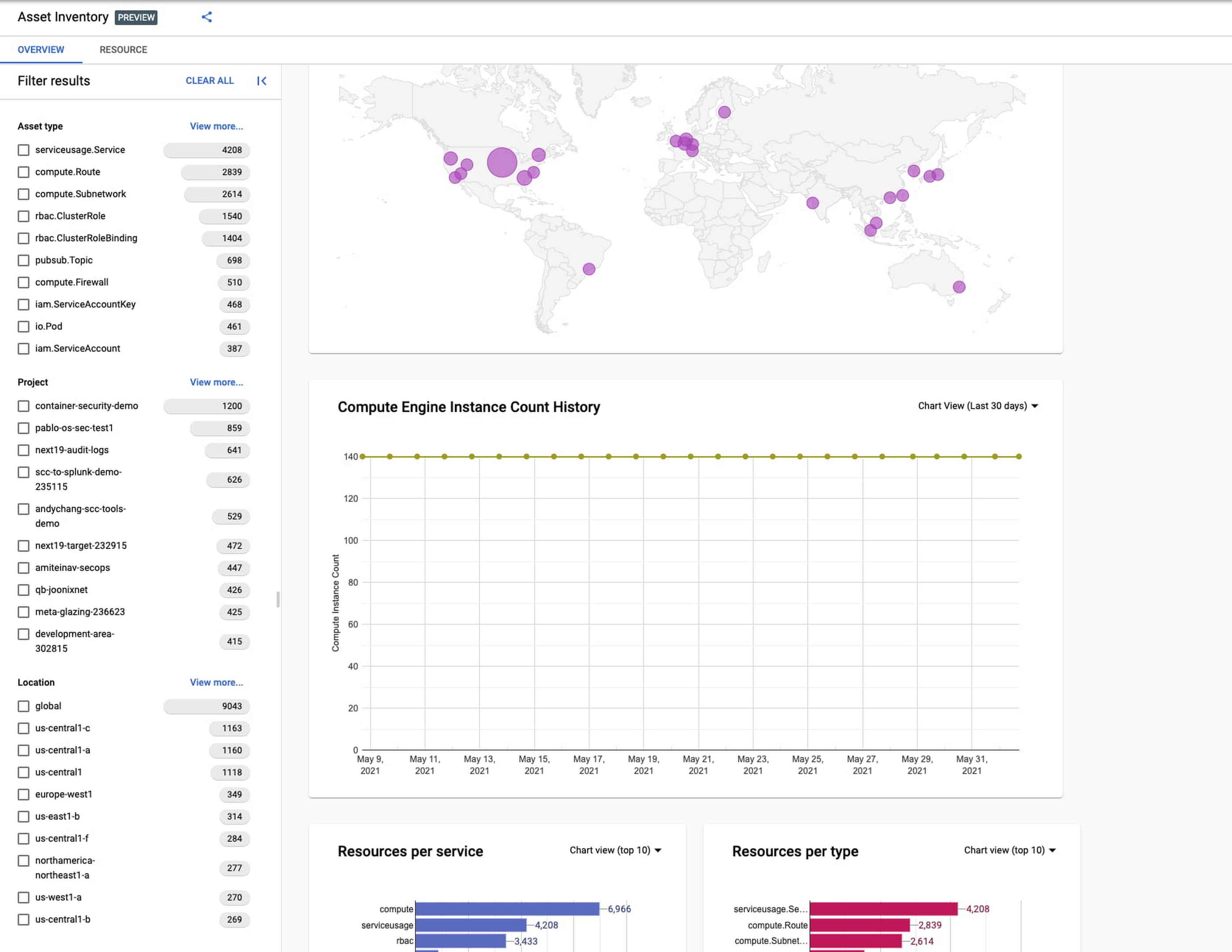
Cloud Asset Inventory console preview is now publicly available for GCP and Anthos customers. This preview provides insights into your cloud footprint, history and details of resource usage with powerful filtering and search capabilities. For example, you can view your global distribution of resources and policies, how your GCE VM footprint has been changing over time, as well as full metadata and change history for all your assets. The CAI console can be filtered at the organization, folder, or project-level, so each user can view the resources they have permissions for down to project level granularity.
Asset discovery and Datadog integration
A new asset list service in CAI provides quick and comprehensive asset discovery, including asset history, without needing to export the data to a storage destination. Datadog, a leading multi-cloud monitoring and security service provider, relies on deep integration with CAI for service and asset discovery. Datadog has been piloting and taking full advantage of the newly released asset list service. Datadog Product Manager, Steve Harrington, commented:
“Google’s new Cloud Asset Inventory API provides us with an immensely valuable, single source of truth for determining the resources present in a given GCP environment. Along with its rich metadata, this enables us to enhance multiple aspects of our integration with GCP, including streamlined metric collection and ingestion of custom labels. We plan to continue building around Cloud Asset Inventory in the future to improve existing features, and are envisioning ways it could help us provide entirely new insights to our customers.”
Answer “who can access what resources?”
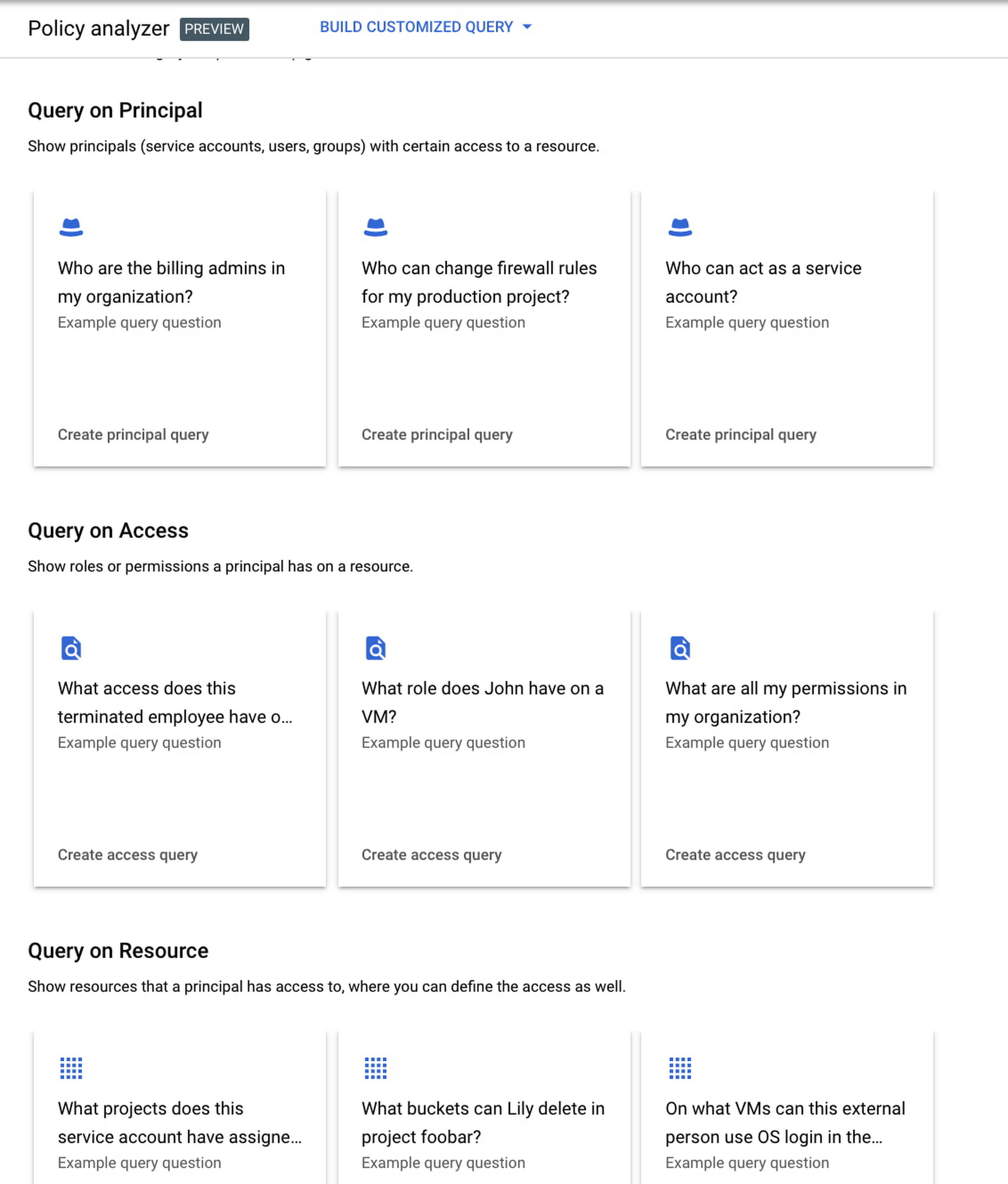
Determining authoritative answers to security-related questions like “Who can read data from my storage bucket that contains PII?” or “Does a terminated employee still have any remaining access to my system?” can be difficult and time consuming. This is why access management and identity certification is one of the top security priorities for enterprises running workloads in the cloud. To help alleviate this challenge, the new Policy Analyzer capability in CAI thoroughly analyzes the relationship between IAM policies and resources. The analysis includes powerful and efficient group expansion, service account impersonation, conditional access analysis, resource expansion, and more. You can even export the results to a BigQuery table or Cloud Storage bucket for further analysis and record keeping. CAI’s enhanced UI makes it even easier for you to build your own flexible queries and quickly get to a comprehensive answer.
Create asset posture visibility
Cloud Asset Inventory now provides seven types of Asset Insights through the Active Assist platform. These new asset insights help proactively detect anomalies within your organization’s IAM policies, which may be opportunities to improve your security posture. The insights can be aggregated at the Organization, Folder or Project level.
The seven new Asset Insights include:
- External members in IAM policies.
- External users that impersonate your service accounts.
- External members as policy editors.
- External users who can view cloud storage buckets.
- Terminated users/groups that are still in IAM policies
- IAM policies containing all users or all authenticated users.
- Projects with only terminated users as owners.
As a Google Cloud customer you can get started and use all the recently released capabilities and features immediately; check out our documentation to see how. We’d love to hear your feedback; email us with any questions or concerns!
More Relevant Stories for Your Company

Simplify Your Modernization Journey from Windows
Microsoft and Windows on Google Cloud provides a first-class experience for Windows workloads. You can self-manage workloads or leverage managed services and use license-included images or bring your own licenses. Now, easily migrate, optimize, and modernize your Windows workloads for agility and scalability. Start with migration Migrate to increase IT

Google Unveils New Cloud Region in Delhi NCR to Power India’s Digitization
In the past year, Google has worked to surface timely and reliable health information, amplify public health campaigns, and help nonprofits get urgent support to Indians in need. Now, we are continuing to focus on helping India’s businesses accelerate their digital transformation, deepening our commitment to India’s digitization and economic recovery.

Forrester Study Finds 72% ROI from Moving Expensive, Traditional OS and Software to Google Cloud!
Google Cloud commissioned Forrester Consulting to conduct a Total Economic Impact™ (TEI) study and examined the potential return on investment (ROI) for companies that have migrated to Google Cloud. The study evaluates the risks, benefits and costs associated with Google Cloud migration and the experiences of five customers with large,
Recapping Google Cloud VMware Engine’s Latest Milestones
We’ve made several updates to Google Cloud VMware Engine in recent weeks—today’s post provides a recap of our latest milestones. Google Cloud VMware Engine delivers an enterprise-grade VMware stack running natively in Google Cloud. This cloud service is one of the fastest paths to the cloud for VMware workloads without making changes
