






3942
Of your peers have already downloaded this article
4:30 Minutes
The most insightful time you'll spend today!

3683
Of your peers have already downloaded this article
1:30 Minutes
The most insightful time you'll spend today!
Across industries, CEOs share a top priority—harness technology to jump-start growth, accelerate time to market, and foster innovation. CIOs and other technology leaders recognize that the C-suite depends on them to achieve growth and meet rising expectations for agility.
They increasingly view IT modernization—including migrating to the cloud, adopting new application architectures, and building on cloud-native services—as a way to sustain these goals. To date, however, most companies have not captured the anticipated agility benefits because a number of challenges hinder technology leaders as they push ahead with modernization initiatives.
While many of these challenges are valid, there are some false tradeoffs that can be avoided. New McKinsey research highlights that cloud migration needs to be combined with a comprehensive organizational approach to allow for a much more effective agile transformation. CIOs need to promote the transformation mind-set of focusing on differentiated business value by adopting agile processes, automating policies, and upskilling talent across the entire organization. They need to look beyond technology to change the way their IT organization operates across three foundational elements—people, processes, and policies.
Priorities include upskilling existing talent and creating new roles (such as site reliability engineers, full-stack engineers, and data scientists), revamping procedures by adopting agile
development processes with security integrated into every step, and enforcing policies through automation.
Download this McKinsey research report to understand the practices of leaders versus that of laggards and get the key “unlocks” that can help organizations move to higher levels of business agility as they pursue increased cloud adoption.
4853
Of your peers have already watched this video.
3:00 Minutes
The most insightful time you'll spend today!
A Winner’s Story of Optimizing IT Operations for Informed Business Decisions with Google Cloud
An award-winning leader in the enterprise software industry, Broadcom Software is known for modernizing, securing and optimizing the most complex and largest hybrid environments. It’s broad portfolio of industry-leading, enterprise infrastructure and security software built on different tech stack and vision of tech leaders, are run on on-prem, private and public cloud and operated differently. To have a unified standard platform to run their wide range of products, Broadcom Software needed infrastructure as a service and Kubernetes orchestration layer, standard DevOps and security practices as well as common set of DevSecOps tools. Although the company knew there was no common ground to run all their products, migrating products into container-based architecture, they discovered many common strands that they could leverage for efficiency. Watch to learn the role played by Google Cloud in the Broadcom’s transformation!

4641
Of your peers have already downloaded this article
1:30 Minutes
The most insightful time you'll spend today!
As organizations continue to move workloads to public clouds, security professionals must protect the sensitive data and digital identities found in those workloads. Once wary of cloud adoption, many security professionals now believe that the native security capabilities of large public cloud platforms actually offer more affordable and superior security than what their teams could deliver themselves if the workloads remained on premises.
However, native security capabilities and features vary across public cloud providers. Three key factors can ensure a smooth transition to the cloud and influence public cloud provider selection: breadth and depth of native security features, unified configuration and management, and aggressive roadmaps.
Forrester researched, analyzed, and scored seven leading public cloud providers on 37 criteria and found that Google Cloud leads the pack.
Download this Forrester Research report to learn why Google Cloud comes out on top.
How Pantheon Improved Performance and Reliability by Moving to Google Cloud

5569
Of your peers have already read this article.
1:30 Minutes
The most insightful time you'll spend today!
Google Cloud Results
- Improves performance and reliability, enabling Pantheon to serve larger customers
- Supports 99.95% uptime across 200,000+ websites
- Reduces cloud infrastructure costs by 40%
- Enables future analytics offerings based on machine learning and big data analytics
Nearly every business needs a web presence—but the vast majority of companies don’t want to be involved in the technical aspects of coding, deployment, hosting, security, and scaling websites. To stay focused on the business value and creative aspects of their websites and avoid managing infrastructure, thousands of companies turn to Pantheon, a website operations and hosting platform that powers over 200,000 websites.
Pantheon promises its customers speed, reliability, and scalability plus world-class collaboration and workflow tools. For five years, the company was able to deliver high service levels in all three areas running its platform on bare-metal virtual cloud servers. However, as its business grew, network links began to saturate under heavy load, risking instability. As Pantheon’s business evolved to focus on servicing some of the largest websites in the world, the company wanted to partner with a more innovative cloud services provider.
“We wanted a partner that could give us what we offer to our own customers: the flexibility to scale smoothly and consume services without building them from scratch,” says David Strauss, CTO, Pantheon. “It was time to move beyond custom containers on managed VMs and extend our cloud strategy to include next-generation technologies for container management and analytics.”
Pantheon evaluated several leading cloud providers and determined that Google Cloud Platform would be the best fit for its business and customers. Engineering had the final say, running a battery of functionality and performance tests at the storage, database, and web server layers.
“In every test our engineers did, Google Cloud Platform came in as better, faster, and more cost effective than the competition,” says Niall Hayes, COO, Pantheon. “We compared MariaDB to Google Cloud SQL and Cassandra to Google Bigtable, and container density improved from 250 to 400 containers per server.”
Migrating 200,000+ sites in 2 weeks
Pantheon wanted to make the transition transparent to its customers, so a fast and smooth migration to Google Cloud Platform was essential. With help from Google, Pantheon completed the migration quickly and moved 500TB of databases, code, and files with zero customer impact.
“We migrated over 200,000 websites to Google Cloud Platform in 2 weeks, including 50,000 that are heavily trafficked and actively developed, and nobody noticed,” says Josh Koenig, Co-founder and Head of Products at Pantheon. “The speed was incredible. There was no downtime, and we filed no additional support tickets with Google during the entire process.”
The platform for platforms
For its content management system runtime environment, Pantheon runs its own homegrown container management technology on Google Compute Engine. To automate scaling for other core services such as its routing layer and distributed file system, it uses Google Kubernetes Engine for cluster management and orchestration.
“Google is the clear leader in Kubernetes and container management, which aligns very well with our open source values and our vision for the future,” says Niall. “With Google Kubernetes Engine we get better resource efficiency, and automated operations and autoscaling take a lot of administration off our plate.”
In addition to smooth scaling, Pantheon and its customers benefit from improved performance and reliability thanks to the high-quality private network offered by Google.
Further, the Google partnership with Fastly enables direct connectivity to Google Cloud Platform to improve performance for edge caching. As a result of these improvements, Pantheon raised its availability service level agreement (SLA) from 99.9% to 99.95% and can now take on even larger customers.
“Google’s network topology, both locally and globally, performs better and more reliably than competing solutions, making Google Cloud Platform the best choice for us and for our customers,” says David. “Google beats any other cloud provider as the best platform-for-platforms.”
Adds Josh: “Google has unbelievable technology around persistence and replication between zones and regions, and that is not something we could find anywhere else. This allows us to offer advanced disaster recovery and failover services to our customers.”
Strengthening customer relationships
Pantheon uses Google BigQuery, a fully managed, cloud-based data warehouse, to integrate with Fastly and analyze website traffic on behalf of its customers. Previously, Pantheon was unable to ingest edge data quickly enough from Fastly, limiting its ability to identify issues and provide the best customer service. Today, Fastly streams logs in real time into Google BigQuery for analysis, giving Pantheon a wealth of insights.
“We use Google BigQuery to identify customers that have outgrown their infrastructure or need to right-size for business growth,” says David. “We can have proactive conversations and add a lot of value to the relationships. Soon, we plan to make Google BigQuery available to our customers so they can better understand their own traffic.”
Adds Niall: “Google Cloud Platform is more data-oriented than other cloud providers, making it a better match for our needs and our customers’ strategic initiatives.”
Integrated, granular security
Pantheon appreciates that Google Cloud services are built for public cloud, with granular security as a core design and development requirement. Employees simply use their G Suite credentials to gain access to Google Cloud Platform infrastructure and services.
“We’ve been a G Suite shop for years because of the paperless collaboration benefits,” says Josh. “G Suite connects our distributed company, and it was very natural to use those same logins for Google Cloud Platform.”
Staying competitive and productive
Moving to Google Cloud Platform opens up new possibilities for services Pantheon can offer to customers in the future, including machine learning and big data analytics, to give them a more complete view of how digital experiences are driving their businesses. Internally, engineers can move faster, do more effective capacity planning, and provide better service as Pantheon moves its products upmarket.
Pantheon expected to save 20% on cloud infrastructure costs by moving to Google Cloud Platform, but was able to double that savings with resource optimization and managed services.
“Since moving to Google Cloud Platform, our platform is more secure, reliable, and scalable than ever. We reduced our cloud infrastructure costs by 40%, and our customers’ sites run 45% faster than industry benchmarks,” says Niall. “Our engineers are Google fans for a reason—they’re happier, more efficient, and more productive on Google Cloud Platform.”
Google Cloud Announces Improvements in Private Catalog to Drive Terraform Deployments

3364
Of your peers have already read this article.
3:00 Minutes
The most insightful time you'll spend today!
As an enterprise admin, when you choose to use Google Cloud Private Catalog to enable curated, self-serve Google Cloud infrastructure provisioning, you need the ability to manage your organization’s deployments. Today, we’re pleased to announce support for several improvements to Terraform driven deployments through Private Catalog.
With this new release, you can update Terraform configurations and keep your end users informed about updates. At the same time, Private Catalog users have the ability to view new updates, note version highlights and then update the deployment. This gives you greater control over managing deployments for solutions provisioned through Private Catalog and ensuring compliance with organizational policies and standards.
Let’s take a closer look at the features you’ll find in this release.
Deployment change management
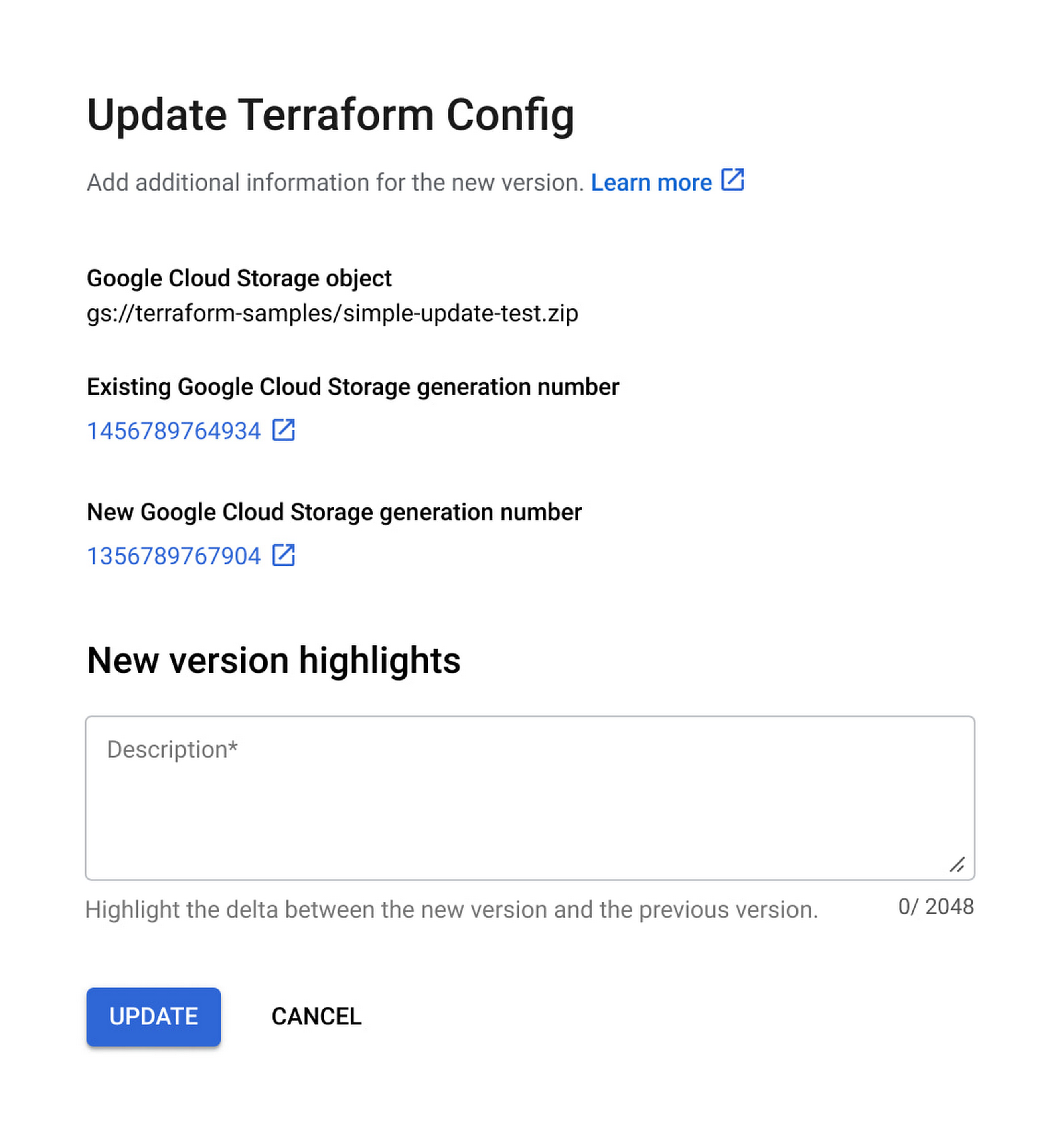
Terraform solutions use Cloud Storage’s Object Versioning to manage updates to configuration files. With this release, you may update configuration files using multiple approaches.
- Update the solution’s Cloud Storage object with a new configuration version
- Use a different Cloud Storage object that contains a new configuration file
Once you view and apply the changes to the solution in a Private Catalog, end users are immediately able to consume the new version of the deployment configuration.

Additionally, prior to applying any changes, you can evaluate the contents of an update by comparing versions to download and compare the current and latest versions of the configuration and use new version highlights to add a description about the updates.

Ease of consumption
Once Private Catalog detects a change to the deployment configuration, it automatically informs catalog users about the change. On the Solutions page, end users have the ability to:
- Get informed about solutions that have updates
- View version highlights published by the admin
- Apply the new version
Additionally, with this release, Catalog users can retry existing deployments by modifying deployment parameters.
Reporting improvements
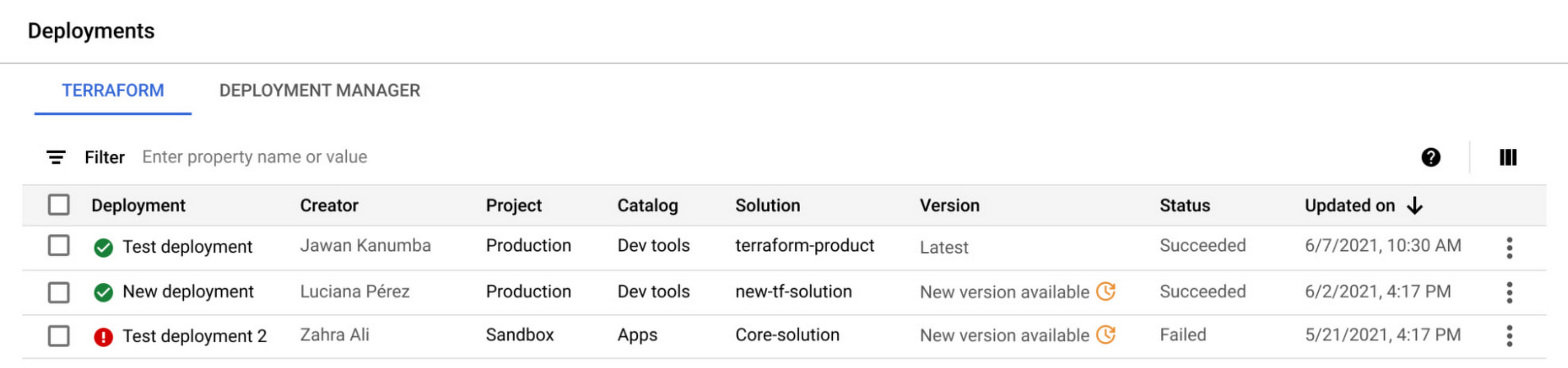
The deployment reporting dashboards for Private Catalog-based deployments now show additional information about the version of a solution deployed. This enables deeper insights into the overall deployment status across all Private Catalog solution assets.

Get started today
These new features are available to all Private Catalog customers. To learn how to use these features, refer to our documentation:
- Create a Terraform configuration in Private Catalog
- Manage and update your Terraform configurations in Private Catalog
More Relevant Stories for Your Company

Why the C-suite Can No Longer Ignore Cloud Computing
Gone are the days when technology was relegated to the sidelines of a business, only considered essential for industries and professionals directly dealing with it. Today, it is not just a value-add, but an integral part of every enterprise’s operations and ultimately, its success. This has wrought many changes in

How Cloud Networks Enable CSPs to Deliver 5G
Communication services providers (CSPs) are experiencing a period of disruption. Overall revenue growth is decelerating and is projected to remain below 1 percent per year, following a trend that started even before the pandemic.1 At the same time, driven by the pandemic, data consumption in 2020 increased by 30 percent relative

How AI-powered ML Models Helps Run Unemployment Claims Verification at Scale
With unemployment application submissions reaching record numbers over the past year, state and local agencies in the United States have faced the challenge of processing unprecedented numbers of claims per week. The digital infrastructure most agencies have in place is unable to handle this volume, resulting in constituents waiting longer,

Explore Google Cloud’s Bi-monthly Technical Learning Series for Innovators in Public Sector
Cloud engineers face a constant barrage of new cloud services, products, and innovations. By late 2021, Google Cloud alone had released thousands of new features across hundreds of services. Couple this with other technologies and service releases, and it quickly becomes a herculean task for engineers to navigate, consume, and
