






3594
Of your peers have already downloaded this article
3:30 Minutes
The most insightful time you'll spend today!
A Record Breaking Calculation: 100 Trillion Digits of π on Google Cloud!

3584
Of your peers have already read this article.
4:00 Minutes
The most insightful time you'll spend today!
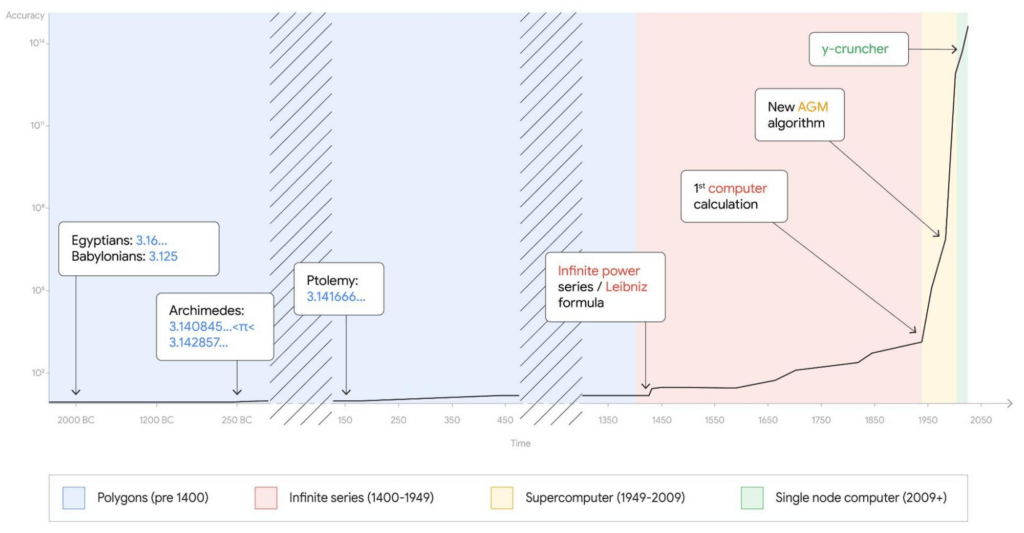
Records are made to be broken. In 2019, we calculated 31.4 trillion digits of π — a world record at the time. Then, in 2021, scientists at the University of Applied Sciences of the Grisons calculated another 31.4 trillion digits of the constant, bringing the total up to 62.8 trillion decimal places. Today we’re announcing yet another record: 100 trillion digits of π.
This is the second time we’ve used Google Cloud to calculate a record number1 of digits for the mathematical constant, tripling the number of digits in just three years.
This achievement is a testament to how much faster Google Cloud infrastructure gets, year in, year out. The underlying technology that made this possible is Compute Engine, Google Cloud’s secure and customizable compute service, and its several recent additions and improvements: the Compute Engine N2 machine family, 100 Gbps egress bandwidth, Google Virtual NIC, and balanced Persistent Disks. It’s a long list, but we’ll explain each feature one by one.
Before we dive into the tech, here’s an overview of the job we ran to calculate our 100 trillion digits of π.
- Program: y-cruncher v0.7.8, by Alexander J. Yee
- Algorithm: Chudnovsky algorithm
- Compute node: n2-highmem-128 with 128 vCPUs and 864 GB RAM
- Start time: Thu Oct 14 04:45:44 2021 UTC
- End time: Mon Mar 21 04:16:52 2022 UTC
- Total elapsed time: 157 days, 23 hours, 31 minutes and 7.651 seconds
- Total storage size: 663 TB available, 515 TB used
- Total I/O: 43.5 PB read, 38.5 PB written, 82 PB total
Architecture overview
Calculating π is compute-, storage-, and network-intensive. Here’s how we configured our Compute Engine environment for the challenge.
For storage, we estimated the size of the temporary storage required for the calculation to be around 554 TB. The maximum persistent disk capacity that you can attach to a single virtual machine is 257 TB, which is often enough for traditional single node applications, but not in this case. We designed a cluster of one computational node and 32 storage nodes, for a total of 64 iSCSI block storage targets.
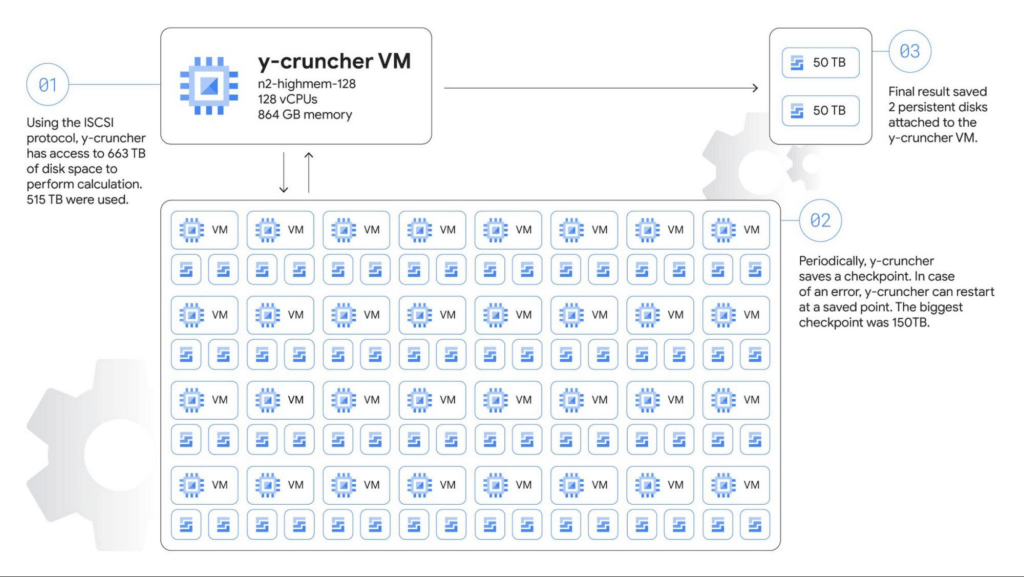
The main compute node is a n2-highmem-128 machine running Debian Linux 11, with 128 vCPUs and 864 GB of memory, and 100 Gbps egress bandwidth support. The higher bandwidth support is a critical requirement for the system as we adopted a network-based shared storage architecture.
Each storage server is a n2-highcpu-16 machine configured with two 10,359 GB zonal balanced persistent disks. The N2 machine series provides balanced price/performance, and when configured with 16 vCPUs it provides a network bandwidth of 32 Gbps, with an option to use the latest Intel Ice Lake CPU platform, which makes it a good choice for high-performance storage servers.
Automating the solution
We used Terraform to set up and manage the cluster. We also wrote a couple of shell scripts to automate critical tasks such as deleting old snapshots, and restarting from snapshots (we didn’t need to use this though). The Terraform scripts created OS guest policies to help ensure that the required software packages were automatically installed. Part of the guest OS setup process was handled by startup scripts. In this way, we were able to recreate the entire cluster with just a few commands.
We knew the calculation would run for several months and even a small performance difference could change the runtime by days or possibly weeks. There are also a number of combinations of parameters in the operating system, infrastructure, and application itself. Terraform helped us test dozens of different infrastructure options in a short time. We also developed a small program that runs y-cruncher with different parameters and automated a significant portion of the measurement. Overall, the final design for this calculation was about twice as fast as our first design. In other words, the calculation could’ve taken 300 days instead of 157 days!
The scripts we used are available on GitHub if you want to look at the actual code that we used to calculate the 100 trillion digits.
Choosing the right machine type for the job
Compute Engine offers machine types that support compute- and I/O-intensive workloads. The amount of available memory and network bandwidth were the two most important factors, so we selected n2-highmem-128 (Intel Xeon, 128 vCPUs and 864 GB RAM). It satisfied our requirements: high-performance CPU, large memory, and 100 Gbps egress bandwidth. This VM shape is part of the most popular general purpose VM family in Google Cloud.
100 Gbps networking
The n2-highmem-128 machine type’s support for up to 100 Gbps of egress throughput was also critical. Back in 2019 when we did our 31.4-trillion digit calculation, egress throughput was only 16 Gbps, meaning that bandwidth has increased by 600% in just three years. This increase was a big factor that made this 100-trillion experiment possible, allowing us to move 82.0 PB of data for the calculation, up from 19.1 PB in 2019.
We also changed the network driver from virtio to the new Google Virtual NIC (gVNIC). gVNIC is a new device driver and tightly integrates with Google’s Andromeda virtual network stack to help achieve higher throughput and lower latency. It is also a requirement for 100 Gbps egress bandwidth.
Storage design
Our choice of storage was crucial to the success of this cluster – in terms of capacity, performance, reliability, cost and more. Because the dataset doesn’t fit into main memory, the speed of the storage system was the bottleneck of the calculation. We needed a robust, durable storage system that could handle petabytes of data without any loss or corruption, while fully utilizing the 100 Gbps bandwidth.
Persistent Disk (PD) is a durable high-performance storage option for Compute Engine virtual machines. For this job we decided to use balanced PD, a new type of persistent disk that offers up to 1,200 MB/s read and write throughput and 15-80k IOPS, for about 60% of the cost of SSD PDs. This storage profile is a sweet spot for y-cruncher, which needs high throughput and medium IOPS.
Using Terraform, we tested different combinations of storage node counts, iSCSI targets per node, machine types, and disk size. From those tests, we determined that 32 nodes and 64 disks would likely achieve the best performance for this particular workload.
We scheduled backups automatically every two days using a shell script that checks the time since the last snapshots, runs the fstrim command to discard all unused blocks, and runs the gcloud compute disks snapshot command to create PD snapshots. The gcloud command returns and y-cruncher resumes calculations after a few seconds while the Compute Engine infrastructure copies the data blocks asynchronously in the background, minimizing downtime for the backups.
To store the final results, we attached two 50 TB disks directly to the compute node. Those disks weren’t used until the very last moment, so we didn’t allocate the full capacity until y-cruncher reached the final steps of the calculation, saving four months worth of storage costs for 100 TB.
Results
All this fine tuning and benchmarking got us to the one-hundred trillionth digit of π — 0. We verified the final numbers with another algorithm (Bailey–Borwein–Plouffe formula) when the calculation was completed. This verification was the scariest moment of the entire process because there is no sure way of knowing whether or not the calculation was successful until it finished, five months after it began. Happily, the Bailey-Borwein-Plouffe formula found that our results were valid. Woo-hoo! Here are the last 100 digits of the result:
4658718895 1242883556 4671544483 9873493812 1206904813
2656719174 5255431487 2142102057 7077336434 3095295560
You can also access the entire sequence of numbers on our demo site.
So what?
You may not need to calculate trillions of decimals of π, but this massive calculation demonstrates how Google Cloud’s flexible infrastructure lets teams around the world push the boundaries of scientific experimentation. It’s also an example of the reliability of our products – the program ran for more than five months without node failures, and handled every bit in the 82 PB of disk I/O correctly. The improvements to our infrastructure and products over the last three years made this calculation possible.
Running this calculation was great fun, and we hope that this blog post has given you some ideas about how to use Google Cloud’s scalable compute, networking, and storage infrastructure for your own high performance computing workloads. To get started, we’ve created a codelab where you can create and calculate pi on a Compute Engine virtual machine with step-by-step instructions. And for more on the history of calculating pi, check out this post on The Keyword. Here’s to breaking the next record!
- We are actively working with Guinness World Records to secure their official validation of this feat as a “World Record”, but we couldn’t wait to share it with the world. This record has been reviewed and validated by Alexander J. Yee, the author of y-cruncher.

5584
Of your peers have already downloaded this article
1:30 Minutes
The most insightful time you'll spend today!
Protecting a global network against persistent and constantly evolving cyber threats is one of the most important challenges faced by Google Cloud. So, how does Google’s global network protects seven different global businesses, each with over 1 billion customers, including popular Google services such as Google Search, YouTube, Maps, and Gmail?
The answer is a multi-step process, which is constantly changing and evolving to stay one step ahead of the malicious hackers and attackers. For instance, it’s network communications protocols—the rules that enable communications between systems—change multiple times per second to make malicious intrusions much harder.
Data in Google Cloud is encrypted both in transit and at rest. Google’s network capacity far exceeds any traffic load it hosts to thwart and DDoS attack. In addition, it has numerous other products, tools, and processes at work to provide defense in depth.
Download this e-book to get a detailed overview of Google Cloud’s approach to security and privacy.
Vimeo Looks to Google Cloud for High-Quality Video Delivery Service

3605
Of your peers have already read this article.
2:15 Minutes
The most insightful time you'll spend today!
About Vimeo
Vimeo gives video creators the tools to host, share, and sell videos of the highest quality possible. It reaches viewers in over 150 countries who can watch content anytime, on nearly every Internet-connected device.

About Fastly
Fastly helps the world’s most popular digital businesses keep pace with their customer expectations by delivering fast, secure, and scalable online experiences. Businesses trust the Fastly edge cloud platform to accelerate the pace of technical innovation, mitigate evolving threats, and scale on demand.

Google Cloud Result
- Improves video streaming speed and quality
- Increases the number of high-quality videos delivered to users
- Frees Vimeo engineers from IT management so they can improve video delivery platform
- Reduces costs and removes challenge of scaling servers and storage
Vimeo is a video-sharing platform that’s home to imaginative video creators and hundreds of millions of viewers. Sixty million people create, host, and sell high-quality videos on Vimeo, including more than 800,000 who subscribe to the service’s premium tools. Over 240 million people in more than 150 countries watch videos monthly.
Vimeo was using its own servers to allow users to upload videos to its service, a cloud storage platform for storing videos, and as an alternative solution for streaming. It was looking for a solution that would do away with its own servers for uploading. Vimeo built a new adaptive video-delivery service on Google Cloud Platform and the Fastly edge cloud that can scale on demand to meet Vimeo’s growing needs for video streaming.
“Our business is dependent on delivering high-quality video; that’s our competitive edge,” says Naren Venkataraman, Senior Director of Engineering at Vimeo. “Thanks to Fastly and Google Cloud Platform, we’re delivering more high-quality videos than ever at less cost, leading to our continuing success and growth.”
Tuning video delivery
Building a great video experience begins with a fast, reliable upload service. Vimeo replaced its servers for accepting video uploads with Google Cloud Storage, fronted by the Fastly edge cloud to help ensure regional routing and low-latency, high-throughput connections for Vimeo’s publishers. Multi-regional Google Cloud Storage offers fast, resumable upload capability that helps make for better user experience.
The video delivery service transcodes videos and streams them to users—videos are customized depending on network traffic and the devices to which the videos are delivered. The goal is to deliver the highest-quality, smooth playback experience across all platforms over varying network conditions and device capabilities.
Google Compute Engine packages the videos, which are stored on Google Cloud Storage. Google Compute Engine can automatically scale to allow Vimeo to deliver videos on the fly, even when demand spikes and many users stream videos simultaneously across a very diverse library. The low latency of Google Cloud Storage helps with fast startup times, while providing scalable storage to host millions of videos from Vimeo’s loyal community of content creators.
“Fastly and Google Cloud Platform enabled us to build a low-latency, highly scalable, on-the-fly adaptive video streaming packager in a short period of time with a small team,” says Naren.
High-quality video means more users
With Fastly and Google Cloud Platform, Vimeo is delivering more and higher-quality videos to its users because of the platform’s low latency, high bandwidth, and ability to scale. Because of the system’s reliability, fewer users stop watching videos because of delays and glitches. Vimeo engineers do not have to spend their time managing infrastructure and now focus on improving the video delivery service, leading to improved customer satisfaction. Costs are reduced because Vimeo does not have to manage the infrastructure in-house.
“We’ve chosen Google for Fastly’s Cloud Accelerator because at Google innovation happens faster, and Google Cloud Platform is driving cloud computing and cloud storage in the right direction,” says Lee Chen, Head of Strategic Partnerships at Fastly.
Google Announces New Cloud Region in Israel to Meet Growing Customer Demands

4869
Of your peers have already read this article.
2:00 Minutes
The most insightful time you'll spend today!
Google has long looked to Israel for globally impactful technologies including popular Search features, Waze, Live Caption, Duplex and flood forecasting. At our Decode with Google 15RAEL event last week, we celebrated 15 years of Google innovation in Israel and our longstanding support of the country’s vibrant startup ecosystem.
Over the years, we’ve expanded our enterprise investments in the country, too. In addition to our over a decade long investment in the space, Google has acquired Israeli-based companies like Alooma, Elastifile and Velostrata, and Uri Frank joined Google Cloud last month to lead our server chip design team from our offices in Tel Aviv and Haifa.
As we continue to meet growing demand for cloud services in Israel, we’re excited to announce that a new Google Cloud region is coming to Israel to make it easier for customers to serve their own users faster, more reliably and securely.
Our global network of Google Cloud regions are the foundation of the cloud infrastructure we’re building to support our customers. With cloud’s 25 regions and 76 zones around the world, we deliver high-performance, low-latency services and products for Google Cloud’s enterprise and public sector customers. With each new Google Cloud region, customers get access to secure infrastructure, smarter analytics tools, an open platform and the cleanest cloud in the industry.
Having a region in Israel will help accelerate innovation for customers of all sizes, including PayBox, a digital wallet application owned by Discount Bank, one of Israel’s largest banks. “When we acquired PayBox, our goal was to improve the security and the user experience for its products, but we also wanted to keep the startup’s agility and innovation. Google Cloud has enabled us to do just that,” said Sarit Beck-Barkai, Managing Director of PayBox at Discount Bank.
“We are very excited that leading vendors like Google are investing and launching a local cloud region in Israel. This will make a significant change in the technology landscape of the public-sector, enterprise and SMB markets in Israel. Matrix is proud to be a major part of the transition to the cloud,” said Moti Gutman, CEO at Matrix, technology services company and Google Cloud partner.
“In the last year, Panorays more than tripled its customer base and scaled its infrastructure, practically at the click of a button. Google Cloud made it easy for us to scale without worrying about DevOps, which meant that our engineers could focus on developing new and better features for our customers. The new region launching in Israel will allow us to serve our local customer base even better, as we’ll be able to experience higher availability and deploy resources in specific regions, thus reducing latency.” said Demi Ben-Ari, Co-founder and CTO, Panorays, a third-party security platform and Google Cloud customer.
“This new cloud region will provide even better access and growth potential for our mutual customers with tech hubs in the region. We are serving hyper growth companies who need Google Cloud’s services and will benefit greatly from this regional presence,” said Yoav Toussia-Cohen, CEO of DoiT International.
When it launches, the Israel region will deliver a comprehensive portfolio of Google Cloud products to private and public sector organizations locally. We look forward to welcoming you to the Israel region, and we’re excited to support your growing business on our platform.
Learn more about our global cloud infrastructure, including new and upcoming regions, here.
Wipro selects Google Cloud to advance its digital transformation strategy

3726
Of your peers have already read this article.
2:30 Minutes
The most insightful time you'll spend today!
Wipro has partnered with Google for migration of its enterprise-wide SAP footprint to the Cloud platform. The engagement will bring SAP applications and workloads to the cloud to support the country’s fourth-largest software services firm’s 180,000-plus employees.
Bhanumurthy B.M, President and Chief Operating Officer, Wipro said that as a provider of digital transformation services to some of the world’s most impactful businesses, it is critical that the company’s own core systems and technologies are running on intelligent and modern platforms that encompass the needs of the future.
“The technology that we’re getting into right now, and the kind of design led approach that we are taking, I think customers will benefit significantly from this,” he told ET.
Read the Full Story on Economic Times
More Relevant Stories for Your Company

How a Mid-Sized Firm is Shrinking Inventory Carryovers 50% with AI
For more than 10 years, NMK Textile Mills has manufactured bed linens for major retailers in the United States and Canada. As e-commerce exploded, the company’s co-founder saw an opportunity to grow the business. So, in addition to manufacturing bed linens wholesale for retail customers, NMK Textile Mills reworked its complete supply

Cloud FinOps: Maximizing Business Value and Optimizing Cloud Spend
We've been saying it for years, the benefits and potential of the cloud abound. And yet, more than 80% of respondents in a survey of 753 business leaders point to managing cloud spend as their top organizational challenge, and these same respondents estimate that nearly 1/3 of their cloud spend

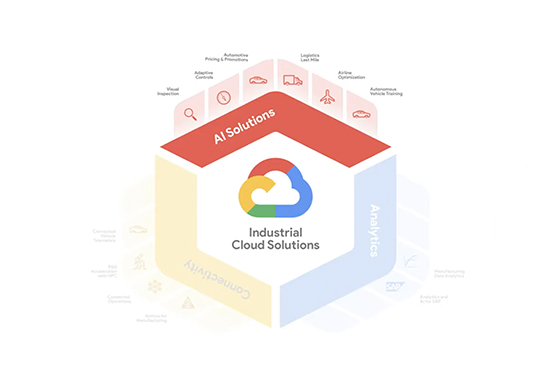


Driving Business Transformation in Manufacturing, Industrial, and Transportation Using Google Cloud and AI/ML
Google Cloud partners closely with manufacturing, industrial, and transportation organizations to drive business transformation. In this video, Mandeep Waraich, Head of Product - Industrial AI, Google Cloud, shares customer stories as well as Google Cloud’s differentiated AI products and solutions. Waraich covers the current state of automation and industrial efficiency

ATB Financial Focuses on Customer Experience with the Speed it Gains in the Cloud
As senior vice president and head of technology enablement for ATB Financial, Barry Hensch has a mission: creating a seamless experience for the Alberta, Canada-based bank’s nearly 800,000 customers by leveraging the latest digital technology. ATB is a purpose-driven financial institution owned and operated by Alberta’s provincial government, with about
