





Cloud FinOps: Maximizing Business Value and Optimizing Cloud Spend

1176
Of your peers have already read this article.
6:30 Minutes
The most insightful time you'll spend today!
We’ve been saying it for years, the benefits and potential of the cloud abound.
And yet, more than 80% of respondents in a survey of 753 business leaders point to managing cloud spend as their top organizational challenge, and these same respondents estimate that nearly 1/3 of their cloud spend is inefficient or wasted (Flexera, 2023). Many organizations are new to optimizing cloud costs and ensuring resources are used efficiently.
As your organization digitally transforms you may be realizing what other organizations are realizing too: When it comes to business value, simply migrating to the cloud isn’t enough. Achieving the full benefits of cloud requires fundamental changes to both mindset and behaviors around existing financial-management practices. It requires changing the way your disparate teams work together.
Enter the Cloud FinOps Building Blocks
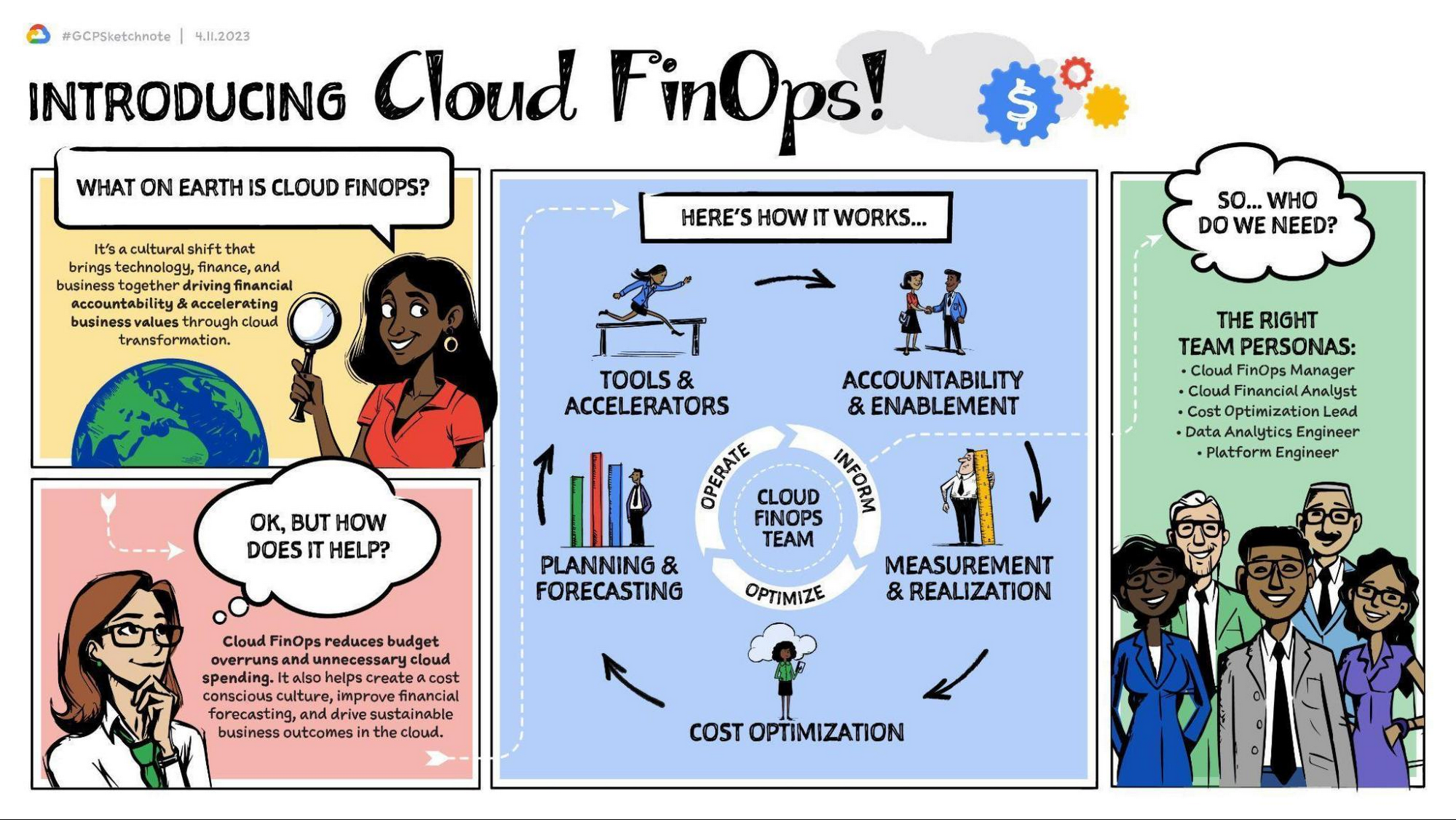
Cloud FinOps is a framework, discipline, and cultural shift combining people, processes, and technology to drive financial awareness and accountability. FinOps practices align engineering, finance, technology and business leaders and teams under a primary objective: to maximize business value from the cloud. With Cloud FinOps practices, every business stakeholder is charged not only to take responsibility for their spending and costs, but also to optimize them. These practices enable businesses to manage consumption and make sound, data-informed cloud-spend decisions. Cloud FinOps is comprised of five building blocks:
- Accountability and enablement
Establishing governance and policies to manage cloud spend and realize business value. - Measurement and realization
Driving financial accountability and value realization with a defined set of KPIs and success metrics. - Cost optimization
Providing financial visibility and recommendations of IT resource usage to optimize cloud spend. - Planning and forecasting
Modernizing budgeting, forecasting, and chargeback methods to allow for iterative, innovative and cost effective development practices. - Tools and accelerators
Deploying and integrating a set of cloud cost tooling to effectively manage and track cloud spend. Learn more here.
For a general overview of the Cloud FinOps framework and more on the five building blocks, check out these resources:
- Video | What is FinOps and 3 reasons why you should care about it.
This 5-minute video provides an overview of FinOps, the 5 building blocks, and how they can benefit your organization. - Podcast | FinOps with Joe Daly
In this podcast, Joe Daly of the FinOps Foundation shares about the key principles of FinOps, which he refers to as financial DevOps. Daly discusses how this framework is helping companies make better and more efficient financial decisions while taking advantage of the cloud. - Blog | Decoding Cloud FinOps to accelerate digital transformation
This blogpost discusses the critical role of FinOps in a successful digital transformation. It outlines key metrics to help measure and track business value and to increase visibility into the effects of digital transformation on top-line revenue. - Article | Cloud FinOps: The secret to unlocking the economic potential of public cloud
This Forbes article profiles OpenX, the first major advertising exchange platform to migrate entirely to the cloud. It details the 5 key pillars of the Cloud FinOps framework, which OpenX leveraged in their digital transformation strategy. In just 9 months, they reduced their per-unit costs by more than 60%.
Importantly, Cloud FinOps isn’t about saving money; it’s about making money. It’s about promoting a cost-conscious culture, financial accountability, and business agility in the cloud. Whatever stage of the cloud journey you’re at, cloud FinOps practices will help you get the most value out of Google Cloud. This framework can help to remove blockers, implement the building blocks, and empower your teams to make better business decisions.
The Cloud FinOps Journey
Implementing Cloud FinOps is neither a destination nor a box your organization will check then archive. Rather, Cloud FinOps is an ongoing journey and discipline. It’s inherently iterative. As such, growth and maturity across processes, capabilities, and domains requires action, repetition, and continuous learning.
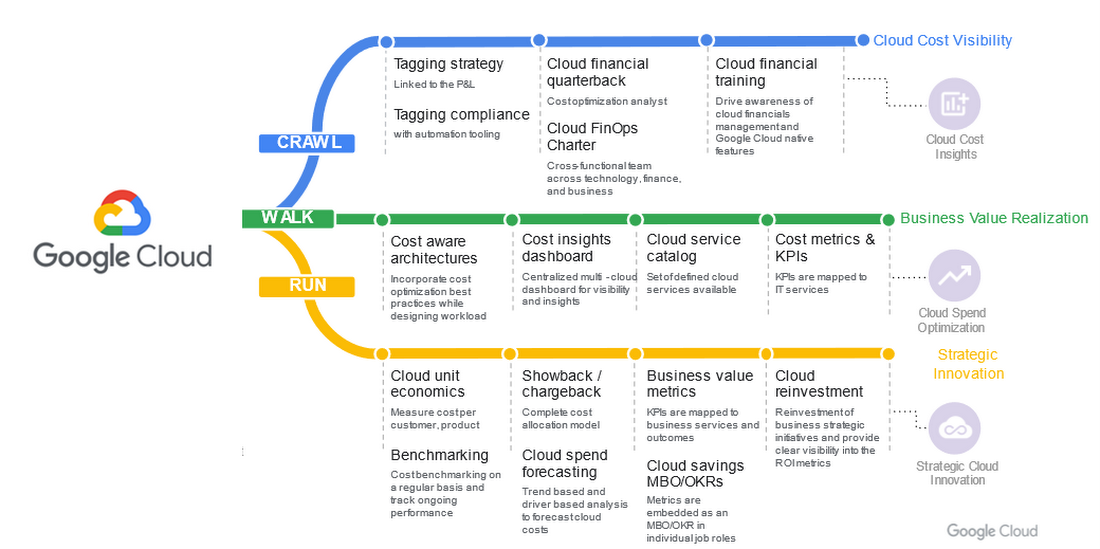
Across the five FinOps building blocks, we’ve identified 50 subprocesses to best understand organizations’ FinOps proficiency, capabilities, practice domains, and blind spots. We scale them from 1 to 5 and categorize them in one of three phases of maturity: Crawl, Walk, or Run. Organizations in the Crawl phase tend to focus on technical problem solving and cloud-cost visibility. Organizations in the Walk phase emphasize strategic improvements such as employing cost visibility dashboards to realize better business value. And organizations in the Run phase are focused primarily on transformational change and strategic innovation, factoring cost considerations into both processes and cloud architecture.
Through this “crawl, walk, run” maturity model, we can evaluate proficiency, establish a benchmark, and recommend a targeted action plan for FinOps adoption. And whatever your level of maturity, your organization can take quick scalable action not only to foster improvement but also to evaluate outcomes and gain insights.
The key here is that regardless of your organization’s Cloud FinOps maturity level, you can take small steps now toward continuous improvement. Here are some common focus areas and several more resources organized by maturity level that you can access.
Crawl phase
Improve cloud-cost visibility.
- Whitepaper | Drive Cloud FinOps at scale with Google Cloud Tagging
Tags and labels can be useful and flexible tools to help your organization segment cloud spend and allocate costs. This whitepaper introduces Google Cloud Tags and best practices for implementing them. It differentiates tags, which offer reliable reporting and governance features, from labels, which can be prone to problems, including poor coverage and a lack of integrity in data labeling. - Whitepaper | Unlocking the value of Cloud FinOps with a new operating model
This white paper unpacks the details of the FinOps operating model, including roles, organizational alignment, and driving culture change. It details how to establish strong financial governance and a cost-conscious culture. - Whitepaper | Cloud FinOps: Shared services cost allocation
In this whitepaper, you’ll explore the elements of cost allocation as well as the complexities and challenges associated with shared-services cost allocation. While some of these concepts and models are interchangeable between legacy and cloud environments, this whitepaper focuses primarily on cloud computing and associated services.
Walk phase
Improve business-value realization.
- Blog | 5 key metrics to measure Cloud FinOps impact in your organization in 2022 and beyond
To drive business growth and topline revenue, business leaders must be able to connect cloud investments to business outcomes. As such, traditional IT metrics and KPIs must continue to evolve. In this blogpost, we’ll explore five key business-value metrics aligned to the five Cloud FinOps building blocks. - Whitepaper | Maximize business value with Cloud FinOps
The cloud introduces new complexity and challenges to traditional IT financial management. As such, it requires strategic financial governance, processes, and partnership across the organization. This whitepaper explains how Cloud FinOps helps enterprises that have invested in cloud to drive financial accountability and accelerate business value.
Run phase
Improve strategic cloud innovation.
- Whitepaper | Unit costing: The next frontier in cloud
In this whitepaper, you’ll explore the nature of and need for cloud unit costing, the standard by which FinOps practitioners obtain full business context for their cloud costs. It features examples from cloud-first organizations that have pioneered FinOps practices. Additionally, it examines several cloud forecasting and budgeting methods, ranging from least to most rigorous. - Blog | You get what you pay for: Principles for designing a chargeback process
Chargeback, a crucial Cloud FinOps capability, is the process of mapping cloud consumption to internal users within an organization. It provides transparency, facilitates accountability, enables recovery of cloud costs, and fosters a culture of fiscal responsibility. This blogpost will walk you through some best practices in designing an effective chargeback process in Google Cloud.
Success with Cloud FinOps
As global markets continue to face challenges, there’s never been a better time to increase the return on your cloud investments. Adopting and implementing FinOps practices will help. For some real-world examples of how organizations across a range of FinOps maturity levels have collectively saved millions of dollars on their overall cloud spend, check out these customers’ stories.
- Video | Next 2022: Top 10 ways to lower your costs on Google Cloud with General Mills
In this video, which highlights ten leading cloud cost optimization practices, hear how General Mills, which is on pace to increase their cloud footprint by 60%, has approached the discipline of cost savings and accelerated their adoption of Cloud FinOps to drive waste out of their cloud usage. - Video | How Nuro optimized their costs on Google Cloud
In this video, you’ll get an overview of the Google Cloud FinOps framework, a deep dive on cost-optimization best practices, and hear about how startup Nuro AI has adopted their own cost-savings discipline and Cloud FinOps practice. - Video | How OpenX reduce per unit costs by 60%
In this video, you’ll learn how to establish a cost center of excellence within your cloud practice, explore several cost-optimization recommendations, and hear from OpenX about how they reduced their costs on Google Cloud. - Case Study | How Sky saved millions with Google Cloud
In this case study, read how a few years into their cloud adoption journey, media and entertainment company, Sky Group discovered over $1.5 million in savings and optimized costs with BigQuery, Compute Engine, and Cloud Storage. - Case Study | Etsy: Doing more with less cost and infrastructure
In this case study, read how after migrating their data center and ecommerce platform to the cloud, Etsy realized more than 50% savings in compute energy and leveraged committed use discounts (CUDs) to reduce their compute costs by 42%.
It’s important to remember that FinOps success looks different for different organizations. It’s neither a one-time fix nor a destination reached by way of a single path. But for every organization, success requires small actions, refinement, and continuous improvement. As you leverage Google Cloud FinOps resources and tools, your organization can:
- Drive financial accountability and visibility.
- Optimize cloud usage and cost efficiency.
- Enable cross organizational trust and collaboration.
- Prevent cloud-spend sprawl.
- Break down departmental silos.
- Accelerate innovation.
Getting started with Cloud FinOps
At Google, we have a team of experts in leading FinOps practices dedicated to helping you create an actionable plan to optimize cloud spend and drive cost efficiency. We’ve created numerous resources to help you get started from any stage in the FinOps journey.
Whitepaper | Maximize Business Value with Cloud FinOps
This whitepaper outlines steps to help your organization implement FinOps. It details required teams and processes as well as the optimal behaviors, approaches, and outcomes to help maximize your investment on Google Cloud.
With Google Cloud FinOps, your organization can also accelerate business value in the cloud. To find out more, join us on the Google Cloud Twitter channel twice a month for open Twitter Spaces discussions or reach out to your Google Cloud Sales Representative for a 1:1 discussion.
6319
Of your peers have already watched this video.
2:00 Minutes
The most insightful time you'll spend today!
Google Cloud’s ML-based Image Classification App: A Key to Global Wildlife Conservation
Wildlife provides critical benefits to support nature and people. Unfortunately, wildlife is slowly but surely disappearing from our planet and we lack reliable and up-to-date information to understand and prevent this loss. By harnessing the power of technology and science, we can unite millions of photos from [motion sensored cameras] around the world and reveal how wildlife is faring, in near real-time…and make better decisions
wildlifeinsights.org/about
Italian Utility Company Deploys its SAP Workloads on Google Cloud to Meet Sustainability Goals

3254
Of your peers have already read this article.
2:00 Minutes
The most insightful time you'll spend today!
With more than 2.5 million customers, Italian utility company A2A is committed to delivering electricity, gas, clean water, and waste collection every day. More recently, the company made another significant commitment: To incorporate the principles of the “circular economy” into its way of doing business — part of the UN 2030 Agenda’s Sustainable-Development Goals — all while also aiming to double its client base by 2030. Growing rapidly but sustainably requires operating as efficiently as possible at every level of the organization, from operating smart meters to generating accurate demand projections. That’s why A2A chose to deploy its SAP S/4HANA ERP and the SAP BW/4HANA data warehouse on Google Cloud.
Roadblocks to innovation
Instead of a linear consumption model that starts with raw materials and ends with use and disposal, the circular economy is a continuous cycle that emphasizes repair, recycling, and the creation of materials rather than their disposal. To take an example from A2A’s own success story: The company keeps 99.7 percent of collected waste out of landfills.1 Of the UN’s sustainability goals, A2A is committing to the three most relevant to its industries:
- Ensuring availability and sustainable management of water and sanitation for all
- Ensuring sustainable consumption and production patterns
- Protecting, restoring, and promoting sustainable use of terrestrial ecosystems
Achieving A2A’s sustainability and customer-first strategies requires high scalability, rapid data ingestion, and rich, accurate analytics. None of this could be reliably supported with the company’s legacy on-premises SAP and Data Warehouse, especially given A2A’s projected growth and the increasing complexity of the data landscape, including IoT deployments and energy market liberalization.
Provisioning data infrastructure was also slow and complex. Simply adding a new metric could require increasing capacity by an order of magnitude. And analytical and transactional data lived in siloes, which created a fragmented and out-of-date view of each customer across sales and customer support teams. A2A’s fragmented data also made it difficult to take proactive action when changing priorities or processes required shifting focus from one data source to another.
With a data warehouse that refreshed only once every 24 hours, simple processes such as responding to a customer calling because their power has been cut off due to an unpaid bill became cumbersome.
Scalability was also a concern. With the on-premises solution, A2A needed to define the budget for its data warehouse over a two-year timeframe, but the rollout of new electricity meters — each sending data every 10 minutes — across Italy made those data requirements hard to predict.
The move to the cloud: From monolith to microservices
The move has been a giant step forward in A2A’s goal of meeting its data-driven, customer-centric strategy. In deploying its SAP systems to Google Cloud, A2A can take advantage of a highly flexible hybrid environment and powerful data management and analytics. It can replicate data from Salesforce, SAP, and other systems in BigQuery, which operates as a data lake with Google Cloud SQL, connected directly to Google Analytics and Google Ads for data-driven customer service, decision-making, and marketing.
“From BigQuery we can feed relevant information directly to the people who need it. Our customer operators work on Salesforce, so we use an OData protocol to embed real-time data in that platform. Elsewhere, we present the information through a dashboard, or with a BI component delivering one-page reports.” —Vito Martino, Head of CRM, Marketing and Sales B2C & B2B, A2A
By running SAP on Google Cloud, A2A can also count on an infrastructure platform that provides:
- Scalability. The robust data architecture on Google Cloud adapts to shifting and increasing demands without compromising on speed or availability, so A2A doesn’t have to worry about over- or under-provisioning as the rollout of smart meters proceeds.
- Speed. The new A2A data solution refreshes every five minutes instead of 24 hours, so the company can respond to its customers’ needs without delays. Customer operators working in Salesforce now receive real-time data from Google BigQuery so that, when a customer calls, operators can see accurate information in seconds. They can now offer value-added services and sustainable options tailored to the customer’s needs, from energy consumption to their preferred method of communication.
- Availability. With microservices orchestrated by Google Kubernetes Engine, the team can update the solution through continuous integration and delivery (CI/CD), eliminating the need for downtime when changes are required.
- Security and control. The A2A IT team uses Google Kubernetes Engine to orchestrate clusters of instances on Google Compute Engine, with Google Cloud Load Balancing and backups on Google Cloud Persistent Disk. Google Cloud Anthos ensures operational consistency across on-premises and cloud platforms.
Ready to grow the sustainable way
By moving to Google Cloud — the industry’s cleanest cloud, with zero net emissions — A2A is ready to grow quickly while locking down the efficiency it will need to meet its ambitious sustainability goals. “To bring sustainable utilities to market, we need to be both responsive to our customers and responsive to the internal needs of A2A,” explains Davide Rizzo, Head of IT Governance and Strategy at A2A. “Understanding what customers need in detail means we can improve their services and reduce their environmental impact at the same time.”
Learn more about the ways Google Cloud can transform your organization’s SAP solutions with scalability, speed, and advanced analytics capabilities.
1. Circular Economy: one of the four founding pillars of A2A’s 2030 sustainability policy | Drupal

No More Migration Challenges: How Nine Clients of Google Cloud Achieved Success
DOWNLOAD E-BOOK3294
Of your peers have already downloaded this article
15:00 Minutes
The most insightful time you'll spend today!
Google Cloud’s hands-on, tailored partnerships and solutions have helped many businesses around the world to ease their cloud migration journey and achieve desired outcomes! Download the E-book to observe the public cloud landscape and understand the common hurdles to cloud adoption, the benefits of multi-phased migration with Google Cloud, cloud migration checklist as well as nine client testimonials.
Make your cloud migration journey cost-effective, fast and easy with Google Cloud!
Majority of Consumer Goods Shoppers in the U.S. will Not Compromise on Brand Principles: Google Commissioned Research

3080
Of your peers have already read this article.
1:30 Minutes
The most insightful time you'll spend today!
Editor’s note: This article first appeared in Consumer Goods Technology Magazine
Shifting work habits, more online shopping options, rising inflation, and stretched supply chains are just a few factors making it harder to discern what’s top-of-mind for shoppers today.
But we’re starting to get a clearer picture of what consumers say they value most right now. New Harris Poll research commissioned by Google Cloud reveals how U.S. shoppers are thinking about consumer goods brands in new ways—from apparel, electronics, and beauty products, to food and beverage.
While price unsurprisingly continues to be a major consideration in purchases, the average shopper is increasingly paying close attention to the values of consumer goods brands and how eco-friendly their products and practices are.
Shoppers want to buy from brands aligned with their values
COVID-19 drove people to reflect on their priorities, elevating concepts like community service, equity, and sustainability. A decade ago, most consumer goods companies would not have made these front-and-center, operational priorities. But today’s consumer not only wants savings and convenience, they also want that good feeling that comes from spending their money with a company that aligns with their values.
Our new research reveals that 82% of shoppers prefer a consumer brand’s values to align with their own, and they’ll vote with their wallet if they don’t feel a match. Three-quarters of shoppers reported parting ways with a brand over a conflict in values.
Even with their favorite consumer goods products, a majority of shoppers will not compromise on principles. If there’s a value mismatch, 39% of shoppers said they’d permanently boycott their favorite brand, and 24% would break ties at least temporarily. Most won’t be quiet about their concerns either: 28% of consumers that found their values at odds with a brand said they have shared their concerns with friends and family, and another 15% have shared their qualms on social media.
Consumer goods companies need to prioritize sustainability
A majority of today’s consumers (52%) are especially interested in supporting sustainable brands. They want to know how companies are managing their resources, specifically whether they are sourcing responsibly. These shoppers want to see meaningful, measurable efforts from CPG firms to save energy and reduce waste, like how Nuuly, URBN’s digital rental and resale business, has woven sustainability into its business operations, from its distribution centers to reusable packaging.
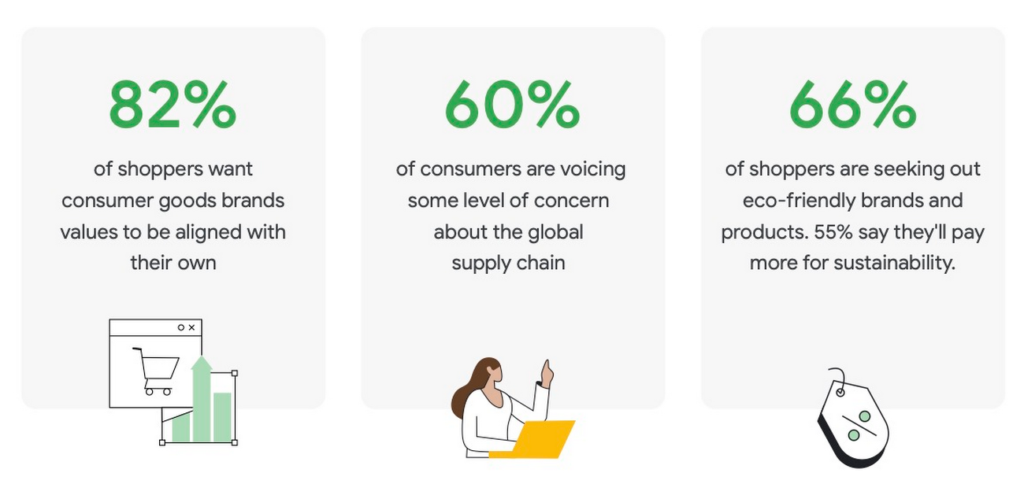
In fact, 66% of shoppers are now seeking out eco-friendly brands, with 55% saying they would pay more for more sustainable products. But these same shoppers are skeptical too: 72% think that companies and brands overstate their sustainability efforts. And they’re right to question brands’ practical application of their values. According to another Harris Poll survey recently commissioned by Google Cloud, 58% of executives polled across 16 countries admit that their organization has overstated its sustainability efforts.
Product availability is table stakes
A final point from the research: The global supply chain has stretched past its limits, and 60% of consumers are voicing some level of concern about it. At the end of the day, if a preferred brand isn’t actually on the shelves of a real or digital store, it doesn’t matter what the brand’s values or sustainability efforts are. A staggering 98% said they’d either buy from a different brand or search other stores or websites.
What’s a brand to do?
After more than 25 years working in the consumer goods industry in roles ranging from marketing and product development to business strategy and technology, at companies like Johnson & Johnson, Kimberly Clark, Carter’s, and now Google Cloud, I’ve seen successful brands do four things well when it comes to their values:
- Don’t be generic.
Your brand’s values need to be authentic, and they need to have teeth. But being too bold could run the risk of alienating some consumer segments. This is where technology can help. Personalizing your messages and outreach to specific shopper profiles is one way to ensure that your core values reach the right customers at the right time. - Make your values clear and consistent.
When focusing on which values to highlight with your consumers and the world, make sure they make sense for your brand and that you’ll stick to them over time. For example, it’s painfully obvious when a brand is being opportunistic and inserting itself into conversations around values like sustainability or social justice, when it doesn’t have a history of voicing those values. The key to clear and consistent messaging of values is balancing authenticity with relatability and the appropriate amount of promotion. - Develop sustainability practices and communicate their impact to everyday people.
How everyday people perceive a consumer goods brand’s sustainability initiatives is different from how an investor or general business audience does. Shoppers don’t read business sustainability plans or impact reports. To increase awareness of your brand’s sustainability efforts, consumers need to identify and interact with your brand and products directly. Some of my favorite examples are how I love that Google Maps gives me the choice of eco-friendly driving directions, and that I know I can buy low-waste, packaging-free cosmetics from a company like Lush. - Reward customer loyalty.
Shoppers have more choices than ever before, and supply chain woes are testing preferences even further. But when someone chooses a specific brand because they feel aligned with their values or like their eco-friendly products, that shopper doesn’t always get recognized or thanked. Implementing a rewards program or following-up with customers after their purchases is one way you can make loyal shoppers feel appreciated while creating a lasting relationship that extends as long as possible.
Start-up Paves Way for More Inclusive Clinical Research: Honoring Black Founders of Acclinate with Google Cloud

8393
Of your peers have already read this article.
4:00 Minutes
The most insightful time you'll spend today!
Editor’s note: February is Black History Month—a time for us to come together to celebrate the diverse set of experiences, perspectives and identities that make up the Black experience. Over the next few weeks, we will highlight Black-led startups and how they use Google Cloud to grow their businesses. Today’s feature highlights Acclinate and its founders, Del and Tiffany.
As patients, as caregivers, and as parents taking our own children to the doctor, we want recommended medications to be safe and effective. It’s a right everyone deserves.
It’s known that certain medications don’t work in the same way in all populations. For example, Albuterol, a medication often prescribed for asthma, is less effective in 67% of all Puerto Ricans and 47% of Black Americans. These problems—which can have deadly consequences—result from historically limited diversity in pharmaceutical clinical trials.
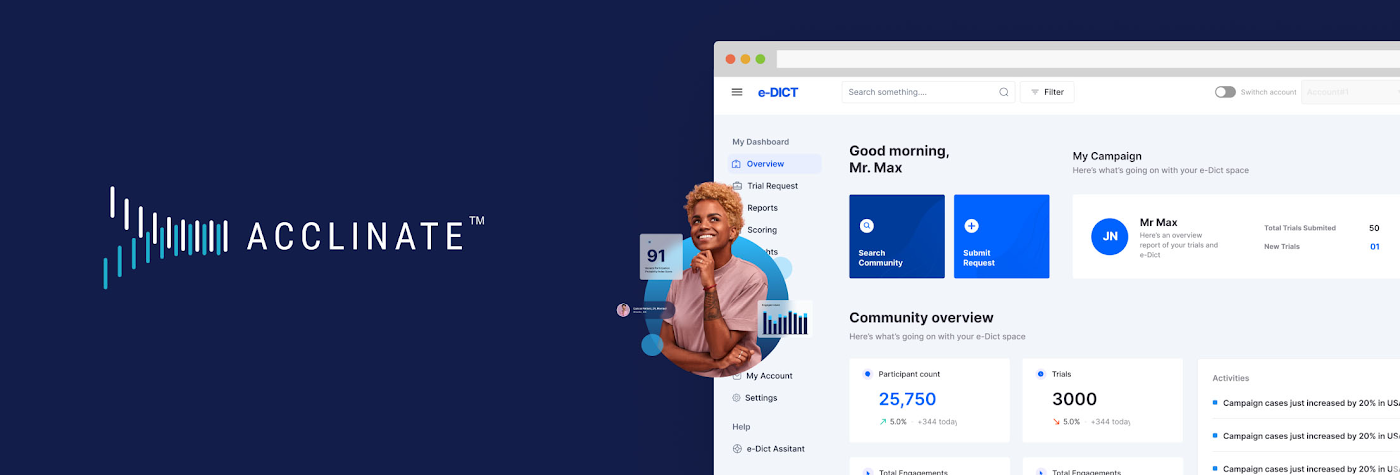
We founded our startup Acclinate to integrate culture and technology to achieve more inclusive clinical research. Help pharmaceutical companies and healthcare organizations access and engage communities of color so research is more inclusive.
Bridging the health equity gap by building trust
It’s important that health research organizations access and engage communities of color so their efforts reflect all the people they serve. Take a disease like diabetes, which affects a significantly higher proportion of Black Americans. When you look at even recent clinical trials for diabetic drugs, the representation of Black Americans among participants is only in the low single digits, despite comprising 13 percent of the U.S. population and more than 40 percent of diabetes patients in this country. Industry leaders have been aware of the lack of diversity issue, but some have chosen to ignore it or brush it aside. The biggest problem, in our opinion, is that there have been no penalties for not achieving higher diversity figures in clinical trials, and only minor financial repercussions to pharma/biotech companies when their treatments either do not work across all groups once approved, or there is a lack of uptake by all groups due to the lack of testing in those groups. The lack of clinical trial diversity has adversely impacted the reputation of the industry and the ability to recruit diverse populations in the future.
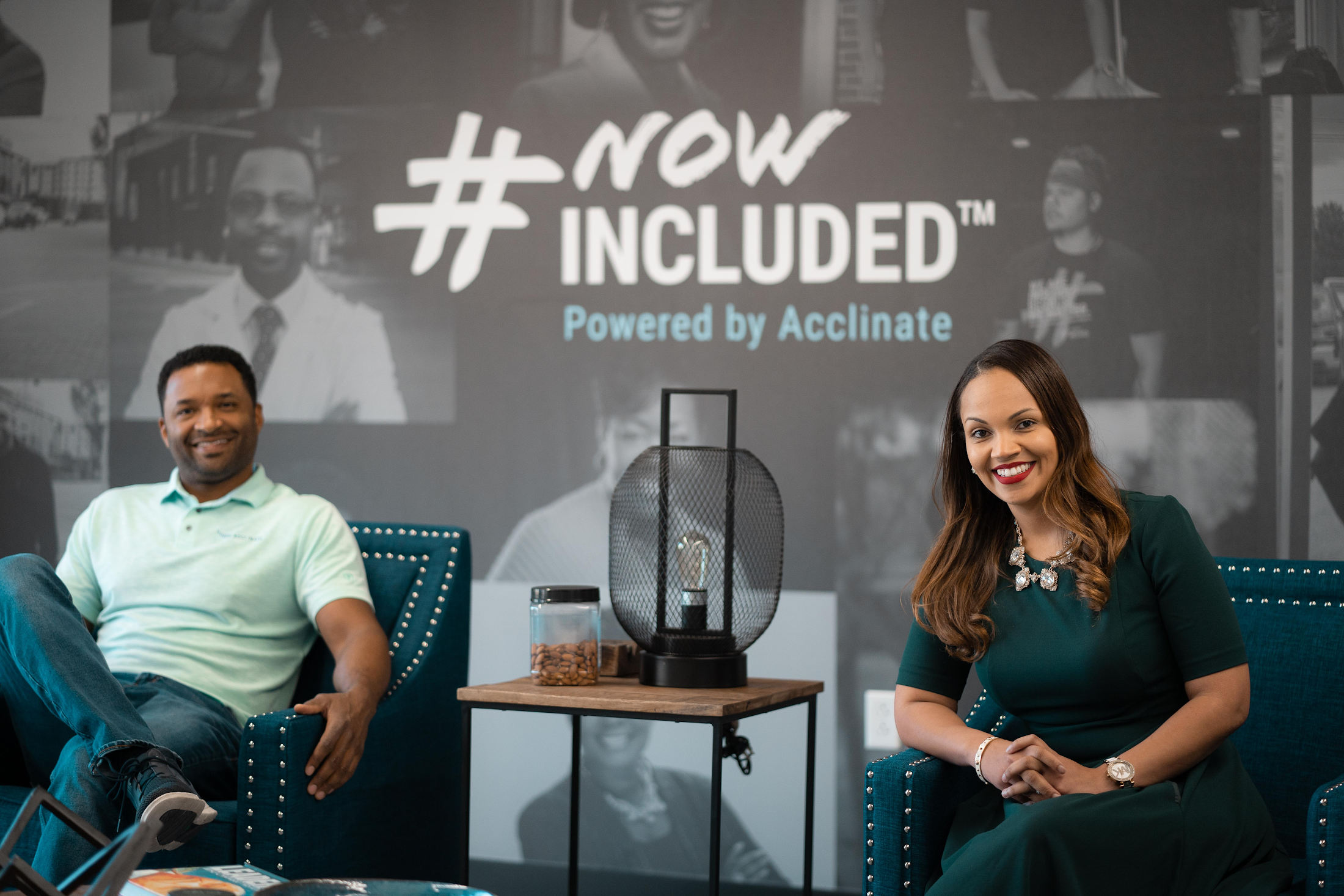
Acclinate integrates culture and technology to promote diverse patient representation in medical research. Our approach is not transactional. We build trust through our #NOWINCLUDED community, which is an ongoing, ever-expanding digital platform that educates and engages with communities of color on health issues.
#NOWINCLUDED includes a website app, and social media presence where members can learn information about diseases, particularly those with greater negative impacts on people of color, such as cancer, diabetes, and cardiovascular diseases. Members can share stories and ask questions. By providing access to trusted resources about these health issues and the latest clinical research, we empower Black people to take control of their health and consider participating in research that is shaping the future of healthcare.
For healthcare-related organizations, we offer the opportunity to better understand the attitudes, aspirations, and unmet needs of underrepresented minority communities. Data from #NOWINCLUDED feeds our HIPAA-compliant SaaS platform, e-DICT™ (Enhanced Diversity in Clinical Trials), which uses predictive analytics and machine learning to identify individuals matching the requirements and most likely to be receptive to participation in a particular clinical trial.
Acclinate scales its platform with Google Cloud
We rely on Google Cloud services, including Vertex AI, to know whom to ask, when to ask, and how to ask for clinical trial participation. With Vertex AI, we enjoy a unified platform for developing our artificial intelligence models, including tools for preparing and storing our datasets. We can easily train and compare models using AutoML, which requires minimal ML expertise or effort with its intuitive graphical interface. This allows us to leverage more than ten ordinal and categorical data points to determine in real time a community member’s likelihood to enroll, which we call our Participation Probability Index (PPI). Our models evolve in an iterative process the more we interact with, and learn about, our community members.
We follow the pay-per-use Google Cloud Platform architecture model using serverless technology, which helps reduce infrastructure management costs and lets us focus on product development and engaging with communities across the U.S.
CloudSQL, a fully managed relational database service, integrates easily with BigQuery so we can glean insights for our clients in real time, all with Google Cloud’s robust security, governance, and reliability controls. Virtual Private Cloud (VPC) gives us scalable and flexible networking for our cloud-based resources and services. We also use Identity and Access Management (IAM) to simplify oversight of Google Cloud resource permissions for different user groups and roles, with appropriate security protections.
API Gateway manages our APIs using Cloud Functions, which both use consumption-based pricing, plus give our developers consistent and highly secure access to our services through a well-defined REST API. We use Memorystore for Redis to reduce platform latency. This is done with a fully managed service powered by the Redis in-memory data store, which builds application caches for fast data access. All of this comes together to provide an outstanding experience for our platform’s users and contributors.
- DSC00049.JPG
- DSC00010 (2).JPG
- pitch del tiff.jpg
Expanding influence with the Google for Startups Accelerator for Black Founders
Three months of one-on-one Google support and mentorship as part of the most recent Google for Startups Accelerator : Black Founders cohort not only helped us build our product, but also helped us earn external credibility. People use Google every day, so whether we’re trying to engage in conversations with industry experts or with somebody in a rural community, it is helpful to have the buy-in of a globally-recognized brand as we take on a historically difficult, systemic issue with challenges around trust. Getting access to the products, best practices, and people we need to build and grow through the Accelerator program has been priceless. For example, working with the Google AdWords team helped us generate important traffic from people interested in learning more about #NOWINCLUDED or sharing their story with us. Jason Scott, who leads the Google for Startups Accelerator: Black Founders program, is still connecting us to people in his network and identifying key opportunities for us months after the program wrapped. He continues to demonstrate that he is invested in seeing us succeed.
Our company has made great progress against our goals, in part thanks to receiving capital from the Google for Startups Black Founders Fund. We received $100K in non-dilutive funding along with Google Cloud credits, Google.org Ads grants, and hands-on support. We used the funds to pay for the transition and development costs associated with moving to Google Cloud. The Google support and accountability has been incredible. After receiving the Google for Startups Black Founders Fund award, we’ve gone on to raise another $1M and moved our cloud from Salesforce to Google Cloud.
We also had the amazing opportunity to be selected as one of six companies to take part in a face-to-face web conference with Sundar Pichai, Google’s CEO. We were thrilled to hear him explain his vision around health equity and the role Google plays. Ultimately, for us, it’s not just about the funding we get, but we are also gratified to receive support from an entity that truly believes in addressing this issue. We know Google is aligned with our mission of health and racial equity.
Championing diversity in clinical trials
Our 2022 looks bright. We expanded our presence to Washington, D.C. as part of the Johnson & Johnson Innovation JLABS ecosystem. We were also selected to take part in the BLUE KNIGHT initiative created between Johnson & Johnson Innovation and the Biomedical Advanced Research and Development Authority (BARDA) under the U.S. Department of Health and Human Services.
Acclinate is also on track to have contracts with five of the top 25 largest biopharmaceutical companies in the U.S this year. They’ve taken note, as has the Food and Drug Administration (FDA), that the lack of diversity in clinical trials represents a significant health concern—to the extent that the FDA has provided strong guidance for pharmaceutical companies to diversify their clinical trials. At the same time, the industry is also responding to pressure from communities of people of color to make equitable representation a priority.
Today, we are in the fortunate but challenging position to have significant inbound opportunities coming our way. In response, we continue to recruit and hire talented people to join our team. On the technology side, we are happy to be aligned with Google Cloud to have powerful cloud infrastructure that will scale with us, as well as high-caliber champions united in partnership. With people’s lives at stake, we are passionate in our commitment to helping ensure medications do what they are supposed to do: heal and improve the quality of life for everyone who takes them.
Hear Acclinate cofounders Del Smith and Tiffany Whitlow chat with Google’s Head of Startup Developer Ecosystem Jason Scott and fellow Black Founders Fund recipient Bobby Bryant about building on Google Cloud in a recent Google for Startups Instagram Live.
If you want to learn more about how Google Cloud can help your startup, visit our page here to get more information about our program, and sign up for our communications to get a look at our community activities, digital events, special offers, and more
More Relevant Stories for Your Company



Indian Retailer Figures Optimizes Hyperlocal Delivery to Increase Customer Experience
Anyone who follows the Indian e-commerce scene knows that one of the largest challenges these companies face is hyperlocal delivery. That was a problem facing Wellness Forever, a retail chain of pharmacies with 150-plus stores across India. “Exactly a year ago, we started our journey of hyperlocal deliveries. This optimization



The Inside Story of How Home Depot Migrated to Google BigQuery From an On-prem DW Solution
In the media, you will often hear story of how born-in-the-cloud companies manage with massive infrastructure. But it is one thing is to be a startup, and build infrastructure with bespoke requirements. And quite another to have a complex, multinational organization with online, with mobile, with brick-and-mortar presence, and hundreds

Strategic Consulting, Training & Implementation Guidelines with Public Sector PSO Helps Governments Stay Compliant
Did you know that by 2025, enterprise IT spending on public cloud computing will overtake traditional IT spending? In fact, 51% of IT spend in application software, infrastructure software, business process services, and system infrastructure will transition to the public cloud, compared to 41% in 20221.. As enterprises continue to

Security at Scale: A Peek into the Life of Google
Defending the world’s largest network against persistent and constantly evolving cyber threats has driven Google to architect, automate, and develop advanced tools to help keep it ahead. Understanding how Google has built and evolved it’s defenses can help you make smart architectural decisions of your own as you move forward.
