






3206
Of your peers have already downloaded this article
1:30 Minutes
The most insightful time you'll spend today!
Enable Specialized Workloads with Bare Metal Solution from Google Cloud

3865
Of your peers have already read this article.
2:00 Minutes
The most insightful time you'll spend today!
Enterprises want to embrace the pace of innovation and an operational business model of the modern-day cloud, but they don’t want to disrupt their existing IT landscape or upgrade all their legacy applications. This presents a conundrum, as most legacy applications were not designed to run in the cloud, and migrating them can be challenging, risky and cost-prohibitive.
The complexity, cost and risk of cloud migration often stand in the way of a successful digital transformation. At Google Cloud, we work to meet you where you are and help you craft a migration strategy that lets you run what you want, where you want, how you want. This is why we’re excited to introduce Bare Metal Solution: to jumpstart the migration of applications that have been holding back your cloud adoption.
Bare Metal Solution consists of all the infrastructure you need to run your specialized workload such as Oracle Database close to Google Cloud. This infrastructure is connected with a dedicated, low-latency and highly resilient interconnect, and connects to all native Google Cloud services. Bare Metal Solution uses OEM hardware that is certified to run multiple enterprise applications, most of which can be migrated to this infrastructure with little or no change, minimizing the risk of migration while simultaneously increasing its velocity.
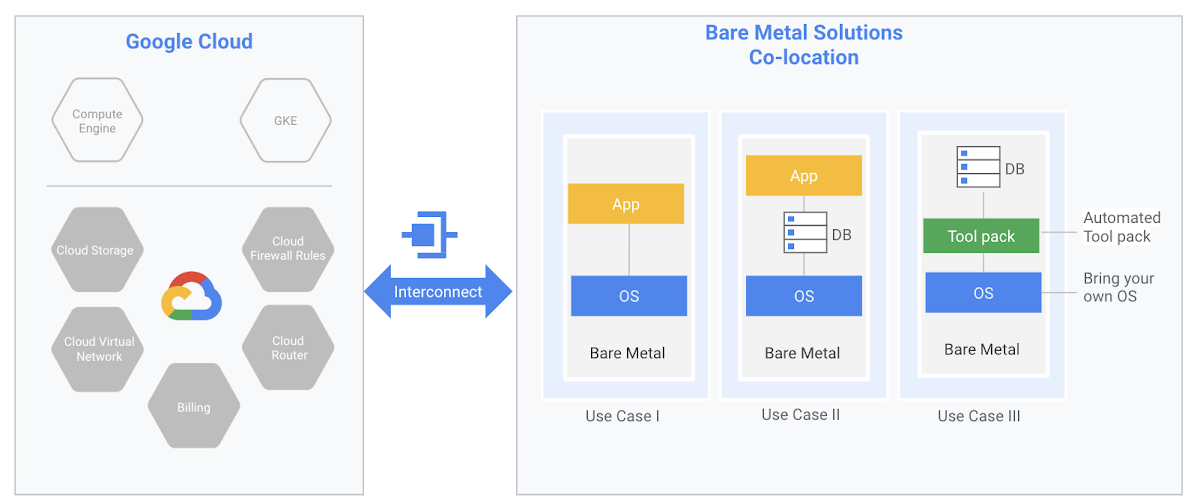
Bare Metal Solution also comes with automation tools to help you onboard your environment quickly—provisioning your applications, relational databases, configuring popular operating systems and setting up services such as backups and monitoring. The management interface will be familiar to your existing IT teams or systems integrator, allowing you to leverage your investments in existing tools, processes and personnel.
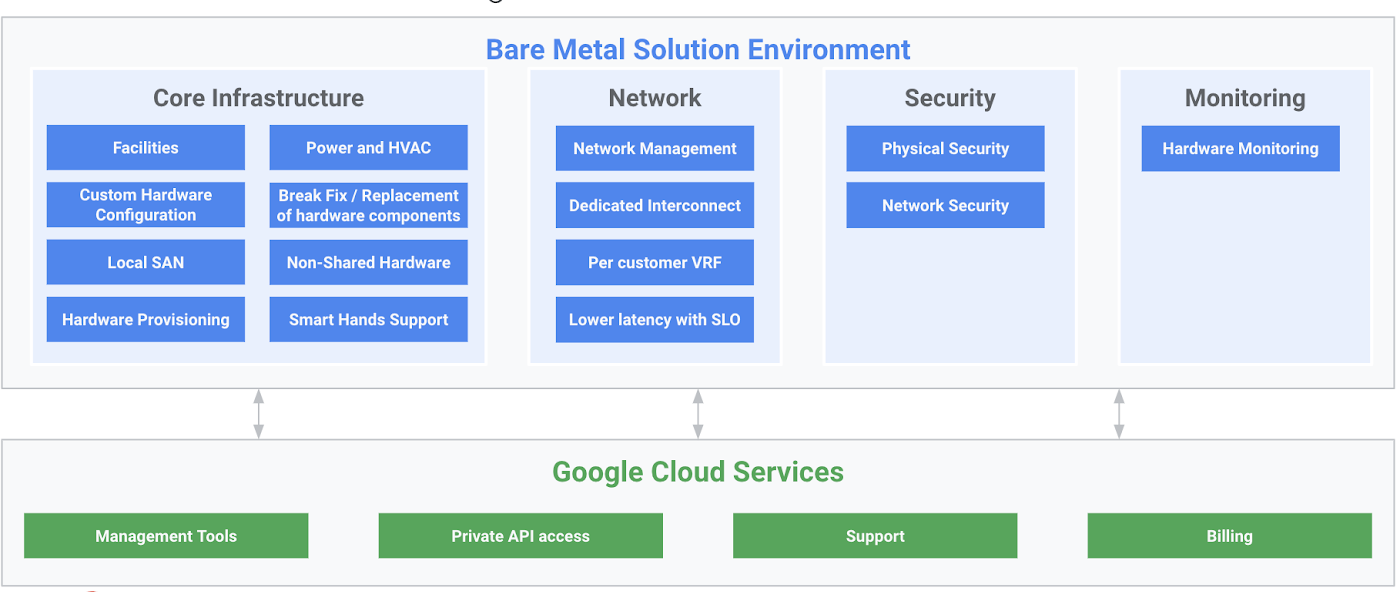
In addition to providing state-of-the-art infrastructure and integrated low-latency access to Google Cloud, Bare Metal Solution also provides the following:
- Completely managed hardware infrastructure: End-to-end infrastructure management such as compute, storage and networking, as well as fully managed and monitored environments such as power, cooling and facilities.
- Google Cloud support and billing: A seamless support experience with support for infrastructure, including defined SLAs for initial response. 24X7 coverage for all Priority 1 and 2 issues. Unified billing across Google Cloud and Bare Metal Solution.
- Service Level Agreements: Defined enterprise-grade SLA for hardware uptime and interconnect availability.
As an integral part of Google Cloud, Bare Metal Solution lets you off-load provisioning, managing and monitoring of your infrastructure to Google, so you can focus on your own data center modernization.
The nitty gritty
Many of the workloads that run on Bare Metal Solution have demanding CPU and I/O requirements. Bare Metal Solution provides a cost-effective and scalable architecture based on state-of-the-art x86 servers and high-performance, resilient storage. The servers are offered in several fixed configurations that support most mainstream enterprise operating systems:
- Dual-socket x86 systems
- 16 core with 384 GB DRAM
- 24 core with 768 GB DRAM
- 56 core with 1536 GB DRAM
- Quad-socket x86 systems
- 56 core with 1536 GB DRAM
- 112 core with 3072 GB DRAM
Bare Metal Solution servers can be used for standalone applications, or configured with application native or database native clustering technologies for high availability. Storage is offered in 1TB volume increments of either hybrid or all-flash disk. For applications that require custom compute shapes or special-purpose hardware, we also offer bespoke hardware configurations.
Bare Metal Solution uses OEM hardware that is certified for many ISV software applications as well as custom built applications, including those built on Oracle Database. These hardware configurations are offered as a subscription, billed monthly with a preferred term length of 36 months. There are no data ingress and egress charges between Bare Metal Solution and Google Cloud in the same region; customers are responsible for provisioning adequate bandwidth for their business needs.
Legacy apps are no barrier to cloud
Google Cloud is the preferred destination for organizations building cloud-native applications as well as migrating existing on-premises applications, bringing reliable infrastructure, leading data analytics capabilities, and a culture of innovation to your IT environment. Whether you’re looking to build new applications in the cloud or to overhaul your infrastructure, we’re here to help you reach your digital transformation goals. And now, with Bare Metal Solution, we’re excited to extend the power of Google Cloud to specialized, legacy workloads. To learn more please visit our website.
VMware Engine’s Exciting New Updates: A Google Cloud Journey

1352
Of your peers have already read this article.
2:30 Minutes
The most insightful time you'll spend today!
IT leaders today are being asked to simultaneously support their company’s infrastructure, find opportunities for growth, and meet their goals with fewer resources and smaller budgets than before. Recently we highlighted three customers who are leveraging Google Cloud VMware Engine to achieve these goals while lowering their TCO and transforming their organization.
It’s because of these successful customer outcomes that we have been awarded the 2023 VMware Cloud Innovation and SaaS Transformation partner achievement award for delivering solutions that accelerate customers’ digital transformation journey. We’re honored to receive this award and continue to stay focused on delivering tremendous value to our customers.
In the past few months, we’ve also made several updates to Google Cloud VMware Engine. Today’s post provides a recap of the latest milestones that make it easier for you to migrate and run your vSphere workloads in a cloud-first, enterprise-class VMware environment in Google Cloud.
Back in September 2022, we announced a number of updates including the preview of API/CLI support (which is now available). In February 2023, we also talked about how to use NetApp CVS as datastores for VMware Engine.
Key updates this time around include:
Availability of VMware Engine in Delhi, Santiago and Milan regions: This brings the availability of VMware Engine to 17 regions worldwide, each supporting 4 9’s of uptime SLA for clusters 5 or more, serving the needs of our regional and multi-national customers. In addition, we have also added a second zone in the London region.
Filestore datastore support for VMware Engine: Generally Available in all VMware Engine regions, you can use Filestore High Scale and Enterprise tier instances as external NFS datastores for VMware Engine nodes. Filestore is VMware certified as an NFS datastore with VMware Engine. You can size compute and storage capacity independently to meet your workload requirements for your storage-intensive VMs. You can also leverage vSAN for low-latency VM requirements and scale Filestore from TBs to PBs for the capacity hungry VMs. If interested in this feature, please contact your Google account team.
Stretched private clouds: These private clouds stretch across two data zones and a witness zone all within the same Google Cloud region. Stretched private clouds use vSphere and vSAN stretched clusters to provide compute and storage high availability against zone-level failures. This capability is now available in Frankfurt and Sydney regions. Learn more here.
Zerto solution version 9.5u1 support: This recovery solution allows critical infrastructure and application virtual machines (VMs) to be replicated continuously from your on-premises vCenter to your private cloud. Learn more about setting up Zerto here.
Google Cloud Backup and Disaster Recovery (GCBDR): GCBDR is available to protect applications running in VMware Engine, and can be managed within the Google Cloud Console. We recently launched GCBDR under Google Cloud Platform Terms of Service simplifying customers’ purchasing and support experience.
vTPM support: Google Cloud VMware Engine private clouds now support the addition of a Trusted Platform Module (TPM) 2.0 virtual cryptoprocessor to a virtual machine. You can add vTPMs to VMs by following VMware instructions or upgrading your existing VMs to include a vTPM. You can read more about this in the VMware blog.
This brings us to the end of our updates this time. For the latest updates to the service, please bookmark our release notes.
Google is named a Leader in 2020 Magic Quadrant for Cloud Infrastructure and Platform Services
3570
Of your peers have already read this article.
10:30 Minutes
The most insightful time you'll spend today!
The capability gap between hyperscale cloud providers has begun to narrow; however, fierce competition for enterprise workloads extends to secondary markets worldwide. Infrastructure and operations leaders should evaluate cloud providers with a broad range of use cases and a wide market presence.
Market Definition/Description
Cloud computing is a style of computing in which scalable and elastic IT-enabled capabilities are delivered as a service using internet technologies. Cloud infrastructure and platform services (CIPS) are defined as standardized, highly automated offerings, in which infrastructure resources (e.g., compute, networking and storage) are complemented by integrated platform services. These include managed application, database and functions as-a-service offerings. The resources are scalable and elastic in near-real time and are metered by use. Self-service interfaces are exposed directly to the customer, including a web-based user interface (UI) and an API. The resources may be single-tenant or multitenant, and can be hosted by a service provider or on-premises in the customer’s data center.The scope of this Magic Quadrant has changed, compared with its predecessor, the “Magic Quadrant for Cloud Infrastructure as a Service.” Gartner has developed this Magic Quadrant to reflect the changing dynamics of cloud services offered and the ways that enterprise customers adopt them. Ultimately, hyperscale cloud providers, and the broad array of services they offer beyond infrastructure as a service (IaaS), have found strategic importance in Gartner’s enterprise clients and the Magic Quadrant needed to evolve to reflect as much.The scope of the Magic Quadrant for CIPS includes IaaS and integrated platform as a service (PaaS) platforms. These include application PaaS (aPaaS), functions as a service (FaaS), database PaaS (dbPaaS), application developer PaaS (adPaaS) and industrialized private cloud offerings that are often deployed in enterprise data centers.
Understanding the Vendor Profiles, Strengths and Cautions
CIPS providers that target enterprise and midmarket customers generally offer high-quality service, with excellent availability, good performance, high security and good customer support. Exceptions will be noted in this Magic Quadrant’s evaluations of individual providers. When we say “all providers,” we specifically mean “all the evaluated providers included in this Magic Quadrant,” not all CIPS providers in general. Keep the following in mind when reading the vendor profiles:
- All the providers have public cloud IaaS and PaaS offerings. Most also offer, or are in the process of building, industrialized private cloud offerings, in which every customer is on standardized infrastructure and cloud management tools. In some cases, the provider’s industrialized, on-premises offering may share similarities to hyperconverged infrastructure (HCI), but tethered to the cloud. However, this may not resemble the provider’s public cloud service in architecture or quality. A single architecture and feature set and cross-cloud management, for both public and private CIPS, make it easier for customers to combine and migrate across service models as their needs dictate. They also enable the provider to use its engineering investments more effectively. Gartner is beginning to describe the notion of cloud-provider-managed infrastructure, wherever it may exist, as “ distributed cloud.”
- All the providers target midmarket businesses and enterprises, as well as other companies that use technology at scale. Some of the providers may also target small businesses and startups. Just because a provider targets a segment, however, does not necessarily mean that it is well-suited to that segment’s needs. Furthermore, not all providers have the capacity to serve very-large-scale customers, and some have capacity constraints in particular regions.
- All the providers offer basic cloud IaaS — compute, storage and networking resources as a service. They also offer additional value-added capabilities, notably cloud software infrastructure services — typically middleware and databases as a service — including PaaS capabilities. These services, along with IT operations management (ITOM) capabilities as a service (especially DevOps-related services), are a vital differentiator in the market, especially for Mode 2 agile IT buyers.
- All the providers claim to have high security standards. However, the extent of the security controls provided to customers varies significantly. All the providers evaluated can offer solutions that will meet common regulatory compliance needs, unless otherwise noted. All the providers have undergone SOC 1, SOC 2 and SOC 3 audits, as well as SSAE 16, ISO/IEC 27001, ISO/IEC 27017 and ISO/IEC 27018 audits. This provides a relatively high level of assurance that the providers are adhering to generally accepted practices for the security of their systems, but it does not address the extent of controls offered to customers.
- Security is a shared responsibility. Customers need to correctly configure controls, and they may need to supply additional controls beyond what their providers offer. Furthermore, providers vary in their degree of transparency as to how services are architected, although customers typically have access to third-party assessment reports under a nondisclosure agreement (NDA).
- Monthly compute availability service-level agreements (SLAs) of 99.95% and higher are generally the norm. They are typically higher than availability SLAs for managed hosting. Service credits for outages in a given month are typically capped at 100% of the monthly bill; however, some providers have caps as low as 25%. This availability percentage is typically non-negotiable, because it is based on an engineering estimate of the underlying infrastructure reliability.
- Single-instance compute SLAs have become common for providers in this Magic Quadrant. It might be more accurate to say that there are usually two SLAs — one for the compute service, and one for individual instances. Some providers have a compute availability SLA that requires customers to use compute capabilities in at least two fault domains (sometimes known as “availability zones” or the like).
- Many providers have additional SLAs. These cover network availability and performance, customer service responsiveness and other service aspects.
- Infrastructure resources are not normally automatically replicated into multiple data centers. Customers are responsible for their own business continuity. Some providers offer optional disaster recovery solutions.
- All providers offer per-second metering of virtual machines (VMs). Some can offer shorter metering increments, which can be more cost-effective for short-term batch jobs. Unless otherwise noted, providers charge on a per-VM basis.
- Providers are increasingly offering bare-metal physical servers on a dynamic basis. These are priced by the second. Providers with a bare-metal option are noted as such.
- All the providers partner with carrier-neutral colocation exchanges. This enables customers to obtain connectivity from a variety of carriers that are located in these facilities. In addition, many customers require a small amount of supplemental colocation in low-latency proximity with their cloud provider. For example, they may have a large-scale database, specialized network equipment or legacy equipment, such as a mainframe.
- Some providers offer software marketplaces. In these marketplaces, software vendors specially license and package their software to run on that provider’s cloud IaaS offering. Marketplace software can be automatically installed, and can be billed through the provider, although the software vendor often provides support.
- All providers offer enterprise-class support with 24/7 customer service. This is provided via phone, email and chat, along with an account manager. Some offer a lower level of support, but allow customers to pay extra for enterprise-class support.
- All the providers will sign contracts with customers, can invoice and can consolidate bills from multiple accounts. All providers offer online sign-up and credit card billing, because they recognize that enterprise buyers prefer contracts and invoices. Some will sign “zero dollar” contracts that do not commit a customer to a certain volume.
- Some providers will sign a U.S. Health Insurance Portability and Accountability Act Business Associate Agreement (HIPAA BAA).
- Unless otherwise noted, all providers will sign the following contract addendums:
- An EU Data Protection Directive (95/46/EC) data-processing agreement (DPA), which includes the model clauses
- An EU General Data Protection Regulation (GDPR) DPA
- Managed and professional services are an optional but important accelerator for customer success. Almost all providers rely heavily on managed service providers (MSPs) and system integration (SI) partners for these services. However, most providers offer their own first-party professional services and some also offer first-party managed services offerings.
- All of the evaluated providers offer a portal, documentation, technical support, customer support and contracts in English. Some can provide one or more of these in languages other than English. Most providers can conduct business in local languages.
The service provider descriptions are accurate as of the time of publication. Our technical evaluation of service features took place between January 2020 and March 2020.
Format of the Vendor Descriptions
When describing each provider, we first summarize the nature of the company, then provide information about its industrialized cloud IaaS offerings in the following format:
- Locations: Cloud data center locations by country, languages in which the company does business and languages in which technical support can be conducted.
- Recommended Uses: These are the circumstances under which we recommend the provider. They are not the only circumstances in which it may be a useful provider, but they are the scenarios for which, in Gartner’s opinion, the provider is well-suited.
For a detailed technical description of CIPS offerings, along with a use-case-focused technical evaluation, see “Critical Capabilities for Cloud Infrastructure and Platform Services, Worldwide.”We also provide a detailed list of evaluation criteria in “Solution Criteria for Cloud Integrated IaaS and PaaS.” A detailed assessment of each provider against these criteria can be found in the Solution Scorecards. The results are also available in Gartner’s Cloud Decisions portal (see “Cloud Decisions’ Cloud Compare: Perform Real-Time IaaS Pricing and Performance Analysis”).
Magic Quadrant
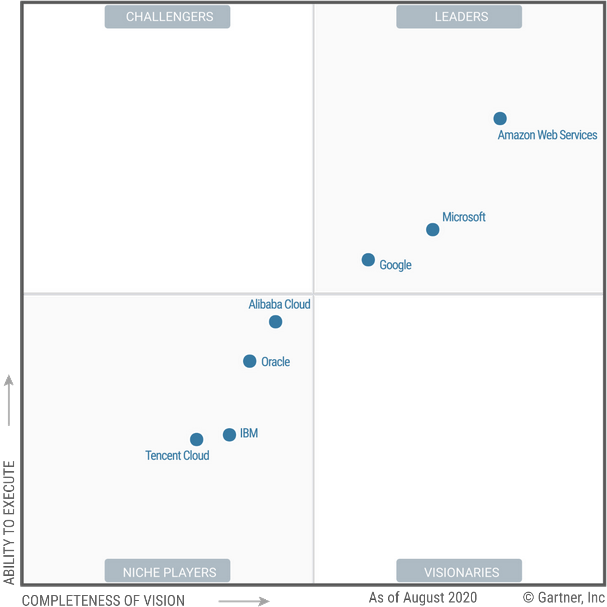
Figure 1. Magic Quadrant for Cloud Infrastructure and Platform Services
Vendor Strengths and Cautions
Google is a Leader in this Magic Quadrant.
Locations: Google has multiple regions across Japan and the U.S., as well as a presence in Belgium, Singapore, Finland, Germany, the Netherlands, the U.K., India, Australia, Brazil, Canada and, Switzerland, as well as the Hong Kong and Taiwan markets.
Recommended Uses: Google has evolved by enhancing its strengths and attacking its limitations to providing a strong offering in every use case, other than the edge use case. Google has a future focus on building out hybrid capabilities and partnerships with telco providers.
Strengths
- Google’s open-source contributions, such as Kubernetes and TensorFlow, have been market-moving innovations that have changed the course of enterprise IT. Such innovations have served to enable other cloud service providers, but also brought developer “mind share” to Google Cloud Platform (GCP). Google’s long-term strategy is to bring additional open-source-focused partners into GCP as managed services.
- During the past year, GCP has experienced a noticeable increase in year-over-year market share in terms of IaaS and dbPaaS, albeit from a lower base, relative to other providers in this Magic Quadrant. Google has also made significant gains by closing a number of critical capability gaps between GCP and Microsoft Azure, its nearest competitor in terms of market share and capabilities.
- Gartner clients continue to associate GCP with its big data and data science capabilities, stemming from the use of services such BigQuery and Dataproc. However, the company is pressing into new territory with Anthos, GCP’s container and Kubernetes-based middleware layer, which is designed to support the development and deployment of cloud applications in a hybrid and multicloud model.
Cautions
- Some of Gartner’s clients remain cautious about Google’s commitment to serving the needs of enterprise clients when put in the context of SAP’s preference for Microsoft Azure, and GCP’s slowness in executing on some highly touted partnerships. GCP lacks enterprise-focused aPaaS capabilities and support for Oracle, and it continues to struggle with having an enterprise mindset in the field.
- From a financial perspective, GCP’s revenue is a small fraction of overall Google revenue and GCP’s criticality to the overall business is not as clear as its competitors. Furthermore, GCP’s success may erode the company’s overall healthy gross margins.
- Google’s much-vaunted network capabilities have been the source of a number of GCP outages during the last year, with devastating impact on customers. One outage was multiregional in scope, affecting GCP customers and Google consumer services, such as G Suite and YouTube. This resulted in complete GCP network unavailability for some customers.

Forrester Surveyed Indian Retailers About Digital Transformation. Here’s What They Found
DOWNLOAD WHITEPAPER4003
Of your peers have already downloaded this article
12:30 Minutes
The most insightful time you'll spend today!
As today’s empowered consumers demand more of the retail experience than ever before, leading retailers and brands in India are investing to rethink and reinvent in their customers’ cross-touchpoint experiences.
Our survey results demonstrate that retail decision makers understand that better customer experience can yield financial benefits, including faster revenue growth, and elevate the reach of influence and brand in the market.
Forty percent or more of retail executives are prioritizing revenue growth, improvement of customer experience (CX), and simplification of operations as the top priorities in their business agendas over the next year.
The survey also covers:
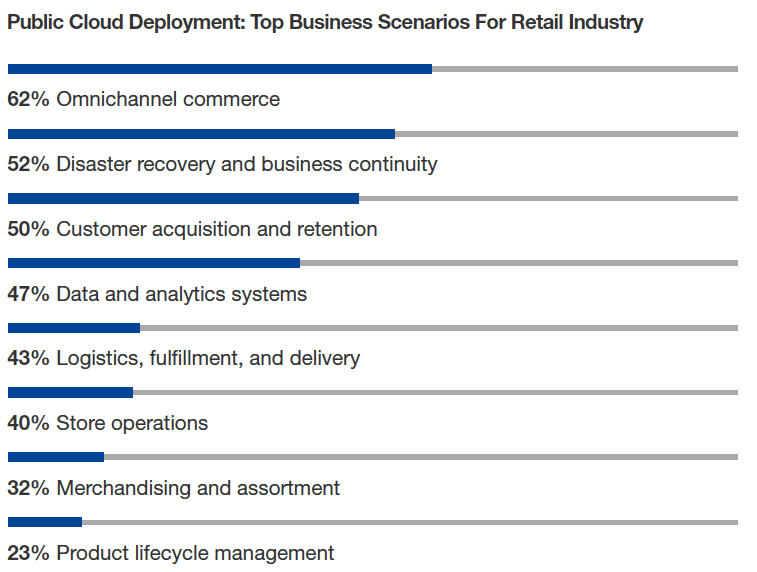
- Key Drivers For Retail Organizations To Migrate Application To Public Cloud
- Cloud Investments In The Retail Industry
- The Three Dimensions That The Industry’s Cloud Challenges Are Taking
- The Top Agendas Retailers Want to Accomplish with the Public Cloud
Download Forrester’s Retail Report Now.
Delivering 10X Improvement to Risk and Regulatory Reporting Through Cloud and AI
5005
Of your peers have already read this article.
2:30 Minutes
The most insightful time you'll spend today!
Enterprise agility and the ability to innovate, adapt and respond quickly to the ever-changing risk and regulatory landscape is no longer a choice, but the cornerstone of successful digital transformation and commercial growth. Traditional access to and ways of managing data invariably create challenges in dealing with multiple data repositories, reconciliations, fire-drills, etc.
In response, the move to cloud is increasing significantly. It enables risk analytics and regulatory reporting at scale in a secure environment with data storage, management and encryption capabilities as a standard. In addition, as regulatory reporting requirements become more granular, machine learning can help facilitate new insights and allow for risk management to become more embedded into operational processes.
This webinar will address the day-to-day challenges in risk management and regulatory compliance, while also exploring how technological innovations can provide massive improvements and potential.
Key themes
- Real-life data challenges in the eyes of risk managers: can compliance, fraud detection and identifying liquidity positions be improved through the use of AI?
- Innovative approaches to streamline regulatory reporting to derive deeper customer insights from data at the moment of truth.
- Reimagining operations: how to modernise the data infrastructure to accommodate data explosion, drive flexibility and deliver a more cost effective outcome.
More Relevant Stories for Your Company

Tau VMs Joins Google Cloud to Offer Cost-effective Performance of Scale-out Workloads
Scale-out workloads demand the best combination of performance and price to bring down the cost of delivering applications, all while providing an excellent user experience. We are excited to announce a new virtual machine (VM) family, Tau VMs, coming to Google Cloud. Tau VMs extend Compute Engine’s VM offerings with a new option


Rethinking Financial Services with Google Cloud
Cloud technologies are not just a way to reduce costs, but also rethink financial services. Firms are using structured and unstructured data to find better trading opportunities and create predictive models. In risk management, professionals can use the cloud’s computational capabilities that take into account a lot more variables and

APAC’s Retail Digital Pulse by Google Cloud and IDC Retail Index
In the post COVID-19 pandemic world, some retail businesses have aced digital transformation while others are still lagging behind. The Google Cloud commissioned IDC Retail Insights analyzed over 1, 108 retailers across seven nations in the Asia Pacific region and across eight different segments (online, drugstores, speciality shops, convenience stores,

AgroStar: Small farms in India getting big help from the cloud
AgroStar has launched a cloud-based mobile app that is helping to boost crop yields and encourage best practices for small farmers in India. Launched as an on-premises ecommerce platform selling farm tools in 2008, the firm turned to Google Cloud Platform (GCP) to expand its offering. It now uses cloud-based analytics and is
