






3455
Of your peers have already listened to this podcast
1:30 Minutes
The most insightful time you'll spend today!
Rethinking Financial Services with Google Cloud
Cloud technologies are not just a way to reduce costs, but also rethink financial services. Firms are using structured and unstructured data to find better trading opportunities and create predictive models. In risk management, professionals can use the cloud’s computational capabilities that take into account a lot more variables and risk models that run through more scenarios with machine learning embedded in these risk models.
In operations, firms are looking at leveraging cloud to streamline processing. Whether it’s using natural language processing to understand loan documents or trader communications — there are lots of places cloud and its related technologies are impacting all aspects of financial services firms’ value chain.
Listen to this podcast to understand how cloud technologies can help improve your firm’s business — from day-to-day operations to advanced risk modelling to improving customer experience.
Mid-Sized B2B Firm Achieves the Business Trifecta with a Single Strategy

6895
Of your peers have already read this article.
2:45 Minutes
The most insightful time you'll spend today!
Thirteen years’ experience in e-commerce has given Teddy Chan, Chief Executive Officer and Chief Technology Officer, AfterShip, a deep understanding of the challenges of shipping and tracking packages to customers worldwide.
“The key problem many merchants face is customers asking ‘where is my order?’ and ‘when I will get the package?’” Chan says. “When I considered this issue, I came up with the idea of AfterShip.” Chan helped found AfterShip in 2011 to enable merchants to keep track of packages sent to customers via a web portal or an API. AfterShip also allows merchants to notify customers of anticipated delivery times.
“Using AfterShip, merchants can provide the same experience to buyers regardless of which couriers they use,” Chan says. “Merchants can also improve their customer engagement by including up-selling or marketing content with their delivery notifications.”
Hong Kong-headquartered AfterShip continues to grow quickly and now has a 40-person team. Thirty members of this team are based on the China special administrative region and 10 are based in India.
“Google Cloud Platform has a network of global datacentres with deep connectivity that enables us to put our infrastructure close to our customers. In addition, the ability to horizontally scale our global database using tools such as Google Cloud Spanner eliminates any limits on our geographic expansion.”
—Teddy Chan, Chief Executive Officer and Chief Technology Officer, AfterShip
By October 2017, the business was tracking about 30 million packages per month and had expanded its services to include label and rate calculation and self-service return. Revenue, package transaction numbers and team size have doubled every year for the past three years, while more than 300,000 merchants and 426 couriers are signed up to the service. Key customers include Wish, Etsy and Groupon.
Close to half AfterShip’s customers are based in the United States, about one third in Europe and the remainder are located in Asia. AfterShip had initially delivered its applications and services from an incumbent public cloud service. However, the company wanted to continue its growth trajectory while automating key infrastructure processes, implementing a continuous deployment model and controlling costs.
The business needed to achieve these objectives while maintaining a global presence and high-quality service. AfterShip started reviewing its options and decided to migrate to Google Cloud Platform (GCP). “Google Cloud Platform has a network of global datacentres with deep connectivity that enables us to place our infrastructure close to our customers,” Chan says.
“In addition, the ability to horizontally scale our global database using tools such as Google Cloud Spanner eliminates any limits to our geographic expansion. Furthermore, the managed services provided through GCP would allow us to focus on building better features for online merchants.” The reliability provided by GCP would also enable AfterShip to meet the stringent service level requirements of large digital marketplaces in the United States, Asia and elsewhere.
“Google Cloud Platform could manage the high volumes and enable us to deliver the service levels that would realise our ambition of becoming the number one tracking API platform in the world,” Chan says. “For example, with Google Cloud Platform, we can provide a 99.95% monthly uptime service level to our customers.” Finally, GCP provided managed solutions, including Google Kubernetes Engine powered by open source container orchestrator Kubernetes, that would enable AfterShip to automate processes such as scaling and enable its team to focus on developing applications.
AfterShip has moved its websites into GCP infrastructure in three datacentres around the world and anticipates completing the migration in Q4 2017. “Google provided a lot of assistance, particularly early in the project when we needed it,” Chan says. “They briefed us on several services we hadn’t known about that could replace the equivalents in the public cloud we were using previously.” The business then completed the migration using its own skilled team members. As well as Google Kubernetes Engine and Google Cloud Spanner, AfterShip is using Google BigQuery to store and analyse transaction information.
“Google Cloud Platform could manage the high volumes and enable us to deliver the service levels that would realise our ambition of becoming the number one tracking API platform in the world.”
—Teddy Chan, Chief Executive Officer and Chief Technology Officer, AfterShip
Deployment times down from one hour to two minutes
With deployment times falling from up to one hour in its previous cloud environment to about two minutes in GCP, AfterShip has been able to adopt a continuous deployment model. “This has improved our service levels,” Chan says. “If there are any issues we can fix them quickly, while we can iterate faster to create new features in response to customer requests or changes in the market. “This enables us to continue to lead our competitors.”
Targeting a 30 percent reduction in costs
AfterShip is now targeting a 30% reduction in costs by optimising its use of Docker containerisation technology on GCP.
“By using Docker with Kubernetes, we have been able to fine-tune our use of compute resources and better control our costs,” Chan says. “We’re extremely pleased with Google Cloud Platform as it really is built for engineers,” he adds. “In addition, its documentation is extremely clear, allowing us to troubleshoot or carry out activities on the platform ourselves. “We look forward to continuing to grow and extend our package tracking and associated services with Google Cloud Platform.”

3518
Of your peers have already downloaded this article
5:30 Minutes
The most insightful time you'll spend today!
When moving to the cloud, many organizations concentrate their focus on the change in technology and overlook an area just as complex and impactful: cultural change. Having your people ready to embrace the change — supporting them with the right processes, equipping them with the right skills — is as important as getting the technology right.
To realize the full value of cloud technologies, many organizations are rethinking their IT organizational structure. There are a variety of potential talent implications too — from adopting agile ways of working to hiring for more cloud-centric skills to looking at redeploying current IT skills and reskilling and upskilling current teams.
As one of the organizations that pioneered hyperscale infrastructure, which led to the creation of the cloud, Google has spent years nurturing its culture and workforce to best operate in the cloud. We leverage this experience every day to help organizations ready their workforce for the change, and in this whitepaper, we aim to pass that experience along to you.
Quick Recap on Google Cloud: Latest News, Launches, Updates, Events and More
12885
Of your peers have already read this article.
2:00 Minutes
The most insightful time you'll spend today!
Want to know the latest from Google Cloud? Find it here in one handy location. Check back regularly for our newest updates, announcements, resources, events, learning opportunities, and more.
Tip: Not sure where to find what you’re looking for on the Google Cloud blog? Start here: Google Cloud blog 101: Full list of topics, links, and resources.
Week of May 24-May 28 2021
- Google Cloud for financial services: driving your transformation cloud journey–As we welcome the industry to our Financial Services Summit, we’re sharing more on how Google Cloud accelerates a financial organization’s digital transformation through app and infrastructure modernization, data democratization, people connections, and trusted transactions. Read more or watch the summit on demand.
- Introducing Datashare solution for financial services–We announced the general availability of Datashare for financial services, a new Google Cloud solution that brings together the entire capital markets ecosystem—data publishers and data consumers—to exchange market data securely and easily. Read more.
- Announcing Datastream in Preview–Datastream, a serverless change data capture (CDC) and replication service, allows enterprises to synchronize data across heterogeneous databases, storage systems, and applications reliably and with minimal latency to support real-time analytics, database replication, and event-driven architectures. Read more.
- Introducing Dataplex: An intelligent data fabric for analytics at scale–Dataplex provides a way to centrally manage, monitor, and govern your data across data lakes, data warehouses and data marts, and make this data securely accessible to a variety of analytics and data science tools. Read more.
- Announcing Dataflow Prime–Available in Preview in Q3 2021, Dataflow Prime is a new platform based on a serverless, no-ops, auto-tuning architecture built to bring unparalleled resource utilization and radical operational simplicity to big data processing. Dataflow Prime builds on Dataflow and brings new user benefits with innovations in resource utilization and distributed diagnostics. The new capabilities in Dataflow significantly reduce the time spent on infrastructure sizing and tuning tasks, as well as time spent diagnosing data freshness problems. Read more.
- Secure and scalable sharing for data and analytics with Analytics Hub–With Analytics Hub, available in Preview in Q3, organizations get a rich data ecosystem by publishing and subscribing to analytics-ready datasets; control and monitoring over how their data is being used; a self-service way to access valuable and trusted data assets; and an easy way to monetize their data assets without the overhead of building and managing the infrastructure. Read more.
- Cloud Spanner trims entry cost by 90%–Coming soon to Preview, granular instance sizing in Spanner lets organizations run workloads at as low as 1/10th the cost of regular instances, equating to approximately $65/month. Read more.
- Cloud Bigtable lifts SLA and adds new security features for regulated industries–Bigtable instances with a multi-cluster routing policy across 3 or more regions are now covered by a 99.999% monthly uptime percentage under the new SLA. In addition, new Data Access audit logs can help determine whether sensitive customer information has been accessed in the event of a security incident, and if so, when, and by whom. Read more.
- Build a no-code journaling app–In honor of Mental Health Awareness Month, Google Cloud’s no-code application development platform, AppSheet, demonstrates how you can build a journaling app complete with titles, time stamps, mood entries, and more. Learn how with this blog and video here.
- New features in Security Command Center—On May 24th, Security Command Center Premium launched the general availability of granular access controls at project- and folder-level and Center for Internet Security (CIS) 1.1 benchmarks for Google Cloud Platform Foundation. These new capabilities enable organizations to improve their security posture and efficiently manage risk for their Google Cloud environment. Learn more.
- Simplified API operations with AI–Google Cloud’s API management platform Apigee applies Google’s industry leading ML and AI to your API metadata. Understand how it works with anomaly detection here.
- This week: Data Cloud and Financial Services Summits–Our Google Cloud Summit series begins this week with the Data Cloud Summit on Wednesday May 26 (Global). At this half-day event, you’ll learn how leading companies like PayPal, Workday, Equifax, and many others are driving competitive differentiation using Google Cloud technologies to build their data clouds and transform data into value that drives innovation. The following day, Thursday May 27 (Global & EMEA) at the Financial Services Summit, discover how Google Cloud is helping financial institutions such as PayPal, Global Payments, HSBC, Credit Suisse, AXA Switzerland and more unlock new possibilities and accelerate business through innovation. Read more and explore the entire summit series.
- Announcing the Google for Games Developer Summit 2021 on July 12th-13th–With a surge of new gamers and an increase in time spent playing games in the last year, it’s more important than ever for game developers to delight and engage players. To help developers with this opportunity, the games teams at Google are back to announce the return of the Google for Games Developer Summit 2021 on July 12th-13th. Hear from experts across Google about new game solutions they’re building to make it easier for you to continue creating great games, connecting with players and scaling your business. Registration is free and open to all game developers. Register for the free online event at g.co/gamedevsummit to get more details in the coming weeks. We can’t wait to share our latest innovations with the developer community. Learn more.
Google Cloud Infrastructure: What Changed in the Last One Year and What’s in the Future?
3462
Of your peers have already read this article.
3:00 Minutes
The most insightful time you'll spend today!
This past year brought both new challenges and successes for our customers around the world. We thought life was going to return to normal… and then it didn’t. Despite the uncertainty, it was exciting to see customers make huge transformations in when, where, and how they run their businesses, with cloud infrastructure as a major enabler.
According to IDC, “by 2024, 50% of organizations will use applications built on abstraction provided by managed services including cloud-native technologies to enable consistency in running in any and many locations.”1 Over the past year we were honored to work with so many of you to start to make this prediction a reality.
Let’s take a deeper look at where our infrastructure progressed in 2021, and where we’re headed in the new year.
Google Cloud is recognized by independent experts for its leadership
For the fourth consecutive year, Google Cloud was named a Leader in the Gartner Magic Quadrant for Cloud Infrastructure and Platform Services.
The Forrester Wave for AI infrastructure placed Google at the topmost position, a testament to Google’s investments in tomorrow’s AI-first world.
Google Cloud also won the HPC Wire Editor’s Choice award for the best use of HPC in the cloud.
We made it easier to migrate enterprise applications
To support enterprises in their transformation journeys we focused on expanding our support for enterprise applications in our cloud. The Home Depot just wrote about its successful migration of SAP to Google Cloud, highlighting how crucial it is to have good processes and strong partnerships. For other companies using SAP applications we also launched Filestore Enterprise, which delivers 99.99% regional availability backed by an SLA.
Our partner NetApp deepened its integration with Google Cloud to enable easier and faster Windows-based application migration, and provided flexible deployment options to modernize workloads. We also added new Network Connectivity Center partners to include companies like Cisco, Palo Alto Networks, and VMware, so as you migrate over time you can easily connect all your networking resources together in one place.
For those of you considering migration to cloud, Forrester dove deeper into the economics of migrating enterprise applications to cloud. (Spoiler alert: companies are finding major cost savings and performance benefits!) It’s so important to us that companies trust that their biggest, most complex applications will run smoothly and securely with us, and we’re pleased at the progress we’ve made toward supporting more enterprise applications this year.
We also made it easier for you to migrate VMware workloads to the cloud by expanding Google Cloud VMware Engine to 12 regions worldwide and enabling several new capabilities across networking, compliance, and scale. Customers such as Mitel and Carrefour migrated their VMware estates to Google Cloud to transform their applications with Google services to increase agility, save money (up to 45%) and reduce energy costs (about 35%) compared to running on-premises.
For High Performance Computing (HPC), we continued to add capabilities such as optimized VM images for HPC, enhanced integration with schedulers such as SchedMD, Slurm, and Altair PBSPro.
New cost and performance options
To further support customers doing high performance computing for things like real-time advertising, dynamic e-commerce, and gaming, we launched a new VM family: Tau VMs. Tau VMs offer 56% higher absolute performance and 42% higher price-performance compared to general-purpose VMs from any of the leading public cloud vendors. We are seeing companies such as Nylas switching from other cloud platforms to Google Cloud to make the most of Tau VMs.
That isn’t the only VM advancement we made. For customers with higher levels of fault tolerance and looking for greater cost efficiencies, we launched Spot VMs, which open up access to Google Cloud’s idle capacity so you can run your application at the lowest price possible. With Spot VMs, you save anywhere from 60-91% off the price of on-demand VMs.
We also launched more options for the highest performance ephemeral block storage — 6TB and 9TB Local SSDs, which offer greater IOPS per dollar when attached to general purpose N2 Compute Engine VMs.
Distributed cloud brings us closer to you
For years, the industry has been telling companies, “move to cloud!” but not all workloads can move to the public cloud immediately or entirely. Factors include industry- or region-specific compliance and data sovereignty needs, low latency or local data-processing requirements, or the need to run applications close to other services.
In October, we expanded our distributed cloud strategy and announced Google Distributed Cloud, a portfolio of fully managed hardware and software solutions that extend Google Cloud’s infrastructure and services to data centers and the edge. This is a major step forward in our ability to meet you where you are, in private data centers and at the edge, and we’re excited to see how this helps you as we move into 2022.
Data protection and security that never sleeps
This year we worked hard to help improve your data protection capabilities. We doubled down on our Actifio acquisition by launching several releases that deepened its integration with Google Cloud. For customers with containerized applications, we took a big step forward with the launch of Backup for GKE. We’re particularly excited about how this new option for GKE users allows you to more easily meet your service-level objectives, automate common backup and recovery tasks, and show reporting for compliance and audit purposes.
We also enhanced Cloud Storage with data protection features like custom region selection for dual-region buckets. Previously, Google Cloud assigned dual-region pairs for you to choose from. With this release, you can select your own region pairs that meet your regulatory or compliance requirements, or optimize your app performance. We also launched Turbo Replication for dual-region buckets, which replicates 100% of your data between regions in 15 minutes or less, backed by a Service Level Agreement, a first from a leading cloud provider.
Security is a key area of focus for us and we partnered with Palo Alto Networks to deliver their industry-leading Intrusion Detection System (IDS) solution natively on Google Cloud. With the recent Apache Log4j vulnerability, we automatically updated Cloud IDS to help detect exploit attempts and protect our customers’ environments quickly. We also integrated Cloud Armor with reCAPTCHA Enterprise to deliver a best-in-class bot and fraud management solution to prevent volumetric attacks. Cloud Armor is deployed with our Cloud Load Balancer and Cloud CDN, extending its security benefits at the network edge for traffic coming into Google Cloud.
We made it easier to build and manage applications
Developers want to focus on code, not configuring, managing or scaling infrastructure. To help, we worked on simplifying networking with new services such as Private Service Connect, which allows you to connect VPCs to applications and services securely without configuring all the network underlay. To make it easier to run workloads in hybrid environments, we introduced BYOIP so you don’t need to change your IP address, and we enhanced Cloud Load Balancer with advanced traffic management, regional and hybrid app delivery to load balance traffic between on-prem and cloud workloads. We also introduced IPv6, DNS policy manager, Cloud Domains, GKE Gateway Controller, eBPF data plane, and Service Directory, all with the goal of making networking easier for developers.
We continue to invest in visibility and observability for efficient day 2 operations. Network Intelligence Center now has dynamic reachability within the Connectivity Tests module, interconnect and VPN visualization in Network Topology, and the Firewall Insights module, which provides visibility into firewall rules to ensure they are being used appropriately and as intended.
And while not new this year, developers continue to tell us how much they love the ease of architecting storage using Cloud Storage. See how easy it is to configure a dual-region bucket. As a result, developers can treat a continent like a single bucket, dramatically simplifying the application programming model. Google Cloud is unique in offering this capability among major public cloud vendors.
We continue to be the most sustainable cloud for you
Another area Google has invested in deeply and that is becoming increasingly important to more organizations is sustainability. Many cloud providers have a vision for a sustainable future, and many aim to match their electricity consumption with 100% renewable energy by 2025 or 2030. We accomplished 100% renewable energy in 2017, which means we’re the only hyperscale cloud to do this today and on data centers that are twice as energy efficient as the average data center.
We also announced a number of new features like our new Carbon Footprint tool. Every Google Cloud user — that means you! — can see the gross carbon emissions associated with the services you use in Google Cloud. This means picking the data center that meets your sustainability goals, and reducing the overall emissions tied to your infrastructure and applications. And we have some pretty big goals for the future. For more, don’t miss our full sustainability recap.
A big thank you to our customers
While we were busy building out our infrastructure in 2021, we’d be nowhere without the partnership of our amazing customers. It’s hard to pick from all the exciting stories we heard this year, but here are just a few: Pega migrated its SAP applications to Google Cloud with zero downtime. Paypal exited its non-strategic data centers and achieved major cost savings. And Wix used our network to serve tens of millions of requests per day.
I’m proud to look back at how our cloud infrastructure has evolved this year to support each of our customers on their transformation journey. As we head into 2022 I’m excited to continue to partner with you to solve your most difficult challenges together.
Interested in hearing more about Google’s vision for the future? Listen to Thomas Kurian’s thoughts from Google Cloud Next ‘21.
1. IDC FutureScape: Worldwide Cloud 2022 Predictions
Google Unveils New Cloud Region in Delhi NCR to Power India’s Digitization

8299
Of your peers have already read this article.
2:00 Minutes
The most insightful time you'll spend today!
In the past year, Google has worked to surface timely and reliable health information, amplify public health campaigns, and help nonprofits get urgent support to Indians in need. Now, we are continuing to focus on helping India’s businesses accelerate their digital transformation, deepening our commitment to India’s digitization and economic recovery. To support customers and the public sector in India and across Asia Pacific, we’re excited to announce that our new Google Cloud region in Delhi National Capital Region (NCR) is now open.
Designed to help both Indian and global companies alike build highly available applications for their customers, the Delhi NCR region is our second Google Cloud region in India and 10th to open in Asia Pacific.
What customers and partners are saying
Navigating this past year has been a challenge for companies as they grapple with changing customers demands and economic uncertainty. Technology has played a critical role, and we’ve been fortunate to partner with and serve people, companies, and government institutions around the world to help them adapt. The Google Cloud region in Delhi NCR will help our customers adapt to new requirements, new opportunities and new ways of working, like we’ve helped so many companies do in the region:
- InMobi scaled a personalized AI platform to support 120+ million active users. “With the arrival of the Google Cloud Delhi NCR, InMobi Group sees the opportunity to continue closing the gap between our users and products,” says Mohit Saxena, Co-founder and Group CTO of Inmobi. “Glance, especially, has been serving AI-powered personalised content to over 120 million active users. We can’t wait to continue giving them truly meaningful experiences that are speedy, scale well, and are relevant to them, by expanding the use of our current tools working on Google Cloud with the opening of a new region.”
- Groww now supports a sizable user base. “Google Cloud provides great technology that enables us to build and scale infrastructure to millions of users, and the new Google Cloud region in Delhi NCR will continue to help more businesses and startups in India access powerful cloud-based infrastructure, products and services,” says Neeraj Singh, Co-founder and Chief Technology Officer, Groww.
- HDFC Bank is positioned for the future. “At HDFC Bank, we are harnessing technology platforms to both run and build the bank. As we progress to be future ready, the objective is to invest in future technologies that give us scale, efficiency and resiliency. Towards this the Google Cloud region in Delhi NCR will enable us to enhance our resiliency and help us in building an active-active design framework for our new generation applications on cloud,” says Ramesh Lakshminarayanan, CIO, HDFC Bank.
- Dr. Reddy’s Lab built a modern data platform with Google Cloud. “At Dr Reddy’s, we pride ourselves in helping patients regain good health, acting quickly to provide innovative solutions to address patients’ unmet needs and in accelerating access to medicines to people worldwide. Our Google Cloud-powered data platform is helping us realize these objectives and we welcome Google’s investment in the new Delhi NCR region as helping us and other businesses in India make further contributions to our social and economic future,” says Mukesh Rathi, Senior Vice President & CIO, Dr. Reddy’s Laboratories.
- “To survive the disruption caused by the pandemic and to succeed in the long term, organizations need to become digital natives, so they can be more agile, explore new business models and build new capabilities that boost resilience. A cloud-first strategy plays a key role in enabling businesses to do this,” said Piyush N. Singh, Lead – India market unit & lead – Growth and Strategic Client Relationships, Asia Pacific and Latin America, Accenture. “Harnessing the potential of cloud requires the right data infrastructure and this expansion by Google Cloud will undoubtedly help Indian enterprises in their digital transformation journeys.”
A global network of regions
Delhi NCR joins 25 existing Google Cloud regions connected via our high-performance network, helping customers better serve their users and customers throughout the globe. As the second region in India, customers benefit from improved business continuity planning with distributed, secure infrastructure needed to meet IT and business requirements for disaster recovery, while maintaining data sovereignty.
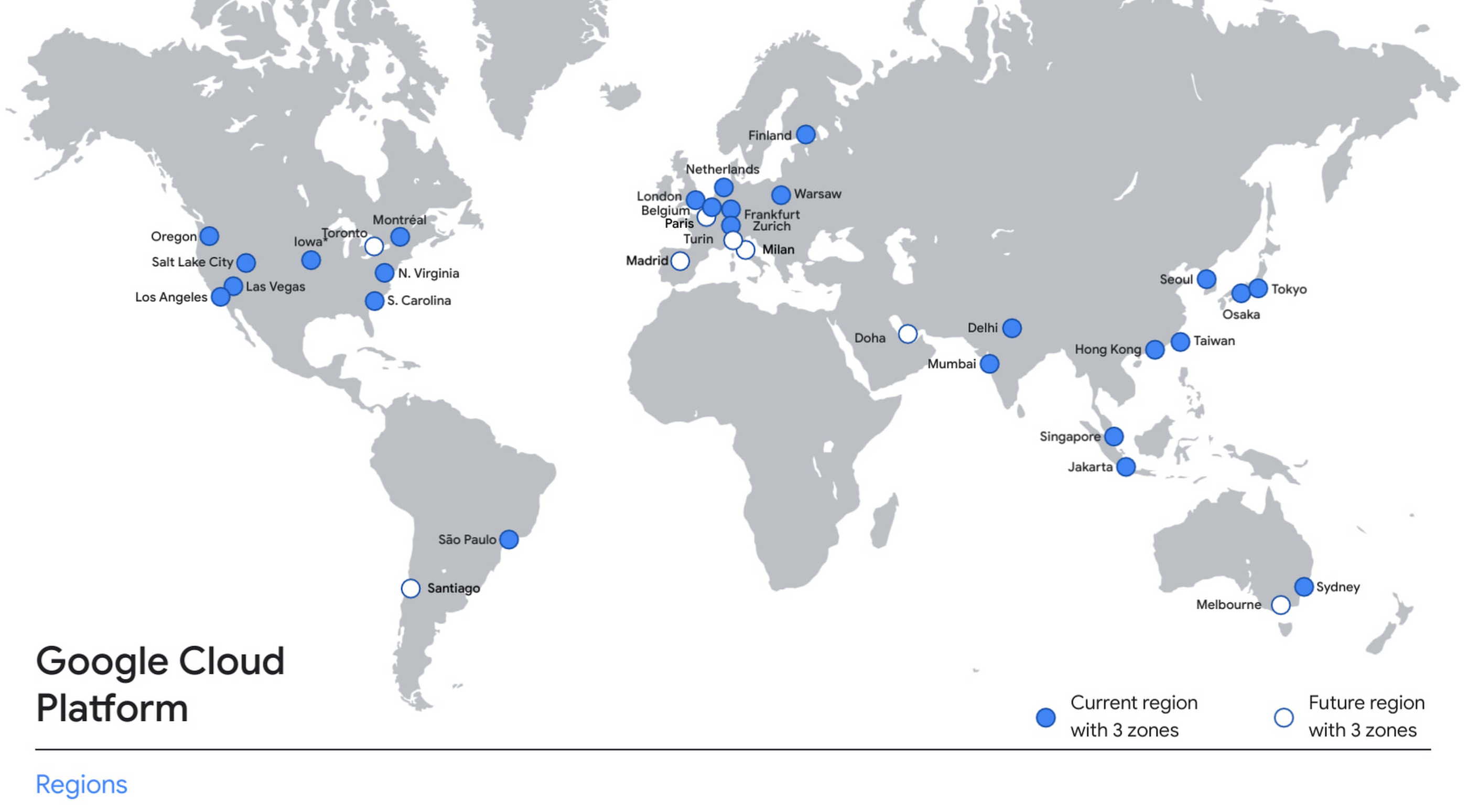
With this new region, Google Cloud customers operating in India also benefit from low latency and high performance of their cloud-based workloads and data. Designed for high availability, the region opens with three availability zones to protect against service disruptions, and offers a portfolio of key products, including Compute Engine, App Engine, Google Kubernetes Engine, Cloud Bigtable, Cloud Spanner, and BigQuery.
Supporting India’s recovery with training and education
Google and Google Cloud will also continue to support our customers with people and education programs. We’re investing in local talent and the local developer community to help enterprises digitally transform and support economic recovery.
Through the India Digitization Fund, we expanded our efforts to support India’s recovery from COVID-19—in particular, through programs to support education and small businesses. In addition to expanding internet access, and investments to help start-ups accelerate India’s digital transformation, we’ve grown our Grow with Google efforts. Businesses can access digital tools to maintain business continuity, find resources like quick help videos, and learn digital skills—in both English and in Hindi.
Helping customers build their transformation clouds
Google Cloud is here to support businesses, helping them get smarter with data, deploy faster, connect more easily with people and customers throughout the globe, and protect everything that matters to their businesses. The cloud region in Delhi NCR offers new technology and tools that can be a catalyst for this change. To learn more, visit the Google Cloud locations page, and be sure to watch the region launch event here.
More Relevant Stories for Your Company

How TapClicks’ Google Cloud Migration Makes Life Easy for Marketers
Editor’s note: In this blog post we learn how TapClicks migrated to Google Cloud to offer their marketing customers a unified platform for data management, operations, insights, and analysis. TapClicks is a smart marketing cloud, powered by data, that unifies our customer’s marketing. By choosing to migrate our core applications last

Google Cloud’s High-performance Compute Speeds Up the Chip Design Process
Cloud offers a proven way to accelerate end-to-end chip design flows. In a previous blog, we demonstrated the inherent elasticity of the cloud, showcasing how front-end simulation workloads can scale with access to more compute resources. Another benefit of the cloud is access to a powerful, modern and global infrastructure. On-prem

Rightmove’s Right Move to Google Cloud
In 2020, Rightmove, UK's renowned property website app saw over a billion minutes from users and clocked about 100 busy days in 2021. To continue innovating their products and improve customer experiences while achieving sustainability goals, Rightmove chose Google Cloud to migrate their infrastructure! The property search application platform already
7 Fantastic Ways Google Cloud VMWare Engine Stands Out from the Rest for Running VMWare Workloads in the Cloud!
Google Cloud VMware Engine delivers an enterprise-grade, cloud-native VMware experience that is built on Google Cloud’s highly performant and scalable infrastructure. By enabling a consistent VMware experience, the service allows customers to adopt Google Cloud rapidly, easily, and with minimal modifications to their vSphere workloads, bringing the best of VMware
