






Best Practices for ML Engineering: 43 Rules from the World’s Best
READ FULL INTRODOWNLOAD AGAIN5448
Of your peers have already downloaded this article
14:30 Minutes
The most insightful time you'll spend today!
How TeamSnap Improved Return on Ad Spend Significantly

5618
Of your peers have already read this article.
3:30 Minutes
The most insightful time you'll spend today!
Anyone who has ever coached or played on a sports team, or had a child involved in sports, knows how difficult scheduling and logistics can be. From game and practice schedules, to uniforms and who’s bringing the snacks, it can be a lot for coaches, administrators, parents, and players to manage.
It’s no wonder that TeamSnap, a sports team, club, and tournament management app, has exploded in popularity worldwide. By syncing events to everyone’s personal calendars and providing messaging and payment tracking, TeamSnap makes communication and organization easy.
TeamSnap markets its app to coaches, players, and clubs via targeted YouTube ads. It also uses Google AdWords and DoubleClick to advertise on search results and run programmatic campaigns. These methods have been highly effective, helping TeamSnap grow to millions of users worldwide and become one of the most popular apps in the iOS app store.
As its business and data grew, TeamSnap was challenged to track ROI and measure the customer journey across channels and devices over time. The company’s marketing budget grew quickly, making it even more important to spend wisely. With data in Google Analytics 360, DoubleClick Campaign Manager, Google AdWords, and Salesforce, TeamSnap needed a way to link and correlate those data sources in a scalable, timely, and cost-effective way to understand the true impact of its digital marketing across websites and mobile apps.
To avoid the painstaking manual process of pulling data from multiple sources, TeamSnap began using Google Analytics 360, which integrates with Google BigQuery, to provide a fully managed big data analysis service. TeamSnap analyzes the data using Tableau, which connects directly to Google BigQuery for fast analytics and helps the company share and collaborate on that information with self-service ease.
The combination allows TeamSnap to easily track the activity of millions of users with self-service ease, without worrying about the scalability or availability of the big data platform.
“Before Google Analytics 360, Google BigQuery, and Tableau, tracking our return on ad spend was difficult because we had so much data,” says Ken McDonald, Chief Growth Officer at TeamSnap. “We didn’t always have insights to make the best choices. We don’t have that problem anymore because we’ve moved to real-time reporting. We find additional revenue growth opportunities almost daily.”
Making Ad Dollars Work Harder
TeamSnap now automatically imports unsampled Google Analytics 360 logs into the Google BigQuery data warehouse. To import data from other sources such as Google AdWords, DoubleClick, and YouTube, TeamSnap uses Google BigQuery Data Transfer Service. With all relevant data consolidated in Google BigQuery, TeamSnap can use Tableau to perform advanced analytics on its digital marketing, executing ad-hoc analyses in seconds, while eliminating data sampling issues, to improve accuracy. These analyses can also be reused and shared with internal and external stakeholders via Tableau Online, promoting governed reuse and consistency.
“Using Google Analytics 360 and Google BigQuery with Tableau to track our return on ad spend is ideal,” says Ken. “It’s easy to use SQL to query the data or explore it with drag-and-drop ease.”
With Google BigQuery, Ken and his team can bring all the data from the TeamSnap billing systems, internal CRM, and other Google services into one straightforward dataset that everyone uses. With Tableau, users are able to perform self-service analytics on this data and provision analyses via shared dashboards that communicate the same consistent truth across the company. These dashboards provide a single view of the business to discover new patterns and questions worth analyzing.
All of this results in enormous time savings because no one is re-inventing the wheel. “Using these tools, we immediately reallocated $300,000 of ad spend that was performing poorly, generating 200% ROI in the first two days,” says Ken.
Ken now spends his time analyzing data instead of trying to pull it all together, identifying pockets of inefficient spend in real time and reallocating those marketing dollars toward better performing campaigns.
“Before, we could only focus on the largest campaign-level datasets because it was so time consuming to pull the data,” he says. “With Google BigQuery and Tableau, we can examine our advertising ROI much more granularly and reallocate more than $10 million in ad spend annually to grow the company faster and more efficiently.”
More Effective A/B Testing
To make sure it is delivering the best customer experiences, TeamSnap uses Google Optimize to run A/B tests on its website. It uses Google BigQuery and Tableau to verify and supplement these findings by measuring longer-term customer behavior across devices, spanning both web and mobile apps.
By pulling in data from Google Optimize, Google Analytics 360, Salesforce, and in-house billing and CRM systems, and understanding it with Tableau, TeamSnap has increased the accuracy and effectiveness of its A/B testing, gaining a more complete picture of customer onboarding and activity. In some cases, it found that short-term indicators it previously trusted were actually poor predictors of long-term behavior.
“Integration between Google Analytics 360 and Google BigQuery is seamless, giving us much more confidence in our A/B testing,” says Ken. “We’re constantly finding new and interesting ways to use our digital marketing data. Often, making a simple change can increase revenue by hundreds of thousands of dollars a year.”
Improving Product Quality
TeamSnap also uses Google BigQuery and Tableau to improve its own product, tracking customer activity at such a granular level that usability and functionality issues can be exposed and addressed faster. It’s also increasing customer engagement by verifying that potential customers are coming in through the right onboarding path—for example, a coach versus a player, or a consumer versus a club or other sports business. Using A/B testing to make sure customers are routed to the appropriate flow, TeamSnap drove $4 million in additional customer value each year.
“We initially chose Google BigQuery and Tableau to help with marketing, but we realized quickly that they could help us on the product side as well,” says Ken. “Most of the testing we do is about making things better and easier for our customers, and we’re accelerating that process with Google BigQuery and Tableau.”
NLP in Healthcare Can Unlock Clinical Insights beyond Typical Data Format Barriers

2901
Of your peers have already read this article.
1:30 Minutes
The most insightful time you'll spend today!
Aches and pains. What, if anything, is the difference between those? And do you know a “myocardial infarction” from a “heart attack”? What about an “MI”? Is that shorthand, or part of the address of a hospital in Michigan?
For people, it can be easy to understand the distinctions and nuances between similar words, phrases, and concepts, even technical ones, like those found throughout the medical field. Yet even for the most advanced AI, the contextual clues that give humans accurate comprehension of words and images remain an elusive challenge. It’s a challenge well worth solving, though: As much as 80% of all healthcare data is said to be unstructured.
It’s the kind of complicated data management challenge that natural language processing was built to solve.
Healthcare and life sciences organizations are generating vast amounts of unstructured data as part of clinical and operational workflows, which presents an enormous opportunity to derive meaningful insights for medical research, population health, and patient care. For example, clinical notes and lab reports have useful, actionable information that, when unlocked, can help improve the overall quality of patient care, accelerate the discovery of new treatments, and increase the efficiency of healthcare delivery.
This approach is at the heart of Google Cloud’s Healthcare Natural Language API, in enabling healthcare organizations to build open, intelligent systems that unlock value from healthcare data. The open cloud approach enables our partners to innovate more easily, and scale more efficiently. We believe this approach will further advance interoperability—and ultimately lead to healthier and fuller lives.
Unlockinging value from clinical documents and research materials
Over the past two years, we have seen just how powerful AI can be in expediting drug discovery efforts for COVID-19, forecasting and modeling COVID-19 cases, and building better models for a host of public health measures. The opportunities extend well beyond battling the pandemic, too, to helping combat cancers, diabetes, and disabilities, and accelerating drug discovery.
As healthcare and life sciences organizations look to incorporate new data sources in their analytics and AI workflows, Google Cloud has been investing in providing open, flexible, and easy to use API services that customers and partners can integrate into their solutions, to accelerate their development with the power of Google’s AI technology.
The Cloud Healthcare Natural Language API is one such example, and aims to provide fully managed services that deliver the latest advances in natural language processing in an easy to use and easy to integrate manner. Healthcare organizations can then build intelligent systems to improve care and reduce cost while not having to worry about the complexities of the underlying and fast-changing technology, thus enabling more open innovation in the development of healthcare applications.
A number of healthcare innovators are exploring the potential for natural language processing.
“Patients come to Mayo Clinic with a history, and that history is well-documented, but often buried in clinical notes. Extracting information from unstructured healthcare data across thousands of patients is a complex problem,” says Vish Anantraman, M.D., Chief Technology Officer at Mayo Clinic. “Custom natural language processing solutions have a great potential to extract higher quality insights from these notes and to deliver more timely, and holistic patient care.”
The best insights can often be the unexpected ones, and that is precisely what Hackensack Meridian Health, in northern New Jersey, is looking for.
“Doctor’s notes are a rich space to create structured information from their natural workflow,” says Michael Draugelis, vice president for predictive health at Hackensack Meridian Health. “We are designing new AI-powered solutions to connect clinical teams, patients, and the community automatically from these insights—without creating cumbersome screen clicks and prompts. This automation allows our clinical teams to focus on connecting with the patient.”
Hospital leaders there are testing Google’s NLP API to gather information such as social determinants of health and behavioral health signals from large amounts of clinical notes, with approximately 35 million processed. Seeking to achieve the greatest value from natural language processing, the team at Hackensack Meridian Health have specifically focused on extracting information that is inherently not easy to capture in more traditional electronic health records.
“The extracted insights from the Google NLP API creates a foundational component to map clinical protocols, pathways, and outcomes, to better understand and improve patient care,” Draugelis says.
And at the National Institutes of Health and elsewhere, researchers are exploring how natural-language-derived variables could offer an additional predictive value over and above the Veteran Health Administrations’s structured EMR-based suicide prediction model.
To help healthcare organizations achieve goals like the ones above, we at Google draw on the expertise of tens of thousands of data scientists across the company who work every day on building better AI and decades of AI research in language understanding to power the development of services such as the Cloud Healthcare Natural Language API.
According to independent benchmarking of Cloud providers offering fully managed healthcare natural language service by tech analysts GigaOm, the Google Cloud Healthcare Natural Language API was among the most accurate in the industry, outperforming other service providers in terms of correctly classified medical entities and relationships, and with very few misclassifications.
Using AI to connect systems and enhance healthcare interoperability
As an industry, healthcare and life sciences organizations have been talking about the importance of data and data interoperability for a while. But our experiences from the past couple years have demonstrated that we cannot be fully prepared for the next global health crisis without greater connections within and between organizations.
Starting with the Healthcare Data Engine, organizations have been integrating and harmonizing data securely across many of their sources—patients, members, operations, research, and public databases—so they can quickly analyze it to get insights, and then make smarter, faster decisions.
This is the start of a broader vision for a new kind of healthcare and life sciences connected world where enterprises, institutions, and startups will securely collaborate to deliver on the next generation of care. Such a future relies on cloud-based solutions that are as open and flexible as they are user-friendly, compliance-ready, and secure.
We envision a future where healthcare organizations can seamlessly connect data from various systems, unlock the value from data regardless of source or format, and break down barriers in healthcare interoperability and AI to improve healthcare and save lives.
With these goals in mind, we continue to enhance the hybrid data clouds that customers are building to organize and analyze their information, and we and our partners continue to build on our data capabilities. Given the complexities both within the field and within each organization, we believe the greatest value comes from having partners and tools available to build the AI and NLP technologies most relevant to your unique needs.

New Technology: The Projected Total Economic Impact™ Of Google Cloud Contact Center AI
DOWNLOAD RESEARCH REPORTS3378
Of your peers have already downloaded this article
15:30 Minutes
The most insightful time you'll spend today!
According to Forrester Research, customers expect easy and effective customer service that builds positive emotional connections every time they interact with a brand or organization. Additionally, 40% of surveyed business leaders say that improving their organization’s customer experience (CX) is a high priority, ahead of initiatives like improving products and differentiation and reducing costs.
While this is a huge opportunity, improving CX in contact centers presents a significant challenge to organizations because most legacy interactive voice response (IVR) systems were never designed with CX in mind, and they are often left unchanged for years at a time except for the addition of more options when a new product or service is launched.
Providing great CX is a top priority for most organizations, but because contact centers typically operate 24/7, decision makers are hesitant to make significant changes or upgrades out of fear of breaking their already overtaxed systems. This paradox has left many organizations to rely on outdated or bloated IVR systems far too long. And with constantly rising customer expectations around service and support, these organizations are falling further and further behind competitors that are investing in next-generation solutions.
Google Cloud Contact Center Artificial Intelligence (CCAI) provides a cloud-based platform that leverages Google Cloud’s artificial intelligence (AI) and machine learning (ML) capabilities, including natural language processing and speech capabilities to augment, support, and assist contact center agents, and to deploy voice bots and chatbots that can naturally converse with customers to understand their intent and help resolve their calls with minimal intervention from an agent.
CCAI also has the ability to tie into an organization’s back-end data to enable bots to perform higher-value tasks, identify and authenticate customers, and augment agent desktops to provide relevant information and turn-by-turn guidance through different scenarios.
Google commissioned Forrester Consulting to conduct a New Technology: Projected Total Economic Impact™ (New Tech TEI) study and examine the projected return on investment (PROI) enterprises may realize by deploying CCAI.
Read the report and find out:
- Why businesses say their traditional contact center tools introduced challenges
- How Google’s Contact Center AI overcomes these challenges
- What effect the switch had to their financial and productivity investments
Enhancing SAP Build Process Automation with Google Document AI and Google Workspace

4155
Of your peers have already read this article.
4:00 Minutes
The most insightful time you'll spend today!
SAP Build Process Automation is designed to optimize business processes and boost efficiency. The platform helps both business users and developers alike digitize core workflows and incorporate artificial intelligence (AI) into time consuming and error-prone manual tasks.
All digital paths can benefit from automation. The pandemic, supply chain shortages, and other disruptive events have upped the pressure on businesses and their workers to perform in more efficient and flexible ways.
Google Cloud and SAP have responded by providing an integrated toolbox that can fundamentally change the way businesses operate — all while creating value for their customers.
With a focus on taking process automation to an even more advanced level and removing inefficiencies from workflows, SAP has introduced integrations with Google Cloud Document AI, and Google Workspace for SAP Build Process Automation customers. This integration can reduce or eliminate many repetitive and error-prone tasks, so that companies can help save money, operate more productively, and scale more easily.
AI unleashes innovation
Continuous advances in digital systems and advanced technology introduce new opportunities to rethink workflows. SAP recognizes the role that AI-powered automation can play in transforming workflows, and that the benefits of doing so extend beyond basic time savings and cost cutting. By plugging Google Cloud Document AI into the application, SAP Build Process Automation’s low-code, no-code platform enables SAP to help its customers in lines of business and IT integrate multiple applications while democratizing access to governed machine learning technology.
Machine learning and process automation can drive efficiency with SAP S/4HANA
Customers using SAP S/4HANA can build workflow improvements into all major core processes, such as order entry, invoice creation, asset posting, and many others, helping them to be faster and more efficient in the process. Google Cloud Document AI extracts key elements — including addresses, article numbers, price, quantity, and more — within emails, PDFs, handwritten notes, and other formats.
Integrated automation can drive results for invoice and purchase order processing
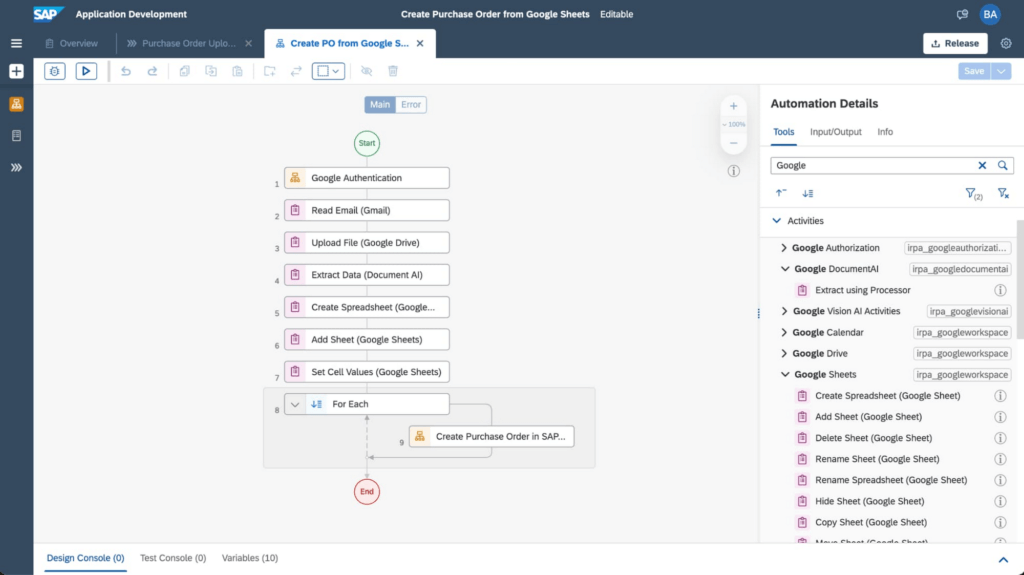
An example of the improvements these integrations have made to SAP Build Process Automation is the use of AI, productivity tools, and automation for processing purchase orders. In the past, workers had to manually select relevant orders in their Gmail accounts and extract key data from large PDF files, including the order date, supplier details, article numbers, quantity, unit price, and the total amount. Then, workers would have to enter all of the individual line items one by one into the SAP S/4HANA system.
Today, through SAP’s integrated automation platform, customers can automatically extract and organize data by Google Workspace (Google Sheets, Google Drive, and Gmail) and Document AI. This works by extracting data contained in Gmail attachments, downloading it into Google Drive and extracting fields using Document AI’s pretrained models. The tool then enters the consolidated order information from Google Sheets into SAP S/4HANA. For example, the Canton of Zurich in Switzerland experienced a significant reduction of workload to process compensation forms once the organization implemented this automation. Furthermore, implementing the automation can avoid audit and compliance issues, and improve data quality.
The screenshot below shows how a workflow operates within the SAP Build Process Automation software.
Sales, procurement, finance, and other functions are also able to handle more strategic work that delivers greater value to customers with these SAP and Google Cloud integrations. They’ve also boosted both security and regulatory compliance for customers, including those in the financial services space.
For example, the Google Cloud Document AI technology can process thousands of supply chain invoices, validates and systematically approves them. And, over time, the machine learning and AI components improve the analysis process and ensure that data processed with SAP Build Process Automation is adhering to a company’s best practices and essential regulatory requirements.
SAP and Google Cloud put automation to work
Achieving the most accurate, efficient business processes is possible with an automation framework that embeds collaboration and productivity applications while giving lines of business and IT users access to machine learning technology. SAP Build Process Automation combined with Google Cloud Document AI, and Google Workspace has proven to be a catalyst in driving innovation and business transformation for customers across multiple industries, leading to an average of 22% to 30% faster time to market, and significant financial gains, including up to 20% accounts payable savings potential. An example of these improvements includes those experienced by TasNetworks, which had a 25% reduction in back-office processing efforts after implementing these technologies.
To learn more about how Google Cloud and SAP are building solutions for accelerating business value, visit cloud.google.com/solutions/sap. You can find more information about SAP Build Process Automation at sap.com/build-automation.
To start your transformation journey today, choose the SAP Business Technology Platform region that’s best for you. We’re also happy to announce that Google Cloud offers the first and only option to run BTP in the cloud in India — learn more here: Google Cloud’s newest SAP Business Technology Platform Region.

3430
Of your peers have already downloaded this article
4:30 Minutes
The most insightful time you'll spend today!
Few industries grapple with the volume of information the financial services industry manages on a daily basis. Whether financial services organizations are analyzing market shifts, or protecting against fraud and money laundering, understanding data and quickly finding the right insights are critical to their success.
Their learnings can be put to use by CFOs across a range of industries.
From the need to analyze more accurately predict revenues based on a variety of market scenarios to finding ways to improve profitability, more CFOs are turning to data, analytics, and machine learning to aid decision-making.
Over the past year, Google has spent a lot of time working with its financial services customers—like HSBC, Citi, UBS, Scotiabank, Two Sigma, and more. And what they’ve found is whether they’re large or small, a startup or a global institution, there are universal themes shared by all.
Here are five ways CFO can use machine learning and the cloud in 2019:
Tackle data silos to unlock the power of their data.
Large, global institutions are using the cloud to overcome the incompatibilities, latencies and blind spots associated with traditional data silos, growing volumes of market data and alternative data sets.
In 2019, we expect to see an increasing number using serverless, advanced data platforms, open APIs, and machine learning capabilities, to make full use of their data for enterprise-wide decision-making with a minimal IT footprint. These decisions will be supported by market data, news and commentary, risk and regulatory data, company data and other specialized and alternative data.
To find out some of the other ways, download the PDF now!
More Relevant Stories for Your Company

Gen App Builder: Create Next-Level AI Search & Conversational Experiences
If you’ve been exploring recently-launched consumer generative AI tools like Bard and thinking about how to build similar experiences for your business, Generative AI App Builder, or Gen App Builder for short, is here to get you started.Gen App Builder is part of Google Cloud’s recently announced generative AI offerings and lets developers, even

Google Migration and BigQuery Brings PedidosYa Closer towards its Goal of Becoming Data-driven
Editor’s note: PedidosYa is the market leader for online food ordering in Latin America, serving 15 markets and over 400 cities. It’s also one of the largest brands within the German multinational company Delivery Hero SE. With over 20 million app downloads, PedidosYa provides the best online delivery experience through




Baking Gets Sweeter: Build ML Models that Help Predict the Best Recipe!
Baking recipes and ML models have one thing in common—they follow a pattern. Machine Learning is all about finding pattern in data sets, you can predict what you are baking based on the core ingredients and their respective amounts! Bread, cake or cookies, watch the video to make you make

Revolutionizing Generative AI Applications with Google’s Vertex AI
At Google Cloud, we’re committed to making generative AI useful for everyone. Doing so requires more than making powerful foundation models available to businesses, governments, and developers. Models also need to be backed by platforms that make adoption faster and safer, with onramps to meet organizations wherever they are, regardless of their
