





Workforce Identity Federation: A Seamless Experience for Users

2747
Of your peers have already read this article.
2:30 Minutes
The most insightful time you'll spend today!
At Google Cloud, we’re focused on giving customers new ways to strengthen their security posture. Managing identities and authorization is a core security control that underpins interactions inside and collaboration outside the organization. To address fraud, identity theft, and other security challenges associated with the proliferation of online accounts, many organizations have opted to use centralized identity provider (IdP) products that can help secure and manage identities for their users and SaaS applications, and we want to strengthen support for these solutions and the use cases they support.
Today we’re pleased to announce Workforce Identity Federation in Preview. This new Google Cloud Identity and Access Management (IAM) feature can rapidly onboard workforce user identities from external IdPs and provide direct secure access to Google Cloud services and resources. Workforce Identity Federation uses a federation approach instead of Directory Synchronization, the method currently used by most organizations for onboarding Google Cloud identities. Workforce Identity Federation provides flexibility to support third-party collaboration use cases and business requirements that can be better addressed by using a localized, customer-managed IdP.
Federating existing identities eliminates the need to maintain separate identities across multiple platforms. This means that organizations using Workforce Identity Federation no longer need to synchronize workforce user identities from their existing identity management solutions to Google Cloud. IdPs can include Identity-as-a-Service (IDaaS) and directory products such as those from ForgeRock, Microsoft, Okta, JumpCloud, or Ping Identity.
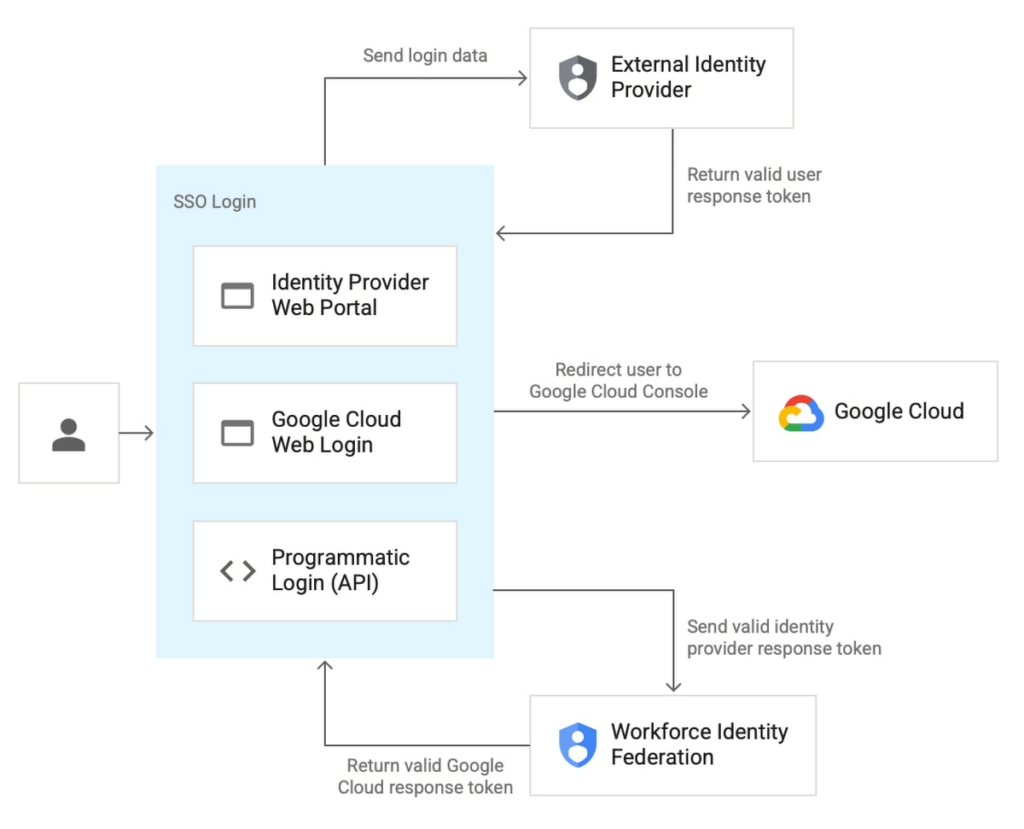
Workforce Identity Federation is another example of how we are working to make Google Cloud’s Invisible Security vision a reality, in this case delivering secure access leveraging customers’ current identity and access management solutions without the need for redundant user administration

VMware is one of our customers using Workforce Identity Federation in Preview. Thiru Bhat, director at VMware, explained why he’s excited for the new feature.
“VMware runs its own IdP and we needed a solution to allow our developers to access their Google Cloud projects while maintaining corporate control over identities and permissions. Syncing of user identities outside of our IdP is not permitted per our InfoSec policies and we deployed Google Cloud’s Workforce Identity Federation to fulfill our identity requirements. Workforce Identity Federation feature meets our needs with a solution that is robust and straightforward to configure.”
Here’s a closer look at a few use cases and the benefits from the new Workforce Identity Federation.
Use case: Employee sign-in and authorization
Streamlined authentication experience with fine-grained access control
Workforce Identity Federation can enable your organization’s users to access Google Cloud through the same login experience they already use for their existing IdP for single sign-on. Workforce Identity Federation also can enable fine-grained access through attribute mapping and attribute conditions. Attributes — which some IdPs call claims — contain additional information about users.
Google Cloud can use these attributes to further inform authentication decisions. Attribute mapping lets your administrators map identity attributes that are defined in your IdP to those that Google Cloud can use. Your administrators can configure Google Cloud with attribute conditions to authenticate conditionally — to let only a subset of external identities authenticate to your Google Cloud project based on attributes.
For example, your administrators might want to let only those employees who are part of the accounting team sign in. To do this, your administrators can configure an IdP attribute, such as EmployeeJobFamily. Using attribute mapping, they could map this attribute to a similar attribute in Google Cloud, such as employee_job_family. Then, they could configure an attribute condition, assertion.employee_job_family=="accounting".
Use case: Secure access for partners and vendors
Restricted and secure access to Google Cloud services from a partner or vendor that has their own IdP and associated privacy and data policies
Today, the modern enterprise depends on partners and vendors more than ever. Partners and vendors can help scale enterprise workflows, but they also can introduce new complexities for IT teams, such as how to secure partner or vendor identities in addition to the rest of their enterprise users.
Workforce Identity Federation can enable enterprises to selectively federate users from partner or vendor IdPs without requiring enterprise IT teams to sync or create a separate identity store to use Google Cloud resources.
One common scenario where Workforce Identity Federation can help is when a company hires a partner or vendor to provide outsourced development services using cloud resources (such as when Google Kubernetes Engine (GKE) DevOps services are outsourced to a partner.) The company creates a separate workforce pool for the partner or vendor’s administrator, who can then use their own IdP to grant access to their workforce.
This use case can also help support organizations who have requirements to store and maintain identity information locally in support of data residency or digital sovereignty initiatives. By using a local IdP, either customer-managed or partner-managed, and federating identities to Google Cloud, organizations can further strengthen control over their identity information.
Seamless experience for users, easy access management for administrators
Before Workforce Identity Federation, organizations would need to duplicate user identities from their IdP by creating user accounts in Google Cloud Identity. Workforce Identity Federation can help you access Google Cloud without having to first create Cloud Identity user accounts. It also reduces toil by eliminating the need to maintain two separate identity management systems.
Identity providers such as ForgeRock see tremendous value in the Workforce Identity Federation, and how Google Cloud can work with them to jointly help customers manage workforce identities. Peter Barker, ForgeRock’s Chief Product Officer, said that his company’s partnership with Google Cloud makes identity management easy and secure for administrators and users alike.
“Our strategic partnership with Google Cloud delivers great value to our customers and we’re excited to continue to expand our relationship. This integration with Google Cloud Workforce Identity Federation enables ForgeRock customers to leverage their current IAM investments and makes it easier for employees, contractors, and partners to securely access Google Cloud resources.”
Getting started with Workforce Identity Federation
Workforce Identity Federation is now available in Preview to customers already using Google Cloud. You can learn more about Workforce Identity Federation by visiting our webpage and watching this video.
Please contact your account manager to see if workforce identity federation is the right fit for your organization. And, you can get started with these new capabilities today using our product documentation.
5230
Of your peers have already watched this video.
17:00 Minutes
The most insightful time you'll spend today!
AppSheet: Reduce Shadow IT and Accelerate Development of Enterprise-grade Apps
Google Cloud findings suggest that nearly 40 percent of organizations’ investments are consumed by shadow IT and can be a detractor to the adoption of cutting-edge tools and solutions. Also, about 51 percent of the surveyed executives are of the opinion that the inability to adapt to digital transformation trends and practices are at the risk of going out of business in the next 3-4 years. However, enterprises need not be blindsided by the mounting expenses involved with the implementation and optimization of solutions and tools meant for empowering employees. AppSheet, Google Cloud’s no-code application development and automation platform is at the helm of empowering organizations to custom build apps for employees without relying on third-party services.
Watch the video from the Google Workspace sessions of Next ’21 to hear experts’ insights on AppSheet to effectively govern workforce and ward off security threats to helps employees build enterprise-grade applications!
5192
Of your peers have already watched this video.
25:30 Minutes
The most insightful time you'll spend today!
Modernize Your Security Posture for Cloud-Native Applications with Anthos
Modern security approaches have moved beyond a traditional perimeter-based security model. As many organizations seek to adopt cloud-native architectures and are deploying applications in hybrid and multi-cloud environments they demand a more flexible and extensible approach towards security.
Learn how to address security issues as early in the development and deployment life-cycle as possible—when addressing security issues can be less costly—and do so in a way that is standardized and consistent. Help keep your organization secure and compliant with Anthos.
The Tech Tightrope: How the U.S. State & Local Agencies Strive to Balance between Innovation and Budget

5019
Of your peers have already read this article.
1:30 Minutes
The most insightful time you'll spend today!
State and local government (SLG) agencies are reeling from a combination of unbudgeted COVID-related expenses and reduced tax revenue caused by unemployment and business closures. Any way you look at it, the situation is challenging. To understand how SLG agencies are coping, Google Cloud collaborated with MeriTalk to survey 200 SLG IT and program managers, uncovering some revealing trends in SLG technology innovation. Unsurprisingly, approximately 84% of SLG organizations report making budgetary tradeoffs to bridge funding the gaps the ongoing pandemic has created.
However, researchers discovered a silver lining: The pandemic has also been a catalyst to modernize the legacy infrastructure in states and cities. The majority of survey respondents (88%) reported that their agency made greater modernization progress this past year than in the prior 10 years.
Walking a tightrope between innovation and budget pressure
According to 89% of state and local leaders, now is the time to invest in technology modernization. But 80% are experiencing a funding gap due to unbudgeted expenses related to the pandemic and declining tax revenue, which makes finding that balance between innovation and budget a serious challenge.
Some agencies are achieving the impossible, though. For example, the City of Pittsburgh Department of Innovation and Performance is working with Google Cloud to migrate and modernize its legacy IT infrastructure. By decommissioning their data center and moving to Google Cloud, the city can build new data analytics tools to drive smart city initiatives and create entirely new applications to improve digital service delivery for its residents. As a result, the city will save costs, abandon its brittle legacy IT structure, and create a cloud-based technology platform for the future—becoming the region’s leader in cloud-native software development.
Google Cloud is enabling the city’s IT team by curating and delivering our certification training at no cost. The program includes live training sessions as well as on-demand training.
Bridging funding gaps
In their drive to modernization, many SLG leaders are turning to grants as an important source of funding. Approximately 84% of those surveyed report making tradeoffs to bridge funding gaps, such as moving resources away from operations and maintenance (37%), increasing reliance on pandemic-related funding (31%), and delaying internal modernization efforts to enable remote work for employees (29%). One way that states are dealing with this tension between budget gaps and the need for innovation is to turn to Google Cloud for cost savings and improved capabilities.
For example, Google Cloud is helping the State of West Virginia innovate and enhance IT security despite decreased state funding. The state entered a multi-year agreement to ensure full access to enterprise-level Google Workspace capabilities for 25,000 state employees, keeping the state at the forefront of technology advancements at a projected cost savings of $11.5 million.
Similarly, Google Cloud helped build the Rhode Island Virtual Career Center to help the state’s constituents get back to work. Using familiar productivity tools within Google Workspace, employees can access new career opportunities quickly, while employers can reach more candidates. Skipper, the CareerCompass RI bot, uses data and machine learning to connect Rhode Islanders with potential new career paths and reskilling opportunities.
Enhancing services
Google Cloud is also helping agencies enhance services, including working with the State of Illinois to get unemployment funding to constituents in need.The state is using Contact Center AI to rapidly deploy virtual agents that help more than 1 million out of work citizens file unemployment claims faster. Capable of engaging in human-like conversations, these intelligent agents provide constituents with 24/7 access and enable government employees to focus on more complex, mission-critical tasks—such as combating fraud. In summer 2020, the virtual agents handled more than 140,000 phone and web inquiries per day, including 40,000 after-hours calls every night. The state anticipates an estimated annual savings of $100 million from the solution, which was deployed in just two weeks.
Working with Google, Ohio also uncovered $2 billion in fraudulent unemployment claims. We will continue to partner with the state to find fraudulent claims, and prioritize the processing of legitimate claims.
Focusing on cybersecurity
Despite expanding security threats topping NASCIO’s list of 2021 State CIO priorities, more than one in three IT managers (35%) say their organization reduces security measures to expedite timelines. Partnering with Google Cloud has enabled many agencies to enhance their security measures while modernizing and staying within budget, investing in support for remote work devices, digital services for residents, and cybersecurity.
NYC Cyber Command works with city agencies to ensure systems are designed, built, and operated in a highly secure manner. NYC3 followed a cloud-first strategy using the Google Cloud Platform. The virtual operations demanded by the pandemic have increased the importance of security and compliance in SLG. Google Cloud is committed to act as a security transformation partner and be the trusted cloud for public sector agencies.
Finally, to strengthen public and private partnerships, SLG organizations told MeriTalk that they need vendor partners to support modernization efforts for flexibility and collaboration (46%), need innovation-focused leadership groups to help balance technology needs with budget constraints (41%), and they expect significant returns on investments in cloud computing (38%), and data management/analytics (33%).
Google Cloud is helping SLG customers across the country invest in innovation to walk the tech tightrope—balancing innovation and budgets—and helping to build a more resilient future. Visit the State and Local Government solutions page to learn more.
Data Security Excellence: Google Takes the Lead in Forrester’s Wave Report

1294
Of your peers have already read this article.
3:30 Minutes
The most insightful time you'll spend today!
To help organizations confidently move their sensitive data to the cloud, Google Cloud works diligently to earn and maintain customer trust. Our Trusted Cloud is committed to giving you a secure foundation that you can verify and independently control. Discovery and protection of sensitive data are integral parts of Google Cloud’s strategy to safeguard customer data. With this as our longstanding approach to protecting customers, we are happy to share that Forrester Research has ranked Google Cloud a Leader in The Forrester Wave™ Data Security Platforms Q1 2023.
Relentless security innovation leveraging Google’s core strengths
Google keeps more people safe online than anyone else. The scale at which we operate allows us to pioneer approaches to cloud-native security and then bring them to commercial and public sector organizations everywhere they operate. Leveraging our data processing and novel analytics capabilities with artificial intelligence and machine learning (AI/ML) allows our technology to help protect enterprises and their end users. At the core of our data security capabilities is our data loss prevention (DLP) technology, which enables customers to discover, classify, and de-identify data in real-time, on-demand, continuously, and in event-driven workloads.
In their explanation for the ranking, Forrester noted in its report “Cloud-first, Google has notable areas of innovation focus, such as harnessing machine learning (ML) and artificial intelligence (AI), productizing internal innovations, and co-innovation with partners in areas like confidential computing, data sovereignty controls, and external cloud key management services.”
Embedded across multiple Google products
Our platform supports the discovery of corporate assets in Chrome Enterprise and Google Workspace applications including Gmail and Google Drive. We also provide support for discovering production and analytical assets such as object storage, relational databases, data warehouses, data lakes, production apps, and workloads such as migration/ETL. This technology identifies and detects various types of sensitive data using a comprehensive set of built-in infoType detectors that are ready to use out-of-the-box along with flexible custom detection options and rules. Types of sensitive data include personal identifiable information and personal health information (PII/PHI), financial identifiers, health context, multi-cloud credentials/secrets, and ML-based full document classification (including source code, SEC filings, and legal briefings).
Driven by Zero Trust principles
The Forrester Wave identified the 14 top significant data security platform providers. Forrester notes in the report that “[Google] also stands out for manageability and integrations for Zero Trust.” and “Google is a strong choice for organizations considering or currently using GCP as well as those using Google Workspace who are taking a Zero Trust approach to enabling bring your own device (BYOD) and remote work.”
Delivering value for our customers
We are honored to be a Leader in The Forrester Wave™: Data Security Platforms, Q1 2023 report. We look forward to continuing to innovate with you and make your digital transformation journey safer with our Trusted Cloud.
A copy of the full report can be viewed here.
Tips and Best Practices: Ensuring Cloud Configuration Compliance

2672
Of your peers have already read this article.
2:30 Minutes
The most insightful time you'll spend today!
Security is often seen as a zero-sum game between “go fast” or “stay secure.” We would like to challenge this school of thought and introduce a framework to change that paradigm to a “win-win game,” so you can do both—“go fast” and “stay secure.”
Historically, application security tools have been implemented much like a gate at a parking lot. The parking lot has perimeter-based ingress and egress boom gates. The boom gates let one car through at a time, and vehicles often are backed up at the gates during busy hours. However, there are few controls once you get inside. You can access nearly any space on any level and easily move between levels.
When you apply this analogy to application development, AppSec tools are often implemented as “toll gates” within waterfall-native workflows. Developers are required to get in line, submit to a security scan, and wait to see the results. When the results are produced, developers spend significant time and energy investigating red flags raised by security. This process is slow and, not surprisingly, not very popular with developers. It’s why they often view traditional security programs as inhibitors to innovation.
Guardrails not gates
We suggest a workflow that’s less like a parking lot gate and more like a freeway with common-sense safety measures. Freeways have directive rules for all users. Speed limits, single direction of travel, and mandatory speed reduction zones when exiting contribute to freeway safety. Some freeways implement preventative measures based on these rules, such as physical walls dividing opposite flows of traffic and protective guardrails to reduce collisions and keep vehicles from veering off the road. While driving on a freeway comes with its own complications, there are no boom-style gates blocking your path.
Following the same directive rules, there are detective and responsive controls, such as speed detectors, cameras, signs reminding drivers which direction they are going, and how fast they are traveling. Some freeways have deployed rumble strips to remind a dozing driver to stay in their lane.
Applying lessons from freeways to application development and compliance in the cloud represents the perfect opportunity to build software more securely.
Modern application security tools should be fully automated, largely invisible to developers, and minimize friction within the DevOps pipeline. To do this, these security tools should work the way developers want to work. Security controls should integrate into the development lifecycle early and everywhere. These controls should live within the developer’s preferred tools and create rapid feedback loops so mistakes can be remediated as soon as possible.
A typical compliance cycle looks like this:
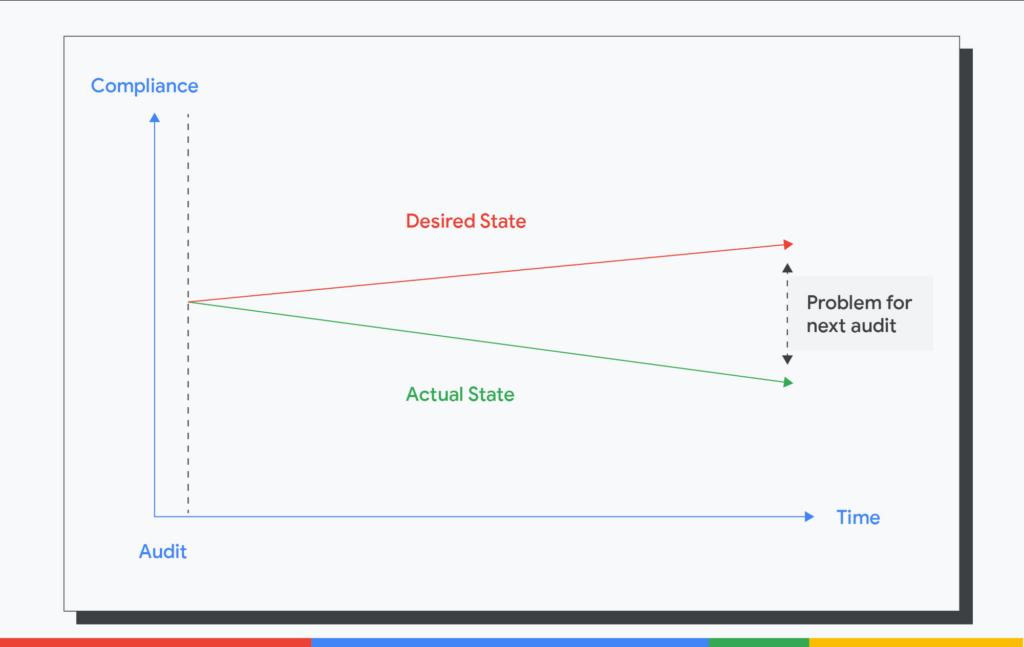
Here, we highlight the gap between the desired state and the actual state that becomes problematic when audit times come. This increases the overall cost of the audit and the time spent in generating the evidence of controls.
Instead, this is what we need.
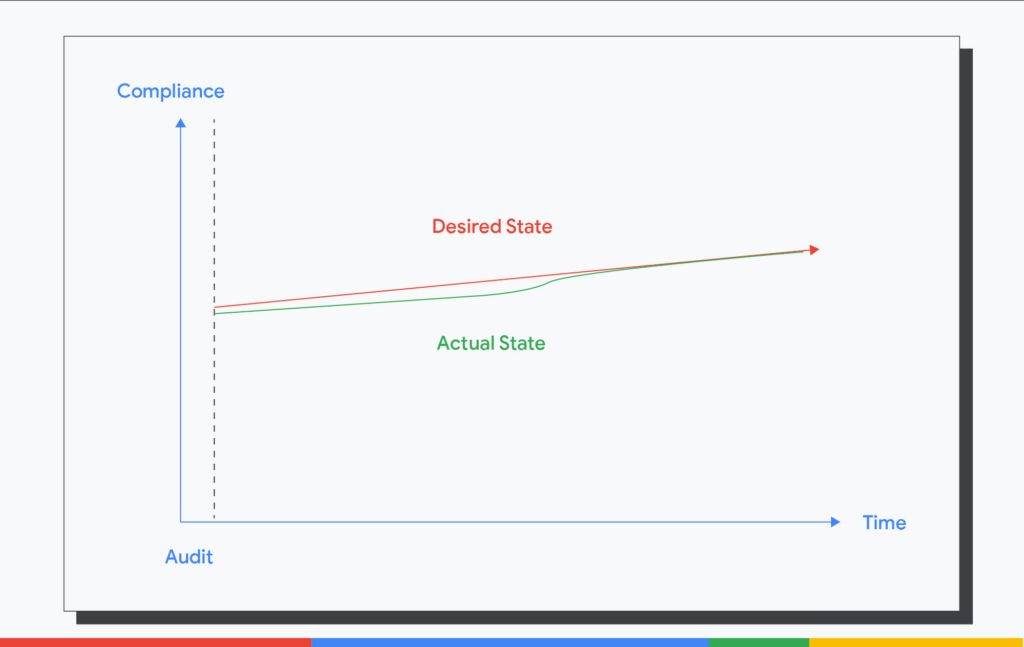
We need the actual state to track the desired state continuously. We need continuous preventative controls to stop insecure resources from being introduced. We need detective controls to find non-compliant resources promptly and constantly. We need responsive controls to fix non-compliant resources automatically. In all, we need continuous compliance.
Infrastructure continuous compliance reference architecture
How do we get started with continuous compliance? Here is the reference architecture that enables you to develop this capability.
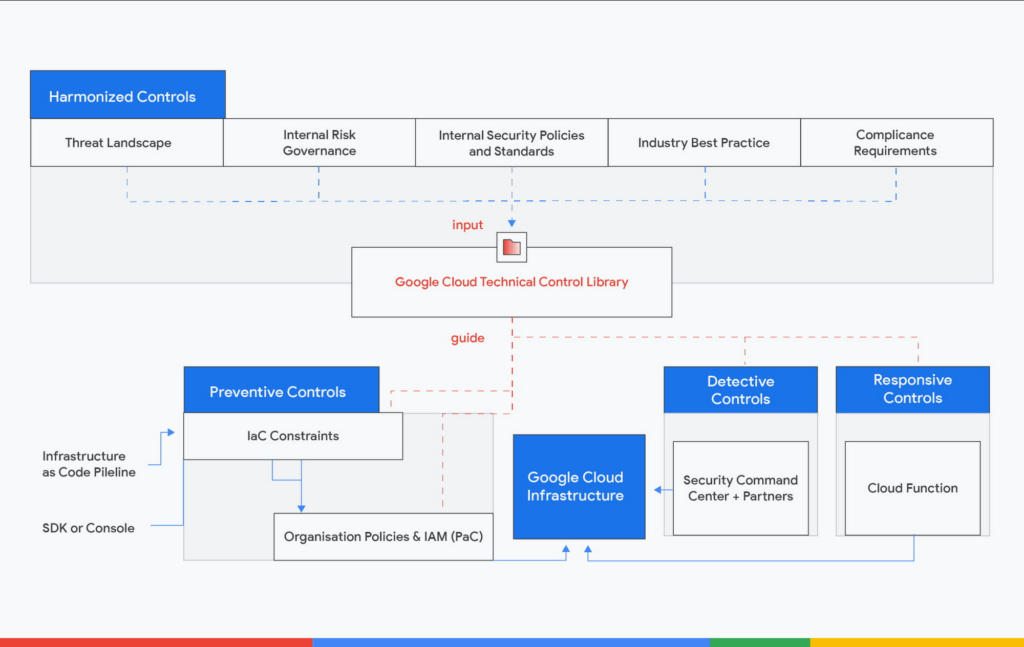
The architecture is centered on building a close-loop of directive, preventative, detective and responsive controls. It is also open and extensible. Although we reference Google Cloud architectures in this blog, you can use them for other cloud service platforms or even on-premise
The National Institute of Standards and Technology’s Open Security Controls Assessment Language (OSCAL) is a helpful resource to express your control library in a machine-readable format. OSCAL can allow organizations to define a set of security and privacy requirements, which are represented as controls, which then can be grouped together as a control catalog. Organizations can use these catalogs to establish security and privacy control baselines through a process that may aggregate and tailor controls from multiple source catalogs. Using the OSCAL profile model to express a baseline makes the mappings between the control catalog and the profile explicit and machine-readable.
Directive controls
The starting point of the close-loop is the directive and harmonized controls. Next, you should have control mappings rationalized to the technical controls against your compliance requirements. These requirements can come from various sources, such as the threat landscape of your industry, your internal security policies and standards, your external regulatory compliance, and industry best practice frameworks.
Control mappings will form a Technical Control Library. The library is a dataset mapping out harmonized controls to requirements written in different compliance frameworks. The control mapping justifies the security controls. It builds the linkage between security and compliance and helps you reduce your compliance audit cost. This dataset should be a living document.
An easy first step in building such as library is to begin with the CIS Google Cloud Platform Foundation Benchmark. The benchmark is lightweight and it constitutes foundational security any entity should get right on Google Cloud. In addition, Security Command Center Premium’s Security Health Analytics can help you to monitor your Google Cloud environment against these benchmarks on a continuous basis across all the projects within your organization.
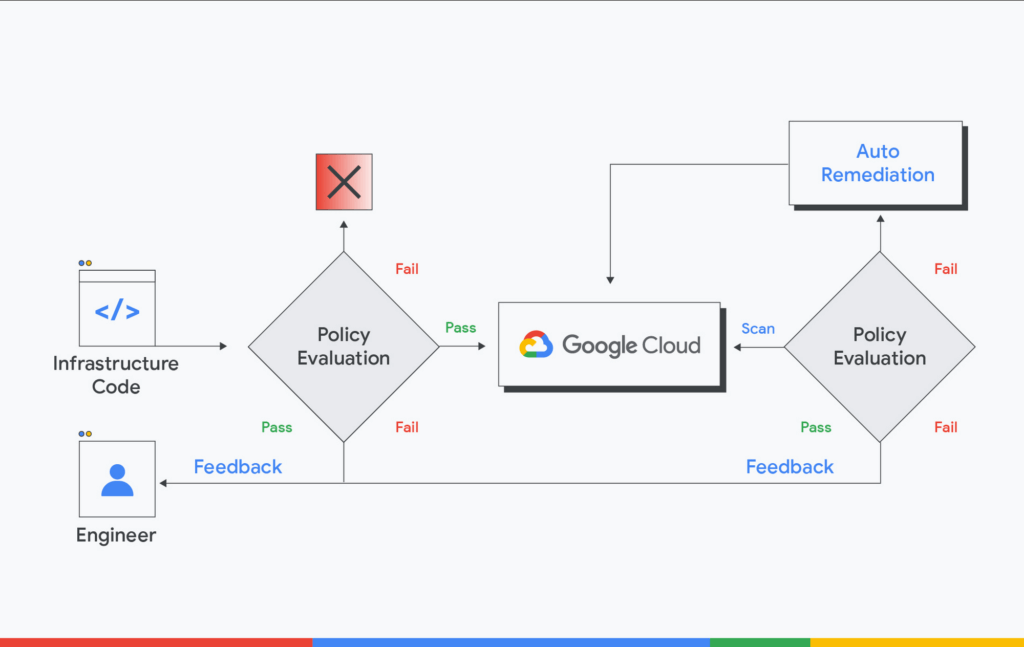
The Technical Control Library will guide the rest of the closed-loop. For every directive control, you should have corresponding preventative control to stop non-compliant resources from being deployed. You should have the detective control to look over the entire environment seeking non-compliant resources. And you should have the responsive control remedying non-compliant resources automatically or kicking off responsive workflow with your Security Operations function. Finally, every policy evaluation point should have a feedback loop to the engineers. A prompt and meaningful feedback loop provides a better engineering experience and increases development velocity in the short run. These feedback loops will breed good behaviors to write better and more secure code in the long run.
Preventive controls
Almost every action on the Google Cloud is an API call, such as when creating, configuring, or deleting resources, so preventative controls are all about API call constraints. There are different wrappers for these API calls, including Infrastructure-as-Code (IaC) solutions such as Terraform or Google Cloud Deployment Manager, the Cloud Console interface, Cloud Shell SDK, Python, or GO SDK.
As with any other application code deployment, the IaC solutions should use a Continuous Integration (CI) solution. On the CI, you could orchestrate IaC constraints, similar to writing unit tests for application code. Since all IaC solutions come in or can be converted to JSON format, you can use Open Policy Agent (OPA) as the IaC constraint solution. OPA’s Rego policy language is declarative and flexible, which allows you to construct almost any policy in Rego.
For the input sources that are not IaC, you could fall back to the organization policies and IAM as these two controls have the closest proximity to Google Cloud. That said, it’s considered a best practice to restrict non-IaC inputs for higher environments such as production-like or production, so you could codify your infrastructure, apply controls and workflows in the source repository.
Detective and responsive controls
Even if you’ve nailed the preventive controls, and the cloud environment is sterile, we still need detective and responsive controls. Here’s why.
For one, not all the controls can be safely implemented as preventative controls in the real world. For instance, we may not fail all the Google Compute Engine deployments at the CI if these VMs have external IP addresses because external IP addresses may be required for a specific software or use cases. Another reason is that we want to produce time-stamped compliance status for audit purposes. Taking the CIS compliance as an example, we could have enforced all the CIS check on the CI and set IaC as the only deployment source for cloud infrastructure.
However, we will still need to demonstrate the runtime CIS compliance report using Security Command Center. Security responsive controls are not limited to remediation actions. They can also take the form of notifications via email, messaging tools, or integration with ITSM systems. If you use Terraform to deploy the infrastructure and use Cloud Function for auto-remediation, you need to pay attention to the Terraform state. Since auto-remediation actions performed by Cloud Function are not recorded in the Terraform state file, you will need to inform the engineers to update the source Terraform code.
The future
The fact that manual processes around security and compliance don’t scale points to automation as the next enabler. The economics of automation require a systemic discipline and holistic enterprise-wide approach to regulatory compliance and cloud risk management.
By defining a data model of the compliance process, the aforementioned OSCAL represents a game-changer for automation in risk management and regulatory compliance. While we realize that adopting “as code” practices is a long-term investment for most of our customers, Risk and Compliance as Code (RCaC) has a number of building blocks to get you started. By adopting the RCaC tenets you shift towards codified policies and infrastructure for a secure cloud transformation. Stay tuned as we introduce exciting new capabilities and features to Google Cloud Risk and Compliance as Code in the months to come.
More Relevant Stories for Your Company

Next-Level Ecommerce Engagement: Transforming User Identities with GCIP
One of the fundamental questions that retailers constantly ask themselves is how well they know their customers and how they can build deeper relationships. Knowing who their customers are can have a direct impact on improving customer engagement, which can lead to increased conversion rates, customer loyalty, lifetime value, and

Three Lesser-Known Ways to Protect Your Customers and Business From Phishing and Fraud
Your users are critical to your business, and you need security controls to keep them — and your business — safe. Built from years of Google Cloud technology and experience, these security features focus on keeping users safe on the web. You can reduce online fraud (chargebacks, hijackings, and abuse)


Application Development with Kpt
Learn how to create and customize configuration packages with Kpt to build applications and adhere to configuration-as-data philosophy.

Know the Leaders of Google Cloud Public Sector Community
At Google Cloud, being a strategic partner is part of our DNA. Whether it’s listening closely to our customers, helping to build team skills for innovation or simply being there (since we know the cloud is 24/7), we get excited about working hands-on with customers to deliver new solutions. As
