





Why Now Moving to Cloud is Great for Media and Broadcasting Companies

3259
Of your peers have already read this article.
1:30 Minutes
The most insightful time you'll spend today!
The broadcasting industry has gone through many evolutions since its inception. From linear over-the-air (OTA) to digital & personalized, to standard to ultra high definition, these evolutions were driven by increased demand from viewers who want more choices. The next evolution is happening now, driven by the emergence in cloud computing in a globally connected world. Broadcasters are understanding that the key for long-term success is embracing technical agility while they innovate their business models. Google Cloud technologies can provide a path for continual transformation, empowering broadcasters a multitude of ways to chart their own growth.
As broadcasters evolve their business models and operations for a digital future, evaluating both financial alongside operational benefits will lead to the best outcome. Legacy and siloed media supply chains restrict the ability to deliver content quickly across multiple consumption platforms. By understanding how cloud capabilities can provide cost savings, allow for more efficiency and scale, and open new revenue streams, broadcasters can harness flexible cloud technologies while achieving cost savings and increasing revenue.
Media workflows in the cloud
Over the last few years we have seen tremendous growth from media companies migrating their supply chains to the cloud. Today, there exists a whole ecosystem of media technologies that are built to take advantage of the cloud. “Does it work on the cloud?” is no longer driving the conversation. Rather, media companies now want to understand how Cloud can integrate with their business and drive better business outcomes.
Over the last years we have partnered with leading media companies including Grupo Globo, TelevisaUnivision and others to not only migrate their content supply chain to the cloud, but also leverage cloud capabilities to innovate their services to:
- Increase and streamline content production
- Distribute personalized content at planet scale
- Forge deep relationships with their audiences
- Identify new monetization opportunities
Impact of Cloud on Performance & Financials
M&E companies need to be able to provide more content at a quicker pace, with experiences that are seamless and exciting to viewers to retain their attention and dollars. Moving legacy systems and processes to the cloud is an organization-wide commitment, and the journey can pay off financially, while providing M&E companies valuable industry capabilities. With Google Cloud business value engagement framework, we partner to identify where there are opportunities in cost, output, and impact that IT can have.
Below are some examples of how we have worked with our customers to map organization optimizations to business drivers

Working Together – How can Google help
Our focus with customers is to help identify and understand the challenges that Media & Entertainment companies have in moving to the cloud, and coming up with the plan and solutions that Google can do to overcome them. Together we commit to understanding your business, both where you are right now in your IT capabilities as well as the progress you want to make to continue providing the best digital capabilities to clients and employees.
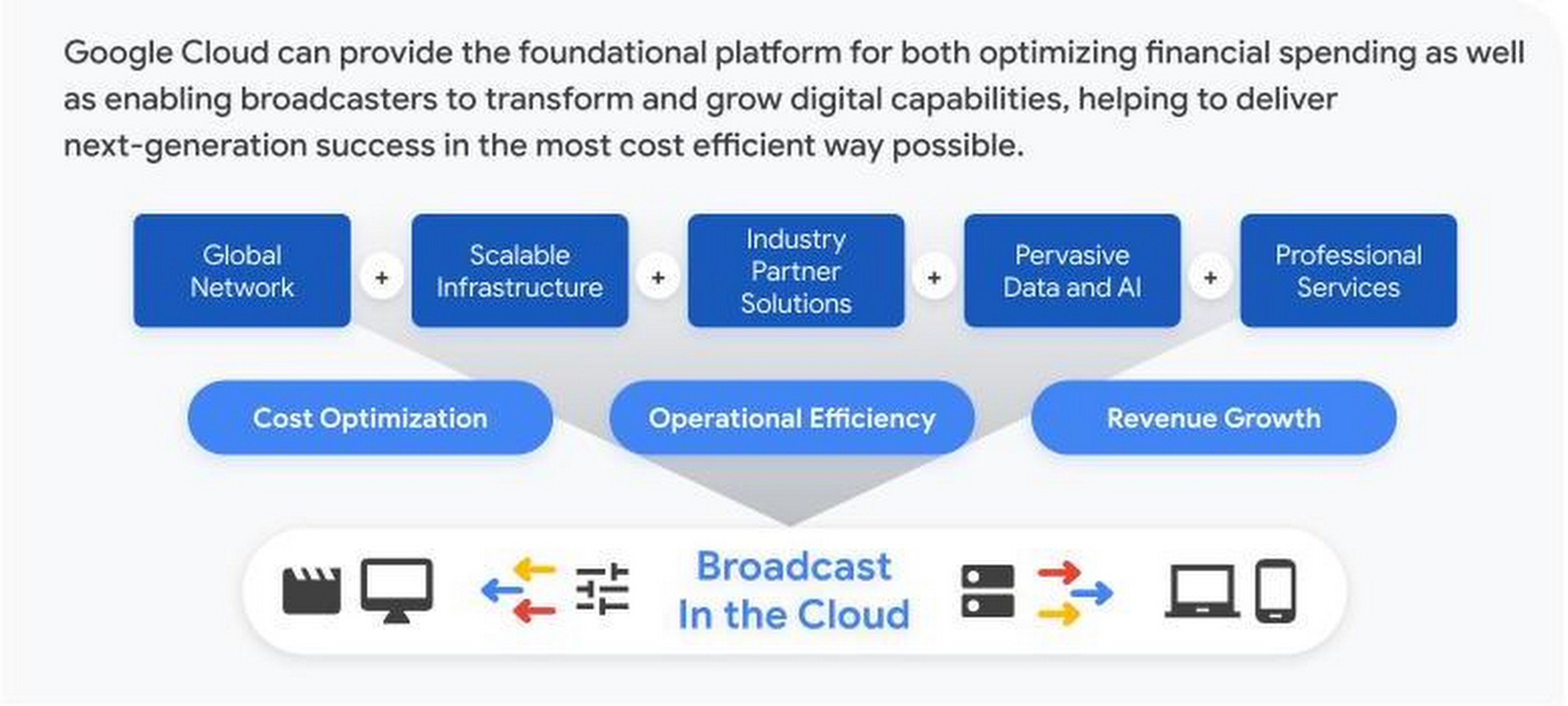
As broadcasters move more processes and solutions to the cloud, the exponential effect of harnessing data and AI power will provide incremental business value across all lines of business. Combined, these impacts to a broadcaster allow both operational excellence while optimizing costs as they continue to expand offerings to customers and regions around the world.
We recognize that every media company’s journey is different and so are expected business outcomes. Google Cloud works closely with customers – partnering every step of the way – to align technology, the media industry, and business outcomes.
3479
Of your peers have already watched this video.
1:30 Minutes
The most insightful time you'll spend today!
Pharma Firm Drives 80% Improvement in Speed with SAP on Google Cloud
FFF Enterprises is a leading supplier of critical-care biopharmaceuticals, plasma products, and vaccines. Their passion for patient safety and product efficacy drives their mission of Helping Healthcare Care.
For FFF Enterprises if they have to focus on ERP infrastructure, that takes away from getting products to patents. Learn why FFF Enterprises chose to deploy SAP on Google Cloud and drove an 80% improvement in speed for their SAP environment at a lower cost.
TVG Network Turns to Google Cloud and Saves $0.5 Million a Year

3636
Of your peers have already read this article.
2:30 Minutes
The most insightful time you'll spend today!
Google Cloud Results
- Maximizes revenue by allowing customers to place bets faster and more confidently
- Scales for major racing events with 80% less IT involvement and up to $500,000 annual savings
- Improves time to market for new product releases by more than 30x
- Helps enable richer mobile experiences to keep fans engaged
- Processes up to 6,000 bets per minute
The first Saturday of May is the biggest horse racing event in North America each year. Minutes before the race, millions of dollars in online bets will flow in through advanced deposit wagering (ADW) operators such as TVG Network. For TVG’s IT team, it’s a high-stakes game: If wagering systems can’t handle thousands of requests per second, revenue and customers will be lost.
To avoid downtime before a major race, TVG used to bombard its systems with ad-hoc load tests a month in advance. Before each big race event, a team of seven people spent eight hours a week deploying new infrastructure and testing various scenarios. But with complex legacy systems and manual processes, the team’s efforts could only go so far. If an unexpected system issue or undetected bottleneck was found during the run-up to the big race, all bets were off.
After a brush with downtime in 2016, TVG decided to move its ADW application to the cloud, taking the opportunity to rewrite the application to take advantage of modern, container-based architectures. After a short period of development on a different cloud services provider, TVG moved to Google Cloud Platform using Google Kubernetes Engine to automate container management and orchestration.
“We chose Google Cloud Platform because it was the most reliable, cost-effective, and automated cloud solution available,” says Tim Morrow, CTO at TVG Network. “We get better security, strong compliance, and the peace of mind that when the biggest race day rolls around, we won’t have any downtime.”
Placing the right bet
Moving to Google Cloud Platform gives TVG a variety of options in different regions and availability zones to satisfy regulatory requirements. Google Cloud Platform offers continuous availability and transparent maintenance, with no scheduled downtime or patching requirements.
“For our online wagering site, we prefer Google’s philosophy of continuous availability and live migration,” says Tim. “Having to plan for scheduled downtime of cloud instances just seems ridiculous in this day and age. And with Google Cloud Platform, we get much more consistent performance as we scale.”
To keep its IT team focused on value-added tasks, TVG uses Google Cloud managed services such as Cloud Bigtable, a highly scalable NoSQL database, as well as Cloud Storage for backups and Cloud Pub/Sub for real-time messaging between applications.
“We like the software-defined nature of Google Cloud Platform,” says Saeid Vafaeisefat, Vice President of IT, TVG Network. “The managed services are so easy to use. Google Cloud Platform even helps us mitigate and absorb distributed denial of service attacks with its global load balancing features, which we don’t pay extra for.”
TVG worked with SADA Systems, a Google Cloud Premier Partner, for consulting and deployment assistance. “SADA Systems helped us gain a deeper understanding of the advantages of Google Cloud Platform so we could make better decisions about how our application would perform and scale,” says Saeid. “They provided the facilitation, follow-up, and expert advice we needed to make our deployment a success.”
Scaling with 80% less work
With an active-active cloud architecture spanning multiple regions and the ability to conduct continuous, automated load tests, TVG no longer worries about downtime during major racing events—or any time, for that matter. Infrastructure and tools that used to be required to scale and provide resiliency are no longer needed, reducing CapEx. And with autoscaling replacing human intervention, accidental downtime is much less of a concern.
“With Google Cloud Platform, we can scale for major racing events with 80% less IT involvement and up to $500,000 annual CapEx savings,” says Tim. “Google Cloud Platform gives us faster deployment—we’re releasing new enhancements to our wagering site four times a week instead of every two months.”
More profitable user journeys
TVG’s success is being driven by ongoing modernization made possible in part by Google Cloud Platform, with TVG becoming the first U.S. operator to launch native iPhone and iPad apps. Lower latency means that stale data is never an issue, allowing customers to place bets faster and more confidently from anywhere they happen to be—which generates more revenue for TVG.
“Being on Google Cloud Platform has allowed us to develop our customer-facing channel faster while focusing on automated deployment and immutable infrastructure,” says Tim. “We have far greater confidence in our platform, and last year we broke records on our major race days while delivering an excellent customer experience.”
Quick Recap on Google Cloud: Latest News, Launches, Updates, Events and More
12936
Of your peers have already read this article.
2:00 Minutes
The most insightful time you'll spend today!
Want to know the latest from Google Cloud? Find it here in one handy location. Check back regularly for our newest updates, announcements, resources, events, learning opportunities, and more.
Tip: Not sure where to find what you’re looking for on the Google Cloud blog? Start here: Google Cloud blog 101: Full list of topics, links, and resources.
Week of May 24-May 28 2021
- Google Cloud for financial services: driving your transformation cloud journey–As we welcome the industry to our Financial Services Summit, we’re sharing more on how Google Cloud accelerates a financial organization’s digital transformation through app and infrastructure modernization, data democratization, people connections, and trusted transactions. Read more or watch the summit on demand.
- Introducing Datashare solution for financial services–We announced the general availability of Datashare for financial services, a new Google Cloud solution that brings together the entire capital markets ecosystem—data publishers and data consumers—to exchange market data securely and easily. Read more.
- Announcing Datastream in Preview–Datastream, a serverless change data capture (CDC) and replication service, allows enterprises to synchronize data across heterogeneous databases, storage systems, and applications reliably and with minimal latency to support real-time analytics, database replication, and event-driven architectures. Read more.
- Introducing Dataplex: An intelligent data fabric for analytics at scale–Dataplex provides a way to centrally manage, monitor, and govern your data across data lakes, data warehouses and data marts, and make this data securely accessible to a variety of analytics and data science tools. Read more.
- Announcing Dataflow Prime–Available in Preview in Q3 2021, Dataflow Prime is a new platform based on a serverless, no-ops, auto-tuning architecture built to bring unparalleled resource utilization and radical operational simplicity to big data processing. Dataflow Prime builds on Dataflow and brings new user benefits with innovations in resource utilization and distributed diagnostics. The new capabilities in Dataflow significantly reduce the time spent on infrastructure sizing and tuning tasks, as well as time spent diagnosing data freshness problems. Read more.
- Secure and scalable sharing for data and analytics with Analytics Hub–With Analytics Hub, available in Preview in Q3, organizations get a rich data ecosystem by publishing and subscribing to analytics-ready datasets; control and monitoring over how their data is being used; a self-service way to access valuable and trusted data assets; and an easy way to monetize their data assets without the overhead of building and managing the infrastructure. Read more.
- Cloud Spanner trims entry cost by 90%–Coming soon to Preview, granular instance sizing in Spanner lets organizations run workloads at as low as 1/10th the cost of regular instances, equating to approximately $65/month. Read more.
- Cloud Bigtable lifts SLA and adds new security features for regulated industries–Bigtable instances with a multi-cluster routing policy across 3 or more regions are now covered by a 99.999% monthly uptime percentage under the new SLA. In addition, new Data Access audit logs can help determine whether sensitive customer information has been accessed in the event of a security incident, and if so, when, and by whom. Read more.
- Build a no-code journaling app–In honor of Mental Health Awareness Month, Google Cloud’s no-code application development platform, AppSheet, demonstrates how you can build a journaling app complete with titles, time stamps, mood entries, and more. Learn how with this blog and video here.
- New features in Security Command Center—On May 24th, Security Command Center Premium launched the general availability of granular access controls at project- and folder-level and Center for Internet Security (CIS) 1.1 benchmarks for Google Cloud Platform Foundation. These new capabilities enable organizations to improve their security posture and efficiently manage risk for their Google Cloud environment. Learn more.
- Simplified API operations with AI–Google Cloud’s API management platform Apigee applies Google’s industry leading ML and AI to your API metadata. Understand how it works with anomaly detection here.
- This week: Data Cloud and Financial Services Summits–Our Google Cloud Summit series begins this week with the Data Cloud Summit on Wednesday May 26 (Global). At this half-day event, you’ll learn how leading companies like PayPal, Workday, Equifax, and many others are driving competitive differentiation using Google Cloud technologies to build their data clouds and transform data into value that drives innovation. The following day, Thursday May 27 (Global & EMEA) at the Financial Services Summit, discover how Google Cloud is helping financial institutions such as PayPal, Global Payments, HSBC, Credit Suisse, AXA Switzerland and more unlock new possibilities and accelerate business through innovation. Read more and explore the entire summit series.
- Announcing the Google for Games Developer Summit 2021 on July 12th-13th–With a surge of new gamers and an increase in time spent playing games in the last year, it’s more important than ever for game developers to delight and engage players. To help developers with this opportunity, the games teams at Google are back to announce the return of the Google for Games Developer Summit 2021 on July 12th-13th. Hear from experts across Google about new game solutions they’re building to make it easier for you to continue creating great games, connecting with players and scaling your business. Registration is free and open to all game developers. Register for the free online event at g.co/gamedevsummit to get more details in the coming weeks. We can’t wait to share our latest innovations with the developer community. Learn more.
Dual Run: A Proven Solution for Secure Mainframe Modernization

961
Of your peers have already read this article.
4:30 Minutes
The most insightful time you'll spend today!
CIOs are again evaluating their mainframe investments, balancing rising operational costs and difficulty finding talent with the perceived costs and risks of moving critical applications to the cloud. Increased business agility, technical innovation, computing elasticity, customer insights, and a growing talent pool all encourage CIOs to migrate and modernize from “Big Iron” onto public cloud platforms.
Google Cloud recently announced Dual Run, a new mainframe modernization solution, to help customers mitigate the risk involved in mainframe migrations and accelerate their migration to the cloud. Leaders can leverage Dual Run in their quest to ensure their mainframe modernization projects will succeed and pay off so let’s dive a little deeper into what Dual Run is, how it works, and how it can help you.
Mainframe modernization with a proven technology
Since so many businesses still run mainframes, we decided to partner with Banco Santander—one of the largest banks in the world—to bring Dual Run to our enterprise customers, since they had already built a solution. In fact, Dual Run was built on top of Banco Santander’s unique technology which has already demonstrated proven results in the regulated financial services industry. Now that Dual Run is available, Banco Santander has been using it to bring their data and workloads onto Google Cloud’s trusted infrastructure.
The concept is not new, but the solution is unique
Dual Run enables you to run a parallel production system, allowing you to simultaneously run workloads on your mainframes and on Google Cloud. While many enterprises running mainframes have thought about parallel production concept and a few even tried before, Google Cloud is unique among the hyperscalers to provide such a solution as an offering to its customers.
With a parallel production run, you can perform real-time testing of your applications on Google Cloud and quickly gather data on performance and stability with no disruption to your business. Once you’re satisfied with the functional and performance equivalence of the two systems, you can make the new Google Cloud environment your system of record, while existing mainframe systems can be used as a backup or decommissioned.
In addition to the transformative benefits you get from moving to Google Cloud–such as AI-based scalability, speed, and security–migrating mainframes with Dual Run offers you even more benefits:
Mitigate migration risk: Dual Run reduces risk during the migration by running your business critical systems in parallel with powerful reporting to track the difference between your current and target systems. This ensures there is no impact or risk to your existing mainframes while migrating to Google Cloud.
Secure migration investments: Avoid costly migration mistakes by basing your decisions and actions on empirical data acquired from your production system.
Reduce business testing effort: Compare the functional equivalence of outcomes in the current and target system with production data and drastically reduce the testing cycles of your migrated workload.
Accelerate migration: Speed up the entire mainframe migration process with a well-defined framework, automation components, predefined dashboards, and a tested approach. Empirical reporting available in Dual Run also enables customers in regulated industries to more readily respond to regulator reviews and requests for information.
Your migration journey with Dual Run
Dual Run is packaged with several automation components to aid your migration journey, from assessment all the way through to production.
This chart shows how Dual Run plays a key role throughout your mainframe modernization journey:
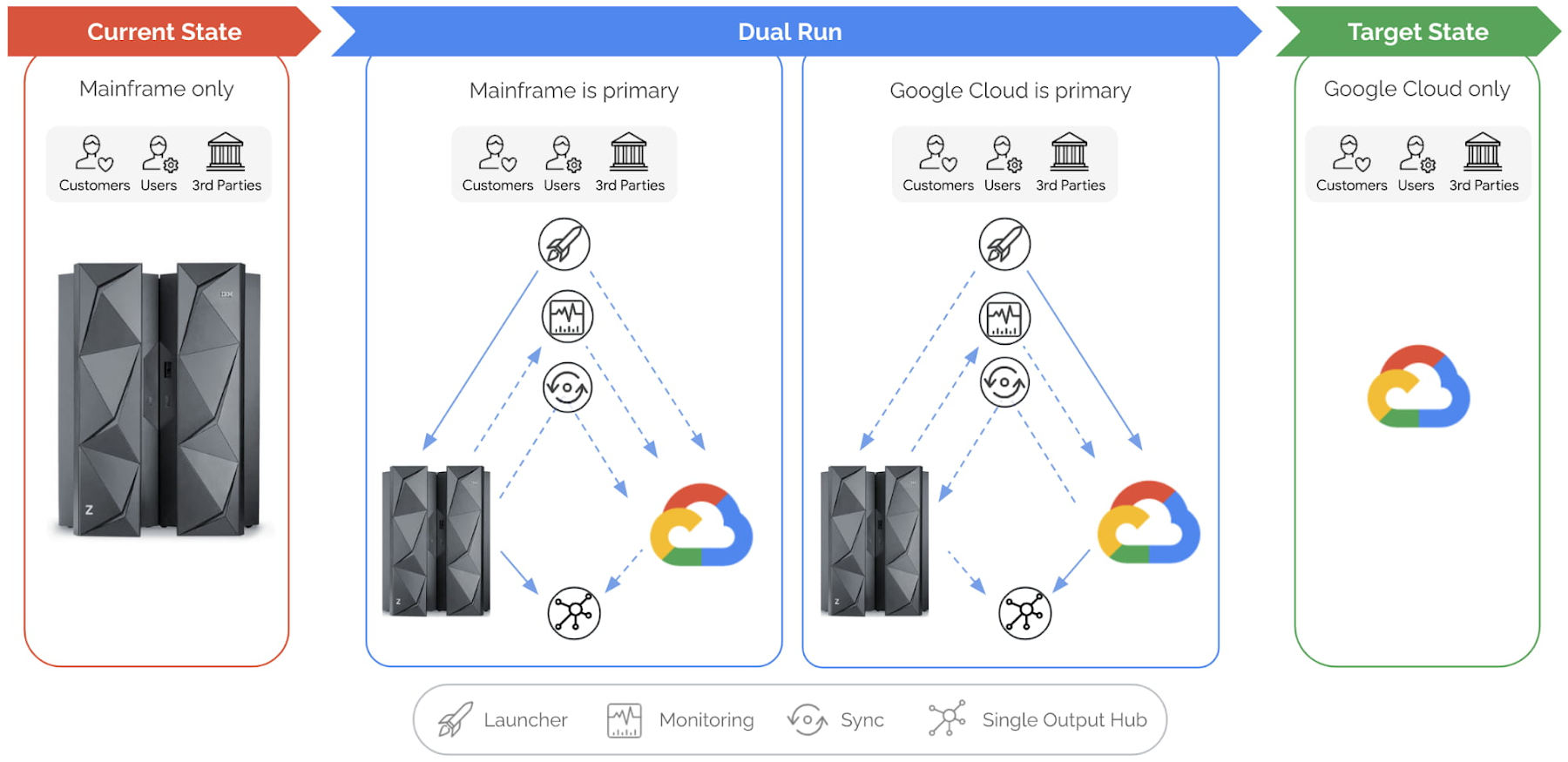
Let’s explore this illustration in a bit more detail, phase by phase:
Current state: This is your starting point, when your production workloads are still running in your mainframe. Dual Run helps you assess your mainframe workload for compatibility on Google Cloud.
After this assessment, Dual Run’s conversion engine helps address the incompatibilities in your current application and then migrates the application and data to Google Cloud. At this stage, you have your current application executing on the mainframe and your migrated application is ready to be executed or tested on Google Cloud.
Dual Run state: In this state, the migrated workload will be executed in two stages.
Dual Run stage 1:
In the first stage of Dual Run, your mainframe will remain as the “primary” system — meaning the response and outputs to other systems are sent from your mainframe — while the migrated workload will be executed in parallel in Google Cloud as “secondary.”
Dual Run performs the following actions as a cyclical process, repeated until you reach your desired migrated application quality is achieved:
- All workloads — batch & transactions — executed in the mainframe are replicated in Google Cloud
- The outcomes from both systems are validated to report any differences, enabling you to take corrective actions in migrated applications
- The functional and performance differences between the two systems will be observed, and the mainframe and Google Cloud data are periodically synchronized to bring both the systems in sync
Typically, most of your migration time will be spent in the first stage of Dual Run until you are satisfied with the results. The key goal for this stage is that your primary, business-critical mainframe workload is not disturbed while your migrated application is tuned to provide the exact same results as your current application.
Dual Run stage 2:
When the Dual Run reporting and results confirm that the migrated application matches your mainframe system, Google Cloud then becomes the “primary” system, while your mainframe will still be executed in parallel as “secondary.” Dual Run will enable you to do a smooth switch between primary and secondary systems through a configuration management system.
Target state: In this final state, the mainframe can be decommissioned while the Dual Run components are removed, enabling an optimal and efficient business execution with Google Cloud.
Summary
For any business or organization that has to migrate or modernize their mainframes, Dual Run offers a unique solution to achieve this with reduced risk and time. In fact, what we’re seeing from our customers is that Dual Run offers the right combination of proven experience, engineering, and strategic partnership that is essential for mainframe migration success. If you would like to learn more, check out our mainframe modernization website.
3813
Of your peers have already watched this video.
8:00 Minutes
The most insightful time you'll spend today!
Target Leverages Google Cloud to Create Market-defining Online Experience
In the hyper-competitive world of online retail sales, ease-of-use and transaction speed can make or break business outcomes. However, a few years ago US Retail giant Target was going through a period of uncertainty.
While the company had over 1800 stores across the US with an estimated 85% of US consumers shopping at a Target store and over 25 million people visiting the Target website or using its app each month, it was still losing ground.
In spite of having millions of loyal customers, the company was dangerously late on digital and its technology wasn’t keeping pace with unstable systems to boot. The company faced the twin challenges of trying to operate today’s business as efficiently as possible and creating tomorrow’s business as quickly as possible. On the one hand it needed productivity and stability and on the other it wanted speed and disruption. Not an easy task to accomplish.
That’s when Target decided to use Google Cloud to solve its challenges. See how Target leveraged Google Cloud to create a market-defining online experience that has made customers happier and more loyal.
More Relevant Stories for Your Company

Revolutionizing Cloud Computing: Introducing G2 VMs with NVIDIA L4 GPUs
Organizations across industries are looking to AI to turn troves of data into intelligence, powered by the latest advances in generative AI. Yet for many organizations, there is a barrier to adopting the latest models because they can be costly to train or serve. A new class of cloud GPUs

Bharat Light & Power’s CEO Says Enough! It’s Time to Leverage AI and IoT
As community and business concern over global warming, sustainability, and energy security continues to rise, companies such as Bharat Light & Power (BLP) are working on answers. Founded in 2010 and located in Bangalore and Delhi, BLP is one of the leading clean energy generation companies in India. According to Tejpreet Singh

Google Cloud is Every Retailer’s Most Trusted Cloud
Whether they were ready for it or not, the COVID-19 pandemic transformed many retailers into digital businesses. Retailers made huge investments into commerce technologies, customer experience tools, sales and fulfillment technology, and improving digital experiences to continue providing their goods and services to their customers. Now, more than a year

Forrester Report on Indian Healthcare: Why this Sector’s Seeing Greater Cloud Investments than BFSI or Retail
The healthcare industry in India is experiencing a rapid change, becoming one of India’s largest sectors in terms of both revenue and employment. But healthcare firms are under immense pressure to improve clinical outcomes and reduce the cost of care. Healthcare firms must recognize that their patients are customers who
