





What You Can Learn from ‘Up or Out’ Framework for Cloud Adoption
3240
Of your peers have already read this article.
1:30 Minutes
The most insightful time you'll spend today!
In times of significant disruption, organizations are faced with three choices: Retrench within legacy solutions, pause and do nothing while waiting for more data or different circumstances, or press ahead, potentially even accelerating to realize the desired outcome. In such an environment, it is critical to ensure you’re delivering the greatest possible impact to the business.
In Google Cloud’s Office of the CTO, or OCTO, we have the privilege of co-innovating with customers to explore what’s possible and how we can re-imagine and solve their most strategic challenges. These collaborative innovation engagements are often core to critical transformational projects, which often include the rehosting, evolution, and at times re-architecture of existing business solutions.
We are happy to offer this brand new white paper, where we have distilled the conversations we’ve had with CIOs, CTOs, and their technical staff into several frameworks that can help cut through the hype and the technical complexity, to help devise the strategy that empowers both the business and IT. We called one such framework “up or out.” (And we don’t mean some consulting firm’s hard-nosed career philosophy.)
One model that we found can help enterprises chart their cloud adoption journey delineates cloud migration along two axes—up and out, and we’ll cover this in much greater detail in the white paper itself.
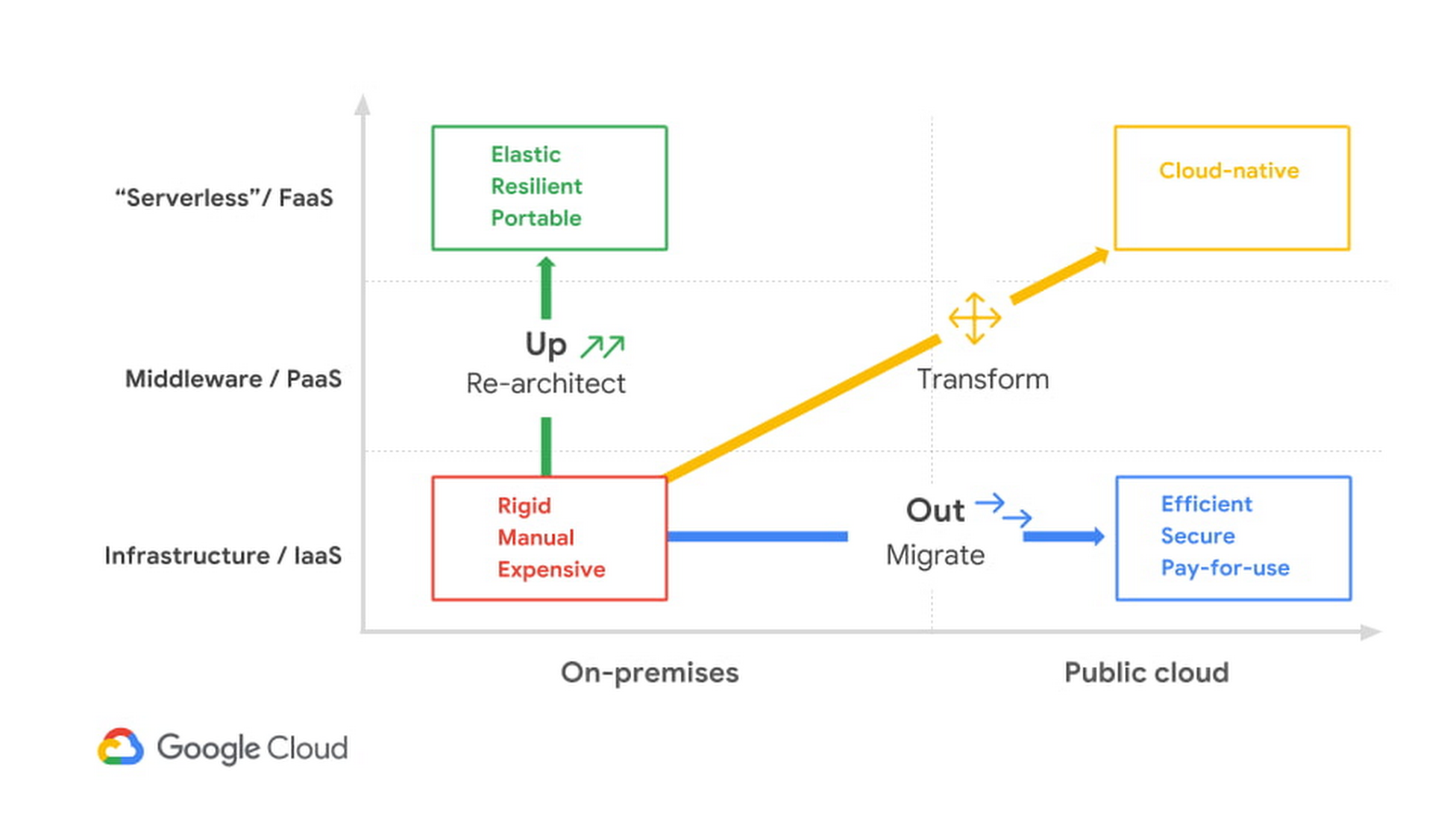
As you can see, there isn’t a single path to the cloud—not for individual enterprises and not even for individual applications. The up or out framework can help an IT organization and its leadership characterize how they can best benefit from migrating their services or workloads. The framework acts as a general pattern that highlights the continuum of approaches to explore, and you can learn all about it by downloading this detailed white paper.
Or, if you’re really ready to jump start your migration today, you can take advantage of our current offer by signing up for a free discovery and assessment.
Cloud FinOps Breaks Down Gaps in Finance, Tech and Business Teams, Accelerating Digital Transformation!

3444
Of your peers have already read this article.
3:00 Minutes
The most insightful time you'll spend today!
Accelerating digital transformation
Digital transformation is what propels businesses and industries forward. Organizations of all sizes—from startups to global enterprises—focus on digital transformation not only to make scaled improvements, but also to drive significant change and fully embrace the digital age. The pandemic has jump started and pushed many organizations into full gear to digitize their business models and transform with increased business agility, resiliency, and velocity, while driving new innovation and business values for the customers.
However, according to the Boston Consulting Group, only about 30% of companies navigate a digital transformation successfully. Many large scale digital transformation programs failed because of lack of clear business priorities, top-down executive sponsorship, or dedicated resources and commitment to see it through.
Laying the foundation for digital transformation success
Digital transformation drives foundational change in how an organization operates, optimizes internal resources, and delivers value to customers; however, this doesn’t just happen overnight. Digital transformation requires a programmatic approach through an incremental yet agile, cost-effective, value-driven, and sustainable strategy to drive successful transformation across the organization.
One of the critical factors foundational to success is Cloud FinOps (Cloud Financial Operations). Cloud FinOps is an operational framework and cultural shift that brings technology, finance, and business together to drive financial accountability and accelerate business value realization through cloud transformation. In the context of Digital Transformation, it requires new ways of working and operating models to drive behaviors and cultural change that foster cross-functional collaboration, drive accountability, provide greater cost transparency, and promote a blameless culture.
Most importantly, Cloud FinOps serves as an enabling function to drive successful digital transformation programs and enable business agility by breaking down the boundaries between technology, finance, and business teams. Through this cross-functional team collaboration, technology leaders partner with finance and business leaders to better understand the technology investments to create sustainable business outcomes. By doing so, business priorities become more clear and the focus shifts to value creation, customer-centricity, and innovation.
As such, companies are reinventing their business models to fund value streams and connect cloud technology investments to strategic business outcomes. With the increased visibility of the cloud costs, finance teams are also gaining greater accuracy in tracking cloud spend against budgets. Organizations can align the TCO of the technology services to the value metrics to make better informed future investment decisions and forecast demand.
Cloud FinOps to accelerate business value realization
The successful deployment and implementation of Cloud FinOps building blocks will enable organizations to accelerate digital transformation beyond cost savings, including the ability to:
- Accelerate business value realization and innovation
- Drive financial accountability and visibility
- Optimize cloud usage and cost efficiency
- Enable cross organizational trust and collaboration
- Prevent cloud spend sprawl
- Break down of departmental silos
Organizations that are successful in digital transformation most often have established processes to measure and track business value. One of the key building blocks of Cloud FinOps is “Measurement & Realization.” By establishing a robust value measurement approach to track and monitor the business value metrics toward business goals, we are bringing technology, finance, and business leaders together through the discipline of Cloud FinOps to show how digital transformation is enabling the organization to create new innovative capabilities and generate top-line revenue.
Business value metrics fall across several factors: cost efficiency, resiliency, velocity, innovation, and sustainability. We suggest assigning KPIs to the following metric categories:
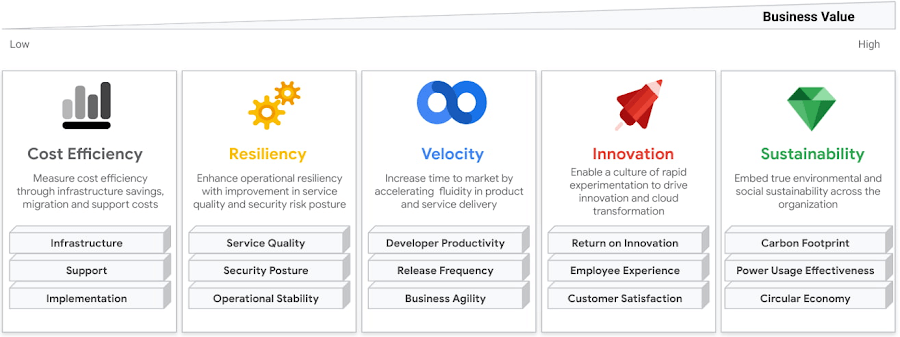
Cost efficiency: Measure cost efficiency through infrastructure savings, migration, and support costs. Customers will commonly start with metrics such as cost of compute and storage per day-week-month, and evolve to unit metrics such as cost per customer served or cost per transaction, where the cost of an application stack is aligned to customer drivers.
Resiliency: Enhance operational resiliency with improvement in service quality and security risk posture. Traditional measures such as system service level and the frequency and duration of critical downtime events are effective measures of IT durability. Customers can also augment these metrics by associating a cost per minute of downtime events, reflecting not only the direct impact of these events but opportunity costs as well.
Velocity: Decrease time to market by accelerating fluidity in product and service delivery. By moving to a cloud-based microservices architecture, customers commonly achieve benefits of increasing software release frequency, as well as being able to run many more test scenarios prior to release, resulting in higher quality code. As an example, our recent Google’s State of DevOps Report 2021, shows that elite performers have 973x more frequent code deployment and release frequency than the low performers.
Innovation: Enable a culture of rapid experimentation to drive innovation and cloud transformation. With cloud technology, companies can avoid the financial constraints of fixed cost investments and lengthy procurement lead times. As a result, the marginal cost of experimentation and time from ideation to experimentation can drop significantly while the number of experiments per unit of time can grow dramatically.
Sustainability: Embed true environmental and social sustainability metrics across the organization by adopting a circular economy strategy and building sustainability into everything we do – from running applications on zero net emissions virtual machines to reducing carbon footprint with enhanced productivity and collaboration services. According to Accenture, companies with average on-premise to cloud migrations can drive 65% energy reduction and carbon emission reduction of 84%1.
Getting started
The Cloud FinOps journey starts with defining or updating your metrics. Since business goals and strategic imperatives will likely change over time, it is important to review the Cloud FinOps metrics whenever the goals change. The review of metrics should include the changes in business goals when there are changes in the internal priorities of the team. Executive leaders need to identify dependency relationships between technology and business outcomes to improve the impact of metrics on decision making and to better prioritize and invest in evolving business and technology capabilities. Defining good metrics is not just about aligning to business goals and demonstrating value. It is also important to help prioritize strategic initiatives, guide effective resource allocation, and generate awareness across the organization to drive a shift in mindset with the new way of operating in the cloud.
The pandemic has accelerated the need for companies to modernize their digital capabilities. With technology-driven disruptions across all industries, it has never been more important for organizations to transform themselves, embrace an agile mindset, and make bold investments in cloud technology and capabilities to achieve sustainable business outcomes.
So, where are you now in your cloud FinOps journey, and how do you move beyond the challenges ahead? Google can help you start the conversation and accelerate your path to maximizing business value with the cloud.
No matter where you are on the cloud transformation journey, through an interactive session with Google, we can bring executives across the organization together to work toward a shared vision and a plan to accelerate and realize business value in the cloud. If you are interested in more information, please contact us.
Special thanks to Pathik Sharma, Bruce Warner, Jon Naseath, and Nihar Jhawar for their contributions and sharing their domain expertise to this important Cloud FinOps topic.
Making Weather Predictions Easy with Weather Research and Forecasting (WRF) Models on Google Cloud!

3592
Of your peers have already read this article.
6:00 Minutes
The most insightful time you'll spend today!
Weather forecasting and climate modeling are two of the world’s most computationally complex and demanding tasks. Further, they’re extremely time-sensitive and in high demand — everyone from weekend travelers to large-scale industrial farming operators wants up-to-date weather predictions. To provide timely and meaningful predictions, weather forecasters usually rely on high performance computing (HPC) clusters hosted in an on-premises data center. These on-prem HPC systems require significant capital investment and have high long-term operational costs. They consume a lot of electricity, have largely fixed configurations, and the underlying computer hardware is replaced infrequently.
Using the cloud instead offers increased flexibility, constantly refreshed hardware, high reliability, geo-distributed compute and networking, and a “pay for what you use” pricing model. Ultimately, cloud computing allows forecasters and climate modelers to provide timely and accurate results on a flexible platform using the latest hardware and software systems, in a cost effective manner. This is a big shift compared with traditional approaches to weather forecasting, and can appear challenging. To help, weather forecasters can now run the Weather Research and Forecasting (WRF) modeling system easily on Google Cloud using the new WRF VM image from Fluid Numerics, and achieve the performance of an on-premises supercomputer for a fraction of the price. With this solution, weather forecasters can get a WRF simulation up and running on Google Cloud in less than an hour!
A closer look at WRF
Weather Research and Forecasting (WRF) is a popular open-source numerical weather prediction modeling system used by both researchers and operational organizations. While WRF is primarily used for weather and climate simulation, teams have extended it to support interactions with chemistry, forest fire modeling, and other use cases. WRF development began in the late 1990s through a collaboration between the National Center for Atmospheric Research (NCAR), National Oceanic and Atmospheric Administration (NOAA), U.S. Air Force, Naval Research Laboratory, University of Oklahoma, and the Federal Aviation Administration. The WRF community comprises more than 48,000 users spanning over 160 countries, with the shared goal of supporting atmospheric research and operational forecasting.
The Google Cloud WRF image is built using Google’s MPI best practices for HPC, with the exception that hyperthreading is not disabled by default, and is easily integrated with other HPC solutions on Google Cloud, including SchedMD’s Slurm-GCP. Normally, installing WRF and its dependencies is a time consuming process. With these new WRF VM images, deploying a scalable HPC cluster with WRF v4.2 pre-installed is quick and easy with our Codelab. OpenMPI 4.0.2 was used throughout this work. Google has had good success with Intel MPI, and we intend to study whether further performance gains can be achieved in this context.
Optimizing WRF
Determining the optimal architecture and build settings for performance and cost was a key part of the process in developing the WRF images. We evaluated how to select the ideal compiler, right CPU platform, and the best file system for handling file IO, so you don’t have to. As a test case for assessing performance, we used the CONUS 2.5km benchmark.
Below, the CONUS 2.5km runtime and cost figure shows the run time required for simulating WRF over a two-hour forecast using 480 MPI ranks (a way of numbering processes) for different machine types available on Google Cloud. For each machine type, we’re showing the lowest measured run time from a suite of tests that varied compiler, compiler optimizations, and task affinity.
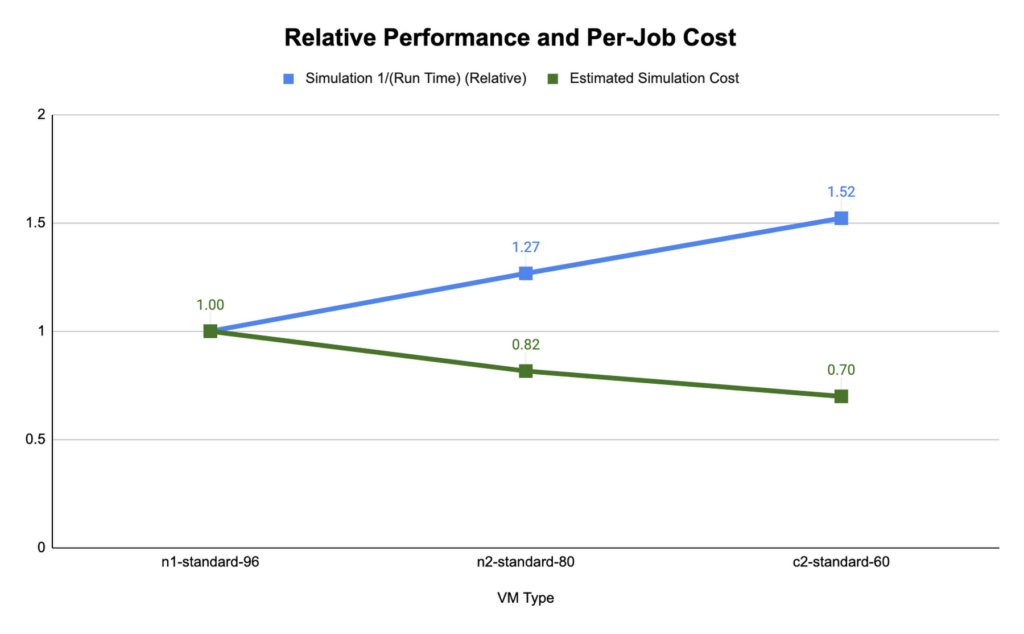
We found that compute-optimized c2 instances provided the shortest run time. The Slurm job scheduler allows you to map the MPI tasks to compute hardware using task affinity flags. When optimizing the runtime and cost for each machine type, we compared using srun –map-by core –bind-to core to launch WRF, which maps each MPI process to a physical core (two vCPU per MPI rank), and srun –map-by thread –bind-to thread, which maps each MPI process to a single vCPU. Mapping by core and binding MPI ranks to cores is akin to disabling hyperthreading.
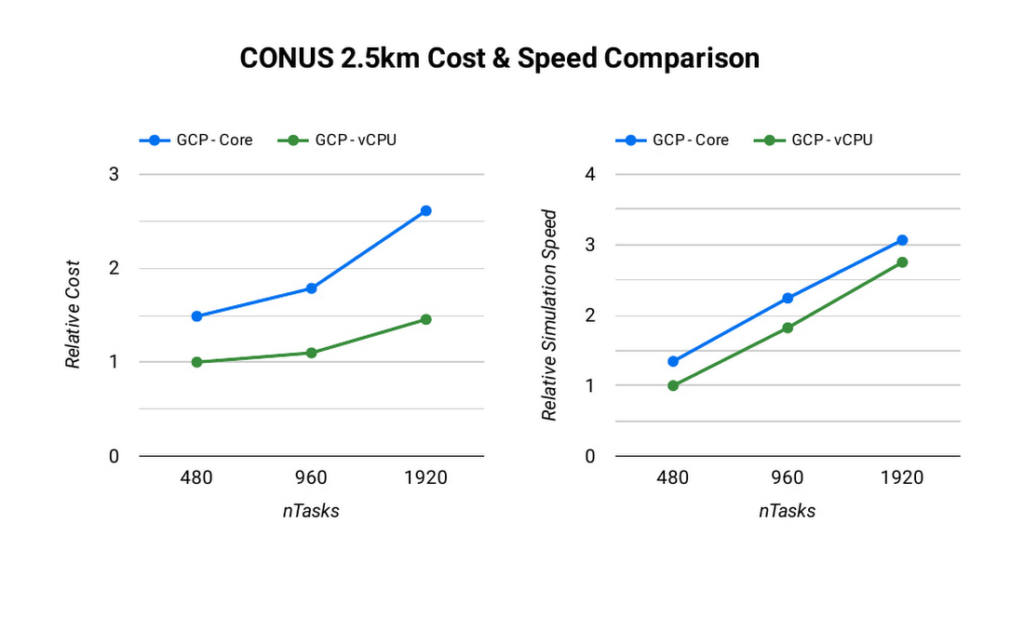
The ideal simulation cost and runtime for CONUS 2.5km for each platform is found when each MPI rank is subscribed to each vCPU. When binding to vCPUs, half as many compute resources are needed when compared to binding to physical cores lowering the per-second cost for the simulation. For CONUS 2.5km, we also found that although mapping MPI ranks to cores results in reduced runtime for the same number of MPI ranks, the performance gains are not significant enough to outweigh the cost savings. For this reason, the WRF-GCP solution does not disable hyperthreading by default.
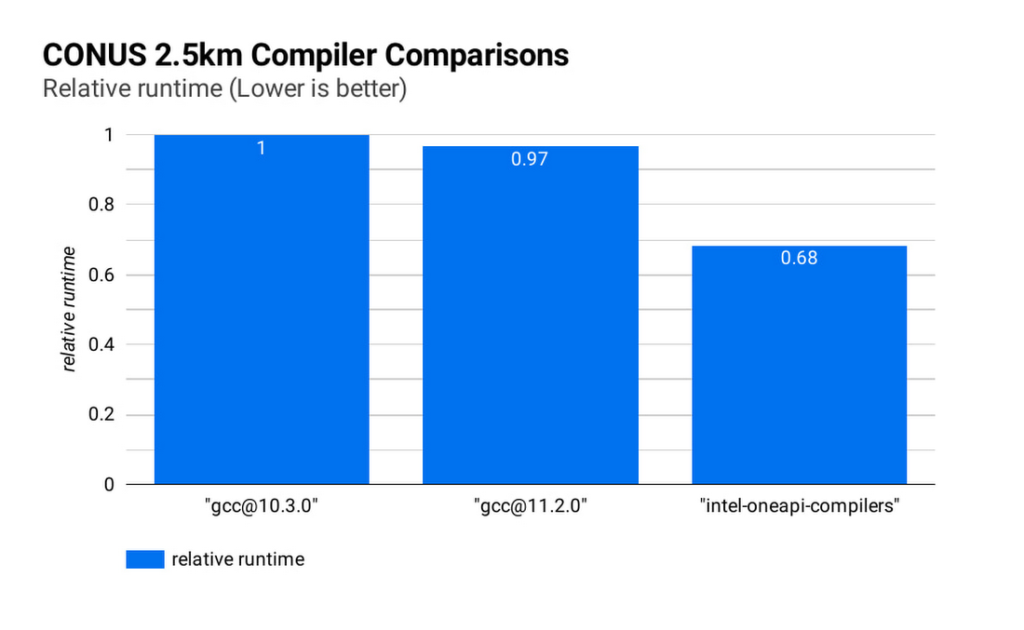
Runtime and simulation cost can be further reduced by selecting an ideal compiler: the figure below (CONUS 2.5km Compiler Comparisons) shows the simulation runtime for the WRF CONUS 2.5km benchmark on eight c2-standard-60 instances, using GCC 10.30, GCC 11.2.0 and the Intel® OneAPI® compilers (v2021.2.0). In all cases, WRF is built using level 3 compiler optimizations and Cascade Lake target architecture flags. By compiling WRF with the Intel® OneAPI® compilers, the WRF simulation runs about 47% faster than the GCC builds, and at about 68% of the cost, on the same hardware. We’ve used OpenMPI 4.0.2 with each of the compilers as the MPI implementation in this work. With other applications, Google has seen good performance with Intel MPI 2018, and we intend to investigate performance comparisons with this and other MPI implementations.
File IO in WRF can become a significant bottleneck as the number of MPI ranks increases. Obtaining the optimal file IO performance requires using parallel file IO in WRF and leveraging a parallel file system such as Lustre.
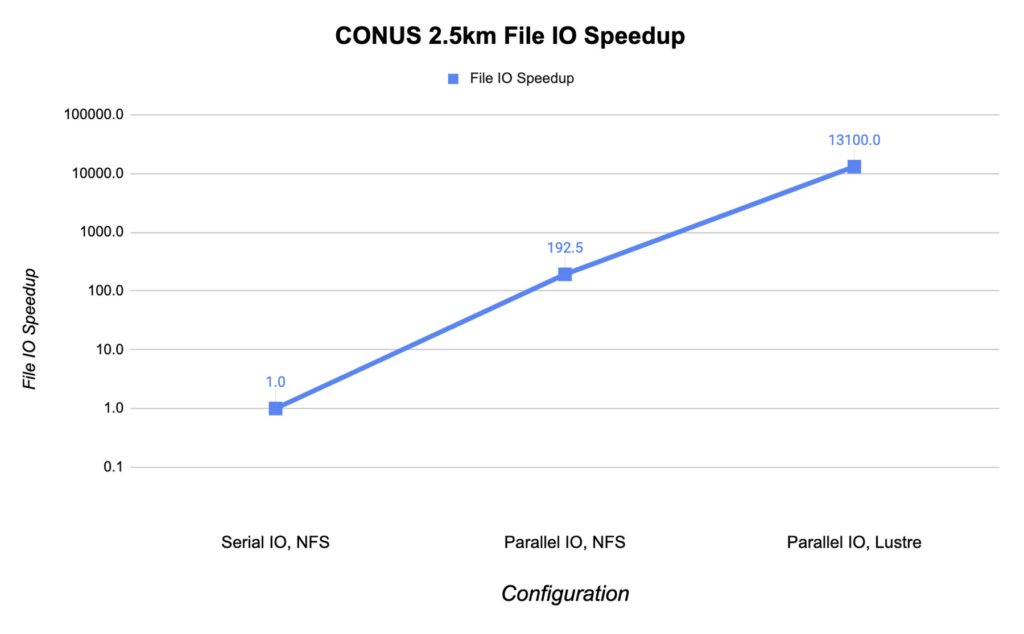
Below, we show the speedup in file IO activities relative to serial IO on an NFS file system. For this example, we are running the CONUS 2.5km benchmark on c2-standard-60 instances with 960 MPI ranks. By changing WRF’s file IO strategy to parallel IO, we accelerate file IO time by a factor of 60.
We further speed up IO and reduce simulation costs by using a Lustre parallel file system deployed from open-source Lustre Terraform infrastructure-as-code from Fluid Numerics. Lustre is also available with support from DDN’s EXAScaler solution in the Google Cloud Marketplace. In this case, we use four n2-standard-16 instances for the Lustre Object Storage Server (OSS) instances, each with 3TB of Local SSD. The Lustre Metadata Server (MDS) is an n2-standard-16 instance with a 1TB PD-SSD disk. After mounting the Lustre file system to the cluster, we set the Lustre stripe count to 4 so that file IO can be distributed across the four OSS instances. By switching to the Lustre file system for IO, we speed up file IO by an additional factor of 193, which is orders of magnitude faster than a single NFS server with serial IO.
Adding compute resources and increasing the number of MPI ranks reduces the simulation run time. Ideally, with perfect linear scaling, doubling the number of MPI ranks would cut the simulation time in half. However, adding MPI ranks also increases communication overhead, which can increase the cost per simulation. The communication overhead is due to the increased amount of communication necessitated by splitting the problem more finely across more machines.
To assess the scalability of WRF for the CONUS 2.5km benchmark, we can execute a series of model forecasts where we successively double the number of MPI ranks. Below, we show two- hour forecasts on the c2-standard-60 instances with the Lustre file system, varying the number of MPI ranks from 480 to 1920. In all of these runs, MPI ranks are bound to vCPUs so that the number of vCPUs dedicated to each simulation increases with the increase in MPI ranks. While many HPC workloads run best with simultaneous multithreading (SMT) disabled, we find the best performance for CONUS 2.5km with SMT enabled. Thus, the number of MPI ranks in our runs equals the total number of vCPUs.
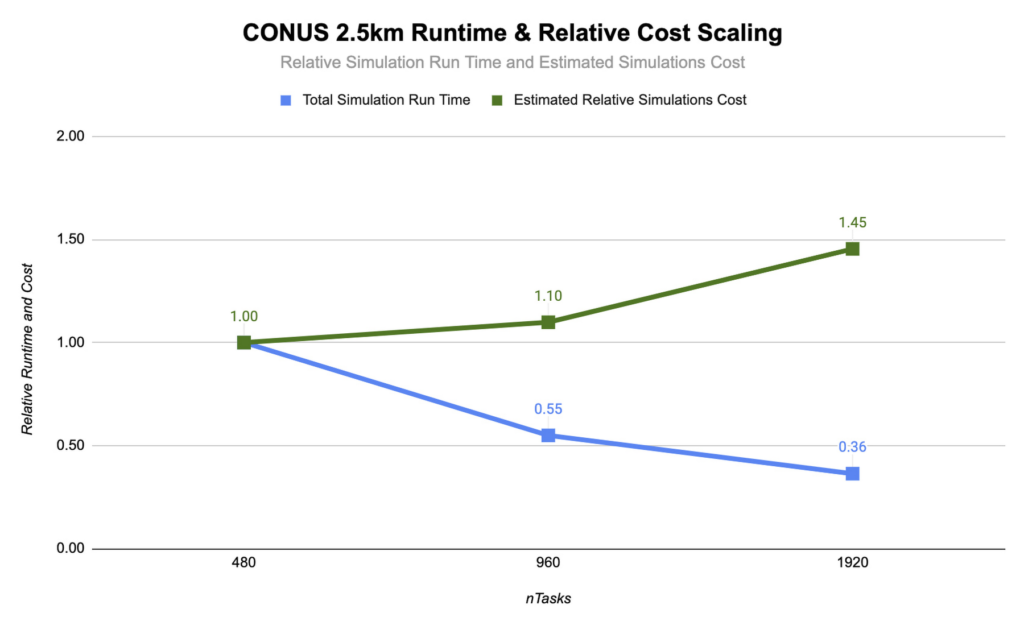
As you can see, the CONUS 2.5km Runtime & Cost Scaling figure shows that the run time (blue bars) decreases as the number of MPI ranks and the amount of compute resources increases, at least up to 1920 ranks. When transitioning from 480 to 960 MPI ranks, the run time drops, yielding a speedup of about 1.8x. Doubling again to 1920 MPI ranks, though, we obtained an additional speedup of just 1.5x. This declining trend in the speedup with increasing MPI ranks is a signature of MPI overhead, which increases with more MPI ranks.
Determining your best fit
Most tightly-coupled MPI applications such as WRF exhibit this kind of scaling behavior, where scaling efficiency decreases with increasing MPI ranks. This makes assessing cost-scaling alongside performance-scaling critical when considering Total Cost of Ownership (TCO). Thankfully, per-second billing on Google Cloud makes this kind of analysis a little bit easier. As shown above, a second doubling of the count from 960 cores to 1920 cores can provide an additional 1.5x speedup, but at a 32% higher cost. In some circumstances, this faster turnaround may be needed and worth the extra cost.
If you want to get started with WRF quickly and experiment with the CONUS 2.5km benchmark, we’ve encapsulated this deployment in Terraform scripts and prepared an accompanying codelab.
You can learn more about Google Cloud’s high performance computing offerings at https://cloud.google.com/hpc, and you can find out more about Google’s partner Fluid Numerics at https://www.fluidnumerics.com.
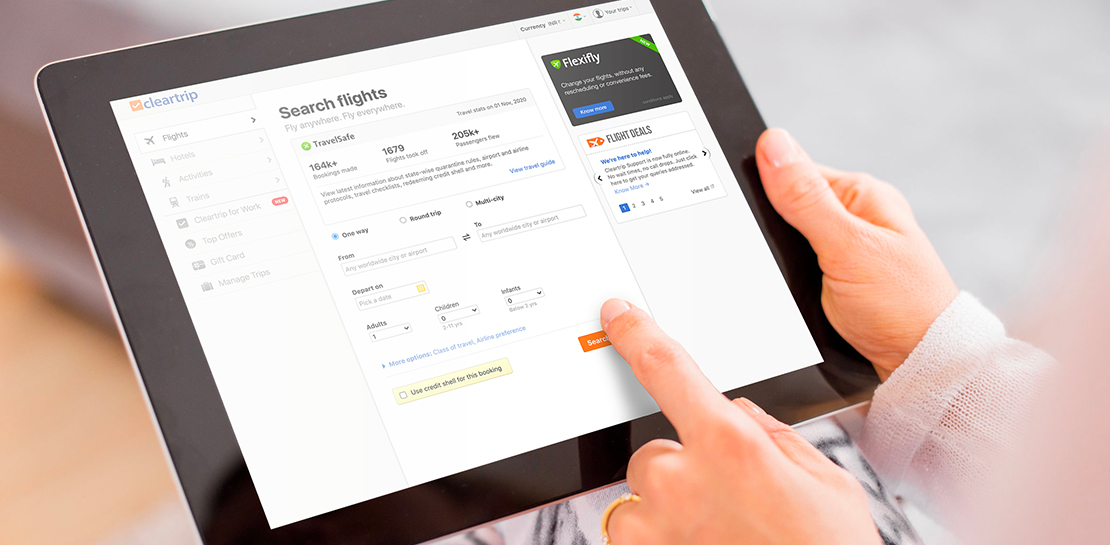
How Cleartrip.com is leveraging Google Cloud to survive the slump in the travel industry
5171
Of your peers have already read this article.
5:30 Minutes
The most insightful time you'll spend today!
With the novel coronavirus COVID-19 sweeping across continents and fatalities climbing every day, it was only a matter of time before countries closed their borders to contain its spread.
In the wake of this decision, travel and tourism, the linchpins of many economies, were among the worst affected.
According to the United Nations World Tourism Organization (UNWTO), the COVID-19 pandemic caused a 22 percent fall in international tourist arrivals during the first quarter of 2020, and could see an annual decline of between 60 percent and 80 percent when compared with 2019.
The impact on the economy and to livelihoods that are dependent on tourism and hospitality has been significant. Prior to the pandemic, the outlook was quite different. Research by UNWTO in 2018 estimated that India would have 50 million outbound tourists by 2020.
Technology was also set to play a huge part in that growth. A Google Travel study showed that 74 percent of travellers were planning their trips on the Internet, and technologies like AI, IoT and VR were all set to be key trends this year.
Now, as borders slowly reopen and travel restrictions are gradually lifted, technology could once again be the game-changer. Manoj Sharma CTO, Cleartrip.com spoke to YourStory about the industry’s road to recovery and how technology will aid that journey.
Read the Full Story on YourStory
Google Cloud Next ’22 to Commence in October: Block Your Calendar!
7940
Of your peers have already read this article.
1:30 Minutes
The most insightful time you'll spend today!
We’re excited to announce that Google Cloud Next returns on October 11–13, 2022.
Join us for keynotes from industry luminaries and engage live with Google developers. Explore dynamic content across various learning levels, and dive deep into technologies and solutions spanning the Google Cloud and Google Workspace portfolios. Participate in breakout sessions, demos, and hands-on training. Hear from the world’s leading companies about their digital transformation journeys. You’ll have opportunities to connect with experts, get inspired, and boost your skills. We can’t wait to see you at Next ’22!
It’s too early to determine how the event experience will span the digital and physical worlds, so please stay tuned for updates as we plan with the health and safety of the attendees in mind. In the meantime, mark October 11–13 in your calendar, and visit our event site for updates. For more inspiration, rediscover Next ’21, now available on demand.
Three German Retail Firms Choose Google Cloud to Migrate SAP Workloads for Business Transformation

3690
Of your peers have already read this article.
1:30 Minutes
The most insightful time you'll spend today!
The retail industry is rapidly evolving, with customers demanding exceptional digital experiences, and retailers adjusting their businesses to be more efficient. With many retailers relying on SAP for critical business functions like digital transactions, finance, supply chains and more, this shift has led them to look for ways to modernize these systems, deliver them on highly scalable infrastructure, and extract more value out of the data from within them.
I’m proud that we are helping German retailers successfully migrate business-critical SAP systems onto Google Cloud, minimizing risk and downtime and ultimately helping them build a foundation for future growth. Our work with retailers like Otto Group, one of the world’s largest ecommerce businesses, MediaMarktSaturn, the large consumer electronics retailer, and METRO, the wholesale retailer with operations across Europe, demonstrates our deep partnership with SAP to support customers’ digital transformations.
Helping Otto Group IT run SAP on secure, sustainable infrastructure
Otto Group, a leading online-retailer and services group in Germany and one of the world’s largest ecommerce companies, migrated their SAP workloads to Google Cloud in order to modernize their SAP landscape and build a more agile environment that would enable them to quickly scale up or down according to business needs.
The Otto Group, which consistently balances the sustainable use of resources and climate-neutral action with economic growth, is also able to leverage Google Cloud’s clean infrastructure to deliver the bulk of its internal SAP environment, ensuring the company’s business systems are running on secure, sustainable infrastructure. Since 2017, Google has matched 100% of its global electricity use with purchases of renewable energy every year, and is now building on that progress with a new goal of running entirely on carbon-free energy at all times by 2030.
With Google Cloud, Otto Group has told us they have access to better means of automation and improved network capability compared to what they had with their previous provider. Through this cloud migration, Otto Group IT is providing modern and flexibly scalable SAP systems to their internal customers.
Powering MediaMarktSaturn’s online ecommerce experience
For MediaMarktSaturn, SAP is critical to the smooth day-to-day running of its business, so the company was keen to ensure maximum availability and stability with a cloud environment. After a thorough examination of its business needs and hands-on support from Google Cloud’s teams, MediaMarktSaturn elected to migrate its SAP HANA database onto Google Cloud, enabling a performance increase of four times compared to its previous on-premises installations.
The SAP suite is critical for the ecommerce platform to run smoothly on a day-to-day basis. By migrating to Google Cloud, the retailer is providing even more support and maximum availability for its customers. With Google Cloud’s industry-specific expertise, MediaMarktSaturn’s customers have access to a reliable and stable ecommerce platform, so they can browse for products online from wherever they are.
Transforming METRO’s business by running SAP workloads in the cloud
With more than 97,000 employees in 34 countries, Germany’s METRO is one of the world’s largest B2B wholesalers. Previously, METRO relied on unique finance systems that were different in each country, and updates or system testing required substantial coordination across numerous teams, which was both time-consuming and costly.
To address these pain points, METRO is moving away from on premise deployments and is now migrating its SAP S/4HANA finance systems to Google Cloud to support everything from classical role-based accounting to the use of cognitive tools. Now, internal METRO teams can work seamlessly across operations, enhancing the services they provide to customers by addressing demands in real time.
To read more about how SAP on Google Cloud drives agility, efficiency, and innovation for our customers, visit our solutions page here.
More Relevant Stories for Your Company

Dual Run: A Proven Solution for Secure Mainframe Modernization
CIOs are again evaluating their mainframe investments, balancing rising operational costs and difficulty finding talent with the perceived costs and risks of moving critical applications to the cloud. Increased business agility, technical innovation, computing elasticity, customer insights, and a growing talent pool all encourage CIOs to migrate and modernize from
7 Fantastic Ways Google Cloud VMWare Engine Stands Out from the Rest for Running VMWare Workloads in the Cloud!
Google Cloud VMware Engine delivers an enterprise-grade, cloud-native VMware experience that is built on Google Cloud’s highly performant and scalable infrastructure. By enabling a consistent VMware experience, the service allows customers to adopt Google Cloud rapidly, easily, and with minimal modifications to their vSphere workloads, bringing the best of VMware

Indian social media platform ShareChat saw a 50% reduction in costs after migrating to Google Cloud
One of the key trends that emerged from the lockdown brought about by the COVID-19 outbreak was the significant rise in people seeking entertainment online. According to data released by Carat India, smartphone usage increased by 1.5 hours a week and social media consumption nearly doubled to 280 minutes a

New Enterprise Capabilities and Changes to Cloud Spanner Reduces Cost of Running Workloads by 90 Percent
Customers love Cloud Spanner because it gives them the benefits of relational semantics and SQL while also delivering the scale and availability of non-relational databases. Many of these customers want to move even more of their work to Spanner, and have requested smaller instance sizes to support development, testing and
