





Transforming Canadian Healthcare and Medical Research with Google Cloud

919
Of your peers have already read this article.
2:30 Minutes
The most insightful time you'll spend today!
Is Cloud an option for Canadian Healthcare healthcare and medical research organizations?
Yes, Canadian healthcare and medical research organizations are moving to the cloud. The cloud market is expected to grow in Canada significantly through 2027.
There are several reasons why Canadian healthcare and medical research organizations are moving to the cloud.
- Reduce costs by eliminating the need to invest in and maintain on-premises infrastructure.
- Enable the healthcare research community to drive their research more expediently to clinical outcomes
- Improve patient satisfaction by making it easier for patients to access their health information and communicate with their providers.
- Improve the quality of care by providing access to patient data and records from anywhere in the country.
Overall, the transition to the cloud is a positive development for Canadian healthcare and medical research organizations.
Canadian healthcare providers face many challenges before they can move to the cloud, such as addressing security and privacy concerns, data sovereignty issues, and ensuring interoperability. To help them overcome these challenges, it is important to provide Healthcare Data Custodians, Infrastructure Architects, and Research Leads with clear guidance on how the cloud can align with Canadian Healthcare Regulations. This will allow them to have a practical understanding of what is required to enhance their cloud journey and facilitate a smoother transition to the cloud.
iSecurity and MD+A Health are actively assisting Canadian healthcare and medical research organizations in comprehending the risks and exploring pathways to embrace the cloud. Through extensive research and analysis, iSecurity and MD+A Health have evaluated Google Cloud as a suitable platform for healthcare. Their diligent efforts have resulted in the production of comprehensive documents that detail their findings via a Threat Risk Assessment (TRA) and a Privacy Impact Report (PIA).
Why a Threat Risk Assessment?
A threat risk assessment is a process of identifying and evaluating threats to an organization and then determining the likelihood and impact of those threats. The goal of a threat risk assessment is to identify the most serious threats and develop mitigation strategies to reduce the likelihood and impact of those threats.
A threat risk assessment typically involves the following steps:
- Identify threats: The first step is to identify all potential threats to the organization. This can be done by brainstorming, interviewing experts, or reviewing historical data.
- Evaluate threats: Once the threats have been identified, they need to be evaluated in terms of their likelihood and impact. The likelihood of a threat is the probability that it will occur, while the impact of a threat is the severity of the consequences if it does occur.
- Prioritize threats: The threats need to be prioritized based on their likelihood and impact. The most serious threats should be addressed first.
- Develop mitigation strategies: Once the threats have been prioritized, mitigation strategies need to be developed to reduce the likelihood and impact of those threats. Mitigation strategies can include things like implementing security controls, training employees, and developing contingency plans.
- Implement mitigation strategies: The mitigation strategies need to be implemented and tested to ensure that they are effective.
- Monitor and review: The threat risk assessment should be monitored and reviewed regularly to ensure that it is still effective.
Why a Privacy Impact Assessment?
A Privacy Impact Assessment (PIA) is a process that organizations use to identify and assess the privacy risks associated with a new or changed information technology (IT) system or project. The goal of a PIA is to help organizations protect the privacy of individuals whose personal information is collected, used, or disclosed by the IT system or project.
PIAs typically include the following steps:
- Identifying the purpose of the IT system or project and the types of personal information that will be collected, used, or disclosed.
- Identifying the privacy risks associated with the IT system or project.
- Assessing the likelihood and severity of the risks.
- Developing and implementing controls to mitigate the risks.
- Monitoring the effectiveness of the controls.
PIAs are an important tool for organizations to help them follow privacy laws and regulations. They can also help organizations build trust with their patients, employees and the research community by demonstrating their commitment to protecting privacy.
The benefits of conducting a PIA:
- Helps organizations identify and assess privacy risks
- Helps organizations develop and implement controls to mitigate privacy risks
- Helps organizations comply with privacy laws and regulations
- Helps organizations build trust with customers and employees
Why Google Cloud?
Google Cloud is committed to providing Canadian healthcare organisations with an environment to expand both their clinical and research environments. Google Cloud has invested significant resources into building out a cloud environment based on best practices coming from Google’s experience running some of the world’s largest platforms.
Some highlights include:
- Built-in security features that help protect your data and applications from unauthorized access, use, disclosure, disruption, modification, or destruction.
- A comprehensive security management platform that helps you assess, prioritize, and address security risks across your organization.
- A team of security experts who can help you design, implement, and manage your security solutions.
- A wide range of security training and resources to help you learn about and stay up-to-date on the latest security threats and best practices.
Expanding Google Cloud Ready – Sustainability Program with 12 New Partners

2820
Of your peers have already read this article.
2:00 Minutes
The most insightful time you'll spend today!
We introduced the Google Cloud Ready – Sustainability designation earlier this year to showcase those partners committed to help global businesses and governments accelerate their sustainability programs. These partners build solutions that enhance the capabilities and ease the adoption of powerful Google Cloud technologies, such as Google Earth Engine and BigQuery, allowing customers to leverage data-rich solutions that help reduce their carbon footprints.
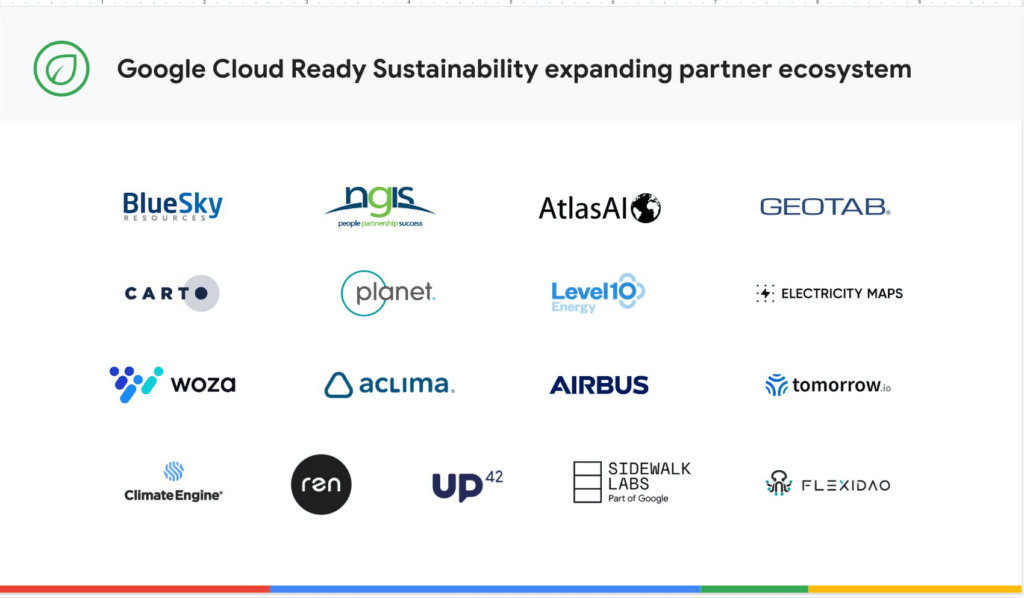
Today, we’re pleased to announce growth of the Google Cloud Ready – Sustainability program, with 12 new partners joining the initiative and bringing their climate, ESG, and sustainability platforms to Google Cloud. These partners include:
Aclima is pioneering an entirely new way to diagnose the health of our air and track climate-changing pollution. Powered by its network of roving and stationary sensors, Aclima measures air pollution and greenhouse gasses at unprecedented scales and with block-by-block resolution.
Sustainability at Airbus means uniting and safeguarding the world in a safe, ethical, and socially and environmentally responsible way. Airbus has a comprehensive sustainability strategy built on four core commitments, which guide the company’s approach to the way it does business and how it designs its products and services: Lead the journey toward clean aerospace, respect human rights and foster inclusion, build the business on the foundation of safety and quality, and exemplify business integrity.
Atlas AI is a predictive analytics platform that analyzes, monitors, and forecasts regions of growth, vulnerability, and opportunity around the world to offer insight into where organizations can grow most successfully, and where investment can boost historically underserved communities. Atlas AI’s platform has been used to expand water and sanitation infrastructure, promote new electrification, target community health services, and broaden internet access in countries across Sub-Saharan Africa and South Asia.
BlueSky Resources makes sense of sensors from both public and private sources by harmonizing inputs from ground, aerial and space based inputs. Expertise in atmospheric science and cloud technology allows BlueSky to provide understanding and insights related to the correlation of emissions insights to assets and activities. This powerful combination of data, climate science and delivery of insights is enabling focused sustainability impact across clients in various industries including energy, waste management, industry and natural resource management.
Electricity Maps provides companies with actionable data quantifying the carbon intensity and origin of electricity. This data is available on an hourly basis across 50+ countries and more than 160 regions. Electricity Maps’ mission is to organize the world’s electricity data to drive the transition toward a truly decarbonized electricity system.
FlexiDAO is a global climate tech company based in the Netherlands and Spain. The company works closely with other critical stakeholders to co-create the international standard around energy-related emissions compliance. Thanks to FlexiDAO’s end-to-end 24/7 Carbon-free Energy platform, companies can quantify and confidently showcase their contribution to society’s decarbonization.
LevelTen Energy helps organizations achieve carbon-free energy usage targets (on an annual and 24/7 basis) by delivering access to the world’s largest clean energy marketplace, and the software, data, analytics, and expertise required for efficient transactions. The LevelTen Platform connects energy buyers and over 40 sustainability advisors with more than 1,800 carbon-free energy projects in 24 countries across North America and Europe.
Ren is a SaaS platform built on Google Cloud that enables companies with global supply chains to source the cleanest energy possible. Despite using country-sized amounts of energy, most companies have no idea how to transition to renewables due to complex financial, technical, and logistical challenges. Ren unlocks cost savings, provides the cleanest energy possible, and ensures companies meet their carbon commitments on time.
Sidewalk Labs, an urban innovation unit in Google, builds products to radically improve quality of life in cities for all. Delve is a product that helps real estate teams design more sustainable buildings and neighborhood blocks, faster. Mesa automates building controls to deliver savings and comfort to commercial building owners and tenants. With these products and others, Sidewalk Labs helps commercial real estate developers, building owners and city planners make more sustainable choices for the built environment that are better for communities and the planet.
Tomorrow.io is The World’s Weather and Climate Security Platform, helping countries, businesses, and individuals manage their weather and climate security challenges. The platform is fully customizable to any industry impacted by the weather. Customers around the world use Tomorrow.io to dramatically improve operational efficiency. Tomorrow.io was built from the ground up to help teams prepare for the business impact of weather by automating decision-making and enabling climate adaptation at scale.
UP42 is a geospatial developer platform and marketplace bringing together industry-leading data and ready-to-use processing algorithms. The platform enables organizations to build, run, and scale geospatial products. With the ability to choose from a wide range of high-resolution commercial and open satellite data, aerial, weather, and others, solution providers can apply best-in-class machine learning and/or processing modules to gain valuable geospatial insights and streamline their processes.
Woza is a sustainable innovation platform that leverages deep geospatial knowledge and existing best-in-class technologies to develop a new generation of streamlined analytics workflows focused on sustainability. Companies in agri-food, energy, and public sector are partnering with Woza to accelerate their journey to Industry 4.0.
Adding expertise to accelerate sustainability use cases
New partners in the initiative join our existing Google Cloud Ready – Sustainability partners like Carto, Climate Engine, Geotab, NGIS, and Planet Labs PBC bringing a wealth of industry knowledge, offering solutions for sustainability challenges ranging from first-mile sustainable sourcing and spatial finance to fleet electrification and rich geospatial visualizations.
CARTO is the world’s leading Location Intelligence platform, enabling organizations to use spatial data and analysis for more efficient delivery routes, better behavioral marketing, strategic store placements, and much more. The company’s solutions extend the geospatial capabilities available in BigQuery, while leveraging the near limitless scalability that Google Cloud provides. When it comes to sustainability, CARTO’s platform is trusted by a wide range of organizations, including Greenpeace, Vizzuality, Litterati, Indigo, WWF, the Marine Conservation Institute, The World Bank, and the Institute for Sustainable Cities.
Climate Engine leverages data from Google Earth Engine and other ecosystem partners to help organizations improve their climate change-related risk planning in areas such as water use, agriculture, storm risk, and wildfire spread. By linking the economy and the environment, organizations can understand how environmental risks are affecting their markets and discover opportunities to reduce their emissions and potential supply chain or operational disruptions from climate-related events.
Geotab is advancing security, connecting commercial vehicles to the cloud, and providing data-driven analytics to help customers better manage their fleets. Processing billions of data points daily, Geotab helps businesses improve and optimize fleet productivity, enhance safety, and achieve sustainability goals and stronger compliance.
Geospatial solutions provider NGIS built a SaaS-based first-mile sustainable sourcing solution called TraceMark using Google Cloud’s geospatial platform and technologies from other ecosystem partners. Several global CPG firms have already used TraceMark to modernize their geospatial workflows and help facilitate the use of space-based data for supply chain sustainability transformation.
Planet Labs PBC operates the largest fleet of Earth imaging satellites in history, with approximately 200 satellites in orbit. Planet’s mission is to image the whole earth’s landmass every day to make global change visible, accessible, and actionable. As a Public Benefit Corporation, Planet’s Public Benefit Purpose is to accelerate humanity toward a more sustainable, secure, and prosperous world by illuminating environmental and social change.
How the Google Cloud Ready – Sustainability program works
If you are a Google Cloud partner with sustainability solutions and expertise to share, the Google Cloud Ready – Sustainability program is open for applications. Entry into the program requires that the partner solution delivers quantifiable results for climate mitigation, adaptation, or reporting needs. To apply for the Google Cloud Ready – Sustainability designation, the solution must:
- Be available on Google Cloud
- Address ESG risk, and assist customers in achieving ESG targets and/or support typical ESG goal frameworks, such as the United Nations’ SDGs
- Demonstrate repeatability
- Meet minimum Google Cloud application development best practices, including security, performance, scalability, availability, and carbon footprint reporting for available services
- Have Google Cloud Carbon Footprint Reporting enabled
- Have at least one public customer case study available.
The selection process begins with an evaluation of the solution. If a partner meets the above criteria, Google Cloud provides a suggested roadmap for tier progression within the program and then issues a formal acknowledgement of participation in the Google Cloud Ready – Sustainability program. Together, Google Cloud sustainability partners can deliver platforms that are helping businesses and governments accelerate progress aligned to their environmental goals.
Google Cloud will showcase the validated solutions on the Google Cloud Partner Directory Listing, Google Cloud Ready Sustainability Partner Advantage page, and — if applicable — via the Google Cloud Marketplace. We hope to help customers better understand how these technologies can help them meet their ESG goals, find the right solution for their particular challenge, and implement a solution faster.
Prospective partners can visit the Partner Portal to learn more about the Google Cloud Ready – Sustainability program or complete an application.
3583
Of your peers have already downloaded this article
3:30 Minutes
The most insightful time you'll spend today!
Defending the world’s largest network against persistent and constantly evolving cyber threats has driven Google to architect, automate, and develop advanced tools to help keep it ahead. Understanding how Google has built and evolved it’s defenses can help you make smart architectural decisions of your own as you move forward.
- At Google every minute:
- 10 million spam messages are prevented from reaching Gmail customers.
- 694,000 indexed Web pages are scanned for harmful software.
- 7,000 deceitful URLs, executables, and browser extensions that may carry viruses, unwanted content, or phishing attempts are spotted and stopped.
- 6000 instances of unwanted software and nearly 1,000 instances of suspected malware are reported to Chrome users.
- 2 phishing sites and 1 malware site are found and labeled.
Download this e-book to know more about Google’s security at scale.
Cloud Computing at Sea: Google Public Sector Boosts U.S. Navy Collaboration

3060
Of your peers have already read this article.
2:00 Minutes
The most insightful time you'll spend today!
With a global, always-on workforce, the U.S. Navy requires secure collaboration between teams across countries and time zones. This is especially relevant for the 50,000 U.S. Navy sailors deployed aboard approximately 100 ships at any given time, who need to connect with personnel at regional shipyards for everything from routine maintenance, to more serious ship repairs.
Google Public Sector directly assists Naval Sea Systems Command (NAVSEA), the largest of the U.S. Navy’s five “systems commands,” by providing support to the U.S. Naval Ship Repair Facility and Japan Regional Maintenance Center (SRF-JRMC) in Yokosuka and Sasebo, Japan. NAVSEA is using Google Workspace, which harnesses Google’s threat protection and zero trust capabilities, to enable effective, secure, and compliant collaboration between the SRF-JRMC and Navy stakeholders around the world.
The workforce in the SRF-JRMC facility had two unique challenges. The first was around ineffective collaboration and communication channels. Before deploying Google Workspace, a Navy officer in Japan would need to be on-base to communicate over a secure connection, and calls were typically late at night given the time difference. This challenge was even further magnified when the COVID-19 pandemic hit, further restricting staff mobility.
The second challenge was a language barrier. With more than 3,000 Japanese Master Labor Contract (MLC) employees providing critical support to SRF-JRMC’s shipyard, Navy leadership needed an easier way to communicate with their Japanese-speaking counterparts. Breaking down this barrier would ensure work could be completed faster and more effectively, facilitating a more collaborative environment.
Enabling secure collaboration
The Navy partnered with Google Public Sector to enable Google Workspace for SRF-JRMC. Today, Google Workspace assists the Navy’s shipyards by enabling Google Voice for secure voice over Internet Protocol (VoIP) calling options, so personnel can join calls and sessions on-site or at-home to communicate securely and reliably across continents. In addition, early access to solutions like English to Japanese translated captions in Google Meet help break down the language barrier by providing instant translation during meetings. The platform also saves the U.S. Navy thousands of dollars a month in phone bills by providing country-specific dial-in numbers for interviews.
Moreover, Google Workspace tools like Google Drive and Docs also help to simplify human resource workflows by streamlining the hiring for onboarding local Japanese employees for the shipyard. Having a shared Google Drive eliminates the need to send multiple files back and forth among the NAVSEA team, allowing them to minimize on-premises storage space. In addition, Google Docs enables Navy employees to communicate and collaborate with each other and with potential candidates securely, and across any device.
“As the largest overseas ship repair facility of the U.S. Navy, operational readiness and continuity of operations is our top priority,” said Peter Guo, chief information officer at SRF-JRMC. “Cloud collaboration capabilities provide us seamless and secure connectivity across continents and break down language barriers with our colleagues across the globe. We’ve improved our ability to operate anytime, and anywhere and have increased our ability to securely communicate and coordinate especially during network outages and natural disasters.”
Providing pandemic assistance
Google for Government’s Workspace solutions also became useful to the SRF-JRMC during the pandemic, providing valuable communication and collaboration tools during a time of uncertainty. In addition to deploying Google Workspace, SRF-JRMC’s IT department created a COVID-19 Pandemic Dashboard, a Google-based site that consolidated Japanese and international open-source data on COVID-19 outbreaks and provided updated guidance. The Dashboard was built in less than two hours, using Looker Studio, and it leveraged an automated data collection process to track local hospitalization numbers. Before building the site, it took the NAVSEA team hours to compile this information; now, the team can access this information in real-time.
“This Dashboard drastically reduced redundant weekly meetings centered on COVID-19 updates, and saved more than 10 hours per week manually gathering data and presenting it via slide decks,” said Guo. “Additionally, this capability enabled our leadership to make real-time, data-driven decisions and put necessary risk mitigations in place. It empowered supervisors across the shipyard to reference this website at any time and put additional health measures in place to minimize the transmission of COVID-19. Every minute counts at our two shipyards in Japan, so this made a tremendous impact on our operational efficiency and ensured the safety of our sailors.”
Delivering the best possible tools means making life better and work more fulfilling for millions of people, inside and outside of government. To help government agencies maintain access to communications and collaboration tools that they need during and after an incident to keep work going, we are also offering workshops for federal, state and local governments. Learn more about Google for Government solutions for the Department of Defense, and Google Workspace for Government.
Google Unveils New Cloud Region in Delhi NCR to Power India’s Digitization

8333
Of your peers have already read this article.
2:00 Minutes
The most insightful time you'll spend today!
In the past year, Google has worked to surface timely and reliable health information, amplify public health campaigns, and help nonprofits get urgent support to Indians in need. Now, we are continuing to focus on helping India’s businesses accelerate their digital transformation, deepening our commitment to India’s digitization and economic recovery. To support customers and the public sector in India and across Asia Pacific, we’re excited to announce that our new Google Cloud region in Delhi National Capital Region (NCR) is now open.
Designed to help both Indian and global companies alike build highly available applications for their customers, the Delhi NCR region is our second Google Cloud region in India and 10th to open in Asia Pacific.
What customers and partners are saying
Navigating this past year has been a challenge for companies as they grapple with changing customers demands and economic uncertainty. Technology has played a critical role, and we’ve been fortunate to partner with and serve people, companies, and government institutions around the world to help them adapt. The Google Cloud region in Delhi NCR will help our customers adapt to new requirements, new opportunities and new ways of working, like we’ve helped so many companies do in the region:
- InMobi scaled a personalized AI platform to support 120+ million active users. “With the arrival of the Google Cloud Delhi NCR, InMobi Group sees the opportunity to continue closing the gap between our users and products,” says Mohit Saxena, Co-founder and Group CTO of Inmobi. “Glance, especially, has been serving AI-powered personalised content to over 120 million active users. We can’t wait to continue giving them truly meaningful experiences that are speedy, scale well, and are relevant to them, by expanding the use of our current tools working on Google Cloud with the opening of a new region.”
- Groww now supports a sizable user base. “Google Cloud provides great technology that enables us to build and scale infrastructure to millions of users, and the new Google Cloud region in Delhi NCR will continue to help more businesses and startups in India access powerful cloud-based infrastructure, products and services,” says Neeraj Singh, Co-founder and Chief Technology Officer, Groww.
- HDFC Bank is positioned for the future. “At HDFC Bank, we are harnessing technology platforms to both run and build the bank. As we progress to be future ready, the objective is to invest in future technologies that give us scale, efficiency and resiliency. Towards this the Google Cloud region in Delhi NCR will enable us to enhance our resiliency and help us in building an active-active design framework for our new generation applications on cloud,” says Ramesh Lakshminarayanan, CIO, HDFC Bank.
- Dr. Reddy’s Lab built a modern data platform with Google Cloud. “At Dr Reddy’s, we pride ourselves in helping patients regain good health, acting quickly to provide innovative solutions to address patients’ unmet needs and in accelerating access to medicines to people worldwide. Our Google Cloud-powered data platform is helping us realize these objectives and we welcome Google’s investment in the new Delhi NCR region as helping us and other businesses in India make further contributions to our social and economic future,” says Mukesh Rathi, Senior Vice President & CIO, Dr. Reddy’s Laboratories.
- “To survive the disruption caused by the pandemic and to succeed in the long term, organizations need to become digital natives, so they can be more agile, explore new business models and build new capabilities that boost resilience. A cloud-first strategy plays a key role in enabling businesses to do this,” said Piyush N. Singh, Lead – India market unit & lead – Growth and Strategic Client Relationships, Asia Pacific and Latin America, Accenture. “Harnessing the potential of cloud requires the right data infrastructure and this expansion by Google Cloud will undoubtedly help Indian enterprises in their digital transformation journeys.”
A global network of regions
Delhi NCR joins 25 existing Google Cloud regions connected via our high-performance network, helping customers better serve their users and customers throughout the globe. As the second region in India, customers benefit from improved business continuity planning with distributed, secure infrastructure needed to meet IT and business requirements for disaster recovery, while maintaining data sovereignty.
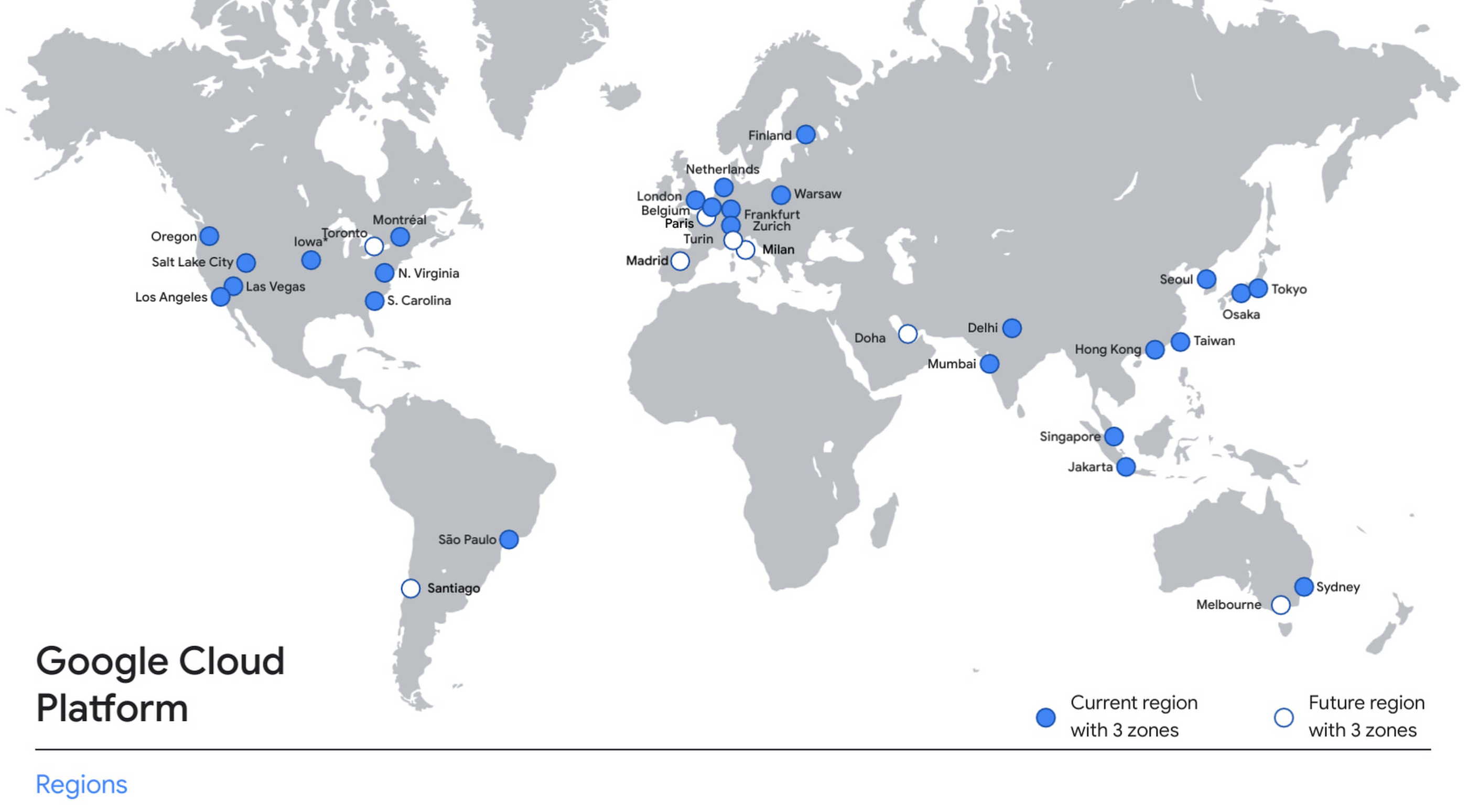
With this new region, Google Cloud customers operating in India also benefit from low latency and high performance of their cloud-based workloads and data. Designed for high availability, the region opens with three availability zones to protect against service disruptions, and offers a portfolio of key products, including Compute Engine, App Engine, Google Kubernetes Engine, Cloud Bigtable, Cloud Spanner, and BigQuery.
Supporting India’s recovery with training and education
Google and Google Cloud will also continue to support our customers with people and education programs. We’re investing in local talent and the local developer community to help enterprises digitally transform and support economic recovery.
Through the India Digitization Fund, we expanded our efforts to support India’s recovery from COVID-19—in particular, through programs to support education and small businesses. In addition to expanding internet access, and investments to help start-ups accelerate India’s digital transformation, we’ve grown our Grow with Google efforts. Businesses can access digital tools to maintain business continuity, find resources like quick help videos, and learn digital skills—in both English and in Hindi.
Helping customers build their transformation clouds
Google Cloud is here to support businesses, helping them get smarter with data, deploy faster, connect more easily with people and customers throughout the globe, and protect everything that matters to their businesses. The cloud region in Delhi NCR offers new technology and tools that can be a catalyst for this change. To learn more, visit the Google Cloud locations page, and be sure to watch the region launch event here.
3429
Of your peers have already watched this video.
1:30 Minutes
The most insightful time you'll spend today!
Google Cloud Cortex Framework: Innovate on Cloud with Less Risk, Cost and Complexity!
Google Cloud Cortex Framework is a comprehensive approach to cloud innovation that enables users to accelerate value with less risk, complexity and cost! The Cortex Framework includes a comprehensive tools and know-how to build, design and deploy cloud solutions to address business challenges and achieve desired outcomes. Watch the video to get started with Google Cloud Cortex Framework.
More Relevant Stories for Your Company




Modeling and Comparing Cloud Solutions, Costs, and Strategy
Sole-tenant nodes? VMaaS and CloudSimple? N1 vs N2 vs E2 instances? BYO Microsoft or Linux licenses? Understand how the choices available with Google Cloud can maximize your savings while expanding your migration scenarios. Watch this webinar and learn how to assess your on-premises private cloud and compare your per-VM costs

Giving Customers More Choice: Google Cloud’s New Product and Pricing Options
Over the past several years, Google Cloud has made significant investments in our infrastructure product portfolio. We launched new Tau T2D VMs, which deliver 42% better price-performance vs. other leading cloud providers. We upgraded Cloud Storage to offer more flexibility to support customers’ enterprise and analytics workloads, with dual-region buckets

2022’s First Cloud CISO Perspectives: Recap of the Megatrends, Releases and News
I’m excited to share our first Cloud CISO Perspectives post of 2022. It's already shaping up to be an eventful year for our industry and we’re only in month one. There’s a lot to recap in this post, including the U.S. government’s recent efforts to address critical security issues, like

Accelerating Success: Tips and Techniques for Optimizing and Scaling Your Startup
At Google Cloud, we want to provide you with the access to all the tools you need to grow your business. Through the Google Cloud Technical Guides for Startups, leverage industry leading solutions with how-to video guides and resources curated for startups. This multi-series contains 3 chapters: Start, Build and
