





The Modernization Imperative (TMI): The Beauty in Boring

914
Of your peers have already read this article.
3:30 Minutes
The most insightful time you'll spend today!
You have something in your pocket right now that possesses more computing power than spacecraft fifteen billion miles away from Earth. No, not your mobile phone — the key fob for your car! Voyager 1 and Voyager 2 launched in 1977, and forty five years later, these little rascals still work and send data back to Earth while moving through cold, empty space at over thirty thousand MPH. Think your key fob will still be going strong in 2068? It’s also amazing that the Romans created a concrete so long-lasting that two thousand years later, structures built with it are still in use. Meanwhile, the roads outside my house develop potholes if a rabbit sneezes on them.
I’m a fan of durability because it allows you to think outside the box. If I know that my foundations are safe, I’ll be more inclined to push the boundaries to innovate outside my comfort zone because the environment can handle it. Durability needs to be a cornerstone of the application modernization conversation, as each application and environment we create for our customers is the first step of their next-generation technology and business strategy. An entire organization’s goals and dreams rests on the shoulders of the technology architectures we are building, and we need to ensure that the foundation has the strength to withstand everything the future can throw at it — and then some.
When it comes to selecting the appropriate foundational technologies for modern applications, it’s crucial to consider the longevity and reliability of the technology. Will an exciting new open-source large language model be around in a year? Or that interesting new database from PayPal? How do I choose something from the ever-growing CNCF landscape diagram? This is where the strength of open-source communities and vendor backing comes into play. For instance, Kubernetes, PostgreSQL, and Java have stood the test of time, thanks to their robust feature sets, dedicated communities, and strong vendor support.
Kubernetes provides a scalable solution for managing and deploying applications, with Google’s strong backing: As of July, we’ve made over 1,000,000 contributions to the k8s project — 2.3 times more than any other contributor. PostgreSQL, meanwhile, is one of the world’s most advanced open-source databases and offers a comprehensive set of features that cater to a wide range of data processing needs, with a vibrant community constantly enhancing its capabilities. And Java, a general-purpose programming language, has been a staple in the development community for decades, providing a reliable platform for building robust applications.
Choosing an established technology not only brings the benefit of a mature feature set but also the assurance of continuity. A new database or language model may be promising, but they lack the track record of these tested technologies. The risk of adopting such new technologies is their potential discontinuation or lack of support, which could jeopardize your application’s stability and longevity.
The Voyager team’s use of aluminum foil is a great illustration of this principle. They chose a simple, reliable, and available solution to protect sensitive instruments during their mission. The choice of aluminum foil might not have been the most cutting-edge or exciting, but it was practical, reliable, and ultimately successful. Similarly, when choosing foundational technologies for your modern applications, sometimes the “boring” choice is the best one. It’s not about chasing the latest trends; it’s about choosing what works and stands the test of time.
Vendor backing is another critical consideration when choosing foundational technologies. A reliable platform provider that runs these technologies ensures a high-uptime Service Level Agreement (SLA). For example, Google Kubernetes Engine (GKE) offers a 99.95% uptime SLA, while Bigtable “just works,” and Cloud Storage doesn’t lose data thanks to a design that supports 99.999999999% annual durability.
Boring doesn’t mean blah
That’s not to say we shouldn’t experiment with new technologies and encourage our customers to do the same. Everyone needs an innovation strategy. The concept of an ‘innovation spectrum’ is helpful here. This spectrum represents different degrees of technological innovation that companies can employ based on their specific needs and capabilities. On one end of the spectrum, there’s incremental innovation, which involves making small improvements or extensions to existing products, services, or processes. On the other end, there’s radical or disruptive innovation, which involves creating entirely new products or services that can potentially disrupt entire industries.
A classic example of balancing cutting-edge technology with “boring” or legacy technology is seen in many financial institutions. They might use AI and ML for fraud detection or predictive analytics while still relying on tried and true technologies for their core banking systems. This blend of newer and older technologies allows them to benefit from the latest advancements without jeopardizing the stability and reliability of their critical operations. However, as the banking industry is finding out, that can also come at a risk of stifling innovation and can cause customers to look elsewhere.
For developers, Google Cloud’s Kubernetes-based platforms present a similar balance between innovation and stability. For example, researchers can leverage cutting-edge GPU sharing in GKE to explore the origins of the universe, while the BBC uses Cloud Run serverless containers to keep up with demands of a very busy news day.
Adopting best practices like platform engineering can provide a robust foundation for rolling out new technologies. Platform engineering focuses on creating a stable, scalable, and secure platform that allows for rapid deployment of applications. GitOps is another important practice that involves using Git as a single source of truth for declarative infrastructure and applications. With Git at the center of the delivery pipelines, developers can use familiar tools to make pull requests. Changes can be rolled out or rolled back easily, making the process of adopting new technologies smoother.
When it comes to modern application development, developers need to be able to trust that the foundational technologies they choose will be reliable and durable. Without this assurance, developers may be hesitant to take risks or explore creative solutions. To give them the confidence they need, an effective platform engineering strategy can provide a strong foundation for rolling out new technologies while ensuring stability and security.
Boring can be beautiful, especially if you’re building for the long haul. Regardless of what you’re developing, from roads and rocketships to microservices or network architecture, the fundamental structure needs to withstand everything the conceivable future can throw at it. A solid, durable foundation offers developers the capabilities they need to push the boundaries, and the reliability they need so their brainchild is still humming along, 15 billion miles away.
Business Evolution with API Ecosystems

3464
Of your peers have already read this article.
1:30 Minutes
The most insightful time you'll spend today!
During uncertain times, ecosystem partnerships that leverage APIs have proven to help companies scale and address gaps in their businesses. Apigee customers, like CHAMP Cargosystems, have pursued API-first ecosystem models to enter adjacent markets, create new customer interaction models, and rapidly grow their brand reach and partner ecosystems. As a result of building their API ecosystem, they are transacting 300 million electronic exchanges and 20 million shipments per year.
CHAMP selected Apigee to provide an API platform and developer self-service portal option to all of its SaaS customers. Google Cloud’s Apigee API management platform and portal allows CHAMP and its customers to quickly connect to a variety of backend systems, including in-house, third party apps, marketplace portals and more– thereby accelerating their digitization strategies and opening up new markets through an API ecosystem.
Join this webcast and hear from this leading Enterprise company on how to:
- Identify new revenue sources and markets using an API management platform
- Improve time to market while still complying with all industry requirements
- How to create a proof of concept to grow API adoption throughout your organization
- Align internal business leaders and partners to see the importance of an API-first platform vision
5217
Of your peers have already watched this video.
24:03 Minutes
The most insightful time you'll spend today!
How to Manage Complexity While Going Multi-Cloud with Anthos
Today’s success depends more than ever on making the most of both on-premises investments and the various cloud offerings available to you. Come learn about how Google Cloud is bringing to you simplified operations everywhere to help you succeed in a world of hybrid, multi cloud and edge scenarios that could otherwise threaten to fragment your deployment. Use Anthos to take an uncompromising stand on quality infrastructure everywhere for your applications.
2,602 Uses of AI for Social Good, and What We Learned from Them

5265
Of your peers have already read this article.
12:30 Minutes
The most insightful time you'll spend today!
For the past few years, we’ve applied core Google AI research and engineering to projects with positive societal impact, including forecasting floods, protecting whales and predicting famine. Artificial intelligence has incredible potential to address big social, humanitarian and environmental problems, but in order to achieve this potential, it needs to be accessible to organizations already making strides in these areas. So, the Google AI Impact Challenge, which kicked off in October 2018, was our open call to organizations around the world to submit their ideas for how they could use AI to help address societal challenges.
“Accelerating social good with artificial intelligence” sheds light on the range of organizations using AI to address big problems. It also identifies several trends around the opportunities and challenges related to using AI for social good. Here are some of the things we learned—check out the report for more details.
AI is globally relevant
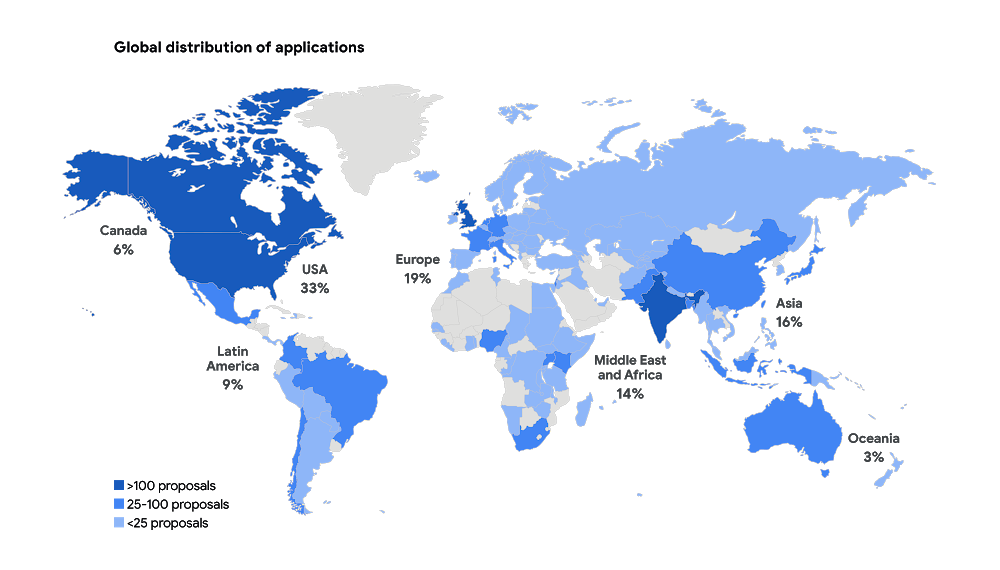
We received 2,602 applications from six continents and 119 countries, with projects addressing a wide range of issue areas, from education to the environment. Some of the applicants had experience with AI, but 55 percent of not-for-profit organizations and 40 percent of for-profit social enterprises reported no prior experience with AI.
Similar projects can benefit from shared resources
When we reviewed all the applications, we saw that many people are trying to tackle the same problems and are even using the same approaches to do so. For example, we received more than 30 applications proposing to use AI to identify and manage agricultural pests. The report includes a list of common project submissions, which will hopefully encourage people to collaborate and share resources with others working to solve similar problems.
You don’t need to be an expert to use AI for social good
AI is becoming more accessible as new machine learning libraries and other open-source tools, such as Tensorflow and ML Kit, reduce the technical expertise required to implement AI. Organizations no longer need someone with a deep background in AI, and they don’t have to start from scratch. More than 70 percent of submissions, across all sectors and organization types, used existing AI frameworks to tackle their proposed challenge.
Successful projects combine technical ability with sector expertise
Few organizations had both the social sector and AI technical expertise to successfully design and implement their projects from start to finish. The most comprehensive applications established partnerships between nonprofits with deep sector expertise, and academic institutions or technology companies with technical experience.
ML isn’t the only answer
Some problems can be addressed by using alternative methods to AI—and result in faster, simpler and cheaper execution. For example, several organizations proposed using machine learning to match underserved populations to legal knowledge and tools. While AI could be helpful, similar results could be achieved through a well-designed website. While we’ve seen the impact AI can have in solving big problems, you shouldn’t rule out more simple approaches as well.
Global momentum around AI for social good is growing—and many organizations are already using AI to address a wide array of societal challenges. As more social sector organizations recognize AI’s potential, we all have a role to play in supporting their work for a better world.
App Engine Basics to Help You Build and Deploy Low-latency, Scalable Apps

3522
Of your peers have already read this article.
2:00 Minutes
The most insightful time you'll spend today!
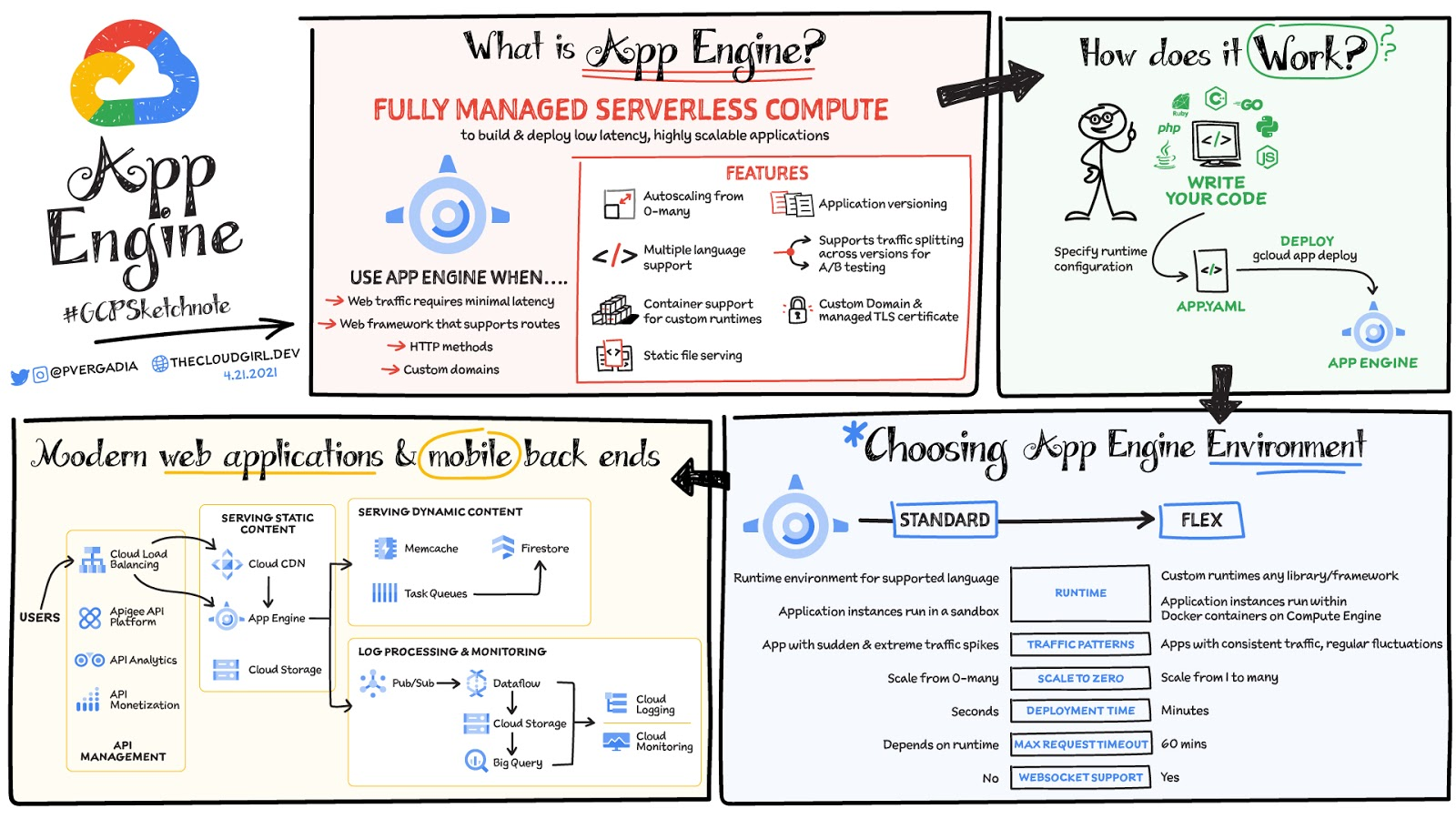
App Engine is a fully managed serverless compute option in Google Cloud that you can use to build and deploy low-latency, highly scalable applications. App Engine makes it easy to host and run your applications. It scales them from zero to planet scale without you having to manage infrastructure. App Engine is recommended for a wide variety of applications including web traffic that requires low-latency responses, web frameworks that support routes, HTTP methods, and APIs.
Environments
App Engine offers two environments; here’s how to choose one for your application:
- App Engine Standard – Supports specific runtime environments where applications run in a sandbox. It is ideal for apps with sudden and extreme traffic spikes because it can scale from zero to many requests as needed. Applications deploy in a matter of seconds. If your required runtime is supported and it’s an HTTP application, then App Engine Standard is the way to go.
- App Engine Flex – Is open and flexible and supports custom runtimes because the application instances run within Docker containers on Compute Engine. It is ideal for apps with consistent traffic and regular fluctuations because the instances scale from one to many. Along with HTTP applications it also supports applications requiring WebSockets. The max request timeout is 60 minutes.
How does it work
No matter which App Engine environment you choose, the app creation and deployment process is the same. First write your code, next specify the app.yaml file with runtime configuration, and finally deploy the app on App Engine using a single command: gcloud app deploy.
Notable features
- Developer friendly – A fully managed environment lets you focus on code while App Engine manages infrastructure.
- Fast responses – App Engine integrates seamlessly with Memorystore for Redis enabling distributed in-memory data cache for your apps.
- Powerful application diagnostics – Cloud Monitoring and Cloud Logging help monitor the health and performance of your app and Cloud Debugger and Error Reporting help diagnose and fix bugs quickly.
- Application versioning – Easily host different versions of your app, and easily create development, test, staging, and production environments.
- Traffic splitting – Route incoming requests to different app versions for A/B tests incremental feature rollouts, and similar use cases.
- Application security – Helps safeguard your application by defining access rules with App Engine firewall and leverage managed SSL/TLS certificates by default on your custom domain at no additional cost.
Conclusion
Whether you need to build a modern web application or a scalable mobile backend App Engine has you covered. For a more in-depth look, check out the documentation. Click here for demos on how to use serverless technology and free hands-on training.https://www.youtube.com/embed/Xuf3J6SKVV0?enablejsapi=1&
For more #GCPSketchnote, follow the GitHub repo. For similar cloud content follow me on Twitter @pvergadia and keep an eye out on thecloudgirl.dev.
3345
Of your peers have already watched this video.
25:30 Minutes
The most insightful time you'll spend today!
Building Globally Scalable Services with Istio and ASM
Building distributed applications is hard! Building globally scalable distributed applications is harder. Maintaining and growing these services as your business grows is even harder.
Learn how to create a globally scalable platform for your business on Google Cloud using service meshes. See how to build a platform on Google Cloud from the ground up.
More Relevant Stories for Your Company

Amadeus: Shaping the Future of Travel with Apigee
If you’ve taken a trip in the past 30 years, then you’ve probably used Amadeus technology. Our solutions connect over 1.5 billion travellers every year to the journeys they want, linking them via travel agents, search engines, and tour operators to over 700 airlines, 110 airports, 580,000 hotel properties, 40

Headless e-Commerce is the Next Big Thing in Retail
Headless Ecommerce In the last couple of years there has been a shift in the way retailers approach ecommerce: where in the past development efforts were prioritized around building a solid foundation for backend transactions and operations now it is clear that companies in this space are focusing on differentiating

New Visual Interface for Google Cloud’s Speech-to-Text API Makes API Easy to Use !
At Google Cloud, we’re committed to making artificial intelligence (AI) accessible to everyone and easier to harness for new use cases. That’s why we’re excited to announce the general availability of our intuitive, new visual user interface for Google Cloud’s Speech-to-Text (STT) API, right in Google Cloud Console, which makes the API

GKE Feature Guide: 5 Ways to Optimize Your Kubernetes Clusters
In this post, we'll be discussing 5 features in GKE you can use to optimize your clusters today. To get started with testing these in GKE, check out our interactive tutorials for getting started with standard and autopilot clusters. If you find value from running workloads on Kubernetes clusters in your organization, chances are
