





Reducing Data Costs by 80% with Google Cloud: Inshorts’ Success in the Indian Mobile News Market

2802
Of your peers have already read this article.
3:30 Minutes
The most insightful time you'll spend today!
About inshorts
Mobile news platform inshorts condenses the latest national and international news into 60-word briefs in English and Hindi. With 10 million downloads so far, it’s expanding to cater to millions more on-the-go Indians reading news on mobile devices.

Across India, hundreds of millions of people turn to their smartphones for news that will enhance their lives and help them achieve their goals. According to Professor Rasmus Kleis Nielsen, Director of the Reuters Institute for the Study of Journalism: “The past few years have seen explosive growth in mobile internet access, and the rapid move to digital media will have profound implications for the practice of journalism, the business of news, media institutions, and thus by extension political and public life in India.” The Institute reports that Indians with internet access have risen from 100 million to 500 million in the past decade alone. The report identifies India’s news industry as “a mobile-first market,” with 66% of Indians citing smartphones as the device they most frequently use to access online news.
Seeing an opportunity to meet the growing need for news on the go, inshorts developed a mobile news platform for Indians on the move who want to stay informed but don’t have time to read long articles. The inshorts solution condenses news, from politics to cricket, into briefs of under 60 words and has been well received, with 10 million downloads since launching in 2013.
To keep the attention of its always-on news consumers and attract more users for continued growth, inshorts knows it must continuously evolve and improve its platform. The company turned to Google Cloud in 2016 in order to free its developers from time-consuming infrastructure maintenance tasks and enable them to focus on creating innovative applications instead. It was also looking for powerful yet cost-effective data and scaling tools to reach more remote corners of India and found this in Google Cloud.
“There’s a new wave of 300 to 400 million first time mobile users projected for India,” says Manish Bisht, Head of Technology at inshorts. “We want to capture those users, and Google Cloud is helping us succeed.”
Freeing up resources for new solutions
By migrating to Google Cloud, inshorts has been able to free up its development team to experiment with new ideas, without worrying about backend management or costs. The company worked with cloud consultancy Searce, a Google Cloud Premier Partner, to define the best solutions for achieving its goals. Searce partners with clients to help them scale their business by leveraging Cloud, AI/ML, and data analytics while reducing the operational IT infrastructure spend. Because it specializes in AI/ML, Anthos, and Cloud Search, inshorts chose it as the ideal partner for futurifying its business on Google Cloud. According to Manish, the Searce team was focused not only on helping inshorts to migrate and adopt a on-demand computing mindset, but helping it to decrease monthly costs as well. “There’s always a positive push from Searce, to help us move forward, and to really put our company’s priorities first,” he says.
Through the application development solutions of Firebase, for example, inshorts is able to test new features in a rapidly shifting market. The product’s ease-of-use and built-in data analytics mean that inshorts can now allocate its developer resources more efficiently across multiple projects, instead of needing an entire team to focus on one project. Product cycles are now just one week long, instead of one month, and each backend and frontend developer in the team of four is able to focus on a separate project, meaning that more work gets done in a shorter time.
Dataflow, which enables real-time data processing, has been a major factor in allowing inshorts to instantly recommend content to users. Previously, the company had managed its own instances, first manually recording what users were doing and later pushing out recommendations. That all changed with Dataflow. “Dataflow freed a lot of our development and instance management time, because we can process data in real time now,” says Manish. “And that means giving users what they want instantly.”
Perhaps one of the biggest time savings came from using Dataproc, which released the inshorts team from the task of managing clusters. “We simply moved to Dataproc, provisioned the machines, and let Google Cloud take over all the management for us,” says Manish. “This one change translated into labor savings of up to six hours a day.”
Where costs are concerned, inshorts is happy to report that Google Cloud has led to not just time savings, but monetary savings as well. The company had begun its cloud journey with a leading provider, but soon found that data analytics services were driving up costs. Meanwhile, the service required high levels of technical expertise to manage the growing infrastructure, which meant it needed to hire a DevOps expert. After switching to Google Cloud products such as Google Kubernetes Engine (GKE), Cloud Deployment Manager, and Cloud Build, inshorts has now reduced most of its DevOps burden.
“At the time, we were spending around USD100,000 per month in data analysis and data-related fields alone. We had to pursue a cost optimization drive,” recalls Manish. “We had no idea how much we would save just by migrating to Google Cloud. We brought down our costs for the entire infrastructure to around USD20,000 per month.”
The company now uses BigQuery with Looker Studio to analyze and predict its tech expenditure. With Looker Studio, it can easily visualize infrastructure costs and break them down by team, services, and project stakeholders.
Processing millions of images quickly, delivering news instantly
inshorts cites the move to GKE as one of its most important moves. “At one point, we were processing a quarter of a million images per day. Because images are uploaded by our users, traffic is unpredictable; planning the exact amount of compute needed in a given moment is almost impossible. Load balancing itself was no longer enough,” shares Manish. “Google Kubernetes Engine makes life easier for our developers, reducing the need for them to be ever present, and giving them a tool that’s easy to work with.”
The inshorts team moved to GKE primarily to gain this ease of use, where its team can now push a few configurations, then spin up clusters, tell them how to handle the load and what kind of machines to provision, and manage resources effectively. The team has reduced its dependency on DevOps since there’s no need for developers to worry about what size of machines they need for their applications. “The size of machine needed depends on the specific job, and with Google Kubernetes Engine it’s very easy to accommodate a whole range of jobs. We simply optimize our resources, scaling up or down as needed,” says Manish.
As inshorts’ platform becomes more feature-rich and sophisticated, it is taking advantage of the global network of Google Cloud. With its data center in the United States, the platform had begun to experience latency of about 600ms, too great a lag in an age of instant news. Because Google Cloud has regional data centers around the world, inshorts was able to simply move its data center closer to home, bringing down average latency to 100 ms. “We achieved significant app performance improvements thanks to being able to migrate our data center,” says Manish. “The loading was faster; everything was faster.”
Mapping the future with localized news
Being able to develop features even faster is enabling inshorts to pursue its goal of expanding into every corner of India. To capture the wave of new mobile consumers, inshorts realizes that it needs to start by finding out exactly where they are. Using Google Maps Platform, the company has launched a location-based social video app called Public, which offers news that’s highly localized to specific Indian communities and relevant to what they want to read.
As a developing nation, India’s mapping landscape is constantly changing. There were 722 administrative regions when inshorts began its work, but by 2018, 10 new districts had been added to this number. Because Public serves rural and suburban audiences, it’s crucial that it can stay on top of these rapid and sometimes confusing changes. According to Manish, Google Maps Platform not only offers granular geo-location through the Geolocation API but adapts to mapping changes in near real time. It’s a capability that inshorts is harnessing to make the Public app into its next success. “The app is experiencing tremendous growth in the tier two and three cities,” shares Manish, “In the short span of six months, it has already become the category’s number-one ranked app on the Google Play store.”
Tell us your challenge. We’re here to help.
Google Cloud Introduces Enterprise-grade Scheduler across All GCP Regions

3424
Of your peers have already read this article.
1:30 Minutes
The most insightful time you'll spend today!
Reliably executing tasks on a schedule is critical for everything from data engineering, to infrastructure management, and application maintenance. Today, we are thrilled to announce that Google Cloud Scheduler, our enterprise-grade scheduling service, is now available in more GCP regions and multiple regions can now be used from a single project removing the prior limit of a single region per project.
With many enterprise customers deploying complex distributed cloud systems, Cloud Scheduler has helped solve the problem of single-server cron scheduling being a single point of failure. With this update you are now able to create Scheduler jobs across distinct cloud regions that can help satisfy cross-regional availability and fail-over scenarios.
Furthermore, you are no longer required to create an AppEngine application in order to use Cloud Scheduler. For existing Cloud Scheduler jobs, it is safe to disable the AppEngine application within the project. Jobs will continue to function without an AppEngine application.
Creating jobs in different regions is easy. You simply pick the location where you would like your job to run. For example you can specify a location when creating a job through the gcloud command line :
HTTP Targets
gcloud scheduler jobs create http <job-name>--location <cloud-region>--schedule <cron-schedule>--uri <target-uri>
Pub/Sub Topics
gcloud scheduler jobs create pubsub <job-name>--location <cloud-region>--schedule <cron-schedule>--topic <topic-name>(--message-body <message-body> | --message-body-from-file <file-path>)
AppEngine Services
gcloud scheduler jobs create app-engine <job-name>--location <cloud-region>--schedule <cron-schedule>
Or you can pick a location when creating a job through the Cloud Console:
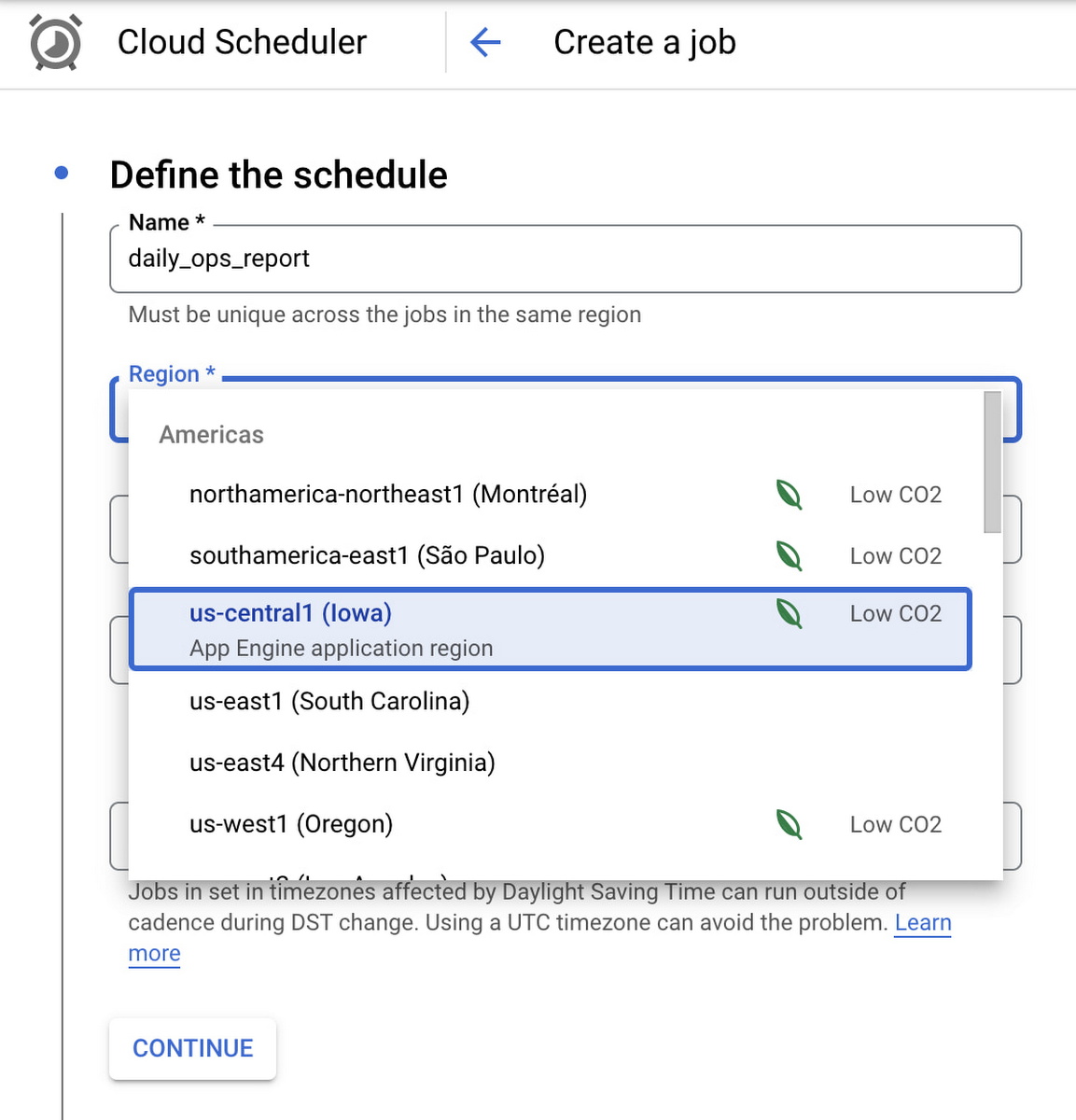
Google Cloud Scheduler is now available in 23 GCP Regions, and this number is expected to grow in the future. You can always find an up-to-date list of available regions by running:
gcloud scheduler locations list
We hope you are as excited about this launch as we are. Please reach out to us with any suggestions or questions in our public issue tracker.
Multicloud Mindset: Thinking About Open Source and Security in a Multicloud World

2780
Of your peers have already read this article.
1:30 Minutes
The most insightful time you'll spend today!
There’s never been a better time to talk about multicloud, and the Google Cloud Multicloud Mindset series on Twitter Spaces was created to do just that! This series takes place once every two weeks and features live conversations with top experts about the latest multicloud topics. You can join the 15-minute Q&A to ask your top questions and listen to episodes later offline for up to 30 days after we chat.
If you happened to miss our last few episodes, we recommend checking out our introduction blog to the series for what you missed. Let’s dive into our latest episodes, discussing the impact of open source and novel security challenges in multicloud environments.
Episode #5: ‘The intersection of open source and multicloud’
Open source technology has been an integral part of computing since its earliest era, predating even the birth of technology hubs like Silicon Valley. Open source projects have been responsible for giving us some of the most popular software in the world, such as Mozilla Firefox and the operating system Linux.
In the fifth episode, we sat down with Mike Coleman, Cloud Developer Advocate at Google Cloud, and took a closer look into the history of open source technologies, the role they play in a multicloud world, and the developer perspective on using these technologies to do their work.
The concept of multicloud anchors on the ability to run workloads across clouds and being able to pick the providers that are best suited for specific parts of workloads. Adopting open source technologies and languages empower companies to use the tools they need, regardless of cloud provider, without the fear of getting locked into a specific provider.
“As you think about moving across different environments, whether that be cloud to cloud, or developer desktop to ultimate destination, whether that be your data center or the cloud. Open source software allows you to do that…and multicloud is just an extension of that. This idea that I need to run the same software wherever I go.” — Mike Coleman, Cloud Developer Advocate at Google Cloud
If you’ve ever wanted a developer’s take on the impact of multicloud and the influence of open source in software development and digital transformation trends, you’ll want to tune into this episode.
You can access the full conversation on Twitter Spaces.
Episode #6: ‘Novel challenges in security with multicloud’
In the sixth episode of the series, we chatted with Dr. Anton Chuvakin, Security Advisor at Office of the CISO at Google Cloud, about how security leaders and architects are shifting away from traditional security models, which are increasingly insufficient for multicloud environments.
As more organizations adopt multicloud approaches, the question of how to maintain security in these complex environments and the increasing burden on SecOps teams is top of mind. As Dr. Chuvakin noted, the challenges in the cloud facing more traditional teams range from types of telemetry and logs to volumes and lack of clarity on detection use cases. However, these issues intensify when extended to include multiple clouds, where learning how to do something on one provider may be completely different on another.
“If you end up multicloud, you need to know public cloud and how it works at a better level than you would if you’re going to a single provider. Just like if you’re trying to repair three cars, you need to first learn how to repair cars. You need to have more cloud knowledge to do multicloud, not less. You need to have more powerful superpowers in the public cloud computing area because you can’t just learn one provider and call it a day.” — Dr. Anton Chuvakin, Security Advisor at Office of the CISO at Google Cloud
During the discussion, he offered three tips for tackling multicloud security:
- Learn cloud more, not less if you’re going multicloud. Multicloud requires more cloud knowledge because you can’t learn a single provider and call it a day. You’ll need to understand the differences in order to be able to secure multiple cloud environments.
- Focus on learning cloud identity management and how it compares to your traditional identity management service functions. Start with identifying the differences and similarities in what you see in one cloud and then continue with other clouds you use.
- Explore where your threat areas change in cloud environments when you plan detection and response activities to understand if your detection is covered across clouds.
If your organization is embracing multicloud, this is a great episode to listen and learn more about cloud security, the primary considerations and challenges facing security teams, and some helpful best practices for thinking about security in multicloud environments.
We’ll be sharing the latest topics and episodes with you every month in this blog series. Until next time.
8438
Of your peers have already watched this video.
21:00 Minutes
The most insightful time you'll spend today!
Journey to Transformation and Modernization with Google’s Distributed Cloud
Google Cloud has been leading the way of helping businesses make most from their cloud investments to drive digital transformation through modern application platforms that cater to today’s customer needs. Watch the video from the Next ’21 to explore three areas where companies are supported by Google Cloud throughout their cloud evolution journey–cloud migration and modernization, extension of services and engineering practices to hybrid and multicloud environments, and delivery of high performance with planet scale distributed infrastructure. Also, learn how Google Cloud is equipped for more complex and unique use cases, from datacenter to the edge. Hear the strategies and customer stories that can help your business modernize people, processes, and applications to fully leverage Google’s distributed cloud!
Reducing Data Costs by 80% with Google Cloud: Inshorts’ Success in the Indian Mobile News Market
2803
Of your peers have already read this article.
3:30 Minutes
The most insightful time you'll spend today!
About inshorts
Mobile news platform inshorts condenses the latest national and international news into 60-word briefs in English and Hindi. With 10 million downloads so far, it’s expanding to cater to millions more on-the-go Indians reading news on mobile devices.
Across India, hundreds of millions of people turn to their smartphones for news that will enhance their lives and help them achieve their goals. According to Professor Rasmus Kleis Nielsen, Director of the Reuters Institute for the Study of Journalism: “The past few years have seen explosive growth in mobile internet access, and the rapid move to digital media will have profound implications for the practice of journalism, the business of news, media institutions, and thus by extension political and public life in India.” The Institute reports that Indians with internet access have risen from 100 million to 500 million in the past decade alone. The report identifies India’s news industry as “a mobile-first market,” with 66% of Indians citing smartphones as the device they most frequently use to access online news.
Seeing an opportunity to meet the growing need for news on the go, inshorts developed a mobile news platform for Indians on the move who want to stay informed but don’t have time to read long articles. The inshorts solution condenses news, from politics to cricket, into briefs of under 60 words and has been well received, with 10 million downloads since launching in 2013.
To keep the attention of its always-on news consumers and attract more users for continued growth, inshorts knows it must continuously evolve and improve its platform. The company turned to Google Cloud in 2016 in order to free its developers from time-consuming infrastructure maintenance tasks and enable them to focus on creating innovative applications instead. It was also looking for powerful yet cost-effective data and scaling tools to reach more remote corners of India and found this in Google Cloud.
“There’s a new wave of 300 to 400 million first time mobile users projected for India,” says Manish Bisht, Head of Technology at inshorts. “We want to capture those users, and Google Cloud is helping us succeed.”
Freeing up resources for new solutions
By migrating to Google Cloud, inshorts has been able to free up its development team to experiment with new ideas, without worrying about backend management or costs. The company worked with cloud consultancy Searce, a Google Cloud Premier Partner, to define the best solutions for achieving its goals. Searce partners with clients to help them scale their business by leveraging Cloud, AI/ML, and data analytics while reducing the operational IT infrastructure spend. Because it specializes in AI/ML, Anthos, and Cloud Search, inshorts chose it as the ideal partner for futurifying its business on Google Cloud. According to Manish, the Searce team was focused not only on helping inshorts to migrate and adopt a on-demand computing mindset, but helping it to decrease monthly costs as well. “There’s always a positive push from Searce, to help us move forward, and to really put our company’s priorities first,” he says.
Through the application development solutions of Firebase, for example, inshorts is able to test new features in a rapidly shifting market. The product’s ease-of-use and built-in data analytics mean that inshorts can now allocate its developer resources more efficiently across multiple projects, instead of needing an entire team to focus on one project. Product cycles are now just one week long, instead of one month, and each backend and frontend developer in the team of four is able to focus on a separate project, meaning that more work gets done in a shorter time.
Dataflow, which enables real-time data processing, has been a major factor in allowing inshorts to instantly recommend content to users. Previously, the company had managed its own instances, first manually recording what users were doing and later pushing out recommendations. That all changed with Dataflow. “Dataflow freed a lot of our development and instance management time, because we can process data in real time now,” says Manish. “And that means giving users what they want instantly.”
Perhaps one of the biggest time savings came from using Dataproc, which released the inshorts team from the task of managing clusters. “We simply moved to Dataproc, provisioned the machines, and let Google Cloud take over all the management for us,” says Manish. “This one change translated into labor savings of up to six hours a day.”
Where costs are concerned, inshorts is happy to report that Google Cloud has led to not just time savings, but monetary savings as well. The company had begun its cloud journey with a leading provider, but soon found that data analytics services were driving up costs. Meanwhile, the service required high levels of technical expertise to manage the growing infrastructure, which meant it needed to hire a DevOps expert. After switching to Google Cloud products such as Google Kubernetes Engine (GKE), Cloud Deployment Manager, and Cloud Build, inshorts has now reduced most of its DevOps burden.
“At the time, we were spending around USD100,000 per month in data analysis and data-related fields alone. We had to pursue a cost optimization drive,” recalls Manish. “We had no idea how much we would save just by migrating to Google Cloud. We brought down our costs for the entire infrastructure to around USD20,000 per month.”
The company now uses BigQuery with Looker Studio to analyze and predict its tech expenditure. With Looker Studio, it can easily visualize infrastructure costs and break them down by team, services, and project stakeholders.
Processing millions of images quickly, delivering news instantly
inshorts cites the move to GKE as one of its most important moves. “At one point, we were processing a quarter of a million images per day. Because images are uploaded by our users, traffic is unpredictable; planning the exact amount of compute needed in a given moment is almost impossible. Load balancing itself was no longer enough,” shares Manish. “Google Kubernetes Engine makes life easier for our developers, reducing the need for them to be ever present, and giving them a tool that’s easy to work with.”
The inshorts team moved to GKE primarily to gain this ease of use, where its team can now push a few configurations, then spin up clusters, tell them how to handle the load and what kind of machines to provision, and manage resources effectively. The team has reduced its dependency on DevOps since there’s no need for developers to worry about what size of machines they need for their applications. “The size of machine needed depends on the specific job, and with Google Kubernetes Engine it’s very easy to accommodate a whole range of jobs. We simply optimize our resources, scaling up or down as needed,” says Manish.
As inshorts’ platform becomes more feature-rich and sophisticated, it is taking advantage of the global network of Google Cloud. With its data center in the United States, the platform had begun to experience latency of about 600ms, too great a lag in an age of instant news. Because Google Cloud has regional data centers around the world, inshorts was able to simply move its data center closer to home, bringing down average latency to 100 ms. “We achieved significant app performance improvements thanks to being able to migrate our data center,” says Manish. “The loading was faster; everything was faster.”
Mapping the future with localized news
Being able to develop features even faster is enabling inshorts to pursue its goal of expanding into every corner of India. To capture the wave of new mobile consumers, inshorts realizes that it needs to start by finding out exactly where they are. Using Google Maps Platform, the company has launched a location-based social video app called Public, which offers news that’s highly localized to specific Indian communities and relevant to what they want to read.
As a developing nation, India’s mapping landscape is constantly changing. There were 722 administrative regions when inshorts began its work, but by 2018, 10 new districts had been added to this number. Because Public serves rural and suburban audiences, it’s crucial that it can stay on top of these rapid and sometimes confusing changes. According to Manish, Google Maps Platform not only offers granular geo-location through the Geolocation API but adapts to mapping changes in near real time. It’s a capability that inshorts is harnessing to make the Public app into its next success. “The app is experiencing tremendous growth in the tier two and three cities,” shares Manish, “In the short span of six months, it has already become the category’s number-one ranked app on the Google Play store.”
Tell us your challenge. We’re here to help.
Autonom8: Achieving growth and profits for businesses with Google Cloud

3035
Of your peers have already read this article.
3:30 Minutes
The most insightful time you'll spend today!
With Google Cloud, Autonom8 can run a platform that accelerates and streamlines customer journeys in a scalable, reliable, cost-effective infrastructure, while using advanced optical character recognition to enable intelligent document processing.
About Autonom8
Headquartered in the United States and India, Autonom8 has built a low-code SaaS platform that allows businesses to digitize customer-facing workflows. The business aims to help clients reduce costs and improve interactions with their customers through automation and enablement of customer journeys.

Google Cloud results:
- Increased margins by up to 30% by switching from a home-grown OCR system to Cloud Vision AI
- Enables one DevOps team member to manage up to 30 customers
- Provides real-time information about customer journeys to enable businesses to respond quickly and accurately
- Ensures use of its platform with containerization in customers’ private data centers
- Reduced operating costs by up to 20% with localized scalability and architecture through GKE
Just as cars are evolving to become autonomous, smart and self-driving, enterprises can gain self-awareness, an ability to learn and an ability to adapt. This is the value proposition put forward by Autonom8, an India- and United States-based enterprise workflow management software business. “We provide a low-code, high-intelligence customer journey automation SaaS platform,” explains Ranjit Padmanabhan, Co-founder and Chief Technology Officer (CTO), Autonom8.
The Autonom8 platform includes components, such as A8Studio, a drag and drop location from which clients can create customer journeys, a chat platform that enables clients to create chatbots, and an analytics module. “With our platform and services, businesses can reduce costs and improve interactions with their customers by applying automation to accelerate and provide better customer journeys,” adds Padmanabhan.
Demand for Autonom8 is being driven by the changing customer demands of enterprises, including the expectation to interact with them over multiple channels, and the rising cost of building software with experienced developers. These trends place enterprises under growing pressure to increase the productivity of the people they do have, particularly those who are less technically inclined. In addition, changing consumer habits, regulations and the emergence of new technologies mean customer journeys cannot remain static and need to evolve.
Developing a microservices-based SaaS platform
From the start, Autonom8 planned to deliver a SaaS platform and initially deployed on a multinational cloud service, chosen due to the team’s familiarity with its products and the availability of credits. However, the company’s decision to opt for a microservices architecture that enables individual services to scale independently while running in a containerized environment, demanded high-quality container orchestration. To optimize cost, scalability and performance, Autonom8 began evaluating Google Kubernetes Engine (GKE).
The business then completed a side-by-side comparison between Google Cloud and its incumbent provider of compute, storage and other services. Google Cloud fared favorably, with Vision AI in particular providing powerful machine learning and optical character recognition (OCR) functionality, supporting a key use case for Autonom8.
In addition, many of Autonom8’s clients at the time are financial institutions in India, and legally required to retain data within the country’s borders. Google Cloud’s global network and local presence means the business could fulfill this requirement easily.
“We decided to evaluate Google Cloud, particularly GKE, from two perspectives. One, from a security perspective, as we sell to banks that audit our platform, and two, as a failover between regions because downtime costs money. We found it a compelling solution.”
— Ranjit Padmanabhan, Co-founder and Chief Technology Officer (CTO), Autonom8
A seamless move to Google Cloud
Autonom8 began deploying on Google Cloud in 2018, with its architecture comprising storage, compute, serverless, container management and orchestration, and Vision AI. “We looked at our scripting with the previous provider, and using the Google Cloud documentation available online, educated ourselves over a few weeks before moving pieces of our architecture step by step to Google Cloud,” says Padmanabhan. “We did not run into any major issues. It was pretty simple, with our experienced engineers training others in the product.”
According to the CTO, the business had two options when moving to Google Cloud. Autonom8 could either install raw virtual machines and effectively create its own virtualized data center, or rely on managed services for functions such as memory store, registration and authentication to save time and resources over the long term. Autonom8 opted for the latter and has transitioned fully to Google Cloud, with the number of cloud products and services in its architecture rising from five to about 15. While each product and service performs a key role in the delivery of Autonom8’s products and services, Padmanabhan nominates GKE, Vision AI and Cloud SQL as providing the greatest value to the business.
Scalability, real-time monitoring and intelligent document processing at low cost
With GKE, the business can now scale the nodes or containers specific to each microservice in the event traffic to a particular client surges, due to a rebate or promotion. “Through the combination of the architecture and localized scalability we achieve with GKE, we are reducing our operating costs by up to 20%,” says Padmanabhan.
Running an open source TimescaleDB on Postgres in Cloud SQL enables Autonom8 to give its clients the ability to monitor customer journey information in real time. An example of a journey is applying for a bank loan. The customer must take steps including providing income, tax and other financial details that the bank then appraises to help make a decision on the application. “The moment someone applies for a loan, for example, a bank knows about it and can monitor for fraud, bottlenecks, or other abnormalities, and immediately route to a remediation workflow,” explains Padmanabhan. “Cloud SQL enables us to maintain transactional logging and provide real-time data to our dashboards.”
After evaluating alternative services, including developing a home-grown OCR engine, the business turned to Cloud Vision AI to manage the intelligent document processing that comprises much of its transactional volume. “Vision AI is significantly better than the alternatives and the cost of maintaining our version did not make sense, because Google Cloud continues to make improvements over time that enable us to deliver more and more accurate results to our customers,” says Padmanabhan. “Switching from our home-grown service to Vision AI has enabled us to increase our profit margins by up to 30%.”
“Through the combination of the architecture and localized scalability we achieve with Google Kubernetes Engine, we are reducing our operating costs by up to 20%.”
—Ranjit Padmanabhan, Co-founder and Chief Technology Officer (CTO), Autonom8
Supporting client demands and improving developer efficiency
Google Cloud also enables Autonom8 to meet the demands of businesses that want to run its platform within their own private data centers. “We can undertake the build within Google Cloud and ship our containers to compatible hosts within those clients’ data centers,” explains Padmanabhan. “With our previous provider, we could create containers, but these would not run properly within those data centers.”
Furthermore, Google Cloud documentation and online resources help Autonom8 reduce the training needed for new developers to become productive, with the Google Cloud learning curve taking up just 10% of the overall onboarding cycle.
The organization spends the equivalent of just 3% of its overall annual revenue on DevOps, measured as DevOps Utility Ratio, while the cloud cost of revenue is about USD 1 for every USD 6 in annual recurring revenue, measured as Cloud Utility Ratio. “These two metrics are about what we can do with the people we have,” explains Padmanabhan. “Our current ratio implies that one DevOps person can handle approximately 30 customers. This is made possible by the tools we have, and the comprehensive support from Google Cloud in terms of security patches, intelligent alerts, resource overloading, and more.”
Google Cloud also provides the flexibility for Autonom8 to accommodate the varying service levels required by individual customers based on factors, such as the impact of downtime, as the business can failover seamlessly between regions to mitigate the impact of any issues that may occur.
“Our current ratio implies that one DevOps person can handle approximately 30 customers. This is made possible by the tools we have, and the comprehensive support from Google Cloud in terms of security patches, intelligent alerts, resource overloading, and more.”
—Ranjit Padmanabhan, Co-founder and Chief Technology Officer (CTO), Autonom8
Integrating Google Workspace with Autonom8 to deliver new capabilities
Autonom8 relies on Google Workspace for communication, collaboration and other workplace productivity requirements, growing its footprint from Gmail when the employee population was four or five, to a range of products including Sheets and Drive as the business grew. “It became natural to use the capabilities in Google Workspace as we matured,” says Padmanabhan. “One of the most interesting capabilities was our ability to integrate Google Workspace into our platform. For example, when someone is running a workflow, they can add data from a Sheet. We’ve added Google Workspace authentication capabilities into our products as well.”
“Everyone is using shared links to Drive and I really like the granular permissions structure,” he adds. “I can open up folders to clients while keeping an internal space within the business to ensure security and privacy.”
With Google Cloud, Autonom8 is now poised to continue growing its business and adding new features and capabilities for clients. “We are extremely excited at the opportunity to step up our offering to clients with Google Cloud,” concludes Padmanabhan.
More Relevant Stories for Your Company

A CIO’s Guide to Application Migration
A well-executed digital transformation should do much more than keep you competitive… it should also position you to excel by untethering IT staff from low value, labor-intensive tasks, allowing them to focus on innovation and high-impact projects. Also, replacing (or supplementing) legacy systems with modern technologies can reduce complexity and

Framework for a Unified Approach to the Cloud
Moving to the cloud offers enormous benefits for businesses. Yet there are risks as well. The challenge is multidimensional, with far reaching implications not just for the solutions that will run in the cloud, but also for the technologies that support them, the people who need to implement them, and

Demystifying FinOps on Google Cloud: Whitepaper
FinOps is a concept similar to DevOps, but with a different set of goals. Cloud FinOps is an operational framework and cultural shift that brings together technology, finance and business to drive financial accountability and accelerate business value realization. In layman terms, FinOps aims to help companies achieve most out



The Transformative Journeys of Financial Firms on Google Cloud: Watch Video
The reliance on cloud-based architectures, high performance computing, big data and more are accelerating in the banking, capital, insurance and financial services industries. Google Cloud had a strong role in transforming many businesses especially in the pandemic to smoothly transition into the digital space and understand their customers. Two years
