





Quick Migration, Zero Outages and Cost Savings: Rossi Residencial’s SAP to Google Cloud Journey!

3790
Of your peers have already read this article.
2:30 Minutes
The most insightful time you'll spend today!
After three migrations to different cloud providers, the company managed to migrate with no system outages for the first time, supported by partner Sky.One.
Results
- Migrated four SAP environments and four servers in just one month with no system outages
- Zero unavailability periods since migrating
- Less time spent worrying about operational issues increases the focus on business
50% savings on monthly cloud costs
Rossi Residencial, one of Brazil’s largest construction companies and real-estate developers, with around 150 employees, hundreds of business and engineering partners, and nationwide service, has used SAP solutions for financial management since 1999. Taxes, accessory obligations, accounting requirements, and other processes are managed through the system in an integrated and automated manner, which provides the business with crucial support.
Over the past few years, the company has begun to promote independent, sustainable business units to focus on strategic locations and products. This prompted its technology team to adapt as well, and they saw the cloud as an opportunity to add flexibility to SAP’s management.
“If I need to open a new branch or break ground on a project, the entire system core is already in the cloud and I don’t have to worry about local infrastructure,” explains Eduardo Araújo, Rossi’s IT Manager. “It also means our operational costs are significantly reduced.”
A few years ago, the company started working with the ECC component in the EHP 8 version, using modules such as FI (financial accounting), CO (controlling), MM (materials management) and TRM (treasury and risk management). But the dollar’s high exchange rate in 2020 increased costs with their then provider too much. The team was also not satisfied with the provider’s service, leading it to look for a new provider and a partner to support migration.
An essential requirement the new provider had to offer was high availability and scalability. Potential partners had to perform migration in a short time window (as the contract with the other service was about to expire) and be familiar with the previous provider to ensure the operation’s success. After spending some time searching, the company chose Google Cloud and Sky.One for the project.
“Out of the cloud options we researched, Google Cloud offered us the best financial conditions and a solution that truly catered to us. And out of the many partners we contacted, Sky.One offered the best work planning and service.”—Eduardo Araújo, IT Manager, Rossi Residencial
First migration with no system outages
The tight migration deadline meant the company would not have the time to install every app in Google Cloud from scratch, so Rossi asked the Sky.One team to mirror its entire previous architecture, that is, migrate the virtual machines from the company’s four SAP environments and four servers from other apps directly to Google Cloud.
After mapping the source structure in detail along with Rossi, the partner was able to complete migration planning in a month. “If you map before migrating and thus understand the customer’s environment well, you are able to prepare the destination so it has every integration and its respective access,” says Ricardo Nunes, Solution Expert at Sky.One.
The tool chosen to move the environments was Migrate for Compute Engine (previously known as Velostrata), which streamlines, facilitates and reduces risks for app migration to Google Cloud. Sky.One selected an expert in this solution to conduct the process, which was also supported by Google Cloud experts to make any needed adjustments.
The process took just a month to complete. The environments were successfully migrated with zero impact on operations, an unprecedented feat for the company. Now SAP environments run in a new infrastructure consisting of Compute Engine, a service for creating and running VMs, and Cloud Storage for data storage.
“This is the first time, after three previous migrations to private and public clouds, that our users have not felt any impact and we didn’t have system outages. It was a six-hands project that worked very well.”—Eduardo Araújo, IT Manager, Rossi Residencial
Flexibility to deal with every business need
Since the migration, Rossi has not suffered system outages or handled related user requests and incidents. Performance has remained high even after the team resized the VMs. The flexibility to add or subtract resources based on the company’s demands proved crucial. “Rossi operates in a segment with elasticity. In any given year, we can have two/three projects or ten. That’s why it’s important to have that resource in the cloud,” says Araújo.
Since the company does not operate 24/7, another benefit from migrating was the ability to schedule when to switch on and off servers, bringing cost savings. Furthermore, billing in reais at a fixed exchange rate with dollars led to a 50% cost reduction versus the previous provider.
The ease of integration between Google Cloud and SAP’s tools pleasantly surprised the team. “We were worried about potential incompatibilities, and we didn’t know if we would be able to work like before. Today we can work even better than before,” says the IT manager. According to Sky.One, the fine adaptation between the solutions becomes noticeable right after migration.
“Google Cloud’s solutions support all SAP migration steps, but after migrating we noticed that daily operations had become even more tightly integrated.”—Ricardo Nunes, Solution Expert, Sky.One
The cloud’s stability and security have streamlined the IT team’s daily routine. They no longer have to go to the company outside business hours to perform updates or repairs. Currently, employees can work remotely with peace of mind and maintain business continuity throughout Brazil.
With more time to focus on business needs instead of operational issues, the team is contemplating the addition of new Google Cloud tools. Rossi’s next challenge is to bolster its business operations and customer service even further using data analytics and AI solutions, making the most of its broad database.
Towards The Next Wave of Google Cloud Infrastructure Innovation: New C3 VM and Hyperdisk

2792
Of your peers have already read this article.
3:00 Minutes
The most insightful time you'll spend today!
Meeting the rapidly growing demands of our customers’ high performance computing and data-intensive workloads requires deep innovation — at Google Cloud, we know we can’t rely on ever-faster CPUs alone, like Moore’s Law has enabled in the past. Customers can either optimize their workloads for a given platform, or we can offer them a platform that is optimized for their specific needs. At Google Cloud, we choose the latter.
Today, we have an exciting new release resulting from these efforts: the new C3 machine series powered by the 4th Gen Intel Xeon Scalable processor and Google’s custom Intel Infrastructure Processing Unit (IPU). Along with the recently announced Hyperdisk block storage which offers 80% higher IOPS per vCPU for high-end database management system (DBMS) workloads when compared to other hyperscalers. C3 machine instances can deliver strong performance gains to enable high performance computing and data-intensive workloads. Customers such as Snap, for example, have seen approximately a 20% increase in performance for a key workload over the previous generation C2.
The C3 machine series is just the latest example of this architectural approach. For over two decades, Google has purpose-built and designed some of the world’s most efficient and scalable computing systems to meet the needs of our customers. We built the Tensor Processing Unit (TPU) to power real-time voice search, photo object recognition, and interactive language translation; unveiled Titan, a secure, low-power microcontroller to help ensure that every machine boots from a trusted state; and launched Video Coding Units (VCUs) to enable video distribution that addresses a range of formats and client requirements. We engineer golden paths from silicon to the console, using a combination of purpose-built infrastructure, prescriptive architectures, and an open ecosystem to deliver what we term workload-optimized infrastructure.
Getting to know the C3 machine series
The Compute Engine C3 machine series, now available in Private Preview, is the first VM in the public cloud with the 4th Gen Intel Xeon Scalable processor and with Google’s custom Intel IPU. C3 machine instances use offload hardware for more predictable and efficient compute, high-performance storage, and a programmable packet processing capability for low latency and accelerated, secure networking.
“We are pleased to have co-designed the first ASIC Infrastructure Processing Unit with Google Cloud, which has now launched in the new C3 machine series. A first of its kind in any public cloud, C3 VMs will run workloads on 4th Gen Intel Xeon Scalable processors while they free up programmable packet processing to the IPUs securely at line rates of 200Gb/s. This Intel and Google collaboration enables customers through infrastructure that is more secure, flexible, and performant.” – Nick McKeown, Senior Vice President, Intel Fellow and General Manager of Network and Edge Group
The System on a Chip hardware architecture introduced in C3 VMs can enable better security, isolation, and performance. In the future, this purpose-built architecture will also allow us to offer a richer product portfolio, such as support for native bare-metal instances.
Hyperdisk block storage and 200 Gbps networking
Block storage and VMs go hand in hand. Last month, we announced the Preview release of Hyperdisk, our next-generation block storage. The new architecture decouples compute instance sizing from storage performance to deliver 80% higher IOPS per vCPU than other leading hyperscale cloud provider. And compared with the previous generation C2, C3 VMs with Hyperdisk deliver 4x higher throughput and 10x higher IOPS. Now, you don’t have to choose expensive, larger compute instances just to get the storage performance you need for data workloads such as Hadoop and Microsoft SQL Server.
To enable high performance computing workloads, C3 VMs also feature 200 Gbps low-latency networking powered by our custom IPU, as well as line-rate encryption using the open source PSP protocol.
What our customers and partners are saying

“We were pleased to observe a 20% increase in performance over the current generation C2 VMs from Google Cloud in testing with one of our key workloads. These continued performance improvements enable better end user experience and application cost efficiency.” – Aaron Sheldon, Sr. Software Engineer, Snap Inc.

“Based on the initial performance data, running weather research and forecasting (WRF) on C3 clusters can deliver as much as 10x quicker time to results for about the same computational cost. This will significantly accelerate R&D for our customers in weather, environment, and engineering domains.” — Michael Wilde, CEO, Parallel Works Inc.

“In early testing with our flagship products, including Ansys Fluent, Mechanical and LS-DYNA, on the new Google Cloud C3 VM, we’re seeing up to 3x performance gains over C2 VMs due to higher memory bandwidth and lower network latency.” – Shane Emswiler, Senior Vice President of Products, Ansys
Where we are headed
With the exponential rise in the complexity of cloud infrastructure, we as an industry must turn to automation to manage these platforms efficiently at scale. Along with Infrastructure as Code, custom chips like the Titan, the TPU and the IPU, pave the way for a not-so-distant future where we’ll automate over half of all infrastructure decisions, configuring systems dynamically in response to usage patterns. At Google Cloud, we are committed to continuing our long history of hardware innovation with a focus on workload optimization and automation.
To learn more about C3 VMs and Hyperdisk, check out our session at NEXT ‘22, How Google Cloud optimizes infrastructure for your workloads. To request access to the C3 VMs or Hyperdisk, please reach out to your sales representative or account manager.

The Cloud-First Imperative To Accelerate Digital Transformation In Retail
DOWNLOAD WHITEPAPER3454
Of your peers have already downloaded this article
1:30 Minutes
The most insightful time you'll spend today!
In a study by Forrester Consulting of 60 business and technology decision makers and influencers from Indian retail organizations, it is found that 2 in 3 organizations are planning to increase their cloud spending by 5% or more in the next 12 months.
According to the study, public cloud platforms help retailers to:
- Scale business faster and more easily
- Free up IT time to focus on core differentiators instead of commodity workloads
- Improve customer experience
- Establish greater connectivity for digital transformation
Download this infographic to understand why Indian retailers are adopting a cloud-first approach to accelerate digital transformation.

3913
Of your peers have already downloaded this article
1:30 Minutes
The most insightful time you'll spend today!
Migrating to the cloud can be complex, time consuming, and risky, especially when you have hundreds or thousands of existing workloads to move. Make your journey fast and smooth by planning ahead and using tried-and-true best practices. To help you get started, here’s a handy guide that outlines four basic phases of a successful cloud migration:
ASSESS: Identify your team, get an overview of your IT landscape, and decide which applications to move first.
PLAN: Choose one or more migration strategies, consider a streaming-based solution, and test your applications’ performance in the cloud.
MIGRATE: Use a phased, agile approach that allows you to revert to the on-premises configuration if necessary.
OPTIMIZE: Fine-tune your cloud environment to align usage with demand and implement capabilities like cost controls and governance tools.
Download this handy guide to get started and get a detailed checklist of key milestones on your journey to the cloud, ensuring that you complete every step and always know what’s next.
Payhawk Becomes a Unicorn with Google Cloud-Powered Automated Financing Software

2723
Of your peers have already read this article.
3:30 Minutes
The most insightful time you'll spend today!
For far too long, managing employee expenses has been a time-consuming process that requires manual data entry and reconciliation to bridge the gap between business bank accounts and ERP systems. In the absence of an integrated workflow, finance teams use multiple systems to manage credit card and cash payments, and finding receipts. In most cases, they also lack real-time visibility into company spending.
The complexity grows exponentially as businesses expand, especially into new regions. Extra administration required to manage new bank accounts, card issuers, and local accounting systems impedes decision making and negatively impacts revenues and growth. Businesses of all sizes struggle with this, but it can be especially challenging for medium to large enterprises.
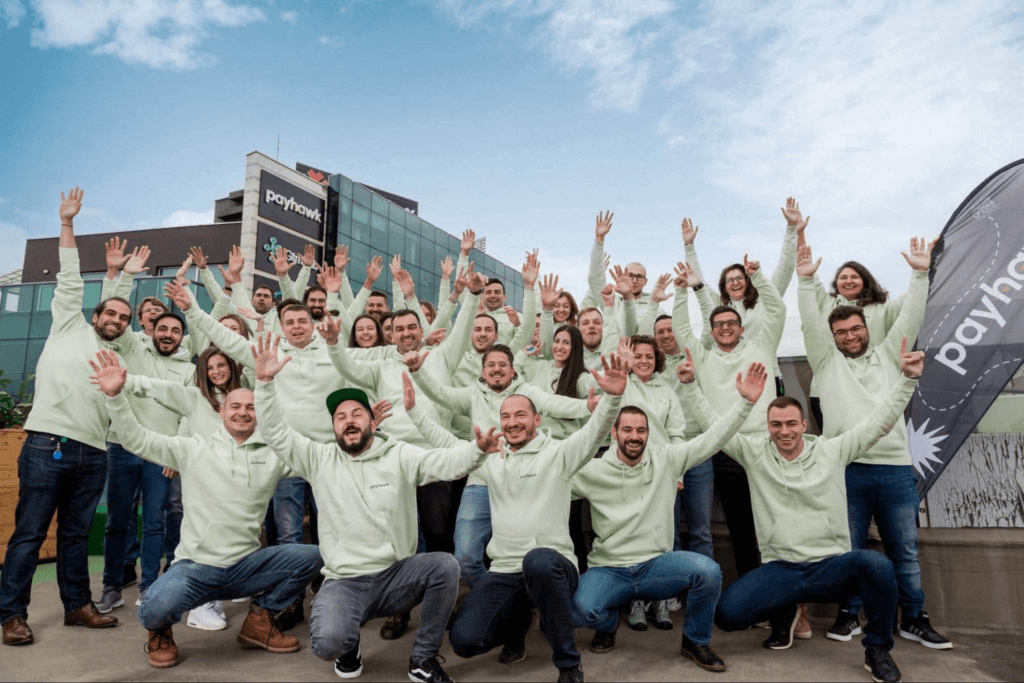
Payhawk set out to help businesses overcome these challenges when we founded the company in 2018. We combine VISA company cards, reimbursable expenses, and accounts payable into a single product. Our customers can automate manual processes, maximize efficiency, and accelerate business expansion.

Setting up our first cloud cluster in less than a week
To support growth and attract investment we were keen to launch our solution on a scalable, future-proof IT architecture that didn’t require extensive technical support. This is where Google Cloud made a big impression, especially the user interface and documentation which massively reduces the resources required to set up clusters and put them into production.
I’m a CTO, not a DevOps specialist, but in less than a week I was able to set up a secure, reliable operating infrastructure. This enabled us to fast-track our application development and we were able to issue our first card in just eight months. Our Google Cloud partner, Cloud Office also gave us valuable assistance, guiding us through the deployment process and advising on Google Cloud’s extensive range of solutions.
Google Kubernetes Engine (GKE) played a critical role, accelerating the deployment and management of our cloud native applications. We use Cloud SQL as our database while other important tools include Cloud Memorystore, Vision AI, Cloud Storage and Artifact Registry for our wider data storage and application needs. With Firebase we’ve been able to build a notification system for mobile devices.
Another incentive is that most other cloud solutions require add-on services to build and keep your product live. With Google Cloud, all the services that Payhawk needs including logging, metrics, monitoring of resources, and utilization of CPU memory come as standard.
For instance, I was really impressed by Google Cloud’s operations suite, which includes Cloud Logging and Cloud Monitoring. If there are any anomalies in our cloud architecture, we can track and resolve them with minimal disruption to our operations. This also removes the need to invest in an additional observability solution.
Reliability that builds customer trust
Google Cloud also supports Payhawk’s mission to put customers at the center of our organization. Thanks to Google Cloud error reporting and tracking and Google Cloud single sign on, Payhawk’s engineering team can anticipate customer issues and correct them in less than one hour. Trust is everything, and Google Cloud gives us the tools to boost customer satisfaction and build long-term relationships.
As a young business, managing costs is also a priority. The Google for Startups Cloud Program, which includes credits for Google software and tools, enabled us to push the business forward without having to worry about financing our infrastructure, especially in the first year. This gave us breathing room to work through funding, application development, and the onboarding of our first customers.
In addition, Google Cloud gives us confidence that we can grow the business fast. In most months we have seen more than 10% growth — in some cases it’s been 20%. In the first half of 2022, the business doubled in size, but Google Cloud gave us the flexibility to scale our infrastructure, adding storage, memory, and processing power as we onboarded new customers. The pricing model is also generous so that we can grow our revenues while keeping control of operational expenditure.
Since launch we have acquired a valuable mix of customers from startups to large businesses that want to reduce the costs of their expenses programs and increase employee satisfaction. They include ATU, a German automobile servicing company, which has successfully digitized its entire procurement process, and Discordia, a Bulgarian logistics business with 10,000 trucks, which has issued Payhawk cards to all its drivers.
Looking to the future, it’s no exaggeration to say that Google Cloud is a foundation of our business and has given investors confidence in our operations. From a first seeding round of €3 million, early this year we closed a Series B extension of $100 million. This gives us a valuation of $1bn and makes Payhawk the first ever Bulgarian unicorn.
We now operate in 32 countries in Europe and the US, and plan to double our team by the end of the year. It feels like we’ve come a long way since we first started using Google Cloud, and I’m thrilled that we have Google Cloud as a global technology partner supporting our mission to transform expense management and financial operations worldwide.
If you want to learn more about how Google Cloud can help your startup, visit our page here to get more information about our program, and sign up for our communications to get a look at our community activities, digital events, special offers, and more.
AWS to Google Cloud Translator: Which AWS Database Service Is Equal to Google Cloud Database?
6313
Of your peers have already read this article.
2:30 Minutes
The most insightful time you'll spend today!
There are multiple reasons a growing number of database administrators, enterprise architects, application developers and other technology practitioners are moving to Google Cloud’s various database services.
Some are being driven by missing features in offering from other providers such as AWS. In Gartner’s Magic Quadrant for Operational Database Management Systems, the research and advisory firm points out that, “AWS’s surveyed reference customers scored its overall product capabilities one standard deviation (STD) below the mean. Their responses identified missing features such as multiregion writes and autosharding.”
Others are moving to database services on Google Cloud Platform driven by a few benefits. According to Gartner, “Reference customers repeatedly commented on Google’s ease of use and implementation, reliability and integration (with other services and other systems). Reference customers scored Google a full STD above the mean for satisfaction with GCP’s pricing; it received the second-highest satisfaction score of any vendor in this Magic Quadrant.
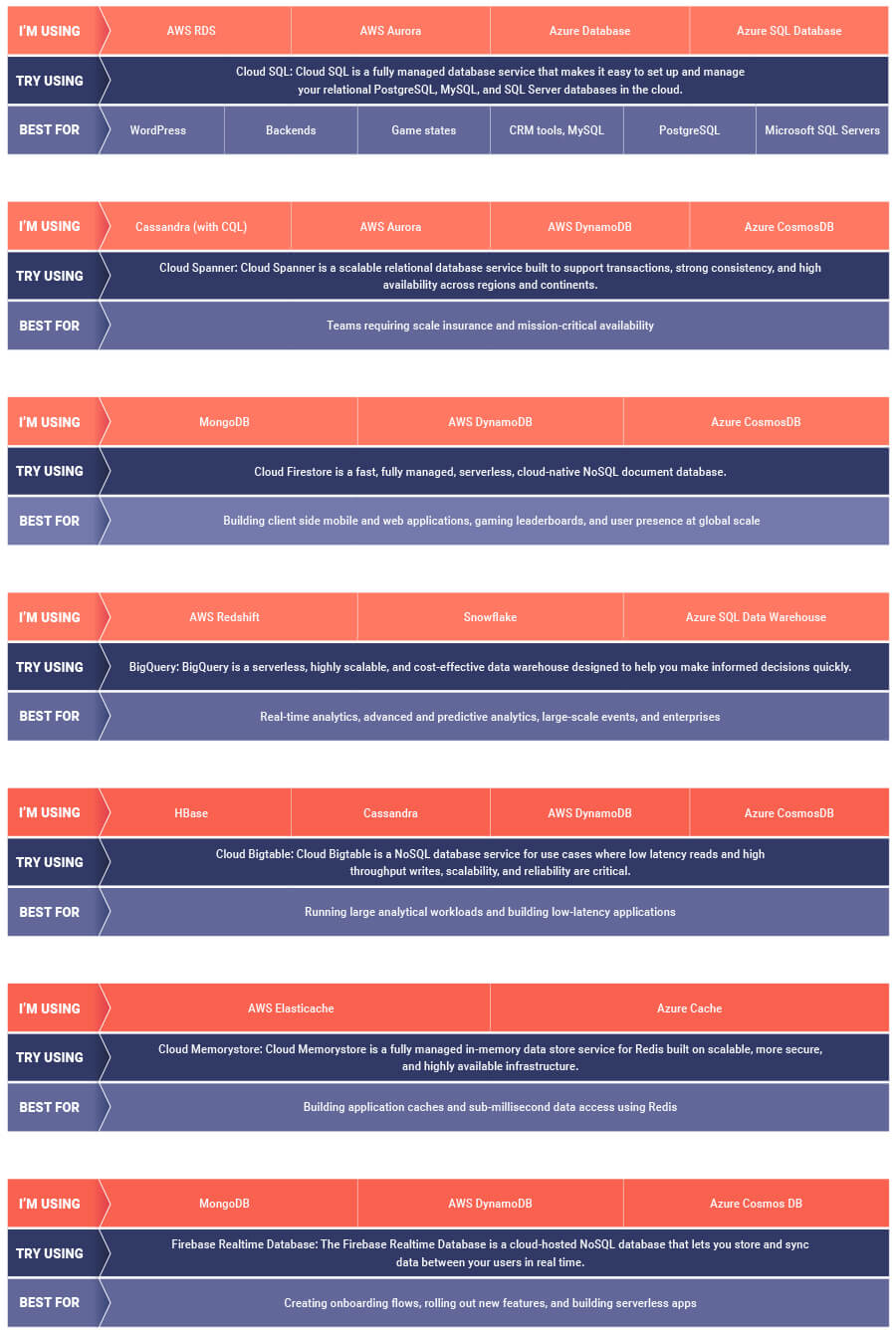
If you are looking to leverage the power of Google Cloud database offerings—but were unsure of which database services comes closest to the service you are currently using, here’s a handy map to find your way.
More Relevant Stories for Your Company

There are 2 Key Traits You Need to Battle the Slowdown. FM Logistic Know How to Enable Them
FM Logistic provides its international customers with complete logistics solutions that cover everything from warehousing and handling, to transport and distribution, co-packing and co-manufacturing, and supply chain optimization. Operating in 14 countries including France, Russia, Poland, India, Vietnam, Brazil, and China, FM Logistic supports its clients by offering specialized services across

Analyze and Evaluate Migration Strategies with Google
In this whitepaper, we outline migration frameworks that we built based on conversations we’ve had with CIOs, CTOs, and their technical staff. The goal of these frameworks is to help you devise a migration strategy that empowers both IT and the business. Learn how to analyze migration strategies for your

The Cloud-First Imperative to Accelerate Digital Transformation in BFSI
In a study of 60 business and technology decision makers and influencers from Indian BFSI organizations, conducted by Forrester Consulting, it is revealed that public cloud adoption in India is on the rise with 78% of the organizations intending to increase the number of secure or compliance-sensitive workloads in the
How We Built a Brand New Bank on Google Cloud and Cloud Spanner: The First Scalable, Enterprise-grade, Database Service
Editor’s note: Technology today lets companies of any size take on entire industries simply with an innovative business model plus digital distribution. Take Shine, a French startup whose platform helps freelancers manage their finances -- and their administrative commitments. Here, Raphael Simon, Shine’s CTO and co-founder, talks about why Shine
