





Prepare for the Unknown in Supply Chain with SAP IBP and Google Cloud

3421
Of your peers have already read this article.
3:00 Minutes
The most insightful time you'll spend today!
Responding to multiple, simultaneous disruptive forces has become a daily routine for most demand planners. To effectively forecast demand, they need to be able to predict the unpredictable while accounting for diverse and sometimes competing factors, including:
- Labor and materials shortages
- Global health crises
- Shifting cross-border restrictions
- Unprecedented weather impacts
- A deepening focus on sustainability
- Rising inflation
Innovators are looking to improve demand forecast accuracy by incorporating advanced capabilities for AI and data analytics, which also speed up demand planning. According to a McKinsey survey of dozens of supply chain executives, 90% expect to overhaul planning IT within the next five years, and 80% expect to or already use AI and machine learning in planning.
Google Cloud and SAP have partnered to help customers navigate these challenges and supply chain disruptions starting with the upstream demand planning process, focusing on improving forecast accuracy and speed through integrated, engineered solutions. The partnership is enabling demand planners who use SAP IBP for Supply Chain in conjunction with Google Cloud services to access a growing repository of third-party contextual data for their forecasting, as well use an AI-driven methodology that streamlines workflows and improves forecast accuracy. Let’s take a closer look at these capabilities.
Unify data from SAP software with unique Google data signals
When it comes to demand forecasting and planning, the more high-quality and relevant contextual data you use, the better, because it helps you understand the influencing factors of your product sales to sense trends and react to disruptions or capitalize on market opportunities more timely and accurately.
The expanded Google Cloud and SAP partnership helps customers who use SAP® Integrated Business Planning for Supply Chain (SAP IBP for Supply Chain) bring public and commercial data sets that Google Cloud offers into their own instances of SAP IBP and include them in their demand planning models in SAP IBP. So, in addition to sales history, promotions, stakeholder inputs and customer data that are typically in SAP IBP, a demand planner can incorporate their advertising performance, online search, consumer trends, community health data, and many more data signals from Google Cloud when working through demand scenarios.
More data enables more robust and accurate planning, so Google continues to build an ecosystem of data providers and grow the number of available data sets on Google Cloud. Some current providers include the U.S. Census Bureau, the National Oceanic and Atmospheric Administration, and Google Earth, and partnerships are underway with Crux, Climate Engine, Craft, and Dun & Bradstreet to help companies identify and mitigate risk and build resilient supply chains.
Augmenting demand planning with additional external causal factor data is a starting point to drive more accurate forecasting. For example, knowing what regional events may be happening, or the weather patterns that may impact sales of your products, allows you to react faster to these changes by making sure adequate supply is being provided. The result is a more accurate overall plan that reduces resource waste and out-of-stock events. Planners can respond with more accurate and granular daily predictions about sales, pricing, sourcing, production, inventory, logistics, marketing, advertising, and more based on the expanded data.
Get more accurate forecasts with Google AI inside
Extending the already expansive algorithm selection available in SAP IBP, the release of version 2205 allows SAP IBP customers to access Google Cloud’s supply chain forecasting engine, which is built on Vertex AI — Google Cloud’s AI-as-a-platform offering — from within SAP IBP as part of their forecasting process.
The benefit of using an AI-driven engine for demand forecasting is that it meaningfully improves forecast accuracy. Most demand forecasting today is done through a manually set, rules-based model versus an AI-driven model that is smarter and gets better at predicting demand as it works.
Take the fastest path from data to value with streamlined workflows
Vertex AI can include relevant contextual data sets for demand planning, and the results can be shown in SAP IBP for planners to incorporate when building their workflows.
In addition to more accurate forecasts, planners can work faster and more efficiently as they build potential scenarios, meaning they can do more simulations than they do now so that a wider range of disruptions can be modeled. Customers of SAP IBP don’t have to do any of the heavy lifting. They just have to share their data from SAP IBP with Google, then access the process workflow capabilities to set up automated workflows that use the combined data. Google makes the data available so that planners can use it as they’re setting up their workflows in Vertex AI.
Users of the Google Supply Chain twin and SAP IBP can combine the rich planning data from IBP with additional SAP data and other Google data sources to provide better supply chain visibility. The Google Supply Chain twin is a real-time digital representation of your supply chain based on sales history, open customer orders, past and future promotions, pricing and competitor insights, consumer history signals, external data signals and Google data.
Leverage Google data signals with SAP IBP for more accurate forecasts
It’s not difficult to access these new capabilities, and the benefits are more accurate near-term forecasts and more return on your investments in SAP IBP and Google Cloud. If you happen to be at the Gartner Supply Chain Symposium from June 6-8th in Orlando, Florida, stop by our booth to say hello. Or, get started now
4898
Of your peers have already watched this video.
11:30 Minutes
The most insightful time you'll spend today!
Driving Business Transformation in Manufacturing, Industrial, and Transportation Using Google Cloud and AI/ML
Google Cloud partners closely with manufacturing, industrial, and transportation organizations to drive business transformation.
In this video, Mandeep Waraich, Head of Product – Industrial AI, Google Cloud, shares customer stories as well as Google Cloud’s differentiated AI products and solutions.
Waraich covers the current state of automation and industrial efficiency and how artificial intelligence is revealing an entirely new universe of possibilities.
He also speaks about Google Cloud’s approach to bringing these AI technologies to the market, and Google Cloud’s “deploy anywhere” methodology that helps achieve the impact of AI at a global enterprise scale.
Tencent Africa Cuts Cost and Improves Stability with Google Cloud

3430
Of your peers have already read this article.
3:00 Minutes
The most insightful time you'll spend today!
About Tencent Africa
Tencent Africa is dedicated to making every day easier for customers and brands. Opening its doors in 2013 as WeChat Africa, the company is responsible for WeChat operations on the continent.

About Siatik Systems
Founded in 2008, South Africa-based Siatik Systems is a leading Google Cloud Platform solutions provider with a focus on cloud integration services, information technology consulting services, and bespoke software engineering solutions.

Google Cloud Results
- Reduced latency in its service from 180 to 35 milliseconds with powerful hardware and a fast, global network from Google Cloud Platform
- Cut costs with per-minute billing and sustained use discounts
- Increased the speed of provisioning new servers with easy-to-use interface of Google Compute Engine
As one of Africa’s leading technology companies, Tencent Africa is responsible for WeChat operations on the continent. WeChat Africa has successfully launched a number of features including the WeChat Wallet, a mobile payment service for smartphones, which enables seamless and secure transactions for friends to send money to one another, cash money out at Standard Bank ATMs, use at accredited retailers, and make purchases from any SnapScan merchant in South Africa. Under the new name, Tencent Africa recently launched two new mobile products, JOOX, a mobile music streaming application, and VOOV, a social live streaming application.
When China’s Tencent brought its hugely popular instant messaging service WeChat to South Africa, it faced a near saturated market. To gain traction, Tencent Africa had to showcase WeChat’s versatility as a platform that goes far beyond just instant messaging. Engaging with local financial partners helped WeChat launch a WeChat Wallet to facilitate electronic payments, while providing exclusive content from South African cultural figures helped bring the platform extra publicity.
As WeChat started to grow its customer base, its on-premises infrastructure was stretched beyond its limits and the company looked for a cloud-based solution. After evaluating all its options, Tencent Africa found Google Cloud Platform best suited its needs.
“We’re a growing business and constantly upgrading our infrastructure. Getting new servers was becoming quite expensive so we wanted a cloud-based solution to reduce costs,” says Christoff Albertyn, Head of Technology at Tencent Africa. “When we did some latency testing, Google came out on top, so it made sense to go with them. Everybody loves Google, it’s a great brand. Just knowing a company like Google is behind it gives you peace of mind.”
Building a platform to scale
Instant messaging services need a stable infrastructure, the ability to scale at speed, and lightning fast performance. When Tencent Africa built an Official Accounts API to run a number of services on WeChat, to help companies engage with users on the platform, latency was its main concern. The Official Accounts services had to deliver replies over WeChat in under five seconds or the connection would drop.
Between the API on-premises servers in South Africa and WeChat’s main servers in China, Tencent Africa’s services regularly hit the limits of the permissible response time. In addition, by 2015, WeChat was starting to garner more customers across South Africa and Tencent Africa had to provision more servers. The on-premises servers were simply being asked to do too much, and expansion was proving expensive, so the company looked for a cloud-based solution.
Before committing to anything, Tencent Services did a thorough latency test of several cloud-based solutions. Google Cloud Platform came top. Tencent also engaged the help of Siatik, a Google Partner, to gauge what solutions best fit the company’s needs and help implement them. Siatik customers span both the public and private sectors and its consultants are regularly engaged in the health care, education, financial and technology industries. In order to provide leading technology solutions, it partners with industry leaders, such as Google, to provide best-of-breed infrastructure and cloud platform solutions to its customers.
“Siatik was a great partner to work with,” says Christoff. “Any questions I had, I could just pick up the phone and whatever it was they’d help me out. They were also able to get some of the team from Google to come to our offices and see how we worked, which was really good.”
With a simple, clean interface in Google Compute Engine, the company was able to spin up virtual instances very quickly and begin migrating its stack to Google. When it became more comfortable with Google Cloud Platform features, Tencent used Google Cloud SQL and Google BigQuery to manage its data streams, and Google Cloud Storage to store them safely.
From day one, it was very smooth. The interface was amazing—Google must have spent a long time perfecting it because it was so easy to use says Christoff. “I set up the first virtual machine in no time without any struggles.”
In addition to powerful hardware from Google Compute Engine, the fast, global network from Google helped to speed up performance. With the infrastructure ported over to Google, Tencent also brought in G Suite as an office productivity solution, which eased the pressure on its servers even more. Throughout the process, Siatik were on hand to advise and provide technical guidance whenever any issues came up.
What I really like is how quickly you can spin servers up. There’s no messing about and the interface is really easy to use, says Christoff. “You can have a virtual machine running in just a few minutes. It’s very impressive.”
Cutting costs, raising expectations
Google Cloud Platform helped Tencent Africa to slash its latency. Before the migration, pings to the Chinese servers and back would regularly take 180 milliseconds. Afterwards, this fell to around 35 milliseconds, helping to ensure smooth service to Tencent’s South African customers. Google offers innovative pricing, such as per-minute billing and sustained use discounts, which helped significantly cut server costs compared to an equivalent on-premises solution.
As its customer base grew, and Tencent Africa began to release new products, the ease of use of Google Compute Engine meant that spinning up new servers took minutes instead of hours and allowed the company to scale up and down at speed. Exploring products such as Kubernetes for rapid deployment or TensorFlow for machine learning, Tencent Africa continues to evolve and experiment with new products to keep WeChat a growing success in South Africa.
“Initially, we just used per-minute billing, but when I saw how much work we were doing with Google BigQuery and Google Cloud SQL, we started to generate sustained-use discounts, which helped save us a lot of money,” says Christoff. “The other great thing is, Google Cloud Platform monitors how you’re using it and tells you what else you can do to reduce costs.”
4438
Of your peers have already watched this video.
15:00 Minutes
The most insightful time you'll spend today!
HSBC Leverages Google Cloud to Deliver Exceptional Cx for 37 Million Customers
HSBC is the world’s largest international bank that has been in existence for 150 years. HSBC is present in 70 countries, has 37 million customers and is the number one bank in trade finance or cross-border finance. HSBC is a systemically important financial institution that is heavily regulated.
Rapid growth in data and aggressive adoption of digital channels by customers drove HSBC to make a significant transformation in their existing IT infrastructure.
The existing IT infrastructure at HSBC has been around for 30 to 40 years and with the growing need to analyze, store and process massive amounts of data it gradually became redundant. To overcome these challenges and balloon the organizations’ compute capacity HSBC decided to adopt a cloud-first strategy.
“Our existing systems are robust, scalable and can do a great job, but they do not have the database structure that allows us to run analytics and machine learning,” says Darryl West, Group CIO, HSBC.
“We are a bank at the core of our business, but we also have a significant technology company embedded within the organization. I asked the management team do we really want to compete with cloud providers, like Google, are we really going to try and do what they do, as well as they do it? Our conclusion was it was better for our business if we do a cloud-first strategy,” says West.
HSBC has been working with Google on some of the most critical business problems. The initial uses cases are typically characterized by business problems that have very large data sets and require very intense computing capability in short bursts. These include anti-money laundering, finance liquidity reporting, risk analytics, risk reporting, valuation services and more.
Watch the full video to understand how HSBC is leveraging Google Cloud Platform to enhance customer experience and deliver continuous innovations.
Google Invests 1 Billion Euros on Germany to Support Growing Businesses

3548
Of your peers have already read this article.
2:00 Minutes
The most insightful time you'll spend today!
In September 2001, the first-ever German Google employee switched on their computer in Hamburg. Since then, we’ve grown to more than 2,500 employees in four offices across Germany. Berlin, Frankfurt, Hamburg and Munich have long been our home, and we continue to invest in the growth of the local economy.
Today, 20 years after the start of “Google Germany”, we are pleased to present one of our most important investment programs to date in this country. With the expansion of our Cloud Region in Frankfurt in a new Google-owned Hanau facility, a new Google Cloud region in Berlin-Brandenburg, and a broad investment plan in renewable energy, our commitment is clear: Google is investing in Germany’s potential and supporting the transition to a digital and sustainable economy. Between now (2021) and 2030, this investment in digital infrastructure and clean energy will total approximately 1 billion euros.
Expanding our Frankfurt cloud region to support growing demand from German businesses and organizations
In Hanau, only 20 kilometers from the DE-CIX Internet hub in Frankfurt, Google is proud to be nearing completion of an additional cloud facility that will be fully operational in 2022. This expansion of our existing Frankfurt Google Cloud region will serve the growing demand for Google Cloud services in Germany.
The 4-story building is 10,000 square meters and was sustainably constructed with energy efficient infrastructure and adherence to our circular economy model for waste. The symbolic handover of the keys from developer NDC-Garbe, together with local government officials, took place on site yesterday.
A new cloud region in Berlin-Brandenburg
In addition to the Hanau expansion of our Google Cloud region in Frankfurt, we are pleased to announce that a new Google Cloud region will be located in Berlin-Brandenburg, further extending our ability to meet growing demand for cloud services in the country. When open, this will be our second Google Cloud region in Germany, providing enterprise customers with faster access to secure infrastructure, smart analytics tools and an open platform. Designed and dedicated to providing enterprise services and products for Google Cloud customers of all sizes and industries in Germany, the Berlin-Brandenburg region will have three zones to protect against service disruptions and join the existing network of 27 Google Cloud regions connected via our high-performance network.
One of the cleanest clouds in the industry becomes even cleaner
Since 2017, Google has matched 100% of our global, annual electricity use with renewable energy. Last year, we set out to run our business on carbon-free energy everywhere and at all times by 2030, enabling us to offer cloud customers one of the cleanest clouds in the industry, while helping Europe achieve its ambitious climate goals.
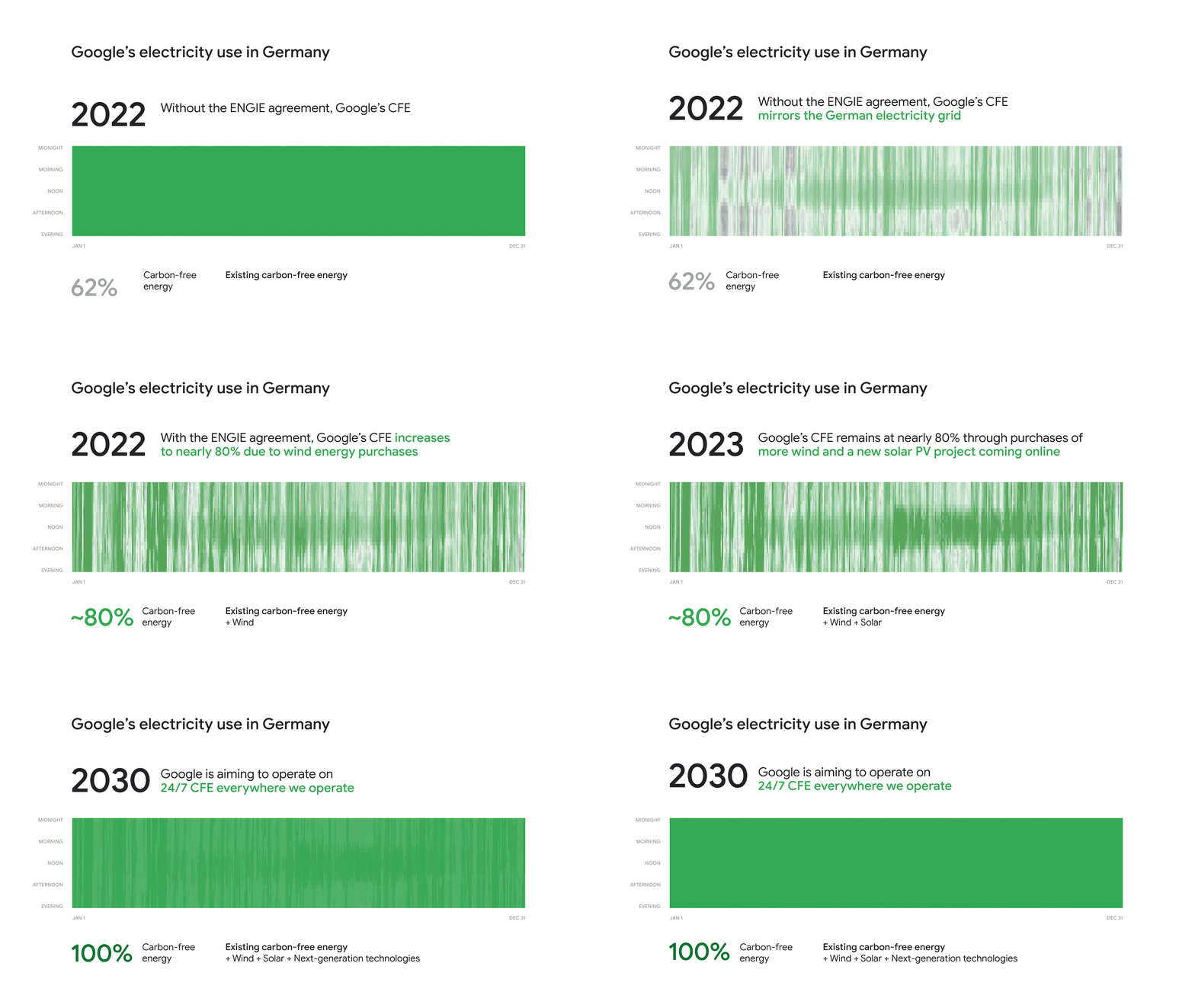
Today, we’re excited to announce that ENGIE Deutschland has been selected as Google’s carbon-free energy supplier in Germany. Under the terms of the agreement, ENGIE will assemble and develop, on Google’s behalf, a 140 megawatt (MW) carbon-free energy portfolio in Germany that has the ability to flex and grow with us as our needs change. This includes a new 39MW solar Photovoltaic system, and 22 wind parks in five federal states that will see their lives extended so they continue to produce electricity instead of being dismantled. This portfolio will ensure that the energy delivered to Google’s German facilities will be nearly 80% carbon-free by 2022 when measured on an hourly basis. This is a first but important step on Google’s journey to reach our goal of full electricity decarbonization by 2030.
This is the first energy supply of its kind in Europe, with a focus on sourcing carbon-free energy for every hour of Google’s operations. Not only will this new agreement draw the roadmap for the industry and more 24/7 carbon-free energy contracts in Europe, but it provides our cloud customers with two more regions where they can lower their carbon footprint. And importantly, by working with our energy suppliers to transform how clean energy is delivered to customers, Google is supporting the broader decarbonization of the German electricity grid.
What customers and partners are saying
As companies continue to grapple with changing customer demands, technology has played a critical role, and we’ve been fortunate to partner with and serve people, companies, and government institutions in Germany and around the world to help them adapt. The Google Cloud region in Berlin-Brandenburg and the expansion of our Google Cloud region in Hanau will help our customers — such as BMG, Delivery Hero, and Deutsche Bank — adapt to new requirements, new opportunities and new ways of working.
“We are very pleased about the symbolic handover of the keys to the building here in Hanau to Google Cloud,” said Hanau Mayor Claus Kaminsky. “With Google, we have a strong partner at our side who is supporting us in setting up Hanau’s economic future, both digitally and sustainably. The data center facility of Google Cloud embodies this transformation: We bring the cloud to us in Hanau and thus support the digital transformation of companies and public authorities. Not only in our city and Hesse, but throughout Germany and Europe. The new building meets high sustainability standards and the clean energy initiative presented today by Google is in line with our aspirations for sustainable digitalization.”
“Sustainability is a central pillar of Deutsche Bank’s strategy and we have made strong public commitments to be part of the solution,” said Bernd Leukert, Chief Technology, Data and Innovation Officer and Member of the Management Board at Deutsche Bank. “We welcome the new Google Cloud region in Germany, which will enable us to deliver additional resilience and performance for our German client base.”
Ralf Bernhard, Senior Originator Renewables, ENGIE, said: “ENGIE is excited to collaborate with Google based on a first-of-a-kind agreement which will support the company with its sustainability goals and ambitious carbon-free energy target. Thanks to our expertise in energy and risk management, we can seamlessly integrate renewable energy from existing plants and develop new assets to design a tailor made product that meets Google’s needs and plans to go even greener.”
20 years since Google first touched down in Germany, our commitment to helping Germany continue to lead in technical innovation is stronger than ever. We are excited to continue working with our partners in Hesse, Berlin and Brandenburg and across Germany to advance infrastructure and clean energy projects, help accelerate digital transformation, and secure a sustainable future for German and European companies and organizations.

5503
Of your peers have already downloaded this article
1:30 Minutes
The most insightful time you'll spend today!
IDC recently examined the benefits of implementing BigQuery for SAP data. The findings reveal massive improvements to the SAP customers’ overall business results due to faster access to data insights, lower data warehouse operation cost, and increased productivity among the data warehouse and development teams. Download the report now!
More Relevant Stories for Your Company

Trading and Investment Companies will Increase Consumption of Cloud Services: Study Confirms
While some traditional financial services companies have more slowly transitioned to the cloud, capital markets firms have embraced cloud computing across their entire value chains — front-, middle-, and back-office. We wanted to understand the dynamics behind this rapid adoption, the most common use cases, and the types of technology

Google Cloud is Every Retailer’s Most Trusted Cloud
Whether they were ready for it or not, the COVID-19 pandemic transformed many retailers into digital businesses. Retailers made huge investments into commerce technologies, customer experience tools, sales and fulfillment technology, and improving digital experiences to continue providing their goods and services to their customers. Now, more than a year

Building Unique Customer Experiences with Speed & Scale: Sprinklr & Google Cloud
Enterprises are increasingly seeking out technologies that help them create unique experiences for customers with speed and at scale. At the same time, customers want flexibility when deciding where to manage their enterprise data, particularly when it comes to business-critical applications. That’s why I’m thrilled that Sprinklr, the unified customer

TELUS and Google Cloud Partner to Move Towards a More Sustainable Future
Environmental sustainability is a key priority for TELUS, a world-leading communications technology company. It continues to rank in the top 100 most sustainably managed companies in the world, and seeks to make a healthier planet for all by leveraging its global-leading technology, compassion to drive social change and reduce our
