





Pizza Hut India: Increasing Customer Coverage and Delivering Pizzas on Time

4980
Of your peers have already read this article.
3:30 Minutes
The most insightful time you'll spend today!
A subsidiary of United States-headquartered corporation Yum! Brands, Pizza Hut prides itself on serving more pizzas than any other pizza business. Founded in 1958, Pizza Hut operates 18,000 restaurants in over 100 countries. In the Indian subcontinent, Pizza Hut and franchise partners Devyani International and Sapphire Foods India operate more than 500 pizza restaurants, including 430 in India itself.
Yum! Brands aims to increase the number of Pizza Hut restaurants in India to 700 by 2022 and has nominated the country as one of the keys to its future growth. The business also operates the KFC and Taco Bell brands in India.
“Globally we are the number one pizza chain in the world based on store count and we aim to be the single biggest pizza brand in India,” says Prashant Gaur, Chief Brand and Customer Officer, Pizza Hut India Subcontinent.
Google Cloud Results
- Maximizes customer coverage and helps ensure riders deliver pizzas to customers within required timeframes
- Onboards new stores to delivery in half a day, rather than the one month required previously
- Meets tech-savvy customer demands to interact across new social media messaging channels
- Launch of live tracking delivers superior customer experience, driving positive word of mouth and repeat business
Pizza Hut launched initially in the country in the late 1990s as a dine-in restaurant brand. However, with changing customer needs, Pizza Hut soon included delivery and takeaway to provide customers with the best tasting pizzas whenever and wherever they wanted them. “Pizza is always at the center of the experience, whether through delivery, dine-in, or takeaway,” says Gaur. “Convenience is key in allowing people to access our products.”
Manual processes
While the business had long shifted into a model that featured delivery and takeaway options, it still used some manual processes. For example, some restaurants used manual listings of customer addresses to manage delivery, which ended up excluding some customers and compromising the brand. In other cases it could take the business up to a week to create a trade zone – a delivery zone assigned to a restaurant – for each new outlet, delaying the commencement of delivery services and costing the business money.
In addition, Pizza Hut India identified an opportunity to more closely track whether pizzas were being delivered within targeted timeframes.
“In some cases, we were using a manual, self-reporting mechanism that provided information about the number of orders that reached consumers less than 30 minutes after an order was placed,” explains Ashish Agarwal, Director, Technology and eCommerce, Pizza Hut India Subcontinent. “We wanted to objectively track and verify delivery times.”
Manual order tracking and execution also limited the number of orders that could be processed effectively during demand peaks. Further, customers could not monitor the status of their pizza orders, including estimated time of arrival.
“Millennial consumers expect products and services to be available when and where they want them. Our focus is to retain the heritage of the brand, which is the dine-in environment, legendary service, and great assets in terms of our stores, while responding to this demand,” adds Gaur.
Pizza Hut India also needed improved analytics in order to identify where the best returns could be achieved by opening new restaurants; how to improve the customer experience; and operate more efficiently.
The business decided to implement a transformation program underpinned by two imperatives: the need to deliver operational efficiencies and scale faster by accelerating the opening of new stores, and the need to give consumers the option of connecting with the brand using the most convenient channel.
A ground-breaking initiative
Pizza Hut India evaluated potential technology partners that could help deliver the program and decided to partner with digital consulting services company MediaAgility, and use Google Maps Platform and Google Cloud Platform services.
“Our journey with MediaAgility and Google incorporated two key initiatives that had a specific impact on our brand and consumers,” says Gaur. “The first of these initiatives was the launch of a feature that enabled consumers and our business to track delivery riders in real time.”
This initiative was ground-breaking for a business that had, until recent years, focused on establishing itself as a restaurant brand. However, with delivery an increasingly important part of its revenue mix, Pizza Hut India decided to build customer engagement through the channel. “By allowing customers to track delivery riders in real time, we could improve engagement – but more importantly give them control,” says Gaur.
During the evaluation, MediaAgility demonstrated Google Maps Platform to Pizza Hut India. “We loved Google Maps Platform as its accuracy and value was proven by consumers using Google Maps for their day-to-day needs,” says Agarwal.
Pizza Hut India conducted brainstorming sessions with MediaAgility and its franchise partners to develop its strategy and complete the implementation. The business then completed several proofs of concept to determine how best to deploy and adapt the technology to some operational processes. “We submitted some data points to our franchise partners and our Pizza Hut brand operations team, and they determined which option to adopt,” says Agarwal.
Google Maps Platform powers delivery
MediaAgility, Pizza Hut India, and the franchise partners then completed a three-month implementation that included onboarding all existing restaurants and new restaurants to the delivery platform based on Google Maps Platform and on Google Cloud Platform.
Pizza Hut India now uses Distance Matrix API through Google Maps Platform to provide travel time and distance based on recommended routes between origins and destinations. This service helps provide delivery riders’ estimated time of arrival to customers.
Directions Service calculates directions by communicating with the Google Maps API Directions Service, which receives direction requests and returns efficient paths based on travel time and factors such as distance and number of turns. This service provides a view of the delivery rider’s position relative to the customer’s location.
Through the Nearest Roads service included in Roads API, Pizza Hut India obtains individual road segments for given GPS coordinates, while Snap to Roads provides the best-fit road geometry for given GPS coordinates.
The business employs Maps Javascript API to customize maps with dedicated content and imagery for websites and mobile devices – showing a map view to store managers and customers – and uses Maps SDK for Android to add maps based on Google Maps to its applications.
Google Cloud Platform runs the delivery platform
Pizza Hut India is running its delivery platform on a Google Cloud Platform architecture that comprises App Engine to run its web applications; virtual machine instances provided through Compute Engine; Cloud Datastore to run a NoSQL document database; Firebase to develop and run its mobile applications; Cloud Storage to store data; and a BigQuery analytics data warehouse.
Realizing goals
With Google Maps Platform and Google Cloud Platform, Pizza Hut India and its franchise partners are realizing the goals of the transformation program.
Rather than take up to seven days to manually map trade zones for stores, Pizza Hut India uses Google Maps Platform to create and update them as required. “After we started working with MediaAgility and Google, we digitized those maps and created trade zones – zones within which Pizza Hut India restaurants will deliver – based on estimated travel times during the busiest time of the week,” says Gaur. “This minimizes the risk of late deliveries.
“The other benefit was reduced time to activate new stores,” he adds. “If you are launching 100 stores per year, this becomes a big, big task. Now we can bring new stores into the market much more quickly.”
With MediaAgility and Google Maps Platform, the business can also help ensure newly built establishments – such as blocks of flats – are captured within trade zones, allowing stores to deliver to residents.
Delivery accounts for increased transactions
Pizza Hut India now automatically allocate orders to delivery riders using a rider tracking application on their mobile phones. When a rider starts his or her journey, Google Maps Platform enables point-by-point tracking by consumers and store managers. The Pizza Hut India delivery operations team monitors delivery performance through a real-time dashboard.
Pizza Hut India is meeting customer expectations of live, map-based streaming of delivery status on their devices – enhancing customer experience and loyalty, and adding accountability to the process. The business is reaping the rewards of its investment, with delivery now a large slice of its overall offering. “We have taken significant strides in the past three to four years to change our customers’ online ordering experience, and the last-mile delivery experience to the customers’ homes,” says Gaur.
Launching delivery tracking has also had a dramatic impact on Pizza Hut India’s internal key performance indicators. “The proportion of calls to our call center that are following up on an order, as opposed to placing an order, has fallen dramatically,” says Gaur.
Advanced analytics
Further, Pizza Hut India is running advanced analysis of data in the BigQuery data warehouse, enabling the business to determine which restaurants are doing well, which deliveries may be delayed, and what locations are most promising to open a new store. These insights enable the business to boost productivity, expand effectively, and operate more efficiently.
The business can now onboard new stores to delivery in half a day, rather than the month required previously. “The process enabled by Google Cloud and MediaAgility is also delivering significant operational cost savings as well as helping us open and grow new stores quickly,” says Agarwal.
“MediaAgility acted as our development partner across the project, helping us deploy everything from zones to rider tracking,” he says. “It’s been with us from the strategy discussion through the implementation and stabilization phases.”
Chatbot in development
MediaAgility has also helped Pizza Hut India create a chatbot using the Dialogflow development suite for creating conversational interfaces. “This project is about giving millennials and other customers one more channel to reach out and connect to the brand,” explains Agarwal.
Pizza Hut India is now ideally placed to continue growing and position itself as a brand of choice for tech-savvy consumers. “We’re extremely pleased with the contribution of all the parties involved in this project and look forward to continue transforming our business to meet the demands of the digital age,” says Agarwal.
While Gaur acknowledges it is difficult to predict change over the next two to five years, he believes delivery is likely to become more prominent in Pizza Hut India’s combination of offerings. “When we began our online journey in 2016, we predicted delivery would be about 25 percent of the mix by 2020,” he says. “With Google and MediaAgility, I think it will keep growing.”
Picsart’s Apigee-powered Pivot: From B2C to B2B, Bringing Graphic Design Capabilities to Businesses

1191
Of your peers have already read this article.
3:30 Minutes
The most insightful time you'll spend today!
With 150 million users and counting, Picsart was originally founded as a photo and video editing app we use to enhance our everyday life before uploading them to various social media platforms. As its user numbers continue growing, the company began exploring options for incorporating its easy-to-use editing tools into other applications and services. Now, businesses looking for a low-lift solution to enhance their product offerings with Picsart’s award-winning software suite can do so. Thanks to Apigee, organizations from assorted markets, such as printers, t-shirt makers, and phone case designers, are benefiting from Picsart’s custom design APIs.
Picsart helps companies reach a new audience of customers by offering them graphic design capabilities at an affordable cost, avoiding the resource and time-intensive process of hiring developers and building these functions from scratch. The benefits of APIs are energizing Picsart’s business partners, too; with the addition of photo editing, keeping customers engaged, and returning to their apps.
“Eighty percent of our users are Generation Z and Millennials,” says Jinny Jung, vice-president of Picsart’s API program. “They’re the future of creators all over the globe. They want creative control.”
“Many of the businesses we serve are looking to tap into that audience. They really need solutions like this to take their business to the next level,” Jung adds. Having an API service also takes Picsart to the next level — thanks in part to Apigee.
How to turn a quick pivot
Moving from strictly business-to-consumer (B2C) services to a business-to-business (B2B) offering wasn’t easy for Picsart. The company had to adopt an entirely new business model and develop a new suite of API products — and they did so quickly.
When a prominent social media site contacted Picsart about offering its editing tools to their users via APIs, Picsart knew it couldn’t miss this opportunity. However, none of their developers knew how to manage APIs for external use, an endeavor involving multiple processes and fraught with logistical complications. Failing to configure APIs correctly allows malicious actors to effortlessly bypass cybersecurity protections, exposing network data.
The company quickly assembled an API business unit to plan and coordinate the creation of a secure API development process. This process would support marketing, sales, distribution, and other facets of the business, all while still delivering great functionality to the company’s original B2C customers. And voila! Picsart was reborn.
The API BU works as “a scrappy startup within a larger company,” as Jung puts it. Its budget is scrappy too. Among the unit’s first tasks: finding an API management platform that could simplify and streamline all the tasks the team faced at an affordable price. Jung says that Apigee was a clear choice.
“Apigee’s offerings gave us the flexibility to get off the ground without a huge budget and grow our business over time. It’s super easy to use, the dashboard is very intuitive, and the price came in well for us.”
The company had already used APIs internally, but had never provided them to customers or partners.
“We needed to lean on gateways and management platforms that already knew how to set everything up,” Jung says. “We really needed the shortcut.”
Her team did consider other API platforms, but being part of Google Cloud gave Apigee a natural edge.
“We were already Google Cloud clients. We were already part of the Google Cloud ecosystem. We really liked Apigee’s ease of use and the power of Google behind it.”
Apigee works seamlessly in tandem with its other Google Cloud services, including the Google Cloud Content Delivery Network (CDN) and BigQuery, Google Cloud’s fully-managed data warehouse.
“Apigee’s integration with the whole Google ecosystem makes our lives easier, and makes it quite natural for us to use,” says Tiberiu Stanescu, director of engineering for the Picsart API business unit. “It allows us to also meet our technical needs, including scalability and even improved performance with queries and, when we’re integrating the data, dashboards.”
Using Apigee for total API control
Picsart uses Apigee to manage all its external APIs, which include those that enable users to remove or change photo backgrounds, apply filters, and add text. Apigee also manages the API features for Picsart’s Editor SDK package.
Key ways in which Picsart uses Apigee include:
- API management. Apigee runs test/stage and production environments, can customize pre-and post-flows, and automatically authorize for services with different methods including API Keys and oAuth.
Apigee’s pre-built integrated portal has helped Picsart “greatly” in the time the company has been using it, Stanescu says. He praised its flexibility and its rate-limiting function, “which allows us to properly define and secure our products.”
- Developer support. With Apigee, Picsart now takes an “API-first” approach to developing new features by using microservice architectures. They’re exposing APIs via their developer portal, which allows them to describe precisely how developers can use each API.
- Apigee helps Picsart’s own developers use APIs to simplify the development process and save the company time and money. In conjunction with other Google products, Apigee is providing Picsart with the data and analytics it needs to view and monitor API-related productivity improvements.
- Security. Apigee’s out-of-the-box security requires no specialized knowledge or skill to implement. Picsart relies on Apigee security features such as including headers to set up security parameters, and custom rate-limiting policies and quotas, allowing the company to avoid stack overflow from API calls.
As a result, the company has experienced zero API-related security incidents, Stanescu notes. “We’re definitely grateful to Apigee for this,” he adds. Recently, Stanescu says, a company performed penetration testing on Picsart’s APIs, looking for vulnerabilities, but failed to discover any security flaws or threats. Apigee’s easy-to-use, but powerful security features are helping Picsart keep its clients and customers safe and secure.
From scrappy startup to business core
In the three years since implementing Google Apigee, Picsart’s API business unit has gone from a seemingly simple request to a critical product offering enabling new and recurring revenue.
“It’s part of the foundation of our business,” says Jinny Jung. “It powers our entire API external-facing business. We wouldn’t be able to sell APIs to developers and partners without the Apigee API gateway. We wouldn’t have gotten off the ground without Apigee.”
Apigee is helping Picsart in another key way, too: its integration with products like BigQuery, Google’s data analytics platform that lets it stay on top of which APIs are most used. That information guides every aspect of the business and helps the company develop and release new generative AI-powered products.
“The data absolutely informs what we choose to develop and where we put our resources,” Jung says. “Apigee makes it super easy for us to track API use and see the trends.”
With Apigee, Picsart is opening up a new world of creative design to audiences across all markets and demographics, while avoiding the stress that comes with a costly development process. Today, generative AI apps continue capturing imaginations, unlocking the ability to create awe-inspiring art with only a few natural language prompts. Picsart and Apigee will continue working together to provide a canvas through APIs no matter where an artist may be.
Google Unveils New Cloud Region in Delhi NCR to Power India’s Digitization

8347
Of your peers have already read this article.
2:00 Minutes
The most insightful time you'll spend today!
In the past year, Google has worked to surface timely and reliable health information, amplify public health campaigns, and help nonprofits get urgent support to Indians in need. Now, we are continuing to focus on helping India’s businesses accelerate their digital transformation, deepening our commitment to India’s digitization and economic recovery. To support customers and the public sector in India and across Asia Pacific, we’re excited to announce that our new Google Cloud region in Delhi National Capital Region (NCR) is now open.
Designed to help both Indian and global companies alike build highly available applications for their customers, the Delhi NCR region is our second Google Cloud region in India and 10th to open in Asia Pacific.
What customers and partners are saying
Navigating this past year has been a challenge for companies as they grapple with changing customers demands and economic uncertainty. Technology has played a critical role, and we’ve been fortunate to partner with and serve people, companies, and government institutions around the world to help them adapt. The Google Cloud region in Delhi NCR will help our customers adapt to new requirements, new opportunities and new ways of working, like we’ve helped so many companies do in the region:
- InMobi scaled a personalized AI platform to support 120+ million active users. “With the arrival of the Google Cloud Delhi NCR, InMobi Group sees the opportunity to continue closing the gap between our users and products,” says Mohit Saxena, Co-founder and Group CTO of Inmobi. “Glance, especially, has been serving AI-powered personalised content to over 120 million active users. We can’t wait to continue giving them truly meaningful experiences that are speedy, scale well, and are relevant to them, by expanding the use of our current tools working on Google Cloud with the opening of a new region.”
- Groww now supports a sizable user base. “Google Cloud provides great technology that enables us to build and scale infrastructure to millions of users, and the new Google Cloud region in Delhi NCR will continue to help more businesses and startups in India access powerful cloud-based infrastructure, products and services,” says Neeraj Singh, Co-founder and Chief Technology Officer, Groww.
- HDFC Bank is positioned for the future. “At HDFC Bank, we are harnessing technology platforms to both run and build the bank. As we progress to be future ready, the objective is to invest in future technologies that give us scale, efficiency and resiliency. Towards this the Google Cloud region in Delhi NCR will enable us to enhance our resiliency and help us in building an active-active design framework for our new generation applications on cloud,” says Ramesh Lakshminarayanan, CIO, HDFC Bank.
- Dr. Reddy’s Lab built a modern data platform with Google Cloud. “At Dr Reddy’s, we pride ourselves in helping patients regain good health, acting quickly to provide innovative solutions to address patients’ unmet needs and in accelerating access to medicines to people worldwide. Our Google Cloud-powered data platform is helping us realize these objectives and we welcome Google’s investment in the new Delhi NCR region as helping us and other businesses in India make further contributions to our social and economic future,” says Mukesh Rathi, Senior Vice President & CIO, Dr. Reddy’s Laboratories.
- “To survive the disruption caused by the pandemic and to succeed in the long term, organizations need to become digital natives, so they can be more agile, explore new business models and build new capabilities that boost resilience. A cloud-first strategy plays a key role in enabling businesses to do this,” said Piyush N. Singh, Lead – India market unit & lead – Growth and Strategic Client Relationships, Asia Pacific and Latin America, Accenture. “Harnessing the potential of cloud requires the right data infrastructure and this expansion by Google Cloud will undoubtedly help Indian enterprises in their digital transformation journeys.”
A global network of regions
Delhi NCR joins 25 existing Google Cloud regions connected via our high-performance network, helping customers better serve their users and customers throughout the globe. As the second region in India, customers benefit from improved business continuity planning with distributed, secure infrastructure needed to meet IT and business requirements for disaster recovery, while maintaining data sovereignty.
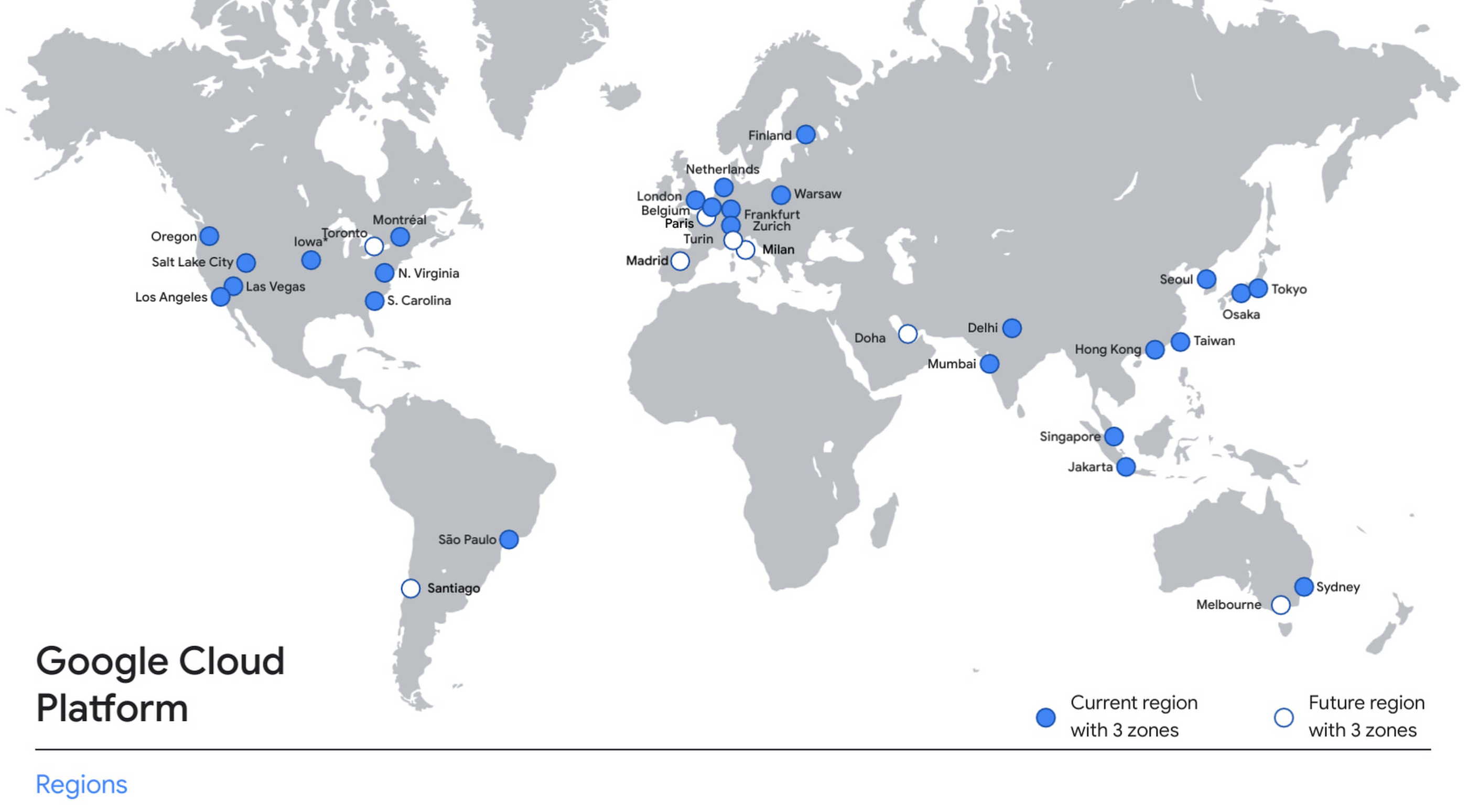
With this new region, Google Cloud customers operating in India also benefit from low latency and high performance of their cloud-based workloads and data. Designed for high availability, the region opens with three availability zones to protect against service disruptions, and offers a portfolio of key products, including Compute Engine, App Engine, Google Kubernetes Engine, Cloud Bigtable, Cloud Spanner, and BigQuery.
Supporting India’s recovery with training and education
Google and Google Cloud will also continue to support our customers with people and education programs. We’re investing in local talent and the local developer community to help enterprises digitally transform and support economic recovery.
Through the India Digitization Fund, we expanded our efforts to support India’s recovery from COVID-19—in particular, through programs to support education and small businesses. In addition to expanding internet access, and investments to help start-ups accelerate India’s digital transformation, we’ve grown our Grow with Google efforts. Businesses can access digital tools to maintain business continuity, find resources like quick help videos, and learn digital skills—in both English and in Hindi.
Helping customers build their transformation clouds
Google Cloud is here to support businesses, helping them get smarter with data, deploy faster, connect more easily with people and customers throughout the globe, and protect everything that matters to their businesses. The cloud region in Delhi NCR offers new technology and tools that can be a catalyst for this change. To learn more, visit the Google Cloud locations page, and be sure to watch the region launch event here.
Without an API Product Owner, Your APIs Have a Limited Lifespan

3552
Of your peers have already read this article.
3:30 Minutes
The most insightful time you'll spend today!
Product teams often serve as the nexus between all organizational units within a company, ensuring that a specific line of business follows a clear roadmap and that cross-functional alignment drives success. At their most empowered, product owners are like miniature CEOs for each offering within a company.
Unfortunately, in today’s complicated IT landscape, not everything that should be thought of as a product receives the designation. In my time as a digital consultant, I’ve seen one particular technology too often dismissed as back-office minutiae — application programming interfaces, or APIs.
APIs can be the glue that binds a company’s resources together and the mechanisms through which an enterprise’s data, functionality, and other digital assets are accessed and distributed. They enable software systems to communicate and let developers leverage software for new applications and digital experiences, abstracting underlying complexity into a consistent interface that allows data and functionality to be combined and reused with unprecedented flexibility.
Unfortunately, many business leaders see APIs as middleware and thus as undeserving of the resources of a full-fledged digital product. Their organizations create APIs as one-off projects, with engineers moving on to other projects when they are done and no one looking after an API’s maintenance or whether it offers utility beyond the bespoke use case for which it was created.
This is a problem because APIs can unlock digital assets that otherwise would be captive within enterprise silos. An API that exposes a customer database can likely be used and reused for numerous purposes, for example, and treating developers as customers of this API can help increase adoption of and the amount of innovation around it. But such a powerful outcome is unlikely if an API has been created only as a system integration detail rather than as a product with an owner who oversees a full lifecycle, from ideation to adoption to iteration. Put bluntly, a project-oriented attitude toward APIs misses the boat.
Pitney Bowes, a company I’ve worked with at Google Cloud, offers a high-profile example in which a notable enterprise has treated APIs as products and given its API program the same treatment it would give to any go-to-market offering. After selling traditional mailing and shipping solutions for nearly 100 years, the company transformed itself into a provider of digital logistics and e-commerce solutions by building out 160 public APIs and 400 internal APIs. This enabled its developers and partners to easily consume the company’s location intelligence and shipping services in new, agile ways. It also accelerated the company’s internal project timelines, shortening the average project lifecycle from over a year to just a few months. What’s more, APIs not only introduced efficiencies and reduced costs, but also opened new revenue streams. Because developers can more easily leverage individual Pitney Bowes business capabilities for their applications, the company’s services are manifesting in new ways — such as when Pitney Bowes technology is harnessed to let customers print USPS shipping labels from within the context of an online marketplace.
Manage APIs as products
Traditionally, but wrongly, APIs have been considered pieces of other products. They’ve been built by the IT team at the request of product owners every time a project came up that required one. When the funding spigot is flowing, APIs generally receive support. But once the project runs its course, the APIs are neglected and quickly grow outdated.
Without consistent resources, APIs can’t be adapted to fluctuations in the enterprise and market dynamics. Worst of all, project-oriented APIs often end up siloed within the business unit that gave birth to them, which defies the benefit of modern APIs: to not only allow enterprise assets to be reused by other business units and partners but also accelerate the business’s innovation by increasing the number of developers interacting with its capabilities.
In contrast, if an API is treated as a product in its own right with its own owner lobbying for consistent funding, the API can be iterated according to shifts in internal and market trends. Ideally, the product owner should continually monitor an API’s engagement and collect and synthesize analytics to improve quality of service. Product-minded companies frequently launch APIs as minimum viable products in order to get ideas to market faster, then use API consumption analytics to understand developer engagement and refine APIs to be even more attractive, powerful, and intuitive.
With the help of management tools that facilitate dynamic changes, an API product owner can also help ensure that developers benefit from the latest and greatest build with minimal interruption.
Virtually all traditional product ownership responsibilities can be easily applied to an API. An API product owner is responsible for galvanizing the entire company around their API’s value. Their team can answer any questions users may have about the API’s value proposition or how to use it. It may sound trivial but having dedicated experts available to assist with any question that may arise can be a boon to an API’s velocity.
Additionally, if a dedicated product owner is assigned to pilot a company’s aggregate API program, they can use comprehensive monitoring and analysis of all API traffic to derive insight into which APIs drive value and which don’t. This can save considerable time and money from being wasted on the wrong bets. The product owner can also create API bundles segmented according to each developer community the program wants to serve. Here, the goal is not just to expose enterprise assets, but also to encourage repeat consumption. When it comes to third-party engagement, these bundles should seek to improve partner stickiness to cultivate and maintain new revenue channels. Just as any product is only useful if it has users adopting it and sticking with it, APIs are typically valuable when they attract communities of repeat users.
Tools and processes that turn APIs into strategic assets
To drive an API as a strategic asset, an API product manager should support the API with management tools and processes.
First off, it’s necessary to establish comprehensive security layers for an API so cross-functional internal groups and third-party partners are comfortable using it. Mechanisms that apply protection with introducing user friction — such as OAuth, API key verification, XML/JSON threat protection — are strongly encouraged. It’s also often prudent to integrate machine learning functionality that can detect bot attacks and other adversaries before they breach an API and affect either its developer users or the end users consuming those developers’ apps.
Enterprise software products are typically afforded visualization tools, dashboards, reports, and self-service functionality to drive adoption — and APIs should be no different. Comprehensive portals that highlight API features (including knowledge centers, interactive documentation, blogs, and forums) should be crafted to promote developer consumption. Anything that is likely to magnetize collaborators and expedite registration should be provided for an API. A primary goal of API-first development is to increase velocity, so offering developers a self-service experience while maintaining visibility and control over API usage is crucial.
Manage with an “outside-in” perspective
Perhaps the most important role an API product owner must fulfill is maintaining a staunch outside-in approach.
In an inside-out perspective, enterprise leaders look internally for gaps and fill them with existing IT capabilities. Internal intuition untested by the market can define planning, and the resources that IT already has — rather than those that customers demand — typically restrict options. In contrast, an outside-in approach requires the company to listen to what the market is asking for and to respond appropriately. Outside-in thinkers start by asking what the customer needs, then build strategies from there. Because customer preferences are moving targets, an outside-in perspective is constantly evolving and seeking new data. In the case of API programs, product managers should find ways to align API user data with business KPIs, which can be essential to organizing stakeholders and achieving buy-in for the program throughout the organization.
Because both consumers and developers will abandon products that do not meet their needs, an outside-in perspective is increasingly non-negotiable. The product owner needs to analyze rapidly-changing market trends, understand the competitive landscape, keep a pulse on customer and stakeholder needs, and facilitate a backlog of changes that can help the company satisfy the market. Essentially, API product owners are the end-user advocate — and that’s for both for developers using the APIs and the people touching the applications powered by those APIs.
None of this means product owners need to be entirely risk averse, however. They should have the freedom to experiment with hypotheses and to make adjustments — but to make experimentation viable over the long run, they also need to have the foresight to kill a project immediately if the early end-user response is poor. If the product owner is not learning and iterating, they probably are not pushing the API program forward.
Calling all product professionals
If an enterprise plans to pursue an API-first mandate, it’s crucial that the API program is a well-funded, autonomous business unit. Without a visionary owner, APIs will not be able to usher in the transformation experienced by companies such as Pitney Bowes. The API-first philosophy requires that APIs are built prior to applications and that the API provide a value proposition of its own — which means that if an enterprise wants to accelerate innovation and take advantage of APIs, its first step should be to hire API product managers.
Google Cloud Partnership Helps Lowe’s SRE Team Achieve 20X More Releases Per Month

5550
Of your peers have already read this article.
2:00 Minutes
The most insightful time you'll spend today!
Editor’s note: Today we hear from the Lowe’s SRE team. They share about how they have been able to increase the number of releases they can support by adopting Google’s Site Reliability Engineering (SRE) framework and leveraging their partnership with Google Cloud.
At Lowe’s, we’ve made significant progress in our multiyear technology transformation. To modernize our systems and build new capabilities for our customers and associates, we leverage Google’s SRE framework and Google Cloud, which helps us meet their needs faster and more effectively. With these efforts, we’ve been able to go from one release every two weeks to 20+ releases daily—about 20X more releases per month.
Our SRE transformation didn’t happen overnight, though. Every step along the way brought some challenges. But looking back, we are excited to see how much we have accomplished for our customers as a result.
Back in 2018, before adopting SRE practices, we were more reactive than proactive, following an “eyes on glass” approach. On-call structures and incident management efficiency were not at optimal levels with too many repetitive and manual tasks, resulting in operational toil. Production concerns were not surfaced into the product roadmap, which resulted in delays in making fixes.
Bootstrapping SRE at Lowe’s
As we moved from on-prem to Google Cloud, we decided to move from a monolithic- to microservices-based architecture. And to better manage this new architecture, we embarked on an SRE journey.
Then as COVID-19 hit, we really had to accelerate this journey as customers increasingly moved to online ordering and delivery to meet their Total Home Improvement needs. To do so, we followed four key principles that allowed us to meet changing customer needs quickly and release fast and reliably.
- Automate away toil
As we moved from traditional Ops to an SRE ecosystem, our biggest opportunity was reducing toil, so that engineers can spend time on activities that drive business impact and customer outcomes. We think of toil as work that is manual, repetitive, tactical, devoid of enduring value—but automatable. So, to tackle toil, we focused on automating away the need for manual intervention. As an example, we made sure engineers were not the first point of contact for any alert. Any triage or resolution that an engineer can perform, a machine can be trained to do the same. We used supervised and unsupervised learning techniques to automate our toil. With a long-term goal of “no toil,” our SREs work on identifying and reducing toil to a manageable level across the organization. - Engineer alignment through roadmaps
Our goal is to maximize the engineering velocity of developer teams while keeping products reliable. We want an engagement model where product, SRE and development teams are closely aligned. A key way we’ve been able to create this alignment is by having our SREs embedded into domain and product teams. Each domain has an SRE, who is involved at the beginning stages of product development to ensure that the domain stakeholders are in alignment with the SRE initiatives. As such, SREs are able to improve the reliability, performance, scalability and launch velocity of the services throughout all phases of the service lifecycle. - Adopt one-touch releases
Our path to production used to contain many manual steps and validations, slowing the rate at which we released features. Additionally, we used to bulk all our releases together to deploy at once, which increased the risk of failure and created a longer feedback loop from production. To tackle this with an SRE mindset, we created a one-touch release process in which SREs review the product team’s pull requests. When approved, this triggers a DevSecOps pipeline that deploys the approved changes to production securely. This process created a safe, reliable and sustainable continuous delivery pipeline with quick feedback loops. Striking the right balance between speed, innovation and stability, we were able to increase our releases exponentially for the year, taking less than 30 minutes per release to deliver quality code, including various automated quality checks and processes, all in just one click. - Embrace capacity planning
To ensure our services have enough spare capacity to handle any surge in traffic patterns, our SREs emphasize capacity planning, making recommended capacity changes in the continuous delivery (CD) pipeline. They constantly monitor performance to make sure the service is robust, stable and available. And when there’s a sudden surge beyond the forecasted volume, SREs change the capacity on demand and document changes for the performance and domain teams.
Capacity planning is especially important for us during peak holiday times such as Black Friday and Cyber Monday (BFCM). We lay out our SRE stability plan three months in advance and surface into the domain team’s product roadmap. This way development teams are able to allocate sufficient engineering time to reliability. We do performance testing to ensure the environment is able to sustain increased load over long periods of time and also handle sudden surges in traffic. We also do region failover testing at a global scale to validate the automatic failover duration of service level agreements (SLAs), SRE and domain readiness. Additionally, we conduct Black Friday and Cyber Monday-specific destructive testing to validate customer experience, reliability and more.
Google Cloud’s Black Friday and Cyber Monday white-glove service played a key role in ensuring our success in both BFCM 2019 and BFCM 2020. This service included on-site visits from Google’s Customer Reliability Engineering (CRE) team who reviewed Lowe’s web architecture, capacity planning, operations practices for event risks, and presented workshops on topics such as incident response best practices.
Looking ahead
There is always room for improvement, and at Lowe’s we aim to continuously improve our SRE practices. One thing that has worked well for us, which we plan to continue, has been our road shows, where senior SRE leads present to other SREs and application domain teams on the latest SRE principles and best practices, and to get input in real-time from them.
Google’s tools and methodology have played an instrumental role in helping reshape our SRE practices and better serve our customers. We look forward to building on the momentum and partnership as we continue our SRE journey at Lowe’s.
If you want to learn more about how to adopt SRE best practices on Google Cloud, check out our documentation. If you want to learn more about Google SRE, visit our website. Stay tuned for the next blogs with Lowe’s discussing how they trained their engineering talent to adopt SRE practices and tooling, and how they improved MTTR using SRE principles.
Centralized Analytics: Apigee and Cloud Run API Management

903
Of your peers have already read this article.
3:30 Minutes
The most insightful time you'll spend today!
Most enterprise companies enforce strict requirements for how APIs should be exposed to the public internet that require centralized handling of the authentication credentials, the collection of metrics metrics and other classic API management capabilities. Before the introduction of sidecars in Cloud Run, developers either had to implement these requirements within the service itself or add a full-lifecycle API management platform in front of their service as described in a previous blog post.
In this post we want to demonstrate a new way to fulfill the requirement for API management in Cloud Run. Specifically we want to look at how the recently announced multi-container feature in Cloud Run enables a sidecar pattern that can be used by developers of Cloud Run services to add pre-packaged API management capabilities. This includes self-service developer onboarding in a developer portal, credential validation and quota enforcements. As an additional operational benefit the described solution also adds centralized analytics and metrics for APIs that are exposed via Cloud Run.
Our solution for adding API management capabilities for Cloud Run is provided by the following three components:
- The Cloud Run service that hosts a traditional RESTful web application and is fronted by a vanilla Envoy proxy.
- An Apigee Envoy Adapter aka. Remote service that runs in GKE Autopilot and acts as a policy decision point PDP for Envoy’s external authorization filter and is responsible for accepting or rejecting calls to the Cloud Run service.
- An Apigee API Platform that is used to manage the API lifecycle of the Cloud Run service. Apigee also offers a turn-key developer portal where developers can obtain access credentials to access an API.
The user journey of an incoming request to our new Cloud Run Service with API management looks as follows:
- An API Developer self-registers in the Apigee Developer Portal and obtains access credentials for the API
- They call the Cloud Run endpoint and provide their credential for authentication
- In Cloud Run service the Envoy proxy container intercepts the request and initiates a gRPC call to the Apigee Envoy adapter to authenticate the client.
- The Apigee Envoy adapter verifies the request’s credentials and identifies the corresponding API product as defined in Apigee. The Envoy adapter also verifies the call quota associated with the client and sends the analytics data and access logs back to the control plane.
- If the credentials are valid and the client hasn’t exhausted their call quota the Apigee Envoy adapter forwards the request to its co-located container in the Cloud Run service.
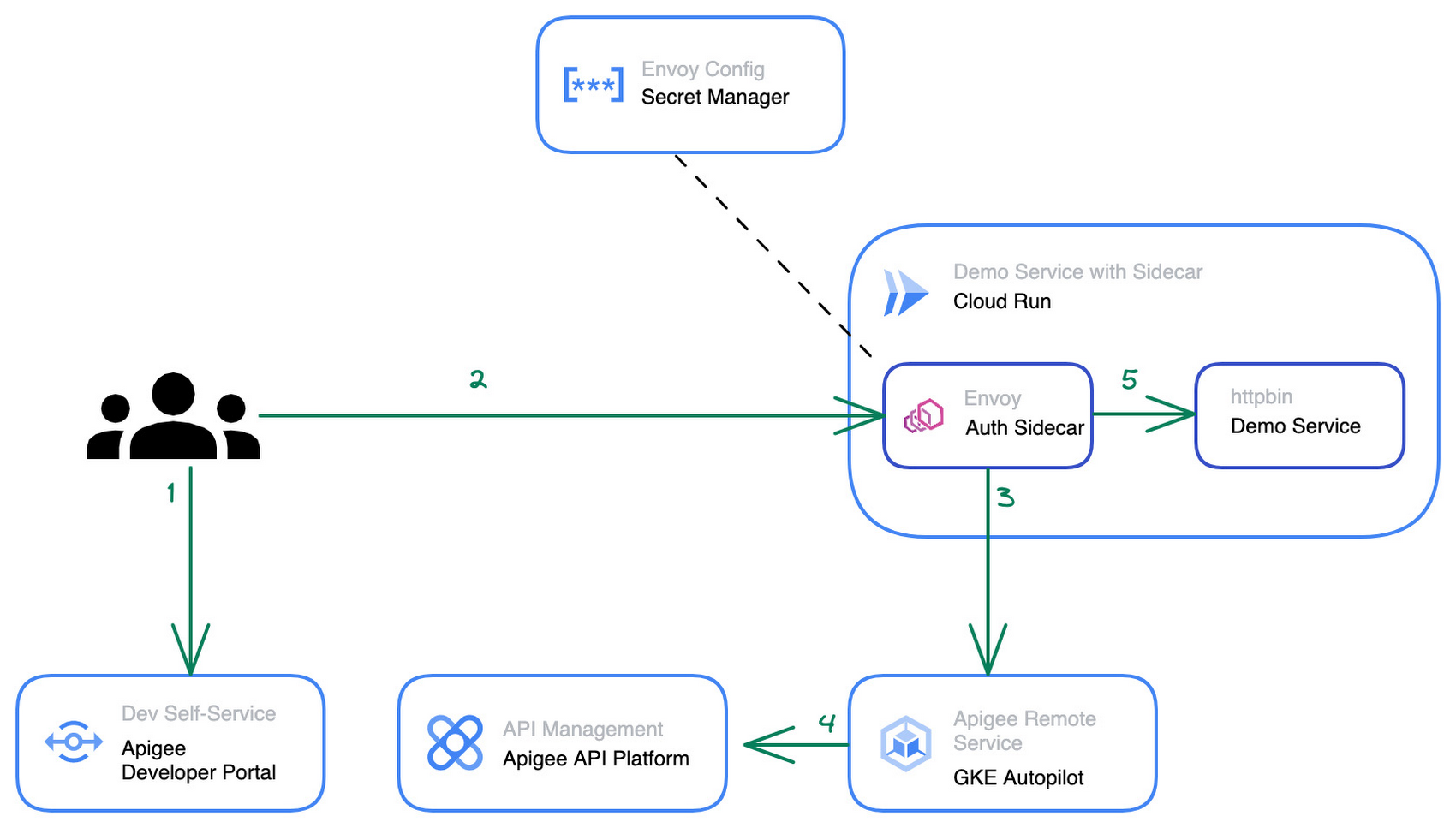
The step by step instructions for how to configure the architecture above can be found in this blog post.
Starting from a pre-existing Apigee installation the Apigee Envoy adapter is used to connect back to the Apigee runtime and control plane for accessing the API product definitions to link the incoming requests to the issued credentials and quotas. The Apigee remote service component can be replicated for high availability and is shared between multiple Cloud Run services that require a gRPC target for the sidecar’s external authorization filter.
The Cloud Run service connects to the Apigee Remote Service via an Envoy proxy that acts as a sidecar to the main application. The configuration for the envoy proxy can either be embedded within a customized Envoy image or mounted via the secret manager integration of cloud run as shown in the diagram above. Externalizing the configuration simplifies the maintenance and upgrade of the sidecar container as it can just pull the latest patch version of Envoy regularly.
The newly added API management capability is transparent for the primary application container within the Cloud Run service and does not require any changes in the application source code. Once the Cloud Run service is re-deployed with the sidecar in place, consuming applications can start to use credentials that they obtained via the Apigee API Management platform or the API developer portal to consume the Cloud Run service. At an operations level the platform operators will start to see requests to the Cloud Run service popping up in Apigee’s analytics dashboards and be able to track consumption and exposure at an API product level.
Next Steps
If you are interested in trying the multi-container support for Cloud Run yourself, check out the release announcement with many more use case descriptions. For another example and a detailed walkthrough on how to use sidecars in Cloud Run to report custom metrics to Google Cloud managed service for Prometheus you can head over to this tutorial in the Cloud Run documentation. Lastly, if you’re interested in the broader picture of how the latest features in Cloud Run are moving serverless forward, then make sure you check out this video.
More Relevant Stories for Your Company

How APIs are Helping Malaysia’s Largest Investment Company Innovate Quickly
Permodalan Nasional Berhad (PNB) is one of Malaysia’s largest investment institutions with more than RM300 billion ($71 milion) in assets under management. Through our wholly-owned company, Amanah Saham Nasional Berhad (ASNB), we manage 14 funds with a total value of RM235.74 billion ($56.34 million) as of Dec. 31, 2018. To expand

Creation of Go applications on Google Cloud Made Easy
Go is the world’s leading programming language for cloud-based development, used by millions of developers to build and scale their cloud applications and business-critical cloud infrastructure. Whether it's building CLIs, web applications, or cloud and network services, developers find Go easy to learn, easy to maintain, and packed with useful features


How to Become a Hero by Metering and Understanding Your Utilization on GKE
It's hard to believe that GKE is already celebrating its fifth birthday. Over these last five years it's been inspiring to see what businesses have accomplished with Google Cloud and GKE—from powering multi-million QPS retail services, to helping a game publisher deploy 1700 times to production in the week of

Rhode Island’s VCC Platform Built on GCP Helps Jobseekers Get Back to Work!
2020 brought many challenges, especially as in-person operations were shut down, and many were left vulnerable to unemployment. The State of Rhode Island responded to these challenges, by modernizing their workforce development operations and moving completely to a custom online platform called the Virtual Career Center, also nicknamed “the VCC.”
