





Latest Update: Keep Your Accounts Secure with Sensitive Actions

2735
Of your peers have already read this article.
2:00 Minutes
The most insightful time you'll spend today!
At Google Cloud, we operate in a shared fate model, working in concert with our customers to help achieve stronger security outcomes. One of the ways we do this is to identify potentially risky behavior to help customers determine if action is appropriate. To this end, we now provide insights on what we are calling Sensitive Actions.
Sensitive Actions, now available in Preview, are focused on understanding IAM account, or user account, behavior. They are changes made in a Google Cloud environment that are security relevant — and therefore important to be aware of and evaluate — because they may be precursors to an attack, an effort to make other attacks possible, or part of an effort to monetize a compromised account. They can quickly highlight potentially malicious activities that are facilitated by authentication cookie theft, and are another defense-in-depth mechanism that Google Cloud offers to help address this attack vector.
The Sensitive Actions that are detected today will appear in two places. They are available in Security Command Center Premium, the primary source for security and risk alerts in Google Cloud, as Observations from the Sensitive Actions Service. They are also available in Cloud Logging, where we recommend that customers integrate them into their monitoring workflows.
Sensitive Actions include the following list of action names (mapped to the MITRE ATT&CK tactics that these actions may correspond to) and descriptions:
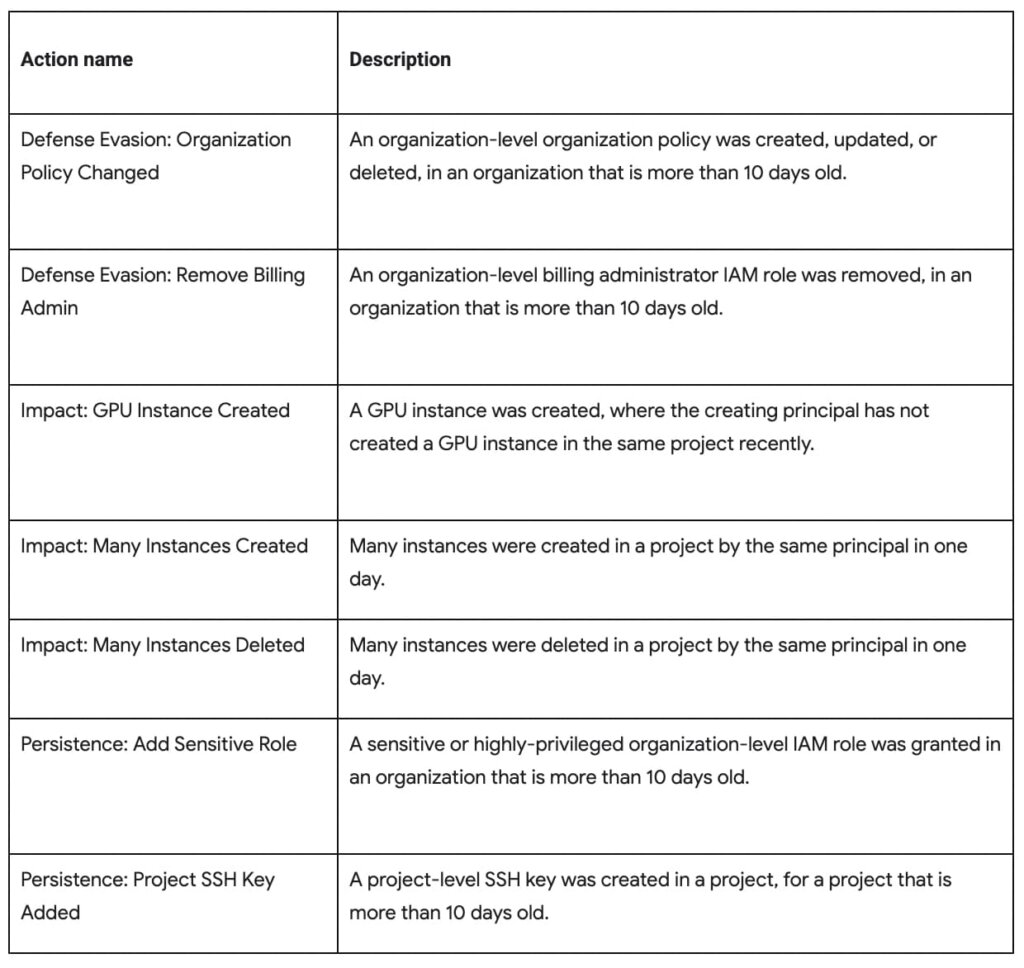
To ensure that adversaries do not have mechanisms to disable this protection or hide logs from users, Sensitive Actions is an on-by-default service now enabled for Cloud customers. In cases where customers have certain privacy controls or policy restrictions applied to their logging pipeline, their logs will not be analyzed by this service.
You can learn more about Sensitive Actions and our overall recommendations for keeping your account secure by visiting our documentation here.
Connected Data is the Lifeblood of Today’s Retailers: IDC’s 2022 Research

4677
Of your peers have already read this article.
4:00 Minutes
The most insightful time you'll spend today!
For a look ahead at the trends that will animate the retail industry this year, let’s take a look back at the 2022 National Retail Federation (NRF) “Big Show” in NYC.
Attendees at January’s event were treated to tangible examples of how retail challenges are being solved today, including new solutions to help them parse customer expectations and buying patterns, adapt stores into omni-channel experience hubs, and improve data visibility and actionability.
NRF 2022 also took the “omni-channel everything” theme of last year’s show to the logical next level: Enabling the best hybrid experiences. The message came through loud and clear of the importance of integration and interoperability in this new hybrid world – making everything work well together.
The need for modern digital infrastructure to enable this blending of physical and digital retail smoothly is paramount. To that end, technology vendors demonstrated how digital transformation initiatives, such as contactless and real time IoT and mobile applications, need to be built on cloud, edge, and secure connectivity to allow retailers to achieve the modern seamless hybrid retail that today’s consumer wants.
Other prominent themes and technologies highlighted at NRF included: extending engagement in the metaverse, sustainability, physical and digital security, and the agility and adaptability imperative.
The Metaverse and Hybrid (Omni-channel) Experiences
Today, the metaverse is an extension of our lives, enhanced by technology, which exists as a series of virtual worlds. In the future, the metaverse will be an interconnected, endless world where digital and physical lives fully converge. Imagine waiting for an appointment at a real booth on the NRF show floor while your avatar roams a fully fleshed-out digital NRF, meeting other virtual attendees, stopping for coffee at the digital Starbucks, and paying for a coffee that an in-the-flesh Starbucks employee brings to them. Digital and physical selves merge seamlessly in the metaverse, as the worlds draw closer together.
In the metaverse, brands have a digital presence, too. Nike filed seven trademarks late last year, including those for “Nike,” “Just Do It,” and its swoosh logo, and posted openings for virtual designer roles, indicating its intent to make and sell virtual branded sneakers and apparel. It subsequently purchased RTFKT Studios, a company that already makes and sells NFTs and digital sneakers. (In one collaboration with teenage artist FEWOCiOUS, the company sold 600 pair/NFTs of sneakers in just six minutes to the tune of more than $3.1 million.)
The metaverse also opens possibilities for gathering data about consumers and product demand. Imagine a sneaker drop in the virtual world. Certain styles of new kicks sell like gangbusters, giving the brand insight into what might sell IRL, intelligence that leads to trend-right production and less inventory headed for markdown or landfills. The metaverse can be a vehicle for more sustainable operations.
The metaverse further bridges the narrowing gap between digital worlds and physical worlds. Most consumers aren’t outfitting an avatar, but they are moving between online and offline and expect retailers to accommodate those hybrid omni-channel journeys seamlessly. Those demands have accelerated around last-mile delivery and experiences such as buying online and picking up in store (BOPIS) or at curbside, shopping in store and returning merchandise online, adding items to a BOPIS purchase when at the store, or communicating a substitution to the third-party grocery delivery service
Hybrid experiences open opportunities to please the consumer in new ways, but they also add expense and complexity. The need to meet this demand while enabling profitability was a major theme behind many of the technologies discussed at NRF. These included artificial intelligence (AI) for recommending the right product, return logistics software for defining and guiding product-specific reverse logistics workflows, order orchestration and fulfillment applications for omni-channel shopping, and last-mile delivery visibility for optimizing customer experience, to name a few. Also on display were task management applications help to improve and optimize in-store employee engagement, as well as touch-free applications to allow for faster payments and customer self-service checkout. RFID continues to improve inventory accuracy and inventory locating on the shelf, throughout the store, and the supply chain.
Sustainability
NRF 2022 saw a strong focus on sustainability. An NRF/IBV study released at the show highlighted the significant embrace of sustainable shopping by consumers. According to the survey, 62% of shoppers are “willing to change their purchasing habits to reduce environmental impacts.” About half indicated a willingness to pay a premium – on average a 70% premium – for sustainable products and brands.
Retailers are working to improve sustainability and reduce carbon footprint across operations by using sustainable sourcing through the supply chain, the store, and even returns. Tech vendors unveiled a variety of solutions enabled by cloud/edge, AI, computer vision, and IoT/RFID to allow retailers to effectively measure and record their environmental efforts, with the goal of reducing their impact.
Several cloud and digital infrastructure providers showcased sustainability clouds and other technology aimed at asset management with the goal of reducing energy consumption, water usage, waste. Examples included using IoT sensors to reduce water usage, optimizing re-use of store assets, and dashboards that allow retailers to accurately monitor and measure carbon output. However, such sustainability solutions can be most successful when running on the next-generation digital infrastructure that helps retailers better compete and differentiate in today’s omni-channel world.
Physical and Digital Security
According to a 2021 NRF survey, 57% of U.S. retailers reported the pandemic led to an increase in organized retail crime, while 50% reported an increase in shoplifting. When IDC’s Future Enterprise Resiliency & Spending Survey, Wave 10 (November 2021) asked retailers which digital infrastructure investments would provide the greatest strategic advantage in 2022, their #1 response was “cybersecurity and recovery investments.”
A wide range of technology vendors acknowledged retailer concerns with regards to security, fraud, and loss prevention:
- Networking, connectivity, and edge vendors highlighted multilayer security solutions that promise to protect data from a range of IoT applications that utilize customer and associate data. Many offer security consulting services to address varied threats including ransomware, retail crime, and loss prevention.
- Security and e-commerce security vendors showcased solutions to prevent fraud and abuse in e-commerce applications as well as omni-channel applications such as BOPIS and curbside pickup, using AI-based analysis for identifying “bad”/risky customers and mitigating risk.
- Cloud vendors highlighted how retail clouds provide consistent, reliable identity management and data security.
- POS/payments/store technology vendors emphasized their ability to handle payments securely from any platform with multifactor tokenization, improved identity techniques such as biometrics and voice authentication, as well as AI-enabled and computer vision solutions for loss prevention at checkout and at the door.
The Agility and Adaptability Imperative
On display at the show were multiple flavors of the digital infrastructure technology that retailers need to achieve agile, personalized, data-driven, integrated seamless operations across the many channels of today’s retail landscape. The emphasis was apt. More than half of retailers plan to boost investment in business agility and operational agility over the next 12 months, according to IDC’s Future Enterprise Resiliency & Spending Survey, Wave 10 (November 2021).
Technology vendors highlighted their connectivity investments to enable business and operational agility and their technology investments for better ease of integration, scalability, and the ability to more easily swap out or mix and match applications with integrated platforms, open systems, hybrid cloud, and retail industry clouds.
Vendors also showed off infrastructure to better harness data while enabling its visibility, maximizing its value, and providing the data-driven personalization essential for competitive advantage and differentiation. Highlights included fast, secure connectivity, 5G and Wifi-6, and edge- and cloud-enabled data and AI platforms to generate real-time insights – all designed to enable today’s omni-channel retail.
Advice for the technology buyer
Retailers should consider these key themes from NRF 2022 when making technology investment decisions for 2022 and beyond. To avoid lagging behind those retailers already moving toward thriving into the future, take action to:
- Enable the seamless, contactless omni-channel approach that today’s consumers want and expect.
- Replace legacy infrastructure that was not built to handle the modern retail environment that requires the agility and adaptability to seamlessly connect rapidly increasing volumes of data securely and more quickly than ever.
Whether sustainability, adaptability, the metaverse, or security are top concerns, addressing business needs holistically and strategically should be job #1.
Continue the conversation by downloading our Transforming retail and CPG markets whitepaper today.
Melbourne Joins Google’s 26 Cloud Regions

4990
Of your peers have already read this article.
1:30 Minutes
The most insightful time you'll spend today!
We opened our Sydney cloud region in 2017 and, since then, we have continued to invest and expand across Australia and New Zealand to support the digital future of organizations of all sizes. In Australia, Google Cloud supports almost A$3.2 billion in annual gross benefits to businesses and consumers. This includes A$686 million to businesses using Google Workspace and Google Cloud Platform, another A$698 million to Google Cloud partners, and A$1.8 billion to consumers.1
For customers in Australia, New Zealand and across Asia Pacific, we’re excited to announce that our new Google Cloud region in Melbourne is now open. Designed to help businesses build highly available applications for their customers, the Melbourne region is our second Google Cloud region in Australia and 11th to open in Asia Pacific.
We’re celebrating the occasion with a digital event where federal minister for the Digital Economy, Jane Hume, and customers Australia Post, Trade Me, Bendigo and Adelaide Bank, The Australian Football League and Macquarie Bank will share their perspectives. Come join us!
A global network of regions
Melbourne joins the existing 26 Google Cloud regions connected via our high-performance network, helping customers better serve their users and customers throughout the globe. With this our second region in Australia, customers benefit from improved business continuity planning with distributed, secure infrastructure needed to meet IT and business requirements for disaster recovery, all the while maintaining data sovereignty in-country.

With this new region, Google Cloud customers operating in Australia and New Zealand will benefit from low latency and high performance of their cloud-based workloads and data. Designed for high availability, the region opens with three zones to protect against service disruptions, and offers a portfolio of key products, including Compute Engine, Google Kubernetes Engine, Cloud Bigtable, Cloud Spanner, and BigQuery.
We also continue to invest in expanding connectivity across the Australia and New Zealand region by working with partners to establish subsea cables and new Dedicated Cloud Interconnect locations and points of presence in major cities including Sydney, Melbourne, Perth, Canberra, Brisbane and Auckland.
Collectively, this will deliver geographically distributed and secure infrastructure to customers across Australia and New Zealand – which is especially important for those in regulated industries such as Financial Services and the Public Sector.
What customers and partners are saying
Navigating this past year has been a challenge for companies as they grapple with changing customers demands and greater economic uncertainty. Technology has played a critical role, and we’ve been fortunate to partner with and serve people, companies, and government institutions around the world to help them adapt. The Google Cloud region in Melbourne will help our customers adapt to new requirements, new opportunities and new ways of working.
“We moved to Google Cloud to improve the stability and resilience of our infrastructure and become more cloud-native as part of a digital transformation program that keeps the customer at the heart of our business. We welcome Google Cloud’s investment in ANZ and the opportunities the Google Cloud Melbourne region presents to improve Trade Me’s agility and performance. – Paolo Ragone, Chief Technology Officer, Trade Me
“We initially turned to Google Cloud to help us process parcels faster and gain deeper insights into our business and its processes. The relationship has continued to deliver benefits to our customers and our organization and we welcome Google Cloud’s opening of the Melbourne region as presenting even more opportunities for businesses to innovate and generate efficiencies.” – Munro Farmer, Chief Information Officer, Australia Post.
“We are well progressed with our multi-year strategy to grow and transform our organization to be Australia’s bank of choice. Google Cloud’s advanced data capabilities and renowned culture of innovation are strongly aligned to this strategy and will allow us to become even more innovative and agile in responding to our customers’ ever-changing needs. We were quick to run our workloads out of the Melbourne cloud region and we believe Google Cloud’s expanded investment in local infrastructure will further assist us on our business transformation journey.” – Andrew Cresp, Chief Information Officer, Bendigo and Adelaide Bank.
“We have a clear vision when it comes to innovating to deliver world-class service to our customers, and our partnership with Google Cloud is core to that strategy. The company’s continued investments in local infrastructure and technology present new opportunities for us as we advance our transformation journey in this digital-first era.” – Chris Smith, Vice President, Digital Service, Optus
Our global ecosystem of channel partners has expanded by more than 400% in the last two years, and we look forward to continuing our close relationships with partners in Australia and New Zealand as we help customers modernize, innovate, scale and grow.
“Australian companies are increasingly realising the benefits of their cloud investments and are now looking to transform their organisations at scale. We are excited about the potential and new value that the Google Melbourne Cloud region will bring to our clients as we continue to work together on delivering intelligent and innovative solutions to Australian organisations.” – Tara Brady, CEO of Accenture Australia and New Zealand
“Google Cloud has always been there for its customers for the long haul and the opening of the new Melbourne Cloud region is great news. This increased resilience and scale will empower companies of all sizes to be bold in accelerating their digital transformation plans.” – Tony Nicol, CEO of Servian
“We’re excited about the launch of the Melbourne Cloud region. It will cater to the needs of industries we work closely with including healthcare and financial services, and will further enhance how we jointly deliver on the compliance, privacy and security requirements of companies as they advance their digital transformation.” – Simon Poulton, CEO of Kasna
“The opening of the new Google Cloud region in Melbourne is fantastic news as it now enables DXC customers access to enhanced services for their mission critical application and data solutions across two regions within Australia. As our customers modernise their application estate, many are seeking dual region cloud services, and DXC is excited to partner with Google Cloud to deliver these services to customers in Australia and New Zealand.” – Tim Fraser, Google Practice Lead ANZ at DXC Technology
Helping customers build their transformation clouds
Google Cloud is here to support businesses, helping them get smarter with data, deploy faster, connect more easily with people and customers throughout the globe, and protect everything that matters to their businesses. The cloud region in Melbourne offers new technology and tools that can be a catalyst for this change. Click here to learn more about all our Google Cloud locations.
1. AlphaBeta, The Economic Impact of Google Cloud to Australia, July 2021
Cloud Security : The First Priority for Enterprises

3333
Of your peers have already read this article.
2:00 Minutes
The most insightful time you'll spend today!
Cloud-based solutions were a technology life raft for organizations during the COVID-19 pandemic as employees took to the virtual office and companies scrambled to adjust to a distributed, remote reality. However, these rapid and substantial changes in the role of cloud technologies on the business came with an increased focus on security.
The accelerated move to the cloud also meant companies needed to rapidly evolve existing security practices to protect everything that matters at the core of business—from their people and their operational and transactional data to customers and their most sensitive personal information. Suddenly, enterprises were keenly aware of where business practices, employee training, and security policies were falling short.
A recent Google-commissioned study by IDG explored the details behind the heightened focus on security solutions since the start of the pandemic while highlighting the role cloud-based security solutions are playing in helping keep customers safe. The survey of 2,000 global IT leaders serves to illustrate that in this new and unfamiliar world, enterprises are more ready than ever to embrace cloud security.LEARN MOREIT Leaders Research ReportWhat are the biggest IT priorities in 2021? Explore insights from a survey of 2,000 Senior IT leaders conducted by IDG, in collaboration with Google Cloud.
Security is an even higher priority post-pandemic
In the wake of the pandemic, many organizations are facing a broader attack surface than ever before as employees moved to temporarily working from remote home offices (and in some cases, encouraged to stay there for the foreseeable future). With fewer inherent security protections on personal internet connections and more work meetings happening via video conferencing, attackers have launched a cyber pandemic of their own designed to take advantage of and exploit new weaknesses.
However, even as businesses amp up security initiatives and preventative measures, the growing wave of threats continue to keep security top of mind for IT leaders. Security risks and concerns remain one of the top pain points impeding innovation according to the IDG study respondents—only surpassed by insufficient IT and developer skills.
Enterprises looking to cloud providers for help with security
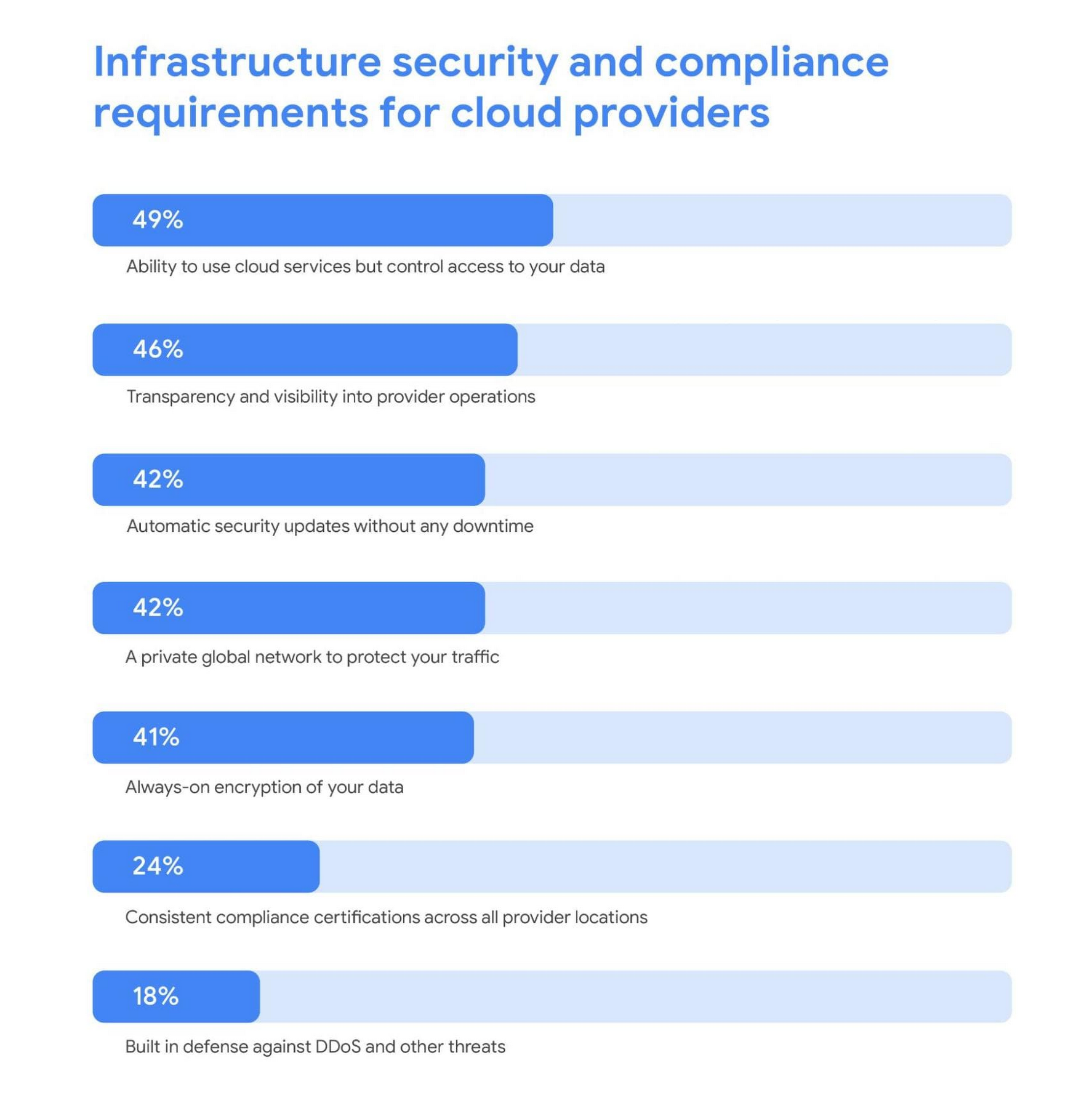
As a result, addressing security risks is a leading area where IT leaders turn to cloud providers for support. For these organizations, the ability to control access to data while using cloud services was the most required infrastructure security and compliance features from a cloud provider.
Cloud security is more trusted than ever
A deeper look into the results also revealed a shift in perspective about whether cloud security is really up to the task of protecting enterprises against modern attacks. Despite skepticism in the past, the majority of IT leaders are now comfortable with using cloud-based security solutions.
Confidence in the security of cloud infrastructure is extremely high with 85% of respondents stating they feel secure (or more secure) than on-premises infrastructure—compared to just 15% who believe on-premises is still safer.
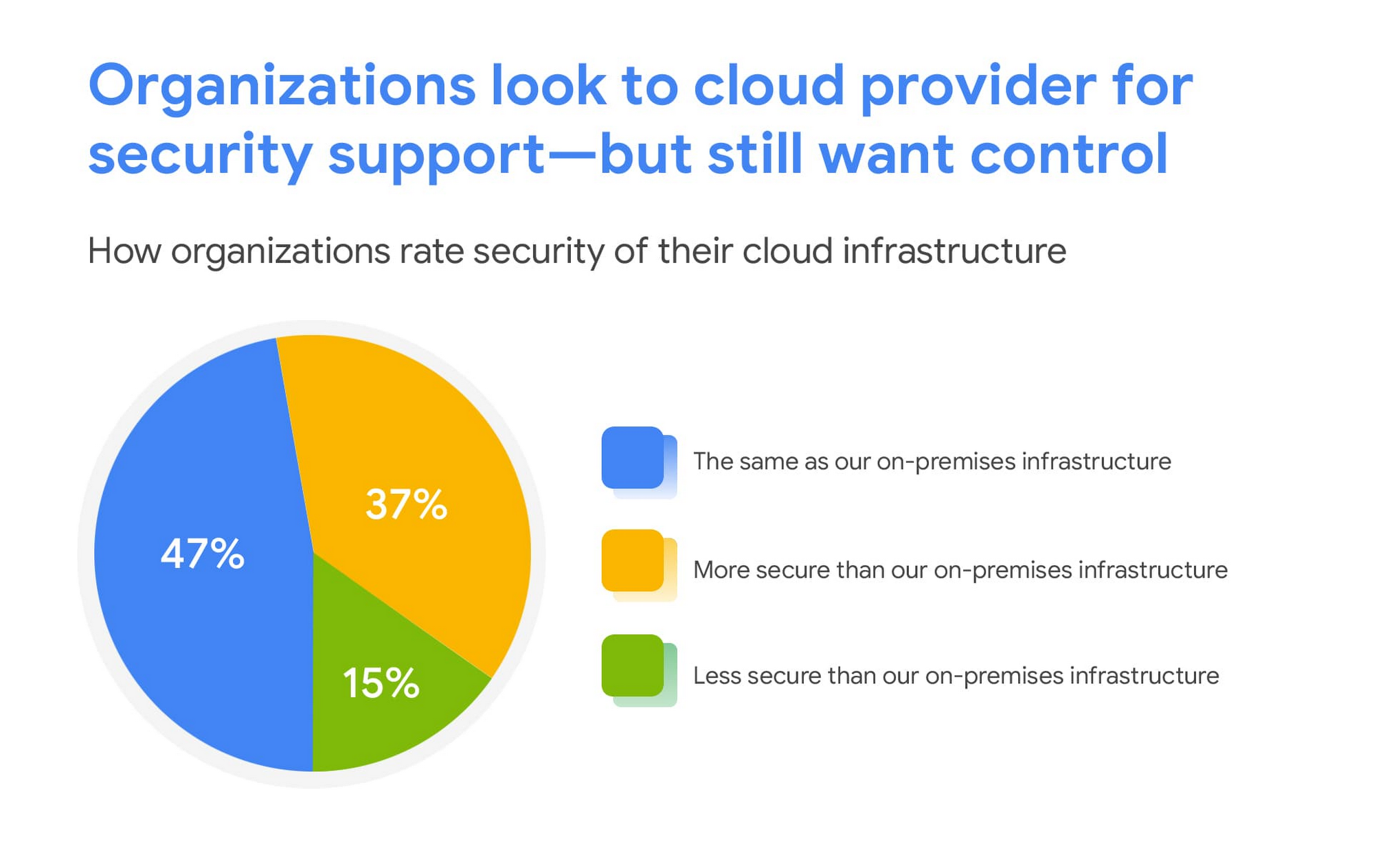
This is a clear indication that there are fewer reservations around the efficacy of cloud-based security solutions, signaling an increase in trust as organizations invest in cloud-based infrastructure and solutions.
We are committed to safe, secure solutions
Google Cloud protects your data, applications, and infrastructure, as well as your customers, from fraudulent activity, spam, and other types of online abuse. We protect you against a growing list of cybersecurity threats using the same infrastructure foundation and security services that we use for our own operations, so you never have to compromise between ease of use and advanced security.
To learn more about the IDG findings and how IT leaders are addressing security concerns post-COVID, download the full report.
Interested in how Google Cloud’s commitment to providing safe, secure solutions helps you address your security needs?
Our networking, data storage, and compute services encrypt data at rest and in transit to ensure the integrity, authenticity, and privacy of your data and your customers’ data. We also offer the ability to encrypt data in use, while it’s being processed in VM and container workloads, and our advanced security tools support compliance and data confidentiality with minimal operational overhead.
Stop Cribbing About Shadow IT and Start Taking Charge Now

3652
Of your peers have already read this article.
2:20 Minutes
The most insightful time you'll spend today!
Employees use tools at their disposal to get work done, but if these tools (often legacy) hamper collaboration or are inflexible, they’ll turn to less secure options for the sake of convenience. According to Gartner, a third of successful attacks experienced by enterprises will come from Shadow IT usage by 2020.
And this problem is not unknown. Eighty-three percent of IT professionals reported that employees stored company data in unsanctioned cloud services, a challenge especially apparent with file sync and share tools. When people work around their legacy systems to use tools like Google Drive, it’s often because they find their current systems to be clunky or that they can’t collaborate with others as easily. They’re unable to do three key things in legacy file sync and share systems (like Microsoft SharePoint):
1. Unable to work on their phones. By now, people expect to be able to work on the go—and this means not just opening an attachment, but actually making edits to and comments on work. It gives them freedom to work when it’s convenient for them and to help teammates anytime.
2. Unable to create workspaces independently and easily. This might sound counterintuitive, but if an employee needs to contact IT to have a new project folder made on a drive, the bar is too high. Employees need to be able to quickly, and independently, create documents that can be shared simply because of the changing nature of collaboration. Work happens ad-hoc, on the go (like we mentioned above), and with people inside and outside of your organization. If someone has to contact IT to create a new folder, they’re more likely to neglect the request or use a different tool altogether to get started.
3. Unable to make the data work for them. Traditional file storage is just that, storage. Like an attic, we store things in these systems, but at some point stuff gets stale and it’s hard to tell what we should keep or pitch. People need their storage systems to not only house their data, but to help them categorize and find information quicker so that they can make this data work better for them.
You have two choices when it comes to making a decision on file sync and share systems:
Option 1: Continue to let your employees work on unsanctioned products, some of which may open your business up to unintended security issues (and, in some instances, scary terms of service).
Option 2: Buy the tools that your users want to use because these tools are making them more productive.
If you want to create a more productive workforce, take cues from your employees. Your tools should not only meet the highest security standards for IT, but let people work the way they want to (and be intelligent enough to guide them along the way).
Imagine if your technology could flag that a file contains confidential information before an employee accidentally shares it. Or surface files as they’re needed to help people work faster. Google Drive does this.
Remember, if the technology doesn’t suit your employees, they’re just going to work around it anyway. Instead of investing time and resources on routine maintenance, shift this energy toward helping your employees stay productive in ways that work for both you and them.
Know the Leaders of Google Cloud Public Sector Community

5007
Of your peers have already read this article.
1:30 Minutes
The most insightful time you'll spend today!
At Google Cloud, being a strategic partner is part of our DNA. Whether it’s listening closely to our customers, helping to build team skills for innovation or simply being there (since we know the cloud is 24/7), we get excited about working hands-on with customers to deliver new solutions.
As we look to solve decades-old challenges with new technologies in workforce productivity, cybersecurity, and artificial intelligence/machine learning, we know that we are only as good as the people behind the technology. Today, we’re proud to spotlight a few of the inspiring folks behind Google Cloud Public Sector and celebrate their recognition in the industry.
Melissa Adamson, Head of Government Channels at Google Cloud, has been named to the highly respected Women of the Channel list for 2021. This annual list recognizes the unique strengths, leadership and achievements of female leaders in the IT channel. The women honored this year pushed forward with comprehensive business plans, marketing initiatives and innovative ideas to support their partners and customers.
Melissa was brought on to build the Public Sector channel from scratch. The initial focus was building the channel for the US government team and has since expanded to include education, Canada and Latin America.
Having a career background at both Microsoft and Accenture, Melissa leveraged her extensive professional network to build the organic partnerships needed to accelerate the Public Sector partner ecosystem. This helped her drive two key wins (US Postal Service and PTO) and personally recruit top cloud partners in the industry. Melissa loves card games and is learning a new language.
Todd Schoeder, Director of Global Public Sector Digital Strategy, was recently featured in the “Top 20 Cloud Executives to Watch in 2021” by Wash Exec. Recognized for his work in helping customers navigate through the impact of COVID-19 and developing innovative solutions to meet mission challenges, he says: “New partnerships are required to solve for the problems of the future. Challenges that were previously thought of as insurmountable, too risky or expensive, are actually quite the opposite — as long as you have the right partner that is working in your best interest with you.”
Josh Marcuse, Head of Strategy & Innovation, received his second Wash100 Award for leading a digital transformation team that works to drive the development of public sector solutions, including cyber defense, smart cities, and public health.
Josh has launched services to support collaborative team operations including Workspace for Government and an artificial intelligence-based customer service platform to support remote work needs. His work also includes leading Google Cloud’s partnerships with organizations to improve data sharing in the public health community, contact tracing activities, and supporting research efforts across national laboratories.
Like Melissa, Josh was brought on to build a new team dedicated to strategy and innovation. This team’s purpose is to bring an intense focus to public sector mission outcomes and the public servants who own them. Josh spent a decade pushing digital modernization and workforce transformation at the U.S. Department of Defense, and co-founded the Federal Innovation Council at the Partnership for Public Service, and now brings that domain expertise to supporting government workers who are driving digital transformation.
Join us in celebrating these folks for their leadership and contributions!
More Relevant Stories for Your Company

IT Team Figures Out Easiest Way to Build Data Pipelines and Create ML Models
Building a strong brand in today's hyper-competitive business environment takes vision. It also requires a flexible, easily managed approach to digital asset management (DAM), so marketing professionals and other stakeholders can easily share, store, track, and manipulate assets to build the brand. Many of today's leading companies, including JetBlue, Slack,

Google Cloud’s Invisible Security Vision: Key Highlights
Yesterday we held our final Google Cloud Security Talks event of 2021. Our event focused on zero trust and covered everything from Google’s history with BeyondCorp to our strategic thinking when it comes to applying zero trust principles to production environments. We shared product updates across the portfolio and talked about how

Customer Voices: How Firms from Across Industries Leverage Google Cloud
From powering everyday operations and accelerating application innovation, to providing tools for specific business needs and executing on big ideas, to advancing the security of technology solutions, companies from across industries have leveraged Google Cloud for business benefits. Companies from across industries have turned to Google Cloud for transforming their

If You Don’t Have These Features in Your Cloud, You’re Missing the Mark on Security
At Google Cloud, we work tirelessly to give our customers increased levels of control and visibility over their data. We've come out with new capabilities for data encryption, network security, security analytics, and user protection designed to deliver on that promise. External Key Manager: Store and manage encryption keys outside
