





Latest News: Secure Digital Infrastructure Services with Apigee Advanced API Security for Google Cloud

4463
Of your peers have already read this article.
3:30 Minutes
The most insightful time you'll spend today!
Organizations in every region and industry are developing APIs to enable easier and more standardized delivery of services and data for digital experiences. This increasing shift to digital experiences has grown API usage and traffic volumes. However, as malicious API attacks also have grown, API security has become an important battleground over business risk.
To help customers more easily address their growing API security needs, Google Cloud is announcing today the Preview of Advanced API Security, a comprehensive set of API security capabilities built on Apigee, our API management platform. Advanced API Security enables organizations to more easily detect security threats. Here’s a closer look at the two key functionality included in this launch: identifying API misconfigurations and detecting bots.
Identify API misconfigurations
Misconfigured APIs are one of the leading reasons for API security incidents. In 2017, Gartner® predicted that by 2022 API abuses will be the most frequent attack vector resulting in data breaches for enterprise web applications. Today, our customers tell us application API security is one of their top concerns, which is supported by an independent study from 2021 by Fugue and Sonatype. The report found that misconfigurations are the number one cause of data breaches, and that “too many cloud APIs and interfaces to adequately govern” are frequently the main point of attack in cyberattacks.
While identifying and resolving API misconfigurations is a top priority for many organizations, the configuration management process can be time consuming and require considerable resources.
Advanced API Security can make it easier for API teams to identify API proxies that do not conform to security standards. To help identify APIs that are misconfigured or experiencing abuse, Advanced API Security regularly assesses managed APIs and provides API teams with a recommended action when configuration issues are detected.
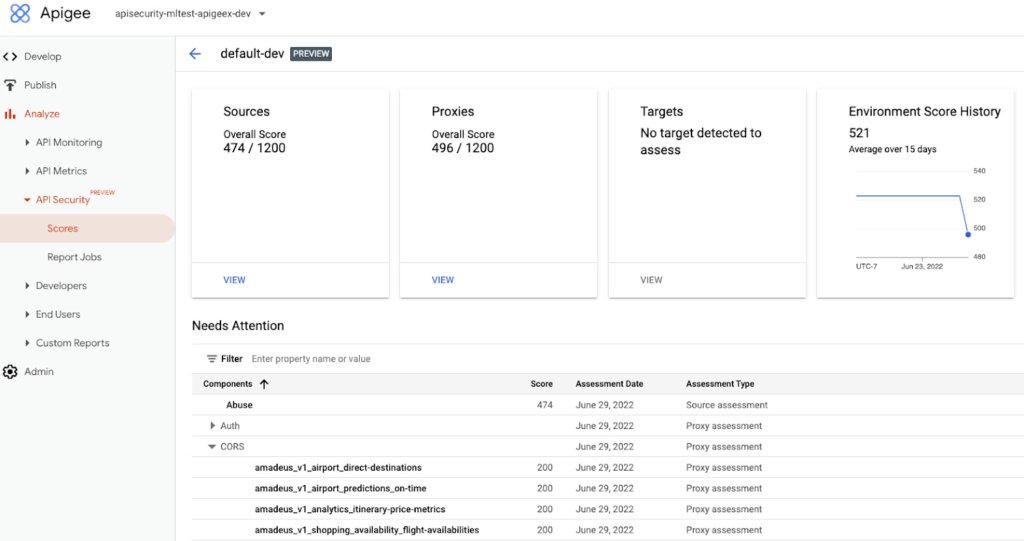
Advanced API Security identifies misconfigured API proxies, including the missing CORS policy.
APIs form an integral part of the digital connective tissue that make modern medicine run smoothly for patients and healthcare staff. One common healthcare API use case occurs when a healthcare organization inputs a patient’s medical coverage information into a system that works with insurance companies. Almost instantly, that system determines the patient’s coverage for a specific medication or procedure, a process which is enabled by APIs. Because of the often-sensitive personal healthcare data being transmitted, it is important that the required authentication and authorization policies are implemented so that only authorized users, such as an insurance company, can access the API.
Advanced API Security can detect if those required policies have not been applied, an alert which can help reduce the surface area of API security risks. By leveraging Advanced API Security, API teams at healthcare organizations can more easily detect misconfiguration issues and can reduce security risks to sensitive information.
Detect Bots
Because of the increasing volume of API traffic, there is also an increase in cybercrime in the form of API bot attacks—the automated software programs deployed over the Internet for malicious purposes like identity theft.
Advanced API Security uses pre-configured rules to help provide API teams an easier way to identify malicious bots within API traffic. Each rule represents a different type of unusual traffic from a single IP address. If an API traffic pattern meets any of the rules, Advanced API Security reports it as a bot.
Additionally, Advanced API Security can speed up the process of identifying data breaches by identifying bots that successfully resulted in the HTTP 200 OK success status response code.
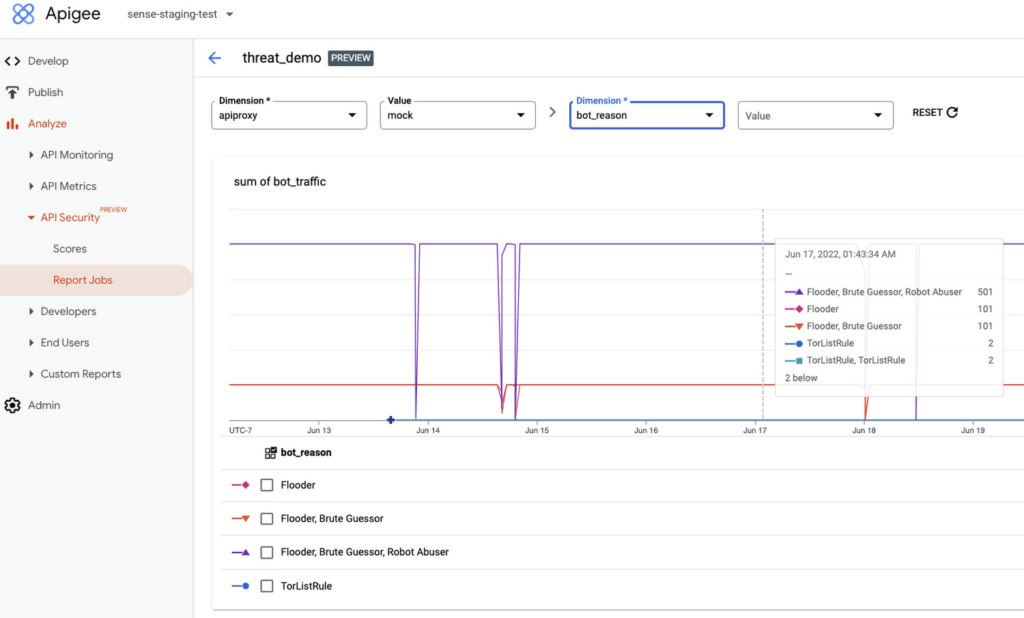
Financial services APIs are frequently the target of malicious bot attacks due to the high-value data that is processed. A bank that has adopted open banking standards by making APIs accessible to customers and partners can use Advanced API Security to make it easier to analyze traffic patterns and identify the sources of malicious traffic. You may experience this when your bank allows you to access your data with a third-party application. While a malicious hacker could try to use a bot to access this information, Advanced API Security can help the bank’s API team to identify and stop malicious bot activity in API traffic.
API Security at Equinix
Equinix powers the world’s digital leaders, bringing together and interconnecting infrastructure to fast-track digital advantage. Operating a global network of more than 240 data centers with a 99.999% or greater uptime, Equinix simplifies global interconnections for organizations, saving customers time and effort with the Apigee API management platform.
“A key enabler of our success is Google’s Apigee, delivering digital infrastructure services securely and quickly to our customers and partners,” said Yun Freund, senior vice president of Platform at Equinix. “Security is a key pillar to our API-first strategy and Apigee has been instrumental in enabling our customers to securely bridge the connections they need for their businesses to easily identify potential security risks and mitigate threats in a timely fashion. As our API traffic has grown, so has the amount of time and effort required to secure our APIs. Having a bundled solution in one managed platform gives us a differentiated high-performing solution.”
Getting started
To learn more, check out the documentation or contact us to request access to get started with Advanced API Security.
To learn more about API security best practices, please register to attend our Cloud OnAir webcast on Thursday, July 28th, 2:00 pm PT.
Google’s ASO to Help U.S. Public Sector Achieve M-21-31 and EO 14028

3135
Of your peers have already read this article.
3:00 Minutes
The most insightful time you'll spend today!
As sophisticated cyberattack campaigns increasingly target the U.S. public and private sectors during the COVID era, the White House and federal agencies have taken steps to protect critical infrastructure and remote-work infrastructure. These include Executive Order 14028 and the Office of Management and Budget’s Memorandum M-21-31, which recommend adopting Zero Trust policies, and span software supply chain security, cybersecurity threat management, and strengthening cyberattack detection and response.
However, implementation can be a challenge for many agencies due to cost, scalability, engineering, and a lack of resources. Meeting the requirements of the EO and OMB guidance may require technology modernization and transformational changes around workforce and business processes.
Today we are announcing Autonomic Security Operations (ASO) for the U.S. public sector, a solution framework to modernize cybersecurity analytics and threat management that’s aligned with the objectives of EO 14028 and OMB M-21-31. Powered by Google’s Chronicle and Siemplify, ASO helps agencies to comprehensively manage cybersecurity telemetry across an organization, meet the Event Logging Tier requirements of the White House guidance, and transform the scale and speed of threat detection and response. ASO can support government agencies in achieving continuous detection and continuous response so that security teams can increase their productivity, reduce detection and response time, and keep pace with – or ideally, stay ahead of – attackers.
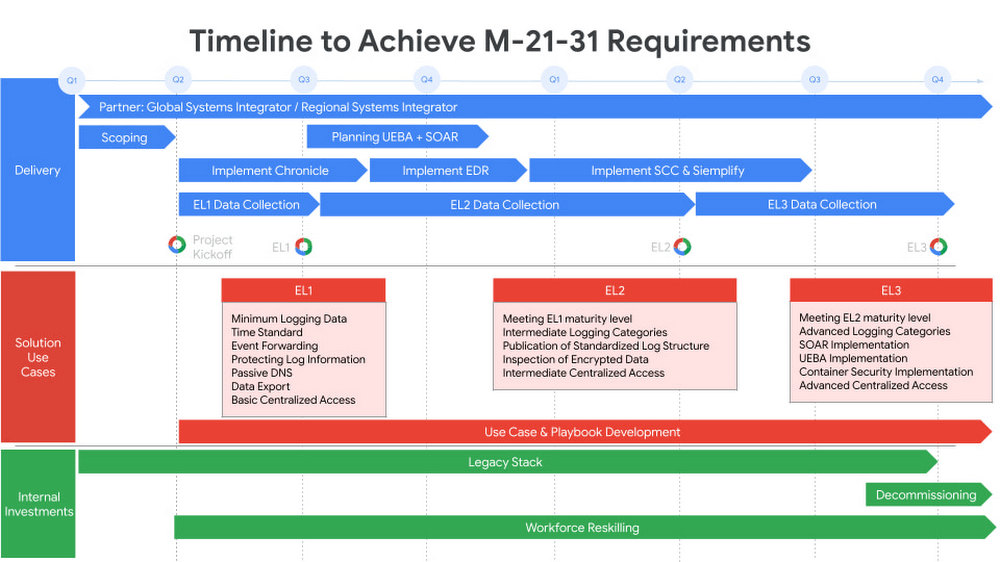
While the focus of OMB M-21-31 is on the implementation of technical capabilities, transforming security operations will require more than just technology. Transforming processes and people in the security organization is also important for long-term success. ASO provides a more comprehensive lens through which to view the OMB event logging capability tiers, which can help drive a parallel transformation of security-operations processes and personnel.
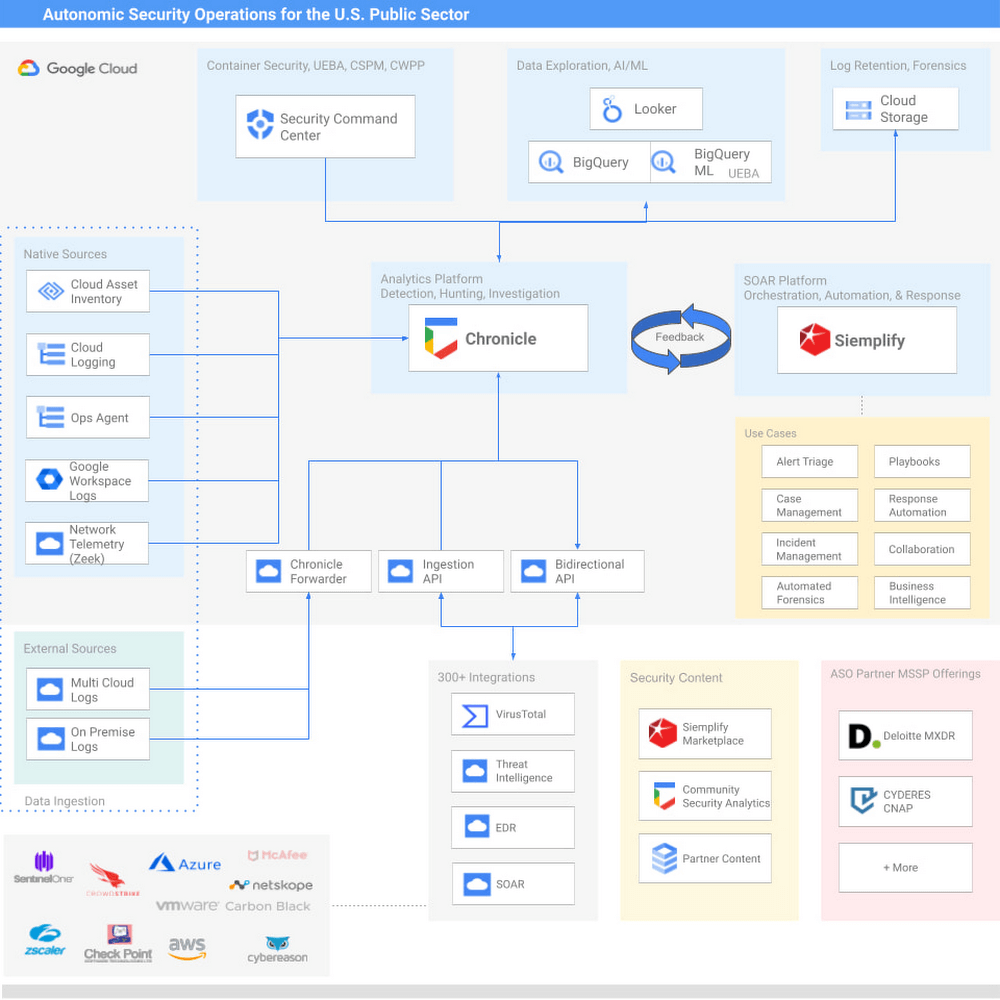
Modern Cybersecurity Threat Detection and Response
Google provides powerful technical capabilities to help your organization achieve the requirements of M-21-31 and EO 14028:
Security Information & Event Management (SIEM) – Chronicle provides high-speed petabyte-scale analysis, and is capable of consuming log types outlined in the Event Logging (EL) tiers in a highly cost-effective manner.
Security Orchestration, Analytics, and Response (SOAR) – Siemplify offers dozens of out-of-box playbooks to deliver agile cybersecurity response and drive mission impact, including instances of automating 98% of Tier-1 alerts and driving an 80% reduction in caseload.
User and Entity Behavior Analytics (UEBA) – For agencies that want to develop their own behavioral analytics, agencies can use BigQuery, Google’s petabyte scale data lake, to store, manage, and analyze diverse data types from many sources. Telemetry can be exported out of Chronicle, and custom data pipelines can be built to import other relevant data from disparate tools and systems, such as IT Ops, HR and personnel data, and physical security data. From there, users can leverage BQML to readily generate machine learning models without needing to move the data out of BigQuery. For Google Cloud workloads, our Security Command Center Premium product offers native, turnkey UEBA across GCP workloads.
Endpoint Detection and Response (EDR) – For most agencies, EDR is a heavily adopted technology that has broad applicability in Security Operations. We offer integrations to many EDR vendors. Take a look at our broad list of Chronicle integrations here.
Threat intelligence – Our solution offers a native integration with VirusTotal, has the ability to operationalize threat intelligence feeds natively in Chronicle, and integrates with various TI and TIP solutions.
Community Security Analytics
To increase collaboration across public-sector and private-sector organizations, we recently launched our Community Security Analytics (CSA) repository, where we’ve partnered with the MITRE Engenuity Center for Threat-Informed Defense, CYDERES, and others to develop open-source queries and rules that support self-service security analytics for detecting common cloud-based security threats. CSA queries are mapped to the MITRE ATT&CK® framework of tactics, techniques and procedures (TTPs) to help you evaluate their applicability in your environment and include them in your threat model coverage.
“Deloitte is excited to collaborate with Google Cloud on their transformational public sector Autonomic Security Operations (ASO) solution offering. Deloitte has been recognized as Google Cloud’s Global Services Partner of the Year for four consecutive years, and also as their inaugural Public Sector Partner of the Year in 2020,” said Chris Weggeman, managing director of GPS Cyber and Strategic Risk, Google Cloud Cyber Alliance Leader, Deloitte & Touche LLP. “Our deep bench of more than 1,000 Google Cloud certifications, capabilities spanning the Google Cloud security portfolio, and decades of delivery experience in the government and public sector makes us well-positioned to help our clients undertake critical Security Operations Center transformation efforts with Google Cloud ASO.”
Cost-effective for government agencies
To help Federal Agencies meet the requirements of M-21-31 and the broader EO, Google’s ASO solutions can drive efficiencies and help manage the overall costs of the transformation. ASO can make petabyte-scale data ingestion and management more viable and cost-effective. This is critical at a time when M-21-31 is requiring many agencies to ingest and manage dramatically higher volumes of data that had not been previously budgeted for.
Partners
We’re investing in key partners who can help support U.S. government agencies on this journey. Deloitte and CYDERES both have deep expertise to help transform agencies’ Security Operations capabilities, and we continue to expand our partners to support the needs of our clients. A prototypical journey can be seen below.
“Cyderes shares Google Cloud’s mission to transform security operations, and we are honored to deliver the Autonomic Security Operations solution to the U.S. public sector. As the number one MSSP in the world (according to Cyber Defense Magazine’s 2021 Top MSSPs List) with decades of advisory and technology experience detecting and responding to the world’s biggest cybersecurity threats, Cyderes is uniquely positioned to equip federal agencies and departments to go far beyond the requirements of the executive order to transform their security programs entirely via Google’s unique ASO approach,” said Robert Herjavec, CEO of CYDERES. “As an original launch partner of Google Cloud’s Chronicle, our deep expertise will propel our joint offering to modernize security operations in the public sector, all with significant cost efficiency compared to competing solutions.” said Eric Foster, President of CYDERES.
Embracing ASO
Autonomic Security Operations can help U.S. government agencies advance their event logging capabilities in alignment with OMB maturity tiers. More broadly, ASO can help the U.S. government undertake a larger transformation of technology, process, and people, toward a model of continuous threat detection and response. As such, we believe that ASO can help address a number of challenges presently facing cybersecurity teams, from the global shortage of skilled workers, to the overproliferation of security tools, to poor cybersecurity situational awareness and analyst burnout caused by an increase of data without sufficient context or tools to automate and scale detection and response.
We believe that by embracing ASO, agencies can help agencies achieve:
10x technology, through the use of cloud-native tools that help agencies meet event logging requirements in the near term, while powering a longer-term transformation in threat management;
10x process, by redesigning workflows and using automation to achieve Continuous Detection and Continuous Response in security operations;
10x people, by transforming the productivity and effectiveness of security teams and expanding their diversity; and
10x influence across the enterprise through a more collaborative and data-driven approach to solving security problems between security teams and non-security stakeholders.
To learn more about Google’s Autonomic Security Operations solution for the U.S. public sector, please read our whitepaper. More broadly, Google Cloud continues to provide leadership and support for a wide range of critical public-sector initiatives, including our work with the MITRE Engenuity Center for Threat-Informed Defense, the membership of Google executives on the President’s Council of Advisors on Science and Technology and the newly established Cyber Safety Review Board; Google’s White House commitment to invest $10 billion in Zero Trust and software supply chain security, and Google Cloud’s introduction of a framework for software supply chain integrity. We look forward to working with the U.S. government to make the nation more secure.
Visit our Google Cloud for U.S. federal cybersecurity webpage.
Related posts:
Autonomic Security Operations for the U.S. Public Sector Whitepaper
“Achieving Autonomic Security Operations: Reducing toil”
“Achieving Autonomic Security Operations: Automation as a Force Multiplier”
“Advancing Autonomic Security Operations: New resources for your modernization journey”
You Need Enhanced Security for a Successful Cloud Transformation

2625
Of your peers have already read this article.
1:30 Minutes
The most insightful time you'll spend today!
Twenty years ago, organizations discovered the magic of server virtualization. Among the many benefits of virtualization, it heralded the end of the need for one physical server per application and the beginning of managing software-defined infrastructure. It helped automate building and installing systems, and it helped lay foundations for today’s Continuous Integration/Continuous Delivery mechanisms and DevOps practices. However, the adoption of virtualization was not always smooth and several hurdles stood in its path. Today’s organizations are facing similar obstacles in their journey to the cloud.
Organizations that wanted to virtualize their server environment two decades ago faced a significant challenge that was neither technical nor budgetary, but organizational, stretching across IT teams and beyond. The first team to be concerned about virtualization was the one in charge of installing the physical servers in the racks of the datacenter, managing the physical network connections and operating environmental controls, such as HVAC and power systems. These tasks were drastically reduced, if not outright eliminated.
The second team affected by this shift in technology was the one responsible for installing the operating system and running the post-install procedures. Their job almost completely disappeared as most virtual machines were automatically instantiated from templates.
As a result, successful adoption relied on the ability to smooth these organizational changes. Along the way, training the staff and making sure they acquire the new skills necessary to operate the virtualization infrastructure was critical. And usually, the affected teams eventually found that their new responsibilities were different but still essential to the organization, and perhaps even more appealing.
Virtualizations lessons for cloud transformation regulators
Discussions on virtualization didn’t end with these internal changes when organizations were operating in a regulated environment. They needed to engage closely with their regulators. Regulated organizations often considered the hypervisor solely as an additional layer of software with potential vulnerabilities.
This viewpoint raised risks (such as virtual machine escape) that didn’t exist with physical servers. Even if this is taken into account and the risks mitigated, it should have been considered in balance with all the benefits of machine virtualization, including security benefits such as asset identification, harmonization, and smoother patch management.
While the relevance and benefits of virtualization are now widely accepted, history has repeated itself as similar issues have arisen for organizations facing cloud migrations. When large cloud service providers (CSP) began supporting critical workloads for their customers, regulators increased their oversight over CSPs and issued guidance concerning cloud adoption. This happened in the European financial sector, with guidelines from the European Supervisory Authorities (European Banking Authority, European Securities and Market Authority and European Insurance and Occupational Pensions Authority,) and the coming Digital Operational Resilience Act regulation.
These regulations can help establish trust between providers and customers. As regulator decisions are vital for organizations, there is an opportunity now with cloud technology to balance the risks with the benefits and take into consideration all the ways CSPs can help organizations improve their overall security and compliance levels.
Cultural transformation can drive cloud transformation
Another similarity between cloud transformation and the journey to virtualization is the required internal transformation. When an organization decides to start its journey to the cloud, training its staff with the new technology and tools is a necessary step, but probably not the first nor the most arduous to make. A change of mindset is paramount to fully incorporate all the cloud benefits, in particular regarding security.
This new approach begins with a deep transformation at the organizational level. Organizations should avoid viewing the cloud as a datacenter because there’s so much more potential to cloud technology. This new approach and its accompanying organizational transformation is driven by two factors: The burdens that the CSP removes from the customer, and the new flexibility that software-defined infrastructure brings to the table.
The CSP directly manages several tasks and services, and their security, which means that they’re no longer a direct concern for the customer. These responsibilities include data center management, security-hardened hardware, default encryption for data at rest and data in transit, and resilient network management.
Since all the infrastructure used by the organization to manage its workloads is software defined, it brings much more flexibility to what can be done with it. Software-defined infrastructure can more easily enable security guardrails and continuous compliance that weren’t possible before.
While there’s a temptation to approach an organization’s cloud transformation as merely a “lift and shift” operation from on-premises infrastructure, the reality is that approach reduces the potential gains a cloud transformation can bring to an organization. Moving systems to the cloud accounts for a small portion of the potential impact, while updating the mindset can be truly transformational. Development, architecture and security processes need to be rebuilt; this inevitably requires a deeper transformation of the organization.
The next step is to transform the operations, to align them with the overall organization and the new defined processes, operationalize CI/CD and build DevOps practices. After that, the technological gap will be adjusted, moving the new tools and teaching teams how to best use them.
The important point here is the order of the transformation to manage: organization, operations and technologies (O-O-T) and not the other way round (T-O-O). Of course, these three steps should not be considered completely sequential, as technology plays an important role in the organization and the operations. However, it is essential to support the development of personnel and frameworks to take full advantage of the transformation opportunity, rather than primarily focusing on the tooling.
In addition, at Google Cloud, we believe in a shared fate that goes far beyond the usual shared responsibility model. We think it is part of our duty to help our customers to achieve their goals in their scope of responsibility. We prepare secure landing zones and guide the customers, we bring transparency to security controls and help them with cyber-insurance.
Our shared objective with our customers is to continuously improve security. Our Google Cybersecurity Action Team initiative helps us to be engaged alongside our customers, provide them with necessary guidance, support them in their security and compliance strategies, and assist their organizational and operational transformation in their cloud journey.
- Listen to a related podcast “How to Apply Lessons from Virtualization Transition to Make Cloud Transformation Better”
- Listen to “Preparing for Cloud Migrations from a CISO Perspective, Part 1”
- Read “The journey to the cloud mitigates enterprise risk”
- Also, review “Megatrends drive cloud adoption—and improve security for all”
- Visit Google Cybersecurity Action Team website
Three Reasons Why Enterprises Must Think Next-gen Serverless

4912
Of your peers have already read this article.
2:00 Minutes
The most insightful time you'll spend today!
As we reflect on the past year, Heraclitus’ phrase “The only constant in life is change” has never rang more true. With the pandemic, companies had to shift operations, launch new products and adapt to extreme demand patterns, sometimes within a matter of weeks.
To respond to customer needs faster and more efficiently, many companies turned to serverless technology, designing applications with real-time signals and intelligence built in. From apps and sites for healthcare appointments and vaccinations, public-sector employment benefits, contact tracing, retail logistics, curbside delivery, hotel and travel booking—you name it, companies built it with serverless.
Redefining serverless
The world changed, the market changed, our lives changed and we here at Google Cloud also changed, introducing new products to meet our customers’ needs and grow with them.
Serverless technology, in particular, has changed a lot since it was first introduced. Google first launched serverless compute in 2008 with the launch of App Engine, helping customers scale their applications faster and seamlessly. We then added the ability to run Functions as a Service with Cloud Functions, giving customers a simple developer experience with integrated telemetry and observability. In parallel, we also introduced innovations to the container market with Kubernetes. Pretty soon, customers started asking us if we could combine the awesome serverless attributes of auto-scaling and developer experience with the flexibility of containers.
Enter Cloud Run, the next generation of serverless. Serverless is now no longer just about event-driven programming or microservices. It’s also about running complex workloads at scale while still preserving a delightful developer experience. In fact, serverless with Cloud Run is about having a true developer platform with the flexibility to run any language, any library, any binary.
There are three capabilities that make Cloud Run the next-generation of serverless, and not the same ‘serverless’ you find elsewhere:
- A great developer-centric experience
- Versatility: expanding to a broader set of containerized apps
- Built-in DevOps and security
Let’s take a look at the attributes in greater depth.
A great developer experience
Being developer-centric comes from having fully-managed self-operating infrastructure and a great developer experience. We want everyone to be able to develop smart applications and for that we have to make it easy. We also want to be sure we are bringing your technical talent closer to where you generate your business value.
To make things easy, last year we introduced buildpacks, which creates container images directly from source code. No need to learn Docker or containers. Although there are containers underneath, they’re transparent to the developer.
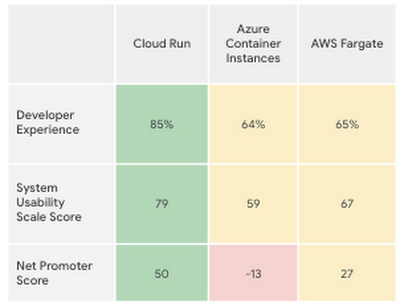
To simplify things further, we also introduced a single “gcloud run deploy” command to build and deploy code to Cloud Run. These types of features are some of the reasons why 98% of Cloud Run users deploy an application on their first try in less than 5 minutes.
In fact, in the past year alone, we added over 25 new features and services to our serverless stack, making development of complex apps easier. One of our main launches was Workflows, which lets you combine Cloud Run with any Google Cloud product or any HTTP-based API service. As a developer, this is very useful when automating complex processes, or integrating GCP’s analytic services across a variety of systems.
Taken together, all these new features make the Cloud Run developer experience far easier than its competitors’, according to a recent report by User Research International.
Versatility
Next-generation serverless is also about versatility. It supports a wider variety of applications and caters to enterprise requirements. Functions and web apps of course, but also heavyweight applications, and in the fullness of time, also brownfield and third-party containerized apps. This versatility is enabled by the container primitive, which removes restrictions on languages, run times, and hardware.
Being able to run a greater variety of apps on our serverless stack means you can optimize for predictable usage. Today, we announced new spend-based committed use discounts for Cloud Run. Enterprises with stable, steady-state, and predictable usage can now purchase committed use contracts directly in the billing UI. There are no upfront payments, so these discounts are a perfect way to reduce your spend by as much as 17%. RELATED ARTICLEMaximize your Cloud Run investments with new committed use discountsCommitted use discounts in Cloud Run enable predictable costs—and a substantial discount!
Another way we provide versatility is with support for WebSockets and gRPC in Cloud Run. With these new additions, you get the benefits of serverless infrastructure to build responsive, high-performance applications. We also added the use of min instances with Cloud Run. This feature allows you to cut cold-start times and run latency-sensitive applications on Cloud Run! At the same time, you can still scale to zero, or keep a minimum amount of compute available, for example when running brownfield Java applications.
Built-in DevOps
Serverless doesn’t just make it faster for developers to set up their apps—it also helps once the application is up and running, taking a big management load off of operations teams. Notably, serverless systems take care of “scaling” an application up or down. That means that if your application suddenly starts fielding a lot of traffic, the serverless platform automatically spins up more resources to handle the load. No more dreaded timeouts, wheels or hourglasses—or work for your operations team. Likewise, as soon as demand goes down, the platform takes care of decommissioning resources, i.e., scaling down, so that you’re not paying for resources that you no longer need. Want to run your service globally with low latency, without an operations team, and zero stranded costs? Cloud Run takes care of global load balancing and autoscaling to zero for you in every Google Cloud region.
Further, features like support for gradual rollouts and rollbacks allow developers to experiment and test ideas quickly, as well as sophisticated traffic management in Cloud Run. Likewise, Cloud Run provides access to distributed tracing with no setup or configuration, allowing developers to find performance bottlenecks in production.
Next up: serverless security
As part of DevOps best practices, we build in security for your serverless applications at every layer: deployment time, runtime and networking. For example, built-in vulnerability scanning ensures you only deploy artifacts you trust.
Today, we are announcing Cloud Run support for Google Secret Manager and customer-managed encryption keys (CMEK), making it easy to protect data at rest and store sensitive data. We’re also integrating Cloud Run with Binary Authorization, which lets you enforce specific policies to make sure only verified images make it to production. And finally, we added a new integration with Identity-Aware Proxy, support for VPC-SC, and egress controls that you can use to enforce a security perimeter, limiting both who can access specific services and what resources can be accessed when these services run in production. You can read more about these security enhancements here. RELATED ARTICLE4 new features to secure your Cloud Run servicesWe’re improving the security of your Cloud Run environment with things like support for Secret Manager and Binary Authorization.
In summary, the next generation of serverless combines the best of serverless with containers to run a broad spectrum of apps, with no language, networking or regional restrictions. The next generation of serverless will help developers build the modern applications of tomorrow—applications that adapt easily to change, scale as needed, respond to the needs of their customers faster and more efficiently, all while giving developers the best developer experience. Learn more by attending The Power of Serverless, a two-hour virtual event where we’ll lay out our vision for serverless compute, and where serverless subject matter experts will present on in-depth serverless development topics. Hope to see you there!
Want to learn even more about serverless and cloud-native application development? Check out the upcoming Modern App Dev & Delivery workshop, and our Ask the Experts roundtable.
Assuring Compliance in the Cloud: Paper by Google Cloud’s Office of the CISO
4903
Of your peers have already read this article.
1:30 Minutes
The most insightful time you'll spend today!
Cloud transformation and the adoption of modern DevOps technology presents both opportunities and challenges for IT compliance functions. With DevOps style application development, the feedback loop for developers and engineers is much tighter than with traditional application development pipelines, enabling speed and agility of application release cycles. While speedy CI/CD is a critical advantage of DevOps, it also shifts compliance left in the development timeline, and therefore puts pressure on the IT risk & compliance organization to modernize their approach to regulatory compliance as well. With the ongoing shift towards cloud technologies and DevOps, modernization of regulatory compliance is no longer optional for an IT compliance function
Compliance modernization is a broad mandate that spans the way the function is governed; the tools, technology, and analytics it uses; the number and nature of its connections to other parts of the business; verifiability and auditability of the controls’ evidence, the expectations assigned to it; and more.
Public cloud technology is becoming a core part of many industries today, and with this comes some potential risks such as cloud misconfigurations exposing intellectual property, loss of physical control of assets, skillset scarcity around cloud based security and compliance.
Given the constantly changing risk landscape, it is critical that regulations more closely align to address these risks. As regulations and risks evolve, the aim of a modern compliance function is to help an organization stay compliant as it goes through a digital transformation. As organizations go through digital transformation, IT compliance also needs to transform — via upgrading the technology stack, modifying the business processes and most importantly re-skilling people to become cloud aware.
Today we are releasing the new paper by Google Cloud’s Office of the CISO. In the paper we reveal a new approach for modernizing your compliance approach using modern approaches and Google Cloud toolsets. Your team can leverage the paper to add value to enterprises, both by charting a course to the safe use of cloud technology and by reducing risk through the use of the public cloud.
Read the paper “Assuring Compliance in the Cloud.”
Also, review these related resources:
- “Risk Governance of Digital Transformation in the Cloud“ paper
- “Making Compliance Cloud-native” (episode 14) with Zeal Somani
- Google Cloud Compliance resource center
- Our compliance blueprints: PCI DSS on GKE and GCP FedRAMP Blueprint
- Google Cloud security best practices center
What You Need to Know About Compute Engines

6523
Of your peers have already read this article.
1:30 Minutes
The most insightful time you'll spend today!
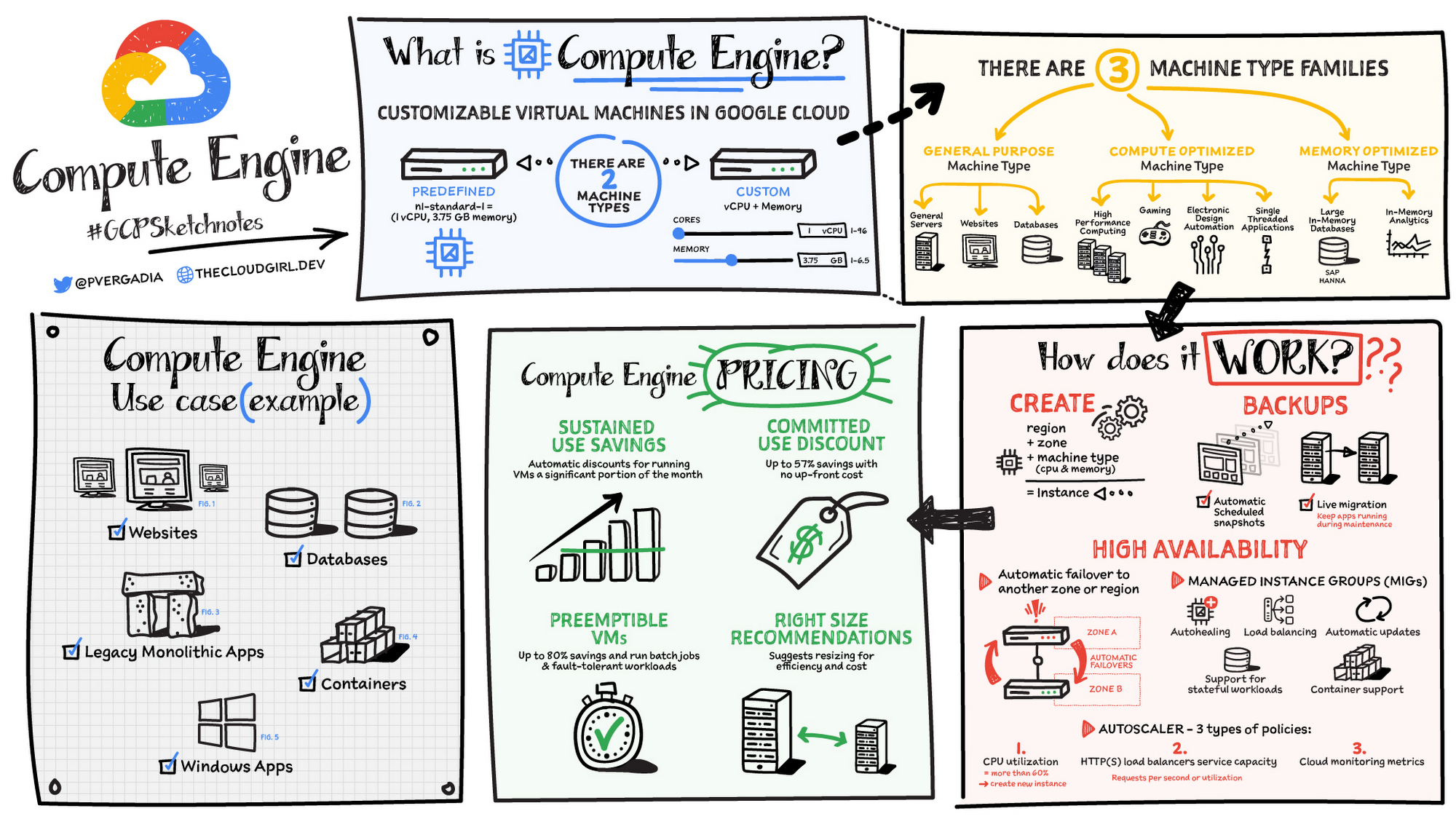
Compute Engine is a customizable compute service that lets you create and run virtual machines on Google’s infrastructure. You can create a Virtual Machine (VM) that fits your needs. Predefined machine types are pre-built and ready-to-go configurations of VMs with specific amounts of vCPU and memory to start running apps quickly. With Custom Machine Types, you can create virtual machines with the optimal amount of CPU and memory for your workloads. This allows you to tailor your infrastructure to your workload. If requirements change, using the stop/start feature you can move your workload to a smaller or larger Custom Machine Type instance, or to a predefined configuration.
Machine types
In Compute Engine, machine types are grouped and curated by families for different workloads. You can choose from general-purpose, memory-optimized, compute-optimized and accelerator-optimized families.
- General-purpose machines are used for Day-to-day computing at a lower cost and for balanced price/performance across a wide range of VM shapes. The use cases that best fit here are web serving, app serving, back office applications, databases, cache, media-streaming, microservices, virtual desktops, development environments.
- Memory-Optimized machine are recommended for ultra high-memory workloads such as in-memory analytics and large in-memory databases such as SAP HANA
- Compute-Optimized machines are recommended for ultra high performance workloads such as High Performance Computing (HPC), Electronic Design Automation (EDA), gaming, video transcoding, single-threaded applications.
- Accelerator-Optimized machines are optimized for high performance computing workloads such as Machine learning (ML), Massive parallelized computations and High Performance Computing (HPC)
How does it work?
You can create a VM instance using a boot disk image, a boot disk snapshot, or a container image. The image can be a public operating system (OS) image or a custom one. Depending on where your users are you can define the zone you want the virtual machine to be created in. By default all traffic from the internet is blocked by the firewall and you can enable the HTTP(s) traffic if needed.
Use snapshot schedules (hourly, daily, or weekly) as a best practice to back up your Compute Engine workloads. Compute Engine offers live migration by default to keep your virtual machine instances running even when software or hardware update occurs. Your running instances are migrated to another host in the same zone instead of requiring your VMs to be rebooted.
Availability
For High Availability (HA) Compute Engine offers automatic failover to other regions or zones in event of a failure. Managed instance groups (MIGs) help keep the instances running by automatically replicating instances from a predefined image. They also provide application based autohealing health checks. If an application is not responding on a VM, the auto healer automatically recreates that VM for you. Regional MIGs let you spread app load across multiple zones. This replication protects against zonal failures. MIGs work with load balancing services to distribute traffic across all of the instances in the group.
Compute Engine offers autoscaling to automatically add or remove VM instances from a managed instance group based on increases or decreases in load. Autoscaling lets your apps gracefully handle increases in traffic, and it reduces cost when the need for resources is lower. You define the autoscaling policy for automatic scaling based on the measured load, CPU utilization, requests per second or other metrics.
Active Assist’s new feature, predictive autoscaling, helps improve response times for your applications–When you enable predictive autoscaling, Compute Engine forecasts future load based on your Managed Instance Group’s (MIG) history and scales it out in advance of predicted load, so that new instances are ready to serve when the load arrives. Without predictive autoscaling, an autoscaler can only scale a group reactively, based on observed changes in load in real time. With predictive autoscaling enabled, the autoscaler works with real-time data as well as with historical data to cover both the current and forecasted load. That makes predictive autoscaling ideal for those apps with long initialization times and whose workloads vary predictably with daily or weekly cycles. For more information, see How predictive autoscaling works or check if predictive autoscaling is suitable for your workload, and to learn more about other intelligent features, check out Active Assist.
Pricing
You pay for what you use. But you can save cost by taking advantage of some discounts! Sustained use saving are automatic discounts applied for running instances for a significant portion of the month. If you know your usage upfront, you can take advantage of committed use discounts which can lead up to significant savings without any upfront cost. And by using short lived preemptive instances you can save up to 80%, they are great for batch jobs and fault tolerant workloads. You can also optimize resource utilization with automatic recommendations. For example if you are using a bigger instance for a workload that can run on a smaller instance you can save costs applying these recommendations.
Security
Compute Engine provides you default hardware security. Using Identity and Access Management (IAM) you just have to ensure that proper permissions are given to control access to your VM resources. All the other basic security principles apply, if the resources are not related and don’t require network communication amongst themselves, consider hosting them on different VPC networks. By default, users in a project can create persistent disks or copy images using any of the public images or any images that project members can access through IAM roles. You may want to restrict your project members so that they can create boot disks only from images that contain approved software that meet your policy or security requirements. You can define an organization policy that only allows Compute Engine VMs to be created from approved images. This can be done by using the Trusted Images Policy to enforce images that can be used in your organization.
By default all VM families are Shielded VMs. Shielded VMs are virtual machine instances that are hardened with a set of easily configurable security features to ensure that when your VM boots, it’s running a verified bootloader and kernel — is the default for everyone using Compute Engine, at no additional charge. For more details on Shielded VMs refer to the documentation here.
For additional security, you also have the option to use Confidential VM to encrypt your data in use, while it’s being processed in Compute Engine. For more details on Confidential VM refer to the documentation here.
Use cases
There are many use cases Compute Engine can serve in addition to running websites and databases. You can also migrate your existing systems onto Google Cloud, with Migrate for Compute Engine, enabling you to run stateful workloads in the cloud within minutes rather than days or weeks. Windows, Oracle or VMware applications have solution sets enabling a smooth transition to Google Cloud. To run windows applications either bring your own license leveraging Sole-tenant nodes or using the included licenced images.
Conclusion
Whatever your application use case may be, from legacy enterprise applications to digital native applications, Compute Engine’s families will fit it. For a more in-depth look into Compute Engine check out the documentation.
For more #GCPSketchnote, follow the GitHub repo. For similar cloud content follow me on Twitter @pvergadia and keep an eye out on thecloudgirl.dev
More Relevant Stories for Your Company

Introducing New Capabilities for Secure Transformations
Organizations large and small are realizing that digital transformation and the changing threat landscape require a grounds up effort to transform security. At Google Cloud, we continue to invest in our vision of invisible security where advanced capabilities are engineered into our platforms, operations are simplified, and stronger security outcomes

New Capabilities in Cloud Asset Inventory Allow Better Visibility into Google Cloud Environments
Businesses that operate in complex cloud environments, large fleets, or sophisticated security operations all require visibility into their cloud assets in order to keep their teams nimble and their data secure. Cloud Asset Inventory (CAI) helps these teams understand their Google Cloud and Anthos environments by providing complete visibility, real-time monitoring, and

Public Cloud’s Zero Trust Architecture Keeps Enterprise Data Safe
Over the past decade, cybersecurity has posed an increasing risk for organizations. In fact, cyber incidents topped the recent Allianz Risk Barometer for only the second time in the survey’s history. The challenges in combating these risks only continue to grow. Adversaries tend to be agile and are consistently looking

Google Cloud is Every Retailer’s Most Trusted Cloud
Whether they were ready for it or not, the COVID-19 pandemic transformed many retailers into digital businesses. Retailers made huge investments into commerce technologies, customer experience tools, sales and fulfillment technology, and improving digital experiences to continue providing their goods and services to their customers. Now, more than a year
