





Hybrid Cloud: The Trade-offs IT Leaders Hate–and a Way Around Them

3535
Of your peers have already read this article.
3:30 Minutes
The most insightful time you'll spend today!
What do CIOs and CTOs deliver for the company? If you said “technology,” that’s just the beginning. According to their research, McKinsey found that 85% of CIOs and CTOs interviewed in the spring of 2019 said they were essential for at least two of the three most common CEO priorities—revenue acceleration, improved agility and time to market, and cost reduction.
IT modernization – including migrating to the cloud – is key to business growth and agility.
Yet, according to a recent McKinsey study, 80% of CIOs report that regardless of their level of cloud migration, they still haven’t reached their projected agility and business benefits.
Sometimes, this is because of issues like training and skills gaps in the IT workforce. Surprisingly often though, the barrier to reaching the goals is based on trade-offs that CIOs themselves feel they must make to strike a balance between the perfect and the possible.
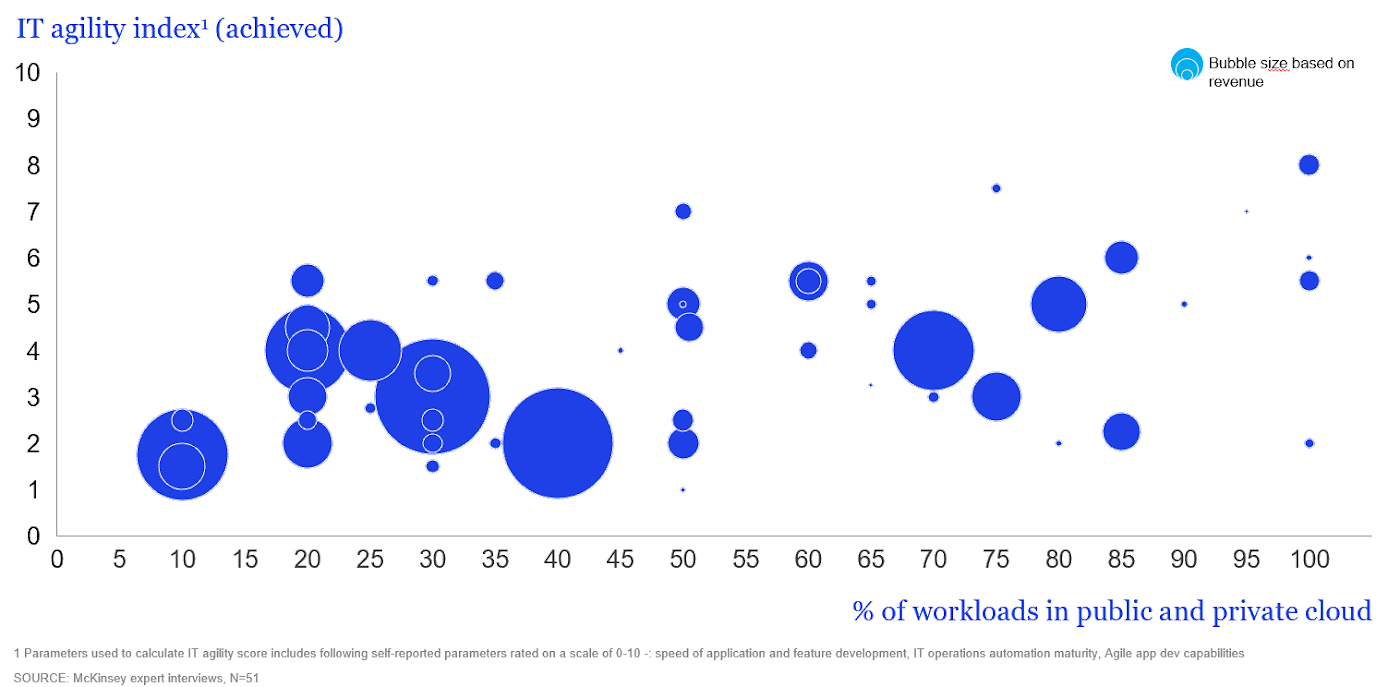
But what if you could have it all without the trade-offs? As Will Grannis, Managing Director of the CTO Office at Google, and Arul Elumalai, Partner at McKinsey & Company discussed in our recent digital conference, many of the compromises CIOs make can be avoided with new technology, modern architectures and by encouraging a transformation mindset across the business.
In interviews, CIOs explained how they’ve leveraged the best of the cloud without compromising on security, agility, and flexibility. Here’s how these leaders avoid three of the top perceived trade-offs—both with technology and by transforming their operating model.
Trade-off #1: Developer agility vs. control and governance
Moving to the cloud offers new opportunities for speed, but 69% of organizations indicate that stringent security guidelines and code review processes can slow developers significantly.
One CISO of a multinational company mentioned that cloud development was so fast that they had to institute manual checks on their developers’ code. So much for agility.
To overcome this trade-off and maintain both speed and security, some respondents found success in DevOps, hiring security-experienced talent and introducing automation for security and quality. Building in security into the CI/CD pipeline and increasing automation don’t just eliminate the tradeoff, they result in higher quality and faster innovation.
At Google Cloud, we’ve also observed that customers with strong DevOps practices have increased speed-to-market and product/service quality. From our own journey, we’ve learned seven critical lessons essential to adopting a DevOps model, ranging from taking up small projects and embracing open source to building an overall DevOps culture.
Trade-off #2: Single-vendor benefits vs. freedom from lock-in
CIOs perceive benefits to using the fewest number of clouds, specifically avoiding introducing multiple systems that require their teams to develop and maintain multiple skillsets. Unfortunately, 83% of the CIOs interviewed said that while they would prefer fewer clouds, the potential financial and technical lock-in drives them to multiple providers.
Successful CIOs said that they can avoid lock-in pitfalls not just with contractual guardrails and executive and board education, but with evolving hybrid cloud technologies that provide additional choices.
Hybrid cloud platforms based on containers can further mitigate the risk of using a single cloud vendor. The key to successful hybrid architectures is the infrastructure abstraction and portability that containers create for them, enabling disparate environments to work together.
This notion has been at the heart of our strategy at Google Cloud with Anthos, which provides an abstraction layer and an application modernization platform for hybrid and multi-cloud environments.
Enterprises can use Anthos to modernize how they develop, secure, and operate hybrid-cloud environments and enable consistency across cloud environments.
Trade-off #3: Best-of-breed tools vs. standardization and familiarity
Optimizing tool chains for different environments can improve productivity, but many CIOs believe that this means reduced functionality and tools.
While 77% of CIOs said they had to standardize to the lowest common denominator, some have found a better solution. Rather than giving up the languages, libraries, and frameworks that their teams prefer, effective leaders said that they found success by investing in training programs to upscale talent and adopting new open and vendor-agnostic solutions. Architectures that are based on open-source components have been the keys that helped remove this tradeoff, and eliminate the notion of a lowest common denominator.
This is why we have built Anthos on open-source components like Kubernetes, Istio and Knative. Anthos gives your business the choice you need. With the ability to create code that works in most environments using the tools, languages, and systems you prefer, you can do more without major changes to how you work.
Regardless of your current cloud adoption level, check out “Unlock business acceleration in a hybrid cloud world” to discover more about McKinsey’s findings, including how CIOs drive agility, methods to make trade-offs unnecessary, and how to prepare your team for the cloud. Then, stay tuned for subsequent posts that take a closer look at how hybrid solutions and strategies can help CIOs drive a transformation mindset across the business—without compromising on security, agility, and flexibility.
Custom AI Solutions, Global Delivery Centers and More Resources Dedicated for Customer Success

4894
Of your peers have already read this article.
2:00 Minutes
The most insightful time you'll spend today!
At Google Cloud, our customers are at the forefront of digital transformation—launching entirely new businesses and products built in the cloud, redefining entire industries with data and artificial intelligence, delivering innovative new consumer experiences, or committing to sustainable new ways of doing business.
We’re committed to our customers’ success, and over the past two years we’ve invested significantly in providing ongoing and integrated support through our customer care portfolio, including launching new Premium and Mission Critical Support offerings that allow us to monitor, prevent, and mitigate impacts quickly, while delivering the fastest response times in the industry.
Today, I’m proud to unveil several new resources and offerings for our customers, including a new Custom AI Solutions practice, new Global Delivery Centers, expanded Executive Briefing Centers, and new leaders to help continue to drive our organization forward.
Helping businesses innovate with a new Custom AI Solutions practice
We are investing in services and offerings to help our customers innovate and drive innovative change to business processes, culture, and customer experiences with Google Cloud products and services. Artificial intelligence (AI) and machine learning (ML) technologies are foundational for many such digital transformations, and to help customers create real business value with these technologies, we’re excited to launch a Custom AI offering to address our customers’ most critical innovation needs.
AI and ML technologies are foundational to digital transformations, yet they are not “one size fits all.” Each customers’ problems and opportunities are unique; a rideshare company will use AI differently than a brick and mortar retailer, or a healthcare company, or an insurance firm. To help organizations deploy AI and ML more effectively, we’re launching a new Custom AI Solutions practice, offering customers custom-built AI and ML solutions built into Vertex AI; access to Google’s engineering expertise; and predictable, subscription-based pricing.
Our teams are already partnering closely with early customers to build and deploy custom AI solutions. For instance, USAA, the large North American insurer, is using Google Cloud ML to process near-real-time damage estimates based on digital images to create a streamlined operations experience.
Learn more about our Custom AI Solutions practice offering here, and how we work together with our customers here. To get in touch, please contact our sales team.
Launching new Global Delivery Centers
Our drive to digitally transform our customers’ businesses is often manifested through our Global Delivery Centers, which expand our professional consulting and emerging practices capabilities available to customers and partners around the world.
The teams at our Global Delivery Centers help customers get up-and-running on Google Cloud quickly and cost effectively, and consult with customers to rapidly build capacity in areas like data analytics, hybrid and multi-cloud, artificial intelligence, and machine learning. More importantly, they help customers successfully execute projects in support of their most mission-critical business objectives. Critically, these centers also help our global partner ecosystem quickly ramp their Google Cloud practices, and get fast, expert consultation for their customers too.
In 2022, we aim to triple the size of our Global Delivery Center teams in Argentina, Poland, and India. In addition, we’ll invest in building deep Google Cloud talent in Mexico and Portugal, furthering our commitment to the industry’s best expert consultation for customers and partners around the world.
Expanding our Executive Briefing Centers footprint
In addition to our Global Delivery Centers, we’re also pleased to expand our resources and facilities that enable digital and face-to-face meetings and working sessions with our customers. This year, we will launch four new Executive Briefing Centers, located on Google Cloud campuses in London, Paris, Singapore, and Munich.
These centers provide an opportunity to listen to our customers, share the best of Google Cloud’s solutions, and inspire digital transformation, in conversations facilitated by Google Cloud leadership, engineers, and industry experts. By bringing this experience to our customers in-region we can foster deeper partnerships and develop cloud solutions that meet their requirements for security, privacy, and digital sovereignty without compromising on functionality or innovation.
Adding new leadership to enable customer success
Finally, I’m excited to welcome two new leaders to Google Cloud on the Customer Experience team, who will help scale our Delivery Centers and deliver exceptional experiences for our customers.
Heading our Global Delivery Center experience is Sunil Rao. Sunil comes to Google Cloud from Accenture, where he spent 18-plus years working with large technology customers across many industry verticals and managed large global teams in Accenture Advanced Technology Center. Sunil will also lead our Technical Onboarding Center, which helps businesses around the world get up to speed with technologies that are critical to understanding customer and business process contexts, and delivering great experiences.
Additionally, Lee Moore is joining Google Cloud to lead Customer Experience in North America. Lee spent nearly 30 years at Accenture in various leadership positions, including services integration for complex problem-solving, product development across a number of industry verticals, and building long-term customer relationships.
You’ll be hearing much more from us in the coming months, as we build out even more powerful and effective cloud-based services and offerings, work with customers to deliver new analytics- and AI-based tools and services, and work with our growing list of partners to help ensure customer success, across the globe.
Navigating the Next Wave of B2B Digital Commerce: Trends and Insights for 2023

1461
Of your peers have already read this article.
1:30 Minutes
The most insightful time you'll spend today!
Editor’s note: Google Cloud partner commercetools shares how modern technologies like composable commerce, cloud-native infrastructure and artificial intelligence/machine learning (AI/ML) will lead the way in business-to-business (B2B) digital commerce this year.
Digital commerce in B2B has been predicted as the next big thing for years; yet, at the start of COVID-19, 60% of B2B companies had zero or limited eCommerce capabilities. The pandemic accelerated digitization and eCommerce has finally taken off: As of February 2022, 65% of B2B companies offered eCommerce capabilities.
The behavior of B2B buyers is also changing: Consumer-like expectations are at the heart of successful B2B commerce, and this is how manufacturers, distributors and wholesalers will shape their customer experiences. Today, 73% of B2B buyers want a personalized business-to-consumer or B2C-like experience. 83% prefer ordering or paying through digital commerce and 72% are eager to purchase across channels.
With digital commerce dictating how B2Bs will grow in 2023 and beyond, what trends will spur digital transformations across this business model? Here’s what the team at commercetools expects to unfold in B2B eCommerce this year.
#1 B2B firms are switching to cloud-native, composable commerce
B2B players still plagued with manual processes and siloed backend systems will move away from monolithic platforms and choose composable commerce. In a nutshell, composability enables businesses to select best-of-breed components, such as search, cart or checkout, and “compose” them into a custom application.
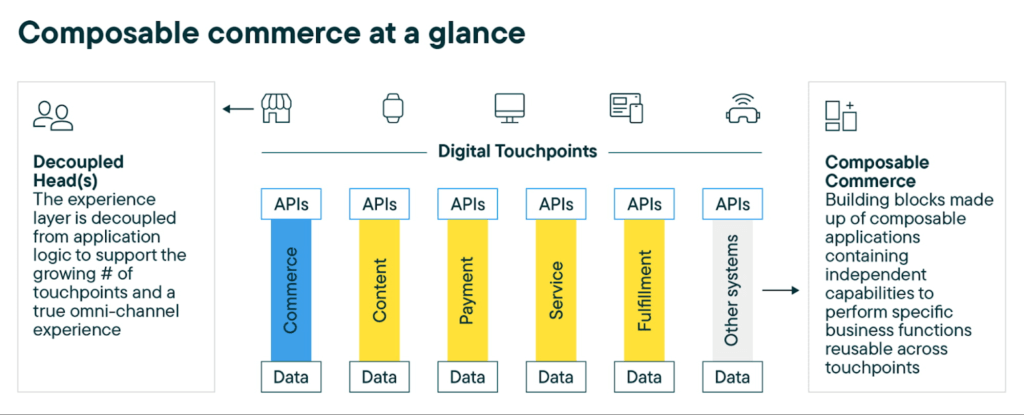
B2B firms will modernize their commerce backend, interoperating siloed systems like Configure Price Quote solutions (CPQs) for sales and enterprise resource planning solutions (ERPs) for order entry with an API-first and composable commerce stack. They will also pivot from on-premise deployments to cloud-native architectures as the baseline for auto-scaling capabilities instead of pre-provisioning online capacity during traffic peaks. That way, B2Bs can customize customer-centric experiences to boost revenue while reducing the complexity and cost of in-house IT infrastructure, as well as gaining operational efficiencies
B2Bs will maximize the cross-section of composable commerce and cloud-native infrastructure by leveraging a commerce backend like commercetools Composable Commerce hosted on Google Cloud. This combined solution provides commercetools’ ready-to-use components built as microservices and exposed as APIs, such as product information management (PIM) and unified cart, integrated through the Google Cloud Marketplace.
#2 Strong focus on data quality and personalization
Focusing on data quality continues to be a big trend in 2023. B2B buyers expect product, pricing, inventory and shipping data points to be accurate across every touchpoint so they can make better purchasing decisions, such as when to order products and calculate quantities.
With so many data points to capture throughout the customer journey — product, inventory, pricing and customer data — we’ll see more B2B companies reorganizing their vast information pools to elevate customer experiences. They will pivot to modular and API-first solutions, plus flexible data models, so they can break data silos from legacy monolithic platforms and access such data when needed.
We also expect to see more customer analytics to unlock data on buyer behavior. By understanding what customers see, click and add to their shopping lists, B2B businesses get valuable insights into how buyers behave, using this data in the shopping journey according to product interests. That way, it’s possible to offer personalized experiences across touchpoints without hassle.
“It is important for B2B companies to look at their data as if it is one of their products; invest in its upkeep and integrity while finding ways to continuously improve it. Using advanced analytics powered by AI and ML to identify patterns from large amounts of data, B2B companies can activate insights into customer decision journeys to maintain loyalty, personalize experiences to improve satisfaction and boost revenue, while also finding ways to optimize costs. For example, with analytics, enterprises can streamline spend to focus on the highest-performing channels and reduce waste.” — Carrie Tharp, Google Cloud VP of Retail and Consumer
With data-driven tools coming into play like Google Cloud’s Discovery AI, Recommendations AI and Vision Product Search connected with composable commerce, B2B players can boost customer analytics to personalize experiences, improve customer satisfaction and reduce churn.
#3 The B2B customer experience will be redesigned
B2B players are taking a page out of the B2C playbook to elevate experiences throughout the customer journey. While intense work needs to happen in the backend commerce engine, B2B players will also redesign their digital frontends. That means boosting website performance, while mobile responsiveness and personalization will be at the forefront of these advanced digital initiatives.
More than ever, B2B companies are looking for digital storefronts delivered as progressive web applications (PWAs) for optimized performance and responsiveness across devices, as well as fast-loading and responsive experiences to boost your digital presence, SEO rankings and conversion rate. B2Bs can further streamline frontend development with solutions natively connecting to Google Cloud Marketplace, which supports a variety of storefront providers, including commercetools Frontend.
Leveraging Google Cloud’s unique capabilities, such as PWA web app development, Google Cloud Discovery AI solutions that include Retail Search and Vision API Product Search, among many others, B2B companies are well positioned to boost digital commerce in the years to come.
What’s next in 2023?
2022 was already a turbulent year; for better or worse, 2023 is expected to have a similar fate. For B2Bs, even the ones with tight budgets, investing in digital commerce can help future-proof businesses for whatever’s happening this year. To dive deeper into all predictions and insights by commercetools in collaboration with Google Cloud, read the guide Pivotal Trends and Predictions in B2B Digital Commerce in 2023.
3425
Of your peers have already watched this video.
1:30 Minutes
The most insightful time you'll spend today!
Google Cloud Cortex Framework: Innovate on Cloud with Less Risk, Cost and Complexity!
Google Cloud Cortex Framework is a comprehensive approach to cloud innovation that enables users to accelerate value with less risk, complexity and cost! The Cortex Framework includes a comprehensive tools and know-how to build, design and deploy cloud solutions to address business challenges and achieve desired outcomes. Watch the video to get started with Google Cloud Cortex Framework.
Efficient, Safe and Dynamic Gaming Experience: Aristocrat’s Digital Journey on Google Cloud

4767
Of your peers have already read this article.
2:00 Minutes
The most insightful time you'll spend today!
Since Aristocrat’s founding in 1953, technology has constantly transformed gaming and the digital demands on our gaming business are a far cry from challenges we faced when we started. As we continue to expand globally, security and compliance are top priorities.
Managing IT security for several gaming subsidiaries and our core business became more complex as we entered into new markets and scaled up our number of users. We needed a centralized platform that could give us full visibility into all of our systems and efficient monitoring capabilities to keep data and applications secure. We also needed the ability to secure our systems without compromising user experiences.
We turned to Google Cloud and Splunk to better manage complexity and support highly efficient, secure, and more dynamic gaming experiences for everyone. We are committed to using today’s modern technologies to give players more optimal experiences.
Bringing our digital footprint into the cloud
When we set out on our digital transformation, we looked to address many business requirements.
These requirements included:
- Regulation: We wanted a platform that could efficiently address our industry’s stringent and global regulatory compliance requirements.
- Player experience: Our IT environment must support smooth gaming experiences to keep users engaged and satisfied.
- Scalability: As we grow and diversify, meeting the changing demands of an increasingly global gaming community, we need an easily scalable platform to align with our current and future needs.
Google Cloud offered us the perfect foundation through solutions such as Compute Engine, Google Kubernetes Engine, BigQuery, and Google Cloud Storage. These acted as the right infrastructure components for us for the following reasons:
- Google Cloud is globally accessible and supports compliance, helping to streamline security and regulatory processes for our team.
- With Google Cloud, we can manage our entire development and delivery processes globally with fast and efficient reconciliation of regional compliance requirements.
- When we need to adjust existing infrastructure or deliver new capabilities, Google Cloud accelerates the process and takes the heavy lifting off of our team.
- Google Cloud allows us to support tens of thousands of players on each of our apps while experiencing minimal downtime and low latency. The importance of this support can’t be underestimated in an industry where players have little to no patience if lags in games occur.
We migrated our back-office IT stack alongside our consumer-facing production applications to Google Cloud given our positive experiences with compliance, security, scalability, and process management. This migration has significantly accelerated our digital transformation while streamlining our infrastructure for faster and more cost-effective performance.
In many ways, Google Cloud has been, with maybe a pun intended, a game-changer for us. For instance, when we suddenly had to support a lot of remote work during the COVID-19 pandemic, native identity and access management tools in Google Cloud allowed us to retire costly VPNs used for backend access and quickly adopt a more easily managed, cost-effective zero-trust security posture.
Accessing vital third-party partners and managed services
Aristocrat has many IT needs best addressed in a multi-cloud environment. Google Cloud is particularly attractive given its strong cloud interoperability, as well as the many products and services available on Google Cloud Marketplace. The marketplace accelerated our deployment of key third-party apps including Splunk and Qualys.
Given the personal information we store and the global regulatory compliance statutes we must oblige, security lies at the heart of our business. Splunk is a critical component of our digital transformation because it offers solutions that provide the enhanced monitoring capabilities and visibility we need. The integration between Splunk and Google Cloud gives us confidence that our data is secure. We know our data can be secure in Google Cloud, while simplified billing through Google Cloud Marketplace makes payments and license tracking easier for our procurement team.
As part of our protected environment, we use the Splunk platform as our security information and event management system, leveraging the InfoSec app for Splunk that provides continuous monitoring and advanced threat detection to significantly improve our security.
We can manipulate and present data in Splunk in a way that provides us with a single pane-of-glass for our hybrid, multi-cloud environment and our third-party apps and systems. Splunk observability tools have likewise helped us to track browser-based applications like our online gaming apps to monitor details related to security and performance.
Splunk and Google Cloud have transformed how we operate. We can now quickly ingest and analyze data at scale within our refined approach to security management by offloading software management to Splunk and Google Cloud. This ability enables us to approach security more strategically, and positions us to integrate more AI/ML capabilities into our products for even greater governance and performance.
This is just the beginning of our journey with Splunk and Google Cloud. We’re excited to see the innovation we can continue bringing to the gaming community worldwide.
Google Cloud’s Metric Scope Makes Multi-project Monitoring Simple

4752
Of your peers have already read this article.
2:00 Minutes
The most insightful time you'll spend today!
Customers need scale and flexibility from their cloud and this extends into supporting services such as monitoring and logging. Google Cloud’s Monitoring and Logging observability services are built on the same platforms used by all of Google that handle over 16 million metrics queries per second, 2.5 exabytes of logs per month, and over 14 quadrillion metric points on disk, as of 2020. However, you let us know through consistent feedback that the previous construct of Workspaces for Cloud Monitoring was not providing the flexibility needed for your larger scale projects.
Cloud Operation’s New Approach to Multi-Project Monitoring
We’re happy to announce a new model for multi-project monitoring, which replaces the concept of Workspaces. This overhaul is geared toward maximizing the flexibility you have to manage your monitoring environments by introducing Metrics Scopes. Starting today you can associate your Google Cloud projects with multiple Metrics Scopes! Like Workspaces, Metrics Scopes will still be used to store all of the configuration content for dashboards, alerting policies, uptime checks, notification channels, and group definitions. However there is no limit to the number of Metrics Scopes to which you can associate a project. Prior to this change, a project could only be scoped with a single Workspace. Now, there are virtually unlimited possibilities for how you can set up multi-project monitoring. This unlocks a large variety of options, from more granular permissions to mission-focused configurations. At its most simple implementation though: operators/SREs can now create org-wide Metrics Scopes with monitoring configurations focused on infrastructure health. And developers can leverage Metrics Scopes built on a subset of their organization’s projects that allow them to focus on their application’s performance.
How it works
- When you have a collection of projects, Metrics Scopes enable you to view each project’s metrics in isolation as well as in combination with metrics stored by other projects.
- The Metrics Scope is hosted by a scoping project. This scoping project is the Cloud project that is selected in the Cloud Console project picker.
Example
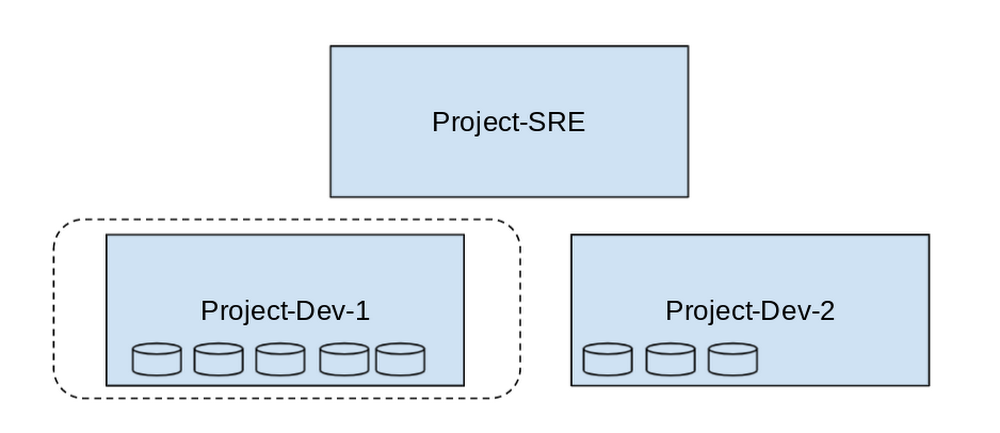
- In this example, Project-SRE is the name of a scoping project to monitor your fleet. You added two developer teams’ projects: Project-Dev-1 and Project-Dev-2, to Project-SRE’s Metrics Scope. If you select Project-SRE with the Cloud Console project picker and then go to the Monitoring page, you view the metrics for all three projects:

- If you select Project-Dev-1 with the Cloud Console project picker and then go to the Monitoring page, you view the Metrics Scope for Project-Dev-1 and you can only see the metrics for that project:
What else is new?
- Metrics Scopes can now monitor up to 375 projects (up from 100).
- New projects automatically start working in Cloud Monitoring without the previous 60-second Workspace creation process.
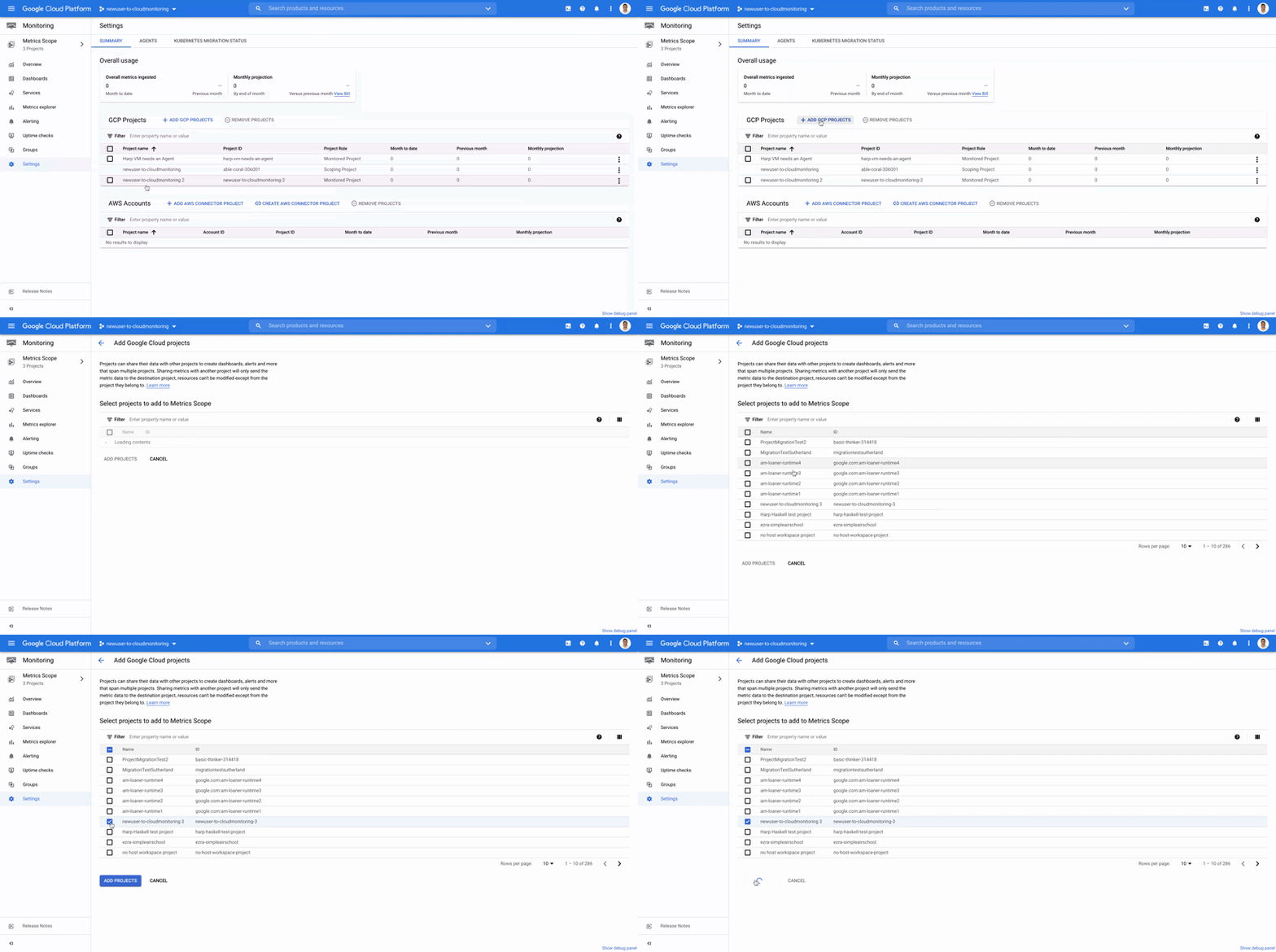
- If you want to monitor more than one project simply add it to your Metrics Scope:
Navigation
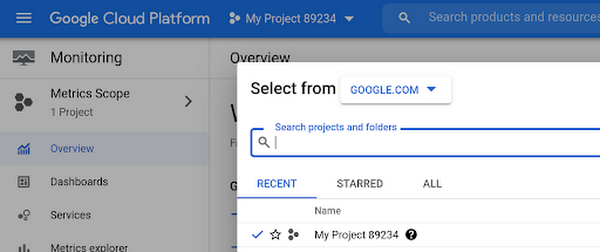
- Mentioned earlier, the Project Picker in the Cloud Console can be used to navigate between Metrics Scopes in Cloud Monitoring:
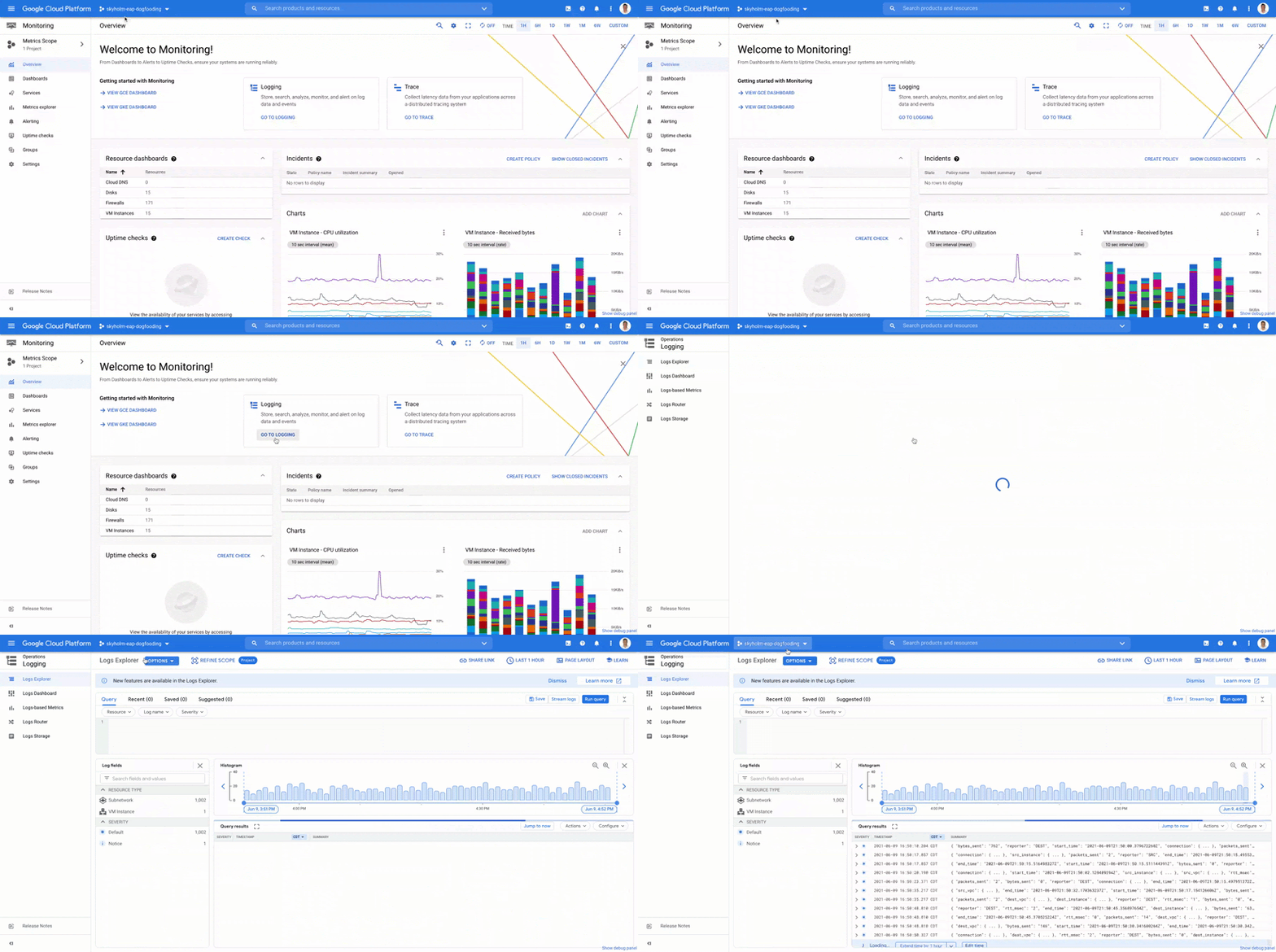
- This is now consistent with many other services across Google Cloud. Specifically, you can see how the project picker stays consistent when navigating from Cloud Monitoring to Cloud Logging:
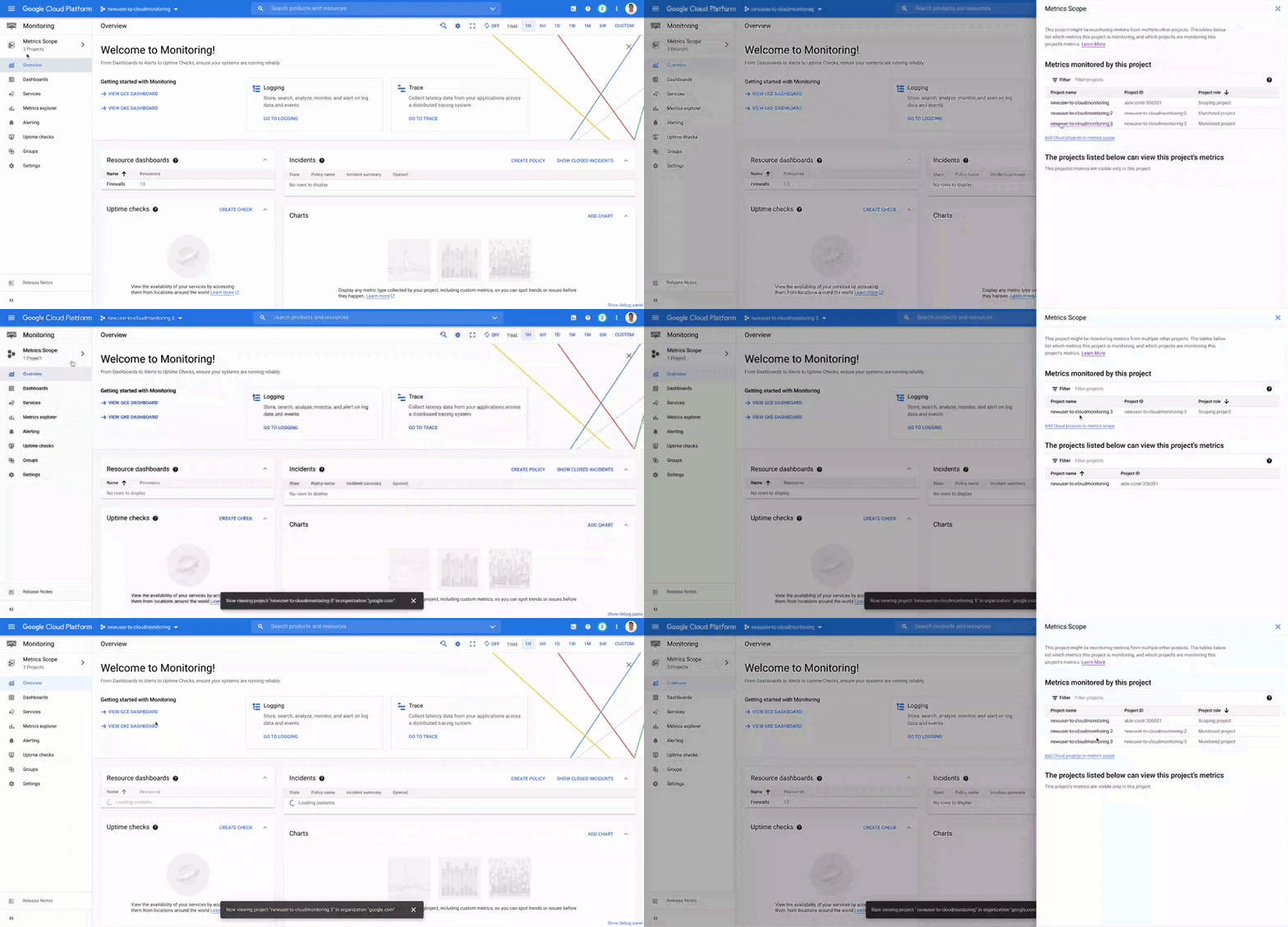
- Additionally, to make your navigation between Metrics Scopes easy we’ve added the new Metrics Scope Tab and Panel in the UI:
Coming Soon
- The Metrics Scope API is coming within the next quarter! This API will enable you to programmatically manage your monitoring configurations and Metrics Scopes.
Current Workspaces users
If you are already using Workspaces in Cloud Monitoring you may have noticed that they converted to Metrics Scopes weeks ago. There is no additional action required and you can start taking advantage of the additional features of Metrics Scopes today.
Get Started
Companies that are digitally native or in the process of digital transformation have placed an increased operational role on developers and this often creates overlapping sets of responsibilities with Operations and SRE teams. Now multiple developer teams can focus on optimizing the performance of their applications while operators can take a fleet-wide view when maintaining and improving the performance of all of the infrastructure under their purview.For information on configuring a Metrics Scope to include metrics for multiple projects, see Viewing metrics for multiple projects.
More Relevant Stories for Your Company
What Are India’s Biggest Companies Doing on Google Cloud?
In the last year, there’s been an upward trend in cloud adoption in India. In fact, NASSCOM finds that cloud spending in India is estimated to grow at 30% per annum to cross the US$7 billion mark by 2022. At Google, in our conversations with customers, discussions have evolved beyond cost savings

Bushel: Empowering Agribusinesses One Step at a Time with Google Cloud
Working to put food on all of our tables, today’s farmers are facing a higher amount of instability from input supply chain issues to weather patterns. Adding to this challenge are problems farmers face when trying to correctly time grain purchases, sales and transport. Farmers have always been stewards of

How One Company Improved Security Significantly–Without Increasing Staff
Quanta Services is the leading specialty contractor with the largest and highly-skilled trained workforce in North America. It provides fully-integrated solutions for the electric power pipeline industrial and telecommunications industries the company's geographic footprint which includes North America Latin America and Australia. It’s network of companies ensures world-class execution with

Managing Change in the Cloud
When moving to the cloud, many organizations concentrate their focus on the change in technology and overlook an area just as complex and impactful: cultural change. Having your people ready to embrace the change — supporting them with the right processes, equipping them with the right skills — is as
