





How Rustomjee Increased speed, agility, and worker mobility with Google Cloud Platform

4212
Of your peers have already read this article.
6:30 Minutes
The most insightful time you'll spend today!
Operating for 23 years, Rustomjee has carved a niche for itself in the ever-growing real estate sector. Rustomjee’s portfolio includes 14.32 million square feet of completed projects; 12 million square feet of ongoing development; and another 28 million square feet of planned development. These projects span the best locations of the Mumbai Metropolitan Region. Rustomjee adds value to the lives of its homeowners through its core business, its corporate social responsibility initiatives, and its philanthropy. The business strives to ensure that every blueprint includes child-friendly spaces for parks, playgrounds, and learning rooms, encouraging families to spend quality time with each other.
In the 17 years Rustomjee’s Corporate Head of Information Systems, V M Samir, has worked with the business, it has grown from 100 employees to more than 800 employees – primarily professionals such as engineers, architects, lawyers, accountants, and regulatory consultants. The remainder work in marketing, sales, administration, security, human resources, and other associated areas.
Historically, Samir says, the real estate industry globally has lagged in embracing new workplace technologies, making building business cases, securing sponsorship, completing implementations, and encouraging adoption a difficult task.
G Suite powers cloud journey
Rustomjee started operations running an on-premises email service. However, the business wanted to upgrade its anti-spam capabilities and, in 2007, turned to G Suite. “There was no practical way I could build an anti-spam engine within that service that could match the power of the G Suite anti-spam engine and the intelligence held within its databases,” says Samir. “Our second key reason for moving was the lower cost of G Suite relative to an on-premises service that required us to spend on compute, backup, storage, and administration resources. Running G Suite would also help ensure users could still access their emails if their machines experienced an outage.”
Finally, G Suite enabled Rustomjee to access and compose emails from any location – a luxury for a real estate organization whose workers often attended construction projects with poor connectivity. “Finally, G Suite was the only service in those days that integrated calendar, meeting, and storage repositories through single sign-on. Google was so far ahead of the curve at that time and we saw the potential of G Suite to transform our communications and ultimately our business.”
“We did not have to shut down the business operations during the migration because Google Cloud Platform complemented every idea we had. And when my business users came to work on the Monday morning [after the final migration], everything was stable and the performance had improved. We told them our infrastructure had changed and they should start thanking Google Cloud!”
—V M Samir, Corporate Head, Information Systems, Rustomjee
The business started its cloud and IT modernization journey by decommissioning its on-premises email servers and using G Suite for Business. It began testing in March 2007 and went live with all production email services for 500 users in June 2008.
The intuitive nature and ease of use of G Suite made the transition seamless. “I did not have to undertake a large-scale change management exercise,” says Samir. “Users bought into the program and acquired the necessary knowledge quickly, meaning our adoption rate was extremely fast.”
With G Suite, email became the new norm to complete a range of tasks at Rustomjee. “We started exchanging CAD drawings, videos, high-resolution images, and other large files with our consultants,” says Samir. “These files had been difficult to store in on-premises environments.”
Rustomjee has improved collaboration and performance with G Suite, primarily due to four services. Gmail enables workers to communicate seamlessly externally and with each other, while Calendar enables them to set up and synchronize meetings. These meetings can be conducted through Hangouts Meet. “If a group of people internally need to discuss a work order or contract, they can coordinate calendars, sit at different locations within our organization, and collaborate using audio and video on a common service,” says Samir. “They can also work from and update a single document in Drive.”
With email and other collaboration applications running smoothly, Rustomjee saw an opportunity to enhance its technology infrastructure. The business had started operations running workplace applications on servers in small air-conditioned rooms. These servers ran databases and applications that sent data across a network to endpoints including desktops and laptops.
Expansion and the changing demands of workplace technology prompted Rustomjee to upgrade its capabilities, and the business commissioned a data center. However, Rustomjee’s continuously fast-growing compute and storage requirements, as well as the need to access new technologies to innovate and compete, quickly strained its technology model. “We required eight weeks each time we needed to add new compute and storage to our environment,” says Samir. “In addition, the heavy investments in our captive data center meant we were unable to easily leverage new technologies and decommission old technologies.”
Public cloud supports growth
Rustomjee reviewed its options and decided public cloud services could best meet its ongoing needs. “The rising cost of maintaining old hardware would force us to refresh data center technologies every five to seven years,” says Samir. “More broadly, a hardware-defined data center could not adapt quickly in the cloud-computing world, making it difficult to align compute with growth.”
The business started by moving its corporate website and microsites to a public cloud service to accommodate increased traffic delivered from a change in business strategy. “We saw an opportunity to shift our marketing and advertising from print advertising to digital platforms,” says Samir. “We wanted to be available to buyers from the point at which they start looking at properties online.”
However, Rustomjee’s digital marketing teams found it difficult to scale instances in line with demand, and work with complex user administration screens and control panels.
“With Google Cloud Platform, we’ve achieved a considerable reduction in timelines and simplified technology management and administration. All of our business users are delighted.”
—V M Samir, Corporate Head, Information Systems, Rustomjee
Google Cloud Platform presented an opportunity for Rustomjee to run its websites and microsites in a reliable, scalable, and responsive infrastructure. “Our evaluation confirmed Google Cloud Platform could support our growing demand for compute and storage,” says Samir. ‘In addition, because we undertake projects that are geographically distributed, networking – not only within the data center, but that could be accessed from any location – was very important. Only Google Cloud Platform had its own networking infrastructure.”
“More broadly, in a cloud environment, we could select any database we needed and start consuming operating systems as a service,” he adds. “In addition, we did not have to invest capital in licenses and hardware and we could always resize network bandwidth. Further, we could take advantage of pay-as-we-use cloud services, and link this to business growth.”
Google Cloud Platform also allowed Rustomjee to reduce the size of the teams needed to manage and operate its infrastructure. “When you have infrastructure running in the data center and in disaster recovery locations, you need to have a large pool of resources working around the clock to ensure constant uptime, sound backup, and good replication measures in place,” says Samir. “With the cloud, everything is simplified and we do not have to consider issues like how many hard drives have failed in on a particular morning.”
The business started testing and created its first virtual machine instance to Google Cloud Platform in April 2017. Because the Mumbai data center was not yet operating Rustomjee initially hosted its instances in the Google Cloud Platform Singapore Region. This initial move enabled the business to reduce the number of required virtual machine instances from six to one. After a year of running the website on Google Cloud Platform, the business found the simplicity of scaling compute resources meant its digital marketing teams were running more campaigns and servicing more leads, while compute spend had fallen by 56 percent. Furthermore, Rustomjee was not experiencing latency that impacted the user experience.
The opening of the Google Cloud Platform Region in Mumbai in late 2017 gave Rustomjee an opportunity to use compute, storage, and networking services located domestically. The business decided to go all-in on Google Cloud Platform and migrated a range of applications to the service.
These included an SAP enterprise resource planning system, running initially on Oracle but moved to the SAP HANA in-memory computing platform, with the assistance of advisory consultants from a leading firm. This system is integral to Rustomjee’s successful operations, meaning it has to be highly available and responsive. “All our financials are captured and stored in this system, as well as projects, materials management, order management, financial systems, and sales ordering systems, both procurement and supply-side,” says Samir. “In short, we cannot live without SAP ERP!”
Rustomjee turned to SAP specialist partner InfraBeat Technologies, a leading network implementation provider, and Google engineers to complete the migration successfully. “We were all in this together and collaborated closely to deliver the project successfully,” says Samir. “We were very impressed by the expertise and skills of everyone involved.”
A nine-day migration
With assistance from Google Cloud and the partners, Rustomjee moved all its SAP workloads, from sandbox to development, development to quality, and quality to production, in just nine calendar days, without impacting the business. “We did not have to shut down the business operations during the migration because Google Cloud Platform complemented every idea we had,” says Samir. “And when my business users came to work on the Monday morning [after the final migration], everything was stable and performance had improved. We told them our infrastructure had changed and they should start thanking Google Cloud!”
Moving to Google Cloud Platform enabled the business to complete certain customer invoicing workloads in just two hours, down from 13 hours previously. Backups of the SAP enterprise resource planning system that had taken up to six hours, were now being completed in six minutes.
“We have now fully embraced a cloud-first approach and have moved 100 percent of our workloads to the cloud. We depend totally on Google Cloud Platform to run our business.”
—V M Samir, Corporate Head, Information Systems, Rustomjee
Eight weeks down to 20 minutes
Rustomjee has also cut the eight-week cycles needed to set up the infrastructure and applications for a new real estate project, and integrate it into the SAP system, to just 20 minutes. “With Google Cloud Platform, we’ve achieved a considerable reduction in timelines and simplified management and administration,” says Samir. “All of our business users are delighted.”
With its website and enterprise resource planning system running successfully on Google Cloud Platform, the business decided to move its virtual application delivery environment into the service. “We decided to move all 800 of our employees into the cloud, so they could access applications through any endpoint, be it a mobile phone, tablet, thin client, desktop, or laptop,” says Samir.
The business decided to replace an existing application virtualization product with public images available on Compute Engine, with testing of Android, iOS and Windows operating systems across a range of devices proving highly successful. “Running the remote desktop service in Compute Engine and using public images enabled us to operate a leaner, simplified desktop as a service environment,” says Samir. “We have been able to deploy business function-specific virtual machine instances on the cloud and compartmentalize data to the business functions that need them. The business completed the move – including 8.1TB of data – in just six weeks. “The only workloads we did not move during that period were intensive workloads for visualization,” says Samir.
However, the four teams that did not use the remote desktop as a service environment – and that created visualization-intensive workloads – were working in traditional ways, compromising productivity and increasing risk. “They used to be given a desk in their respective offices and their workstations loaded with the applications,” says Samir. “There was no way of taking hourly backups of these devices and there was no recovery mechanism for the applications, because they were not in the data center.
“The other challenge was what happens to the data, because we operate out of multiple locations. The users in these four teams always had to come back to pre-assigned desks and continue working from there. This was counterproductive.”
The business subsequently implemented virtual machine instances with GPU access for visualization-intensive workloads. “We started evaluating Nvidia T4 (Tesla) GPUs in the Mumbai Region on 13 February and went live on 11 March in Mumbai,” says Samir. “By moving these 40 team members to Google Cloud Platform, we have enabled them to work with visualization workloads from any location, improving productivity and flexibility.”
Focus on core business
With Google Cloud Platform, Rustomjee can focus on running real estate projects and using technology to enable them. “I don’t have to refresh my technology every five to seven years, and I can leverage new technologies as they come on stream,” says Samir.
Reliable application access
With the flexibility and scalability of Google Cloud Platform, Rustomjee is now well-positioned to support further growth and operate in accordance with the time-limited nature of the real estate industry in India. “If we have promised to hand over the keys to a customer by a certain deadline and we fail to do so, we face a penalty of 10 percent of the cost of the project,” explains Samir. “The Indian Government introduced this regime in 2017 and business and technology have to align with its requirements.
“Google Cloud Platform is the right service to move us forward and enable us to overcome these challenges,” he adds. “We have now fully embraced a cloud-first approach and have moved 100 percent of our workloads to the cloud. We depend totally on Google Cloud Platform to run our business.”
4888
Of your peers have already watched this video.
9:37 Minutes
The most insightful time you'll spend today!
L’Oréal: Managing Big-data Complexity with Google Cloud
L’Oreal is a global company with a presence in 150 countries worldwide. Between managing all of its brands and requirements for different countries, L’Oreal looks to data to make insightful business decisions. How does L’Oreal unify its data across all its systems and databases? How does L’Oreal make the data accessible to thousands of employees? In this video, Antoine Castex, Enterprise Architect at L’Oreal, discusses with Martin Omander how L’Oreal built a serverless, multi-cloud warehouse based on Google Cloud.
Chapters:
0:00 – Intro
0:23 – Why does L’Oreal need a new data warehouse?
0:51 – Who is the L’Oreal group?
1:35 – Which systems does L’Oreal use?
2:14 – How does L’Oreal manage complexity?
3:59 – What is ELT?
4:57 – Who are L’Oreal’s data consumers?
5:41 – How L’Oreal built the data warehouse
8:51 – L’Oreal’s future plans
9:10 – Wrap up
Google Cloud Workflows → https://goo.gle/3q20M1V
Cloud Run → https://goo.gle/3CSWbXG
Eventarc → https://goo.gle/3B7qhFy
BigQuery → https://goo.gle/3KHgyJ3
Looker → https://goo.gle/3Rx4Ind
Checkout more episodes of Serverless Expeditions → https://goo.gle/ServerlessExpeditions
Subscribe to Google Cloud Tech → https://goo.gle/GoogleCloudTech
4033
Of your peers have already watched this video.
15:00 Minutes
The most insightful time you'll spend today!
Modernize your Windows Workloads by Migrating them to Google Cloud
Google has plenty to offer when it comes to migrating and modernizing traditional enterprise Windows workloads to the cloud. Explore different approaches for re-hosting, modernizing, and transforming Windows applications, and the benefits of moving to Google Cloud.
Learn from demos on some of the cutting-edge technologies that can offload some of the operational IT burden into optimized managed services.
6695
Of your peers have already downloaded this article
4:30 Minutes
The most insightful time you'll spend today!
Unlocking the Power of Data and Creativity with
the Cloud: The WPP Story
Three German Retail Firms Choose Google Cloud to Migrate SAP Workloads for Business Transformation

3668
Of your peers have already read this article.
1:30 Minutes
The most insightful time you'll spend today!
The retail industry is rapidly evolving, with customers demanding exceptional digital experiences, and retailers adjusting their businesses to be more efficient. With many retailers relying on SAP for critical business functions like digital transactions, finance, supply chains and more, this shift has led them to look for ways to modernize these systems, deliver them on highly scalable infrastructure, and extract more value out of the data from within them.
I’m proud that we are helping German retailers successfully migrate business-critical SAP systems onto Google Cloud, minimizing risk and downtime and ultimately helping them build a foundation for future growth. Our work with retailers like Otto Group, one of the world’s largest ecommerce businesses, MediaMarktSaturn, the large consumer electronics retailer, and METRO, the wholesale retailer with operations across Europe, demonstrates our deep partnership with SAP to support customers’ digital transformations.
Helping Otto Group IT run SAP on secure, sustainable infrastructure
Otto Group, a leading online-retailer and services group in Germany and one of the world’s largest ecommerce companies, migrated their SAP workloads to Google Cloud in order to modernize their SAP landscape and build a more agile environment that would enable them to quickly scale up or down according to business needs.
The Otto Group, which consistently balances the sustainable use of resources and climate-neutral action with economic growth, is also able to leverage Google Cloud’s clean infrastructure to deliver the bulk of its internal SAP environment, ensuring the company’s business systems are running on secure, sustainable infrastructure. Since 2017, Google has matched 100% of its global electricity use with purchases of renewable energy every year, and is now building on that progress with a new goal of running entirely on carbon-free energy at all times by 2030.
With Google Cloud, Otto Group has told us they have access to better means of automation and improved network capability compared to what they had with their previous provider. Through this cloud migration, Otto Group IT is providing modern and flexibly scalable SAP systems to their internal customers.
Powering MediaMarktSaturn’s online ecommerce experience
For MediaMarktSaturn, SAP is critical to the smooth day-to-day running of its business, so the company was keen to ensure maximum availability and stability with a cloud environment. After a thorough examination of its business needs and hands-on support from Google Cloud’s teams, MediaMarktSaturn elected to migrate its SAP HANA database onto Google Cloud, enabling a performance increase of four times compared to its previous on-premises installations.
The SAP suite is critical for the ecommerce platform to run smoothly on a day-to-day basis. By migrating to Google Cloud, the retailer is providing even more support and maximum availability for its customers. With Google Cloud’s industry-specific expertise, MediaMarktSaturn’s customers have access to a reliable and stable ecommerce platform, so they can browse for products online from wherever they are.
Transforming METRO’s business by running SAP workloads in the cloud
With more than 97,000 employees in 34 countries, Germany’s METRO is one of the world’s largest B2B wholesalers. Previously, METRO relied on unique finance systems that were different in each country, and updates or system testing required substantial coordination across numerous teams, which was both time-consuming and costly.
To address these pain points, METRO is moving away from on premise deployments and is now migrating its SAP S/4HANA finance systems to Google Cloud to support everything from classical role-based accounting to the use of cognitive tools. Now, internal METRO teams can work seamlessly across operations, enhancing the services they provide to customers by addressing demands in real time.
To read more about how SAP on Google Cloud drives agility, efficiency, and innovation for our customers, visit our solutions page here.
Google Cloud’s Professional Service Organization: How it Accelerates Operational Health Review Cloud Migration

3364
Of your peers have already read this article.
2:00 Minutes
The most insightful time you'll spend today!
Introduction
The Google Cloud Professional Services Organization’s (PSO) mission is to help our customers get the most out of Google products. PSO is responsible for customer success by sharing our technical expertise in order to unlock business value from the cloud by providing cloud strategy and best practice advice, implementation guidance, and training using our proven methodology.
In this blog post, we want to focus specifically on Operational Health Reviews and how PSO engages in a myriad of activities to ensure the overall success and health of a customer engagement while ensuring we are meeting customer expectations and objectives, managing risk, and ultimately delivering value during or after the Google Cloud migration. We will discuss the assets, methodology, and tools that we leverage to ensure this success.
What is an Operational Health Review and what purpose does it serve?
Operational Health Reviews (OHR) are regular reviews to proactively address the below topics:
- A customer’s support experience
- Analysis of trends in key operational metrics
- Analysis of trends in Google Cloud usage
- Status reports for high-priority cloud projects
- Discussion of upcoming events
- Discussion of potential opportunities for training
- Review of feature requests
The core aim of an OHR is to measure progress and advise customers on the overall health of the account and migration progress while providing recommendations as a team on what adjustments should be considered to ensure continued success. During the OHR, we will address any pain points as well as identify and remediate any negative trends in support interfaces and usage metrics.
The intention of the activity is to also perform a blameless reflection for continuous improvement. This supports the effort to maintain common ground and obtain mutual optimism for the next phase of the customer’s journey on Google Cloud.
Let’s dive a little deeper into some of the activities that go into an OHR.
Support experience
One of the Google Cloud’s Support Organization’s goals is to simplify and streamline our customer’s support experience with a scalable and flexible set of offerings built with the customer needs at the center. This includes supporting an ongoing partnership model, with a proactive and collaborative approach. Premium Support is our top-tier support model which is a paid support offering designed for enterprises that run mission critical workloads and require fast response times, platform stability, and increased operational efficiencies. As part of this offering, customers are provided with a Technical Account Manager (TAM) who is in charge of delivering frequent touchpoints, including OHRs.
During the support experience section of an OHR, some of the following topics may be reviewed:
- Case volume by priority
- Case volume by product
- Cases linked to Google Cloud incidents
- Escalated cases or incidents
- Case initial response time (IRT)
- Case IRT SLO Met Rate
- Case total resolution time (TRT) hours
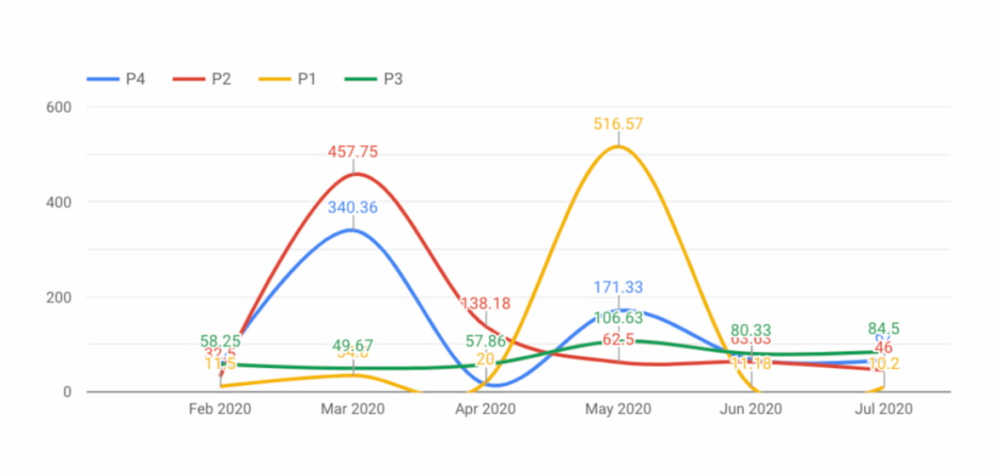
The purpose of this activity is to better understand the efficiency of both the customer’s and Google’s cloud operations from a support trend perspective. The goal is to celebrate any positive trends, but also to identify potential negative trends and proactively determine a remediation strategy.
Status reports for high-priority cloud projects
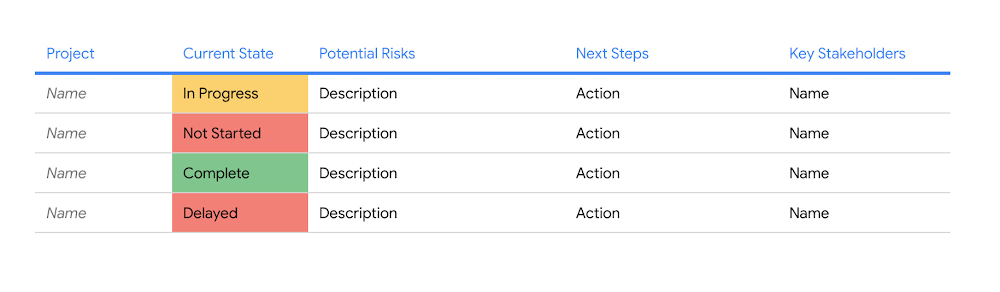
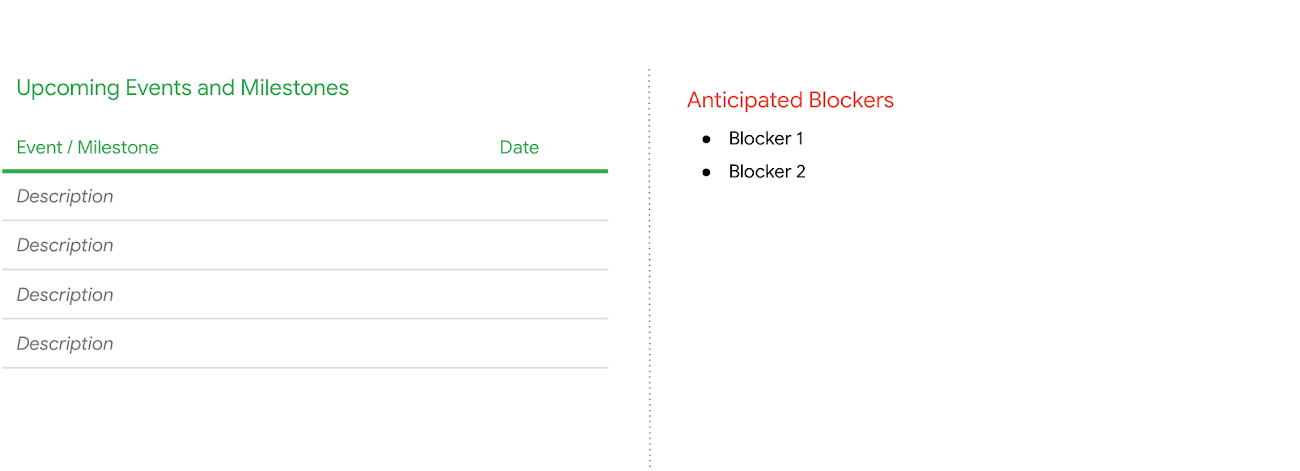
The purpose of this part of the OHR is to ensure the senior management stakeholders have continued visibility into the status of all their high-priority cloud initiatives with an easy-to-read, sometimes color-coded assessment on the status of each project. The assessment [Figure 1] may include, but is not limited to potential identified risks, key next steps, key stakeholders, and a mitigation plan for any high priority issues that may occur during their migration engagement. Additionally, the TAM may also cover any upcoming milestones or events, as well as any potential anticipated future blockers [Figure 2].
Review trends in Google Cloud usage
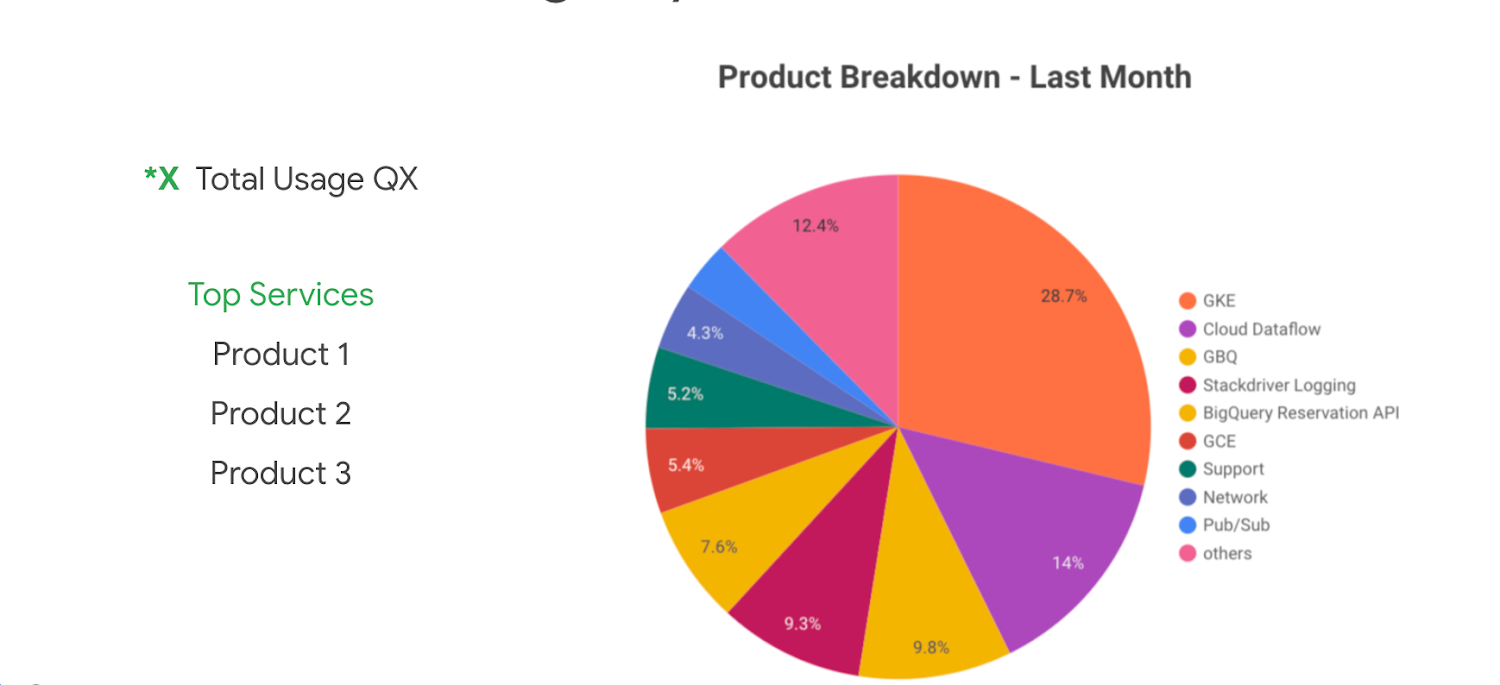
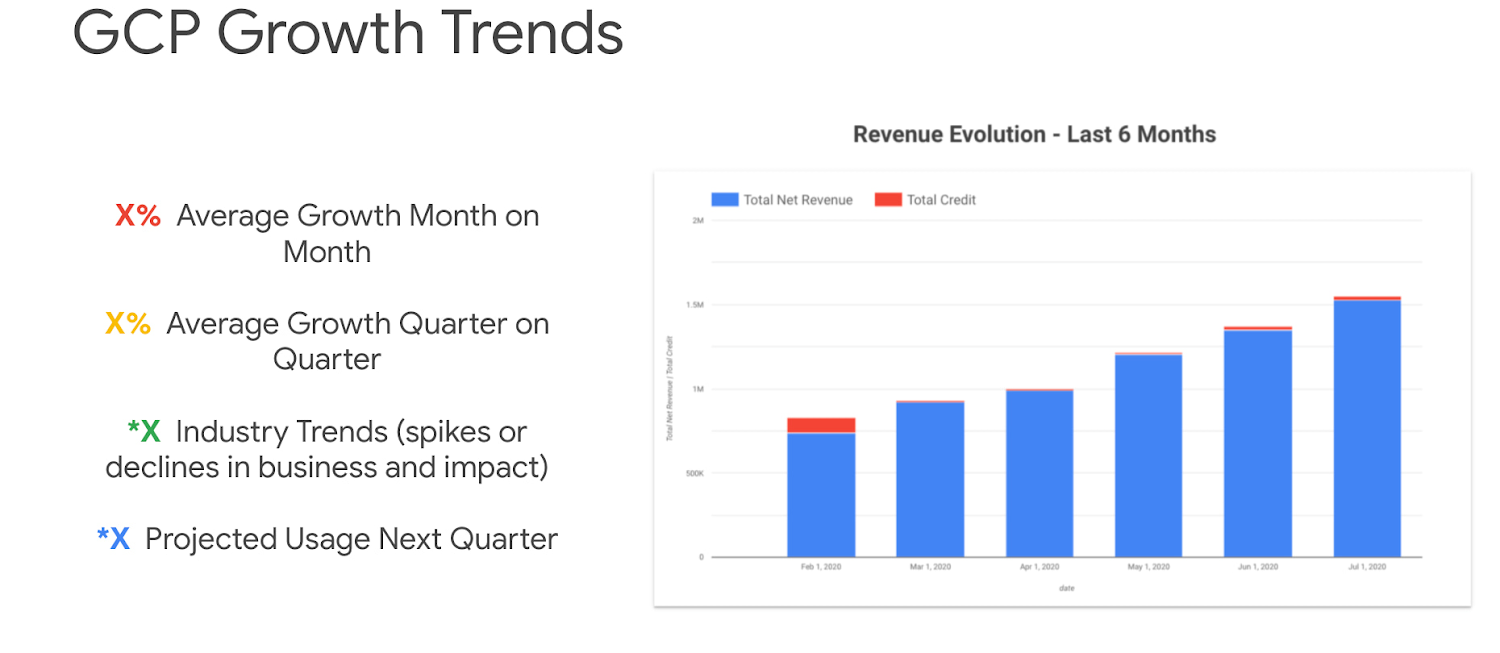
This part of the OHR is meant to provide the customer with a holistic view of their overall Google Cloud usage. The purpose is to provide understanding around what products are being used on Google Cloud and also where cost is generally being allocated for overall cost management and budget tracking purposes. This can help customers with their overall cost optimization efforts. Some of the metrics we may cover in this section are:
- Current Google Cloud usage by service
- Google Cloud growth trends
- Google Cloud growth trends by service
- Google Cloud growth trends by project
- Review of used and available service credits
Feature request review and advocacy
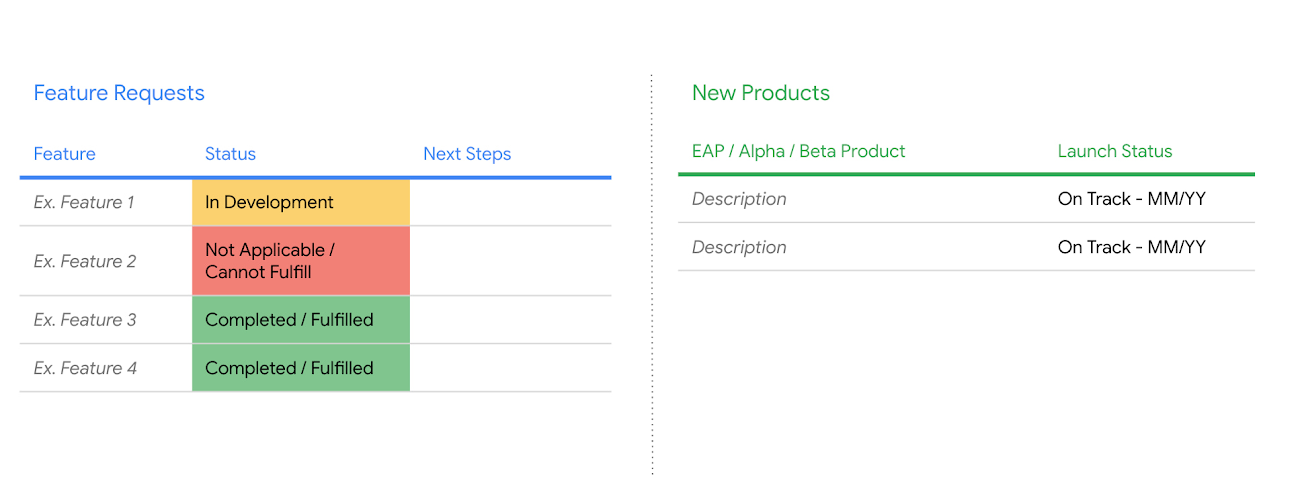
TAMs will work with customers to help identify product needs and advocate for feature requests with Google Product Management and Engineering teams. While feature request advocacy is an ongoing activity, during the OHR, the TAM will review any high priority feature requests that have previously been submitted, providing updates on status including potential release dates.
When a feature is coming up for the release, the TAM can help the customer prepare for implementation (providing early Preview access, coordinating a meeting with the Product Manager to review the feature, etc.) and then continue to provide support until the feature is successfully implemented in the customer environment. Similarly, if a high priority or technical blocking feature is not yet coming available, the TAM can help offer an alternative solution that can unblock the customer in the short term.
The OHR is also a great time for the TAM to work with the customer to ensure they have early access to new and exciting features that are in Alpha or Beta, and that would be beneficial to the customer and their environment.
Training strategy
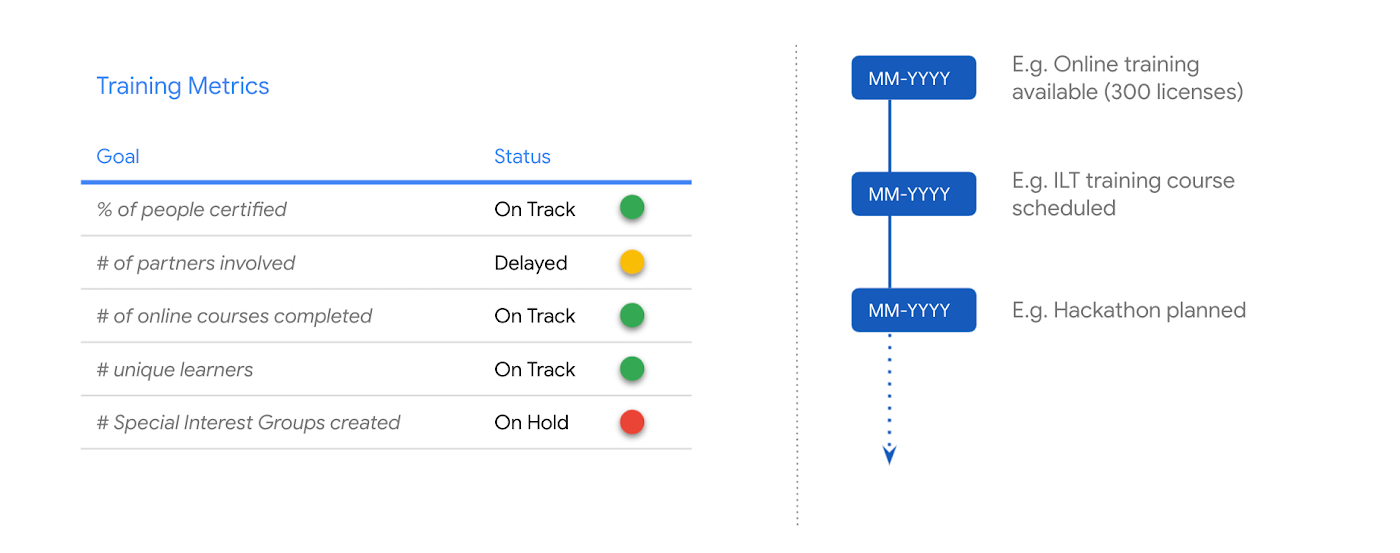
Training is a primary component to ensuring the overall success in adopting Google Cloud. During the OHR, a review of training metrics will be provided. This may include tracking metrics to determine how the customer is tracking towards an initially agreed upon learning plan or coming up with additional upskilling strategies as necessary. Additionally, throughout an engagement, the customer’s TAM will provide opportunities for both free and paid Google Cloud training.
Conclusion
PSO is the voice of customer health, maintaining priority to proactively and strategically guide large enterprise customers to operate effectively and efficiently in the cloud, both during and after the migration process. The OHR is an efficient and effective way to maintain alignment, ensure expectations and objectives are being met, manage risk, and overall ensure the success of the customer.
Learn more about our methodology and get started with Google Cloud by completing a free discovery and assessment of your migration. Alternatively, if you’d like to engage directly with our PSO team on your migration, contact us!
More Relevant Stories for Your Company

Google Cloud Announces Improvements in Private Catalog to Drive Terraform Deployments
As an enterprise admin, when you choose to use Google Cloud Private Catalog to enable curated, self-serve Google Cloud infrastructure provisioning, you need the ability to manage your organization’s deployments. Today, we’re pleased to announce support for several improvements to Terraform driven deployments through Private Catalog. With this new release, you can




Journey to Transformation and Modernization with Google’s Distributed Cloud
Google Cloud has been leading the way of helping businesses make most from their cloud investments to drive digital transformation through modern application platforms that cater to today's customer needs. Watch the video from the Next '21 to explore three areas where companies are supported by Google Cloud throughout their

Take a Look at 30 Eventrac Locations!
New locations in Eventarc Back in August, we announced more Eventarc locations (17 new regions, as well as 6 new dual-region and multi-region locations to be precise). This takes the total number of locations in Eventarc to more than 30. You can see the full list in the Eventarc locations page or by running gcloud

Melbourne Joins Google’s 26 Cloud Regions
We opened our Sydney cloud region in 2017 and, since then, we have continued to invest and expand across Australia and New Zealand to support the digital future of organizations of all sizes. In Australia, Google Cloud supports almost A$3.2 billion in annual gross benefits to businesses and consumers. This includes A$686
