





How Digital Simulation of Physical Stores Helped e-Commerce Companies Replenish Stocks and Fulfil Online Orders at Scale in 2020

2976
Of your peers have already read this article.
3:00 Minutes
The most insightful time you'll spend today!
Editor’s note: We’re inviting partners from across our retail ecosystem to share stories, best practices, and tips and tricks on how they are helping retailers transform during a time that has seen tremendous change. The original version of this blog was published by Trax Retail in October 2021. Please enjoy this updated entry from our partner.

In 2020, we saw a massive leap in online grocery. Within a few weeks, the industry reached numbers that were unexpected for at least four more years. In a snap, what seemed like a relatively insignificant channel became one that grocery retailers simply couldn’t ignore and, what’s more, is likely to remain a norm.
Retailers trying to stay ahead of the curve have already started experimenting with methods like building warehouses and installing robots to fulfill the growing demand, but in-store picking has been and will continue to remain one of the primary methods of fulfilling online orders as it offers several advantages. First, it allows the use of existing infrastructure – large retailers already have geographically well-located outlets in major cities, which enables shorter lead time to delivery. Secondly, it allows retailers to stay flexible and move swiftly between in-store and online order fulfillment. And finally, it fits perfectly with the omnichannel approach to allow customers to shop wherever and however they want – click and collect, curbside pick-up, or inside brick-and-mortar stores.
How improving on-shelf availability helps ecommerce profitability

Despite its many advantages, in-store picking is expensive and affects profitability in an already competitive space since the cost of picking is directly tied with hourly labor fees. Moreover, with labor being a major challenge to obtain and retain, every minute spent picking counts. However, there is an easy way to keep costs down – optimizing the picking process by ensuring product availability and reducing the need for substitution.
An average of 8% of products are not available on-shelf in stores at any given time. As a result, pickers waste much of their time hunting for products that simply aren’t on the shelf or are misplaced, or spend time looking for substitutes, further increasing the time and cost for picking. In fact, grocery pickers often claim that out-of-stock (OOS) occurrences are the main reason that slows down the picking process. Without these factors, pick rates could be two times faster. Since picking accounts for 50% of the fulfillment cost, it has a substantial impact on the order’s bottom line and often makes the difference between a loss-making and a profitable basket.
Maintaining on-shelf availability for the thousands of products in every store has always been a significant problem to solve. The shift to online ordering has made the availability issue even more significant as the shelf is also now the fulfillment center for the majority of online orders. For e-commerce, out of stocks present two major issues for retailers. First, the impact of out-of-stock items is even more noticeable for online shoppers as they do not select their own substitutions. Additionally, out-of-stocks cause inefficiencies in the item fulfillment process, which is already a costly and margin-diluting practice for retailers. The good news is that through a partnership between Trax and Google Cloud, and the power of Google Cloud’s AI/ML capabilities, these challenges are addressed. The granular, real-time data at scale to enable picking efficiency and the data transparency to unlock a better shopping experience are now a reality which benefits both shoppers and store associates.
Trax and Google Cloud technology helps the bottom line
Trax and Google Cloud offer solutions that can help retailers improve on-shelf availability (OSA). Trax Retail Watch powered by Google Cloud uses computer vision (CV) and AI to create a digital version of the physical store in real-time and informs out-of-stocks so that retailers always have full visibility of items that are running low and can replenish them quickly. In turn, pickers are more likely to find everything they need quickly without facing the problem of missing products or having to look for substitutes. Trax Retail Watch also allows store associates to quickly spot any issues arising on shelves without having to physically walk down each aisle. From misplaced products to low stock, having full visibility means that shelf managers make more informed decisions, so that pickers face fewer obstacles, are aware of the true inventory, and significantly improve their pick rates. Faster picking means lower costs and ultimately, higher margins for online grocery orders.
With more e-commerce retailers crowding the online space, competition is tough. Want to know how frustrated e-commerce shoppers are about on-shelf availability? Trax uncovered this problem through an in-depth consumer study. Learn how to address shopper happiness while driving more profitable fulfillment and stay on the leaderboard with this Trax and Google Cloud whitepaper: Winning the online grocery race.
Generative AI Takes Center Stage at Google I/O Conference 2023

1186
Of your peers have already read this article.
7:00 Minutes
The most insightful time you'll spend today!
Over the past decade, artificial intelligence has evolved from experimental prototypes and early successes to mainstream enterprise use. And the recent advancements in generative AI have begun to change the way we create, connect, and collaborate. As Google CEO Sundar Pichai said in his keynote, every business and organization is thinking about how to drive transformation. That’s why we’re focused on making it easy and scalable for others to innovate with AI.
In March, we announced exciting new products that infuse generative AI into our Google Cloud offerings, empowering developers to responsibly build with enterprise-level safety, security, and privacy. They include Gen App Builder, which lets developers quickly and easily create generative chat and enterprise search applications, and Generative AI support in Vertex AI, which expands our machine learning development platform with access to foundation models from Google and others to quickly build, customize and deploy models. We also introduced our vision for Google Workspace, and delivered generative AI features to trusted testers in Gmail and Google Docs that help people write.
Last month we introduced Security AI Workbench, an industry-first extensible platform powered by our new LLM security model Sec-PaLM, which incorporates Google’s unique visibility into the evolving threat landscape and is fine-tuned for cybersecurity operations.
Today at Google I/O, we are excited to share the next steps not only in our own AI journey, but also those of our customers and partners as well. We’ve already seen a number of organizations begin to develop with and deploy our generative AI offerings. These organizations have been able to move their ideas from experimentation to enterprise-ready applications with the training models, security, compute infrastructure, and cost controls needed to provide their customers with transformative experiences. Our open ecosystem, which provides opportunities for every kind of partner, continues to grow as well. And we are also pleased to share new services and capabilities across Google Cloud and Workspace, including Duet AI—our AI-powered collaborator—to enable more users and developers to start seeing the impact AI can have on their organization.
Customers bringing ideas to life with generative AI
Leading companies in a variety of industries like eDreams ODIGEO, GitLab, Oxbotica, and more, are using our generative AI technologies to create engaging content, synthesize and organize information, automate business processes, and build amazing customer experiences. A few examples we showcased today include:
- Adore Me, a New York-based intimate apparel brand, is creating production-worthy copy with generative AI features in Docs and Gmail. This is accelerating projects and processes in ways that even surprised the company.
- Canva, the visual communication platform, uses Google Cloud’s rich generative AI capabilities in language translation to better support its non-English speaking users. Users can now easily translate presentations, posters, social media posts, and more into over a hundred languages. The company is also testing ways that Google’s PaLM technology can turn short video clips into longer, more compelling stories. The result will be a more seamless design experience while growing the Canva brand.
- Character.AI, a leading conversational AI platform, selected Google Cloud as its preferred cloud infrastructure provider because we offer the speed, security and flexibility required to meet the needs of its rapidly growing community of creators. We are enabling Character.AI to train and infer LLMs faster and more efficiently, and enhancing the customer experience by inspiring imagination, discovery, and understanding.
- Deutsche Bank is testing Google’s generative AI and large language models (LLMs) at scale to provide new insights to financial analysts, driving operational efficiencies and execution velocity. There is an opportunity to significantly reduce the time it takes to perform banking operations and financial analysts’ tasks, empowering employees by increasing their productivity while helping to safeguard customer data privacy, data integrity, and system security.
- Instacart is always looking for opportunities to adopt the latest technological innovations, and by joining the Workspace Labs program, they have access to the new features and can discover how generative AI will make an impact for their teams.
- Orange is exploring a next-generation contact center with Google Cloud. With customers in 26 countries, the global telecommunications firm is testing generative AI to transcribe the call, summarize the exchange between the customer and service representatives, and suggest possible follow up actions to the agent based on the discussion. This experiment has the potential to dramatically improve both the efficiency and quality of customer interactions. Orange is working closely with Google to help ensure data protection and make sure that systematic employee review of Generative AI output and transparency can be implemented.
- Replit is developing a collaborative software development platform powered by AI. Developers using Replit’s Ghostwriter coding AI already have 30% of their code written by generative AI today. With real-time debugging of the code output and context awareness of the program’s files, Ghostwriter frees up developers’ time for more challenging and creative aspects of programming.
- Uber is creating generative AI for customer-service chatbots and agent assist capabilities, which handle a range of common service issues with human-like interactions with the aim of achieving greater customer satisfaction and cost efficiency. Additionally, Uber is working on using our synthetic data systems (a technique for improving the quality of LLMs) in areas like product development, fraud detection, and employee productivity.
Wendy’s is working with Google Cloud on a groundbreaking AI solution, Wendy’s FreshAI, designed to revolutionize the quick service restaurant industry. The technology is transforming Wendy’s drive-thru food ordering experience with Google Cloud’s generative AI and LLMs—with the ability to discern the billions of possible order combinations on the Wendy’s menu. In June, Wendy’s plans to launch its first pilot of the technology in a Columbus, Ohio-area restaurant, before expanding to more drive-thru locations.
Partnering creates a strong ecosystem of real-world options for customers
At Google Cloud, we are dedicated to being the most open hyperscale cloud provider, and that includes our AI ecosystem. Today, we are excited to expand upon the partnerships announced earlier this year for every layer of the AI stack—chipmakers, companies building foundation models and AI platforms, technology partners enabling companies to develop and deploy machine learning (ML) models, app-builders solving customer use cases with generative AI, and global services and consulting firms that help enterprise customers implement all of this technology at scale.
We announced new or expanded partnerships with SaaS companies like Box, Dialpad, Jasper, Salesforce, and UKG; and consultancies including Accenture, BCG, Cognizant, Deloitte, and KPMG. Together with our previous announcements with companies like AI21 Labs, Aible, Anthropic, Anyscale, Bending Spoons, Cohere, Faraday, Glean, Gretel, Labelbox, Midjourney, Osmo, Replit, Snorkel AI, Tabnine, Weights & Biases, and many more, they provide the a wide range of options for businesses and governments looking to bring generative AI into their organizations.
Introducing new generative AI capabilities for Google Cloud
To help cloud users of all skill levels solve their everyday work challenges, we’re excited to announce Duet AI for Google Cloud, a new generative AI-powered collaborator. Duet AI serves as your expert pair programmer and assists cloud users with contextual code completion, offering suggestions tuned to your code base, generating entire functions in real-time, and assisting you with code reviews and inspections. It can fundamentally transform the way cloud users of all skill sets build new experiences and is embedded across Google Cloud interfaces—within the integrated development environment (IDE), Google Cloud Console, and even chat.
For developers looking to create generative AI applications more simply and efficiently, we are also introducing new foundation models and capabilities across our Google Cloud AI products. And to continue to enable and inspire more customers and partners, we are opening up generative AI support in Vertex AI and expanding access to many of these new innovations to more organizations.
- New foundation models are now available in Vertex AI. Codey, our code generation foundation model, helps accelerate software development with code generation, code completion, and code chat. Imagen, our text-to-image foundation model, lets customers generate and customize studio-grade images. And Chirp, our state-of-the-art speech model, allows customers to more deeply engage with their customers and constituents inclusively in their native languages with captioning and voice assistance. They can each be accessed via APIs, tuned through our intuitive Generative AI Studio, and feature enterprise-grade security and reliability, including encryption, access control, content moderation, and recitation capabilities that let organizations see the sources behind model outputs.
- Text Embeddings API is a new API endpoint that lets developers build recommendation engines, classifiers, question-answering systems, similarity matching, and other sophisticated applications based on semantic understanding of text or images.
- Reinforcement Learning from Human Feedback (RLHF) allows organizations to incorporate human feedback to deeply customize and improve model performance.
Underpinning all of these innovations is our AI-optimized infrastructure. We provide the widest choice of compute options among leading cloud providers and are excited to continue to build them out with the introduction of new A3 Virtual Machines based on NVIDIA’s H100 GPU. These VMs, alongside the recently announced G2 VMs, offer a comprehensive range of GPU power for training and serving AI models.
Extending generative AI across Google Workspace
Earlier this year, we shared our vision for bringing generative AI to Workspace, and gave many users early access to features that helped them write in Gmail and Google Docs. Today, we are excited to announce Duet AI for Google Workspace, which brings together our powerful generative AI features and lets users collaborate with AI so they can get more done every day. We’re delivering the following features to trusted testers via Workspace Labs:
- In Gmail, we’re adding the ability to draft responses that consider the context of your existing email thread—and making the experience available on mobile.
- In Google Slides and Meet, we’re enabling you to easily generate images from text descriptions. Custom images in slides can help bring your story to life, and in Meet they can be used to create custom backgrounds.
- In Google Sheets, we’re automating data classification and the creation of custom plans—helping you analyze and organize data faster than ever.
Moving the industry forward, responsibly
Customers continue to amaze us with their ideas and creativity, and we look forward to continuing to help them discover their own paths forward with generative AI. While the potential for impact on business is great, we remain committed to taking a responsible approach, guided by our AI Principles. As we gather more feedback from our customers and users, we will continue to bring new innovations to market, with a goal to enable organizations of every size and industry to increase efficiency, connect with customers in new ways, and unlock entirely new revenue streams.
New ML-Powered API Abuse Detection

1579
Of your peers have already read this article.
3:30 Minutes
The most insightful time you'll spend today!
API security incidents are increasingly common and disruptive. With the growth of API traffic, enterprises across the world are also experiencing an uptick in malicious API attacks, making API security a heightened priority. According to our latest API Security Research Report, 50% of organizations surveyed have experienced an API security incident in the past 12 months and of those, 77% delayed the rollout of a new service or application.
At the RSA Conference 2023 today, we’re making it faster and easier to help detect API abuse incidents with the introduction of Advanced API Security Machine Learning powered abuse-detection dashboards. Our newly introduced Machine Learning models are trained to detect business logic attacks.
These types of attacks are notoriously hard to identify, and target APIs tied to intellectual property, business processes, or sensitive information, such as user data, listing of goods, or crediting accounts. These APIs must be accessible to provide business value, but have also become targets for attackers.
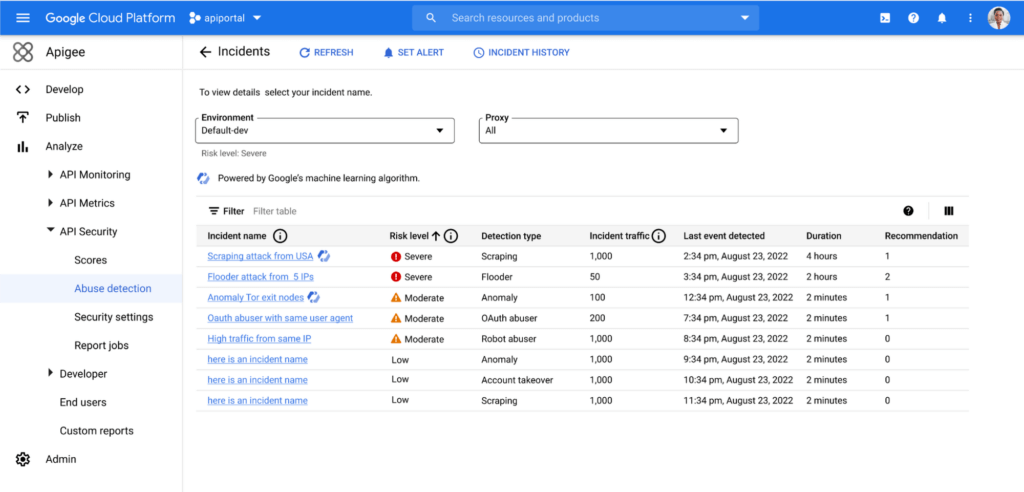
API security incidents can have a considerable impact on an organization’s operations and its bottom line. In June 2022, Imperva released a report titled Quantifying the Cost of API Insecurity, which estimates that lack of secure APIs could result in an average annual API-related total global cyber loss of between $41 billion to $75 billion annually. Furthermore, according to IBM’s 2022 Cost of a Data Breach Report, the average cost of a data breach is $4.35 million. It’s vital that organizations detect and mitigate API abuse incidents early to prevent prolonged fiscal and reputational damage to the business.
However, business logic attacks are harder to detect using static security policies, which allows attackers to manipulate legitimate functionality to achieve a malicious goal without triggering any static security alerts. For example, if a malicious actor gains control of a server and makes subtle changes, the shift in activity patterns of the server is generally undetectable to most monitoring tools. However, in this scenario, the Advanced API Security’s ML-powered API abuse detection model can help differentiate between legitimate and deviant traffic and immediately notify key stakeholders to act quickly and minimize blast radius of the problem.
The ML models that power API abuse detection have been trained and used by Google’s internal teams to help protect our public-facing APIs. The models rely on years of learning and best practices and are now available to all Apigee Advanced API Security customers.
Another challenge in detecting API abuse incidents is the volume of alerts. To reduce the risk of missing key security incidents, many static rules that detect less sophisticated attacks are incredibly sensitive: They generate a high volume of alerts. This makes finding the critical incidents within API traffic and acting to resolve them like “finding a needle in a haystack” for many IT teams. Apigee Advanced Security’s ML-powered dashboards more accurately identify critical API abuses and find similar patterns within the large number of bot alerts to help reduce the time to find and act on most important incidents.
With the help of Apigee Advanced API Security’s ML-powered abuse detection dashboards, customers can uncover critical API abuse incidents, including business logic attacks, scraping, and anomalies, faster. Critical threats are surfaced with clear and concise descriptions to capture the essence of the attack along with the most important characteristics such as the source of the attack, the number of API calls, and the duration of the attack, to help resolve the incident more rapidly.
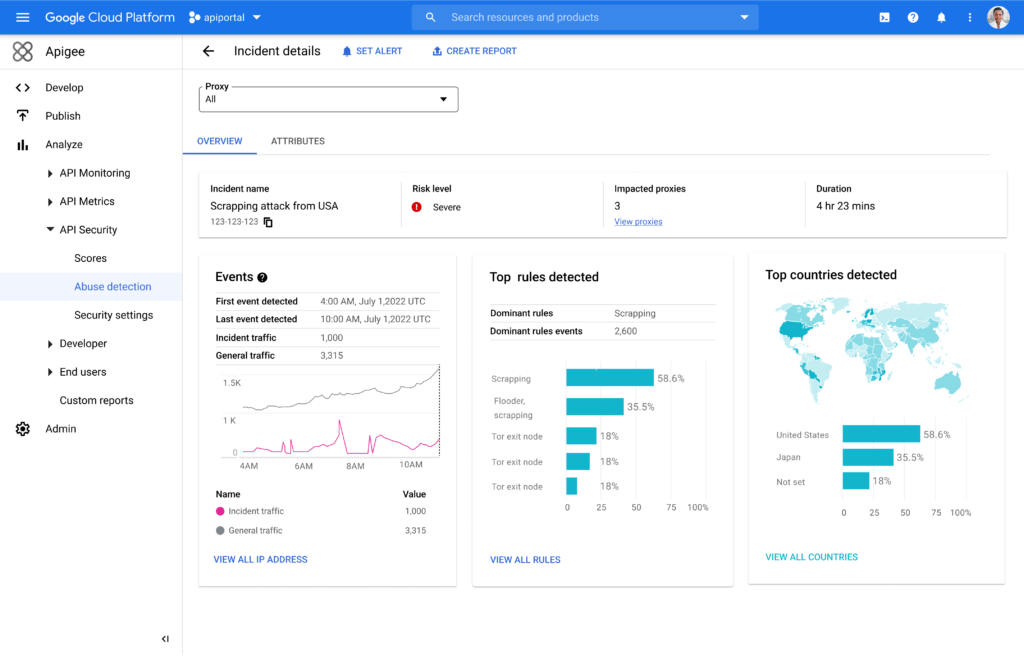
Machine Learning powered abuse-detection dashboards are available in Advanced API Security, a feature of Apigee API management that enables you to more easily detect API security misconfigurations, bad bots, and malicious activities.
To get started with Advanced API Security’s ML-powered dashboards, start your free Apigee trial now.
Lufthansa: Wind Forecasting with Google Cloud ML Helps Increase On-time Flights

2503
Of your peers have already read this article.
3:30 Minutes
The most insightful time you'll spend today!
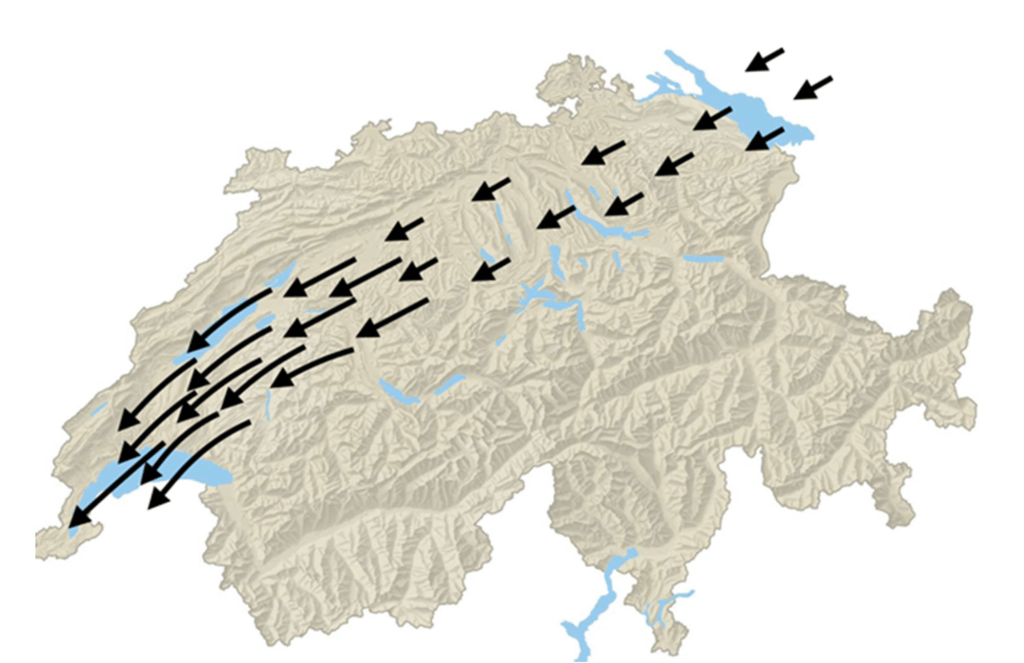
The magnitude and direction of wind significantly impacts airport operations, and Lufthansa Group Airlines are no exception. A particularly troublesome kind is called BISE: it is a cold, dry wind that blows from the northeast to southwest in Switzerland, through the Swiss Plateau. Its effects on flight schedules can be severe, such as forcing planes to change runways, which can create a chain reaction of flight delays and possible cancellations. In Zurich Airport, in particular, BISE can potentially reduce capacity by up to 30%, leading to further flight delays and cancellations, and to millions in lost revenue for Lufthansa (as well as dissatisfaction among their passengers).
Being able to predict this kind of wind well in advance lets the Network Operations Control team schedule flight operations optimally across runways and timeslots, to minimize disruptions to the schedule. However, predicting speed and magnitude can be incredibly difficult to model and thus to predict— which is why Lufthansa reached out to Google Cloud.
Machine learning (ML) can help airports and airlines to better anticipate and manage these types of disruptive weather events. In this blog post, we’ll explore an experiment Lufthansa did together with Google Cloud and its Vertex AI Forecast service, accurately predicting BISE hours in advance, with more than 40% relative improvement in accuracy over internal heuristics, all within days instead of the months it often takes to do ML projects of this magnitude and performance.
“Being impressed with Google’s technology and prowess in the field of AI and machine learning, we were certain that my working together with their expert, to combine our technology with their domain expertise, we would achieve the best results possible,“ said Christian Most, Senior Director, Digital Operations Optimization at Lufthansa Group.
Collecting and preparing the dataset
The goal of Lufthansa and Google Cloud’s project was to forecast the BISE wind for Zurich’s Kloten Airport using deep learning-based ML approaches, then to see if the prediction surpasses internal heuristics-driven solutions and gauge the ease of use and practicality of the deep learning approach in production.
Since deep learning-based techniques require large datasets, the project relies on Meteoswiss simulation data, a dataset consisting of multiple meteorological sensor measurements collected from several weather stations across Switzerland over the past five years. By using this dataset, we obtained data on factors like wind direction, speed, pressure, temperature, humidity and more, at a 10 min resolution, along with some information about the location of the weather stations, such as altitude. These factors, which we hypothesized to be predictive of the BISE, ended up carrying valuable signals, as we would see later.
This collected data was next subjected to an extensive cleaning and feature engineering process using Vertex AI Workbench, in order to prepare the final dataset for training. The cleaning phase included steps to drop the features, or rows, that contained too many missing values, or failed statistical tests for entropy, etc. Since the direction of wind is a circular feature (between 0 and 360 degrees), this column/feature was replaced with two features: the corresponding sine and cosine embedding. The dataset was then flattened such that the columns contained all the relevant features and sensor measurements from all the weather stations at a particular 10-minute interval.
Since the target variable — i.e,. BISE — was not directly available, we engineered a proxy target variable for BISE called “tailwind speed around runway,” which above a certain threshold indicates the presence of BISE along the runway.
Forecasting wind in the Cloud
Once the dataset was ready, Lufthansa and Google Cloud evaluated several options before deciding to experiment and tune Vertex AI Forecast, Google’s AutoML-powered forecasting service, in order to achieve optimum results. Vertex Forecast is capable of the required feature engineering, neural architecture search, and hyper parameter tuning, and it is managed by Google Cloud to score in the top 2.5% in the M5 Forecasting Competition on Kaggle, in a completely automated fashion. These qualities made it an excellent choice for Lufthansa, to reduce the manual overhead of creating, deploying, and maintaining top performing deep learning models.
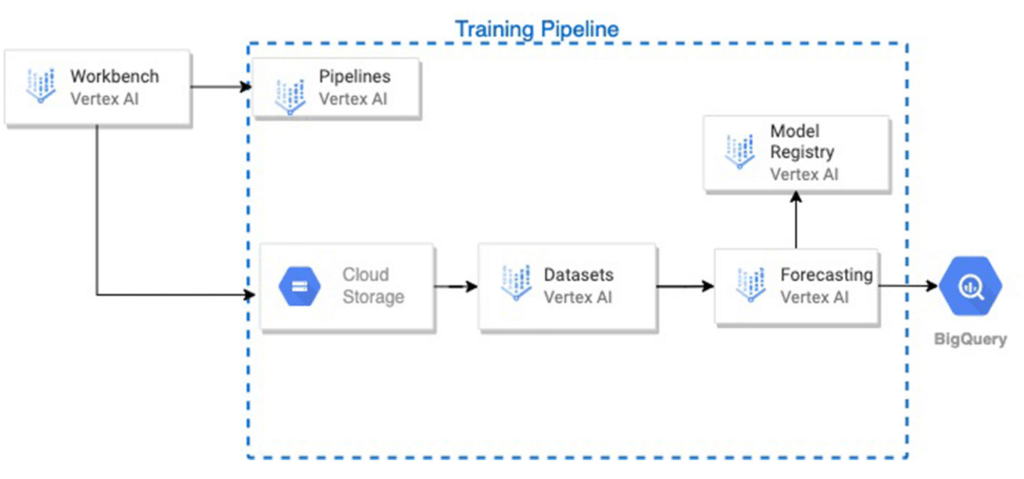
The raw data files were loaded from cloud storage, preprocessed on Vertex AI Workbench. Then, a training pipeline was initiated on Vertex AI Pipelines, which performed the following steps in sequence:
The .csv data file was loaded from Cloud Storage into a Vertex AI managed dataset.
A Vertex AI forecasting training job was initiated with the dataset, and it was also registered as a model in the Vertex AI Model Registry.
Upon completion, the model was evaluated on the test set, and the model’s predictions and the input features and ground truth of the test set, were stored in a user-defined table in BigQuery. Several test metrics were also available on the service and model dashboards.
One of the biggest challenges was the severe imbalance in the dataset, as measurements with BISE were very far and few in between. In order to account for this, instances where BISE occurred, as well the occurrences temporally close to them, were upweighted using weights calculated with methods including Inverse of Square Root of Number of Samples (ISNS), Effective Number of Samples (ENS), and Gaussian reweighting. The formulas for the methods are given below. These weights were supplied as separate columns in the dataset, and were iteratively used thereafter by the service as the “weight” column.
ISNS

ENS

Weighted gaussian

Results and next steps
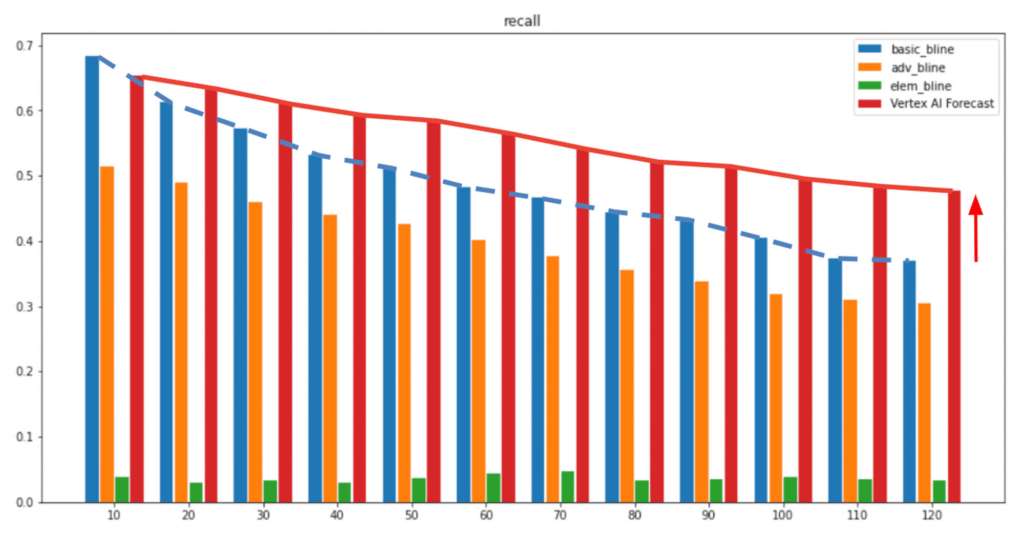
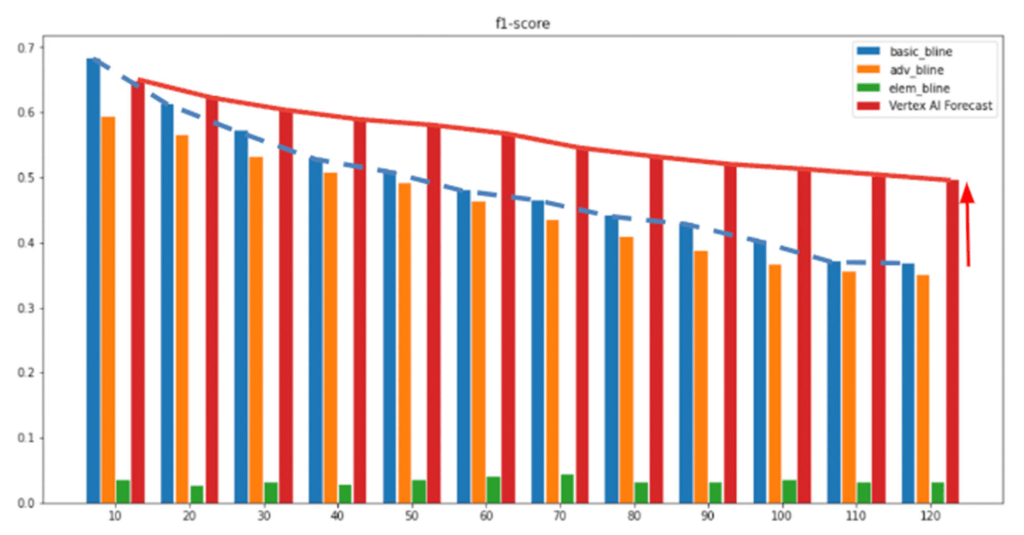
In the above figures, the x-axis represents the forecast horizon and the Y-axis shows the respective metrics (Recall/F1-score). As shown after multiple experiments, we can see Vertex AI Forecast achieved higher recall and precision t (red bar), outperforming Lufthansa’s internal baseline heuristics, with the performance gap widening steadily as the forecast horizon extends further into the future. At the two-hour mark, our custom-configured Vertex AI Forecast model improved by 40% relative to the internal heuristics and 1700% compared to the random guess baseline. As we saw with other experiments, at a six-hour forecast horizon, the performance gap widens even more, with Vertex AI Forecast in the lead. Since forecasting BISE a few hours in advance is very beneficial to prevent flight delays for Lufthansa, this was a great solution for them.
“We are very excited to be able to not only do accurate long term forecasts for the BISE, but also that Vertex AI Forecasting makes training and deploying such models much easier and faster, allowing us to innovate rapidly to serve our customers and stakeholders in the best possible manner,” said Swiss Oliver Rueegg, Product Owner, Swiss International Airlines.
Lufthansa plans to explore productionizing this solution by integrating it into their Operations Decision Support Suite, which is used by the network controllers in the Operations Control Center in Kloten, as well as to work closely with Google’s specialists to integrate both Vertex AI Forecast and other of Google’s AI/ML offerings for their use cases.

3398
Of your peers have already listened to this podcast
30:54 Minutes
The most insightful time you'll spend today!
AI-as-a-Service is Here. It’s Really Almost Plug-and-Play
Editor’s note: We’re inviting partners from across our retail ecosystem to share stories, best practices, and tips and tricks on how they are helping retailers transform during a time that has seen tremendous change. The original version of this blog was published by Trax Retail in October 2021. Please enjoy this updated entry from our partner.
In 2020, we saw a massive leap in online grocery. Within a few weeks, the industry reached numbers that were unexpected for at least four more years. In a snap, what seemed like a relatively insignificant channel became one that grocery retailers simply couldn’t ignore and, what’s more, is likely to remain a norm.
Retailers trying to stay ahead of the curve have already started experimenting with methods like building warehouses and installing robots to fulfill the growing demand, but in-store picking has been and will continue to remain one of the primary methods of fulfilling online orders as it offers several advantages. First, it allows the use of existing infrastructure – large retailers already have geographically well-located outlets in major cities, which enables shorter lead time to delivery. Secondly, it allows retailers to stay flexible and move swiftly between in-store and online order fulfillment. And finally, it fits perfectly with the omnichannel approach to allow customers to shop wherever and however they want – click and collect, curbside pick-up, or inside brick-and-mortar stores.
How improving on-shelf availability helps ecommerce profitability
Despite its many advantages, in-store picking is expensive and affects profitability in an already competitive space since the cost of picking is directly tied with hourly labor fees. Moreover, with labor being a major challenge to obtain and retain, every minute spent picking counts. However, there is an easy way to keep costs down – optimizing the picking process by ensuring product availability and reducing the need for substitution.
An average of 8% of products are not available on-shelf in stores at any given time. As a result, pickers waste much of their time hunting for products that simply aren’t on the shelf or are misplaced, or spend time looking for substitutes, further increasing the time and cost for picking. In fact, grocery pickers often claim that out-of-stock (OOS) occurrences are the main reason that slows down the picking process. Without these factors, pick rates could be two times faster. Since picking accounts for 50% of the fulfillment cost, it has a substantial impact on the order’s bottom line and often makes the difference between a loss-making and a profitable basket.
Maintaining on-shelf availability for the thousands of products in every store has always been a significant problem to solve. The shift to online ordering has made the availability issue even more significant as the shelf is also now the fulfillment center for the majority of online orders. For e-commerce, out of stocks present two major issues for retailers. First, the impact of out-of-stock items is even more noticeable for online shoppers as they do not select their own substitutions. Additionally, out-of-stocks cause inefficiencies in the item fulfillment process, which is already a costly and margin-diluting practice for retailers. The good news is that through a partnership between Trax and Google Cloud, and the power of Google Cloud’s AI/ML capabilities, these challenges are addressed. The granular, real-time data at scale to enable picking efficiency and the data transparency to unlock a better shopping experience are now a reality which benefits both shoppers and store associates.
Trax and Google Cloud technology helps the bottom line
Trax and Google Cloud offer solutions that can help retailers improve on-shelf availability (OSA). Trax Retail Watch powered by Google Cloud uses computer vision (CV) and AI to create a digital version of the physical store in real-time and informs out-of-stocks so that retailers always have full visibility of items that are running low and can replenish them quickly. In turn, pickers are more likely to find everything they need quickly without facing the problem of missing products or having to look for substitutes. Trax Retail Watch also allows store associates to quickly spot any issues arising on shelves without having to physically walk down each aisle. From misplaced products to low stock, having full visibility means that shelf managers make more informed decisions, so that pickers face fewer obstacles, are aware of the true inventory, and significantly improve their pick rates. Faster picking means lower costs and ultimately, higher margins for online grocery orders.
With more e-commerce retailers crowding the online space, competition is tough. Want to know how frustrated e-commerce shoppers are about on-shelf availability? Trax uncovered this problem through an in-depth consumer study. Learn how to address shopper happiness while driving more profitable fulfillment and stay on the leaderboard with this Trax and Google Cloud whitepaper: Winning the online grocery race.
3098
Of your peers have already watched this video.
24:30 Minutes
The most insightful time you'll spend today!
Creating Value With the Breadth and Depth of AI Platform
Watch Craig Wiley, Director of Product Management – Google Cloud, as he breaks down and simplifies AI for enterprises and the adoption of AI.
“As I think about AI, fundamentally AI only does two things. One it helps you grow your market, increase subscribership, increase users, increase their spend or increase their conversion. Or it helps you in the back-end. It can drive efficiencies, reduce costs and drive out waste from the system.
He also talks about how customers have unlocked the power of data by utilizing Google’s AI Platform. From APIs to AutoML to writing your own model code, he will show real-world examples of how customers create value, and critical tips on how to accelerate your own AI journey.
Finally, he will show how can Google Cloud maps business strategy to the right AI absorption strategy and the different ways that Google Cloud can help you deploy AI without compromising flexibility speed, quality or scale.
More Relevant Stories for Your Company

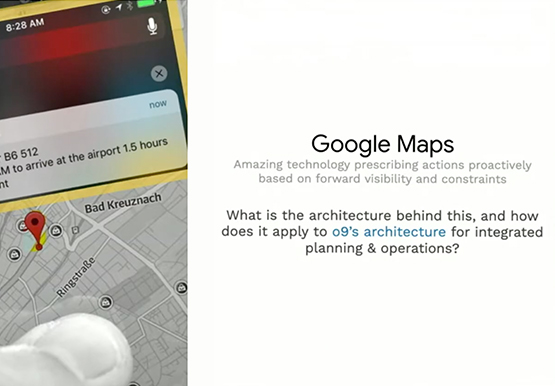

Becoming Future-Proof: AI-Powered Integrated Business Planning on Google Cloud
If there’s one thing that the pandemic will leave us with it’s this: A deep desire to be better prepared. Not prepared for the next possible catastrophe because that’s hard to do, but better prepared for the repercussions of such disaster. In this video, Stephan de Barse, Executive Vice President,


Generating Value with AI
Hear how enterprises leveraging the Google Cloud--across industries--are using AI to navigate uncertain times, and how they are innovating with AI to generate value moving forward. In this video, you'll uncover how to start using innovations from Google Cloud AI in your business today, and how customers deploy AI to

Leverage ML to Spot Anomalies in Real-time Forex Data
Let's say you are a quantitative trader with access to real-time foreign exchange (forex) price data from your favorite market data provider. Perhaps you have a data partner subscription, or you're using a synthetic data generator to prove value first. You know there must be thousands of other quants out there with your same

Insurer Uses Google Cloud AI to Battle Slow Growth: It Improves Sales by 5% in 8 Weeks
For a business to succeed in the long term, it needs to learn not just to adapt to inevitable change, but to harness it. South Africa-based PPS has been an insurance company since 1941 and today is the biggest mutual insurance provider in the country. As a mutual company, PPS is owned
