





Home Depot’s Interconnected Retail Experience by Virtue of Google Cloud Migration for SAP Applications

8266
Of your peers have already read this article.
1:30 Minutes
The most insightful time you'll spend today!
With nearly 2,300 stores, The Home Depot is the world’s largest home-improvement chain — a brand that professional contractors and DIYers alike have come to depend on. The home improvement industry continues to experience unprecedented demand and dramatic increases in online ordering accompanied by expanding consumer expectations for things like curbside pickup and same day delivery. The Home Depot’s decision to migrate to cloud-based infrastructure, including the migration of the company’s SAP applications on Google Cloud which began in 2017, has set it up for success in an increasingly digital world, and helped the company adapt to changing market conditions quickly.
Interconnected retail at scale
Building on a strong customer-first philosophy, The Home Depot aims to create what it calls interconnected retail—allowing customers to shop however, whenever, and wherever they want. “So many companies are focused on omni-channel retail,” explains Sam Moses, Vice President of Corporate Systems. “At The Home Depot, we wanted to take it to the next level. Interconnected retail puts the customer at the center of everything and enables them to shop in store, online, or both. Customers can begin a transaction online and continue in-store, or vice-versa.”
To support this strategy, the company’s SAP environment needed to be more agile. Running everything on-premises, from central finance to POS systems, meant that The Home Depot’s IT teams experienced redundancy and repetitive, manual processes. Their data warehouse needed an upgrade to process and analyze growing and increasingly diverse data sets. The Home Depot chose to migrate its SAP environment to Google Cloud to support both the velocity and scale needed for the business as well as critical analytics capabilities needed for its bold digital initiatives. “We chose Google Cloud to support our SAP implementation. Our decision had a lot to do with the relationship between Google Cloud and SAP and also for the applications and services that are offered by Google Cloud, like BigQuery, which are helping to enable data and analytics within our organization,” Moses explains.
After migrating its SAP applications—including S/4HANA, its customer activity repository (CAR), general ledger, e-commerce system, enterprise data warehouse and more to Google Cloud, the company now has the speed, scale and flexibility to tackle enormous spikes in the business, all while staying fully available for their customers. Additionally, The Home Depot was able to transform its financial systems and make them more agile to deliver critical information across multiple business functions in real time.
Maximizing data insights to support customer experiences
By migrating to Google Cloud, The Home Depot is leveraging Google Cloud analytics to build the industry’s most efficient supply chain including more robust demand forecasting, supplier lead times, estimated delivery times and more, all while maintaining better security than before. “We experienced unprecedented change in our customers’ behavior and their buying patterns, which puts a lot of pressure on our supply chain,” explains Moses. “So having the ability to leverage data and analytics gives us insights to know exactly what it is that our customers need.”
The company’s analysts now use BigQuery ML for machine learning directly against the company’s BigQuery data and use AutoML to determine the best model for predictions. The Home Depot’s engineers have also adapted BigQuery to monitor, analyze, and act on application performance data across all its stores and warehouses in real time—capabilities that were not as seamless in the on-premises environment.
With hundreds of projects on Google Cloud, The Home Depot’s cloud journey is well on track, but the company is always looking to the future. “As our customers’ needs have continued to evolve, and as technology has continued to evolve, our relationship with Google will continue to advance — to be able to innovate together, to be able to find new solutions together, to better serve our customers.”
Learn more about how The Home Depot is renovating its retail operation with SAP on Google Cloud.
Mercari’s Big Leap: Supercharging Growth with Google Cloud’s BigQuery

1121
Of your peers have already read this article.
6:30 Minutes
The most insightful time you'll spend today!
When peer-to-peer marketplace Mercari came to the US in 2014, it had its work cut out for it. Surrounded by market giants like eBay, Craigslist, and Wish, Mercari needed to carve out an approach to compete for new users. Furthermore, Mercari wanted to build a network for buyers and sellers to return to, rather than a site for individual specialty purchases.
As an online marketplace that connects millions of people across the U.S. to shop and sell items of value no longer being used, Mercari is built for the everyday shopper and casual seller. Two teams, Machine Learning (ML) team and Marketing Technology specialists, both led by Masumi Nakamura, Mercari VP of Engineering, saw an opportunity to supercharge Mercari’s growth in the US by leveraging their first-party data in BigQuery and connecting predictive models built in Google Cloud directly to marketing channels, such as churn predictions and item recommendations for email campaigns, and LTV predictions to optimize paid media. Churn predictions could be used to target marketing communications, and item recommendations could be used to personalize the content of those communications at the user level. By fully utilizing cloud computing services, they could grow sustainably and flexibly, focusing their team’s efforts where they belonged — user understanding and personalized marketing.
In 2018, the Mercari US team engaged GrowthLoop, formerly Flywheel Software, experts in leveraging first-party customer data for business growth. Working exclusively in Google Cloud and BigQuery, GrowthLoop helped Masumi transform Marketing Technology at Mercari in the US.
Use cases: challenges
Masumi and the ML team’s primary goal aimed to reduce churn across buyers and sellers. Customers would make an initial purchase, but repurchase and resale rates were lower than the team hoped for. The ML team, led by Masumi, was confident that if they could get customers to make a second and third purchase, they could drive strong lifetime value (LTV).
Despite the team’s robust data science capabilities and investments in a data warehouse (BigQuery), they were missing the ability to streamline efforts for efficient audience segmentation and targeting. Like most companies looking to utilize data for marketing, the team at Mercari had to engage with engineering in order to build out customer segments for campaign launches and testing. From start to finish, launching a single campaign could take three months.
In short, Mercari needed a way to speed up the process across the teams at Mercari. How could they turn the team’s predictions into active marketing experiments with greater velocity and agility?
Solution: BigQuery and GrowthLoop supercharge growth across the customer lifecycle
With their strong data engineering foundation and BigQuery already in place, the Mercari team began addressing their needs step-by-step. First, they used predictions to identify retention features, then built out initial segment definitions based on those features. From there, the team designed and launched experiments and measured their performance, refining as they went. By providing Mercari’s marketing team with the ability to build their own customer lists that leveraged predictive models without requiring continuous support from other teams’ data engineers and business intelligence analysts, GrowthLoop enabled them to address churn and acquisition with a single, self-serve solution.
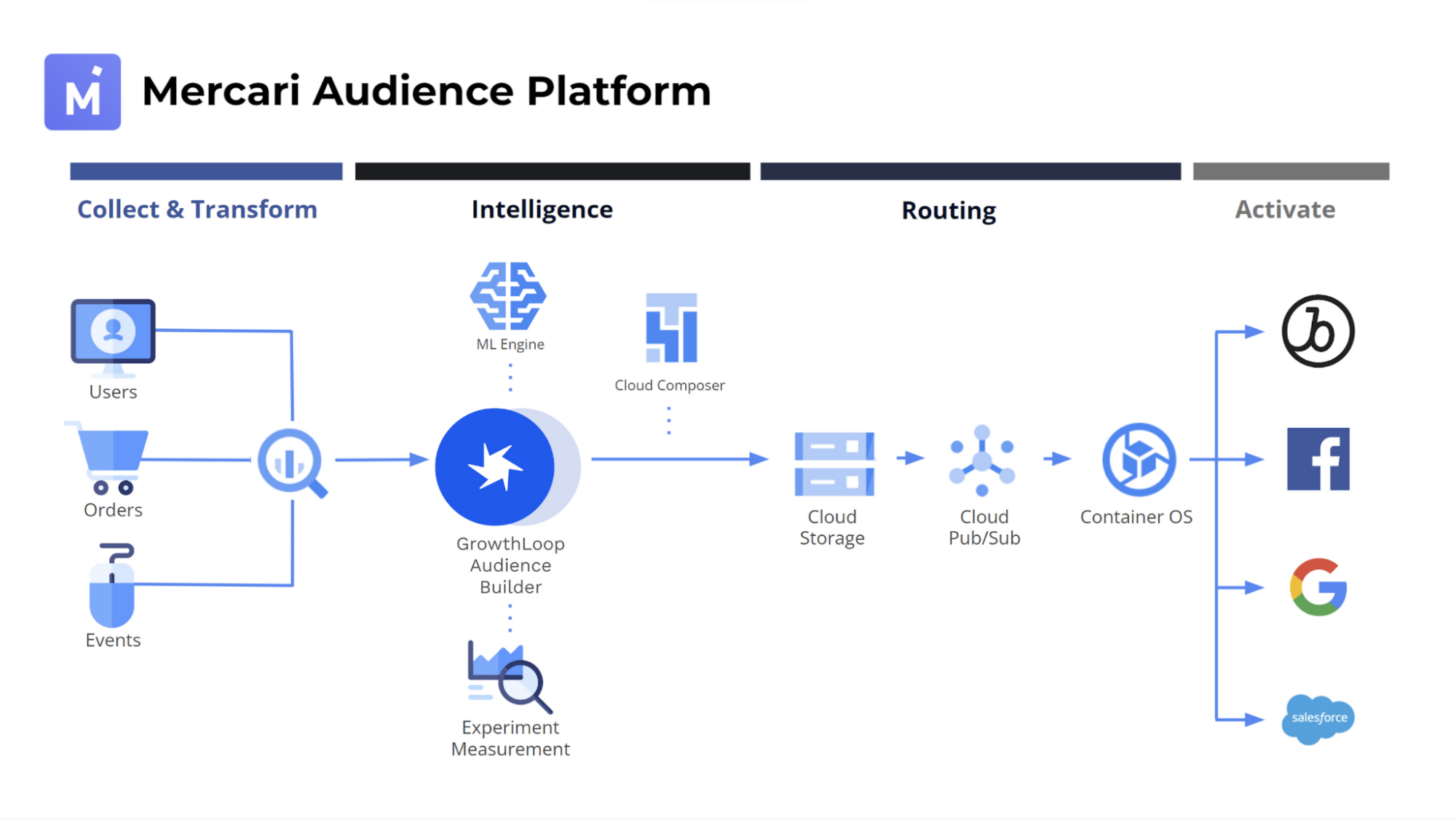
The dynamic duo: GrowthLoop and BigQuery
- Customer 360: GrowthLoop enabled Mercari to combine their data sources into a single view of their customers in BigQuery, then connected them to marketing and sales channels via GrowthLoop’s platform. Notably, Mercari is able to leverage its own complex data model, which was ideal for a two-sided marketplace. This is shown in the “Collect & Transform” stage in the architecture diagram above.
- Predictive models: GrowthLoop activated predictions that had been snapshotted by Mercari’s team in BigQuery. The Mercari ML team used Jupyter notebooks offering part of Google Vertex AI Workbench to build user churn and customer lifetime value (CLTV) prediction models, then productionized them using Cloud Composer to deploy Airflow DAGs, which wrote the predictions back to BigQuery for targeting, and triggered exports to destination channels using Pub/Sub. This is shown in the “Intelligence” stage of the architecture diagram above.
- Extensible measurement and data visualization: Since GrowthLoop writes all audience data back to BigQuery, the Mercari analytics team can conduct performance analysis on metrics from revenue to retention. They are able to use GrowthLoop’s performance visualization in-app, but they are also able to create custom data visualizations with Looker Studio. This is also shown in the “Intelligence” stage of the architecture diagram.
- Seamless routing and activation: With GrowthLoop’s audience platform connected directly to Customer 360 and the predictive model’s results in BigQuery, the marketing team is able to launch and sync audiences and their personalization attributes across all of Mercari’s major marketing, sales and product channels, such as Braze, Google Ads and other destinations. This is shown in the “Routing” and “Activate” stage of the architecture diagram.
“Being able to measure what you’re doing – that results-based orientation – is key. The thing that I like most about GrowthLoop is that you brought a really fundamental way of thinking which was very feedback-based and open to experimenting but within reason. With other products, that feedback loop isn’t so built in that it’s very easy to get lost.”– Masumi Nakamura, VP of Engineering at Mercari
Predictive modeling puts the burn on churn
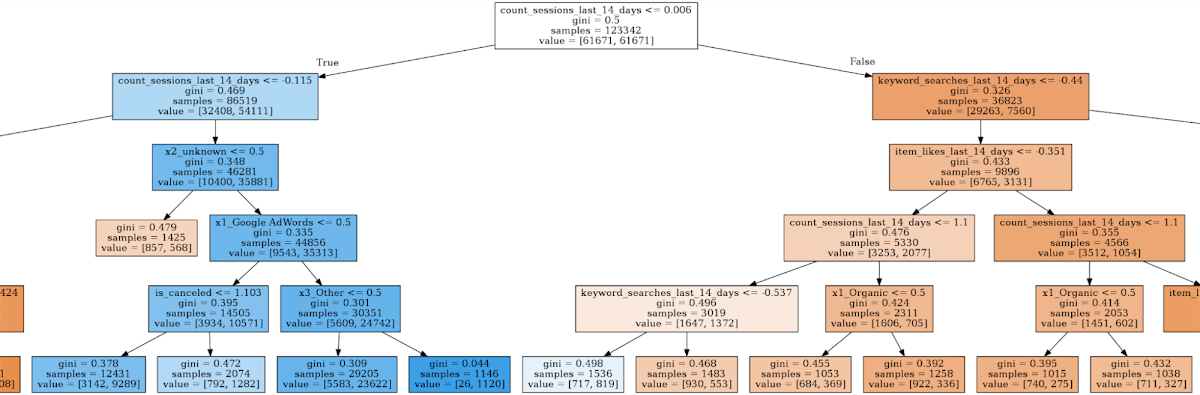
In collaboration with GrowthLoop, Mercari began analyzing user data in BigQuery via Vertex AI Workbench to identify patterns across churned customers. The teams evaluated a range of attributes like the customer acquisition channel, categories browsed or purchased from, and whether or not they had any saved searches while shopping. Comparing various models and performance metrics, the teams selected the best model for accurately predicting when a buyer or seller was at risk to churn. For sellers, they evaluated audience members by the time elapsed since their last sale – for buyers, the time since their last purchase.
These churn prediction scores could then be applied to data pipelines that would feed into GrowthLoop’s audience builder. Audience members with a high likelihood to churn would be segmented into their own group and from there, Mercari could target those users with relevant paid media and email campaigns.
By partnering with GrowthLoop, Mercari was able to simultaneously bridge the gap between the data and marketing teams – and reduce the time between segmentation and campaign launch from months to just a few days.
“One of the big areas of benefit of working with GrowthLoop was the increased integration of marketing channels such as the CRM, User Acquisition, as well as more traditional marketing channels.” – Masumi Nakamura, VP of Engineering at Mercari
Creating the audience within the audience
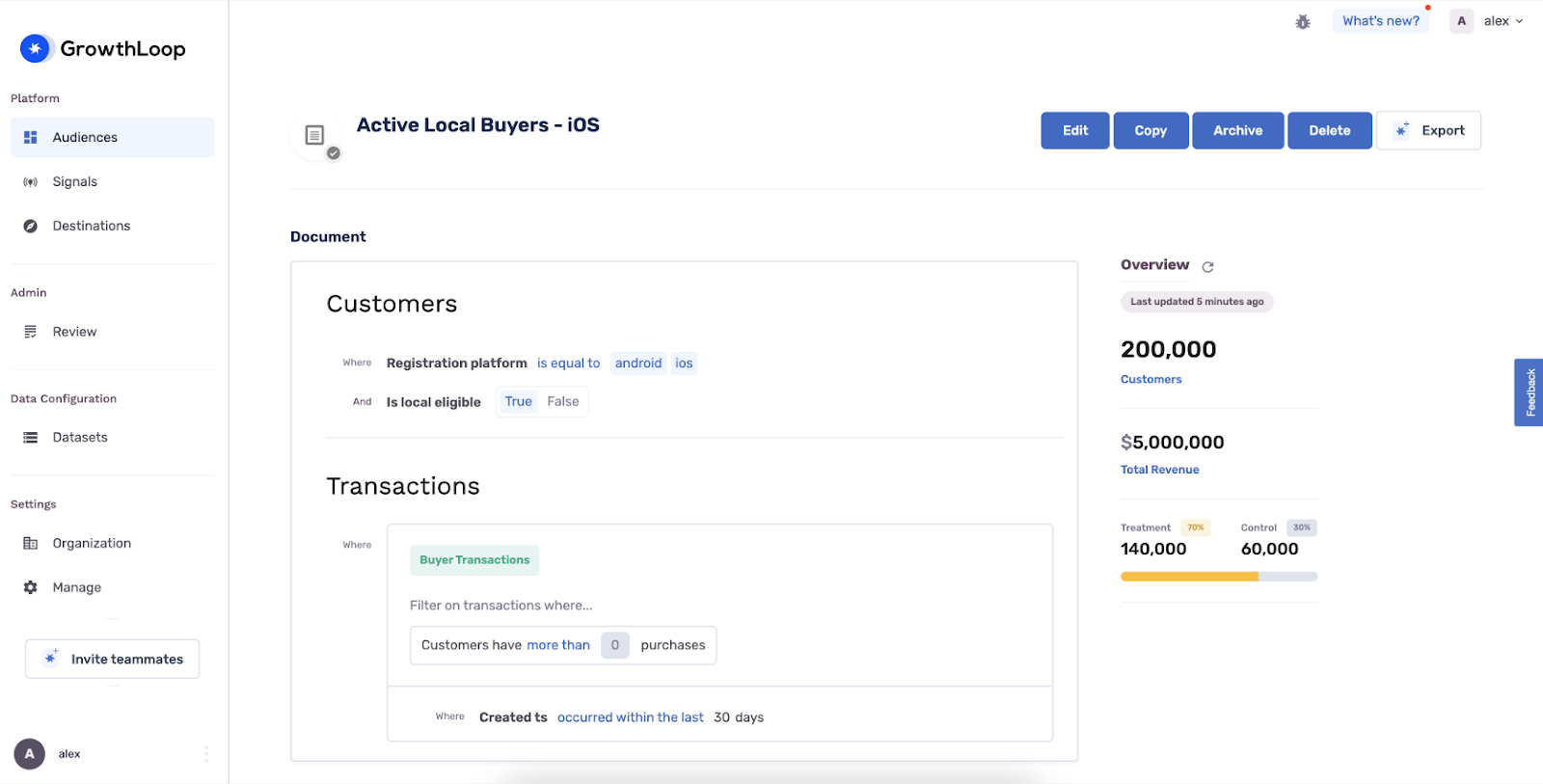
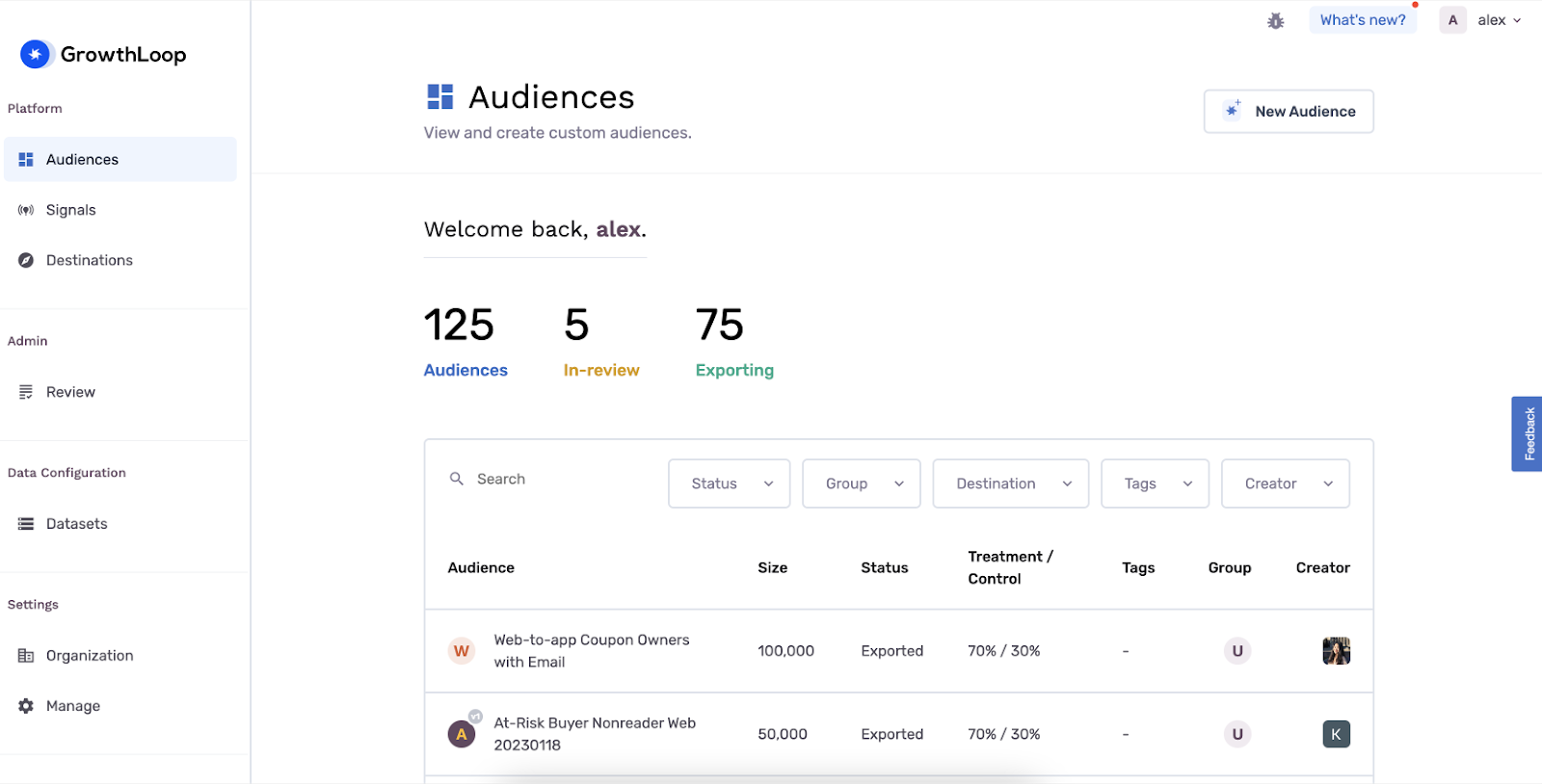
Once the team had successfully created a model to predict churn across buyers and sellers, Mercari needed to launch retargeting campaigns to measure their ability to reduce churn. Each of their ongoing experiments features tailored segments along with automatic A/B testing. With analytics and activation all under one roof, the marketing team at Mercari could craft audiences and begin measuring the impact of their targeted campaigns. Since starting their work with GrowthLoop, the Mercari team has created over 120 audiences.
“Our marketing teams are more sophisticated with in-house knowledge, but GrowthLoop provides a more user-friendly way to build audiences for campaigns.” – Masumi Nakamura, VP of Engineering, Mercari
“GrowthLoop brings a very fundamental way of thinking about problems, including experimentation…. The ability to organize experiments and results was key. The number of variables is too high for most people without good organization.”– Masumi Nakamura, VP of Engineering at Mercari
Making segmentation smarter
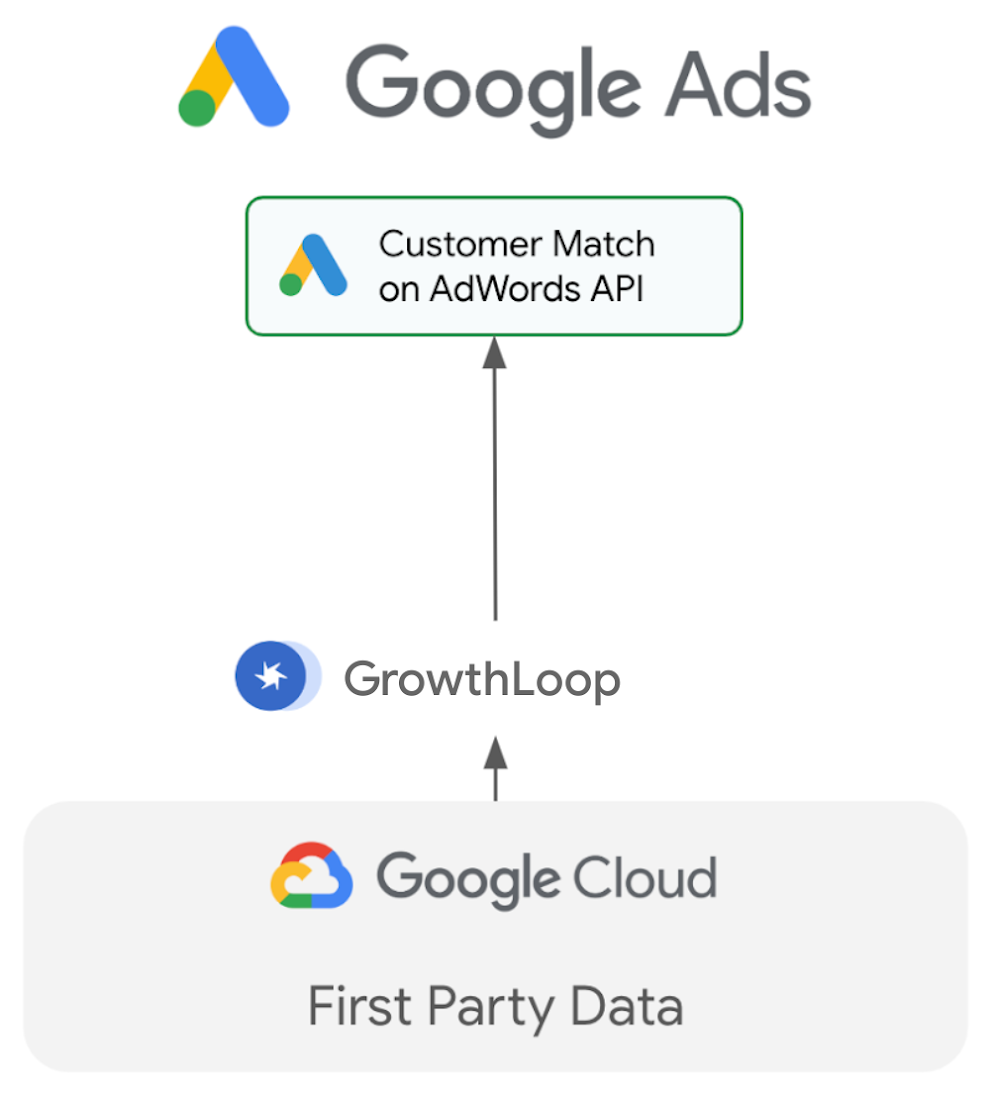
Mercari’s first audiences leveraging GrowthLoop were sent to Braze to supercharge email campaigns and coupons with churn predictions and automated campaign performance evaluations. Then, Mercari shifted its focus to Facebook for paid media retargeting, using GrowthLoop’s lifecycle segmentation framework to target customers at the right step in their user journey. Lastly, Mercari moved its focus to Google Ads, where they used GrowthLoop to implement new segmentation models based on product category propensity. Mercari had long used Google Ads for product listing ads, and with GrowthLoop, Mercari was able to define more powerful product propensity segments and measure custom incremental lift metrics.
Finding new users in the haystack
Finally, in addition to preventing churn and driving retention, the Mercari team also wanted to boost user acquisition. They were having trouble measuring performance of UA campaigns due to new iOS and Facebook data privacy restrictions that made measuring campaign attribution impossible for many users. Using the familiar stack of Vertex AI Workbench for analysis, performance analysis on campaign data in BigQuery, and Airflow DAGs deployed via Cloud Composer to productionize the data pipelines, GrowthLoop enabled the team to activate targeted campaigns based on a user’s geographical location. In this way, Mercari could make decisions about their UA campaigns using incrementality analysis between geographic regions rather than attribution data, thus preserving user privacy.
The Mercari approach to customer data activation and acquisition
Other marketplace retailers can learn from Mercari’s successes activating data from BigQuery with GrowthLoop. Here are a few best practices to apply:
Identify your team’s needs and existing strengths
Mercari knew that their team had built out a strong foundation for data analysis within BigQuery. They also knew that their process was missing a key component that would allow them to activate that data. In order to achieve similar results, work to evaluate the strength of your team and your data – and define exactly what you aim to achieve with customer segmentation.
Partner with the right providers
With BigQuery, the Mercari team had all of their data centralized in one single location, simplifying the process for predictive modeling, segmentation, and activation. By partnering with GrowthLoop, this centralized data could be activated with ease across Mercari’s marketing teams. When evaluating providers for data warehousing, segmentation, and activation, be sure to partner with a provider that ensures you can get the most out of your data.
Know your audience
With a deeper understanding of their customers, Mercari was able to see nearly immediate value. By investing in the proper tools to accurately predict customer behavior, Mercari delivered impact in exactly the right areas. Using the data you’ve already compiled on your customers, consider partnering with a customer segmentation platform provider like GrowthLoop. In fact, Masumi went so far as to organize his Machine Learning team around these concepts: “We split the ML team into two areas – one to augment and work with GrowthLoop, the other team was to augment and orient around item data.”
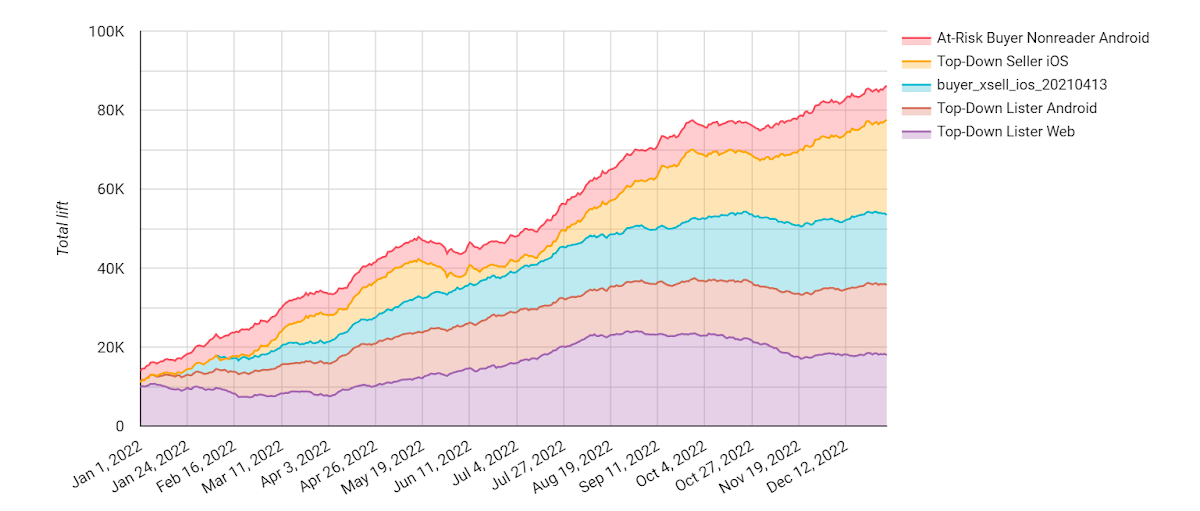
Scale has been modified to intentionally obfuscate actual results.
How to boost growth like Mercari in three steps
Today, many leading brands leverage GrowthLoop and BigQuery to drive marketing and sales wins. Whether your company is in retail, financial services, travel, software, or another industry entirely, you can join the growing number of companies driving sustainable growth through real-time analytics by connecting BigQuery from Google Cloud to GrowthLoop. Here’s how:
If you have customer data in BigQuery…
- Book a GrowthLoop + BigQuery demo customized to your use cases.
- Link your BigQuery tables and marketing and sales destinations to the GrowthLoop platform.
- Launch your first GrowthLoop audience in less than one week.
If you are getting started with BigQuery…
- Get a Data Strategy Session with a GrowthLoop Solutions Architect at no cost.
- Use our Quick Start Program to get started with BigQuery in 4 to 8 weeks.
- Launch your first GrowthLoop audience in less than one week thereafter.
GrowthLoop and Google: Better together
The key question for many marketers today is, “How do you best leverage all you know about your customers to drive more intelligent and effective marketing engagement?” When Mercari set out to answer this question in 2019, they applied an innovative BigQuery data strategy that leveraged machine learning models. However, they achieved remarkable marketing results because they were among the first companies to discover and apply GrowthLoop to enable the marketing team to launch audiences with a first party data platform directly connected to their datasets and predictions in BigQuery. This greatly accelerated the design-launch-measure feedback loop to generate repeatable growth in customer lifetime value.
The Built with BigQuery advantage for ISVs and Data Providers
Google is helping companies like GrowthLoop build innovative applications on Google’s data cloud with simplified access to technology, helpful and dedicated engineering support, and joint go-to-market programs through the Built with BigQuery initiative. Participating companies can:
- Accelerate product design and architecture through access to designated experts who can provide insight into key use cases, architectural patterns, and best practices.
- Amplify success with joint marketing programs to drive awareness, generate demand, and increase adoption.
BigQuery gives ISVs the advantage of a powerful, highly scalable data warehouse that’s integrated with Google Cloud’s open, secure, sustainable platform. And with a huge partner ecosystem and support for multi-cloud, open source tools and APIs, Google provides technology companies the portability and extensibility they need to avoid data lock-in.
Click here to learn more about Built with BigQuery.
We thank the Mercari, GrowthLoop and Google Cloud team members who collaborated on the blog:
Mercari: Masumi Nakamura, VP of Engineering
GrowthLoop: Julia Parker, Product Marketing Manager; Alex Cuevas, Head of Analytics
Google: Sujit Khasnis, Solutions Architect
Unifying Data and AI: Bringing Unstructured Data Analytics to BigQuery

4178
Of your peers have already read this article.
2:30 Minutes
The most insightful time you'll spend today!
Over one third of organizations believe that data analytics and machine learning have the most potential to significantly alter the way they run business over the next 3 to 5 years. However, only 26% of organizations are data driven. One of the biggest reasons for this gap is that a major portion of the data generated today is unstructured, which includes images, documents, and videos. It is estimated to cover roughly up to 80% of all data, which has so far remained untapped by organizations.
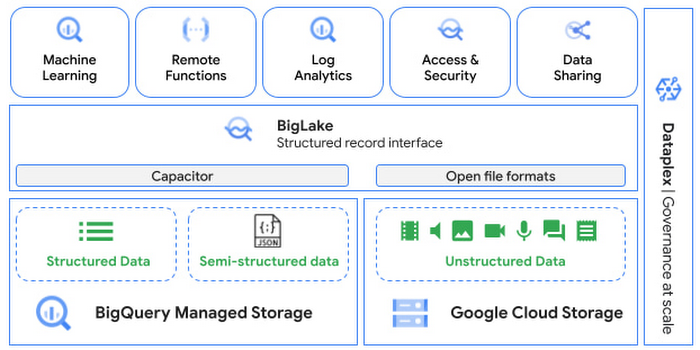
One of the goals of Google’s data cloud is to help customers realize value from data of all types and formats. Earlier this year, we announced BigLake, which unifies data lakes and warehouses under a single management framework, enabling you to analyze, search, secure, govern and share unstructured data using BigQuery.
At Next ‘22, we announced the preview of object tables, a new table type in BigQuery that provides a structured record interface for unstructured data stored in Google Cloud Storage. This enables you to directly run analytics and machine learning on images, audio, documents and other file types using existing frameworks like SQL and remote functions natively in BigQuery itself. Object tables also extend our best practices of securing, sharing and governing structured data to unstructured, without needing to learn or deploy new tools.
Directly process unstructured data using BigQuery ML
Object tables contain metadata such as URI (Uniform Resource Identifier), content type, and size that can be queried just like other BigQuery tables. You can then derive inferences using machine learning models on unstructured data with BigQuery ML. As part of preview, you can import open source TensorFlow Hub image models, or your own custom models to annotate the images. Very soon, we plan to enable this for audio, video, text and many other formats, and pre-trained models to enable out-of-the box analysis. Check out this video to learn more and watch a demo.
Create an object table
CREATE EXTERNAL TABLE my_dataset.object_table
WITH CONNECTION us.my_connection
OPTIONS(uris=["gs://mybucket/images/*.jpg"],
object_metadata="SIMPLE", metadata_cache_mode="AUTOMATIC");
# Generate inferences with BQML
SELECT * FROM ML.PREDICT(
MODEL my_dataset.vision_model,
(SELECT ML.DECODE_IMAGE(data) AS img FROM my_dataset.object_table)
);By analyzing unstructured data natively in BigQuery, businesses can
- Eliminate manual effort as pre-processing steps such as tuning image sizes to model requirements are automated
- Leverage the simple and familiar SQL interface to quickly gain insights
- Save costs by utilizing existing BigQuery slots without needing to provision new forms of compute
Adswerve is a leading Google Marketing, Analytics and Cloud partner on a mission to humanize data. Twiddy & Co. is Adswerve’s client – a vacation rental company in North Carolina. By combining structured and unstructured data, Twiddy and Adswerve used BigQuery ML to analyze images of rental listings and predict the click-through rate, enabling data-driven photo editorial decisions.
“Twiddy now has the capability to use advanced image analysis to stay competitive in an ever changing landscape of vacation rental providers – and can do this using their in-house SQL skills.” said Pat Grady, Technology Evangelist, Adswerve
Process unstructured data using remote functions
Customers today use remote functions (UDFs) to process structured data for languages and libraries that are not supported in BigQuery. We are extending this capability to process unstructured data using object tables.
Object tables provide signed URLs to allow remote UDFs running on Cloud Functions or Cloud Run to process the object table content. This is particularly useful for running Google’s pre-trained AI models, including Vision AI, Speech-to-Text, Document AI, open source libraries such as Apache Tika, or deploying your own custom models where performance SLAs are important.
Here’s an example of an object table being created over PDF files that are parsed using an open source library running as a remote UDF.
SELECT uri, extract_title(samples.parse_tika(signed_url)) AS title<br>FROM EXTERNAL_OBJECT_TRANSFORM(TABLE pdf_files_object_table,<br>["SIGNED_URL"]);
Extending more BigQuery capabilities to unstructured data
Business intelligence – The results of analyzing unstructured data either directly in BigQuery ML or via UDFs can be combined with your structured data to build unified reports using Looker Studio (at no charge), Looker or any of your preferred BI solutions. This allows you to gain more comprehensive business insights. For example, online retailers can analyze product return rates by correlating them with the images of defective products. Similarly, digital advertisers can correlate ad performance with various attributes of ad creatives to make more informed decisions.
BigQuery search index – Customers are increasingly using the search functionality of BigQuery to power search use cases. These capabilities now extend to unstructured data analytics as well. Whether you use BigQueryML to produce inference on images or use remote UDFs with Doc AI to produce document extraction, the results can now be search indexed and used to support search access patterns.
Here’s an example of search index on data that is parsed from PDF files:
CREATE SEARCH INDEX my_index ON pdf_text_extract(ALL COLUMNS);
SELECT * FROM pdf_text_extract WHERE SEARCH(pdf_text, "Google");Security and governance – We are extending BigQuery’s row-level security capabilities to help you secure objects in Google Cloud Storage. By securing specific rows in an object table, you can restrict the ability of end users to retrieve the signed URLs of corresponding URIs present in the table. This is a shared responsibility security model, for which administrators need to ensure that end users don’t have direct access to Google Cloud Storage, and use signed URLs from object tables as the only access mechanism.
Here’s an example of a policy for PII images that are secured to be first processed through a blur pipeline:
CREATE ROW ACCESS POLICY pii_data ON object_table_images
GRANT TO ("group:admin@example.com")
FILTER USING (ARRAY_LENGTH(metadata)=1 AND
metadata[OFFSET(0)].name="face_detected")
Soon, Dataplex will support object tables, allowing you to automatically create object tables in BigQuery and manage and govern unstructured data at scale.
Data sharing – You can now use Analytics Hub to share unstructured data with partners, customers and suppliers while not compromising on security and governance. Subscribers can consume the rows of object tables that are shared with them, and use signed URLs for unstructured data objects.
Getting Started
Submit this form to try these new capabilities that unlock the power of your unstructured data in BigQuery. Watch this demo to learn more about these new capabilities.
Special thanks to engineering leaders Amir Hormati, Justin Levandoski and Yuri Volobuev for contributing to this post.
Enhancing SAP Build Process Automation with Google Document AI and Google Workspace

4142
Of your peers have already read this article.
4:00 Minutes
The most insightful time you'll spend today!
SAP Build Process Automation is designed to optimize business processes and boost efficiency. The platform helps both business users and developers alike digitize core workflows and incorporate artificial intelligence (AI) into time consuming and error-prone manual tasks.
All digital paths can benefit from automation. The pandemic, supply chain shortages, and other disruptive events have upped the pressure on businesses and their workers to perform in more efficient and flexible ways.
Google Cloud and SAP have responded by providing an integrated toolbox that can fundamentally change the way businesses operate — all while creating value for their customers.
With a focus on taking process automation to an even more advanced level and removing inefficiencies from workflows, SAP has introduced integrations with Google Cloud Document AI, and Google Workspace for SAP Build Process Automation customers. This integration can reduce or eliminate many repetitive and error-prone tasks, so that companies can help save money, operate more productively, and scale more easily.
AI unleashes innovation
Continuous advances in digital systems and advanced technology introduce new opportunities to rethink workflows. SAP recognizes the role that AI-powered automation can play in transforming workflows, and that the benefits of doing so extend beyond basic time savings and cost cutting. By plugging Google Cloud Document AI into the application, SAP Build Process Automation’s low-code, no-code platform enables SAP to help its customers in lines of business and IT integrate multiple applications while democratizing access to governed machine learning technology.
Machine learning and process automation can drive efficiency with SAP S/4HANA
Customers using SAP S/4HANA can build workflow improvements into all major core processes, such as order entry, invoice creation, asset posting, and many others, helping them to be faster and more efficient in the process. Google Cloud Document AI extracts key elements — including addresses, article numbers, price, quantity, and more — within emails, PDFs, handwritten notes, and other formats.
Integrated automation can drive results for invoice and purchase order processing
An example of the improvements these integrations have made to SAP Build Process Automation is the use of AI, productivity tools, and automation for processing purchase orders. In the past, workers had to manually select relevant orders in their Gmail accounts and extract key data from large PDF files, including the order date, supplier details, article numbers, quantity, unit price, and the total amount. Then, workers would have to enter all of the individual line items one by one into the SAP S/4HANA system.
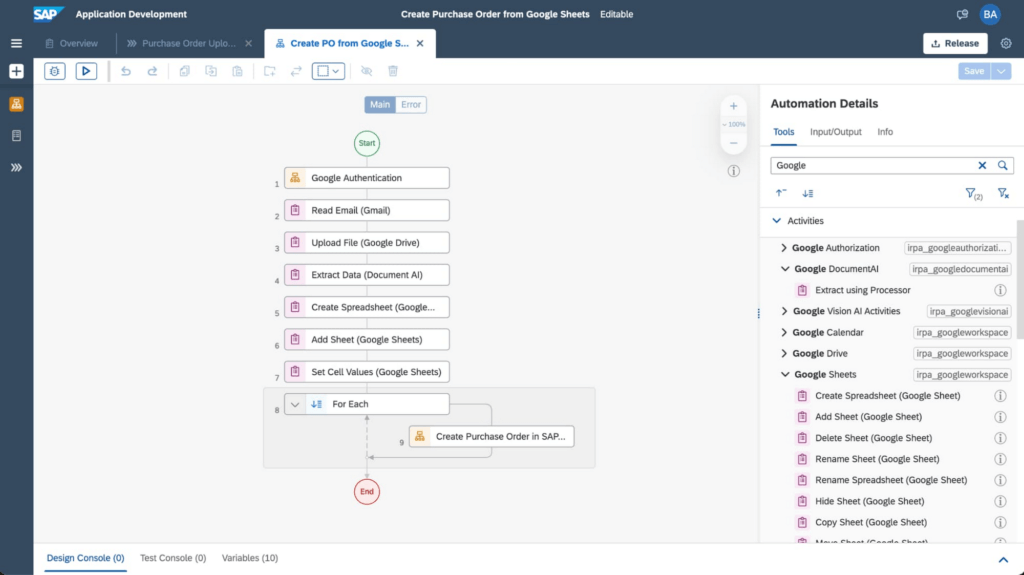
Today, through SAP’s integrated automation platform, customers can automatically extract and organize data by Google Workspace (Google Sheets, Google Drive, and Gmail) and Document AI. This works by extracting data contained in Gmail attachments, downloading it into Google Drive and extracting fields using Document AI’s pretrained models. The tool then enters the consolidated order information from Google Sheets into SAP S/4HANA. For example, the Canton of Zurich in Switzerland experienced a significant reduction of workload to process compensation forms once the organization implemented this automation. Furthermore, implementing the automation can avoid audit and compliance issues, and improve data quality.
The screenshot below shows how a workflow operates within the SAP Build Process Automation software.
Sales, procurement, finance, and other functions are also able to handle more strategic work that delivers greater value to customers with these SAP and Google Cloud integrations. They’ve also boosted both security and regulatory compliance for customers, including those in the financial services space.
For example, the Google Cloud Document AI technology can process thousands of supply chain invoices, validates and systematically approves them. And, over time, the machine learning and AI components improve the analysis process and ensure that data processed with SAP Build Process Automation is adhering to a company’s best practices and essential regulatory requirements.
SAP and Google Cloud put automation to work
Achieving the most accurate, efficient business processes is possible with an automation framework that embeds collaboration and productivity applications while giving lines of business and IT users access to machine learning technology. SAP Build Process Automation combined with Google Cloud Document AI, and Google Workspace has proven to be a catalyst in driving innovation and business transformation for customers across multiple industries, leading to an average of 22% to 30% faster time to market, and significant financial gains, including up to 20% accounts payable savings potential. An example of these improvements includes those experienced by TasNetworks, which had a 25% reduction in back-office processing efforts after implementing these technologies.
To learn more about how Google Cloud and SAP are building solutions for accelerating business value, visit cloud.google.com/solutions/sap. You can find more information about SAP Build Process Automation at sap.com/build-automation.
To start your transformation journey today, choose the SAP Business Technology Platform region that’s best for you. We’re also happy to announce that Google Cloud offers the first and only option to run BTP in the cloud in India — learn more here: Google Cloud’s newest SAP Business Technology Platform Region.
New ML-Powered API Abuse Detection

1576
Of your peers have already read this article.
3:30 Minutes
The most insightful time you'll spend today!
API security incidents are increasingly common and disruptive. With the growth of API traffic, enterprises across the world are also experiencing an uptick in malicious API attacks, making API security a heightened priority. According to our latest API Security Research Report, 50% of organizations surveyed have experienced an API security incident in the past 12 months and of those, 77% delayed the rollout of a new service or application.
At the RSA Conference 2023 today, we’re making it faster and easier to help detect API abuse incidents with the introduction of Advanced API Security Machine Learning powered abuse-detection dashboards. Our newly introduced Machine Learning models are trained to detect business logic attacks.
These types of attacks are notoriously hard to identify, and target APIs tied to intellectual property, business processes, or sensitive information, such as user data, listing of goods, or crediting accounts. These APIs must be accessible to provide business value, but have also become targets for attackers.
API security incidents can have a considerable impact on an organization’s operations and its bottom line. In June 2022, Imperva released a report titled Quantifying the Cost of API Insecurity, which estimates that lack of secure APIs could result in an average annual API-related total global cyber loss of between $41 billion to $75 billion annually. Furthermore, according to IBM’s 2022 Cost of a Data Breach Report, the average cost of a data breach is $4.35 million. It’s vital that organizations detect and mitigate API abuse incidents early to prevent prolonged fiscal and reputational damage to the business.
However, business logic attacks are harder to detect using static security policies, which allows attackers to manipulate legitimate functionality to achieve a malicious goal without triggering any static security alerts. For example, if a malicious actor gains control of a server and makes subtle changes, the shift in activity patterns of the server is generally undetectable to most monitoring tools. However, in this scenario, the Advanced API Security’s ML-powered API abuse detection model can help differentiate between legitimate and deviant traffic and immediately notify key stakeholders to act quickly and minimize blast radius of the problem.
The ML models that power API abuse detection have been trained and used by Google’s internal teams to help protect our public-facing APIs. The models rely on years of learning and best practices and are now available to all Apigee Advanced API Security customers.
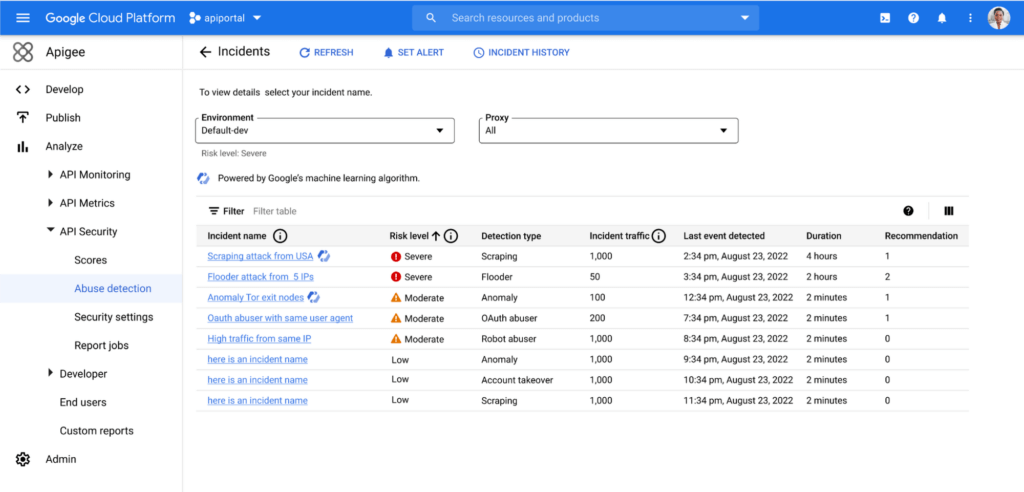
Another challenge in detecting API abuse incidents is the volume of alerts. To reduce the risk of missing key security incidents, many static rules that detect less sophisticated attacks are incredibly sensitive: They generate a high volume of alerts. This makes finding the critical incidents within API traffic and acting to resolve them like “finding a needle in a haystack” for many IT teams. Apigee Advanced Security’s ML-powered dashboards more accurately identify critical API abuses and find similar patterns within the large number of bot alerts to help reduce the time to find and act on most important incidents.
With the help of Apigee Advanced API Security’s ML-powered abuse detection dashboards, customers can uncover critical API abuse incidents, including business logic attacks, scraping, and anomalies, faster. Critical threats are surfaced with clear and concise descriptions to capture the essence of the attack along with the most important characteristics such as the source of the attack, the number of API calls, and the duration of the attack, to help resolve the incident more rapidly.
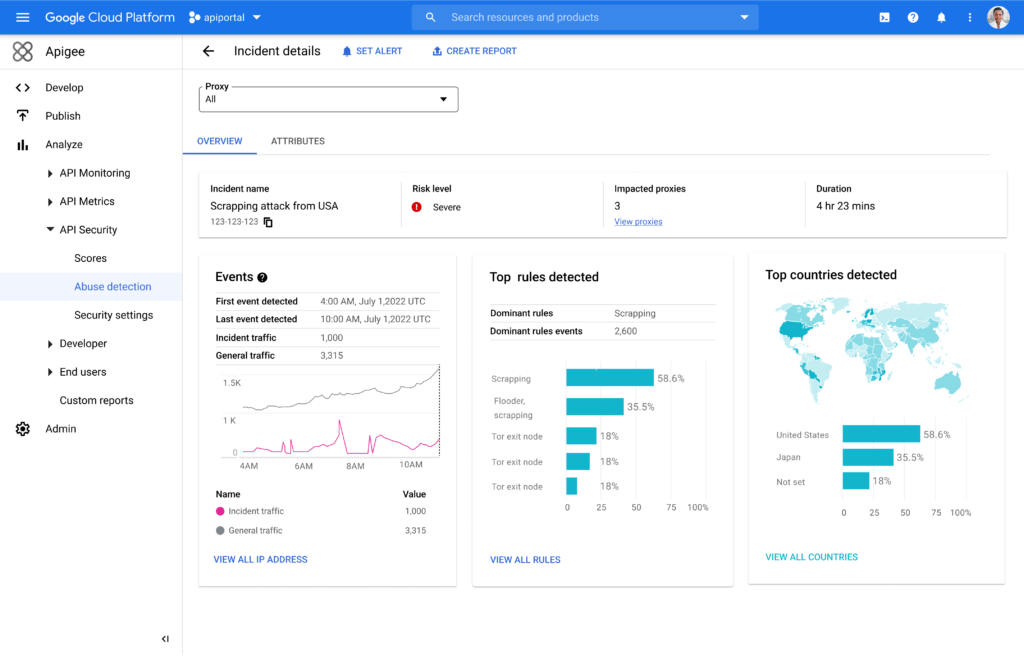
Machine Learning powered abuse-detection dashboards are available in Advanced API Security, a feature of Apigee API management that enables you to more easily detect API security misconfigurations, bad bots, and malicious activities.
To get started with Advanced API Security’s ML-powered dashboards, start your free Apigee trial now.
12014
Of your peers have already watched this video.
3:26 Minutes
The most insightful time you'll spend today!
How L&T Financial Services Processes 95% of Motorcycle Loans in Less Than Two Minutes
L&T Financial Services is one of the largest lenders in India. India’s demonetization policy in recent years has led to a shift from cash transactions to digital payments. In 2016, the government withdrew 500 and 1000 rupee notes from circulation and encouraged a heavily cash-based population to deposit their canceled notes in banks. Financial institutions needed to pivot to a new way of doing business to stay competitive. L&T Financial Services modernized its IT infrastructure to keep up with changes and capture digital opportunities.
“Working capital is crucial to stimulate growth in rural communities. Our role as a lender is to provide access to funds. We don’t want to burden borrowers with the complexities of getting a loan. Towards this end, digitization is an important step,” says Dinanath Dubhashi, Managing Director and CEO at L&T Financial Services. “Google Cloud helps us streamline service delivery and identify the right customers. By offering the fastest processing time in the industry, we want to be the go-to lender for all customers.”
L&T Financial Services considered multiple cloud providers before choosing Google Cloud. According to Dinanath, Google Cloud understands both the need for businesses to move fast and the need for IT to modernize at different speeds. “We weren’t forced to abandon existing IT systems and migrate lock, stock, and barrel to Google Cloud on day one.”
L&T Financial Services engaged Google Cloud Professional Services to guide its digital transformation journey. The smooth migration from proof of concept to full-scale deployment on Google Cloud took a matter of months.
“Collaboration: a small idea with big opportunities. G Suite helps us connect remote branches with the head office, easily access shared files to submit and track approvals, and conduct face-to-face discussions to accelerate approval processes.”
—Dinanath Dubhashi, MD and CEO, L&T Financial Services
Digitizing the workforce with G Suite
The move to the cloud at L&T Financial Services started in 2017 when the company introduced G Suite to its 14,500 employees. The legacy email system was cumbersome to use, especially for frontline staff who need email access while they are on the road. Using Gmail, employees can connect with customers and co-workers from anywhere, on any device. Employees save time by scheduling meetings with Calendar, collaborating on Docs, and conducting video calls using Hangouts Meet.
Converting data into credit insights using BigQuery
Taking data intelligence one step further, L&T Financial Services adopts a responsible lending approach by applying algorithm-based data analytics to improve credit standards. Beyond traditional data such as credit score and credit payment history, the company also considers macro-economic indicators for risk audits. For example, a farmer’s ability to pay off the loan of his new tractor depends on a successful planting and harvest. So L&T Financial Services feeds long-term data into BigQuery and runs queries to predict loan defaults based on rainfall and crop yield.
More Relevant Stories for Your Company

Discover Gen App Builder: Transform Search and Conversational Experiences Through Generative AI
If you’ve been exploring recently-launched consumer generative AI tools like Bard and thinking about how to build similar experiences for your business, Generative AI App Builder, or Gen App Builder for short, is here to get you started.Gen App Builder is part of Google Cloud’s recently announced generative AI offerings and lets developers,

Quantum Metric Increases Business 10-fold
At Quantum Metric, we’re in the business of bringing our customers business insights that are based on customer experience data and analytics for mid-market and Fortune 500 companies. Our software, powered by big data, machine intelligence, and Google Cloud, helps our customers identify, quantify, prioritize and measure opportunities to improve

2,602 Uses of AI for Social Good, and What We Learned from Them
For the past few years, we’ve applied core Google AI research and engineering to projects with positive societal impact, including forecasting floods, protecting whales and predicting famine. Artificial intelligence has incredible potential to address big social, humanitarian and environmental problems, but in order to achieve this potential, it needs to be accessible to organizations

Empowering AI Startups: Google Cloud’s Game-Changing Benefits
New AI startup program benefits and Accelerator introduced at the Google Cloud Startup Summit Google Cloud is committed to supporting the growth and advancement of startups, with particular focus on helping startups looking to build and scale. We’re seeing tremendous innovation from startups choosing Google Cloud to advance their generative
