





Highnote Build the First Flexible, End-to-end Embedded Finance Platform on Google Cloud

3265
Of your peers have already read this article.
3:00 Minutes
The most insightful time you'll spend today!
The ability to quickly introduce and evolve payment options for products or services is essential for businesses, as nearly 50% of consumers who can’t use a preferred payment method abandon their purchase. At the same time, gift cards, branded credit cards and rewards programs are critical tools that companies rely on to build more loyal and lasting customer relationships. With Highnote, companies have an all-in-one embedded platform to quickly create payment cards and wallets, offer innovative rewards programs and credit, and provide sustainable wage access. It is the first platform that allows enterprises to make card issuance an embedded capability of their product without creating an entirely new (and costly) organization.
Creating an exciting fintech future with Google Cloud
When thinking about building the industry’s first end-to-end embedded finance platform, we quickly realized Highnote would only be successful if it enabled companies to truly innovate and quickly roll out new programs. To do so, the platform would have to be built on scalable infrastructure capable of securely delivering services with speed and reliability while offering easy access to actionable Big Data analytics.
Working closely with the team at the Google for Startups Cloud Program, we successfully implemented Google Cloud as a versatile, future-proof foundation of our platform—and built Highnote from the ground up in just one year. Highnote’s GraphQL-based API platform reinvents the card issuance process. Utilizing the developer-friendly Highnote platform, product and engineering teams at digital enterprises of all sizes can easily and efficiently embed virtual and physical payment cards (commercial and consumer prepaid, debit, credit, and charge), ledger, and wallet capabilities into their existing products. This creates compelling value while growing revenue and building a unique and differentiated brand.
We leverage Cloud Spanner, BigQuery, and Google Kubernetes Engine (GKE) to create a unified and highly secure PCI DSS-compliant platform with GraphQL APIs that provide rapid and flexible money transfers. This gives us a reliable platform to deliver and test customer experiences, respond to outcomes, and make better business decisions. Powered by Google Cloud, our data models and application domains are architected to support configurations and customizations that unlock a diverse set of new use cases across industries, including retail, travel, logistics, healthcare, and sustainable wage access programs.
We are especially proud to highlight our enablement of sustainable wage access, as this program helps the 50% of Americans living paycheck to paycheck. Embedding this program within payroll systems provides a viable alternative to payday lenders who often charge exorbitant fees and interest rates. In real world terms, this means Highnote helps people access earned wages before payday at no cost.
The other customer we just went live with was Tillful, and their Tillful card helps small businesses build their business credit. This program will help new and emerging businesses as well as underrepresented owners of small businesses by making the credit ecosystem accessible. Highnote’s platform is designed to support multiple use cases across many industries. For example, we also help the trucking and logistics companies to develop fleet and fuel cards, and spend management companies who are looking to uplevel offerings.
Delivering high-performance transactions with Cloud Spanner
Building one of the world’s most modern card platforms would not have been possible without Cloud Spanner. We needed a solution that would keep our massive petabyte databases from buckling and more securely deliver data anywhere in the U.S. Cloud Spanner does all this and more, as it routinely connects purchases from millions of customers to tens of thousands of vendors. We also wanted to reduce overhead by 80% by eliminating manual sharding, partitioning, and optimization of data. These processes are automatic with Cloud Spanner so we can operate at maximum efficiency.
We specifically selected Cloud Spanner as our distributed SQL database management and storage solution because of its outstanding availability, zero plan maintenance downtime, security certifications, and the highest consistency guarantees of any scale-out database. We continue to optimally scale without any downtime or compromises to the integrity or security of our data. This is key for us because we can address unexpected spikes, long-term growth, and new services without costly rearchitecting.
Highnote is designed to perform over billions of transactions on Cloud Spanner, and the average latency of less than 250 ms is a testament to the robustness of Google Cloud services.
Enabling actionable customer insights at scale
BigQuery is another key Google Cloud solution that we rely on to deliver deep insights and visibility for our customers on a highly secure and scalable platform. When building Highnote, we knew we needed a cost-effective solution that excelled at data analytics. This is particularly critical for accurately measuring the performance—whether profitability or efficacy—of any program or card.
Using BigQuery, we successfully run analytics at scale with as much as a 34% lower three-year TCO than cloud data warehouse alternatives. Over the past year, BigQuery has enabled our customers to unlock data-rich capabilities with a ledger that tracks money in real time and serves up complete debit and credit entries for every event across their accounts. Companies also access real time balances for revenue, fees, customer accounts, and available funds management without complicated spreadsheets.
To quickly and efficiently roll out Highnote to our customers, we needed a simple way to automatically deploy, scale, and manage Kubernetes. When selecting a Kubernetes management tool, our top priorities were rapidly spinning up and securely scaling across multiple sites. As part of Google Cloud’s expansive ecosystem, Google Kubernetes Engine (GKE) was the top choice due to seamless and automatic Kubernetes scaling and management.
We quickly got off the ground with single-click clusters and scaled up by using the high-availability control plane—including multi-zonal and regional clusters—to easily accommodate multiple active-active regions (which other solutions cannot do). As an embedded finance platform, stringent security protocols were obviously a key consideration for us. GKE is secure by default and runs routine vulnerability scans of container images and data encryption. Further security assistance was provided by Google Cloud partners 66degrees and DoiT International to help us rapidly validate VPC PCI compliance and ensure the uninterrupted performance of thousands of transactions per second.
Winning in fintech with Google for Startups
Building the industry’s first end-to-end embedded finance platform would have been extremely challenging without the extensive Google Cloud support. By working closely with our Startups team and Google partners, we had access to Google Cloud services to more easily validate VPC PCI compliance and address most issues before we exited stealth. Their responsiveness is incredible and stands out compared to support services we’ve seen from other technology providers.
Our participation in the Google for Startups Cloud program has been instrumental to our success. With Google Cloud, we are making embedded payments accessible to our customers without a big budget price tag. By doing so, we help unleash the creativity of emerging enterprises by enabling them to innovate with payment services and rewards programs to reach new markets and customers. If companies can dream, we can enable them to realize it on Highnote. Our platform really is that flexible. We’re excited where we can go and grow with Google Cloud.
If you want to learn more about how Google Cloud can help your startup, visit our page here to get more information about our program, and sign up for our communications to get a look at our community activities, digital events, special offers, and more.
Vimeo Looks to Google Cloud for High-Quality Video Delivery Service

3597
Of your peers have already read this article.
2:15 Minutes
The most insightful time you'll spend today!
About Vimeo
Vimeo gives video creators the tools to host, share, and sell videos of the highest quality possible. It reaches viewers in over 150 countries who can watch content anytime, on nearly every Internet-connected device.
About Fastly
Fastly helps the world’s most popular digital businesses keep pace with their customer expectations by delivering fast, secure, and scalable online experiences. Businesses trust the Fastly edge cloud platform to accelerate the pace of technical innovation, mitigate evolving threats, and scale on demand.
Google Cloud Result
- Improves video streaming speed and quality
- Increases the number of high-quality videos delivered to users
- Frees Vimeo engineers from IT management so they can improve video delivery platform
- Reduces costs and removes challenge of scaling servers and storage
Vimeo is a video-sharing platform that’s home to imaginative video creators and hundreds of millions of viewers. Sixty million people create, host, and sell high-quality videos on Vimeo, including more than 800,000 who subscribe to the service’s premium tools. Over 240 million people in more than 150 countries watch videos monthly.
Vimeo was using its own servers to allow users to upload videos to its service, a cloud storage platform for storing videos, and as an alternative solution for streaming. It was looking for a solution that would do away with its own servers for uploading. Vimeo built a new adaptive video-delivery service on Google Cloud Platform and the Fastly edge cloud that can scale on demand to meet Vimeo’s growing needs for video streaming.
“Our business is dependent on delivering high-quality video; that’s our competitive edge,” says Naren Venkataraman, Senior Director of Engineering at Vimeo. “Thanks to Fastly and Google Cloud Platform, we’re delivering more high-quality videos than ever at less cost, leading to our continuing success and growth.”
Tuning video delivery
Building a great video experience begins with a fast, reliable upload service. Vimeo replaced its servers for accepting video uploads with Google Cloud Storage, fronted by the Fastly edge cloud to help ensure regional routing and low-latency, high-throughput connections for Vimeo’s publishers. Multi-regional Google Cloud Storage offers fast, resumable upload capability that helps make for better user experience.
The video delivery service transcodes videos and streams them to users—videos are customized depending on network traffic and the devices to which the videos are delivered. The goal is to deliver the highest-quality, smooth playback experience across all platforms over varying network conditions and device capabilities.
Google Compute Engine packages the videos, which are stored on Google Cloud Storage. Google Compute Engine can automatically scale to allow Vimeo to deliver videos on the fly, even when demand spikes and many users stream videos simultaneously across a very diverse library. The low latency of Google Cloud Storage helps with fast startup times, while providing scalable storage to host millions of videos from Vimeo’s loyal community of content creators.
“Fastly and Google Cloud Platform enabled us to build a low-latency, highly scalable, on-the-fly adaptive video streaming packager in a short period of time with a small team,” says Naren.
High-quality video means more users
With Fastly and Google Cloud Platform, Vimeo is delivering more and higher-quality videos to its users because of the platform’s low latency, high bandwidth, and ability to scale. Because of the system’s reliability, fewer users stop watching videos because of delays and glitches. Vimeo engineers do not have to spend their time managing infrastructure and now focus on improving the video delivery service, leading to improved customer satisfaction. Costs are reduced because Vimeo does not have to manage the infrastructure in-house.
“We’ve chosen Google for Fastly’s Cloud Accelerator because at Google innovation happens faster, and Google Cloud Platform is driving cloud computing and cloud storage in the right direction,” says Lee Chen, Head of Strategic Partnerships at Fastly.
3071
Of your peers have already watched this video.
6:00 Minutes
The most insightful time you'll spend today!
How Ambrook and Google Cloud Ensure Sustainability and Profits for Farmers
Ambrook is one of the leading innovators in the agriculture sector that offers farm accounting and management software to help farmers grow finances and resources to be more sustainable and profitable. In this video session with Google Cloud, learn how Ambrook broke the gap between profitability and sustainability in the natural resource industry, allowing farmers ease back office paperwork and finance management challenges with their easy-to-use, book-keeping software with the tools and spending cards to save producers time and money. Also, watch to learn how the firm uses Google Cloud to make sustainability profitable!
Lending DocAI Shortens Borrowers’ Journey on Roostify

11811
Of your peers have already read this article.
3:00 Minutes
The most insightful time you'll spend today!
The home lending journey entails processing an immense number of documents daily from hundreds of thousands of borrowers. Currently, home lending document processing relies on some outdated digital models and a high dependency on manual labor, resulting in slow processing times and higher origination costs. Scaling a business that sorts through millions of documents daily, while increasing efficacy and accuracy, is no small feat. When it comes to applying for a mortgage loan, consumers expect a digital experience that’s as good as the in-person one. Roostify simplifies the home lending journey for lenders and their customers.
No time to spare: Overcoming document processing challenges with AI
Roostify provides enterprise cloud applications for mortgage and home lenders. In order to empower its customers to deliver a better, more personalized lending experience, they needed to automate and scale their in-house document parsing functionality.
As a key component of its document intelligence service, Roostify is leveraging Google Cloud’s Lending DocAI machine learning platform to automate processing documents required during a home loan application process, such as tax returns or bank statements with multi-language support. This partnership delivers data capture at scale, enabling Roostify customers to automatically identify document types from the uploaded file and to extract relevant entities such as wages, tax liabilities, names, and ID numbers for further processing, and make things move faster in the cumbersome lending process.
Roostify’s solutions leverage Google Cloud’s Lending DocAI, which is built on the recently announced Document AI platform, a unified console for document processing. Customers can easily create and customize all the specialized parsers (e.g., mortgage lending documents and tax returns parsers) on the platform without the need to perform additional data mapping or training. All Google Cloud’s specialized parsers are fine-tuned to achieve industry-leading accuracy, helping customers and partners confidently unlock insights from documents with machine learning. Learn more about the solution from the GA launch blog and the overview video.
Integrating Lending DocAI’s intelligent document processing capabilities into the Roostify platform means more innovation for their customers and tangible results: faster loan processing times, fewer document intake errors, and lower origination costs. Additional support in Google Lending DAI for other languages and more documents like global Know Your Customer (KYC) documents or payroll reports is in the near future.
Full integration of AI solutions
Working together with Roostify’s platform team, we were able to help them solve their document processing challenge through integration of various GCP products such as Lending DocAI (LDAI), Data Loss Prevention (DLP) for redacting sensitive data, BigQuery for data warehousing and analytics, and Firestore for API status. To make it very safe and secure, all data was encrypted end-to-end at Rest and in Transit. LDAI won’t require any training data to process. It is an easy plug and play API.
Here is a sneak peek in the high level deployment architecture for LDAI in Roostify environment:

Here are the steps for processing data:
- Receives document processing request from the client.
- API Function directs requests to the pre-processing service. For Async requests a processing ID is generated and returned to the caller.
- Pre-processing service sends the request for further processing (Long/short PDF conversion), calling other microservices and receives back the responses. Any error in the response received is then sent to the response processing service.
- If the response is synchronous, the pre-processing service directs it to the LDAI Invoker service.
- If the response is asynchronous, the pre-processing service feeds it into the Cloud Pub/Sub service.
- Cloud Pub/Sub service feeds the response back to the LDAI Invoker service.
- LDAI Invoker service routes the request to the Google LDAI API for classification if there are multiple pages in the document.
- Document will be split based on LDAI response and then saved in a GCS bucket for temporary storage.
- LDAI entity interface for single page processing and then LDAI Invoker sends LDAI results to LDAI Response Processing
- If a request is a synchronous request the LDAI Response Processor sends results to the API Function so that it can complete the synchronous call and respond to the rConnect caller.
- If the request is an asynchronous request the LDAI Response Processor will respond to the caller’s webhook and complete the transaction.
- Finally, Data stored in the GCP bucket will be deleted.
All the responses that come from the LDAI API can optionally feed into BigQuery via the Response Processor, after parsing it through Data Loss Prevention (DLP) API to redact the PII/sensitive information. Throughout the processing of both asynchronous and synchronous requests all transactions are logged using Cloud Logging. For asynchronous transactions, the state is maintained throughout the process using Cloud Firestore.
Roostify currently uses this technology to power two different solutions: Roostify Document Intelligence and Roostify Beyond™. Roostify Document Intelligence is a real-time document capture, classification, and data extraction solution built for home lenders. It ingests documents uploaded by borrowers and loan officers, identifies the relevant documents, and extracts and classifies key information. Roostify Document Intelligence is available as a standalone API service to any home lender with any digital lending infrastructure already in place.
Roostify Beyond™ is a robust suite of AI-powered solutions that enables home lenders to create intelligent experiences from start to close. It combines powerful data, insightful analytics, and meaningful visualization to streamline the underwriting process. Roostify Beyond™ is currently available only to Roostify customers as part of an Early Adopter program and will be rolled out to the market later this year.


Through this partnership, Roostify has enabled its customers to adopt a data-first approach to their home lending processes, which will lead to improved user experiences and significantly reduced loan processing times.
Fast track end-to-end deployment with Google Cloud AI Services (AIS)
Google AIS (Professional Services Organization), in collaboration with our partner Quantiphi, helped Roostify deploy this system into production and fast-tracked the development multifold to generate the final business value.
The partnership between Google Cloud and Roostify is just one of the latest examples of how we’re providing AI-powered solutions to solve business problems.
Google Invests 1 Billion Euros on Germany to Support Growing Businesses

3544
Of your peers have already read this article.
2:00 Minutes
The most insightful time you'll spend today!
In September 2001, the first-ever German Google employee switched on their computer in Hamburg. Since then, we’ve grown to more than 2,500 employees in four offices across Germany. Berlin, Frankfurt, Hamburg and Munich have long been our home, and we continue to invest in the growth of the local economy.
Today, 20 years after the start of “Google Germany”, we are pleased to present one of our most important investment programs to date in this country. With the expansion of our Cloud Region in Frankfurt in a new Google-owned Hanau facility, a new Google Cloud region in Berlin-Brandenburg, and a broad investment plan in renewable energy, our commitment is clear: Google is investing in Germany’s potential and supporting the transition to a digital and sustainable economy. Between now (2021) and 2030, this investment in digital infrastructure and clean energy will total approximately 1 billion euros.
Expanding our Frankfurt cloud region to support growing demand from German businesses and organizations
In Hanau, only 20 kilometers from the DE-CIX Internet hub in Frankfurt, Google is proud to be nearing completion of an additional cloud facility that will be fully operational in 2022. This expansion of our existing Frankfurt Google Cloud region will serve the growing demand for Google Cloud services in Germany.
The 4-story building is 10,000 square meters and was sustainably constructed with energy efficient infrastructure and adherence to our circular economy model for waste. The symbolic handover of the keys from developer NDC-Garbe, together with local government officials, took place on site yesterday.
A new cloud region in Berlin-Brandenburg
In addition to the Hanau expansion of our Google Cloud region in Frankfurt, we are pleased to announce that a new Google Cloud region will be located in Berlin-Brandenburg, further extending our ability to meet growing demand for cloud services in the country. When open, this will be our second Google Cloud region in Germany, providing enterprise customers with faster access to secure infrastructure, smart analytics tools and an open platform. Designed and dedicated to providing enterprise services and products for Google Cloud customers of all sizes and industries in Germany, the Berlin-Brandenburg region will have three zones to protect against service disruptions and join the existing network of 27 Google Cloud regions connected via our high-performance network.
One of the cleanest clouds in the industry becomes even cleaner
Since 2017, Google has matched 100% of our global, annual electricity use with renewable energy. Last year, we set out to run our business on carbon-free energy everywhere and at all times by 2030, enabling us to offer cloud customers one of the cleanest clouds in the industry, while helping Europe achieve its ambitious climate goals.
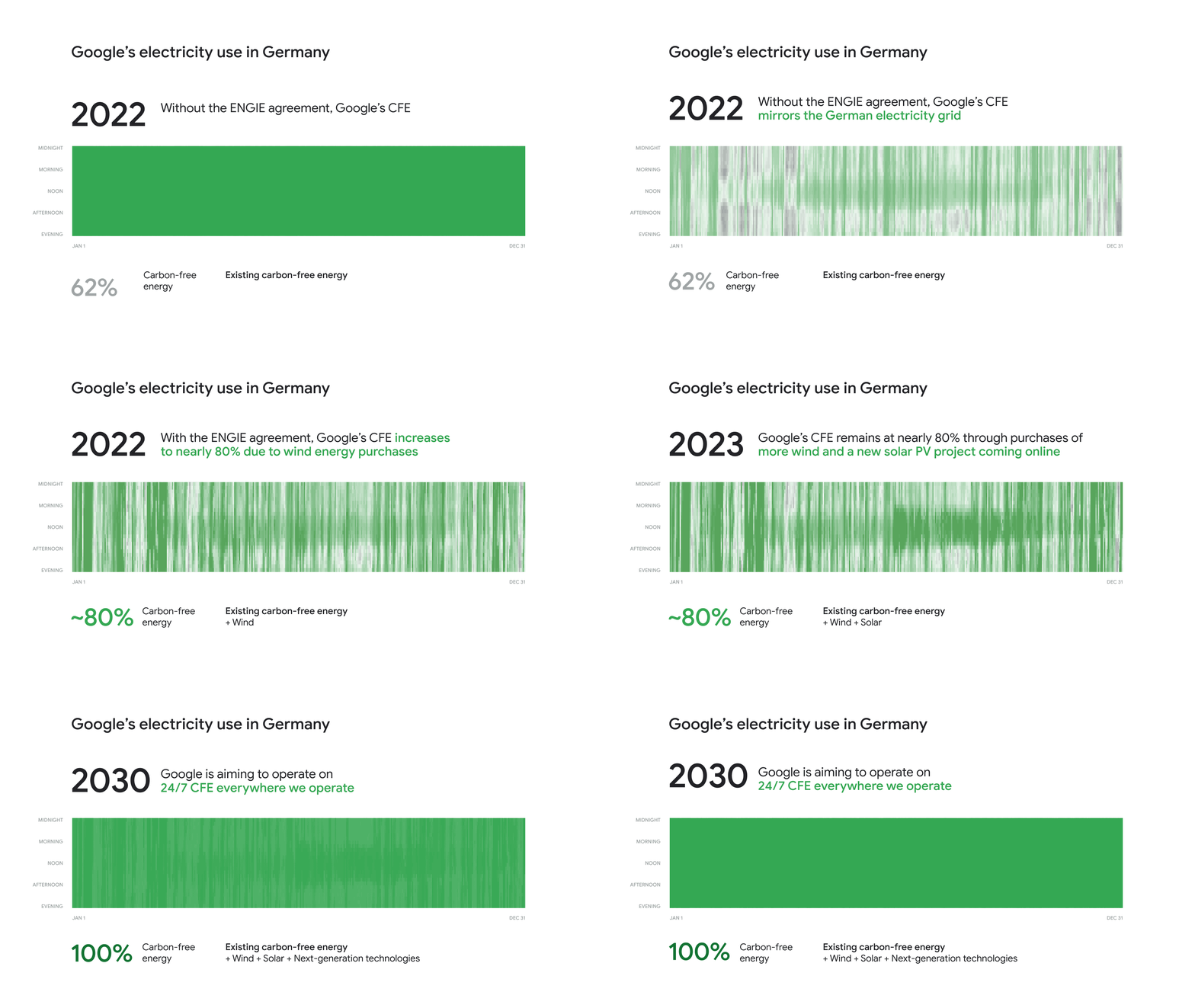
Today, we’re excited to announce that ENGIE Deutschland has been selected as Google’s carbon-free energy supplier in Germany. Under the terms of the agreement, ENGIE will assemble and develop, on Google’s behalf, a 140 megawatt (MW) carbon-free energy portfolio in Germany that has the ability to flex and grow with us as our needs change. This includes a new 39MW solar Photovoltaic system, and 22 wind parks in five federal states that will see their lives extended so they continue to produce electricity instead of being dismantled. This portfolio will ensure that the energy delivered to Google’s German facilities will be nearly 80% carbon-free by 2022 when measured on an hourly basis. This is a first but important step on Google’s journey to reach our goal of full electricity decarbonization by 2030.
This is the first energy supply of its kind in Europe, with a focus on sourcing carbon-free energy for every hour of Google’s operations. Not only will this new agreement draw the roadmap for the industry and more 24/7 carbon-free energy contracts in Europe, but it provides our cloud customers with two more regions where they can lower their carbon footprint. And importantly, by working with our energy suppliers to transform how clean energy is delivered to customers, Google is supporting the broader decarbonization of the German electricity grid.
What customers and partners are saying
As companies continue to grapple with changing customer demands, technology has played a critical role, and we’ve been fortunate to partner with and serve people, companies, and government institutions in Germany and around the world to help them adapt. The Google Cloud region in Berlin-Brandenburg and the expansion of our Google Cloud region in Hanau will help our customers — such as BMG, Delivery Hero, and Deutsche Bank — adapt to new requirements, new opportunities and new ways of working.
“We are very pleased about the symbolic handover of the keys to the building here in Hanau to Google Cloud,” said Hanau Mayor Claus Kaminsky. “With Google, we have a strong partner at our side who is supporting us in setting up Hanau’s economic future, both digitally and sustainably. The data center facility of Google Cloud embodies this transformation: We bring the cloud to us in Hanau and thus support the digital transformation of companies and public authorities. Not only in our city and Hesse, but throughout Germany and Europe. The new building meets high sustainability standards and the clean energy initiative presented today by Google is in line with our aspirations for sustainable digitalization.”
“Sustainability is a central pillar of Deutsche Bank’s strategy and we have made strong public commitments to be part of the solution,” said Bernd Leukert, Chief Technology, Data and Innovation Officer and Member of the Management Board at Deutsche Bank. “We welcome the new Google Cloud region in Germany, which will enable us to deliver additional resilience and performance for our German client base.”
Ralf Bernhard, Senior Originator Renewables, ENGIE, said: “ENGIE is excited to collaborate with Google based on a first-of-a-kind agreement which will support the company with its sustainability goals and ambitious carbon-free energy target. Thanks to our expertise in energy and risk management, we can seamlessly integrate renewable energy from existing plants and develop new assets to design a tailor made product that meets Google’s needs and plans to go even greener.”
20 years since Google first touched down in Germany, our commitment to helping Germany continue to lead in technical innovation is stronger than ever. We are excited to continue working with our partners in Hesse, Berlin and Brandenburg and across Germany to advance infrastructure and clean energy projects, help accelerate digital transformation, and secure a sustainable future for German and European companies and organizations.
3626
Of your peers have already downloaded this article
5:30 Minutes
The most insightful time you'll spend today!
Although most companies have migrated some infrastructure to public cloud, most enterprise workloads still run in on-premises data centers. Technology leaders want to migrate more workloads and infrastructure to public cloud, but they are frustrated by the process of assessing their existing workloads, identifying a migration strategy that aligns IT and business needs, and ensuring they have the right talent and skills in-house to execute a migration on time and on budget.
To encourage faster migration of a broader set of workloads to public cloud, enterprises seek not only cost optimization, but also strategy advice, powerful migration tools and professional services, and skill development.
Download this Forrester report to understand how to get your cloud migrations right the first time.
More Relevant Stories for Your Company

Hybrid Work with Google Workspace: What Customers can Expect
In June, we shared our vision for navigating the future of hybrid work with a single connected experience in Google Workspace. Now, as many of our customers begin to embark on their own hybrid journeys, I wanted to share how we’re helping them bridge the gaps in this new way of
The Future of Cloud Computing
Increasingly, technology, data, and human interactions will follow a new model of real-time inputs, enabling change without interruption and positive iteration. Cloud computing powers an important shift for information technology, and it will usher in new and better ways to serve customers, make discoveries, and build great products and services.

Southwire Completes SAP Migration to Google Cloud as a First Step of its Tech Evolution
“Talk about tough times, right?” That’s how Dan Stuart, Senior Vice President of IT Services at Southwire Company, refers to the months following a December 2019 ransomware event, and the COVID crisis that began in spring of 2020. Those events hit just as the company was preparing for an overhaul

The Journey ahead for Google Cloud and SAP
The partnership between Google Cloud and SAP is entering a new chapter. Over the years, our close partnership with SAP and our mutual dedication to customers has inspired us to do some of our most unique and innovative work—such as building Fast Restart and Memory Poisoning Recovery capabilities for S/4HANA workloads, offering real-time
