





Google’s Latest ‘Carbon Footprint’ can Flag Users about Carbon Emission Levels from their Cloud Usage

7081
Of your peers have already read this article.
4:00 Minutes
The most insightful time you'll spend today!
Google Cloud is proud to support our customers with the cleanest cloud in the industry. For the past four years, we’ve matched 100% of our electricity use with renewable energy purchases, and we were the first company of our size to commit going even further by running on carbon-free energy 24/7 by 2030. As we work to achieve 24/7 carbon-free energy, we help you take immediate action to decarbonize your digital applications and infrastructure. We’re also working with our customers across every industry to develop new solutions for the unique climate change challenges that organizations face. Today, we’re excited to expand our portfolio of carbon-free solutions and announce new partnerships that will help every company build a more sustainable future.
First, we’re launching Carbon Footprint, a new product that provides customers with the gross carbon emissions associated with their Google Cloud Platform usage. Now available to every GCP user for free in the Cloud Console, this tool helps you measure, track and report on the gross carbon emissions associated with the electricity of your cloud usage. Of course, the net operational emissions associated with your Google Cloud usage is still zero. With growing requirements for Environmental Social and Governance (ESG) reporting, companies are looking for ways to show their employees, boards and customers their progress against climate targets. Using Carbon Footprint, you have access to the gross energy related emissions data you need for internal carbon inventories and external carbon disclosures, with one click.
Built in collaboration with customers like Atos, Etsy, HSBC, L’Oréal, Salesforce, Thoughtworks and Twitter, our Carbon Footprint reporting introduces a new standard of transparency to support you in meeting your climate goals. You can monitor your gross cloud emissions over time, by project, by product and by region, giving IT teams and developers metrics that can help them reduce their carbon footprint. Our detailed calculation methodology is published so that auditors and reporting teams can verify that their cloud emissions data meets GHG Protocol guidance.
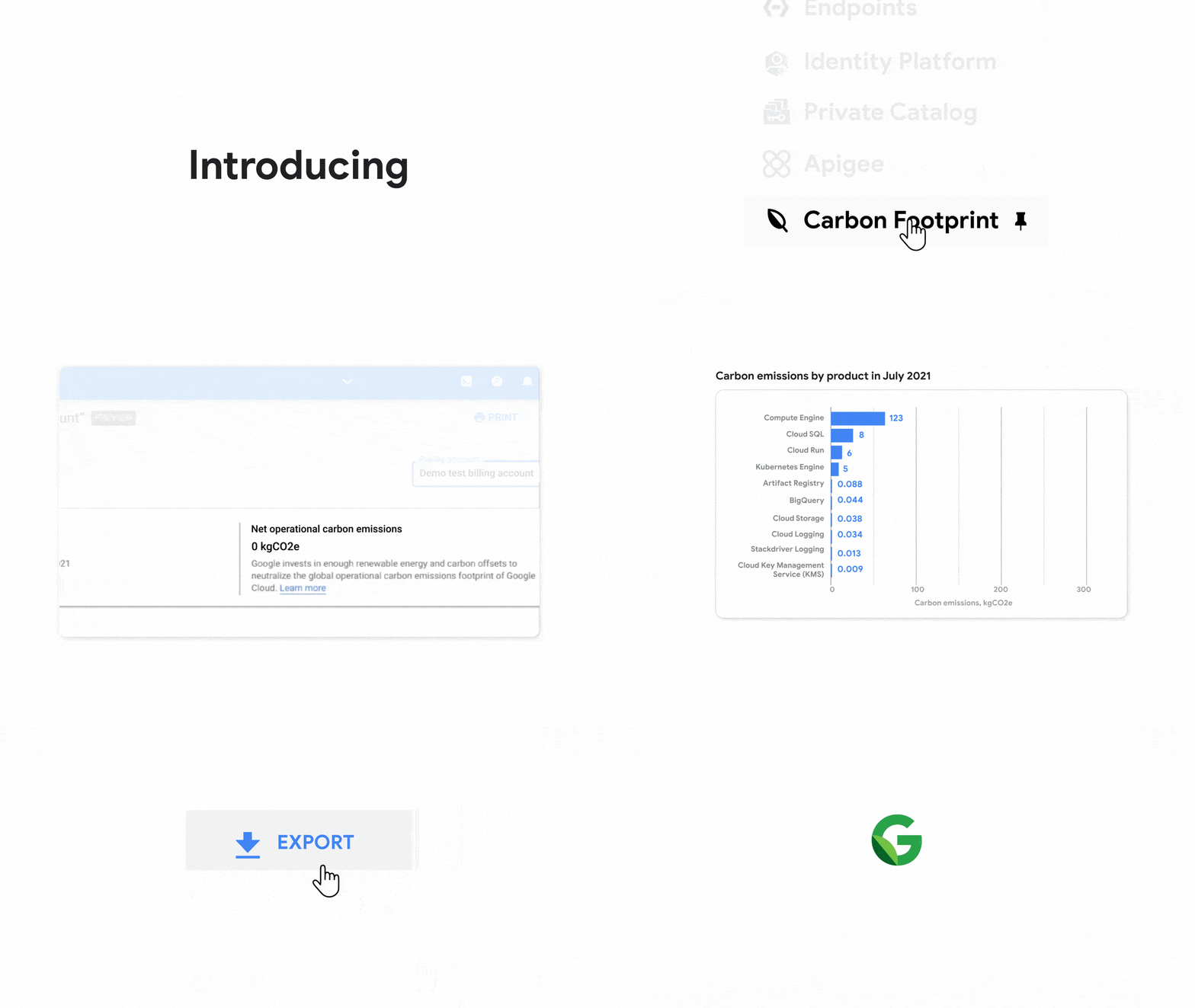
“The power of knowledge combined with the power of technology innovation plays a vital role in proactively responding to the climate crisis we are facing. With Google Carbon Footprint reporting, Atos feeds emissions data in our Decarbonization Data Platform, demonstrating potential emissions reductions from the Google Cloud Platform to our customers. This reporting opens up new levels of emissions transparency, trajectory planning, and data insight to support our customers in meeting, and potentially accelerating towards, their climate goals.”—Nourdine Bihmane, Head of Decarbonization Business Line, Atos
“The capability to measure and understand the environmental footprint of our Public Cloud usage is among the key axis of our sustainable tech roadmap. With Google Cloud Carbon Footprint, we are now able to directly follow the impact of our sustainable infrastructure approach and architecture principles.”—Hervé DUMAS, Sustainability IT Director, L’Oreal
While digital infrastructure emissions are just one part of your environmental footprint, accurately accounting for IT carbon emissions is necessary to measure progress against the carbon reduction targets required to avert the worst consequences of climate change. To help you account for emissions beyond our cloud and across your organization, we’re excited to partner with Salesforce Sustainability Cloud, integrating our Google Cloud Platform emissions data into their carbon accounting platform.
“As we face unprecedented climate challenges, companies across the globe need to embed sustainability into the core of their business in order to meet growing customer and stakeholder expectations, and reduce their environmental impact. Together, Google Cloud and Salesforce Sustainability Cloud can help our joint customers accelerate their path to Net Zero, leveraging data-driven insights and visualizations to track and reduce their carbon emissions to drive sustainable change.”—Ari Alexander, GM of Salesforce Sustainability Cloud.
From information to action
With the gross energy-related emissions footprint of data associated with your Google Cloud usage now available, we’re committed to providing tools to not only measure your carbon footprint, but help you reduce it. We recently launched low-carbon region icons to help you choose cleaner regions to locate your Google Cloud resources. New users who see the icons are over 50% more likely to choose clean regions over others, ensuring their applications emit less carbon over time.
For current Google Cloud users, we’re pleased to announce that Active Assist Recommender will include a new sustainability impact category, extending its original core pillars of cost, performance, security, and manageability. Starting with the Unattended Project Recommender, you’ll soon be able to estimate the gross carbon emissions you’ll save by removing your idle resources. Unattended Project Recommender uses machine learning to identify, with a high degree of confidence, projects that are likely abandoned based on API and networking activity, billing, usage of cloud services, and other signals, and provides actionable recommendations on how to remediate those abandoned projects. By deleting these projects, not only can you reduce costs and mitigate security risks, but you can also reduce your carbon emissions. In August, Active Assist analyzed the aggregate data from all customers across our platform, and over 600,000 gross kgCo2e was associated with projects that it recommended for cleanup or reclamation. If customers deleted these projects they would significantly reduce future gross carbon emissions. Check out this blog to learn more about Active Assist.

Solutions for climate resilience
Many of our customers face difficult questions about how their business impacts the natural environment today, and how it will be affected by climate change in the future. Answering these questions requires rich datasets about the planet, better analytics tools and smarter models to predict potential outcomes. For over a decade Google Earth Engine has supported scientists and developers with hyperscale computing power and the world’s largest catalog of satellite image data. Today, we are delighted to announce the preview of Earth Engine as part of Google Cloud Platform. Now, you can access Earth Engine and combine it with other geospatial-enabled products like BigQuery. By extending Earth Engine’s powerful platform to enterprises through Google Cloud, we are bringing the best of Google together.
Over the past year we’ve worked with a number of organizations to use Earth Engine technology with tools like BigQuery and the Cloud AI Platform to develop new solutions for responsible commodity sourcing, sustainable land management and carbon emissions reduction. Earth Engine enables companies to track, monitor and predict changes in the Earth’s surface due to extreme weather events or human-caused activities, thus helping them save on operational costs, mitigate and better manage risks, and become more resilient to climate change threats. This new offering will wrap the unique data, insights and functionality of Earth Engine with a fully-managed, enterprise-grade experience and reliability.
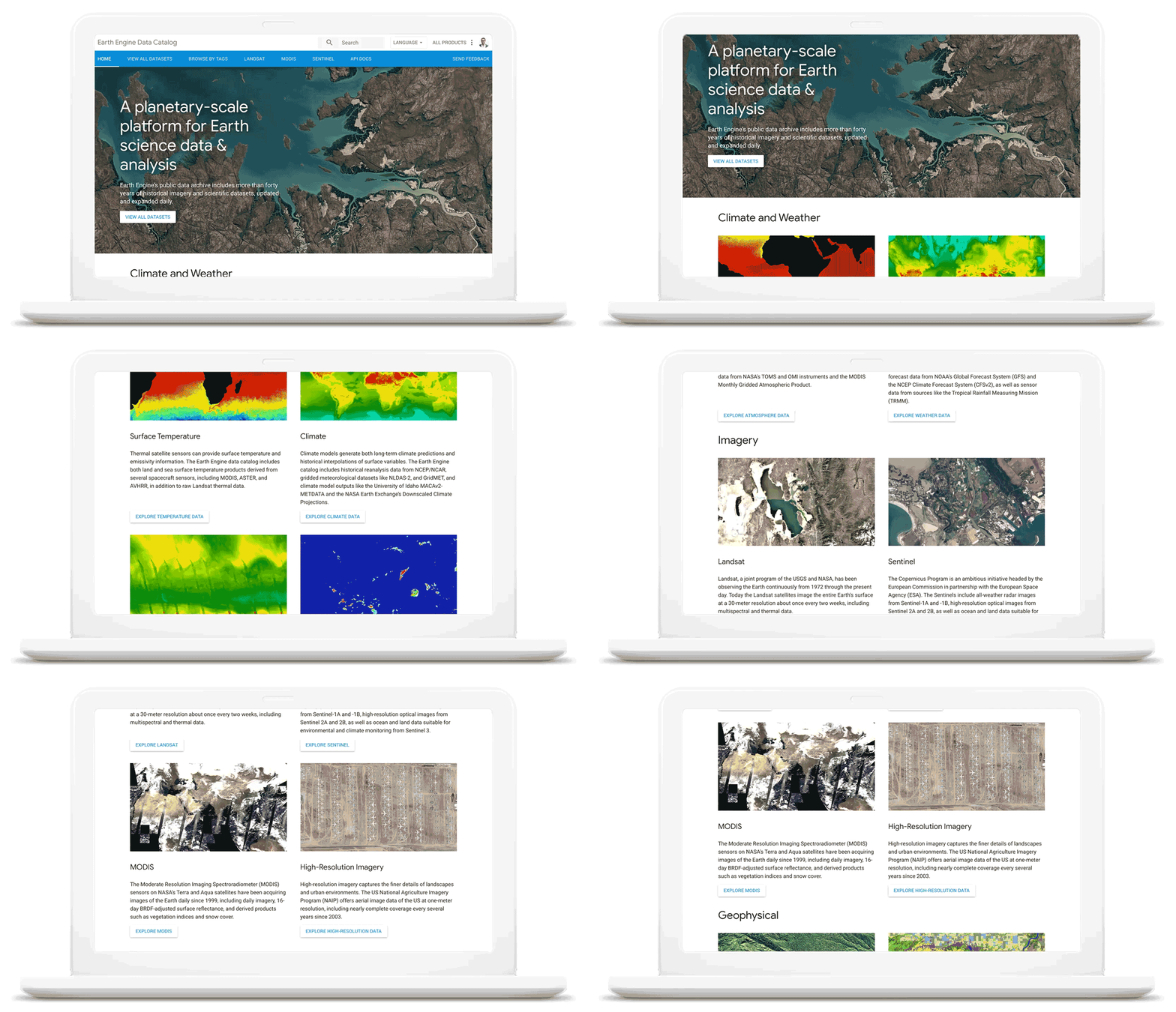
As we work with our customers to accelerate their sustainability initiatives, earth observation data is proving critical to effectively plan for the long-term impacts of climate change. To extend our geospatial and sustainability use cases we’re also expanding our partnerships with CARTO, Climate Engine, Geotab, NGIS, and Planet to bring their data and core applications to Google Cloud.
These partners will each make their existing platforms and datasets available globally on Google Cloud, giving you low-latency and reliable access to critical data and applications that will inform your sustainability initiatives. By integrating water availability, agricultural data, weather risks, and extensive daily satellite imagery into Earth Engine and BigQuery, you can achieve more ambitious goals for the sustainability of your business and our planet.
Committing to help you meet your climate goals
With each of these tools, we’re working to reduce the barriers you face in adopting more sustainable technology practices. We understand that building more sustainable applications and infrastructure is not easy. You face competing priorities, technical challenges, and the perception that climate action is costly.
It doesn’t have to be this way. Today, we are making a sustainability pledge to you: teams across Google Cloud are committing to eliminating the barriers you face in building a more sustainable digital future for your organization, and will help you take action today to realize your climate goals. We’ll do this in a number of ways:
- In digital transformation projects and workshops, sustainability teams will always have a seat at the planning table, so we can work together on using cloud technology to build a more sustainable future.
- We’re putting low-carbon signals natively into our products to help developers choose more sustainable options early in their application development.
- We’ll ensure carbon impact is measured consistently with other key performance indicators. Leveraging the social cost of carbon, the ROI models and value assessments you conduct with Google Cloud will project your emissions impact too.
- We’ll be transparent about our carbon impact, by publishing third-party reviewed reports and methodologies, so you can trust the data for your own reports and disclosures.
- We’ll continue to work with the industry on best practices, including educational resources like Sustainable IT – Decoded, a new masterclass created in partnership with Intel, that shares the expertise of sustainability thought leaders.
For the next decade we need to work together to avert the worst consequences of climate change. We’ve made tremendous progress in building technology that helps everyone do more for the planet, and we’re excited to see what you do with it. Visit this page to learn more about Google Cloud’s sustainability efforts.
4905
Of your peers have already watched this video.
9:37 Minutes
The most insightful time you'll spend today!
L’Oréal: Managing Big-data Complexity with Google Cloud
L’Oreal is a global company with a presence in 150 countries worldwide. Between managing all of its brands and requirements for different countries, L’Oreal looks to data to make insightful business decisions. How does L’Oreal unify its data across all its systems and databases? How does L’Oreal make the data accessible to thousands of employees? In this video, Antoine Castex, Enterprise Architect at L’Oreal, discusses with Martin Omander how L’Oreal built a serverless, multi-cloud warehouse based on Google Cloud.
Chapters:
0:00 – Intro
0:23 – Why does L’Oreal need a new data warehouse?
0:51 – Who is the L’Oreal group?
1:35 – Which systems does L’Oreal use?
2:14 – How does L’Oreal manage complexity?
3:59 – What is ELT?
4:57 – Who are L’Oreal’s data consumers?
5:41 – How L’Oreal built the data warehouse
8:51 – L’Oreal’s future plans
9:10 – Wrap up
Google Cloud Workflows → https://goo.gle/3q20M1V
Cloud Run → https://goo.gle/3CSWbXG
Eventarc → https://goo.gle/3B7qhFy
BigQuery → https://goo.gle/3KHgyJ3
Looker → https://goo.gle/3Rx4Ind
Checkout more episodes of Serverless Expeditions → https://goo.gle/ServerlessExpeditions
Subscribe to Google Cloud Tech → https://goo.gle/GoogleCloudTech
Google Cloud’s Autism Career Program to Nurture Neurodiverse Talent
3565
Of your peers have already read this article.
1:30 Minutes
The most insightful time you'll spend today!
My passion for neurodiversity began 10 years ago, when I became involved with Els for Autism, an organization that works with children and adults who have autism, as well as their families. At the time, I had a friend who was struggling to find resources for his son with autism. The foundation promotes acceptance and inclusion for people on the spectrum, helping them live independently and find jobs that harness their talents and skills. The organization’s focus on autism in the workplace resonated deeply with me, due to the rich experiences I had working with individuals with autism over the course of my career.
Approximately two percent of the population has autism, but it’s estimated this number is actually quite low as many individuals go undiagnosed. Of those that have been diagnosed, only 29% have had any sort of paid work in their lives. Personally, I find this tragic, because individuals with autism can be highly-functioning and contributing professionals in any organization. Too often, though, the interview process can pose challenges due to unconscious bias from a hiring manager or interviewer, for example, if the candidate doesn’t look an interviewer in the eyes or asks for additional time to complete a test. This bias often unintentionally marginalizes great candidates and means businesses miss out on valuable talent who can contribute and enrich the workplace.
Introducing Google Cloud’s Autism Career Program
It is in that spirit that I am excited to announce the launch of Google Cloud’s Autism Career Program, designed to hire and support more talented people with autism in the rapidly growing cloud industry.
We are working with experts from the Stanford Neurodiversity Project (part of the Stanford University School of Medicine), which provides consultation services to employers to advise on opportunities and success metrics for neurodiverse individuals in the workplace.
One key pillar of our program is to train up to 500 Google Cloud managers and others who are involved in hiring processes. Our goal is to empower these Googlers to work effectively and empathetically with autistic candidates and ensure Google’s onboarding processes are accessible and equitable. Stanford will also provide coaching to applicants, as well as ongoing support for them, their teammates and managers once they join the Google Cloud team.
We’re taking this approach to break down the barriers that candidates with autism most often face. In addition to bias, there may be challenges with how interviews are structured or conducted without the right tools. For these reasons, we will offer candidates in this program reasonable accommodations like extended interview time, providing questions in advance, or conducting the interview in writing in a Google Doc rather than verbally on a call. These accommodations don’t give those candidates an unfair advantage. It’s just the opposite: They remove an unfair disadvantage so candidates have a fair and equitable chance to compete for the job.
This program is just one example of Google Cloud’s commitment to inclusion, and it is an important step forward to building a more representative team and creating value for customers and stakeholders.
Manhattan Associates and Google Cloud: How the Partnership Accelerates Future of Digital Retail

4968
Of your peers have already read this article.
1:30 Minutes
The most insightful time you'll spend today!
While the shift to digital business and the cloud has been well under way for some years now, organizations today have a new sense of urgency due to COVID-19. Delivering digital transformation is no longer a ‘nice to have’ option, rather, it is an operational imperative. Taking advantage of the infrastructure, platform and solution gains that cloud and microservices architecture provide is a must for brands today.
At Google Cloud, we understand the pressures and challenges organizations of all sizes, across all industries are facing. The pandemic has dramatically impacted global commerce at-large, exposing (for many organizations across multiple sectors) gaps in omnichannel capabilities, business continuity and forecasting plans, not to mention spots in supply chain agility, resilience and responsiveness.
A rapidly evolving consumer-driven commerce landscape has put innovation squarely in the spotlight for supply chain teams all over the world, with the effects of the global pandemic making it increasingly difficult for manufacturers, wholesalers, third party logistics providers and retailers (in particular) to weather the perfect storm of fast-moving consumer trends and a need for ‘always on’ digital innovation.
These same effects have driven increasing interest and uptake of technology like the Manhattan Active® suite of solutions, as well as our own cloud platform; both of which afford organizations the levels of agility, flexibility and scalability needed to insulate their people, processes and long-term business strategies against unforeseen future obstacles such as global pandemics or international trade disputes.
An excellent example of this agility, flexibility and scalability in action is PVH’s response to the global pandemic. One of the most admired fashion and lifestyle companies with such iconic brands as Calvin Klein, TOMMY HILFIGER, Van Heusen, and IZOD, PVH was forced to temporarily close its physical stores and, as a result, experienced a sudden massive increase in online sales. The retailer was able to quickly pivot by adjusting its business rules in Manhattan Distributed Order Management (part of Manhattan Active Omni) to expose store inventory to online consumers and reroute its fulfillment processes. Thanks to Manhattan’s solution delivered through Google Cloud, in a matter of days, PVH was able to leverage both its distribution centers and vast store network to fulfill its online orders.
“The events of 2020 have accelerated retail and ecommerce operations forward,” said David Herridge, executive vice president of Global Value Chain Technologies for PVH. “With quick, creative thinking and the right partner, we were able to pivot operations, satisfy our customers and prepare for the future.”
Manhattan’s products have been recognized for their ability to solve real-world challenges through innovation, and used by many of the world’s top brands to solve some of their most complex commerce and supply chain challenges: the latest recognition is Manhattan’s position as sole leader in the 2021 Forrester Wave™ for Order Management Solutions.
Since December 2018, Google Cloud has been collaborating closely with the team at Manhattan and its ‘always on’, versionless approach to innovation. And, during the last two and a half years, Manhattan has significantly accelerated its cloud-first solutions and market adoption, resulting in tremendous growth in its overall cloud business efforts.
By building cloud native solutions on Google Cloud, the teams at Manhattan continue to deliver the high-performance, elastic, high-redundancy, secure solutions their customers rely on. Moreover, it means both Google Cloud and Manhattan continue to innovate and push the boundaries of what is possible in terms of the supply chain and omnichannel innovations that underpin global commerce – innovation that is needed more now than maybe ever before.
Our commitment to distributed cloud solutions and ongoing innovation, not to mention the fact Google Cloud operates a net carbon-neutral cloud, means that the working partnership between both industry leading teams continues to be a perfect match of brand values; not just from a technology perspective, but also a long-term sustainability and environmental one too.
More information on the partnership can be found here.
Google Cloud Featured at TechCrunch Disrupt 2021
4928
Of your peers have already read this article.
1:30 Minutes
The most insightful time you'll spend today!
Startups need to move quickly and focus their limited resources on areas where they can differentiate. If infrastructure isn’t your differentiator, don’t put a lot of energy into your infrastructure when someone else can do it for you. What’s more, time-to-market matters to startups more now than ever. Successful early stage companies know this, and leverage existing tools, libraries, frameworks and innovations whenever possible.
Next week Google Cloud will be featured at TechCrunch Disrupt, the iconic annual event where “founders and investors shaping the future of disruptive technology” come together to share stories, network, and learn from each other. Google Cloud will host a session and Google Cloud engineers will be available in a virtual booth to answer startup questions.
The session, “Demo Derby – How startups are disrupting the status quo with innovative data analytics, AI and modern app development” will be a fun, fast-paced set of presentations showing short demos of startups and startup projects built with Google Cloud.
Demo Derby Presenters
- Andrea Le Vot, Chief Data Protection Officer with startup BlueZoo will deliver a demo showing how they are revolutionizing the property insurance industry with AI and Cloud – and doing so while actually protecting people’s privacy.
- Dale Markowitz and Zack Akil, Applied AI Engineers, will show how easy it is to use AI for everything from video search to editing to automated translation.
- Vidya Nagarajan, Group Product Manager from Google Cloud will deliver a fast paced demo that shows how startups can drive developer productivity with serverless innovations.
“Disrupt is iconic for its engagement with founders, investors, and the broad community of early stage companies,” said Andrea Le Vot, Chief Data Protection Officer at BlueZoo. “We are thrilled to share our insights with others in our community, and to show how we have partnered with Google Cloud to innovate faster than most of the larger, well funded insurance companies in our market.”
The series of snippet sized demos will be followed by a roundtable discussion with the demo developers focused on lessons learned, best practices, how to reduce time-to-market, and how to focus on where you can most effectively differentiate.
The session will air on Day One of the event: Tuesday September 21, 2021 at 1pm PT and will be available on demand after the event for all Disrupt attendees.
Media CDN to Intelligently Deliver Streaming Experiences to Viewers around the World!

3301
Of your peers have already read this article.
3:00 Minutes
The most insightful time you'll spend today!
The digital media and entertainment industry is experiencing dramatic growth, as audiences migrate to online experiences and content providers seek to deliver new and innovative content. According to The Global Internet Phenomena Report, streaming video accounted for 53.7% of internet bandwidth traffic, up by 4.8% from a year ago. This rapid growth of over-the-top content is straining existing infrastructure, fueling media companies’ shift to the public clouds with their global presence and greater distribution capacities. In addition, other use cases such as gaming, social networks, AR/VR experiences, and education continue to fuel the need for intelligent media services and operations.
Today, at the 2022 NAB Show Streaming Summit, we’re excited to announce the general availability of Media CDN — a modern, extensible platform for delivering immersive experiences with unparalleled scale and intelligence. Media CDN will enable media and entertainment customers to efficiently and intelligently deliver streaming experiences to viewers anywhere in the world. The same infrastructure that Google has built over the last decade to serve YouTube content to over 2 billion users is now being leveraged to deliver media at scale to Google Cloud customers with Media CDN.
Unparalleled planet-scale reach and scale
Media CDN’s foundational advantage is the Google network. We have invested decades of resources to build tremendous capacity and reach in over 200 countries and more than 1,300 cities around the globe. Modern video applications are sensitive to fluctuations in latency, so getting content closer to users enables higher bitrates and reduces rebuffers, resulting in a superior experience for the end user. Media CDN builds on the success of the existing Cloud CDN portfolio for web and API acceleration and complements it by enabling delivery of immersive media experiences.
In addition to running on planet-scale infrastructure, Media CDN tailors delivery protocols to individual users and network conditions. Media CDN includes out-of-the-box support for QUIC (HTTP/3), TLS 1.3, and BBR, optimizing for last-mile delivery . When the Chrome team rolled out widespread support for QUIC, video rebuffer time decreased by more than 9% and mobile throughput increased by over 7%.
Media CDN also achieves industry-leading offload rates. With multiple tiers of caching, we minimize calls to origin — even for infrequently accessed content. This alleviates performance or capacity stress in the content origin and saves costs. These features are built into the product and seamlessly support customer content hosted on Google Cloud, on-premises, or on a third-party cloud.
“We are excited to leverage Media CDN to continue to deliver an exceptional streaming experience for Stan users across Australia. With Google’s massive network, and a deep reach into the ISPs, we are able to deliver the highest quality video for our users, no matter where they are”—John Hogan, Chief Technology Officer, Stan
“Our mission at U-NEXT is to deliver the highest quality and most entertaining content to our users. Google Cloud’s Media CDN helps us efficiently scale our infrastructure, which is challenging with a vast library of content. Media CDN offloaded 98.3% of requests from our origin server while delivering consistent great quality.”—Rutong Li, Chief Technology Officer, U-NEXT
Broader platform for monetization and immersive experiences
While global distribution is critical for a high-quality end-user experience, it’s only one piece of delivering a world-class platform for immersive experiences. Media CDN offers additional capabilities to enable this transformation — ad insertion, ecosystem integrations and platform extensibility, and powerful AI/ML analytics for interactive experiences.
Streaming providers can improve monetization through integrated ad serving via the Video Stitcher API, which allows manipulation of video content to dynamically insert ads.
Through extensible ecosystem integrations, Media CDN connects customers to key capabilities to simplify their operations. For example, the Transcoder API supports custom streaming formats, while the Live Stream API transcodes mezzanine live signals into direct-to-consumer streaming formats, for multiple device platforms.
Media CDN is built with AI/ML that will give viewers more control over how they see, experience, and even interact with content. For example, sports fans watching a game can obtain real-time stats and analytics, viewers can purchase items from virtual billboards, etc.
Cloud-native and developer-friendly operations
Media companies are under pressure to develop and deploy innovative experiences at a furious pace. Media CDN was built by developers, for developers, with automation and observability built in, giving media providers the speed and flexibility they need to integrate delivery provisioning and management into their content release processes.
Media CDN offers comprehensive APIs and automation tools such as Terraform. Detailed, pre-aggregated metrics and playback tracing make it easy to diagnose performance across the entire infrastructure stack. Real-time visibility is provided via Google Cloud’s operations suite, and integrates with tools that developers already use such as Grafana and ElasticSearch.
“Leveraging the same infrastructure as YouTube, Google Cloud’s Media CDN combines geographic reach, API-first architecture and integration with the Cloud operations suite. This is a transformative move that is aligned with the future of the CDN industry.”— Ghassan Abdo, Research Vice President, WW Telecom, Virtualization and CDN, IDC
“Viewers around the world are demanding best-in-class video quality and performance across modes of consumption. A video-first delivery network can be a game changer in this space. We’re excited to partner with Google Cloud and to leverage Media CDN to enable premium video experiences and customer engagements.”—Juan Martin, Founder and CTO, Firstlight Media
Planet-scale advanced security
Media CDN lets streaming media providers take advantage of Google’s decades-long experience delivering video safely, securely, and reliably. The platform includes deep integration with Google Cloud Armor for planet-scale DDoS protection and a rich set of capabilities to detect and mitigate attacks, prevent abuse, manage risk, and comply with regulatory or licensing requirements.
If you want to deliver rich, immersive experiences to global audiences with an extensible, modern delivery platform, we’d love to hear from you. For more information, including technical specifications and platform architecture, please visit cloud.google.com/media-cdn. To get started with Media CDN, contact your sales team.
More Relevant Stories for Your Company

How Lowe’s SRE Team Decreases Mean-time-to-recovery (MTTR)
Editor’s Note: In a previous blog, we discussed how home improvement retailer Lowe’s was able to increase the number of releases it supports by adopting Google’s Site Reliability Engineering (SRE) framework on Google Cloud. Lowe’s went from one release every two weeks to 20+ releases daily, helping meet its customer needs faster and

More and More Businesses Trust the Cloud. Here’s Why.
What’s behind the rising confidence in cloud security? First hand experience, and careful, systematic assessments that tap multiple sources such as detailed audits and comparisons. The most frequent driver of increased confidence was the direct experience of the quality of security in the cloud versus on-premises. As a result, the

Revolutionizing Cloud Computing: Introducing G2 VMs with NVIDIA L4 GPUs
Organizations across industries are looking to AI to turn troves of data into intelligence, powered by the latest advances in generative AI. Yet for many organizations, there is a barrier to adopting the latest models because they can be costly to train or serve. A new class of cloud GPUs
Google Cloud VMware Engine Achieves HIPAA Compliance
We are excited to announce that as of April 1, 2021, Google Cloud VMware Engine is covered under the Google Cloud Business Associate Agreement (BAA), meaning it has achieved HIPAA compliance. Healthcare organizations can now migrate and run their HIPAA-compliant VMware workloads in a fully compatible VMware Cloud Verified stack running natively
