





Partnering for Stronger Security: Google and Mandiant Join Forces

2793
Of your peers have already read this article.
2:30 Minutes
The most insightful time you'll spend today!
Over the past two decades, Google has innovated to build some of the largest and most secure computing systems in the world. This scale requires us to deliver pioneering approaches to cloud security, which we pass on to our Google Cloud customers. We are committed to solving hard security problems like only Google can, as the tip of the spear of innovation and threat intelligence.
Today we’re excited to share the next step in this journey with the completion of our acquisition of Mandiant, a leader in dynamic cyber defense, threat intelligence and incident response services. Mandiant shares our cybersecurity vision and will join Google Cloud to help organizations improve their threat, incident and exposure management.
Combining Google Cloud’s existing security portfolio with Mandiant’s leading cyber threat intelligence will allow us to deliver a security operations suite to help enterprises globally stay protected at every stage of the security lifecycle. With the scale of Google’s data processing, novel analytics approaches with AI and machine learning, and a focus on eliminating entire classes of threats, Google Cloud and Mandiant will help organizations reinvent security to meet the requirements of our rapidly changing world.
We will retain the Mandiant brand and continue Mandiant’s mission to make every organization secure from cyber threats and confident in their readiness.
Context and threat intelligence from the frontlines
Our goal is to democratize security operations with access to the best threat intelligence and built-in threat detections and responses. Ultimately, we hope to shift the industry to a more proactive approach focused on modernizing Security Operations workflows, personnel, and underlying technologies to achieve an autonomic state of existence – where threat management functions can scale as customers’ needs change and as threats evolve.
Today Google Cloud security customers use our cloud infrastructure to ingest, analyze and retain all their security telemetry across multicloud and on-premise environments. By leveraging our sub-second search across petabytes of information combined with security orchestration, automation and response capabilities, our customers can spend more time defending their organizations.
The addition of Mandiant Threat Intelligence—which is compiled by their team of security and intelligence individuals spread across 22 countries, who serve customers located in 80 countries—will give security practitioners greater visibility and expertise from the frontlines. Mandiant’s experience detecting and responding to sophisticated cyber threat actors will offer Google Cloud customers actionable insights into the threats that matter to their businesses right now. We will continue to share groundbreaking Mandiant threat research to help support organizations, even for those who don’t run on Google Cloud.
Advancing shared fate for security operations
Google Cloud operates in a shared fate model, taking an active stake in the security posture of our customers. For security operations that means helping organizations find and validate potential security issues before they become an incident.
Detecting, investigating and responding to threats is only part of better cyber risk management. It’s also crucial to understand what an organization looks like from an attacker’s perspective and if an organization’s cybersecurity controls are as effective as expected.
By adding Mandiant’s attack surface management capabilities to Google Cloud’s portfolio, organizations will be able to continually monitor assets for exposures, enabling intelligence and red teams to move security programs from reactive to proactive to understand what’s vulnerable, misconfigured and exposed.
Once an organization’s attack surface is understood, validating existing security controls is critical. With Mandiant Security Validation, organizations will be able to continuously validate and measure the effectiveness of their cybersecurity controls across cloud and on-premise environments.
Transforming security operations and incident response
Security leaders and their teams often lack the resources and expertise required to keep pace with today’s ever changing threats. Organizations already harness Google’s security tools, expert advice and rich partner ecosystem to evolve their security program. Google’s Autonomic Security Operations also serves as a prescriptive solution to guide our customers through this modernization journey.
With the addition of Mandiant to the Google Cloud family, we can now offer proven global expertise in comprehensive incident response, strategic readiness and technical assurance to help organizations mitigate threats and reduce business risk before, during and after an incident.
In addition, Google Cloud’s security operations suite will continue to provide a central point of intelligence, analysis and operations across on-premise environments, Google Cloud and other cloud providers. Google Cloud is also deeply committed to supporting our technology and solution partners, and this acquisition will enable system integrators, resellers and managed security service providers to offer broader solutions to customers.
Comments on the news
“The power of stronger partnerships across the cybersecurity ecosystem is critical to driving value for clients and protecting industries around the globe. The combination of Google Cloud and Mandiant and their commitment to multicloud will further support increased collaboration, driving innovation across the cybersecurity industry and augmenting threat research capabilities. We look forward to working with them on this mission.” – Paolo Dal Cin, Global Lead, Accenture Security
“Google’s acquisition of Mandiant, a leader in security advisory, consulting and incident response services will allow Google Cloud to deliver an end-to-end security operations suite with even greater capabilities and services to support customers in their security transformation across cloud and on-premise environments.” – Craig Robinson, Research VP, Security Services, IDC
“Bringing together Mandiant and Google Cloud, two long-time cybersecurity leaders, will advance how companies identify and defend against threats. We look forward to the impact of this acquisition, both for the security industry and the protection of our customers.” – Andy Schworer, Director, Cyber Defense Engineering, Uber
We welcome Mandiant to the Google Cloud team, and together we look forward to helping security teams achieve so much more in defense of their organizations. You can read our release and Kevin Mandia’s blog for more on this exciting news.
Google Unveils New Cloud Region in Delhi NCR to Power India’s Digitization

8332
Of your peers have already read this article.
2:00 Minutes
The most insightful time you'll spend today!
In the past year, Google has worked to surface timely and reliable health information, amplify public health campaigns, and help nonprofits get urgent support to Indians in need. Now, we are continuing to focus on helping India’s businesses accelerate their digital transformation, deepening our commitment to India’s digitization and economic recovery. To support customers and the public sector in India and across Asia Pacific, we’re excited to announce that our new Google Cloud region in Delhi National Capital Region (NCR) is now open.
Designed to help both Indian and global companies alike build highly available applications for their customers, the Delhi NCR region is our second Google Cloud region in India and 10th to open in Asia Pacific.
What customers and partners are saying
Navigating this past year has been a challenge for companies as they grapple with changing customers demands and economic uncertainty. Technology has played a critical role, and we’ve been fortunate to partner with and serve people, companies, and government institutions around the world to help them adapt. The Google Cloud region in Delhi NCR will help our customers adapt to new requirements, new opportunities and new ways of working, like we’ve helped so many companies do in the region:
- InMobi scaled a personalized AI platform to support 120+ million active users. “With the arrival of the Google Cloud Delhi NCR, InMobi Group sees the opportunity to continue closing the gap between our users and products,” says Mohit Saxena, Co-founder and Group CTO of Inmobi. “Glance, especially, has been serving AI-powered personalised content to over 120 million active users. We can’t wait to continue giving them truly meaningful experiences that are speedy, scale well, and are relevant to them, by expanding the use of our current tools working on Google Cloud with the opening of a new region.”
- Groww now supports a sizable user base. “Google Cloud provides great technology that enables us to build and scale infrastructure to millions of users, and the new Google Cloud region in Delhi NCR will continue to help more businesses and startups in India access powerful cloud-based infrastructure, products and services,” says Neeraj Singh, Co-founder and Chief Technology Officer, Groww.
- HDFC Bank is positioned for the future. “At HDFC Bank, we are harnessing technology platforms to both run and build the bank. As we progress to be future ready, the objective is to invest in future technologies that give us scale, efficiency and resiliency. Towards this the Google Cloud region in Delhi NCR will enable us to enhance our resiliency and help us in building an active-active design framework for our new generation applications on cloud,” says Ramesh Lakshminarayanan, CIO, HDFC Bank.
- Dr. Reddy’s Lab built a modern data platform with Google Cloud. “At Dr Reddy’s, we pride ourselves in helping patients regain good health, acting quickly to provide innovative solutions to address patients’ unmet needs and in accelerating access to medicines to people worldwide. Our Google Cloud-powered data platform is helping us realize these objectives and we welcome Google’s investment in the new Delhi NCR region as helping us and other businesses in India make further contributions to our social and economic future,” says Mukesh Rathi, Senior Vice President & CIO, Dr. Reddy’s Laboratories.
- “To survive the disruption caused by the pandemic and to succeed in the long term, organizations need to become digital natives, so they can be more agile, explore new business models and build new capabilities that boost resilience. A cloud-first strategy plays a key role in enabling businesses to do this,” said Piyush N. Singh, Lead – India market unit & lead – Growth and Strategic Client Relationships, Asia Pacific and Latin America, Accenture. “Harnessing the potential of cloud requires the right data infrastructure and this expansion by Google Cloud will undoubtedly help Indian enterprises in their digital transformation journeys.”
A global network of regions
Delhi NCR joins 25 existing Google Cloud regions connected via our high-performance network, helping customers better serve their users and customers throughout the globe. As the second region in India, customers benefit from improved business continuity planning with distributed, secure infrastructure needed to meet IT and business requirements for disaster recovery, while maintaining data sovereignty.
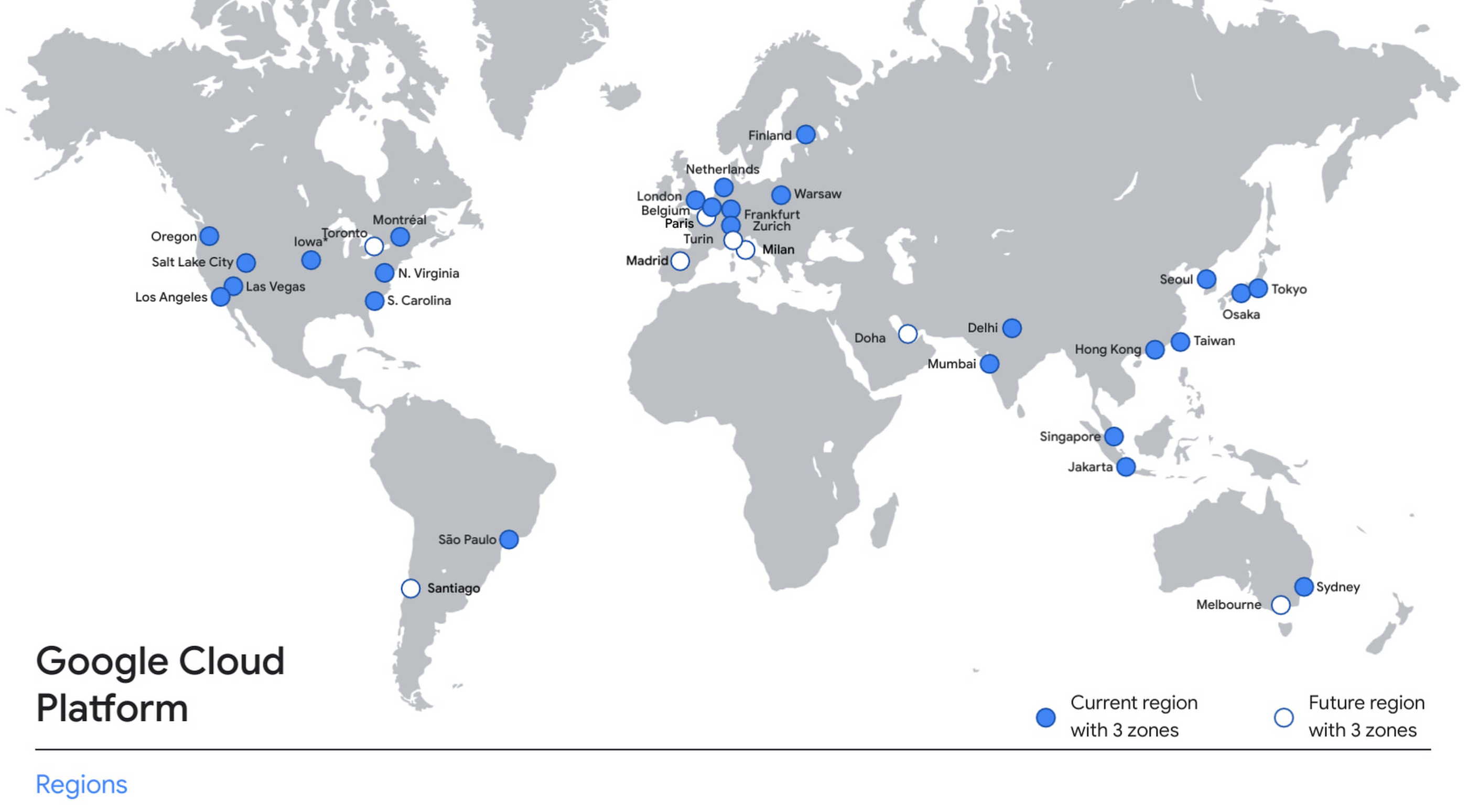
With this new region, Google Cloud customers operating in India also benefit from low latency and high performance of their cloud-based workloads and data. Designed for high availability, the region opens with three availability zones to protect against service disruptions, and offers a portfolio of key products, including Compute Engine, App Engine, Google Kubernetes Engine, Cloud Bigtable, Cloud Spanner, and BigQuery.
Supporting India’s recovery with training and education
Google and Google Cloud will also continue to support our customers with people and education programs. We’re investing in local talent and the local developer community to help enterprises digitally transform and support economic recovery.
Through the India Digitization Fund, we expanded our efforts to support India’s recovery from COVID-19—in particular, through programs to support education and small businesses. In addition to expanding internet access, and investments to help start-ups accelerate India’s digital transformation, we’ve grown our Grow with Google efforts. Businesses can access digital tools to maintain business continuity, find resources like quick help videos, and learn digital skills—in both English and in Hindi.
Helping customers build their transformation clouds
Google Cloud is here to support businesses, helping them get smarter with data, deploy faster, connect more easily with people and customers throughout the globe, and protect everything that matters to their businesses. The cloud region in Delhi NCR offers new technology and tools that can be a catalyst for this change. To learn more, visit the Google Cloud locations page, and be sure to watch the region launch event here.

5268
Of your peers have already downloaded this article
10:30 Minutes
The most insightful time you'll spend today!
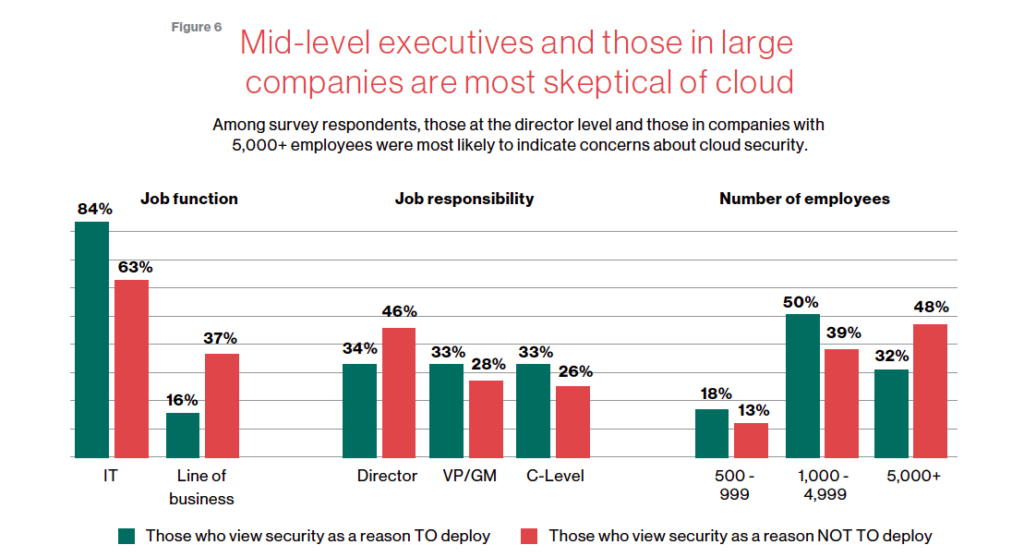
The age of unthinking fears about cloud security is over. Not only is cloud adoption rising steadily across geographies, industries and job functions, but confidence in cloud security is rising as well — to the point where increased security is a major reason enterprises opt for cloud solutions.
Gone are the days when organizations accessed applications and infrastructure over the internet only because it was the least expensive way to scale compute, storage and networking resources as business needs changed. The cloud today is a strategic necessity, with increased agility, integration and speed (as well as security) being the prime drivers of its increased adoption.
This MIT SMR survey of security professionals studies trends in security, which workloads are seeing the highest cloud utilization, the steady growth of comfort with cloud security–and interestingly paints a picture of the executives who are holding out with regards to cloud security.
Download the report now!
Google Cloud Accelerates Financial Organizations’ Journey towards Digital Transformation

10479
Of your peers have already read this article.
2:00 Minutes
The most insightful time you'll spend today!
When I reflect back on the past year and the pandemic, I’m struck by how the reliance on remote work and operations has changed the fundamentals of business forever. For the financial services industry, this rings particularly true. Many conversations I’m having right now with organizations revolve around embracing a transformation cloud, and thinking of cloud computing not just as an infrastructure decision, but also as the locus for transformation throughout the company.
Today, as we welcome the industry to our Financial Services Summit, we’ll demonstrate just how Google Cloud accelerates a financial organization’s digital transformation through app and infrastructure modernization, data democratization, people connections, and trusted transactions. We hope you’ll join us.
How we’re helping financial services firms build their transformation clouds
At Google Cloud, we continue to focus on areas where we can bring the best of our capabilities to banking, capital markets, insurance, and payments customers around the world. Our work with financial services industry customers has given us a deep understanding of the real-world, specific use cases that matter most to them. This groundwork led us to engineer products and solutions that are open and flexible, not ones that force them to rip out existing investments in ERP or other early IaaS cloud implementations.
It’s why we’ve engineered solutions such as Lending DocAI, Open Banking with Apigee, and Datashare for financial services to help transform the industry. These solutions were created with our customers’ security and compliance top-of-mind and are built at the intersection of user-optimized experience, technology, and sovereignty.
At their core, financial institutions want to drive growth, reduce costs, mitigate risk, stay compliant, and increase efficiency. As a result, when we partner with them on their transformation journeys, we consider three essential focus areas:
- Enabling the human experience and connected interactions
- Building an open and intelligent data foundation for better insights
- Providing the most trusted and secure cloud in the industry
Enabling humans and connected interactions
A company’s transformation is about more than technology; people and culture ultimately drive change. HSBC, for example, recognized its business users would benefit from guided answers to common questions around risk policy compliance, and turned to Google Cloud to leverage AI and machine learning bots to assist employees, ease the burden on policy experts, and improve the user experience. Using Dialogflow, a core component of Contact Center AI, HSBC was able to build a conversational platform that quickly and accurately addresses user needs at scale.
Another example is Equifax, which used Google Workspace to support collaboration not only internally between employees, but also externally with customers. Customers can use Google Cloud solutions for financial services to build these sorts of technology-enabled human interactions quickly and easily—supporting organizational change at scale.
Building an open and intelligent data foundation for smarter, faster insights
The real impact of Google Cloud solutions for financial services comes when the whole company has access to the right information at the right time, and can act more intelligently on that data. Our solutions help businesses safely leverage their data and get a complete 360-degree view of their customers’ information, which can often be scattered across multiple systems (CRM, lending, credit, etc.). This helps financial institutions improve the overall customer experience—and sometimes even develop new products quickly.
Indeed, all financial institutions are looking for ways to grow revenue and reduce expenses, and data can be a critical ingredient to doing both effectively. As daily transactions rise, so does the volume and complexity of data. But to implement new customer experience innovations (and new revenue streams), financial institutions must first capture data effectively. This is why AXA Switzerland, for example, uses real-time analytics on Google Cloud to gain cross-industry insights about future trends and customer preferences.
Financial services organizations also need the confidence of building on a platform that provides choice, flexibility, and agility to move fast. It’s why we have an open cloud approach that allows Google Cloud services to run in different physical locations such as on-premises, other public clouds, and the edge. Customers can also harness the power of data and AI through our open APIs, machine-learning services, and analytics engines on any major cloud platform. This is why companies like Macquarie Bank are taking advantage of Google Cloud’s open, hybrid architecture to modernize and empower its developers.
Compliant and secure to address risk and regulatory needs
As a highly regulated industry, financial services is focused on security and compliance, risk and regulations, and fraud detection and prevention. Google Cloud offers unique capabilities to earn customers’ trust as part of our continuing work to be the most trusted cloud in the industry. Google Cloud provides a secure foundation that you can verify and independently control. Our cloud technology reduces risk and data loss, because it is built on comprehensive zero-trust architecture. Finally, we offer a shared-fate model built on best practices in risk management via automation, guidance, and insurance. This is why customers like BBVA have confidence anywhere their systems may operate.
On the regulatory front, global legislators and regulators continue to focus on the stability of the industry that only a decade ago went through one of the biggest liquidity crises in history. With this oversight comes strong expectations of risk mitigation. Google Cloud offers a single, global set of controls, reviewed by financial institutions and regulators around the world, and verified in collaborative audits—making compliance simpler and less costly for our customers.
Finally, Google Cloud allows financial services firms to operate confidently with advanced security tools that help protect data, applications, and infrastructure, as well as their customers from fraudulent activity, spam, and abuse. We help protect your data against threats, using the same infrastructure and security services we use for our own operations, ensuring you never have to trade-off between ease of use and security. Google Cloud encrypts data at-rest and in-transit. And we now also offer the ability to encrypt data-in use, while it’s being processed for customer VM and container workloads.
Let us help you with your transformation cloud journey
We’ve seen leading financial services companies embrace Google Cloud to help them move beyond infrastructure toward the next phase of their cloud evolution. This is an era where no company is better positioned to lead than Google Cloud, and we’re excited to help you with your journey.
Learn more about Google Cloud for financial services.
Latest News: Secure Digital Infrastructure Services with Apigee Advanced API Security for Google Cloud

4476
Of your peers have already read this article.
3:30 Minutes
The most insightful time you'll spend today!
Organizations in every region and industry are developing APIs to enable easier and more standardized delivery of services and data for digital experiences. This increasing shift to digital experiences has grown API usage and traffic volumes. However, as malicious API attacks also have grown, API security has become an important battleground over business risk.
To help customers more easily address their growing API security needs, Google Cloud is announcing today the Preview of Advanced API Security, a comprehensive set of API security capabilities built on Apigee, our API management platform. Advanced API Security enables organizations to more easily detect security threats. Here’s a closer look at the two key functionality included in this launch: identifying API misconfigurations and detecting bots.
Identify API misconfigurations
Misconfigured APIs are one of the leading reasons for API security incidents. In 2017, Gartner® predicted that by 2022 API abuses will be the most frequent attack vector resulting in data breaches for enterprise web applications. Today, our customers tell us application API security is one of their top concerns, which is supported by an independent study from 2021 by Fugue and Sonatype. The report found that misconfigurations are the number one cause of data breaches, and that “too many cloud APIs and interfaces to adequately govern” are frequently the main point of attack in cyberattacks.
While identifying and resolving API misconfigurations is a top priority for many organizations, the configuration management process can be time consuming and require considerable resources.
Advanced API Security can make it easier for API teams to identify API proxies that do not conform to security standards. To help identify APIs that are misconfigured or experiencing abuse, Advanced API Security regularly assesses managed APIs and provides API teams with a recommended action when configuration issues are detected.
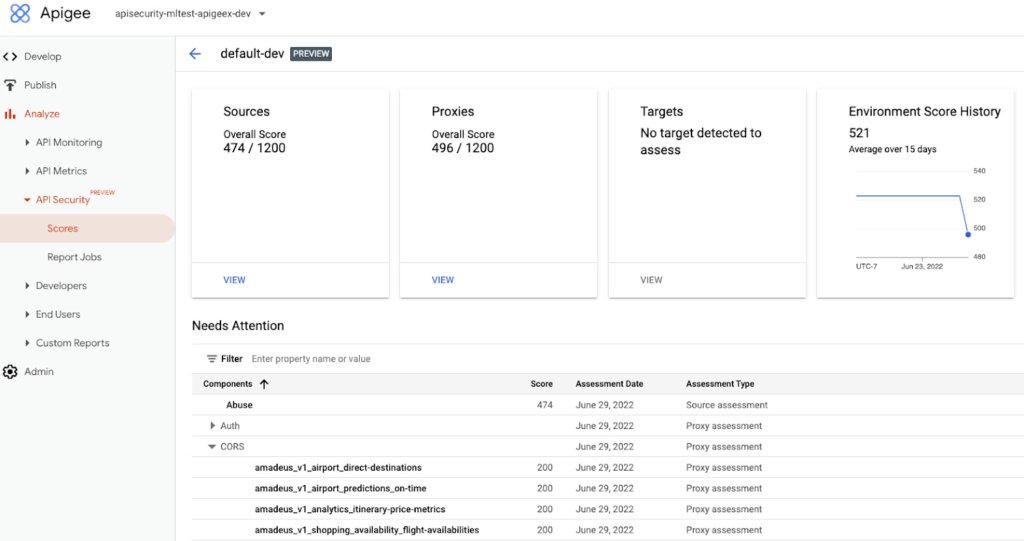
Advanced API Security identifies misconfigured API proxies, including the missing CORS policy.
APIs form an integral part of the digital connective tissue that make modern medicine run smoothly for patients and healthcare staff. One common healthcare API use case occurs when a healthcare organization inputs a patient’s medical coverage information into a system that works with insurance companies. Almost instantly, that system determines the patient’s coverage for a specific medication or procedure, a process which is enabled by APIs. Because of the often-sensitive personal healthcare data being transmitted, it is important that the required authentication and authorization policies are implemented so that only authorized users, such as an insurance company, can access the API.
Advanced API Security can detect if those required policies have not been applied, an alert which can help reduce the surface area of API security risks. By leveraging Advanced API Security, API teams at healthcare organizations can more easily detect misconfiguration issues and can reduce security risks to sensitive information.
Detect Bots
Because of the increasing volume of API traffic, there is also an increase in cybercrime in the form of API bot attacks—the automated software programs deployed over the Internet for malicious purposes like identity theft.
Advanced API Security uses pre-configured rules to help provide API teams an easier way to identify malicious bots within API traffic. Each rule represents a different type of unusual traffic from a single IP address. If an API traffic pattern meets any of the rules, Advanced API Security reports it as a bot.
Additionally, Advanced API Security can speed up the process of identifying data breaches by identifying bots that successfully resulted in the HTTP 200 OK success status response code.
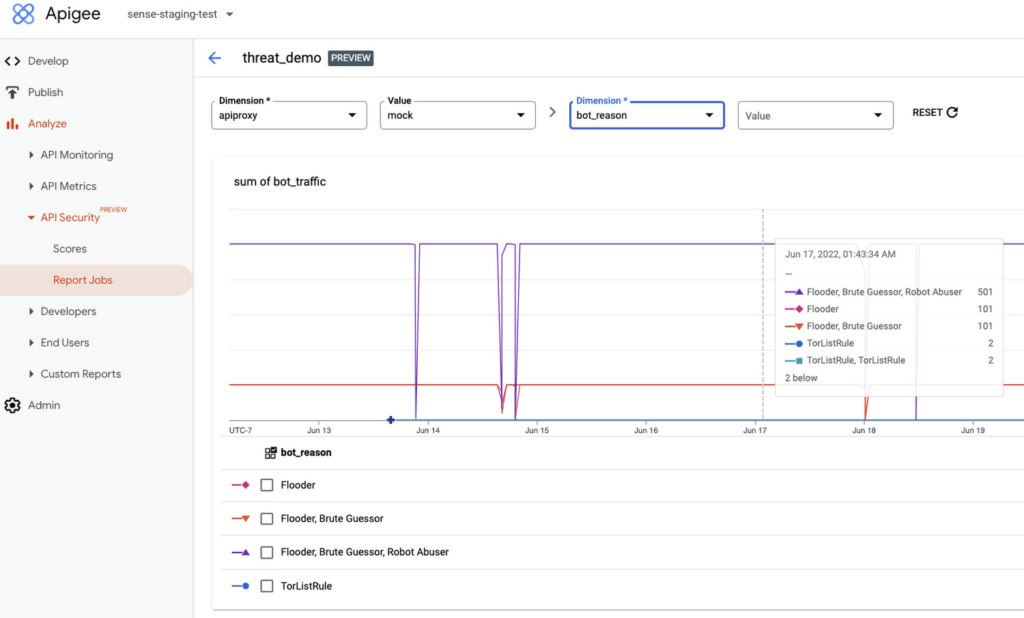
Financial services APIs are frequently the target of malicious bot attacks due to the high-value data that is processed. A bank that has adopted open banking standards by making APIs accessible to customers and partners can use Advanced API Security to make it easier to analyze traffic patterns and identify the sources of malicious traffic. You may experience this when your bank allows you to access your data with a third-party application. While a malicious hacker could try to use a bot to access this information, Advanced API Security can help the bank’s API team to identify and stop malicious bot activity in API traffic.
API Security at Equinix
Equinix powers the world’s digital leaders, bringing together and interconnecting infrastructure to fast-track digital advantage. Operating a global network of more than 240 data centers with a 99.999% or greater uptime, Equinix simplifies global interconnections for organizations, saving customers time and effort with the Apigee API management platform.
“A key enabler of our success is Google’s Apigee, delivering digital infrastructure services securely and quickly to our customers and partners,” said Yun Freund, senior vice president of Platform at Equinix. “Security is a key pillar to our API-first strategy and Apigee has been instrumental in enabling our customers to securely bridge the connections they need for their businesses to easily identify potential security risks and mitigate threats in a timely fashion. As our API traffic has grown, so has the amount of time and effort required to secure our APIs. Having a bundled solution in one managed platform gives us a differentiated high-performing solution.”
Getting started
To learn more, check out the documentation or contact us to request access to get started with Advanced API Security.
To learn more about API security best practices, please register to attend our Cloud OnAir webcast on Thursday, July 28th, 2:00 pm PT.
Google Cloud & Siemplify Join Forces to Empower Companies to Manage Threat Responses Better

2977
Of your peers have already read this article.
1:30 Minutes
The most insightful time you'll spend today!
At Google Cloud, we are committed to advancing invisible security and democratizing security operations for every organization. Today, we’re proud to share the next step in this journey with the acquisition of Siemplify, a leading security orchestration, automation and response (SOAR) provider. Siemplify shares our vision in this space, and will join Google Cloud’s security team to help companies better manage their threat response.
In a time when cyberattacks are rapidly growing in both frequency and sophistication, there’s never been a better time to bring these two companies together. We both share the belief that security analysts need to be able to solve more incidents with greater complexity while requiring less effort and less specialized knowledge. With Siemplify, we will change the rules on how organizations hunt, detect, and respond to threats.
Providing a proven SOAR capability unified with Chronicle’s innovative approach to security analytics is an important step forward in our vision. Building an intuitive, efficient security operations workflow around planet-scale security telemetry will further realize Google Cloud’s vision of a modern threat management stack that empowers customers to go beyond typical security event and information management (SIEM) and extended detection and response (XDR) tooling, enabling better detection and response at the speed and scale of modern environments.
“We’re excited to join Google Cloud and build on the success we’ve had in the market helping companies address growing security threats,” said Amos Stern, CEO at Siemplify. “Together with Chronicle’s rich security analytics and threat intelligence, we can truly help security professionals transform the security operations center to defend against today’s threats.”
The Siemplify platform is an intuitive workbench that enables security teams to both manage risk better and reduce the cost of addressing threats. Siemplify allows Security Operation Center analysts to manage their operations from end-to-end, respond to cyber threats with speed and precision, and get smarter with every analyst interaction. The technology also helps improve SOC performance by reducing caseloads, raising analyst productivity, and creating better visibility across workflows.
We plan to invest in SOAR capabilities with Siemplify’s cloud services as our foundation and the team’s talent leading the way. Our intention is to integrate Siemplify’s capabilities into Chronicle in ways that help enterprises modernize and automate their security operations.
We’re looking forward to welcoming the Siemplify team to Google Cloud and working with them to help security operations teams accomplish so much more in defense of their organizations. You can read Siemplify CEO Amos Stern’s blog for more on this exciting news.
More Relevant Stories for Your Company

Manage IAM permissions with the Google Cloud mobile app
What’s new with Permissions Management on the Cloud Mobile App Identity and Access Management (IAM) is the foundation of a strong cloud security posture, ensuring that the right access and permissions for cloud resources are granted across your organization. The Google Cloud mobile app gives cloud administrators the ability to quickly and easily

Know the Leaders of Google Cloud Public Sector Community
At Google Cloud, being a strategic partner is part of our DNA. Whether it’s listening closely to our customers, helping to build team skills for innovation or simply being there (since we know the cloud is 24/7), we get excited about working hands-on with customers to deliver new solutions. As

New Study Suggests Public Sector Firms Must Move Over Legacy Productivity Tools
Prior to joining Google Cloud, I spent 20 years in the public sector serving in various security roles, most recently as the head of the cybersecurity division at the newly established Cybersecurity and Infrastructure Security Agency (CISA). I was responsible for delivering services and capabilities to about 100 civilian agencies,

SEED: The 4 Areas of a Well-functioning and Responsible AI
The future of AI is better AI—designed with ethics and responsibility built in from the start. This means putting the brakes on AI-driven transformation until you have a well-functioning strategy and process in place to ensure your models deliver fair outcomes. Failing to recognize this imperative is a threat to
