





SEED: The 4 Areas of a Well-functioning and Responsible AI

4334
Of your peers have already read this article.
2:00 Minutes
The most insightful time you'll spend today!
The future of AI is better AI—designed with ethics and responsibility built in from the start. This means putting the brakes on AI-driven transformation until you have a well-functioning strategy and process in place to ensure your models deliver fair outcomes. Failing to recognize this imperative is a threat to your bottom line. The following post provides a simple framework to follow to keep your business on the right track as you place more trust in algorithms.
AI is inherently sociotechnical. AI systems represent the interconnectedness of humans and technology. They are designed to be used by and to inform humans within specific contexts, and the speed and scale of AI means that any lack of responsibility—such as bias, safety, privacy, scientific excellence etc—will also replicate at that same speed and scale. Without ethics and responsibility built in by design, AI systems lack the critical “inputs” or societal context that enable long term success.
Lawsuits stemming from AI systems that are biased towards certain groups are stacking up. In August 2020, IBM was forced to settle a lawsuit with the city of Los Angeles for misappropriating data it collected for its weather channel app. Health services company, Optum, is being investigated by regulators for creating an algorithm that allegedly recommended that doctors and nurses pay more attention to white patients than to sicker black patients. And Facebook, which granted Cambridge Analytica, a political firm, access to the personal data of more than 50 million people, is buried in legal work. Google has also run into its share of issues with algorithms making egregious mistakes.
While lawsuits are real, the foundational reason ethical AI is critical to your bottom line is trust. Without it, increasingly, consumers will ignore you and choose a brand they do trust. Research from Kantar, which runs one of the largest global brand equity studies (4 million consumers, 18,000 brands, across 50 markets), revealed that almost 9% of a brand’s equity is driven by corporate reputation, of which responsibility is a key attribute. Over the last decade, the importance of responsibility to consumers in relation to making brand choices has tripled.
The study stated brands perceived to be among the world’s most trusted and responsible shared three crucial factors that proved particularly important for building consumer trust and confidence, even when a brand might be new to a market. These are:
- Honesty and openness
- Respect and inclusion
- Identifying with and caring for customers
Brands that develop these associations more strongly tend to outperform their competitors in defending and growing their brand value.
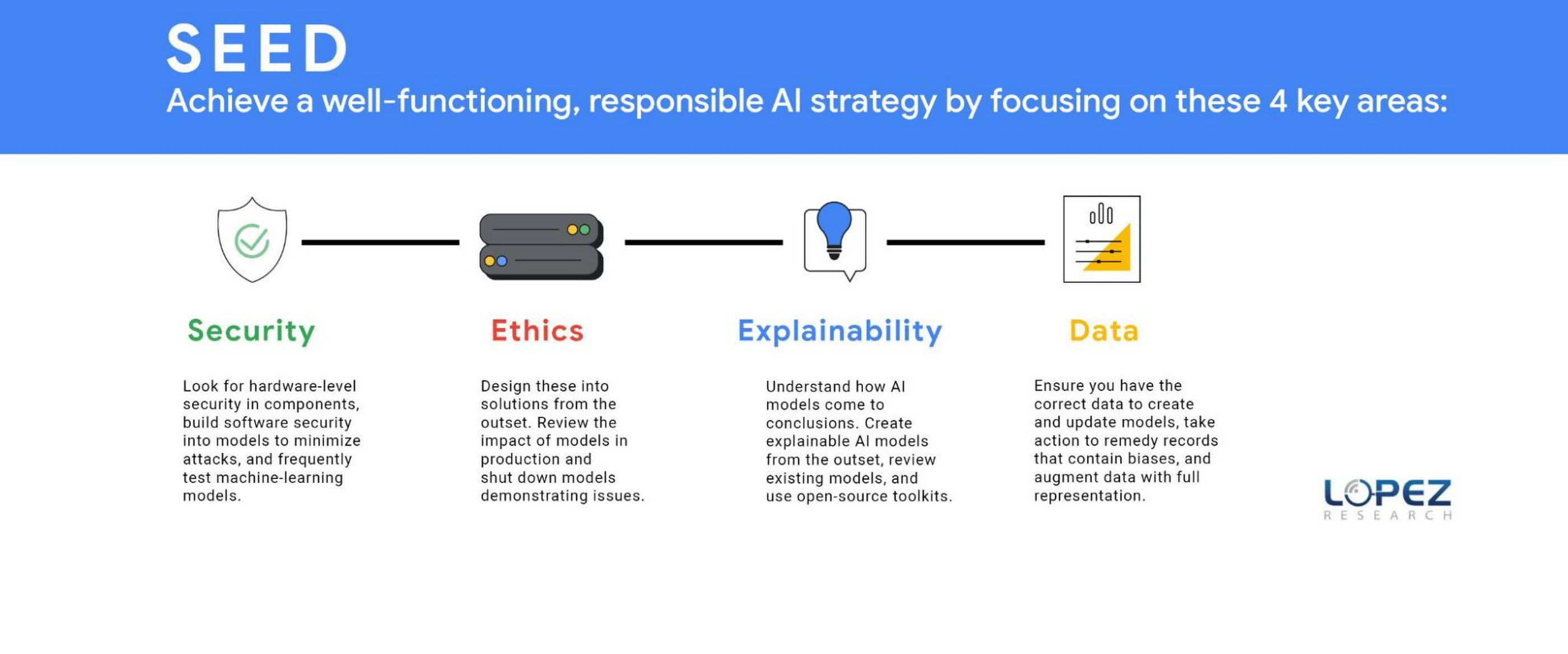
Technology and business leaders need to focus on four areas to accomplish a well-functioning ethical AI strategy. Lopez Research refers to this group of tasks as SEED, which stands for security, ethics, explainability, and data (SEED). Each of these topics could be an article in itself, but this post will define several essential components.
SECURITY (S)
It might not seem obvious, but a robust AI strategy requires an embedded security strategy. Companies should look for hardware-level security in components such as GPUs and CPUs. IT leaders should build software security into models to minimize attacks such as poisoning, evasion, deepfakes, backdoors, and model extraction. The threat of adversarial data poisoning attacks machine learning models by maliciously introducing inaccurate data designed to corrupt the model’s ability to be accurate. Another security threat is model extraction, also known as model cloning, where a hacker finds a way to either reconstruct a black-box machine learning model or extract the training data. The first line of defense against all security attacks is to design security at the outset, but the next best step is to frequently test models to ensure they are operating as planned. Business leaders, data science experts, and IT leaders must work together to regularly review the outcomes of AI models.
ETHICS (E)
Today, organizations must understand that ethics should be designed into the solution at its outset. The ethics process starts with defining the potential positive and negative outcomes of the model that your business is creating. Once the team has evaluated potential harmful effects, which means unpacking the systems, beliefs, power hierarchies and dynamics that interconnect with the technology, it’s your responsibility to eliminate or minimize the impact of these outcomes. It’s also critically important to review the impact of models in production and shut down models demonstrating issues. An example of this was the public beta release of the Tay chatbot that Microsoft deployed and rapidly shut down because it propagated negative biases.
Yet, many organizations aren’t taking this action. The FICO study revealed that 93% of companies said responsible AI was critical for success but only 33% of these companies were measuring AI model outputs to ensure these models were operating as expected (measuring for model drift). Another survey by Pew Research revealed that 68% believe that ethical principles focused primarily on the public good will not be employed in most AI systems by 2030.
Regulations may turn this tide, regardless of whether organizations plan to adopt an ethical AI framework. Laws governing the ethical use of data in AI are expected to be finalized as soon as 2022, such as the European Commission’s proposed legal framework for AI. Organizations that start with ethical use of AI in mind will be better positioned to deal with customer privacy concerns and regulatory compliance.
EXPLAINABILITY(E)
As models have become more sophisticated, it’s also become increasingly difficult to explain why a model created a specific outcome. In the FICO Responsible AI report, 65% of respondents could not explain how specific AI model decisions or predictions are made, and only 35% said their organization made an effort to use AI in a way that was transparent and accountable. However, it’s never been more important to clarify how AI models came to conclusions such as why a loan was denied, why a particular strategy should be implemented, and how AI selected a set of resumes to review for a position. The goal is to create an explainable AI model from the outset but many of today’s models lack this capability. Every business should review its existing models and use open-source toolkits that can be found on Github.com that support the interpretability and explainability of machine learning models.
Keep in mind that explainability isn’t one-size-fits-all. Different stakeholders need different types of information. Much of explainability to date has focused on “opening the black box” which gets equated to information that is only useful for other data scientists. That’s important, but it doesn’t help the line of business users whose workflows AI is integrated into, or end users who deserve information about how decisions are made; or policymakers who don’t have data science backgrounds, and so on.
DATA (D)
An equally important item in ethics is data. Ethics starts with ensuring you have the correct data to create and update models. Three main issues include representative data, inherent biases within existing data, and inaccurate data. A critical issue that most companies miss in creating models is that current data sets frequently lack full market representation. A recent Capgemini Research Institute report revealed that 65% of executives “were aware of the issue of discriminatory bias” with these systems.
Awareness is the first step, but organizations must take action to remedy this issue. Historical data may no longer serve a company’s current needs for model creation. Historical records may contain biases against certain groups. For example, historical criminal data records show an imbalance in ethnic groups’ incarceration, which would lead to model biases. Additionally, laws and societal norms also change. Certain groups were prosecuted for sexual preference in the past, but today this information would create an inaccurate model.
Companies have also discovered that using demographic data, a common practice in marketing, can also lead to model bias. For example, individuals that primarily used cash for transactions and others that lived in specific zip codes were at a disadvantage in banking models to determine creditworthiness. To minimize these issues, a company needs to augment its data with full representation in areas such as ethnicity, gender, age, behavioral and economic profiles.

Design AI models with a continuous feedback loop
Another, more prominent, yet tricky issue is data accuracy. As the adage says, garbage in, equals garbage out. The least appreciated but arguably the most essential component of the AI model lifecycle is ensuring the model has accurate data at all times. Inaccurate data from either poor data hygiene or data that was tampered with for security purposes can cause model failures. Organizations need to invest the time and resources to ensure they have the correct data. Data privacy is another key element that businesses must address, but the concepts of data privacy, sovereignty, and security are significant enough that we will come back to this in a separate article.
Overall, it’s clear that while we may have an abundance of data, it most likely doesn’t represent what we want to model for the future. A successful AI strategy is an ethical AI strategy that requires the organization to be thoughtful in its model creation by ensuring it has a broad representation of accurate data and testing the outcomes to ensure the models are secure and operating as expected.
Organizations that define an AI model lifecycle with a continuous feedback loop will reap the benefits of better intelligence. This will increasingly mean stronger, longer lasting trust with customers and staying on the right side of new laws and regulations.
Google Cloud is Every Retailer’s Most Trusted Cloud

6622
Of your peers have already read this article.
3:00 Minutes
The most insightful time you'll spend today!
Whether they were ready for it or not, the COVID-19 pandemic transformed many retailers into digital businesses. Retailers made huge investments into commerce technologies, customer experience tools, sales and fulfillment technology, and improving digital experiences to continue providing their goods and services to their customers. Now, more than a year into the COVID-19 pandemic, digital retail is the new normal. In fact, many retailers are planning on expanding their digital investments. However, as their digital footprint expands, so do their threats and security concerns.
As a digital-focused retailer, your website is the most visible part of your attack surface. Your website is where your customers search for goods or services, make payments, or learn more about your brand. However, your website does not operate in isolation. There is an underlying infrastructure as well as the services that run on top of it that need protection from a wide array of attacks that may seek to compromise your data, internal employees, business, and customers. During this week’s Google Cloud Retail Summit, we’ve shared why Google Cloud is built to be the most trusted cloud for retailers. From providing you with control over your data as you move from your own data centers to the public cloud to giving you built-in technology to protect your applications all the way to your end users, Google Cloud helps you safely migrate to and operate in our Trusted Cloud.
Trusted Cloud Gives You Control, Transparency, and Sovereignty
- Access Transparency: We offer the ability to monitor and approve access to your data or configurations by Google Cloud support and engineering based on specific justifications and context, so you have visibility and control over insider access.
- Certificate Authority Service (CAS): CAS is a highly scalable and available service that simplifies and automates the management and deployment of private CAs while meeting the needs of modern developers and applications. With CAS, you can offload to the cloud time-consuming tasks associated with operating a private CA, like hardware provisioning, infrastructure security, software deployment, high-availability configuration, disaster recovery, backups, and more, allowing you to stand up a private CA in minutes, rather than the months it might normally take to deploy.
- Confidential Computing: We already encrypt data at-rest and in-transit, but customer data needs to be decrypted for processing. Confidential Computing is a breakthrough technology which encrypts data in-use—while it’s being processed. Confidential VMs take this technology to the next level by offering memory encryption so that you can further isolate your workloads in the cloud. With the beta launch of Confidential VMs, we’re the first major cloud provider to offer this level of security and isolation while giving you a simple, easy-to-use option for your newly built and “lift and shift” applications.
- Cloud Key Management: We allow you to configure the locations where your data is stored, where your encryption keys are stored, and where your data can be accessed from. We give you the ability to manage your own encryption keys, even storing them outside Google’s infrastructure. Using our External Key Management service, you have the ability to deny any request by Google to access encryption keys necessary to decrypt customer data at rest for any reason.
Trusted cloud Helps You Prevent, Detect, and Respond to Threats
- BeyondCorp Enterprise is Google’s comprehensive zero trust product offering. Google has over a decade of experience managing and securing cloud applications at a global scale, and this offering was developed based on learnings from our experience managing our own enterprise, feedback from customers and partners, as well as informed by leading engineering and security research. We understand that most customers host resources across different cloud providers. With this in mind, BeyondCorp Enterprise was purpose-built as a multicloud solution, enabling customers to securely access resources hosted not only on Google Cloud or on-premises, but also across other clouds such as Azure and Amazon Web Services (AWS).
- Cloud Armor: We’re simplifying how you can use Cloud Armor to help protect your websites and applications from exploit attempts, as well as Distributed Denial of Service (DDoS) attacks. With Cloud Armor Managed Protection Plus, you will get access to DDoS and WAF services, curated rule sets, and other services for a predictable monthly price.
- Chronicle: Chronicle is a threat detection solution that identifies threats, including ransomware, at unparalleled speed and scale. Google Cloud Threat Intelligence for Chronicle surfaces highly actionable threats based on Google’s collective insight and research into Internet-based threats. Threat Intel for Chronicle allows you to focus on real threats in the environment and accelerate your response time.
- Google Workspace Security: Used by more than five million organizations worldwide, from large banks and retailers with hundreds of thousands of people to fast-growing startups, Google Workspace and Google Workspace for Education include the collaboration and productivity tools found here. Google Workspace and Google Workspace for Education are designed to help teams work together securely in new, more efficient ways, no matter where members are located or what device they use. For instance, Gmail scans over 300 billion attachments for malware every week and prevents more than 99.9% of spam, phishing, and malware from reaching users. We’re committed to protecting against security 1 threats of all kinds, innovating new security tools for users and admins, and providing our customers with a secure cloud service.
- Identity & Access Management IAM: Identity and Access Management (IAM) lets administrators authorize who can take action on specific resources, giving you full control and visibility to manage Google Cloud resources centrally. For enterprises with complex organizational structures, hundreds of workgroups, and many projects, IAM provides a unified view into security policy across your entire organization, with built-in auditing to ease compliance processes.
- reCAPTCHA Enterprise: reCAPTCHA has over a decade of experience defending the internet and data for its network of more than 5 million sites. reCAPTCHA Enterprise builds on this technology with capabilities, such as two-factor authentication and mobile application support, designed specifically for enterprise security concerns. With reCAPTCHA Enterprise, you can defend your website against common web-based attacks like credential stuffing, account takeovers, and scraping and help prevent costly exploits from malicious human and automated actors. And, just like reCAPTCHA v3, reCAPTCHA Enterprise will never interrupt your users with a challenge, so you can run it on all webpages where your customers interact with your services.
- Security Command Center: With Security Command Center (SCC), our native posture management platform, you can prevent and detect abuse of your cloud resources, centralize security findings from Google Cloud services and partner products, and detect common misconfigurations, all in one easy-to-use platform. We have Premium tier for Security Command Center to provide even more tools to protect your cloud resources. It adds new capabilities that let you spot threats using Google intelligence for events in Google Cloud Platform (GCP) logs and containers, surface large sets of misconfigurations, perform automated compliance scanning and reporting. These features help you understand your risks on Google Cloud, verify that you’ve configured your resources properly and safely, and document it for anyone who asks.
- VirusTotal: VirusTotal inspects items with over 70 antivirus scanners and URL/domain blocklisting services, in addition to a myriad of tools to extract signals from the studied content. Any user can select a file from their computer using their browser and send it to VirusTotal.
- Web Risk API: With Web Risk, you can quickly identify known bad sites, warn users before they click infected links, and prevent users from posting links to known infected pages from your site. Web Risk includes data on more than a million unsafe URLs and stays up to date by examining billions of URLs each day.
Trusted cloud Plays an Active Role in Our Shared Fate
Our trusted cloud provides a shared-fate model for risk management. We stand with retailers from day one, helping them implement best practices for safely migrating to and operating in our trusted cloud.
We hope you enjoy the sessions we’ve created for you with Google Cloud Retail Summit and that they help you understand the ways our trusted cloud can help secure retailers all over the world.
Connected Data is the Lifeblood of Today’s Retailers: IDC’s 2022 Research

4695
Of your peers have already read this article.
4:00 Minutes
The most insightful time you'll spend today!
For a look ahead at the trends that will animate the retail industry this year, let’s take a look back at the 2022 National Retail Federation (NRF) “Big Show” in NYC.
Attendees at January’s event were treated to tangible examples of how retail challenges are being solved today, including new solutions to help them parse customer expectations and buying patterns, adapt stores into omni-channel experience hubs, and improve data visibility and actionability.
NRF 2022 also took the “omni-channel everything” theme of last year’s show to the logical next level: Enabling the best hybrid experiences. The message came through loud and clear of the importance of integration and interoperability in this new hybrid world – making everything work well together.
The need for modern digital infrastructure to enable this blending of physical and digital retail smoothly is paramount. To that end, technology vendors demonstrated how digital transformation initiatives, such as contactless and real time IoT and mobile applications, need to be built on cloud, edge, and secure connectivity to allow retailers to achieve the modern seamless hybrid retail that today’s consumer wants.
Other prominent themes and technologies highlighted at NRF included: extending engagement in the metaverse, sustainability, physical and digital security, and the agility and adaptability imperative.
The Metaverse and Hybrid (Omni-channel) Experiences
Today, the metaverse is an extension of our lives, enhanced by technology, which exists as a series of virtual worlds. In the future, the metaverse will be an interconnected, endless world where digital and physical lives fully converge. Imagine waiting for an appointment at a real booth on the NRF show floor while your avatar roams a fully fleshed-out digital NRF, meeting other virtual attendees, stopping for coffee at the digital Starbucks, and paying for a coffee that an in-the-flesh Starbucks employee brings to them. Digital and physical selves merge seamlessly in the metaverse, as the worlds draw closer together.
In the metaverse, brands have a digital presence, too. Nike filed seven trademarks late last year, including those for “Nike,” “Just Do It,” and its swoosh logo, and posted openings for virtual designer roles, indicating its intent to make and sell virtual branded sneakers and apparel. It subsequently purchased RTFKT Studios, a company that already makes and sells NFTs and digital sneakers. (In one collaboration with teenage artist FEWOCiOUS, the company sold 600 pair/NFTs of sneakers in just six minutes to the tune of more than $3.1 million.)
The metaverse also opens possibilities for gathering data about consumers and product demand. Imagine a sneaker drop in the virtual world. Certain styles of new kicks sell like gangbusters, giving the brand insight into what might sell IRL, intelligence that leads to trend-right production and less inventory headed for markdown or landfills. The metaverse can be a vehicle for more sustainable operations.
The metaverse further bridges the narrowing gap between digital worlds and physical worlds. Most consumers aren’t outfitting an avatar, but they are moving between online and offline and expect retailers to accommodate those hybrid omni-channel journeys seamlessly. Those demands have accelerated around last-mile delivery and experiences such as buying online and picking up in store (BOPIS) or at curbside, shopping in store and returning merchandise online, adding items to a BOPIS purchase when at the store, or communicating a substitution to the third-party grocery delivery service
Hybrid experiences open opportunities to please the consumer in new ways, but they also add expense and complexity. The need to meet this demand while enabling profitability was a major theme behind many of the technologies discussed at NRF. These included artificial intelligence (AI) for recommending the right product, return logistics software for defining and guiding product-specific reverse logistics workflows, order orchestration and fulfillment applications for omni-channel shopping, and last-mile delivery visibility for optimizing customer experience, to name a few. Also on display were task management applications help to improve and optimize in-store employee engagement, as well as touch-free applications to allow for faster payments and customer self-service checkout. RFID continues to improve inventory accuracy and inventory locating on the shelf, throughout the store, and the supply chain.
Sustainability
NRF 2022 saw a strong focus on sustainability. An NRF/IBV study released at the show highlighted the significant embrace of sustainable shopping by consumers. According to the survey, 62% of shoppers are “willing to change their purchasing habits to reduce environmental impacts.” About half indicated a willingness to pay a premium – on average a 70% premium – for sustainable products and brands.
Retailers are working to improve sustainability and reduce carbon footprint across operations by using sustainable sourcing through the supply chain, the store, and even returns. Tech vendors unveiled a variety of solutions enabled by cloud/edge, AI, computer vision, and IoT/RFID to allow retailers to effectively measure and record their environmental efforts, with the goal of reducing their impact.
Several cloud and digital infrastructure providers showcased sustainability clouds and other technology aimed at asset management with the goal of reducing energy consumption, water usage, waste. Examples included using IoT sensors to reduce water usage, optimizing re-use of store assets, and dashboards that allow retailers to accurately monitor and measure carbon output. However, such sustainability solutions can be most successful when running on the next-generation digital infrastructure that helps retailers better compete and differentiate in today’s omni-channel world.
Physical and Digital Security
According to a 2021 NRF survey, 57% of U.S. retailers reported the pandemic led to an increase in organized retail crime, while 50% reported an increase in shoplifting. When IDC’s Future Enterprise Resiliency & Spending Survey, Wave 10 (November 2021) asked retailers which digital infrastructure investments would provide the greatest strategic advantage in 2022, their #1 response was “cybersecurity and recovery investments.”
A wide range of technology vendors acknowledged retailer concerns with regards to security, fraud, and loss prevention:
- Networking, connectivity, and edge vendors highlighted multilayer security solutions that promise to protect data from a range of IoT applications that utilize customer and associate data. Many offer security consulting services to address varied threats including ransomware, retail crime, and loss prevention.
- Security and e-commerce security vendors showcased solutions to prevent fraud and abuse in e-commerce applications as well as omni-channel applications such as BOPIS and curbside pickup, using AI-based analysis for identifying “bad”/risky customers and mitigating risk.
- Cloud vendors highlighted how retail clouds provide consistent, reliable identity management and data security.
- POS/payments/store technology vendors emphasized their ability to handle payments securely from any platform with multifactor tokenization, improved identity techniques such as biometrics and voice authentication, as well as AI-enabled and computer vision solutions for loss prevention at checkout and at the door.
The Agility and Adaptability Imperative
On display at the show were multiple flavors of the digital infrastructure technology that retailers need to achieve agile, personalized, data-driven, integrated seamless operations across the many channels of today’s retail landscape. The emphasis was apt. More than half of retailers plan to boost investment in business agility and operational agility over the next 12 months, according to IDC’s Future Enterprise Resiliency & Spending Survey, Wave 10 (November 2021).
Technology vendors highlighted their connectivity investments to enable business and operational agility and their technology investments for better ease of integration, scalability, and the ability to more easily swap out or mix and match applications with integrated platforms, open systems, hybrid cloud, and retail industry clouds.
Vendors also showed off infrastructure to better harness data while enabling its visibility, maximizing its value, and providing the data-driven personalization essential for competitive advantage and differentiation. Highlights included fast, secure connectivity, 5G and Wifi-6, and edge- and cloud-enabled data and AI platforms to generate real-time insights – all designed to enable today’s omni-channel retail.
Advice for the technology buyer
Retailers should consider these key themes from NRF 2022 when making technology investment decisions for 2022 and beyond. To avoid lagging behind those retailers already moving toward thriving into the future, take action to:
- Enable the seamless, contactless omni-channel approach that today’s consumers want and expect.
- Replace legacy infrastructure that was not built to handle the modern retail environment that requires the agility and adaptability to seamlessly connect rapidly increasing volumes of data securely and more quickly than ever.
Whether sustainability, adaptability, the metaverse, or security are top concerns, addressing business needs holistically and strategically should be job #1.
Continue the conversation by downloading our Transforming retail and CPG markets whitepaper today.
10 Reasons that Make Google Cloud the Champion of IaaS
10434
Of your peers have already read this article.
5:00 Minutes
The most insightful time you'll spend today!
When you choose to run your business on Google Cloud you benefit from the same planet-scale infrastructure that powers Google’s products such as Maps, YouTube, and Workspace.
We have picked 10 ways in which Google Cloud Infrastructure services outshine alternatives in the market in how they simplify your operations, save money, and secure your data.
1. Custom Machine Types means no wasted resources
Compute Engine offers predefined machine types that you can use when you create a VM instance. A predefined machine type has a preset number of vCPUs and a preset amount of memory; each type is billed at a set price as described on the Compute Engine pricing page.
If predefined machine types don’t meet your needs, you can create a VM instance with a custom number of vCPUs and custom amount of memory, effectively building a custom machine type. Custom machine types are available only for general-purpose machine families. When you create a custom machine type, you are deploying a custom machine type from the E2, N2, N2D, or N1 machine family on GCP. No other leading cloud vendor offers custom machine types so extensively.
Custom machine types are a good idea for workloads that aren’t a good fit for the predefined machine types and for workloads that require more processing power or memory but don’t need all of the upgrades provided by the next machine type level. This translates into lower operating costs. They are also useful for controlling software licensing costs that are based on the number of underlying compute cores.
Jeremy Lloyd, Infrastructure and Application Modernization Lead at Appsbroker, a Google partner:
“Custom machine types coupled with Google’s StratoZone data center discovery tool provides Appsbroker with the flexibility we need to provide cost efficient virtual machines matched to a virtual machine’s actual utilization. As a result, we are able to keep our customers’ operating costs low while still providing the ability to scale as needed.”
2. Compute Engine Virtual Machines are optimized for scale-out workloads
For scale-out workloads, T2D, the first instance type in the Tau VM family, is based on 3rd Gen AMD EPYC processors and leapfrogs VMs for scale-out workloads of any leading public cloud provider today, both in terms of performance and price-performance. Tau VMs offer 56% higher absolute performance and 42% higher price-performance compared to general-purpose VMs from any leading public cloud vendor (source). The x86 compatibility provided by these AMD EPYC processor-based VMs gives you market-leading performance improvements and cost savings, without having to port your applications to a new processor architecture. Sign up here if you are interested in trying out T2D instances in Preview.
For SAP HANA, Google Cloud has demonstrated with SAP how we can run the world’s largest scale-out HANA system in the public cloud (96TB). With such innovation, you are covered as your business grows exponentially.
3. Largest single node GPU-enabled VM
Google is the only public cloud provider to offer up to 16 NVIDIA A100 GPUs in a single VM, making it possible to train very large AI models. Users can start with one NVIDIA A100 GPU and scale to 16 GPUs without configuring multiple VMs for single-node ML training, without crossing the VM layer.
Additionally, customers can choose smaller GPU configurations—1, 2, 4 and 8 GPUs per VM—providing the flexibility to scale their workload as needed.
The A2 VM family was designed to meet today’s most demanding applications—workloads like CUDA-enabled machine learning (ML) training and inference, for example. This family is built on the A100 GPU which offers up to 20x the compute performance compared to the previous generation GPU and comes with 40 GB of high-performance HBM2 GPU memory. To speed up multi-GPU workloads, the A2 VMs use NVIDIA’s HGX A100 systems to offer high-speed NVLink GPU-to-GPU bandwidth that delivers up to 600 GB/s. A2 VMs come with up to 96 Intel Cascade Lake vCPUs, optional Local SSD for workloads requiring faster data feeds into the GPUs and up to 100 Gbps of networking. A2 VMs provide full vNUMA transparency into the architecture of underlying GPU server platforms, enabling advanced performance tuning. Google Cloud offers these GPUs globally.
4. Non-disruptive maintenance means you worry less about planned downtime
Compute Engine offers live migration (non-disruptive maintenance) to keep your virtual machine instances running even when a host system event, such as a software or hardware update, occurs. Google’s Compute Engine live migrates your running instances to another host in the same zone without requiring your VMs to be rebooted. Live migration enables Google to perform maintenance that is integral to keeping infrastructure protected and reliable without interrupting any of your VMs. When a VM is scheduled to be live-migrated, Google provides a notification to the guest that a migration is imminent.
Live migration keeps your instances running during:
- Regular infrastructure maintenance and upgrades
- Network and power grid maintenance in the data centers
- Failed hardware such as memory, CPU, network interface cards, disks, power, and so on. This is done on a best-effort basis; if a hardware component fails completely or otherwise prevents live migration, the VM crashes and restarts automatically and a hostError is logged.
- Host OS and BIOS upgrades
- Security-related updates
- System configuration changes, including changing the size of the host root partition, for storage of the host image and packages
Live migration does not change any attributes or properties of the VM itself. The live migration process transfers a running VM from one host machine to another host machine within the same zone. All VM properties and attributes remain unchanged, including internal and external IP addresses, instance metadata, block storage data and volumes, OS and application state, network settings, network connections, and so on. This has the benefit of reducing operational and maintenance overhead, helps you build a more robust security posture where infrastructure can be consciously revamped from a known good state and minimizes risks for advanced persistent threats.
Refer to Lessons learned from a year of using live migration in production on Google Cloud from the Google engineering team.
5. Trusted Computing: Shielded VMs guard you against advanced, persistent attacks
Establishing trust in your environment is multifaceted, involving hardware and firmware, as well as host and guest operating systems. Unfortunately, threats like boot malware or firmware rootkits can stay undetected for a long time, and an infected virtual machine can continue to boot in a compromised state even after you’ve installed legitimate software.
Shielded VMs can help you protect your system from attack vectors like:
- Malicious guest OS firmware, including malicious UEFI extensions
- Boot and kernel vulnerabilities in the guest OS
- Malicious insiders within your organization
To guard against these kinds of advanced persistent attacks, Shielded VMs use:
- Unified Extensible Firmware Interface (UEFI) BIOS: Helps ensure that firmware is signed and verified
- Secure and Measured Boot: Helps ensure that a VM boots an expected, healthy kernel
- Virtual Trusted Platform Module (vTPM): Establishes root-of-trust, underpins Measured Boot, and prevents exfiltration of vTPM-sealed secrets
- Integrity Monitoring: Provides tamper-evident logging, integrated with Stackdriver, to help you quickly identify and remediate changes to a known integrity state
The Google approach allows customers to deploy Shielded VMs with only a simple click, thereby easing implementation.
6. Confidential Computing encrypts data while in use
Google Cloud was a founding member of the Confidential Computing Consortium. Along with encryption of data in transit and at rest using customer-managed encryption keys (CMEK) and customer-supplied encryption keys (CSEK), Confidential VM adds a “third pillar” to the end-to-end encryption story by encrypting data while in use. Confidential Computing uses processor-based technology that allows data to be encrypted in use while it is being processed in the public cloud. Confidential VM allows you to to encrypt memory in use on a Google Compute Engine VM by checking a single checkbox.
All Confidential VMs support the previously mentioned Shielded VM features under the covers—you can think of Shielded VM as helping to address VM integrity, while Confidential VM addresses the memory encryption aspect which relies on CPU features. With the confidential execution environments provided by Confidential VM and AMD Secure Encrypted Virtualization (SEV), Google Cloud keeps customers’ sensitive code and other data encrypted in memory during processing. Google does not have access to the encryption keys. In addition, Confidential VM can help alleviate concerns about risk related to either dependency on Google infrastructure or Google insiders’ access to customer data in the clear.
See what Google Cloud partners say about Confidential Computing here.
7. Advanced networking delivers full-stack networking and security services with fast, consistent, and scalable performance
Google Cloud’s network delivers low latency, reduces operational costs and ensures business continuity, enabling organizations to seamlessly scale up or down in any region to meet business needs. Our planet-scale network uses advanced software-defined networking and security with edge caching services to deliver fast, consistent, and scalable performance. With 28 regions, 85 zones, and 146 PoPs connected by 16 subsea fiber cables around the world, Google Cloud’s network offers a full stack of layer 1 to layer 7 services for enterprises to run their workloads anywhere. Enterprises can be assured that they have best-in-class networking and security services connecting their VMs, containers, and bare metal resources in hybrid and multi-cloud environments with simplicity, visibility, and control.
Google Cloud’s network has protected customers from one of the world’s largest DDoS attacks at 2.54 Tbps. With our multi-layer security architecture and products such as Cloud Armor, our customers ran their business with no disruptions. Furthermore, our recent integration of Cloud Armor with reCAPTCHA Enterprise adds best-in-class bot and fraud management to prevent volumetric attacks. Cloud Armor is deployed with our Cloud Load Balancer and Cloud CDN, extending the secure benefits at the network edge for traffic coming into Google Cloud so customers have security, performance, and reliability all built in. Furthermore, we are excited to offer Cloud IDS in preview, which was co-developed with security industry leader, Palo Alto Networks, to run natively in Google Cloud.
Our advanced networking capabilities also extends to GKE and Anthos networking. With the GKE Gateway controller, customers can manage internal and external HTTPS load balancing for a GKE cluster or a fleet of GKE clusters with multi-tenancy while maintaining centralized admin policy and control. Unlike other Kubernetes offerings, we offer eBPF dataplane which brings powerful tooling such as Kubernetes network policy and logging to GKE. eBPF is known to kernel engineers as a “superpower” for its unique architecture to load and unload modules in kernel space, and now this capability is built in with Google Cloud networking.
For observability and monitoring, our customers deploy Network Intelligence Center, Google Cloud’s comprehensive network monitoring, verification and optimization platform. With four key modules in Network Intelligence Center, and several more to come, we are working towards realizing our vision of proactive network operations that can predict and heal network failures, driven by AI/ML recommendations and remediation. Network Intelligence Center provides unmatched visibility into your network in the cloud along with proactive network verification. Centralized monitoring cuts down troubleshooting time and effort, increases network security and improves the overall user experience.
8. Regional Persistent Disk for High Availability
Regional Persistent Disk is a storage option that provides synchronous replication of data between two zones in a region. Regional Persistent Disks can be a great building block if you need to ensure high availability of your critical applications as they offer cost-effective durable storage and replication of data between two zones in the same region.
Regional Persistent Disks are also easy to set up within the Google Cloud Console. If you are designing robust systems or high availability services on Compute Engine, Regional Persistent Disks combined with other best practices such as backing up your data using snapshots enable you to build an infrastructure that is highly available and recoverable in a disaster. Regional Persistent Disks are also designed to work with regional managed instance groups. In the unlikely event of a zonal outage, Regional Persistent Disks allow continued I/O through failover of your workloads to another zone. Regional Persistent Disks can help meet zero RPO and near-zero RTO requirements and other stringent SLAs that your critical applications might require by maximizing application availability and protection of data during events such as host/VM failures and zonal outages.
9. Cloud Storage’s single namespace for dual-region and multi-region means managing regional replication is incredibly simple
Similar to how Persistent Disk makes data more available by replicating data across zones, Cloud Storage provides similar benefits for object storage. Cloud Storage within a region is cross-zone by definition, reducing the risk that a zonal outage would take down your application. Cloud Storage adds to this by also providing a cross-region option that can protect against a regional outage and gets your data closer to distributed users. This comes in the form of Dual-region or Multi-region settings for a bucket. These are the simplest to implement cross-region replication offerings in the industry—just a simple button or API call to enable them. In addition to being simple to implement, they offer an added advantage of using a single bucket name that spans regions.
This is unique in the industry. Competitive offerings currently require setting up and managing two distinct buckets, one in each region and they don’t offer the strong consistency properties Cloud Storage offers across regions. Operations and app development are burdened by this design. Google’s single namespace approach dramatically simplifies application development (the app runs on single region or dual/multi-region without any changes), and provides simpler application restarts and testing for DR.
10. Predictive autoscaling
Customers use predictive autoscaling to improve response times for applications with long initialization times or for applications with workloads that vary predictably with daily or weekly cycles. When you enable predictive autoscaling, Compute Engine forecasts future load based on your Managed Instance Group’s history and scales out the MIG’s in advance of predicted load, so that new instances are ready to serve when the load arrives. Without predictive autoscaling, an autoscaler can only scale a group reactively, based on observed changes in load in real time.
With predictive autoscaling enabled, the autoscaler works with real-time data as well as with historical data to cover both the current and forecasted load. Forecasts are refreshed every few minutes (faster than competing clouds) and consider daily and weekly seasonality, leading to more accurate forecasts of load patterns.
For more information, see How predictive autoscaling works and Checking if predictive autoscaling is suitable for your workload.
These are just a few examples of customer-centric innovation that set Google Cloud infrastructure apart. Bring your applications and let the platform work for you.
Get started by learning about your options for migration, or talk to our sales team to join the thousands of customers who have embarked upon this journey.
Acknowledgement
Special thanks to Dheeraj Konidena (Google) for contributing to this article.
3442
Of your peers have already watched this video.
2:30 Minutes
The most insightful time you'll spend today!
Learn to Use reCAPTCHA Enterprise to Protect Your Website from Fraud
One of the top questions enterprises have is: How can I use reCAPTCHA Enterprise to protect my website from online fraudulent activity?
Fraudulent web activities cost enterprises billions of dollars each year. Security teams need to keep the bad actors out of their websites and ensure that their customers can always get in.
Google reCAPTCHA has been defending millions of sites for almost a decade, and the reCAPTCHA Enterprise service built on this technology with capabilities designed specifically for enterprise security concerns.
In this demo, you can see how reCAPTCHA Enterprise identifies the difference between a real user and a bad actor and how you can view this within the Admin Analytics dashboard to see what is happening with your website.
Google’s ASO to Help U.S. Public Sector Achieve M-21-31 and EO 14028

3149
Of your peers have already read this article.
3:00 Minutes
The most insightful time you'll spend today!
As sophisticated cyberattack campaigns increasingly target the U.S. public and private sectors during the COVID era, the White House and federal agencies have taken steps to protect critical infrastructure and remote-work infrastructure. These include Executive Order 14028 and the Office of Management and Budget’s Memorandum M-21-31, which recommend adopting Zero Trust policies, and span software supply chain security, cybersecurity threat management, and strengthening cyberattack detection and response.
However, implementation can be a challenge for many agencies due to cost, scalability, engineering, and a lack of resources. Meeting the requirements of the EO and OMB guidance may require technology modernization and transformational changes around workforce and business processes.
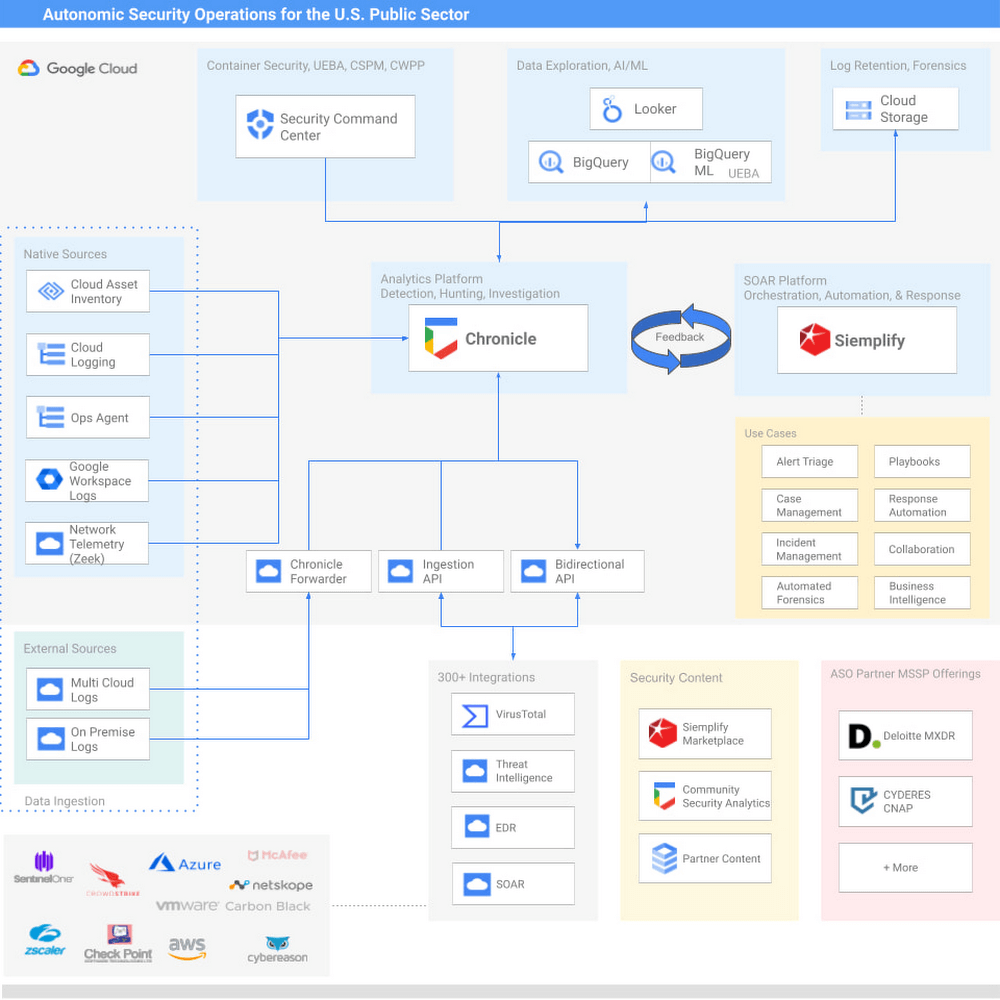
Today we are announcing Autonomic Security Operations (ASO) for the U.S. public sector, a solution framework to modernize cybersecurity analytics and threat management that’s aligned with the objectives of EO 14028 and OMB M-21-31. Powered by Google’s Chronicle and Siemplify, ASO helps agencies to comprehensively manage cybersecurity telemetry across an organization, meet the Event Logging Tier requirements of the White House guidance, and transform the scale and speed of threat detection and response. ASO can support government agencies in achieving continuous detection and continuous response so that security teams can increase their productivity, reduce detection and response time, and keep pace with – or ideally, stay ahead of – attackers.
While the focus of OMB M-21-31 is on the implementation of technical capabilities, transforming security operations will require more than just technology. Transforming processes and people in the security organization is also important for long-term success. ASO provides a more comprehensive lens through which to view the OMB event logging capability tiers, which can help drive a parallel transformation of security-operations processes and personnel.
Modern Cybersecurity Threat Detection and Response
Google provides powerful technical capabilities to help your organization achieve the requirements of M-21-31 and EO 14028:
Security Information & Event Management (SIEM) – Chronicle provides high-speed petabyte-scale analysis, and is capable of consuming log types outlined in the Event Logging (EL) tiers in a highly cost-effective manner.
Security Orchestration, Analytics, and Response (SOAR) – Siemplify offers dozens of out-of-box playbooks to deliver agile cybersecurity response and drive mission impact, including instances of automating 98% of Tier-1 alerts and driving an 80% reduction in caseload.
User and Entity Behavior Analytics (UEBA) – For agencies that want to develop their own behavioral analytics, agencies can use BigQuery, Google’s petabyte scale data lake, to store, manage, and analyze diverse data types from many sources. Telemetry can be exported out of Chronicle, and custom data pipelines can be built to import other relevant data from disparate tools and systems, such as IT Ops, HR and personnel data, and physical security data. From there, users can leverage BQML to readily generate machine learning models without needing to move the data out of BigQuery. For Google Cloud workloads, our Security Command Center Premium product offers native, turnkey UEBA across GCP workloads.
Endpoint Detection and Response (EDR) – For most agencies, EDR is a heavily adopted technology that has broad applicability in Security Operations. We offer integrations to many EDR vendors. Take a look at our broad list of Chronicle integrations here.
Threat intelligence – Our solution offers a native integration with VirusTotal, has the ability to operationalize threat intelligence feeds natively in Chronicle, and integrates with various TI and TIP solutions.
Community Security Analytics
To increase collaboration across public-sector and private-sector organizations, we recently launched our Community Security Analytics (CSA) repository, where we’ve partnered with the MITRE Engenuity Center for Threat-Informed Defense, CYDERES, and others to develop open-source queries and rules that support self-service security analytics for detecting common cloud-based security threats. CSA queries are mapped to the MITRE ATT&CK® framework of tactics, techniques and procedures (TTPs) to help you evaluate their applicability in your environment and include them in your threat model coverage.
“Deloitte is excited to collaborate with Google Cloud on their transformational public sector Autonomic Security Operations (ASO) solution offering. Deloitte has been recognized as Google Cloud’s Global Services Partner of the Year for four consecutive years, and also as their inaugural Public Sector Partner of the Year in 2020,” said Chris Weggeman, managing director of GPS Cyber and Strategic Risk, Google Cloud Cyber Alliance Leader, Deloitte & Touche LLP. “Our deep bench of more than 1,000 Google Cloud certifications, capabilities spanning the Google Cloud security portfolio, and decades of delivery experience in the government and public sector makes us well-positioned to help our clients undertake critical Security Operations Center transformation efforts with Google Cloud ASO.”
Cost-effective for government agencies
To help Federal Agencies meet the requirements of M-21-31 and the broader EO, Google’s ASO solutions can drive efficiencies and help manage the overall costs of the transformation. ASO can make petabyte-scale data ingestion and management more viable and cost-effective. This is critical at a time when M-21-31 is requiring many agencies to ingest and manage dramatically higher volumes of data that had not been previously budgeted for.
Partners
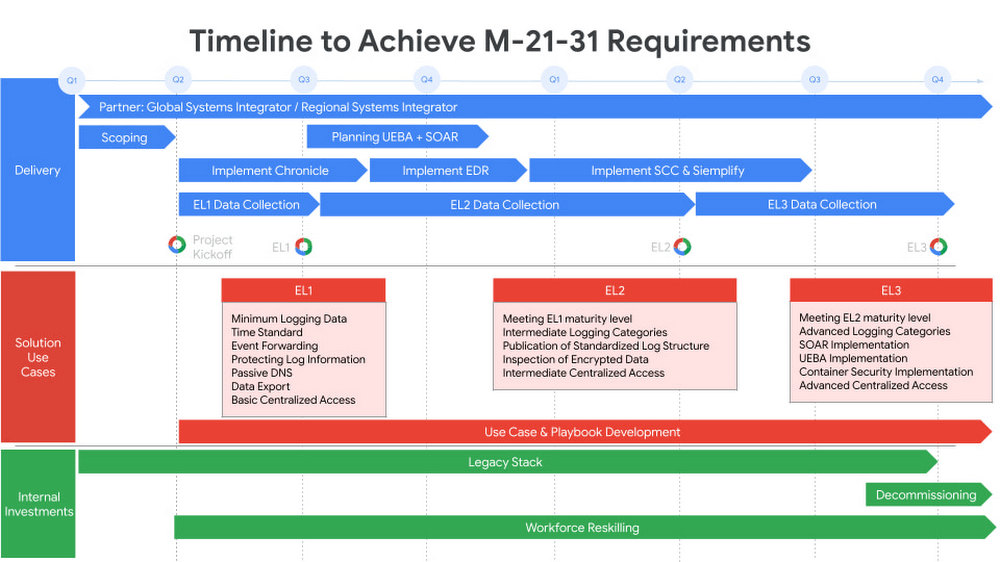
We’re investing in key partners who can help support U.S. government agencies on this journey. Deloitte and CYDERES both have deep expertise to help transform agencies’ Security Operations capabilities, and we continue to expand our partners to support the needs of our clients. A prototypical journey can be seen below.
“Cyderes shares Google Cloud’s mission to transform security operations, and we are honored to deliver the Autonomic Security Operations solution to the U.S. public sector. As the number one MSSP in the world (according to Cyber Defense Magazine’s 2021 Top MSSPs List) with decades of advisory and technology experience detecting and responding to the world’s biggest cybersecurity threats, Cyderes is uniquely positioned to equip federal agencies and departments to go far beyond the requirements of the executive order to transform their security programs entirely via Google’s unique ASO approach,” said Robert Herjavec, CEO of CYDERES. “As an original launch partner of Google Cloud’s Chronicle, our deep expertise will propel our joint offering to modernize security operations in the public sector, all with significant cost efficiency compared to competing solutions.” said Eric Foster, President of CYDERES.
Embracing ASO
Autonomic Security Operations can help U.S. government agencies advance their event logging capabilities in alignment with OMB maturity tiers. More broadly, ASO can help the U.S. government undertake a larger transformation of technology, process, and people, toward a model of continuous threat detection and response. As such, we believe that ASO can help address a number of challenges presently facing cybersecurity teams, from the global shortage of skilled workers, to the overproliferation of security tools, to poor cybersecurity situational awareness and analyst burnout caused by an increase of data without sufficient context or tools to automate and scale detection and response.
We believe that by embracing ASO, agencies can help agencies achieve:
10x technology, through the use of cloud-native tools that help agencies meet event logging requirements in the near term, while powering a longer-term transformation in threat management;
10x process, by redesigning workflows and using automation to achieve Continuous Detection and Continuous Response in security operations;
10x people, by transforming the productivity and effectiveness of security teams and expanding their diversity; and
10x influence across the enterprise through a more collaborative and data-driven approach to solving security problems between security teams and non-security stakeholders.
To learn more about Google’s Autonomic Security Operations solution for the U.S. public sector, please read our whitepaper. More broadly, Google Cloud continues to provide leadership and support for a wide range of critical public-sector initiatives, including our work with the MITRE Engenuity Center for Threat-Informed Defense, the membership of Google executives on the President’s Council of Advisors on Science and Technology and the newly established Cyber Safety Review Board; Google’s White House commitment to invest $10 billion in Zero Trust and software supply chain security, and Google Cloud’s introduction of a framework for software supply chain integrity. We look forward to working with the U.S. government to make the nation more secure.
Visit our Google Cloud for U.S. federal cybersecurity webpage.
Related posts:
Autonomic Security Operations for the U.S. Public Sector Whitepaper
“Achieving Autonomic Security Operations: Reducing toil”
“Achieving Autonomic Security Operations: Automation as a Force Multiplier”
“Advancing Autonomic Security Operations: New resources for your modernization journey”
More Relevant Stories for Your Company

Security Talks: Addressing the Toughest SOC Challenges with SolarWinds, Chrome, Zero Trust, and More
Security operations teams are facing a “perfect storm” of challenges from nation-state actors turning their attention to financial crime, to rising uncertainty and potential complexities because of rapidly advancing cloud migration and IoT adoption, to the long-lamented skills shortage. Now imagine having to face this trifecta without visibility into your IT and security infrastructure because

New Certificate Manager Helps Leverage Google’s Network Security and Performance
We’re excited to announce the public preview of Certificate Manager and its integration with External HTTPS Load Balancing. Certificate Manager enables you to use External HTTPS Load Balancing with as many certificates or domains as you need. You can bring your own TLS certificates and keys if you have an



Modernize Your Security Posture for Cloud-Native Applications with Anthos
Modern security approaches have moved beyond a traditional perimeter-based security model. As many organizations seek to adopt cloud-native architectures and are deploying applications in hybrid and multi-cloud environments they demand a more flexible and extensible approach towards security. Learn how to address security issues as early in the development and
What to Look for from Cloud CISO Perspective
May is a big month for the security industry. It's been over a year since we gathered for RSA in San Francisco for one of 2020’s last major in-person events. While we likely won’t be together in person this year, it's an important time for the security community to come
