





Google Extends Support for Windows Server Containers on Anthos for Faster App Modernization and Consistent Dev Experience

5586
Of your peers have already read this article.
3:00 Minutes
The most insightful time you'll spend today!
Today, many applications in organizations’ data centers run on Windows Server. Modernizing these traditional Windows apps onto Kubernetes promises a host of benefits: a consistent platform across environments, better portability, scalability, availability, simplified management and speed of deployment, just to name a few. But how? Rewriting traditional .NET applications to run on Linux with .NET Core can be challenging and time-consuming. There is, however, a lower-toil, more developer friendly option.
Last year, we announced support for Windows Server containers running on Google Kubernetes Engine (GKE), our cloud-based managed Kubernetes service, which lets you take the advantage of containers without porting your apps to .NET core or rewriting them for Linux. Today, we’re going a step further with support for Windows Server containers on Anthos clusters on VMware in your on-premises environment. Now available in preview, you can consolidate all your Windows operations across on-prem and Google Cloud.
Bringing Windows Server support to our family of Kubernetes-based services—GKE running on Google Cloud, and Anthos everywhere—with the same experience, lets you modernize apps faster and achieve a consistent development and deployment experience across hybrid and cloud environments. Further, by running Windows and Linux workloads side by side, you get operational consistency and efficiency—no need to have multiple teams specializing in different tooling or platforms to manage different workloads. The single-pane-of-glass view and the ability to manage policies from a central control plane simplifies the management experience, while bin packing multiple Windows applications drives better resource utilization, leading to infrastructure and license savings.
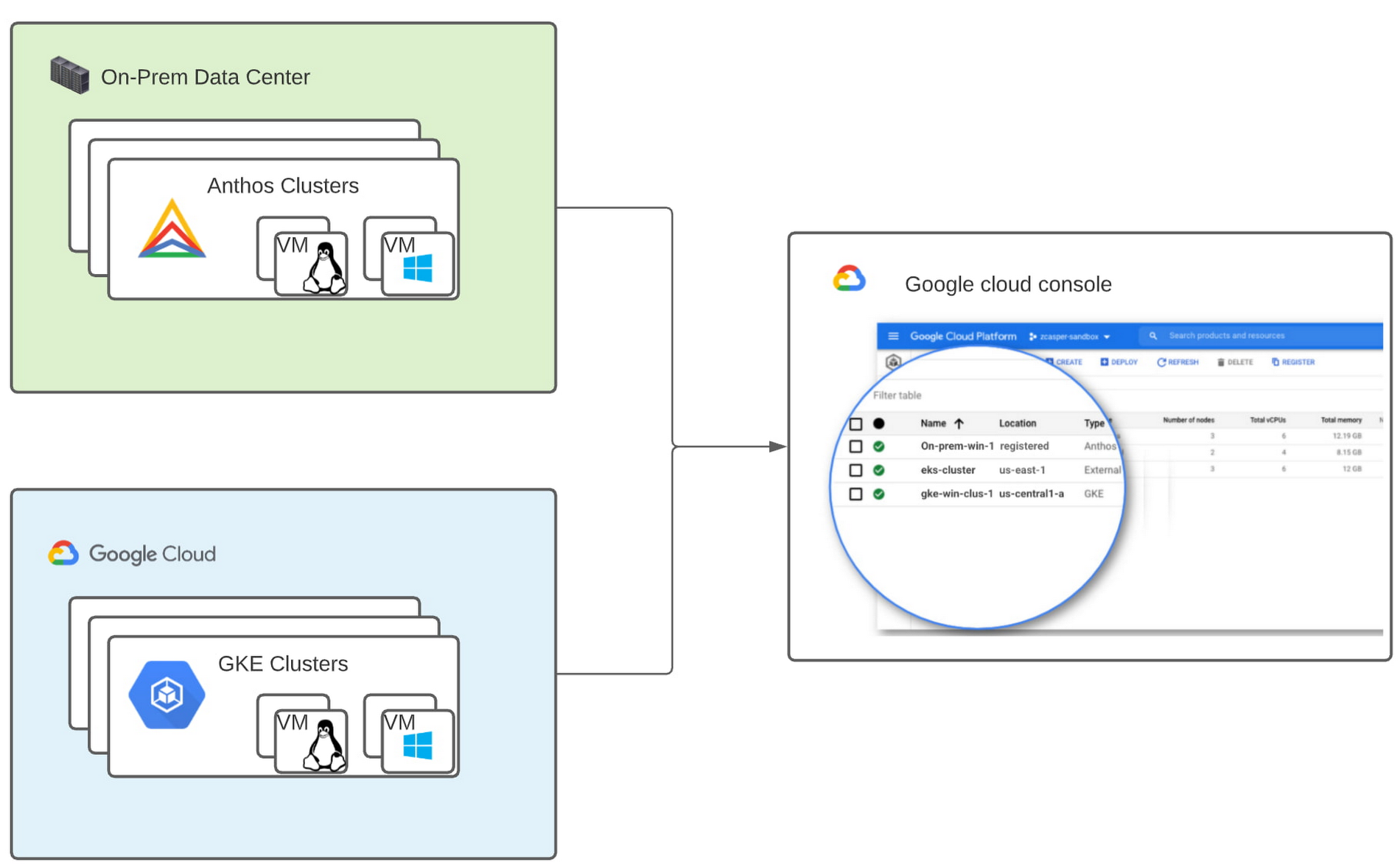
With all these benefits, it’s no surprise that customers such as Thales, a French multinational firm specializing in aerospace and security services, have been able to reap significant benefits by moving Windows applications to GKE.
“We moved our Windows applications from VMs to Windows containers on GKE and now have a unified mechanism for Linux and Windows-based application management, scaling, logging, and monitoring. Earlier, setting up these applications in VMs and configuring them for high availability used to take up to a week, and the applications were not easily scalable,” said Najam Siddiqui, Solutions Architect at Thales. “Now with GKE, the setup takes only a few minutes. GKE’s automatic scaling and built-in resiliency features make scaling and high-availability setup seamless. Also, manually maintaining the VMs and applying security patches used to be tedious, which is now handled by GKE.”
Let’s take a deeper look at the architecture that lets you run your Windows container-based workloads on-prem.
Windows Server running on-prem with Anthos
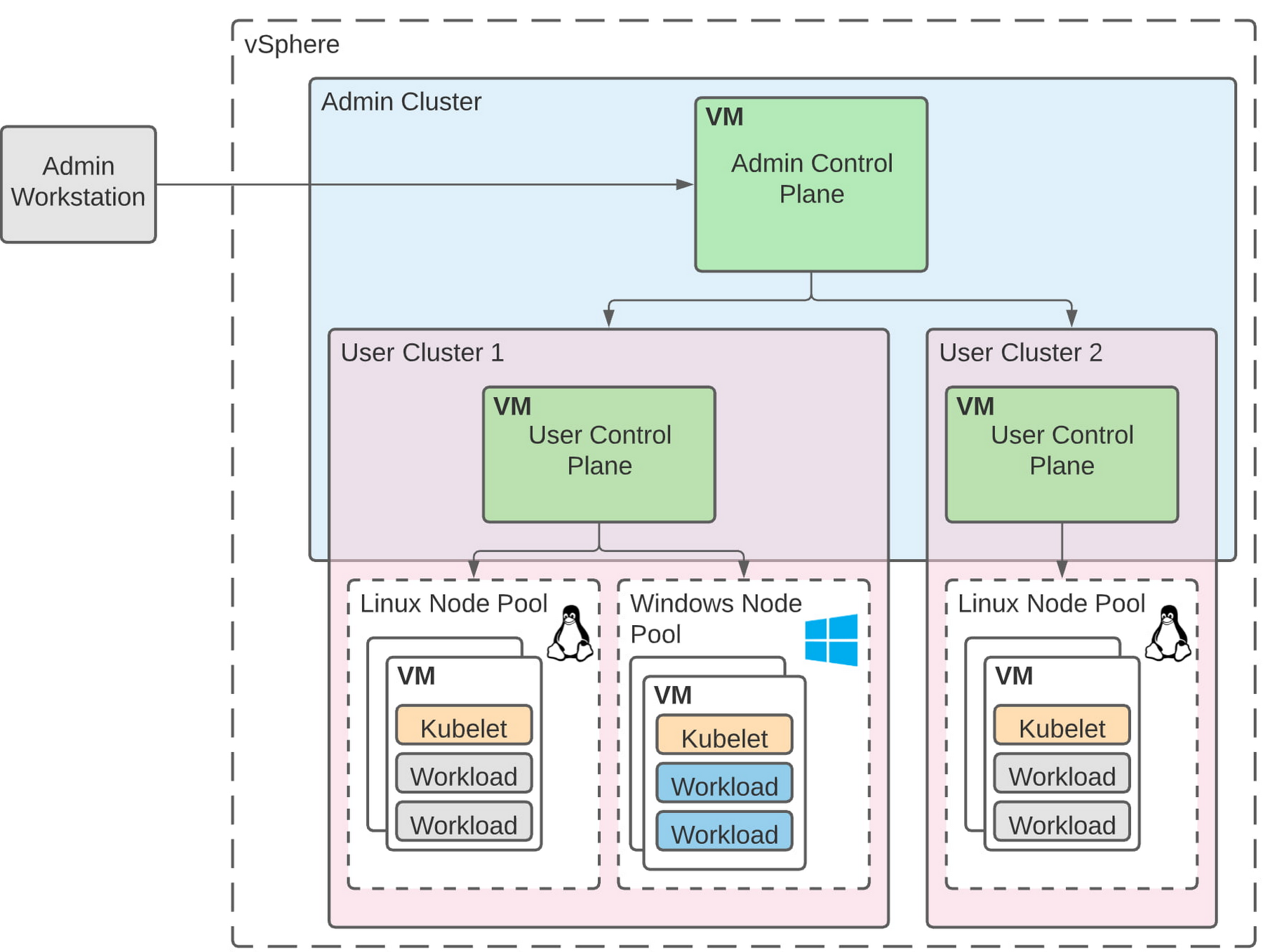
The diagram below illustrates the high-level architecture of running Windows container-based workloads in an on-prem GKE cluster with Anthos. Windows server node-pools can be added to an existing or new Anthos cluster. Kubelet and Kube-proxy run natively on Windows nodes, allowing you to run mixed Windows and Linux containers in the same cluster. The admin cluster and the user cluster control plane continue to be Linux-based, providing you a consistent orchestration experience and management ease across Windows and Linux workloads.
Get started today
When considering modernizing your on-prem Windows estate, we recommend running Windows Server containers on Anthos in your own data center. If you are new to Anthos, the Anthos getting started page and the Coursera course on Architecting Hybrid Cloud with Anthos are good places to start. You can also find detailed documentation on our website, and our partners are eager to help you with any questions related to the published solutions, as is the GCP sales team. And as always, please don’t hesitate to reach out to us at anthos-onprem-windows@google.com if you have any feedback or need help unblocking your use case.
Seven Steps to Making DevOps a Reality

3919
Of your peers have already read this article.
2:30 Minutes
The most insightful time you'll spend today!
When it comes to creating a business that can thrive in the digital age, the benefits of DevOps are clear. In a recent survey sponsored by Google Cloud, Harvard Business Review Analytic Services found that about two-thirds of the respondents who use DevOps have seen benefits that impact their bottom line, including increased speed to market (identified by 70% of the respondents), productivity (67%), customer relevance (67%), innovation (66%) and product/service quality (64%). Not only do these factors deliver profitability, but they’re precisely what cements a winning reputation among customers – the ultimate payoff.
We’ve seen these benefits within Google where DevOps helped us build secure products used and loved by billions of people across the world. However, as head of DevOps practices at Google, I know firsthand how daunting implementing a new model can be, even if it’s worthwhile. Intrigued but unsure of where to begin, customers constantly ask me: “How can I make DevOps a reality?”
Implementing DevOps can be really hard. Getting people to work differently doesn’t happen overnight. From our own journey toward embracing what are now known as DevOps practices, we learned seven critical lessons essential to adopting a DevOps model:
1. Pilot a small project. This provides a low-stakes opportunity to master key DevOps capabilities, such as building small, diverse teams with shared goal. A few small wins will provide evidence to the rest of organization that DevOps works. Soon others will want to follow suit.
2. Be an open-source player. Leveraging open-source tools and engaging in the community keeps you up-to-date on the best solutions and practices and attracts top talent. It also flattens your company’s learning curve and speeds up release cycles. According to a recent DORA study, 58% of businesses made extensive use of open source.
3. Embed security within software development process. By addressing potential security issues as early as possible, you’ll avoid pushing those issues out to production. Over half of participants in the Harvard Business Review Analytic Services survey look for holistic approaches to improve security while automating the DevOps toolchain. In addition, the recent DORA study also found that top performers who build security into software development conduct security reviews and complete changes in just days.
4. Apply DevOps best practices. Use Site Reliability Engineering (SRE) principles to help build collaboration, reduce waste, and increase efficiency. Also look for ways to implement end-to-end automation. Not only does automation enable higher productivity, it frees organizations up to focus on what really matters: delivering value and driving performance.
5. Provide immersive training. People will only commit to organizational change when they understand its premise and are given the resources and opportunity to put new tech to work. That’s why three-quarters of the top-performing DevOps teams in the Harvard Business Review Analytic Services survey, as well as Google, provide immersive, hands-on DevOps coaching and training, such as code labs and quick-start projects.
6. Establish a no-blame culture. By running blameless post-mortem meetings in a safe environment built on trust, we learn from our mistakes. Because let’s face it, defects and coding errors happen when building software. By presenting mistakes as opportunities, you enable people to relate to one another and solve problems together, while ensuring that the same mistake won’t happen again. That’s how the DevOps model can evolve faster.
7. Build a culture that supports DevOps. I’m underlining this because the rest is worthless without it. When people feel like they have each other’s backs, they’re more likely to take smart risks; more likely to create; more likely to move faster. Trust comes down to these principles:
- Data-driven decisions: Look at data from code, logs, and traces, and use that data to arrive at decisions.
- Transparency: Choose sharing over secrecy and siloing. Everyone sees the same data means everyone feels comfortable and confident.
- Shared goals: Constantly collaborate so developers and operators are working toward a common goal.
Those are the basics. Reading the Harvard Business Review Analytic Services survey in its entirety will help flesh out the details. The report is full of proven tactics used by the most successful DevOps-based businesses, as well as statistics that demonstrate why it’s a worthy investment. After you’ve digested those facts and figures, consider my own intangible observation: there’s something magical about understanding what makes people productive, collaborating with them, and then empowering them to deliver value. Hope you get as much out of this transformation as we did.
Kaluza & Google Cloud: Committed to Powering Up 73 Million EVs by 2040

1224
Of your peers have already read this article.
4:00 Minutes
The most insightful time you'll spend today!
Electric vehicles already account for one in seven car sales globally, and with new gas and diesel cars being phased out across the world, global sales are forecast to reach 73 million units in 2040. But with power grids becoming increasingly dependent on variable energy sources such as wind and solar, rising demand from electric vehicles risks overstraining grids at peak times, potentially leading to power outages.
At Kaluza, we believe that our platform has a vital role to play in helping power grids and utility companies to stabilize their networks, while at the same time delivering more affordable, cleaner energy to the consumer. Powered by Google Cloud, the advanced algorithms behind our Kaluza Flex solution automatically charge electric vehicles when the power supply is at its cheapest and greenest, helping to accelerate the global transition towards a zero-carbon future.
Decarbonizing the grid with low-cost smart charging programs
Launched by OVO Energy in 2019, Kaluza has taken its deep understanding of the energy market to partner with some of the world’s major energy suppliers and vehicle manufacturers, including AGL in Australia, Fiat and Nissan in the UK, and Mitsubishi Corporation and Chubu in Japan, to launch smart charging programs that help customers save money while reducing their carbon footprint.
A good example of this is Charge Anytime, which we recently launched with OVO Energy in the UK. With this tariff, customers use Kaluza to smart-charge their electric vehicle, and pay just 10p per kWh — a third of their household electricity rate — to do so. This means that if the customer plugs in their vehicle to charge when they get home from work at, say, 6:00 p.m. — a time when both demand and the carbon intensity on the grid are at their highest — their vehicle will then be smartly charged at the lowest cost and greenest periods throughout the night, ready for when they need it in the morning.
This smart charging reduces the energy company’s costs by enabling them to take advantage of lower wholesale electricity prices. These savings are then passed on to the end customer through tariffs such as Charge Anytime, saving customers hundreds of pounds a year and reducing their carbon footprint. Meanwhile, the National Grid is able to reduce the strain on the network during peak hours, while simultaneously using up the excess renewable energy that might otherwise have gone to waste.
Optimized charging schedules, fueled by Google Cloud
Behind Kaluza’s smart charging solution lies some sophisticated technology, all of which is built on Google Cloud. Our core optimization engine gathers real-time data from a wide range of sources, including battery and charging data from the electric vehicles, and data from the energy suppliers and grid operators, such as the carbon intensity, and price forecasts.
After passing through our real-time data backbone, that data is stored in BigQuery where it’s used to train and validate our smart charging optimization models. These models are then deployed with Google Kubernetes Engine so that whenever a customer plugs in an electric vehicle, data from that vehicle passes in real-time through our optimization engine to calculate the ideal charging schedule for that vehicle, ensuring it uses the cheapest, least carbon-intensive energy available.
Customer interface: easy to use, simple to build
Of course, the customer isn’t aware of any of this complexity. All they need to do is open their charging app and use Kaluza’s intuitive interface to set what time they want their car to be ready and how much charge they want in their battery. Then they simply plug in their car, and our algorithms take care of the rest.
Customers can also use Kaluza to view breakdowns of how much carbon and money they’ve saved, along with insights around things like billing and battery life, all of which is backed by Cloud SQL.
With Google Cloud, we were able to roll out this end-user app very quickly. Instead of having to build a different version of the app for each operating system, we were able to build an OS-agnostic version using Flutter, which then builds the app for each platform, enabling us to get to market faster.
This has been a benefit of our architecture in general. With Google Cloud taking the complexity out of otherwise time-consuming development processes, we’ve been able to experiment with and validate propositions rapidly, and roll out new products and features at speed, to ensure that we remain at the vanguard of a rapidly evolving sector.
Giving energy companies full visibility with BigQuery and Looker
As for the grid operators and energy companies, the Kaluza platform allows them to visualize how many participating electric vehicles are plugged into the network at any one time. BigQuery and Looker Studio dashboards provide granular insights, such as how many vehicles are idle, how many are charging, and how well our optimization engine is working.
The platform also allows companies to view those vehicles on an aggregate level, and identify any issues. Google Cloud machine learning capabilities can even allow grid operators to use this aggregate view to forecast how much energy will be required at any one time, and dial the power generation up or down accordingly.
Ultimately, these insights help network operators and utility companies to optimize energy usage, and balance out the peaks and troughs of supply and demand, ensuring that excess renewable energy is captured, while carbon-intensive fuel use is reduced.
Feeding energy back into the grid with bidirectional charging
Vehicle-to-Grid (V2G), or bidirectional, charging is something that we are very excited about, and have begun rolling out in the UK, as we prepare to launch in other global markets. Built on the same Google Cloud architecture as the rest of Kaluza Flex, V2G not only enables smart charging, but allows electric vehicles to feed stored energy back into the grid.
Imagine an electric vehicle battery that can store 40 kWh of energy, but only uses 5 kWh a day. That leaves 35 kWh a day that can be charged to the battery during times of low demand, when energy is cheapest and greenest, then fed back into the network during peak periods, removing the need for more fossil fuels to be burned to meet demand.
Not only does V2G go further than conventional smart charging to make use of renewable energy when it’s abundant and support the balancing of the energy system, it also results in even lower energy prices for the customer, as they are effectively selling energy back to the grid. For example, as part of a large domestic V2G trial made in partnership with OVO and Nissan, Kaluza saved customers an average of £450 a year, with some customers saving up to £800/year by selling surplus energy back to the grid — transforming their homes into mini power stations.
With Kaluza Flex, we have a platform that offers benefits for all parties, from the grid operators, through to energy retailers and vehicle manufacturers, and all the way to the customer. Now, our aim is to bring this exciting offering to as many markets as possible, a goal which is made easier thanks to the scalable infrastructure and time-saving solutions of Google Cloud.
As more people make the switch to electric vehicles, our goal is to ensure that smart charging becomes standard practice, as we help to deliver on the potential of electric vehicles to contribute to a greener, decarbonized future.
Google Cloud Helps Northwell Health to Boost Caregiver Productivity and Access to Right Care Using AI

7949
Of your peers have already read this article.
2:00 Minutes
The most insightful time you'll spend today!
Lung cancer is the leading cause of cancer death in the United States and like any cancer, early detection is crucial to survival. Screening at-risk populations is an important part of reducing mortality, and if concerning nodules are found on imaging, further testing may be required. Today, we’ll share how Northwell Health uses Google Cloud products such as Cloud Healthcare APIs and BigQuery to increase caregiver productivity and deliver better care for patients with findings that indicate potential development of lung cancer.
Northwell is New York’s largest healthcare provider
Northwell Health is New York’s largest healthcare provider with 23 hospitals and nearly 800 outpatient facilities. Northwell’s nearly 4,000 doctors care for millions of patients each year, and at this scale, there is an immense amount of healthcare data to manage. To better manage and leverage this data, Northwell Health partnered with Google Cloud starting in 2018.
Enabling caregivers to spend more time with patients
Nic Lorenzen, the lead developer of Northwell Emerging Technology and Innovation team, has a mission to put together data for caregivers in a way that makes sense. It is no secret that inefficient electronic health records systems have a negative impact on a physician’s ability to deliver quality care. Traditional EHRs have information distributed across many tabs, which forces caregivers to spend considerable time at the computer trying to find information. Moreover, speed of care matters. If care is delayed, patients may have to spend more time in the hospital and may suffer worse health outcomes.
To solve this problem, Nic’s team focused on giving caregivers the most relevant pieces of data at the right time by developing an intelligent clinician rounding app. The data needed to derive these insights can depend on the caregiver’s role–a nurse cares about different things than a cardiologist. This system aggregates multiple data sources, and provides patient-specific insights to caregivers.
This system would not have been possible before with traditional EHRs and data warehouses that have proprietary data models and rarely sync data in real time. Now with data easily accessible through Google Cloud’s Healthcare solutions, Nic’s team can deliver the right clinical information to the right people instantly. These days, Nic says, “instead of spending 75% of our time dealing with architecting the underlying platforms, we spend 75% of our time focused on higher value use cases for clinicians and patients. Google Cloud’s Healthcare solutions have greatly improved our developer productivity and time to value.”
Caregivers have found this new system to be a game changer.Before the implementation of this system, caregivers would spend, on average, seven to nine minutes finding the data needed to make medical decisions for one patient. Now, that aggregated information is delivered to a caregiver’s mobile device in less than a second.
Ensuring patients get the right care with the power of AI
There are a number of reasons why patients might not get the care that they need. For example, patients today can go to multiple hospitals and clinics settings, and coordinating care across multiple facilities is complex. Regional hospitals and clinics have their own siloed view of their data, so pertinent information gathered by one clinic might not be seen by another. These gaps in clinical data lead to gaps in patient care.
When a patient gets radiologic imaging, they may have findings unrelated to the reason they initially got the imaging. For example, a chest CT for a car accident might reveal an incidental lung nodule that could be cancerous. Unfortunately, research shows that a large portion of patients do not get follow up for these incidental findings because it isn’t the primary reason why the patient is seeing a doctor. Moreover, social determinants of health are a factor that affects which patients receive follow-up care. Identifying these patients and providing the necessary follow up care prevents adverse events related to delayed detection of cancer.

With Cloud Healthcare solutions, Northwell built an AI model to identify these patients so that oncologists can appropriately follow up with patients who have findings suspicious for lung cancer. The AI model detects incidental pulmonary nodules in radiology reports so that doctors can then contact the patients that need follow-up care. Nic says his team was able to build this system in a week: “Google Cloud did a lot of heavy-lifting for us and allowed us to get to the AI applications much faster. It allowed us to build a platform that just works.”
Healthcare systems can now rapidly generate healthcare insights with one end-to-end solution, Google Cloud Healthcare Data Engine. It builds on and extends the core capabilities of the Google Cloud Healthcare API to make healthcare data more immediately useful by enabling an interoperable, longitudinal record of patient data. Northwell Health uses Google Cloud as the core of their platform, enabling their developers to create solutions to the most pressing healthcare problems.
Special thanks to Kalyan Pamarthy, Product Management Lead on Cloud Healthcare and Natural Language APIs for contributing to this blog post.
3141
Of your peers have already watched this video.
18:45 Minutes
The most insightful time you'll spend today!
Reduce Costs, Increase Profits by Modernizing Your Mainframe Applications with Google Cloud
Mainframe powers much of global commerce and for decades—with its proprietary platform and legendary lock-in—was resistant to effective competition. Even years after most organizations began adopting public cloud, migrating off the mainframe remains too complex for many organizations to undertake.
Google Cloud brings a unique, automated approach to modernization enabling customers to go from mainframe to containers.
Gain operational efficiency
Escape capital-intensive mainframe refresh cycle with Google cloud. Move to a modern cloud-based model to reduce operational cost and improve maintainability.
Deliver agile services
You can also evolve software capabilities for faster and frequent updates. Use cloud-native technologies such as GKE alongside your on-premises workloads and accelerate time to market.
Mitigate risk and get access to talent
Also, eliminate the dependency on scarce skills. Gain access to top engineering talent and avoid vendor lock-in by modernizing to open software languages.
Watch this video where Travis Webb, Cloud Solutions Architect for Enterprise at Google Cloud, takes you through the challenges of modernizing mainframe and the key technical aspects of this solution that make it possible.

3570
Of your peers have already downloaded this article
2:30 Minutes
The most insightful time you'll spend today!
After undergoing an agile transformation, ING realized it needed a standardized platform to support the work their developers were doing. “Our DevOps teams got empowered to be autonomous,” says Thijs Ebbers, Infrastructure Architect.
“It has benefits, you get all kinds of ideas. But a lot of teams are going to devise the same wheel. Teams started tinkering with Docker, Docker Swarm, Kubernetes, Mesos. Well, it’s not really useful for a company to have one hundred wheels, instead of one good wheel,” Ebbers added.
Using Kubernetes for container orchestration and Docker for containerization, the ING team began building an internal public cloud for its CI/CD pipeline and green-field applications. The pipeline, which has been built on Mesos Marathon, will be migrated onto Kubernetes.
The bank-account management app Yolt in the U.K. (and soon France and Italy) market already is live hosted on a Kubernetes framework. At least two greenfield projects currently on the Kubernetes framework will be going into production later this year. By the end of 2018, the company plans to have converted a number of APIs used in the banking customer experience to cloud-native APIs and host these on the Kubernetes-based platform.
“Cloud native technologies are helping our speed, from getting an application to test to acceptance to production,” says Infrastructure Architect Onno Van der Voort. “If you walk around ING now, you see all these DevOps teams, doing stand-ups, demoing. They try to get new functionality out there really fast.”
Find out how.
More Relevant Stories for Your Company

State of DevOps 2018: Strategies for a New Economy
According to the new Accelerate: State of DevOps 2018: Strategies for a New Economy report, elite DevOps performers have more frequent code deployments, faster lead times, lower change failure rates, and far quicker incident recovery times. And that’s just the beginning. This year’s report reflects a fundamental industry change in

FAQs: Everything Your Need to Know About Cloud Computing
There are a number of terms and concepts in cloud computing, and not everyone is familiar with all of them. To help, we’ve put together a list of common questions, and the meanings of a few of those acronyms. You can find all these, and many more, in our learning resources.



Video: How Pitney Bowes Leveraged Apigee to Create New Revenue Streams
Headquartered in Stamford, Connecticut, Pitney Bowes helps businesses navigate the complex world of commerce. They enable organizations to send parcels and packages across the globe. Pitney Bowes serves 90 percent of Fortune 500 companies, has 90 plus years of innovation, supports 1.5 million small businesses and has 15,000 employees globally.
Assuring Compliance in the Cloud: Paper by Google Cloud’s Office of the CISO
Cloud transformation and the adoption of modern DevOps technology presents both opportunities and challenges for IT compliance functions. With DevOps style application development, the feedback loop for developers and engineers is much tighter than with traditional application development pipelines, enabling speed and agility of application release cycles. While speedy CI/CD
