





Google Cloud’s Role in Minimizing Memory Errors Impact for SAP Customers
3744
Of your peers have already read this article.
2:00 Minutes
The most insightful time you'll spend today!
Every cloud system begins with high-quality hardware infrastructure. Sometimes, however, hardware breaks — and when it happens, our most important goal is to minimize the impact on our customers and their cloud workloads.
Memory errors are the most common type of hardware failure, and they’re also one of the most challenging in terms of their impact on production workloads and system reliability. That’s why we’re excited to share what Google Cloud has been doing to minimize the impact of memory errors. If your business runs SAP HANA in the cloud, this is an important innovation — one that Google Cloud is proud to deliver to our customers.
Memory errors: A big problem with a long history
First things first: Memory errors are a high priority because they happen often. And when they happen, the disruption can have far-reaching effects on your customers and your business.
In 2009, Google Cloud published the first major study on memory reliability. We found an average error rate of over 8% per year in DIMM modules installed in production systems. Given that each generation of DDR RAM packs more capacity into smaller packages, it’s safe to think that memory hardware has become less reliable since then.
Memory error impacts: They could be worse, but they’re far from good
What happens when a system detects a bad segment in a DIMM module? While data loss or corruption from memory errors is not common, some errors are correctable but some are not, potentially resulting in a critical system failure..
Modern CPUs are equipped with error-correcting memory features and are very good at correcting simple errors with ECC (Error Correction Code). The challenge is that most of the software that runs on a host system — whether it’s a hypervisor, a virtual machine, an operating system, a database or an application — will crash instantly when it encounters an uncorrectable memory error. In a cloud environment, this kind of crash can take down cached data and even data saved to a local SSD. The crashed applications will recover, but the process means several minutes of downtime. The more data you have, the longer this process will take.
Sometimes, that’s merely an inconvenience. Other times, it’s a very big deal. A Google Cloud customer running business-critical SAP applications and an in-memory HANA database might measure downtime costs well over $10,000 per minute in lost revenue and other direct impacts. Many HANA databases load into terabytes of memory, and it can take an hour or longer to get everything restarted and back to normal after a crash. For SAP HANA, a fast recovery with up to 10 minutes of downtime requires a redundant replica provisioned all the time, doubling the cost.
And statistically speaking, when a HANA instance occupies almost all of the memory on a host system, it’s also the most likely application to stumble across a memory error. You can see why this would be a problem.
The ‘victim neighbor’ VM challenge
There’s a final problem to consider when a memory error takes out production applications: what we call the “victim neighbor” issue.
In any cloud, a single physical host is a multi-tenant environment that might run dozens of VMs, potentially owned by dozens of different customers. A memory error won’t just crash the VM actually using the bad section, it will crash every VM running on the system. That’s a standard VM response to memory errors on a host system, and it will happen to any VM architecture available on the market today to avoid memory corruption.
Overall, this “victim neighbor” effect accounts for more than 90% of the VMs that get knocked down by a memory error on a physical server. That’s a huge blast radius for such a common problem.
A practical solution to memory-error impacts
You can see why managing this problem is a big deal for Google Cloud. While we know that some failures are inevitable, we have developed another way to tackle the problem. Google Cloud already maintains some unique and valuable tools, such as Live Migration, that help our customers minimize unplanned downtime.When we integrate these tools with recent work that leverages error-handling capabilities built into CPUs (courtesy of Intel) and into certain applications (in particular, SAP HANA), we get a solution that dramatically reduces downtime and disruptions related to memory errors — in many cases, to the point where customers won’t even know there was a problem.
The Google Cloud solution: Memory poisoning recovery
At a big picture level, we refer to our solution as Memory Poisoning Recovery (MPR). It combines some existing Google Cloud capabilities, some new capabilities, and some important third-party capabilities at the CPU (Intel) and application (SAP HANA) levels. MPR can be broken down into two main processes:
Memory Error Isolation
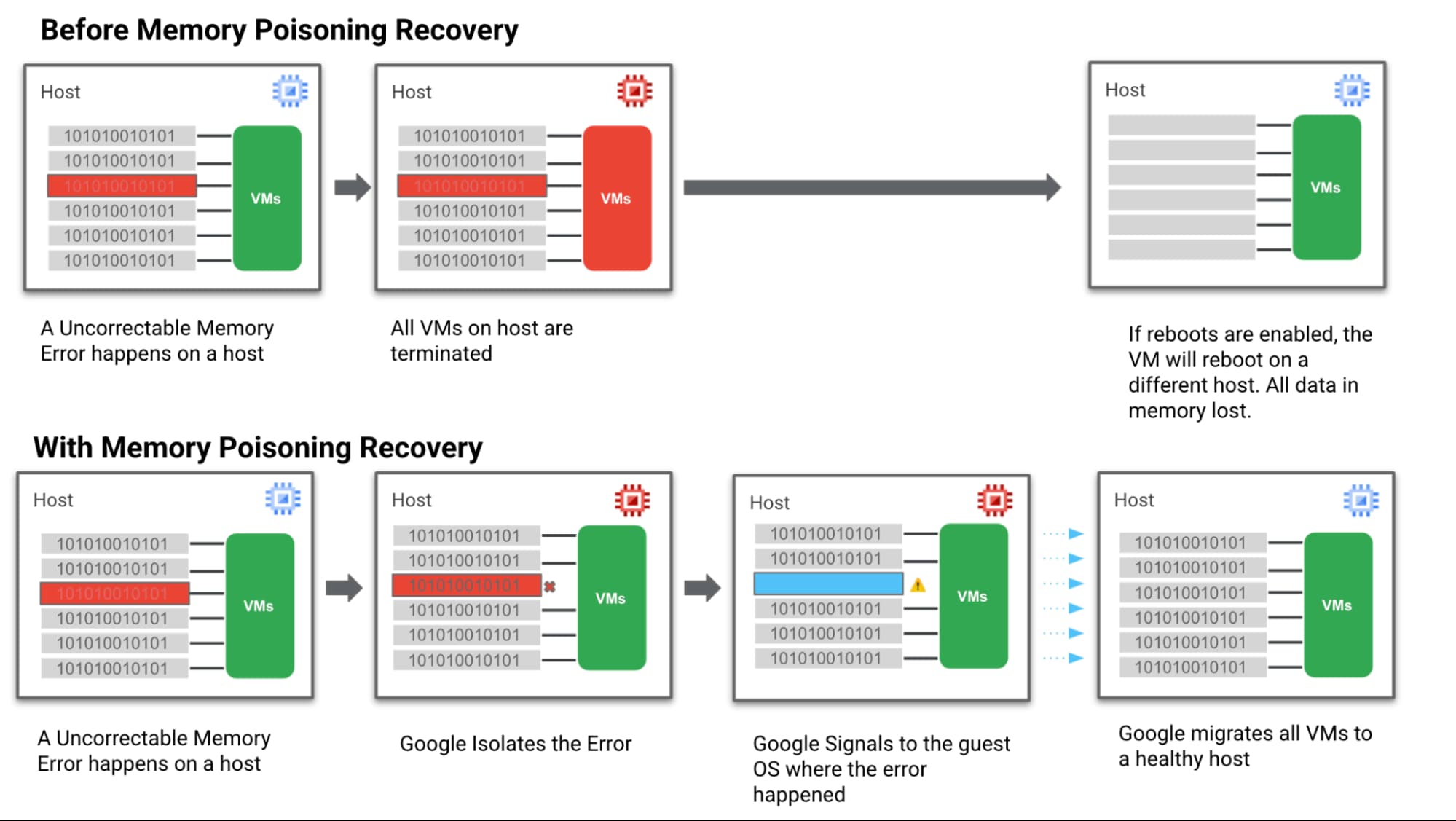
- Step 1: We hardened our VM technology to be more robust against memory errors. We intercept and analyse the memory error coming from the system. Then we flag the signaled region of a memory DIMM with an uncorrectable error as “poisoned”.
- Step 2: Then we trigger processes to keep track of these “poisoned” regions and the VMs they affect so they can’t affect data integrity.
Memory Error Recovery
- Step 3: Then we notify the Guest OS & the MCE-aware applications that a memory error has been recorded, in a manner that allows the applications to execute application relevant memory error handling.
- Step 4: At the same time we communicate with Google Cloud Live Migration to begin moving guest VMs off the affected host. This ensures customers are running on a healthy host which reduces the probability of more uncorrectable errors happening and avoids further downtime.
Below is a simple visual of how this all works:
How MPR makes life better for customers
Let’s look again at the different groups of Google Cloud customers involved in a memory error scenario and how we can help them achieve a happier ending after a crash — starting with the customer running the VM and application that actually triggered the memory error.
Customer Group: MCE-Aware SAP HANA with Fast Restart enabled on a VM directly affected by a memory error.
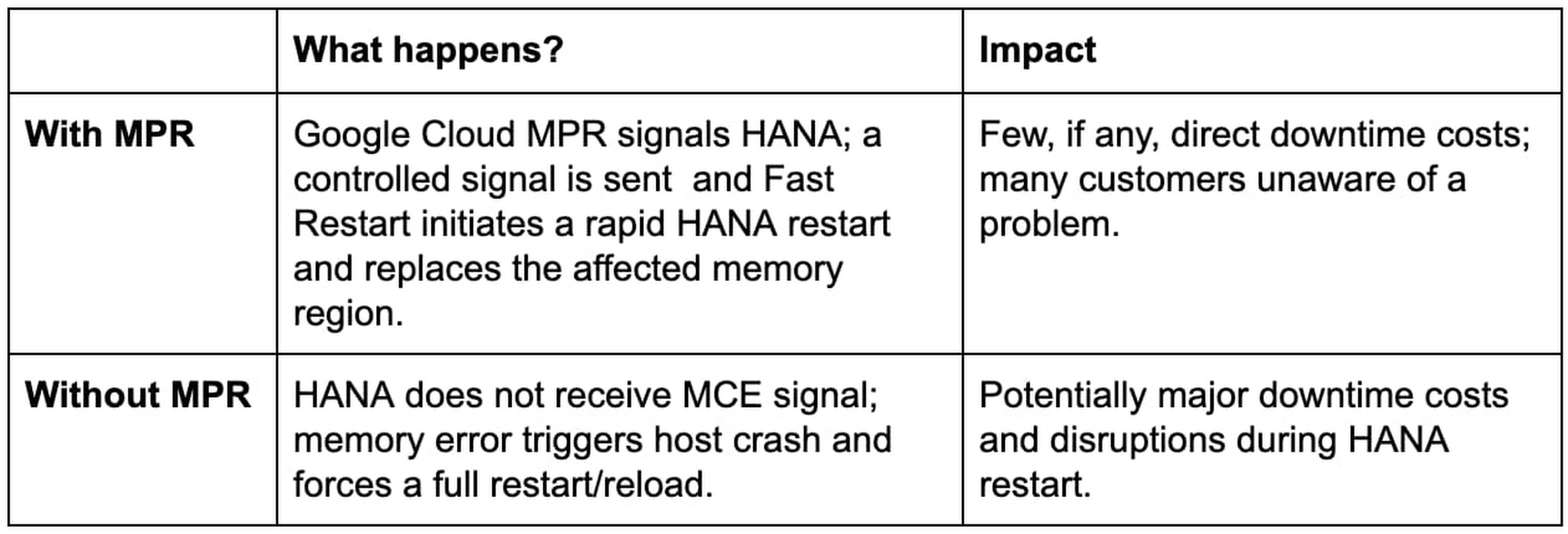
Customer Group: Customers running other, non MCE Aware applications on a VM directly affected by a memory error

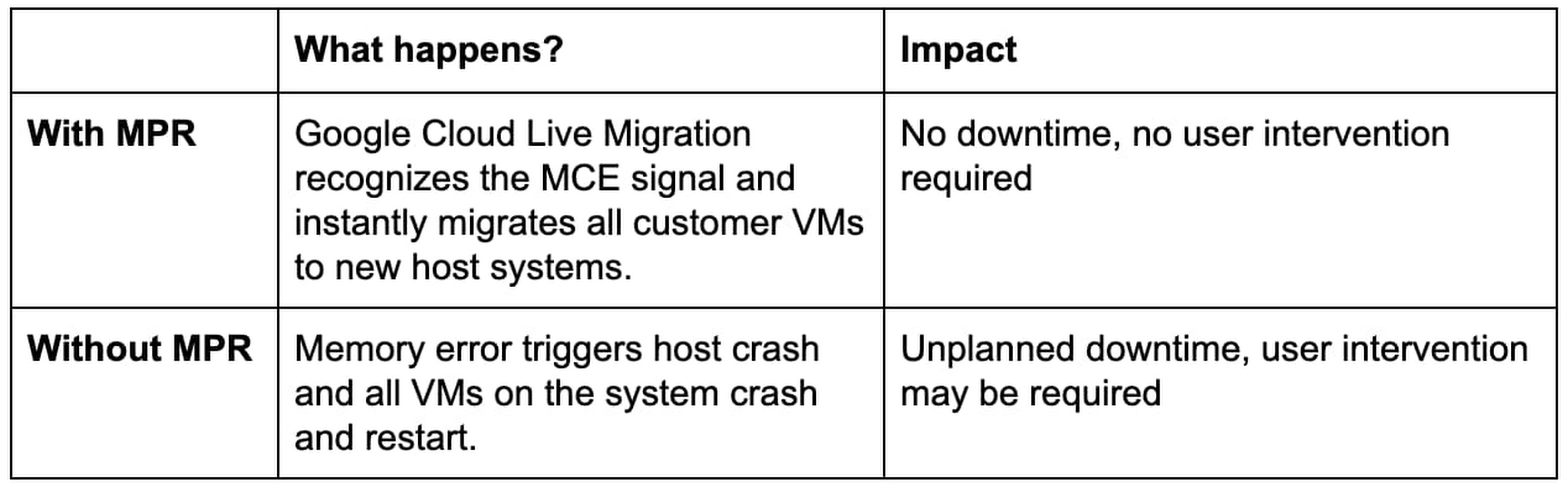
Next, our “victim neighbors” group probably won’t even know there was a problem with the host system. Google Cloud Live Migration will move them to a new host, instantly and automatically, and avoid the crash-and-restart scenario.
Customer Group: Customers running other, any application on a VM not directly affected by a memory error
Simple steps for taking advantage of MPR
Our MPR capabilities will be available on our Google Cloud memory-optimized Compute Engine second generation instances in Q4 of 2021. We’ll continue to roll out the capability during the months ahead to additional instances and look for new ways to work with applications that adopt a MCE Aware architecture.
Most customers in the “victim neighbor” category will not need to lift a finger to experience the benefits. By marrying our Live Migration feature to some awareness of those MCE signals, we ensure that it hears the alarm first and gets a critical head start on the migration process before issues begin with the guest VMs. Our customers land safely on a new host, and their applications keep running.
For our SAP customers running HANA, MPR is all about protecting against loss. Unplanned downtime for a HANA environment is incredibly expensive, the recovery process from a hard crash is extremely long, and the business disruptions can be truly damaging to the business. Thanks to MPR, all of that cost and worry can get compressed almost to nothing — with Fast Restart reducing what can be an hour or more of downtime to a matter of seconds.
But our SAP customers have to take a critical first step to claim these benefits. Fast Restart is a crucial piece of the MPR solution, and it is not enabled by default. Configuring your SAP HANA instance for Fast Restart involves changing a few configuration settings; the process is fast, easy, and doesn’t involve risk.
Finally, if you’re not running your workloads — SAP or otherwise — on Google Cloud, consider the benefits of running on a cloud that mitigates a hardware reliability issue affecting businesses of every size and industry. And consider the value of tools like Live Migration that already help Google Cloud customers improve uptime and reduce risk.
Hardware failures happen, and they probably always will. But we’re proving how valuable it can be to avoid the bad things that usually happen when memory failures occur. Right now, only Google Cloud has a practical solution to this very difficult problem.
Learn more about Fast Restart for SAP HANA, Live Migration and other key Google Cloud capabilities for your SAP environment.
Confidential Computing: Google Cloud Security, Project Zero and AMD Come Together to Secure Sensitive Workloads

4567
Of your peers have already read this article.
3:00 Minutes
The most insightful time you'll spend today!
At Google Cloud, we believe that the protection of our customers’ sensitive data is paramount, and encryption is a powerful mechanism to help achieve this goal. For years, we have supported encryption in transit when our customers ingest their data to bring it to the cloud. We’ve also long supported encryption at rest, for all customer content stored in Google Cloud.
To complete the full data protection lifecycle, we can protect customer data when it’s processed through our Confidential Computing portfolio. Confidential Computing products from Google Cloud protect data in use by performing computation in a hardware isolated environment that is encrypted with keys managed by the processor and unavailable to the operator. These isolated environments help prevent unauthorized access or modification of applications and data while in use, thereby increasing the security assurances for organizations that manage sensitive and regulated data in public cloud infrastructure.
Secure isolation has always been a critical component of our cloud infrastructure; with Confidential Computing, this isolation is cryptographically reinforced. Google Cloud’s Confidential Computing products leverage security components in AMD EPYC™ processors including AMD Secure Encrypted Virtualization (SEV) technology.
Building trust in Confidential Computing through industry collaboration
Part of our mission to bring Confidential Computing technology to more cloud workloads and services is to make sure that the hardware and software used to build these technologies is continuously reviewed and tested. We evaluate different attack vectors to help ensure Google Cloud Confidential Computing environments are protected against a broad range of attacks. As part of this evaluation, we recognize that the secure use of our services and the Internet ecosystem as a whole depends on interactions with applications, hardware, software, and services that Google doesn’t own or operate.
The Google Cloud Security team, Google Project Zero, and the AMD firmware and product security teams collaborated for several months to conduct a detailed review of the technology and firmware that powers AMD Confidential Computing technology. This review covered both Secure Encrypted Virtualization (SEV) capable CPUs, and the next generation of Secure Nested Paging (SEV-SNP) capable CPUs which protect confidential VMs against the hypervisor itself. The goal of this review was to work together and analyze the firmware and technologies AMD uses to help build Google Cloud’s Confidential Computing services to further build trust in these technologies.
This in-depth review focused on the implementation of the AMD secure processor in the third generation AMD EPYC processor family delivering SEV-SNP. SNP further improves the posture of confidential computing using technology that removes the hypervisor from the trust boundary of the guest, allowing customers to treat the Cloud Service Provider as another untrusted party. The review covered several AMD secure processor components and evaluated multiple different attack vectors. The collective group reviewed the design and source code implementation of SEV, wrote custom test code, and ran hardware security tests, attempting to identify any potential vulnerabilities that could affect this environment.
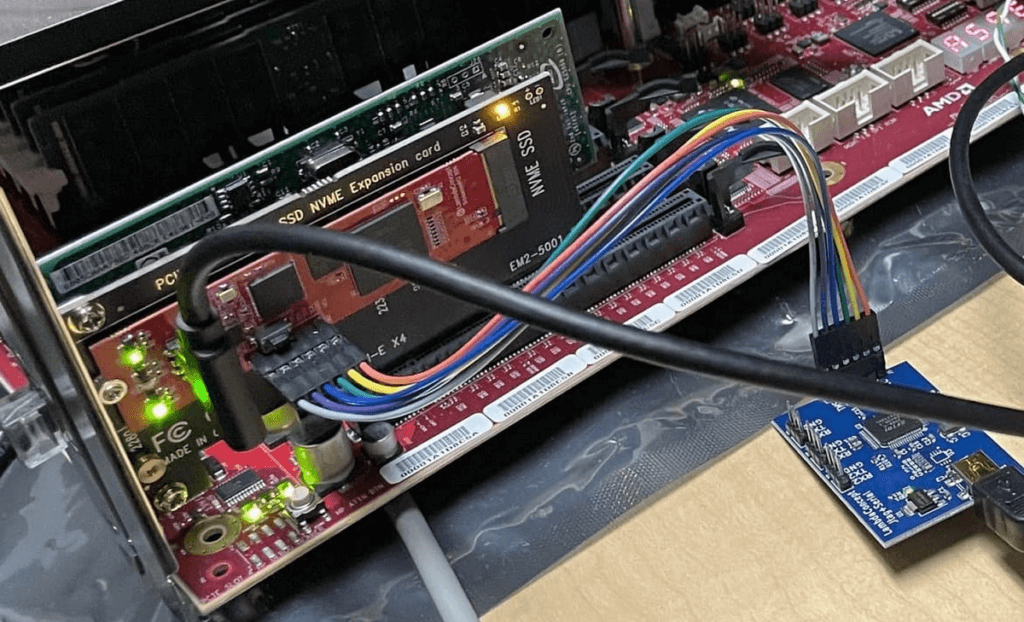
Working on this review, the security teams identified and confirmed potential issues of varying severity. AMD was diligent in fixing all applicable issues and now offers updated firmware through its OEM channels. Google Cloud’s AMD-based Confidential Computing solutions now include all the mitigations implemented during the security review.
“At Google, we believe that investing in security research outside of our own platforms is a critical step in keeping organizations across the broader ecosystem safe,” said Royal Hansen, vice president of Security Engineering at Google. “At the end of the day, we all benefit from a secure ecosystem that organizations rely on for their technology needs and that is why we’re incredibly appreciative of our strong collaboration with AMD on these efforts.”
“Together, AMD and Google Cloud are continuing to advance Confidential Computing, helping enterprises to move sensitive workloads to the cloud with high levels of privacy and security, without compromising performance,” said Mark Papermaster, AMD’s executive vice president and chief technology officer. ”Continuously investing in the security of these technologies through collaboration with the industry is critical to providing customer transformation through Confidential Computing. We’re thankful to have partnered with Google Cloud and the Google Security teams to advance our security technology and help shape future Confidential Computing innovations to come.”
Reviewing trusted execution environments for security is difficult given the closed-source firmware and proprietary hardware components. This is why research and collaborations such as this are critical to improve the security of foundational components that support the broader Internet ecosystem. AMD and Google believe that transparency helps provide further assurance to customers adopting Confidential Computing, and to that end AMD is working toward a model of open source security firmware.
With the analysis now complete and the vulnerabilities addressed, the AMD and Google security teams agree that the AMD firmware which enables Confidential Computing solutions meets an elevated security bar for customers, as the firmware design updates mitigate several bug classes and offer a way to recover from vulnerabilities. More importantly, the review also found that Confidential VMs are protected against a broad range of attacks described in the review.
Google Cloud’s Confidential Computing portfolio
The Google Cloud Confidential VMs, Dataproc Confidential Compute, and Confidential GKE Nodes have enabled high levels of security and privacy to address our customers’ data protection needs without compromising usability, performance, and scale. Our mission is to make this technology ubiquitous across the cloud. Confidential VMs run on hosts with AMD EPYC processors which feature AMD Secure Encrypted Virtualization (SEV). Incorporating SEV into Confidential VMs provide benefits and features including:
Isolation: Memory encryption keys are generated by the AMD Secure Processor during VM creation and reside solely within the AMD Secure Processor. Other VM encryption keys such as for disk encryption can be generated and managed by an external key manager or in Google Cloud HSM. Both sets of these keys are not accessible by Google Cloud, offering strong isolation.
Attestation: Confidential VMs use Virtual Trusted Platform Module (vTPM) attestation. Every time a Confidential VM boots, a launch attestation report event is generated and posted to customer cloud logging, which gives administrators the opportunity to act as necessary.
Performance: Confidential Computing offers high performance for demanding computational tasks. Enabling Confidential VM has little or no impact on most workloads.
The future of Confidential Computing and secure platforms
While there are no absolutes in computer security, collaborative research efforts help uncover security vulnerabilities that can emerge in complex environments and help to prevent Confidential Computing solutions from threats today and into the future. Ultimately, this helps us increase levels of trust for customers.
We believe Confidential Computing is an industry-wide effort that is critical for securing sensitive workloads in the cloud and are grateful to AMD for their continued collaboration on this journey.
To read the full security review, visit this page.
Acknowledgments
We thank the many Google security team members who contributed to this ongoing security collaboration and review, including James Forshaw, Jann Horn and Mark Brand.
We are grateful for the open collaboration with AMD engineers, and wish to thank David Kaplan, Richard Relph and Nathan Nadarajah for their commitment to product security. We would also like to thank AMD leadership: Ab Nacef, Prabhu Jayanna, Hugo Romero, Andrej Zdravkovic and Mark Papermaster for their support of this joint effort.
City of San Jose Ensures Critical Services Reach Community Using AI Translation

5178
Of your peers have already read this article.
1:30 Minutes
The most insightful time you'll spend today!
San José is one of the most diverse U.S. cities, with residents speaking more than 100 languages. Several years ago, we set out to improve city community interactions through more equitable service management and delivery. This demanded a new approach to automating the intake of requests from a majority population whose first language is not English.
We first created the 311 portal and app, which was an important step as we effectively separated resident service requests from emergencies. The way we describe it to our citizens, you call 311 for a burning question, and 911 for a burning building. In the last fiscal year, San José 311 received nearly 210,000 contacts by phone and an additional 211,000 service requests through the SJ 311 app.
Through the portal and app, we gave citizens an omnichannel experience enabling them to interact with the city to request improvements, access useful information, and get emergency help when they need it.
In order to truly serve our diverse communities, we recognized language translation services would be required to offer truly equitable services to everyone. That’s when we started working closely with SpringML, Google Cloud, and other partners with involvement from our Mayor and City CIO.
Building public services with community engagement in mind
When we first rolled out the My San José website and mobile app, we used an out-of-the-box translation service that ended up not working. It had poor accuracy and did not meet our needs to provide all citizens with coherent services. After looking at many other options, we decided to partner with SpringML and Google Cloud to leverage the AutoML Translation with other technologies such as our virtual agent.
SpringML was selected through an open RFP process, and helped us to build and optimize our integrations, interfaces, and more between several systems, making the app and website more intuitive to manage. SpringML delivered the product we needed on time and up to specifications, and additional value came from the training sessions they provided to our team. This enabled us to understand everything we could do with AutoML and opened the door to other enhancements such as simplifying the vernacular used with our residents, making government access easier to navigate regardless of natural language spoken.
After establishing the My San José app’s translation capabilities using AutoML, SpringML also helped us incorporate Dialogflow virtual agents. Dialogflow also positions us to make modifications with our own staffing practices – something that has become increasingly important amid the frequent changes in service levels from COVID-19 response in the past year.
Responding to community needs
With the app up-and-running, our next step was to bring in community members to help with testing, improvements, and more. We wanted the app and the website to not just be something we provided to the community, but rather something they helped us build so they would readily adopt it.
Thanks to the greater accuracy of translation supported by Google Cloud services, we were able to leverage the expertise of a small pool of community members to evaluate translations. AutoML Translation and Glossary proved to be a powerful combination that pushed us closer to our goals.
Our primary targets were Spanish and Vietnamese translations. We are now seeing 90 percent accuracy in automated Spanish translations while Vietnamese translations continue to improve. We continue to work to simplify the language used in these services, which makes a big difference in terms of ensuring optimal language accessibility.
This work includes best serving our community members who primarily use phones to get in touch with us through 311 services. Using Google Cloud Contact Center AI, we have been able to effectively manage the calls we receive 24×7 and communicate with residents who speak Spanish as well as English. No matter which channel one of our residents choose to use to reach out, we can serve them efficiently.
A well-timed release
We’re proud of the work we’ve done. We’ve made many government services available to our community 24 hours a day, 7 days a week — accessible through many channels. Regardless of a person’s native language, the consistency of experiences enjoyed by everyone is improving every day thanks to AI. We’re also actively incorporating more language translation capabilities to better serve more people.
While we began this process several years ago, the recent integration of machine learning language translation with our customer relationship management system in late 2020 was very well-timed because we were able to incorporate this into our COVID-19 pandemic response.
We’re also beginning to work with other municipalities across the U.S. to share some of the lessons we’ve learned and success we’ve seen in hopes of furthering more equitable citizen services far beyond our City limits.
We are excited to continue working with SpringML, Google Cloud, and other partners to improve our city and the equity and quality of services that our residents enjoy.
Learn more about how you can work with a Google Cloud Partner here.
Transforming Canadian Healthcare and Medical Research with Google Cloud

924
Of your peers have already read this article.
2:30 Minutes
The most insightful time you'll spend today!
Is Cloud an option for Canadian Healthcare healthcare and medical research organizations?
Yes, Canadian healthcare and medical research organizations are moving to the cloud. The cloud market is expected to grow in Canada significantly through 2027.
There are several reasons why Canadian healthcare and medical research organizations are moving to the cloud.
- Reduce costs by eliminating the need to invest in and maintain on-premises infrastructure.
- Enable the healthcare research community to drive their research more expediently to clinical outcomes
- Improve patient satisfaction by making it easier for patients to access their health information and communicate with their providers.
- Improve the quality of care by providing access to patient data and records from anywhere in the country.
Overall, the transition to the cloud is a positive development for Canadian healthcare and medical research organizations.
Canadian healthcare providers face many challenges before they can move to the cloud, such as addressing security and privacy concerns, data sovereignty issues, and ensuring interoperability. To help them overcome these challenges, it is important to provide Healthcare Data Custodians, Infrastructure Architects, and Research Leads with clear guidance on how the cloud can align with Canadian Healthcare Regulations. This will allow them to have a practical understanding of what is required to enhance their cloud journey and facilitate a smoother transition to the cloud.
iSecurity and MD+A Health are actively assisting Canadian healthcare and medical research organizations in comprehending the risks and exploring pathways to embrace the cloud. Through extensive research and analysis, iSecurity and MD+A Health have evaluated Google Cloud as a suitable platform for healthcare. Their diligent efforts have resulted in the production of comprehensive documents that detail their findings via a Threat Risk Assessment (TRA) and a Privacy Impact Report (PIA).
Why a Threat Risk Assessment?
A threat risk assessment is a process of identifying and evaluating threats to an organization and then determining the likelihood and impact of those threats. The goal of a threat risk assessment is to identify the most serious threats and develop mitigation strategies to reduce the likelihood and impact of those threats.
A threat risk assessment typically involves the following steps:
- Identify threats: The first step is to identify all potential threats to the organization. This can be done by brainstorming, interviewing experts, or reviewing historical data.
- Evaluate threats: Once the threats have been identified, they need to be evaluated in terms of their likelihood and impact. The likelihood of a threat is the probability that it will occur, while the impact of a threat is the severity of the consequences if it does occur.
- Prioritize threats: The threats need to be prioritized based on their likelihood and impact. The most serious threats should be addressed first.
- Develop mitigation strategies: Once the threats have been prioritized, mitigation strategies need to be developed to reduce the likelihood and impact of those threats. Mitigation strategies can include things like implementing security controls, training employees, and developing contingency plans.
- Implement mitigation strategies: The mitigation strategies need to be implemented and tested to ensure that they are effective.
- Monitor and review: The threat risk assessment should be monitored and reviewed regularly to ensure that it is still effective.
Why a Privacy Impact Assessment?
A Privacy Impact Assessment (PIA) is a process that organizations use to identify and assess the privacy risks associated with a new or changed information technology (IT) system or project. The goal of a PIA is to help organizations protect the privacy of individuals whose personal information is collected, used, or disclosed by the IT system or project.
PIAs typically include the following steps:
- Identifying the purpose of the IT system or project and the types of personal information that will be collected, used, or disclosed.
- Identifying the privacy risks associated with the IT system or project.
- Assessing the likelihood and severity of the risks.
- Developing and implementing controls to mitigate the risks.
- Monitoring the effectiveness of the controls.
PIAs are an important tool for organizations to help them follow privacy laws and regulations. They can also help organizations build trust with their patients, employees and the research community by demonstrating their commitment to protecting privacy.
The benefits of conducting a PIA:
- Helps organizations identify and assess privacy risks
- Helps organizations develop and implement controls to mitigate privacy risks
- Helps organizations comply with privacy laws and regulations
- Helps organizations build trust with customers and employees
Why Google Cloud?
Google Cloud is committed to providing Canadian healthcare organisations with an environment to expand both their clinical and research environments. Google Cloud has invested significant resources into building out a cloud environment based on best practices coming from Google’s experience running some of the world’s largest platforms.
Some highlights include:
- Built-in security features that help protect your data and applications from unauthorized access, use, disclosure, disruption, modification, or destruction.
- A comprehensive security management platform that helps you assess, prioritize, and address security risks across your organization.
- A team of security experts who can help you design, implement, and manage your security solutions.
- A wide range of security training and resources to help you learn about and stay up-to-date on the latest security threats and best practices.
3806
Of your peers have already watched this video.
8:00 Minutes
The most insightful time you'll spend today!
Target Leverages Google Cloud to Create Market-defining Online Experience
In the hyper-competitive world of online retail sales, ease-of-use and transaction speed can make or break business outcomes. However, a few years ago US Retail giant Target was going through a period of uncertainty.
While the company had over 1800 stores across the US with an estimated 85% of US consumers shopping at a Target store and over 25 million people visiting the Target website or using its app each month, it was still losing ground.
In spite of having millions of loyal customers, the company was dangerously late on digital and its technology wasn’t keeping pace with unstable systems to boot. The company faced the twin challenges of trying to operate today’s business as efficiently as possible and creating tomorrow’s business as quickly as possible. On the one hand it needed productivity and stability and on the other it wanted speed and disruption. Not an easy task to accomplish.
That’s when Target decided to use Google Cloud to solve its challenges. See how Target leveraged Google Cloud to create a market-defining online experience that has made customers happier and more loyal.
Explore the Complete Startups’ Technical Guide on Google Cloud Tech Channel

3385
Of your peers have already read this article.
1:30 Minutes
The most insightful time you'll spend today!
Bootstrap your Startup with our technical guided series
At Google Cloud, we want to provide you with the access to all the tools you need to grow your business. Through the Google Cloud Technical Guides for Startups, leverage industry leading solutions with how-to video guides and resource handbooks curated for startups.
This multi-series contains 3 chapters: Start, Build and Grow, which matches your startup’s stage of growth:
- The Start Series: Begin by building, deploying and managing new applications on Google Cloud from start to finish.
- The Build Series: Optimize and scale existing deployments to reach your target audiences.
- The Grow Series: Grow and attain scale with deployments on Google Cloud.
Kick off with The Start Series
The Start Series is designed to help your startup begin building, deploying and managing new applications on Google Cloud from start to finish. The series contains 12 videos and is dedicated to those who are starting out their cloud journey with Google Cloud. From setting up your project, to choosing the right compute option, to configuring your networking to managing your databases, and understanding support and billing – the Start Series guides you at every step of the journey.
Check out our website and our Google Cloud Technical Guides for Startups full playlist.
Coming up next – The Build Series
Launch into the next part of the journey continuing from the Start Series, with the upcoming Build Series, where we will be focusing on the optimization and scaling of existing deployments to help your startups reach your target audiences.
Join us by checking out the video series on the Google Cloud Tech channel, and subscribe to stay up to date.
See you in the cloud!
More Relevant Stories for Your Company

Consumption Packs Shorten’s Customers Transition to Google Cloud and Boosts Partners’ Financial Growth
When we launched Partner Advantage, we committed to making it predictable and easy for partners to drive business with us. Since launch, those commitments have been validated by channel experts like CRN, which gave Partner Advantage a 5-Star award for 2022, and by the fact that our partners have seen

Datashare for Financial Services: Securing the Publishers and Consumers’ Access to Market Data
Access to the cloud has advanced the distribution and consumption of financial information on a global scale. In parallel, the global financial data landscape has been transformed by an influx of alternative data sources, including social media, meteorological data, satellite imagery, and other data. Exchanges and market data providers now

Three Benefits of VPC Network Peering for SAP Managed Apps
Over the past year, RISE with SAP has emerged as a valuable solution for SAP customers seeking a faster, simpler, and more affordable path to the cloud. RISE with SAP is a subscription-based offering that typically includes a number of fully managed cloud application options, including SAP S/4HANA Cloud and

Three Typical Connectivity Use Cases to Pick the Right Option for Your Enterprise
Enterprises today have a very broad mix of networks — from SD-WANs, dedicated WANs such as MPLS, cloud interconnects, to VPNs. At the same time, they’re moving those WANs to the cloud to take advantage of faster turn-up, lower cost, and increased feature velocity. As workloads migrate to the cloud
