





Bigtable’s High Performance and Low Opex is Great for Building Personalization

3757
Of your peers have already read this article.
3:00 Minutes
The most insightful time you'll spend today!
Customer expectations have shifted as a result of evolving needs. Across industries, customers expect that you treat them as individuals, and demonstrate how well you understand and serve their unique needs. This concept—personalization—is the idea that you’re delivering a tailored experience to each customer corresponding to their needs and preferences; you’re setting up a process to create individualized interactions that improves the customer’s experience. According to Salesforce, 84% of consumers say being treated like a person, not a number, is very important to winning their business.
Entire industries are undergoing digital transformation to better serve their customers through personalized experiences. For example, retailers are improving engagement and conversion with personalized content, offers, and product recommendations. Advertising technology organizations are increasing the relevance and effectiveness of their ads using customer insights like their specific interests, purchasing intent, and buying behavior. Digital music services are helping their customers discover and enjoy new music, playlists, and podcasts based on their listening behavior and interests.
As customers want more and more personalization, modern technology is making it possible for many more businesses to achieve this. In this post, we’ll look at some common challenges to implementing personalization capabilities and how to solve them with transformative database technologies like Google Cloud’s Bigtable. Bigtable powers core Google services such as Google Maps that supports more than a billion users, and its petabyte scale, high availability, high throughput, and price-performance advantages help you deliver personalization at scale.
Challenges with personalization
Data is at the heart of personalization. To deliver personalization at scale, an application needs to store, manage, and access large volumes of data (a combination of customer-specific data and anonymized aggregate data across customers) to develop a deep understanding of the behavior, needs, and preferences of each customer. Your database needs to very quickly write large volumes of data concurrently for all active customers. You need to continuously capture data on customer behavior because each step potentially informs the next, e.g., adding an item to a shopping cart can be used to trigger new recommendations for related or complementary products. Much of this data needed for personalization is semi-structured and sparse, and therefore requires a database with a flexible data model.
Personalization at scale requires large volumes of data to be read in near real-time so that it can be in the critical serving path to deliver a seamless user experience, often with a total application latency of less than 100ms. This means your requests to the database need to return results with latencies of single-digit milliseconds. You need to ensure that application latencies do not degrade as you onboard more customers. Data needs to be organized efficiently and integrated with other tools so that you can run deep analytical queries and use machine learning (ML) models to develop personalized recommendations, and store the aggregates in your operational database for serving your customers. You also need the ability to run large batch reads for analytics without affecting the serving performance of your application.
In addition, you need to ensure that your database costs do not explode with the popularity of your application. Your database needs to consistently deliver low total cost of ownership (TCO), and high price-performance as your data volumes and throughput needs grow. Your database needs to scale seamlessly and linearly to deliver consistent, predictable performance to all users around the world. Additionally, your database needs to be easy to manage, so that you can focus on your application instead of managing the complexity of your database.
Why a NoSQL database is the right fit for personalization
Every database reflects a set of engineering tradeoffs. When relational databases were designed 40 years ago, storage, compute, and memory were thousands of times more expensive than they are today. Databases were deployed on a single server to a relatively small number of concurrent users, whose access to the systems tended to be during normal business hours when users had network access. Relational databases were designed with these resources, costs, and use in mind. They work very hard to be storage and memory efficient, and assume a single server for deployments.
As the costs of storage, memory, and compute decreased, and as data and workloads grew to exceed the capacity of commodity hardware, engineers began to reconsider these tradeoffs with different goals in mind. New types of databases later emerged that assumed distributed architectures so they could be easier to scale, especially with cloud infrastructure. With this approach the tradeoff in turn was to forego the sophistication of SQL and much of the data integrity and transactional capabilities developed in relational systems. These systems are commonly called NoSQL databases.
Traditional relational databases assume a fixed schema that will change infrequently over time. While this predictability of data structure allows for many optimizations, it also makes it difficult and cumbersome to add new and varying data elements in your application. NoSQL databases, such as key value stores and document databases, relax the rigidity of the schema and allow for data structures to evolve much more easily over time. Flexible data models speed the pace of innovation in your application, and increase your ability to iterate on your ML models, which is essential for personalization. In addition, the scalability of systems like Cloud Bigtable allow you to deliver personalization to millions of concurrent users while you continue to evolve how you personalize experiences for your customers.
How Cloud Bigtable enables personalization at scale
Cloud Bigtable supports personalization at scale with its ability to handle millions of requests per second, cost-effectively store petabytes of data1, and deliver consistent single-digit millisecond latencies for reads and writes. Bigtable delivers a unique mix of high performance and low operating cost to reduce your TCO.
We’ve heard from Spotify, Segment, and Algolia about how they’ve built personalized experiences for their customers with Bigtable. Check out this presentation to hear Peter Sobot of Spotify describe how they use Bigtable for personalization.
Let’s imagine a scenario where your application takes off like a rocketship, and grows to 250 million users. Let’s assume a peak 1.75 million concurrent users of your application2, with each user sending two requests per minute to your database. This will drive 3.5 million requests per minute to your database, or approximately 58.3K requests per second. Pricing for Bigtable to run this workload will start at under $400 per day3.
Bigtable scales throughput linearly with additional nodes. With separation of compute and storage, Bigtable automatically configures throughput by adjusting the association of nodes and data to provide consistent performance. When a node is experiencing heavy load, Bigtable automatically moves some of the traffic to a node with lower load to improve the overall performance. Bigtable also supports cross-region replication, with local writes in each region. This allows you to manage your data near your customers’ geographic locations, reducing network latency and bringing predictable, low-latency reads and writes to your customers in different regions around the world.
Bigtable is a NoSQL database developed and operated by Google Cloud. Bigtable provides a column family data model that allows you to flexibly store varying data elements for customers associated with their behavior and preferences, store a very large number of such data elements across your customers, and quickly iterate on your application. Bigtable supports trillions of rows with millions of columns. Each row in Bigtable supports up to 256 MB of data, so that you can easily store all personalized data for a customer in a single row. Bigtable tables are sparse, and there is no storage penalty for a column that is not used in a row; you only pay for the columns that store values.
BigQuery ML allows you to create and run ML models directly in BigQuery to develop personalization recommendations that you can bring back to Bigtable. You can easily pipe Bigtable data into BigQuery to run deep analytical queries and develop recommendations. These aggregates, like computed recommendations, are brought back to Bigtable so your application can serve those recommendations to users with low latency and massive scale.
Bigtable integrates with the Apache Beam ecosystem and Dataflow to make it easier for you to process and analyze your data. With application profiles and replication in Bigtable, you can isolate your workloads so that batch reads do not slow down your serving workload that has a mix of reads and writes. This enables your application to perform near real-time reads at scale to develop and train machine learning models in TensorFlow for personalization. Bigtable gives you the right operational data platform to develop personalization recommendations offline or in real-time, and serve them to your customers.

Here’s a look at conceptual schema examples for personalization in ecommerce:

And here’s a quick overview of what personalization use cases require, and how Bigtable addresses them.

Bigtable is fully managed to free you from the complexity of managing your database, so that you can focus on delivering a deeply personalized experience to your customers. Learn more about Bigtable.
1. Storage pricing (HDD) starts at $0.026 per GB/mo (us-central1)
2. Assumes application is used 24 hours a day, average user session is 5 minutes (Android app average), and daily peak is 2x the average. (250 million / (24 hours / 5 minutes) *2 = 1,736,111 peak concurrent users (us-central1 region)
3. Cloud Bigtable pricing for us-central1 region. Assumes 25 TB SSD storage (100 KB per user, for 250 million users) per month, 10 compute nodes per month (with no replication), includes data backup. Bigtable pricing details.
Google Cloud and Univision Partnership to Up the Ante in UX for Spanish-speaking Audience

6895
Of your peers have already read this article.
1:00 Minutes
The most insightful time you'll spend today!
The past year has given everyone lots to think about—about our priorities as people and as businesses. As the world retreated behind closed doors, we saw how shared interests and experiences can bring us together. As the world grappled with a common enemy, we witnessed just how differently individuals, communities and indeed entire countries can experience a situation. And as we faced seemingly unending obstacles to making it through the pandemic, we saw how making smart decisions based on data can drive meaningful solutions—fast.
That’s why we here at Google Cloud are so proud to partner Univision, the country’s leading Spanish-language content and media company. By partnering with Google Cloud, Univision will be able to accelerate growth across its portfolio of properties, deliver an enhanced user experience for Spanish-speaking audiences and provide the enterprise solutions needed to create the Spanish-language media company of the future.
According to Instituto Cervantes, there are over 580 million Spanish language speakers worldwide. Those viewers, like people everywhere, are avid consumers of streaming content. In Q4 of 2020 alone, viewing time for that content increased by 44%1, and in 2020, from 50%2 more sources. With that surge in demand, Univision needed a cloud provider whose infrastructure could reach Hispanic viewers around the world. With two-plus decades spent building out its network and data centers, as well as global content-delivery capabilities, Google Cloud has the infrastructure Univision needs to reach viewers across the Spanish-speaking world.
At the same time, with such a diverse audience for their content, Univision needs to target that content to viewers’ specific preferences. By applying Google Cloud’s artificial intelligence (AI) and machine learning (ML) technology across its content, Univision intends to personalize content based on shows users have previously watched, enhancing their engagement and viewing experience.
And as Univision transforms the user experience, it can use Google Cloud’s data and analytics suite to garner deeper insights into its audience and forge stronger relationships with them on an individual basis. With Looker and BigQuery, Univision employees will have access to real-time data to help them make business decisions about programming.
Univision will also migrate video distribution and production operations to Google Cloud, where we’ll help them streamline media workflows and develop innovative new capabilities. Meanwhile, Google Cloud’s tight business and technical integration with other Google services will help ensure Univision reaches viewers on the device of their choice, wherever they are in the world. For example, in the coming years, Univision will expand its global YouTube partnership and will integrate with entertainment features on Google Search that help people better discover TV shows and movies. The company will also use Google Ad Manager for global ad decisioning and Google’s Dynamic Ad Insertion for PrendeTV and future video-on-demand offerings. Finally, Univision will distribute its content and services on Google Play across Android phones and tablets, as well as Google TV and other Android TV OS devices.
We’re thrilled to partner with Univision to help them reach the Spanish-speaking world with their content. With our cloud portfolio, we can help them reach individual viewers around the world, with personalized content that they can consume however they see fit. Best of all, together, we can help them achieve this vision fast, leveraging established cloud, content delivery, and data analytics technologies. You can learn more about the partnership here.
4 Steps to a Successful Cloud Migration

3965
Of your peers have already read this article.
2:00 Minutes
The most insightful time you'll spend today!
Digital transformation and migration to the cloud are top priorities for a lot of enterprises. At Google Cloud, we’re working hard to make this journey easier. For example, we recently launched Migrate for Compute Engine and Migrate for Anthos to simplify cloud migration and modernization. These services have helped customers like Cardinal Health perform successful, large-scale migrations to GCP.
But we understand that the migration journey can be daunting. To make things easier, we developed a whitepaper on application migration featuring investigative processes and advice to help you design an effective migration and modernization strategy. This guide outlines the four basic steps you need to follow to migrate successfully and efficiently:
- Build an inventory of your applications and infrastructure: Understanding how many items, such as applications and hardware appliances, exist in your current environment is an important first step.
- Categorize your applications: Analyze the characteristics of all of your applications and evaluate them across two dimensions: migration to cloud, and modernization.
- Decide whether or not to migrate an application to the cloud: Not all applications should move to the cloud quite yet. The whitepaper lists the questions to ask to determine whether or not to migrate a given application.
- Pick your migration strategy: For the applications you decided to migrate, decide on your ideal strategy—pure lift and shift, containers, cloud managed services, or a combination thereof.
There’s a lot to consider when you start thinking about digital transformation, and every cloud modernization project has its nuances and unique considerations. The secret to success is understanding the advantages and disadvantages of the options at your disposal, and weighing them against what you want to transform and why. To learn how to migrate and modernize your applications with Google Cloud, download this whitepaper.
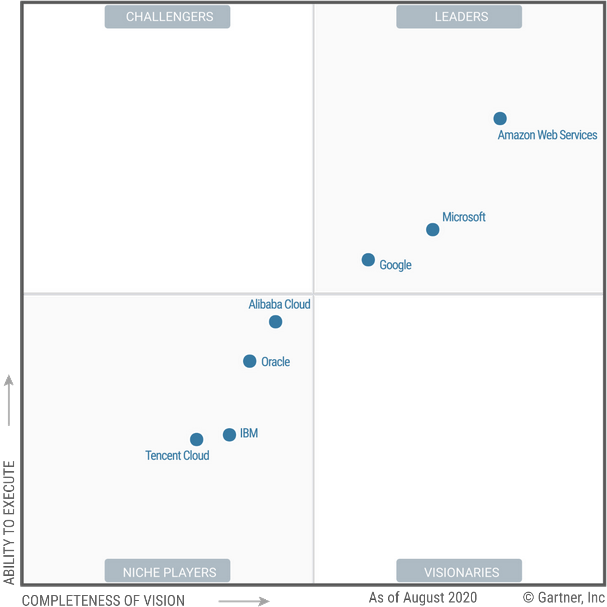
Google is named a Leader in 2020 Magic Quadrant for Cloud Infrastructure and Platform Services
3568
Of your peers have already read this article.
10:30 Minutes
The most insightful time you'll spend today!
The capability gap between hyperscale cloud providers has begun to narrow; however, fierce competition for enterprise workloads extends to secondary markets worldwide. Infrastructure and operations leaders should evaluate cloud providers with a broad range of use cases and a wide market presence.
Market Definition/Description
Cloud computing is a style of computing in which scalable and elastic IT-enabled capabilities are delivered as a service using internet technologies. Cloud infrastructure and platform services (CIPS) are defined as standardized, highly automated offerings, in which infrastructure resources (e.g., compute, networking and storage) are complemented by integrated platform services. These include managed application, database and functions as-a-service offerings. The resources are scalable and elastic in near-real time and are metered by use. Self-service interfaces are exposed directly to the customer, including a web-based user interface (UI) and an API. The resources may be single-tenant or multitenant, and can be hosted by a service provider or on-premises in the customer’s data center.The scope of this Magic Quadrant has changed, compared with its predecessor, the “Magic Quadrant for Cloud Infrastructure as a Service.” Gartner has developed this Magic Quadrant to reflect the changing dynamics of cloud services offered and the ways that enterprise customers adopt them. Ultimately, hyperscale cloud providers, and the broad array of services they offer beyond infrastructure as a service (IaaS), have found strategic importance in Gartner’s enterprise clients and the Magic Quadrant needed to evolve to reflect as much.The scope of the Magic Quadrant for CIPS includes IaaS and integrated platform as a service (PaaS) platforms. These include application PaaS (aPaaS), functions as a service (FaaS), database PaaS (dbPaaS), application developer PaaS (adPaaS) and industrialized private cloud offerings that are often deployed in enterprise data centers.
Understanding the Vendor Profiles, Strengths and Cautions
CIPS providers that target enterprise and midmarket customers generally offer high-quality service, with excellent availability, good performance, high security and good customer support. Exceptions will be noted in this Magic Quadrant’s evaluations of individual providers. When we say “all providers,” we specifically mean “all the evaluated providers included in this Magic Quadrant,” not all CIPS providers in general. Keep the following in mind when reading the vendor profiles:
- All the providers have public cloud IaaS and PaaS offerings. Most also offer, or are in the process of building, industrialized private cloud offerings, in which every customer is on standardized infrastructure and cloud management tools. In some cases, the provider’s industrialized, on-premises offering may share similarities to hyperconverged infrastructure (HCI), but tethered to the cloud. However, this may not resemble the provider’s public cloud service in architecture or quality. A single architecture and feature set and cross-cloud management, for both public and private CIPS, make it easier for customers to combine and migrate across service models as their needs dictate. They also enable the provider to use its engineering investments more effectively. Gartner is beginning to describe the notion of cloud-provider-managed infrastructure, wherever it may exist, as “ distributed cloud.”
- All the providers target midmarket businesses and enterprises, as well as other companies that use technology at scale. Some of the providers may also target small businesses and startups. Just because a provider targets a segment, however, does not necessarily mean that it is well-suited to that segment’s needs. Furthermore, not all providers have the capacity to serve very-large-scale customers, and some have capacity constraints in particular regions.
- All the providers offer basic cloud IaaS — compute, storage and networking resources as a service. They also offer additional value-added capabilities, notably cloud software infrastructure services — typically middleware and databases as a service — including PaaS capabilities. These services, along with IT operations management (ITOM) capabilities as a service (especially DevOps-related services), are a vital differentiator in the market, especially for Mode 2 agile IT buyers.
- All the providers claim to have high security standards. However, the extent of the security controls provided to customers varies significantly. All the providers evaluated can offer solutions that will meet common regulatory compliance needs, unless otherwise noted. All the providers have undergone SOC 1, SOC 2 and SOC 3 audits, as well as SSAE 16, ISO/IEC 27001, ISO/IEC 27017 and ISO/IEC 27018 audits. This provides a relatively high level of assurance that the providers are adhering to generally accepted practices for the security of their systems, but it does not address the extent of controls offered to customers.
- Security is a shared responsibility. Customers need to correctly configure controls, and they may need to supply additional controls beyond what their providers offer. Furthermore, providers vary in their degree of transparency as to how services are architected, although customers typically have access to third-party assessment reports under a nondisclosure agreement (NDA).
- Monthly compute availability service-level agreements (SLAs) of 99.95% and higher are generally the norm. They are typically higher than availability SLAs for managed hosting. Service credits for outages in a given month are typically capped at 100% of the monthly bill; however, some providers have caps as low as 25%. This availability percentage is typically non-negotiable, because it is based on an engineering estimate of the underlying infrastructure reliability.
- Single-instance compute SLAs have become common for providers in this Magic Quadrant. It might be more accurate to say that there are usually two SLAs — one for the compute service, and one for individual instances. Some providers have a compute availability SLA that requires customers to use compute capabilities in at least two fault domains (sometimes known as “availability zones” or the like).
- Many providers have additional SLAs. These cover network availability and performance, customer service responsiveness and other service aspects.
- Infrastructure resources are not normally automatically replicated into multiple data centers. Customers are responsible for their own business continuity. Some providers offer optional disaster recovery solutions.
- All providers offer per-second metering of virtual machines (VMs). Some can offer shorter metering increments, which can be more cost-effective for short-term batch jobs. Unless otherwise noted, providers charge on a per-VM basis.
- Providers are increasingly offering bare-metal physical servers on a dynamic basis. These are priced by the second. Providers with a bare-metal option are noted as such.
- All the providers partner with carrier-neutral colocation exchanges. This enables customers to obtain connectivity from a variety of carriers that are located in these facilities. In addition, many customers require a small amount of supplemental colocation in low-latency proximity with their cloud provider. For example, they may have a large-scale database, specialized network equipment or legacy equipment, such as a mainframe.
- Some providers offer software marketplaces. In these marketplaces, software vendors specially license and package their software to run on that provider’s cloud IaaS offering. Marketplace software can be automatically installed, and can be billed through the provider, although the software vendor often provides support.
- All providers offer enterprise-class support with 24/7 customer service. This is provided via phone, email and chat, along with an account manager. Some offer a lower level of support, but allow customers to pay extra for enterprise-class support.
- All the providers will sign contracts with customers, can invoice and can consolidate bills from multiple accounts. All providers offer online sign-up and credit card billing, because they recognize that enterprise buyers prefer contracts and invoices. Some will sign “zero dollar” contracts that do not commit a customer to a certain volume.
- Some providers will sign a U.S. Health Insurance Portability and Accountability Act Business Associate Agreement (HIPAA BAA).
- Unless otherwise noted, all providers will sign the following contract addendums:
- An EU Data Protection Directive (95/46/EC) data-processing agreement (DPA), which includes the model clauses
- An EU General Data Protection Regulation (GDPR) DPA
- Managed and professional services are an optional but important accelerator for customer success. Almost all providers rely heavily on managed service providers (MSPs) and system integration (SI) partners for these services. However, most providers offer their own first-party professional services and some also offer first-party managed services offerings.
- All of the evaluated providers offer a portal, documentation, technical support, customer support and contracts in English. Some can provide one or more of these in languages other than English. Most providers can conduct business in local languages.
The service provider descriptions are accurate as of the time of publication. Our technical evaluation of service features took place between January 2020 and March 2020.
Format of the Vendor Descriptions
When describing each provider, we first summarize the nature of the company, then provide information about its industrialized cloud IaaS offerings in the following format:
- Locations: Cloud data center locations by country, languages in which the company does business and languages in which technical support can be conducted.
- Recommended Uses: These are the circumstances under which we recommend the provider. They are not the only circumstances in which it may be a useful provider, but they are the scenarios for which, in Gartner’s opinion, the provider is well-suited.
For a detailed technical description of CIPS offerings, along with a use-case-focused technical evaluation, see “Critical Capabilities for Cloud Infrastructure and Platform Services, Worldwide.”We also provide a detailed list of evaluation criteria in “Solution Criteria for Cloud Integrated IaaS and PaaS.” A detailed assessment of each provider against these criteria can be found in the Solution Scorecards. The results are also available in Gartner’s Cloud Decisions portal (see “Cloud Decisions’ Cloud Compare: Perform Real-Time IaaS Pricing and Performance Analysis”).
Magic Quadrant
Figure 1. Magic Quadrant for Cloud Infrastructure and Platform Services
Vendor Strengths and Cautions
Google is a Leader in this Magic Quadrant.
Locations: Google has multiple regions across Japan and the U.S., as well as a presence in Belgium, Singapore, Finland, Germany, the Netherlands, the U.K., India, Australia, Brazil, Canada and, Switzerland, as well as the Hong Kong and Taiwan markets.
Recommended Uses: Google has evolved by enhancing its strengths and attacking its limitations to providing a strong offering in every use case, other than the edge use case. Google has a future focus on building out hybrid capabilities and partnerships with telco providers.
Strengths
- Google’s open-source contributions, such as Kubernetes and TensorFlow, have been market-moving innovations that have changed the course of enterprise IT. Such innovations have served to enable other cloud service providers, but also brought developer “mind share” to Google Cloud Platform (GCP). Google’s long-term strategy is to bring additional open-source-focused partners into GCP as managed services.
- During the past year, GCP has experienced a noticeable increase in year-over-year market share in terms of IaaS and dbPaaS, albeit from a lower base, relative to other providers in this Magic Quadrant. Google has also made significant gains by closing a number of critical capability gaps between GCP and Microsoft Azure, its nearest competitor in terms of market share and capabilities.
- Gartner clients continue to associate GCP with its big data and data science capabilities, stemming from the use of services such BigQuery and Dataproc. However, the company is pressing into new territory with Anthos, GCP’s container and Kubernetes-based middleware layer, which is designed to support the development and deployment of cloud applications in a hybrid and multicloud model.
Cautions
- Some of Gartner’s clients remain cautious about Google’s commitment to serving the needs of enterprise clients when put in the context of SAP’s preference for Microsoft Azure, and GCP’s slowness in executing on some highly touted partnerships. GCP lacks enterprise-focused aPaaS capabilities and support for Oracle, and it continues to struggle with having an enterprise mindset in the field.
- From a financial perspective, GCP’s revenue is a small fraction of overall Google revenue and GCP’s criticality to the overall business is not as clear as its competitors. Furthermore, GCP’s success may erode the company’s overall healthy gross margins.
- Google’s much-vaunted network capabilities have been the source of a number of GCP outages during the last year, with devastating impact on customers. One outage was multiregional in scope, affecting GCP customers and Google consumer services, such as G Suite and YouTube. This resulted in complete GCP network unavailability for some customers.

3597
Of your peers have already downloaded this article
3:30 Minutes
The most insightful time you'll spend today!
Defending the world’s largest network against persistent and constantly evolving cyber threats has driven Google to architect, automate, and develop advanced tools to help keep it ahead. Understanding how Google has built and evolved it’s defenses can help you make smart architectural decisions of your own as you move forward.
- At Google every minute:
- 10 million spam messages are prevented from reaching Gmail customers.
- 694,000 indexed Web pages are scanned for harmful software.
- 7,000 deceitful URLs, executables, and browser extensions that may carry viruses, unwanted content, or phishing attempts are spotted and stopped.
- 6000 instances of unwanted software and nearly 1,000 instances of suspected malware are reported to Chrome users.
- 2 phishing sites and 1 malware site are found and labeled.
Download this e-book to know more about Google’s security at scale.
5585
Of your peers have already downloaded this article
1:30 Minutes
The most insightful time you'll spend today!
Protecting a global network against persistent and constantly evolving cyber threats is one of the most important challenges faced by Google Cloud. So, how does Google’s global network protects seven different global businesses, each with over 1 billion customers, including popular Google services such as Google Search, YouTube, Maps, and Gmail?
The answer is a multi-step process, which is constantly changing and evolving to stay one step ahead of the malicious hackers and attackers. For instance, it’s network communications protocols—the rules that enable communications between systems—change multiple times per second to make malicious intrusions much harder.
Data in Google Cloud is encrypted both in transit and at rest. Google’s network capacity far exceeds any traffic load it hosts to thwart and DDoS attack. In addition, it has numerous other products, tools, and processes at work to provide defense in depth.
Download this e-book to get a detailed overview of Google Cloud’s approach to security and privacy.
More Relevant Stories for Your Company
A Year of Going Carbon-free! Google’s Road to Sustainability Looks Promising
Last year, we announced our most ambitious sustainability goal yet: to operate everywhere on 24/7 carbon-free energy by 2030. We’ve set this goal to ensure that Google Cloud continues to be the cleanest cloud in the industry, and to show that full-scale decarbonization of electricity use is possible. Since setting our target,

Unlocking Economic Potential: Cloud FinOps
Built for a CapEx world, most organizations’ finance systems aren’t set up to take advantage of cloud’s dynamic, OpEx-driven consumption patterns. Practicing Cloud FinOps can unlock the business value latent in adopting public cloud. GETTY It may not be a household name yet, but chances are you’ve crossed paths with OpenX

Lucent Bio: Boosting collaboration and sustainability with Google Workspace
From electrifying transportation to shifting the grid to renewable energy, environmental sustainability is one of the greatest challenges of our generation. A critical but often forgotten goal is the development of sustainable agricultural practices, especially given increasing water shortages and soil degradation around the world. Lucent Bio was born to

Cloud on Europe’s Terms: How Google Sets to Deliver Cloud Services for Driving Digital Sovereignty
Cloud computing is globally recognized as the single most effective, agile and scalable path to digitally transform and drive value creation. It has been a critical catalyst for growth, allowing private organizations and governments to support consumers and citizens alike, delivering services quickly without prohibitive capital investment. European organizations—in both
