





Tackling Real-Time Bidding Challenges: Arpeely’s Fresh Approach with Google Cloud

1134
Of your peers have already read this article.
4:30 Minutes
The most insightful time you'll spend today!
At Arpeely, we’ve developed some of the world’s most advanced advertising technology. Our machine learning (ML) media acquisition platform and “win-win” business model enables customers to bring highly intentful users to their offerings with precision, peace of mind and minimal overhead.
Real-time bidding is a dynamic and intricate process that involves buying and selling ad impressions in milliseconds. Each time a user opens an app or website, advertisers or ad-tech companies acting on behalf of advertisers have milliseconds to bid on ad spaces in real-time auctions, and the highest bidder wins the opportunity to display their ad. This is where Arpeely comes in, leveraging advanced algorithms, innovative UX and funnels to optimize the bidding process and maximize performance for advertisers.
At Arpeely, we use various signals often not used by traditional competitors to outperform the market and zero-down on high-intent and soon-to-be loyal users. For example, in advertising a mobile app, we predict, based on real-time conditions and user context, the user’s likelihood to make an in-app purchase many weeks into the future.
As for the ads themselves, gone are the days of simple banners; today’s ads are “mini products” that captivate and engage users. We employ a wide range of ad formats that go beyond industry standards. Our ads can be immersive videos, compelling messages, interactive experiences like mini-games or mini-apps, or even a multi-step mixture of all of the above. By integrating logic and interactivity, Arpeely enables users to engage with the ad content seamlessly and gauge user intent without leaving their main activity.
Our business model dictates that we don’t get paid if our advertiser doesn’t get paid. We like to say that our algorithms, like water, can trickle into hidden market opportunities missed by the rest of the industry that uses less granular tools. These and other capabilities make Arpeely a strategic partner in the challenging space of media and user acquisition.
Innovation at the edges of data science and engineering
Today, we handle millions of impressions per second and over a billion ML predictions daily. We are directly connected to seven of the world’s largest real-time bidding exchanges, including Google AdX. We also work very closely with our clients, ranging from prominent startups to companies in the S&P Top 20.
Daily, we tackle complex engineering and data challenges on multiple fronts. On the engineering side, we ensure that every real-time auction receives a lightning-fast response within a strict 150ms timeframe. On the data side, we fire multiple ML predictions per auction and ingest TBs of data daily. On the user-serving front, we serve A/B-tested assets across a long tail of geos and devices, with even the slightest fluctuations in load speeds affecting business dramatically.
Right from the start, we knew we couldn’t do it alone when it came to building our technology stack. When you look at available platforms, it’s clear Google Cloud has a robust architecture that is easy to manage, use and scale, especially for our use cases. They also have reliability and feature completeness which are critical in our line of business.
Under the hood
Building upon Google Kubernetes Engine (GKE), we run multiple services that handle our main bidding flows. We utilize Golang for services that run at a large scale and Python for when we prioritize development speed, community and readability. All of these can reach an immensely high scale, which is managed and monitored automatically in GKE. Communication between these services and our Redis (our Google Cloud partner) cluster happens in sub-millisecond latency over Google Cloud’s strong network infrastructure and enables us to run complex real-time logic for every impression.
Once we have tackled the actual bidding, we are left with the challenge of streaming our data into BigQuery for analytics and model training. We utilize a mix of Cloud Pub/Sub, Memorystore and Cloud Storage to create a mechanism capable of ingesting many TBs per day in near real-time without compromising on cost. Real-time data is critical for a company like Arpeely to test and reiterate at a fast pace.
BigQuery is our data warehouse for operational analysis and is an essential part of our business. We use it both as a warehouse, for large-scale computations and in an operational capacity that closes the loop between production, data, and ML retraining. A team of two or three people can manage petabytes at scale with minimal maintenance.
On top of these, we’ve built a state-of-the-art in-house model pipeline suited specifically for ad-tech industry purposes. It allows us to effectively deploy complex solutions — on-the-fly calibration, flexible conversion steps, sampling of heavily imbalanced data sets, adjusting weights, and A/B-tested model deployment and more.
Google Cloud also offers us an entry point for several very useful built-in products that have become deeply embedded in our daily stack and routine. Among them are Operations Suite (formerly Stackdriver), Cloud Profiler, Cloud Storage, Cloud CDN, Cloud SQL, Memorystore, Cloud Scheduler, Error Reporting, and more.
In addition to all the technology, there’s also a human touch. Google’s skilled Customer Success team possesses a unique blend of technical expertise and business acumen, acting as strategic advertisers and opening doors we did not know existed.
Opening the door to the future of advertising
Standardizing on Google Cloud enables us to focus our resources on innovation and growth. Instead of having to research business solutions and invest time integrating disparate technologies, we can tap into a wide range of Google Cloud tools as needed. Thus, it is crucial that we set up a good technological foundation and prepare for future growth of the business.
Google Cloud enables us to focus our resources on innovation rather than our infrastructure. This means we can put more effort into finding ways to match clients with high-value customers and grow their revenues. Even though online advertising has been around for over 20 years and pioneered by Google itself, Google Cloud gives us the impetus to disrupt the market and deliver greater levels of value to our customers today and in the future.
If you want to learn more about how Google Cloud can help your startup, visit our page here to get more information about our program, and sign up for our communications to get a look at our community activities, digital events, special offers, and more.
Check out the Redis listing on Google Cloud Marketplace. Please give it a try and let us know what you think!
Dataplex: Google Cloud’s Intelligent Data Fabric to Manage Data and Analytics at Scale

4862
Of your peers have already read this article.
2:30 Minutes
The most insightful time you'll spend today!
Enterprises are struggling to make high quality data easily discoverable and accessible for analytics, across multiple silos, to a growing number of people and tools within their organization. They are often forced to make tradeoffs—to move and duplicate data across silos to enable diverse analytics use cases or leave their data distributed but limit the agility of decisions.
Today we are excited to announce Dataplex, an intelligent data fabric that provides a way to centrally manage, monitor, and govern your data across data lakes, data warehouses and data marts, and make this data securely accessible to a variety of analytics and data science tools.
Dataplex provides an integrated analytics experience, bringing together the best of Google Cloud and open source tools, so you can rapidly curate, secure, integrate, and analyze data at scale. With built-in data intelligence using Google Artificial Intelligence (AI) and machine learning (ML) capabilities and a flexible consumption model, you can now spend less time wrestling with infrastructure and more time focused on driving business outcomes.
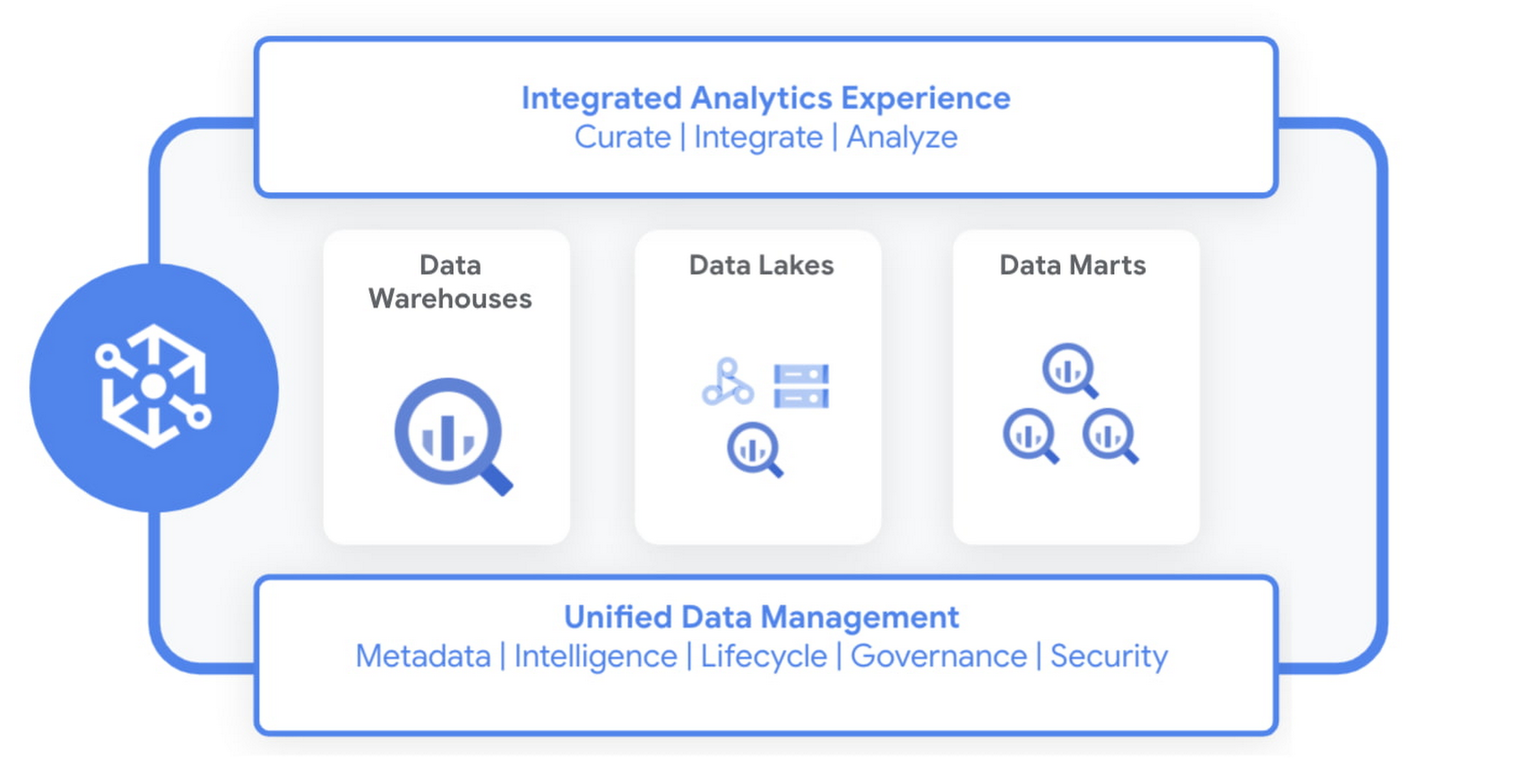
Dataplex enables you to:
- Achieve freedom of choice to store data wherever you want for the right price/performance and choose the best analytics tools for the job, including Google Cloud and open source analytics technologies such as Apache Spark and Presto.
- Enforce consistent controls across your data to ensure unified security and governance
- Take advantage of the built-in data intelligence using Google’s best in class AI/ML capabilities to automate much of the manual toil around data management and get access to higher quality data.
Early customers like Equifax, Loblaw, and ANZ are excited about using Dataplex to address data management complexity.
“Dataplex will greatly simplify the existing analytics workflows within Equifax with its unified data fabric and single interface for policy management and governance across all our analytics data. Its built-in data discovery and data quality features will ensure that our data scientists and analysts always have access to high quality data that they can trust. Dataplex aligns well with our enterprise data strategy and we are excited to partner with Google Cloud on this.”
—Kumar Menon, SVP, Data Fabric & Decision Science Technology, Equifax.
“Loblaw is Canada’s food and pharmacy leader, and we are excited to be an early adopter of Dataplex. We could significantly benefit from Dataplex as it provides a single pane of glass for end-to-end data management and governance. We are particularly interested in improving platform resilience and data quality by detecting anomalies as early as possible in the data pipeline with the help of Dataplex.”
—Elton Martins, Senior Director of Data Insights & Analytics, Loblaw
“We are undergoing a major data transformation at ANZ, bringing together our various data assets and building a cohesive data ecosystem for customer benefit. Dataplex’s vision and capabilities align well with our current data strategy to build a unified data fabric for all our analytics and AI/ML use cases. We are excited to partner with GCP on Dataplex and test the product in private preview.”
—Ashish Shekhar, Head of Technology – Enterprise Analytics & Applied AI, ANZ
Dataplex is built for distributed data. We are starting with data stored in Google Cloud Storage and BigQuery, with support for other data sources coming soon. It provides a workflow-driven experience helping you build an open data platform and make data easily accessible to your end users while ensuring your policies and best practices are consistently enforced.
Organizing and curating your data
One of the core tenets of Dataplex is letting you organize and manage your data in a way that makes sense for your business, without data movement or duplication. For that, we are providing logical constructs like lakes, data zones and assets. Those constructs enable you to abstract away the underlying storage systems and become the foundation for setting policies around data access, security, lifecycle management, and so on.
For example, you can create a lake per department within your organization (Retail, Sales, Finance, etc.) and create data zones that map to data readiness and usage (landing, raw, curated_data_analytics, curated_data_science, etc.).
Once you have your lakes and zones setup, you can now attach data to these zones as assets. You can add data from different types of storage (e.g. GCS Bucket and BigQuery dataset) under the same zone. You can also attach data across multiple projects under the same zone.

You can ingest data into your lakes and zones using the tools of your choice including services such as Dataflow, Data Fusion, Dataproc, Pub/Sub or choose from one of our partner products. Dataplex provides built-in 1-click templates for common data management tasks.
Securing your data
Dataplex enables you to define and enforce consistent policies across your data, irrespective of where it physically resides. Data owners can easily set up policies for specific data domains based on business needs, without thinking about where the data is stored while data stewards get global visibility into governance policies and permissions across their data.
You can apply security and governance policies for your entire lake, a specific zone, or an asset. Dataplex maps the policies to the underlying storage and pushes down permissions to the storage layer to provide end-to-end secure data access. Additionally, you can secure not just data but also related artifacts like notebooks, scripts, and models using the same set of access policies.
Making high quality data available for analytics and data science
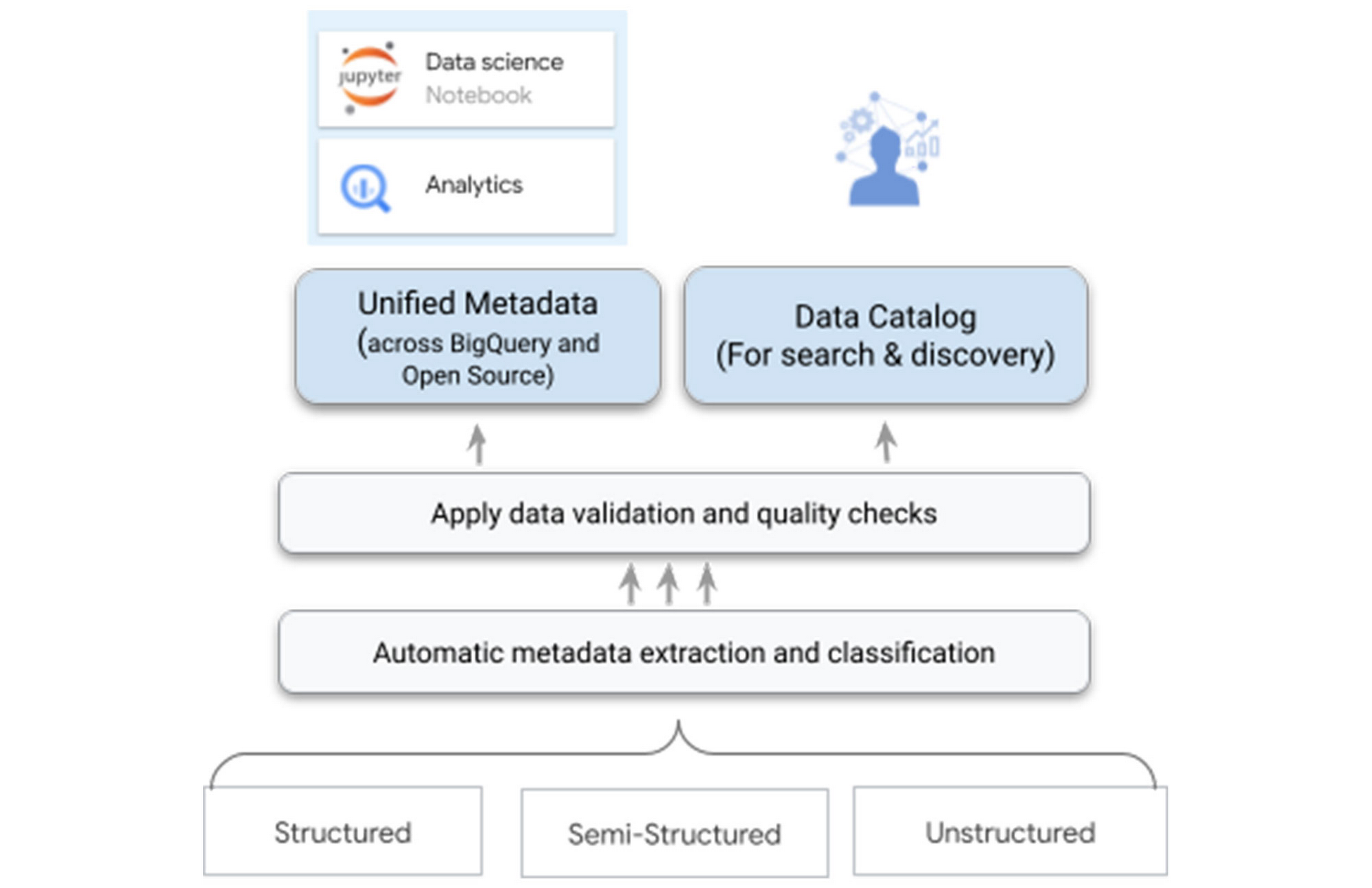
One of the biggest differentiators for Dataplex is our data intelligence capabilities using Google’s best in class AI/ML technologies. As you bring the data under management, Dataplex will automatically harvest the metadata for both structured and unstructured data, with built-in data quality checks. All of the metadata is automatically registered in a unified metastore, and made available for search and discovery. It is also published to Bigquery, Dataproc Metastore, and Data Catalog – ensuring that you have the same consistent data context and access across your tools.
For example, when you write parquet files to a Google Cloud Storage bucket – Dataplex will automatically extract metadata of these files, detect a tabular schema, including hive-style partitions, run data quality checks, and make this data queryable in BigQuery as an external table and from any open source or partner application – with the same consistent security and access policies you defined at the logical data layer.
Your data scientists and analysts now have secured access to this data that meets your quality bar and governance rules via the tools of their choice, without needing any additional processing.
One-click access to collaborative analytics
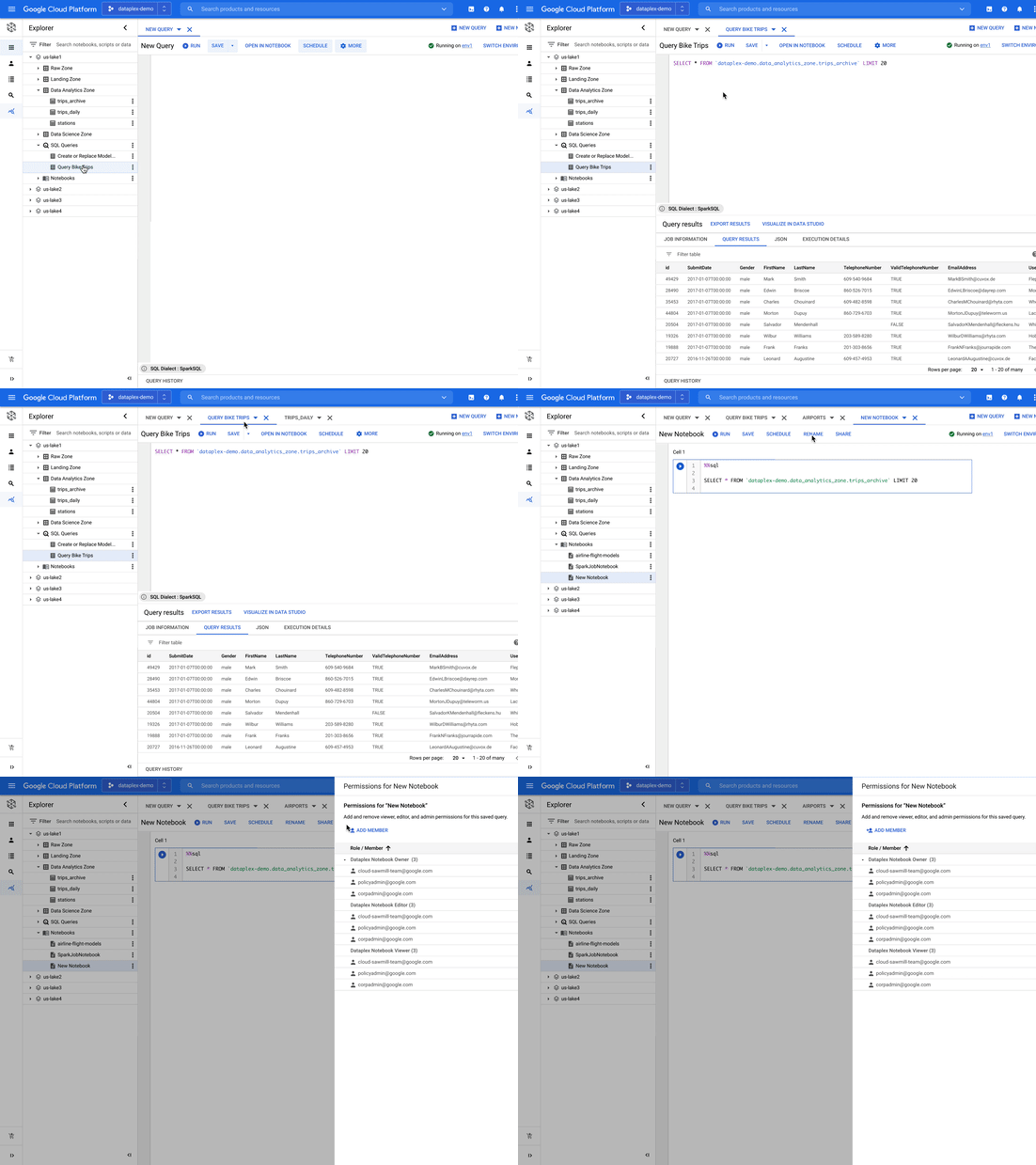
Dataplex provides fully managed, one-click analytics environments enabling you to use the power of Apache Spark and BigQuery with support for other engines coming in the future.
As data administrators, you now have the flexibility to pre-configure these environments with the right cost and financial governance measures without taking on the overhead of managing and maintaining the infrastructure required to power these environments. You can easily configure different environments for different types of workloads and share it with multiple users using their IAM credentials. Dataplex manages the provisioning, monitoring, scaling, and shutdown of these environments.
As data scientists, analysts, and engineers, you now have a turn-key experience to run your analysis using notebooks and a SQL workbench. You can search for notebooks and scripts alongside data, save and share your work with other users, and schedule your notebooks or scripts for recurring workloads – all using the same integrated experience within Dataplex.
Building an open platform with industry leaders
We are partnering with industry leaders such as Accenture, Collibra, Confluent, Informatica, HCL, Starburst, NVIDIA, Trifacta, and others to build an open platform to power analytics at scale. Our partners are excited about the capabilities that Dataplex will provide:
“Collibra is excited to partner with Dataplex to provide data governance and data quality for consistent controls across distributed data. Pairing Collibra’s multi-cloud and hybrid solution with Dataplex allows enterprises to securely open up access to more, higher quality data for users and analytics using a single unified view.”
—Jim Cushman, Chief Product Officer, Collibra
“Dataplex builds on Google Cloud’s commitment to open source by integrating with Apache Kafka®, a leading open source platform for event streaming. We at Confluent, the platform for data in motion that completes Apache Kafka® to be enterprise-ready, are excited to partner with Dataplex to enable customers to bring together distributed, real-time data and build a unified data fabric for end to end analytics.”
—Paul Mac Farland, VP, Head of Customer Solutions and Innovation, Confluent
“We are excited to partner with Google Cloud’s Dataplex team as we look to provide our joint customers an integrated and open data fabric for analytics at scale. Extending Dataplex’s data management and data quality capabilities with Starburst Enterprise will accelerate time to value for enterprises looking to connect distributed data without having to move data.”
—Justin Borgman, CEO and Co-founder, Starburst
Next Steps
Dataplex is now available in preview for a select number of customers. For more information, visit our website or watch the recording. If you would like to sign up, please click here.

3485
Of your peers have already downloaded this article
15:15 Minutes
The most insightful time you'll spend today!
Today’s business leaders face more challenges than ever, in a world that is evolving rapidly, that is hyper-connected, and that is data-driven.
As the pace of change intensifies, marketers have come under immense pressure to demonstrate value and to lead their organizations through this new landscape.
This is particularly pronounced in Asia, home to many of the world’s fastest-growing economies. Innovations in e-commerce, online payments, and communications are driving new business models and shifts in consumer behavior both here and around the globe.
Now, more than ever, strong consumer insights are essential in order to succeed. We are surrounded by signals that can help decode how behavior will change in the coming years.
Marketers who invest in detecting and developing these signals will stay ahead of the curve. In today’s world, opportunity and growth lie at the intersection of data and foresight.
This thought-leadership study showcases newly-breaking trends, examples of what companies are doing now, stories of how emergent leaders are pushing the boundaries, and what the future could hold.
The study covers:
- Cutting-edge trends including Shoppingmas, Retailarity, Leisuressence, Part-time Preneurs, and Mindful Impact
- The implications for CMOs and businesses
- How to use data and machine learning to prepare
Download Now: A Peek Into Your Consumer’s Future

3133
Of your peers have already downloaded this article
22:30 Minutes
The most insightful time you'll spend today!
Companies everywhere are seeking to leverage the power of AI. And rightly so. The smart applications of AI enable organizations to improve, to scale, and to accelerate the decision-making process across most business functions, so as to work both more efficiently and more effectively. It can also open up new avenues and new revenue streams, providing the organization with an additional competitive edge.
In short, many believe (as we do) that the enterprises that invest in building industry-specific AI solutions today are positioning themselves to be the global economic leaders of tomorrow. But the path to building an effective AI capability is not an easy one. There are many challenges to overcome. Challenges with the technology to develop platforms and solutions. With the people who will implement and manage that technology. With the data that fuels the technology. And with the processes that govern the whole of it. How do you harness the power inherent in AI, while avoiding any potential missteps?
That’s where Google Cloud comes in. Our framework for AI adoption provides a guide to technology leaders who want to build an effective AI capability, one that enables them to leverage the power of AI to enhance and streamline their business, smoothly and smartly. The framework is informed by Google’s own evolution, innovation, and leadership in AI, including experience deploying AI in production through products such as Gmail and Google Photos. It is also inspired by many years of experience helping cloud customers — from startups to enterprises, in various industries — to solve complex challenges.
With Google Cloud’s AI Adoption Framework, you’ll be able to create and evolve your own transformative AI capability. You’ll have a map for assessing where you are in the journey and where, at the end of it, you’d like to be. You’ll have a structure for building scalable AI capabilities to create better insights from big data with powerful algorithms across the entire business.
With Google Cloud as your guide, the path to AI is considerably smoother.
Download this whitepaper to find out:
- A map for assessing where you are in your AI journey and where you want to be
- A comprehensive structure for building an effective AI capability across your entire organisation to create actionable insights from data
- A technical deep dive for technology leaders
How Google Cloud Helps RecruitMilitary Connect More Veterans to Jobs

3032
Of your peers have already read this article.
3:30 Minutes
The most insightful time you'll spend today!
Editor’s note: Today’s post is by Mike Francomb, Senior Vice President of Technology, RecruitMilitary and a U.S. Army Veteran. RecruitMilitary is a wholly owned subsidiary of Bradley-Morris, Inc. (BMI), the largest military-focused recruiting company in the United States. RecruitMilitary uses Google Cloud Talent Solution to power its job search experience and connect more organizations with veteran talent.
For seven years, I served in the U.S. Army as a Field Artillery Officer, Military Occupation Code 13A. My time in service included a deployment to Operation Desert Shield / Desert Storm with the 24th Infantry Division out of Fort Stewart, GA, and a variety of front line artillery leadership roles, serving as a logistics officer for my unit and as an instructor teaching new officers how to be professional artillerymen. My day-to-day entailed leading teams of highly trained soldiers and managing logistics and materials to help those soldiers perform at a high level in stressful, fast-paced environments. It was my job to ensure we were ready to handle any circumstance.
The hardest part about transitioning out of the Army in May 1996 as a highly trained artillery veteran was the fact that, though I felt prepared for any challenge ahead, I wasn’t sure I was making the right choice. I made a common mistake of transitioning veterans, I jumped right into an entrepreneurial venture. Looking back, I wish I’d had access to resources that displayed career options that would help translate my skills for the corporate world, it would have helped me be better prepared and know what my options were. I wasn’t ready to jump from the Army into running a business, and it was a long two years.
Though my first job out of the Army was challenging, it taught me that I loved the start-up environment, and I joined RecruitMilitary in October 1998 when it was five months old. For the past 21 years, I have been fortunate enough to play an important role in helping RecruitMilitary grow to what it is today, the industry leader in connecting military veterans with organizations.
RecruitMilitary connects organizations with veteran talent through over 30 products and services, all of which are fueled by our job board. Our job board, with over 1,400,000 members, is core to our business. In fact, if we don’t have an active and growing job board population, we don’t have the supply of veteran talent we need to deliver to our clients across our suite of services.
With veteran unemployment at a 50-year low, it became increasingly challenging for RecruitMilitary to grow our veteran job seeker database and keep those veterans actively applying to client jobs. Being a data-driven company, we saw our existing search functionality was no longer producing the desired results for clients and began to receive client feedback about decreased candidate activity.
It was clear to us that we needed to begin adopting machine learning and more advanced search capabilities into our products and operations. The HR Tech space is shifting that way fast, and we want to be at the forefront. As we researched paths to take and learned of Google’s operating philosophy leading with AI, and that they were developing a tool for veteran job search, it made a lot of sense to go with a leader.
When Grow with Google announced its commitment to support veterans, we learned that we could add their military occupation code (MOS) translation feature to our job board through Cloud Talent Solution. This feature lets transitioning service members enter their military occupation codes (MOS, AFSC, NEC, or rating) directly into our search bar to see relevant civilian jobs available at client companies. We’re also using Cloud Talent Solution’s remote work functionality to provide an improved job search experience that allows our customers to make remote work opportunities in the U.S. more discoverable on their career sites. We’re excited about this feature, as it enhances our ability to deliver meaningful jobs to important members of our military community, military spouses, and veterans with limited mobility.
The results of Cloud Talent Solution compared to our previous search are tremendous. Our job seekers are getting a much better experience, and to us that means more veterans are connected to jobs with our clients. We know this because our number of daily job applications has grown by 78 percent. And knowing that we now have a tool that’s going to learn and get better as more of our job seekers use it means that we will reap benefit for work done over time, and so will our clients and veterans who use our job board. That’s tremendous ROI to receive for a lean development staff.
These are just a few of the types of tools I wish I’d had access to when I was considering my transition in 1996. With the help of technology and resources, like those from RecruitMilitary and Grow with Google, people in the military community, including veterans like myself, can prepare for and build meaningful careers.
Mercari’s Big Leap: Supercharging Growth with Google Cloud’s BigQuery

1124
Of your peers have already read this article.
6:30 Minutes
The most insightful time you'll spend today!
When peer-to-peer marketplace Mercari came to the US in 2014, it had its work cut out for it. Surrounded by market giants like eBay, Craigslist, and Wish, Mercari needed to carve out an approach to compete for new users. Furthermore, Mercari wanted to build a network for buyers and sellers to return to, rather than a site for individual specialty purchases.
As an online marketplace that connects millions of people across the U.S. to shop and sell items of value no longer being used, Mercari is built for the everyday shopper and casual seller. Two teams, Machine Learning (ML) team and Marketing Technology specialists, both led by Masumi Nakamura, Mercari VP of Engineering, saw an opportunity to supercharge Mercari’s growth in the US by leveraging their first-party data in BigQuery and connecting predictive models built in Google Cloud directly to marketing channels, such as churn predictions and item recommendations for email campaigns, and LTV predictions to optimize paid media. Churn predictions could be used to target marketing communications, and item recommendations could be used to personalize the content of those communications at the user level. By fully utilizing cloud computing services, they could grow sustainably and flexibly, focusing their team’s efforts where they belonged — user understanding and personalized marketing.
In 2018, the Mercari US team engaged GrowthLoop, formerly Flywheel Software, experts in leveraging first-party customer data for business growth. Working exclusively in Google Cloud and BigQuery, GrowthLoop helped Masumi transform Marketing Technology at Mercari in the US.
Use cases: challenges
Masumi and the ML team’s primary goal aimed to reduce churn across buyers and sellers. Customers would make an initial purchase, but repurchase and resale rates were lower than the team hoped for. The ML team, led by Masumi, was confident that if they could get customers to make a second and third purchase, they could drive strong lifetime value (LTV).
Despite the team’s robust data science capabilities and investments in a data warehouse (BigQuery), they were missing the ability to streamline efforts for efficient audience segmentation and targeting. Like most companies looking to utilize data for marketing, the team at Mercari had to engage with engineering in order to build out customer segments for campaign launches and testing. From start to finish, launching a single campaign could take three months.
In short, Mercari needed a way to speed up the process across the teams at Mercari. How could they turn the team’s predictions into active marketing experiments with greater velocity and agility?
Solution: BigQuery and GrowthLoop supercharge growth across the customer lifecycle
With their strong data engineering foundation and BigQuery already in place, the Mercari team began addressing their needs step-by-step. First, they used predictions to identify retention features, then built out initial segment definitions based on those features. From there, the team designed and launched experiments and measured their performance, refining as they went. By providing Mercari’s marketing team with the ability to build their own customer lists that leveraged predictive models without requiring continuous support from other teams’ data engineers and business intelligence analysts, GrowthLoop enabled them to address churn and acquisition with a single, self-serve solution.
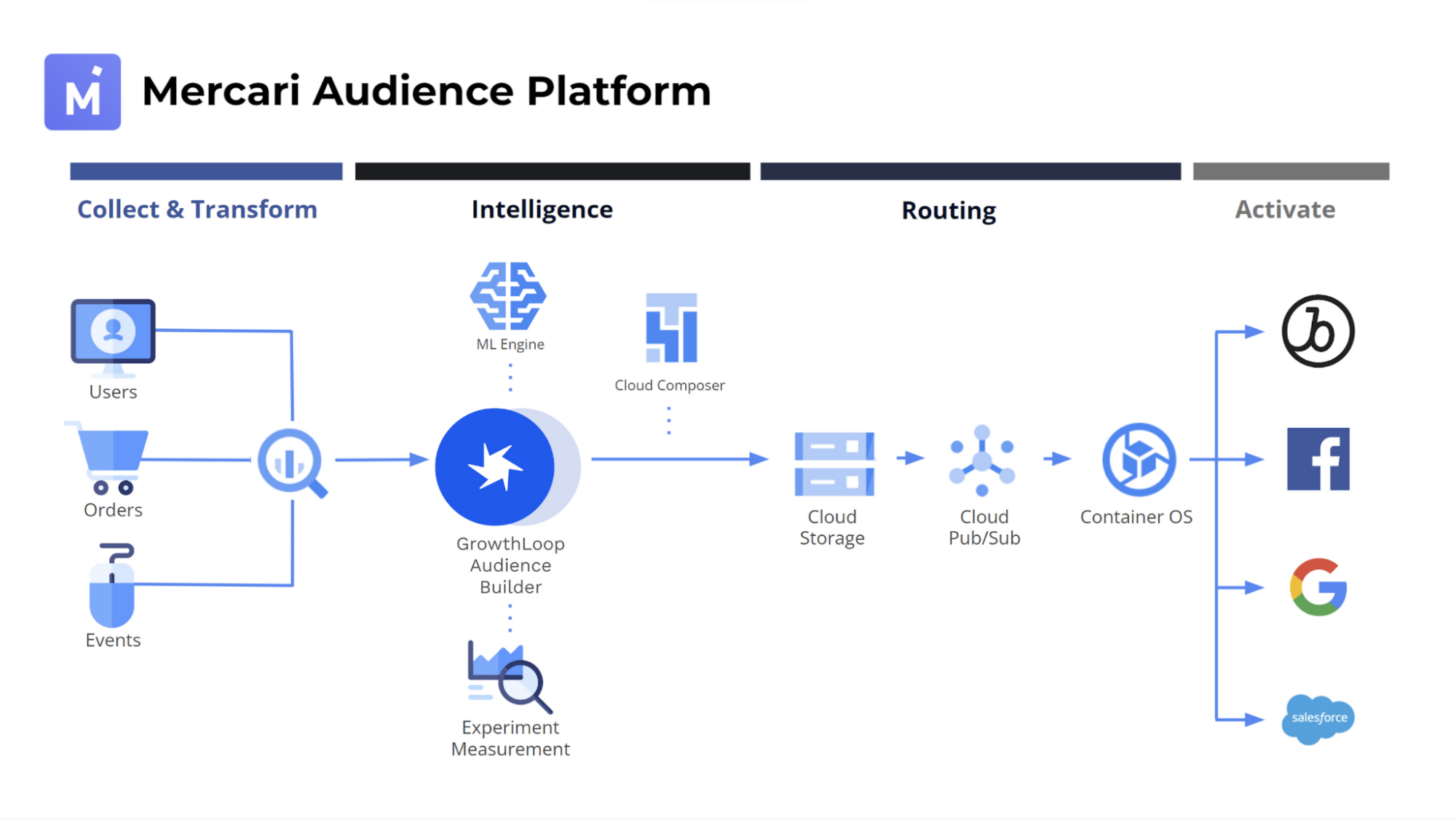
The dynamic duo: GrowthLoop and BigQuery
- Customer 360: GrowthLoop enabled Mercari to combine their data sources into a single view of their customers in BigQuery, then connected them to marketing and sales channels via GrowthLoop’s platform. Notably, Mercari is able to leverage its own complex data model, which was ideal for a two-sided marketplace. This is shown in the “Collect & Transform” stage in the architecture diagram above.
- Predictive models: GrowthLoop activated predictions that had been snapshotted by Mercari’s team in BigQuery. The Mercari ML team used Jupyter notebooks offering part of Google Vertex AI Workbench to build user churn and customer lifetime value (CLTV) prediction models, then productionized them using Cloud Composer to deploy Airflow DAGs, which wrote the predictions back to BigQuery for targeting, and triggered exports to destination channels using Pub/Sub. This is shown in the “Intelligence” stage of the architecture diagram above.
- Extensible measurement and data visualization: Since GrowthLoop writes all audience data back to BigQuery, the Mercari analytics team can conduct performance analysis on metrics from revenue to retention. They are able to use GrowthLoop’s performance visualization in-app, but they are also able to create custom data visualizations with Looker Studio. This is also shown in the “Intelligence” stage of the architecture diagram.
- Seamless routing and activation: With GrowthLoop’s audience platform connected directly to Customer 360 and the predictive model’s results in BigQuery, the marketing team is able to launch and sync audiences and their personalization attributes across all of Mercari’s major marketing, sales and product channels, such as Braze, Google Ads and other destinations. This is shown in the “Routing” and “Activate” stage of the architecture diagram.
“Being able to measure what you’re doing – that results-based orientation – is key. The thing that I like most about GrowthLoop is that you brought a really fundamental way of thinking which was very feedback-based and open to experimenting but within reason. With other products, that feedback loop isn’t so built in that it’s very easy to get lost.”– Masumi Nakamura, VP of Engineering at Mercari
Predictive modeling puts the burn on churn
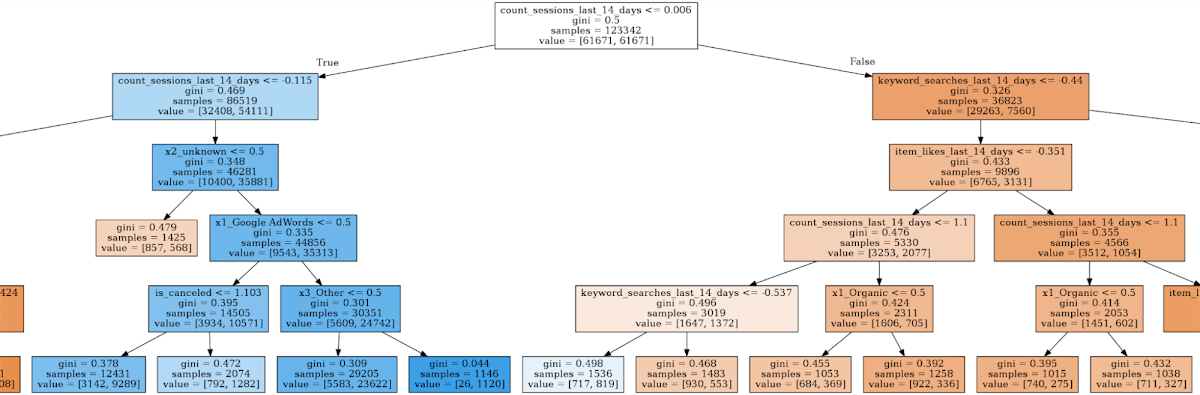
In collaboration with GrowthLoop, Mercari began analyzing user data in BigQuery via Vertex AI Workbench to identify patterns across churned customers. The teams evaluated a range of attributes like the customer acquisition channel, categories browsed or purchased from, and whether or not they had any saved searches while shopping. Comparing various models and performance metrics, the teams selected the best model for accurately predicting when a buyer or seller was at risk to churn. For sellers, they evaluated audience members by the time elapsed since their last sale – for buyers, the time since their last purchase.
These churn prediction scores could then be applied to data pipelines that would feed into GrowthLoop’s audience builder. Audience members with a high likelihood to churn would be segmented into their own group and from there, Mercari could target those users with relevant paid media and email campaigns.
By partnering with GrowthLoop, Mercari was able to simultaneously bridge the gap between the data and marketing teams – and reduce the time between segmentation and campaign launch from months to just a few days.
“One of the big areas of benefit of working with GrowthLoop was the increased integration of marketing channels such as the CRM, User Acquisition, as well as more traditional marketing channels.” – Masumi Nakamura, VP of Engineering at Mercari
Creating the audience within the audience
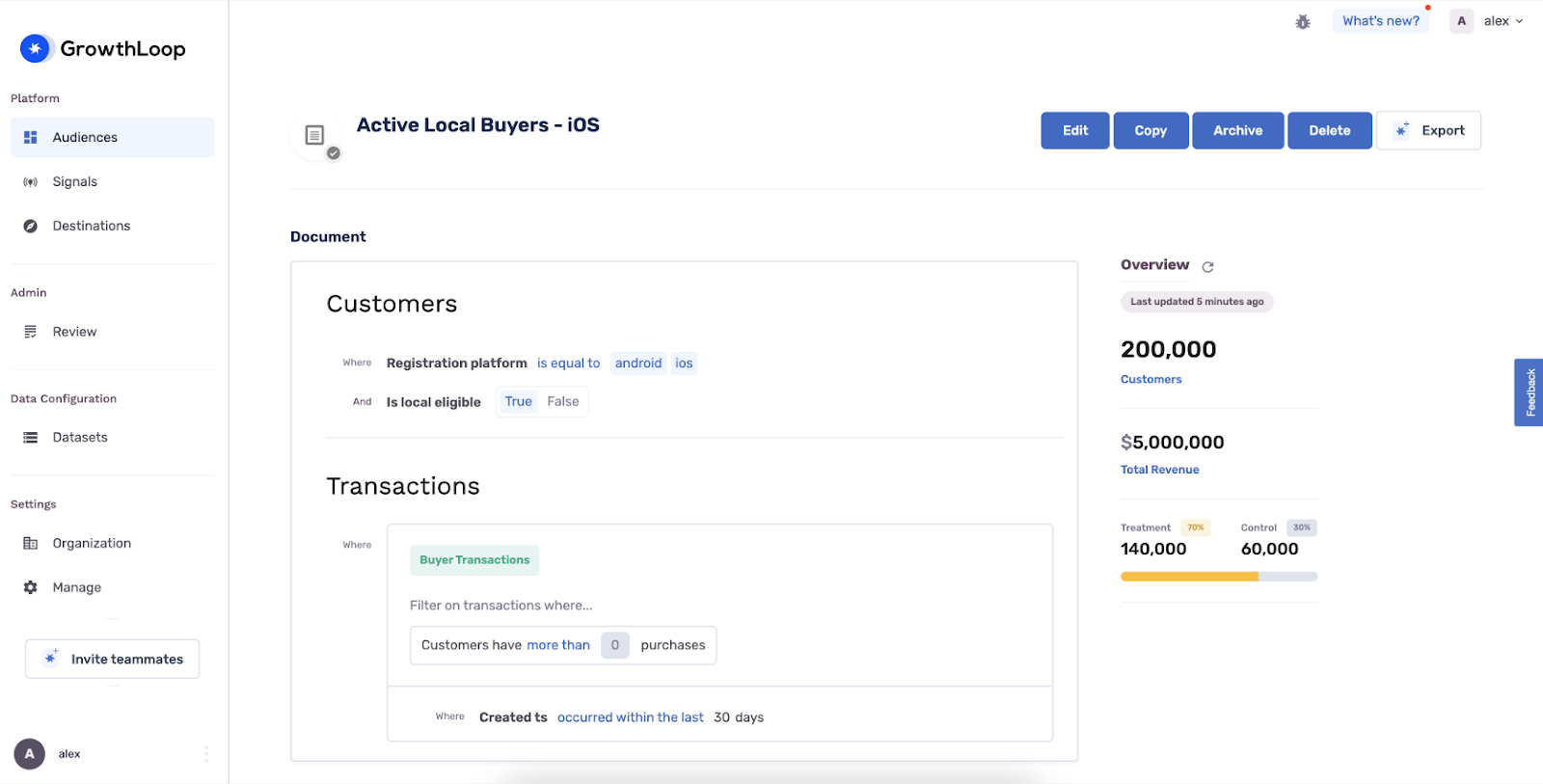
Once the team had successfully created a model to predict churn across buyers and sellers, Mercari needed to launch retargeting campaigns to measure their ability to reduce churn. Each of their ongoing experiments features tailored segments along with automatic A/B testing. With analytics and activation all under one roof, the marketing team at Mercari could craft audiences and begin measuring the impact of their targeted campaigns. Since starting their work with GrowthLoop, the Mercari team has created over 120 audiences.
“Our marketing teams are more sophisticated with in-house knowledge, but GrowthLoop provides a more user-friendly way to build audiences for campaigns.” – Masumi Nakamura, VP of Engineering, Mercari
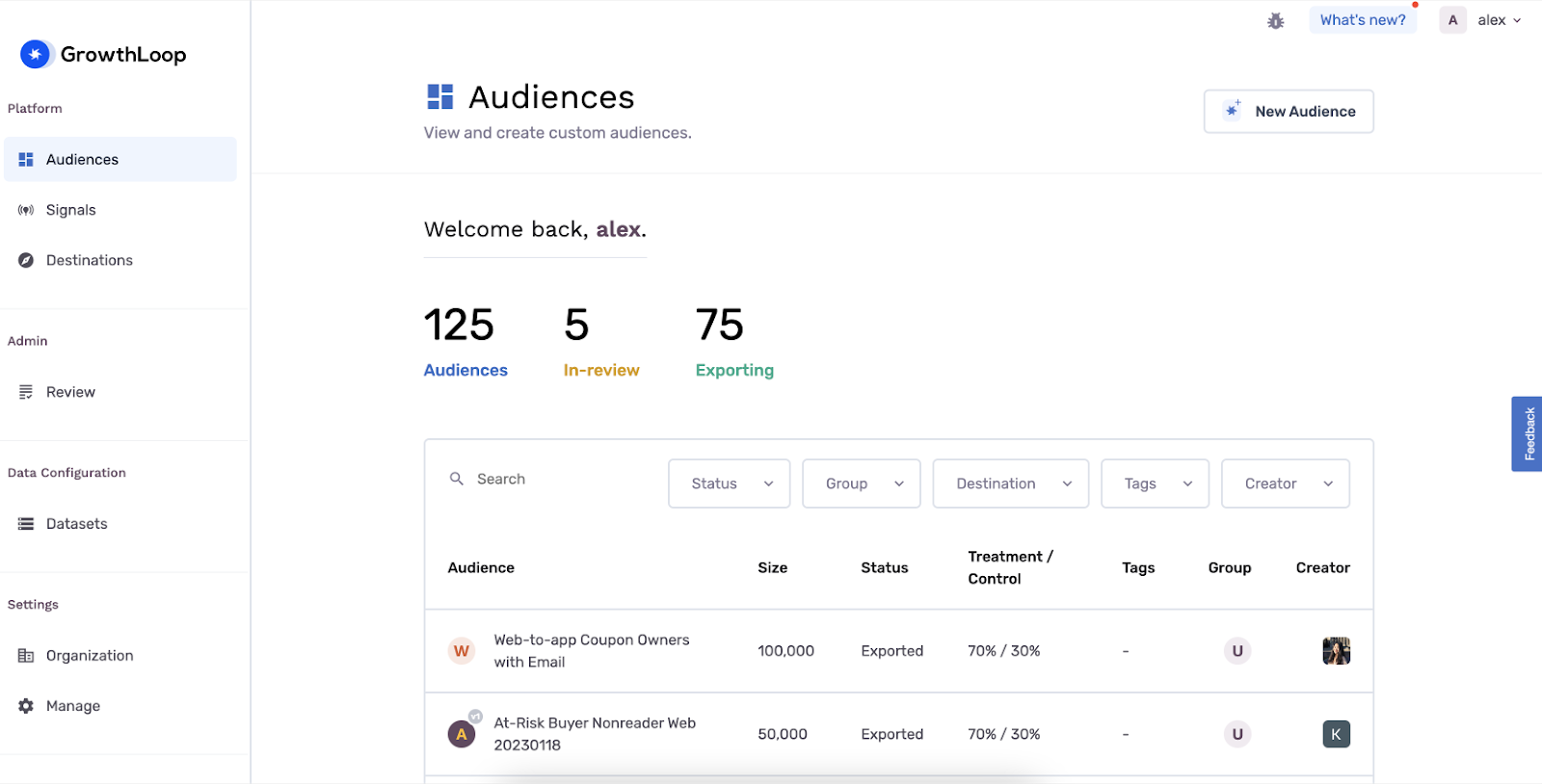
“GrowthLoop brings a very fundamental way of thinking about problems, including experimentation…. The ability to organize experiments and results was key. The number of variables is too high for most people without good organization.”– Masumi Nakamura, VP of Engineering at Mercari
Making segmentation smarter
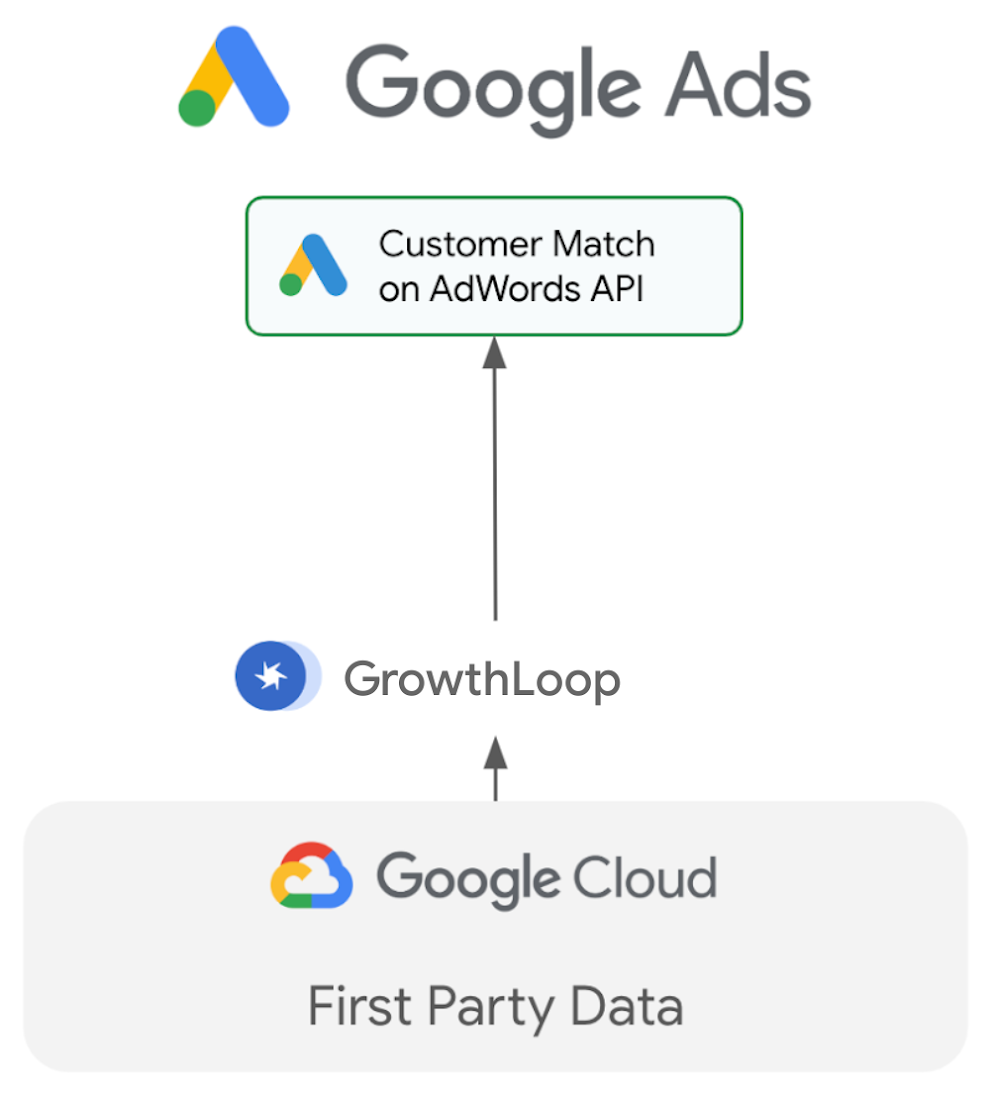
Mercari’s first audiences leveraging GrowthLoop were sent to Braze to supercharge email campaigns and coupons with churn predictions and automated campaign performance evaluations. Then, Mercari shifted its focus to Facebook for paid media retargeting, using GrowthLoop’s lifecycle segmentation framework to target customers at the right step in their user journey. Lastly, Mercari moved its focus to Google Ads, where they used GrowthLoop to implement new segmentation models based on product category propensity. Mercari had long used Google Ads for product listing ads, and with GrowthLoop, Mercari was able to define more powerful product propensity segments and measure custom incremental lift metrics.
Finding new users in the haystack
Finally, in addition to preventing churn and driving retention, the Mercari team also wanted to boost user acquisition. They were having trouble measuring performance of UA campaigns due to new iOS and Facebook data privacy restrictions that made measuring campaign attribution impossible for many users. Using the familiar stack of Vertex AI Workbench for analysis, performance analysis on campaign data in BigQuery, and Airflow DAGs deployed via Cloud Composer to productionize the data pipelines, GrowthLoop enabled the team to activate targeted campaigns based on a user’s geographical location. In this way, Mercari could make decisions about their UA campaigns using incrementality analysis between geographic regions rather than attribution data, thus preserving user privacy.
The Mercari approach to customer data activation and acquisition
Other marketplace retailers can learn from Mercari’s successes activating data from BigQuery with GrowthLoop. Here are a few best practices to apply:
Identify your team’s needs and existing strengths
Mercari knew that their team had built out a strong foundation for data analysis within BigQuery. They also knew that their process was missing a key component that would allow them to activate that data. In order to achieve similar results, work to evaluate the strength of your team and your data – and define exactly what you aim to achieve with customer segmentation.
Partner with the right providers
With BigQuery, the Mercari team had all of their data centralized in one single location, simplifying the process for predictive modeling, segmentation, and activation. By partnering with GrowthLoop, this centralized data could be activated with ease across Mercari’s marketing teams. When evaluating providers for data warehousing, segmentation, and activation, be sure to partner with a provider that ensures you can get the most out of your data.
Know your audience
With a deeper understanding of their customers, Mercari was able to see nearly immediate value. By investing in the proper tools to accurately predict customer behavior, Mercari delivered impact in exactly the right areas. Using the data you’ve already compiled on your customers, consider partnering with a customer segmentation platform provider like GrowthLoop. In fact, Masumi went so far as to organize his Machine Learning team around these concepts: “We split the ML team into two areas – one to augment and work with GrowthLoop, the other team was to augment and orient around item data.”
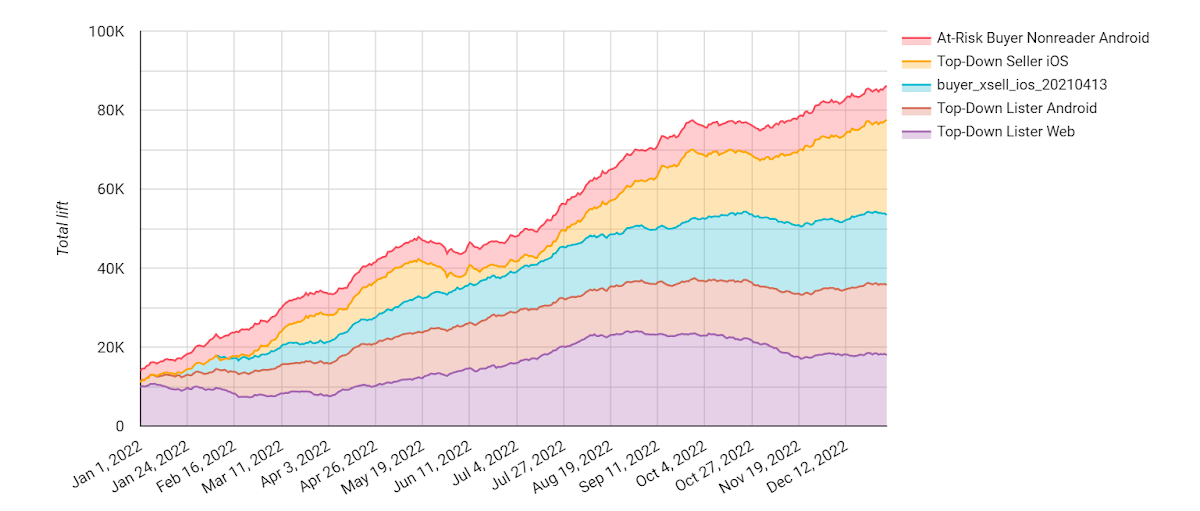
Scale has been modified to intentionally obfuscate actual results.
How to boost growth like Mercari in three steps
Today, many leading brands leverage GrowthLoop and BigQuery to drive marketing and sales wins. Whether your company is in retail, financial services, travel, software, or another industry entirely, you can join the growing number of companies driving sustainable growth through real-time analytics by connecting BigQuery from Google Cloud to GrowthLoop. Here’s how:
If you have customer data in BigQuery…
- Book a GrowthLoop + BigQuery demo customized to your use cases.
- Link your BigQuery tables and marketing and sales destinations to the GrowthLoop platform.
- Launch your first GrowthLoop audience in less than one week.
If you are getting started with BigQuery…
- Get a Data Strategy Session with a GrowthLoop Solutions Architect at no cost.
- Use our Quick Start Program to get started with BigQuery in 4 to 8 weeks.
- Launch your first GrowthLoop audience in less than one week thereafter.
GrowthLoop and Google: Better together
The key question for many marketers today is, “How do you best leverage all you know about your customers to drive more intelligent and effective marketing engagement?” When Mercari set out to answer this question in 2019, they applied an innovative BigQuery data strategy that leveraged machine learning models. However, they achieved remarkable marketing results because they were among the first companies to discover and apply GrowthLoop to enable the marketing team to launch audiences with a first party data platform directly connected to their datasets and predictions in BigQuery. This greatly accelerated the design-launch-measure feedback loop to generate repeatable growth in customer lifetime value.
The Built with BigQuery advantage for ISVs and Data Providers
Google is helping companies like GrowthLoop build innovative applications on Google’s data cloud with simplified access to technology, helpful and dedicated engineering support, and joint go-to-market programs through the Built with BigQuery initiative. Participating companies can:
- Accelerate product design and architecture through access to designated experts who can provide insight into key use cases, architectural patterns, and best practices.
- Amplify success with joint marketing programs to drive awareness, generate demand, and increase adoption.
BigQuery gives ISVs the advantage of a powerful, highly scalable data warehouse that’s integrated with Google Cloud’s open, secure, sustainable platform. And with a huge partner ecosystem and support for multi-cloud, open source tools and APIs, Google provides technology companies the portability and extensibility they need to avoid data lock-in.
Click here to learn more about Built with BigQuery.
We thank the Mercari, GrowthLoop and Google Cloud team members who collaborated on the blog:
Mercari: Masumi Nakamura, VP of Engineering
GrowthLoop: Julia Parker, Product Marketing Manager; Alex Cuevas, Head of Analytics
Google: Sujit Khasnis, Solutions Architect
More Relevant Stories for Your Company

2,602 Uses of AI for Social Good, and What We Learned from Them
For the past few years, we’ve applied core Google AI research and engineering to projects with positive societal impact, including forecasting floods, protecting whales and predicting famine. Artificial intelligence has incredible potential to address big social, humanitarian and environmental problems, but in order to achieve this potential, it needs to be accessible to organizations

Survey: What Everyone Else In Your Industry is Doing with AI
Across industries and use cases, organizations that have implemented ML report demonstrable return on investment and substantial business benefits ranging from better, faster data analysis to improved efficiency and cost savings. The vast majority of early adopters — nearly 90 percent, according to one study — believe that ML provides

Google Cloud’s Recommendation AI Helps Bazaarvoice with 60 Percent increase in CTR
Not long ago, building AI into recommendation engines was a daunting, expensive task that could take years to get off the ground. But as Bazaarvoice has shown, with the help of cloud services, the time from AI investment to business outcomes is shorter than ever. Bazaarvoice is the leading provider

IKEA’s AI-driven Personalized and Real-time Recommendations Up its Conversion Rates and Average Order Value
Background At IKEA we have multiple places in our customer journey in various channels where different kinds of personalization can deliver a superior customer experience. Product recommendations in the shopping basket, content recommendations in editorial sections, inspirational recommendations on product pages and more. After a while in the broader “recommendations”
