





Anthos Makes Hybrid and Multi-Cloud Deployments Easy

3667
Of your peers have already read this article.
1:30 Minutes
The most insightful time you'll spend today!
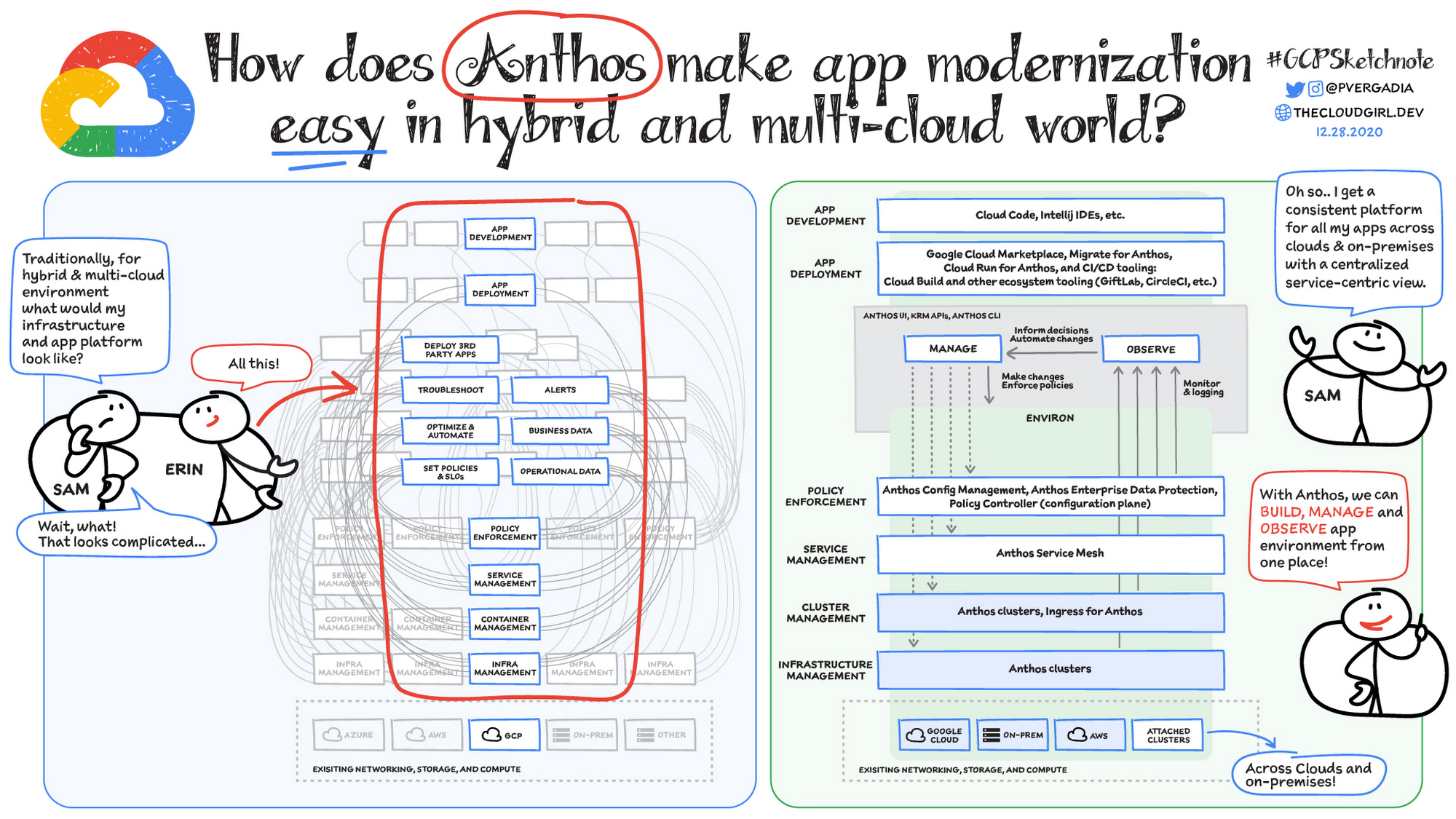
Most enterprises have applications in disparate locations—in their own data centers, in multiple public clouds, and at the edge. These apps run on different proprietary technology stacks, which reduces developer velocity, wastes computing resources, and hinders scalability. How can you consistently secure and operate existing apps, while developing and deploying new apps across hybrid and multicloud environments? How can you get centralized visibility and management of the resources? Well, that is why Anthos exists!
This post explores why traditional hybrid and multicloud deployments are difficult, and then shows how Anthos makes it easy to manage applications across multiple environments.
Why is traditional hybrid and multicloud difficult?
In hybrid and multicloud environments, you need to manage infrastructure. Let’s say you use containers on the clouds, and you develop apps using services on Google Cloud and AWS. Regardless of environment, you will need policy enforcement across your IT footprint. To manage your apps across the environment, you need monitoring and logging systems. You need to integrate that data into meaningful categories, like business data, operational data, and alerts.
Digging further, you might use operational data and alerts to inform optimizations, implement automations, and set policies or SLOs. You might use business data to do all those things, and to deploy third-party apps. Then, to actually enact the changes you decide to implement, you need to act on different parts of the system. That means digging into each tool for policy enforcement, securing services, orchestrating containers, and managing infrastructure. Don’t forget, all of this work is in addition to what it takes to develop and deploy your own apps.
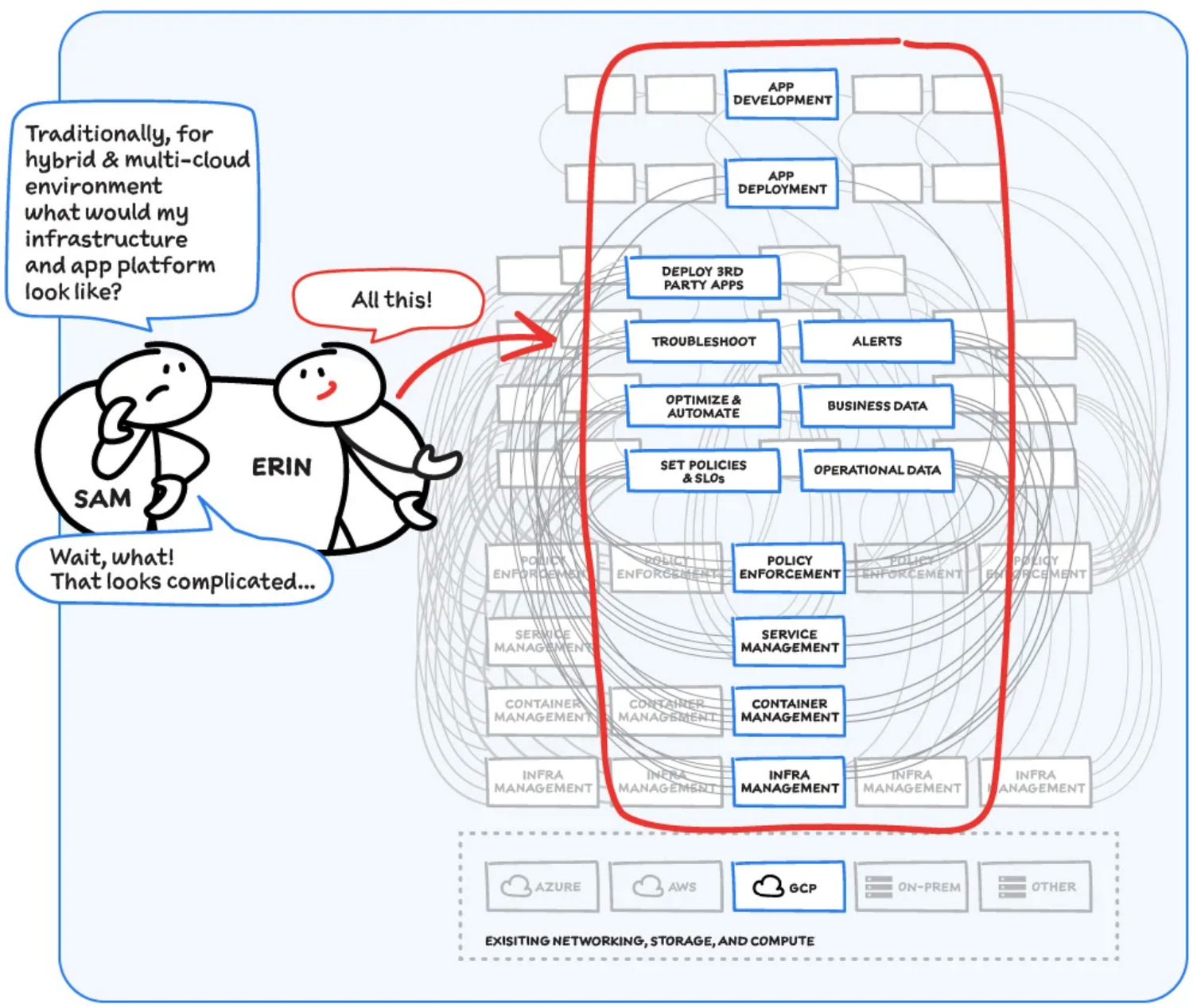
Now, consider repeating this set of tasks across a hybrid and multicloud landscape. It becomes very complex, very quickly. Your platform admins, SREs, and DevOps teams who are responsible for security and efficiency have to do manual, cluster-by-cluster management, data collection, and information synthesis. With this complexity, it’s hard to stay current, to understand business implications, and to ensure compliance (not to mention the difficulty of onboarding a new hire). Anthos helps solve these challenges!
How does Anthos make hybrid and multicloud easy?
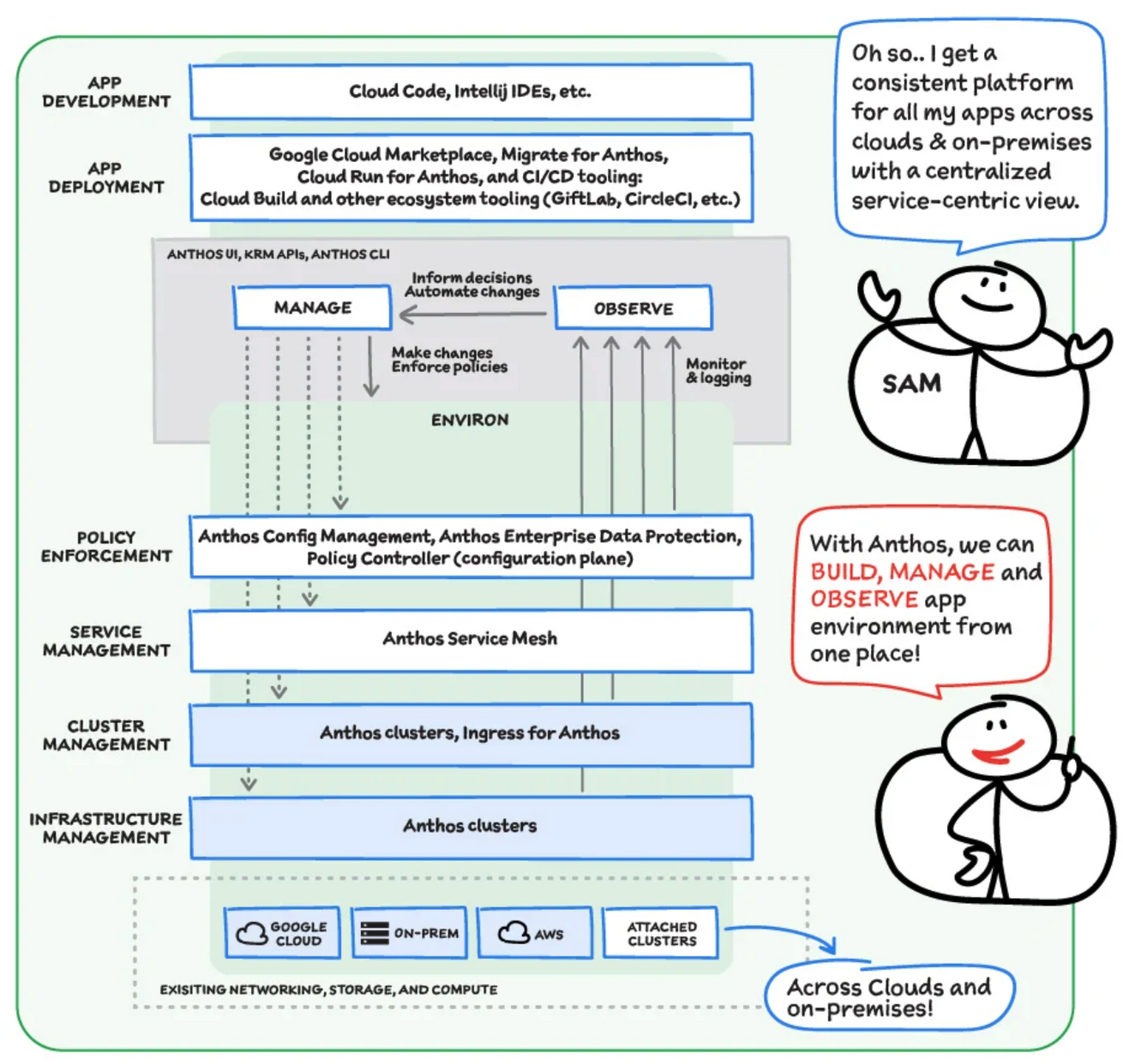
With Anthos, you get a consistent way to manage your infrastructure, with similar infrastructure management, container management, service management, and policy enforcement across your landscape.
As a result, you have observability across all your platforms in one place, including access to business information, alerts, and operations information. With this information you might decide to optimize, automate, and set policies or SLOs.
Digging deeper into Anthos
Environs
You may have different regions that need different policies, and also have different development, staging, or production environments that need different permissions. Some parts of your work may need more security. That’s where environs come in! Environs are a way to create logical sets of underlying Kubernetes clusters, regardless of which platform those clusters live on.
By considering, grouping, and managing sets of clusters as logical environs, you can think about and work with your applications at the right level of detail for what you need to do, be it acquiring business insights over the entire system, updating settings for a dev environment, or troubleshooting data for a specific cluster. Using environs, each part of the functional stack can take declarative direction about configuration, compliance, and more.
Modernize application development
Anthos also helps modernize application development because it uses environs to enforce policies and processes, and abstracts away the cluster and container management from application teams. Anthos enables you to easily abstract away infrastructure from application teams, making it easy for them to incorporate a wide variety of CI/CD solutions on top of environs. It lets you view and manage your applications at the right level of detail, be it business insights for services across the entire system, or troubleshooting data for a specific cluster. Anthos also works with container-based tools like buildpacks to simplify the packaging process. It offers Migrate for Anthos to take those applications out of the VMs and move them to a more modern hosting environment.
What’s in it for platform administrators?
Anthos provides platform administrators a single place to monitor and manage their landscape, with policy control and marketplace access. This reduces person-hours needed for management, enforcement, discovery, and communication. Anthos also provides administrators an out-of-the-box structured view of their entire system, including services, clusters, and more, so they can improve security, use resources more efficiently, and demonstrate measurable success. Administrators also save time and effort by managing declaratively, and they can communicate the success, cost savings, and efficiency of the platforms without needing to manually combine data.
Interested in getting started with Anthos? Check out the free on-demand training here and my YouTube series.
For more resources, you can also read the Anthos ebook at no cost. For more #GCPSketchnote and similar cloud content, follow me on twitter @pvergadia and keep an eye out on thecloudgirl.dev
App Engine Basics to Help You Build and Deploy Low-latency, Scalable Apps

3523
Of your peers have already read this article.
2:00 Minutes
The most insightful time you'll spend today!
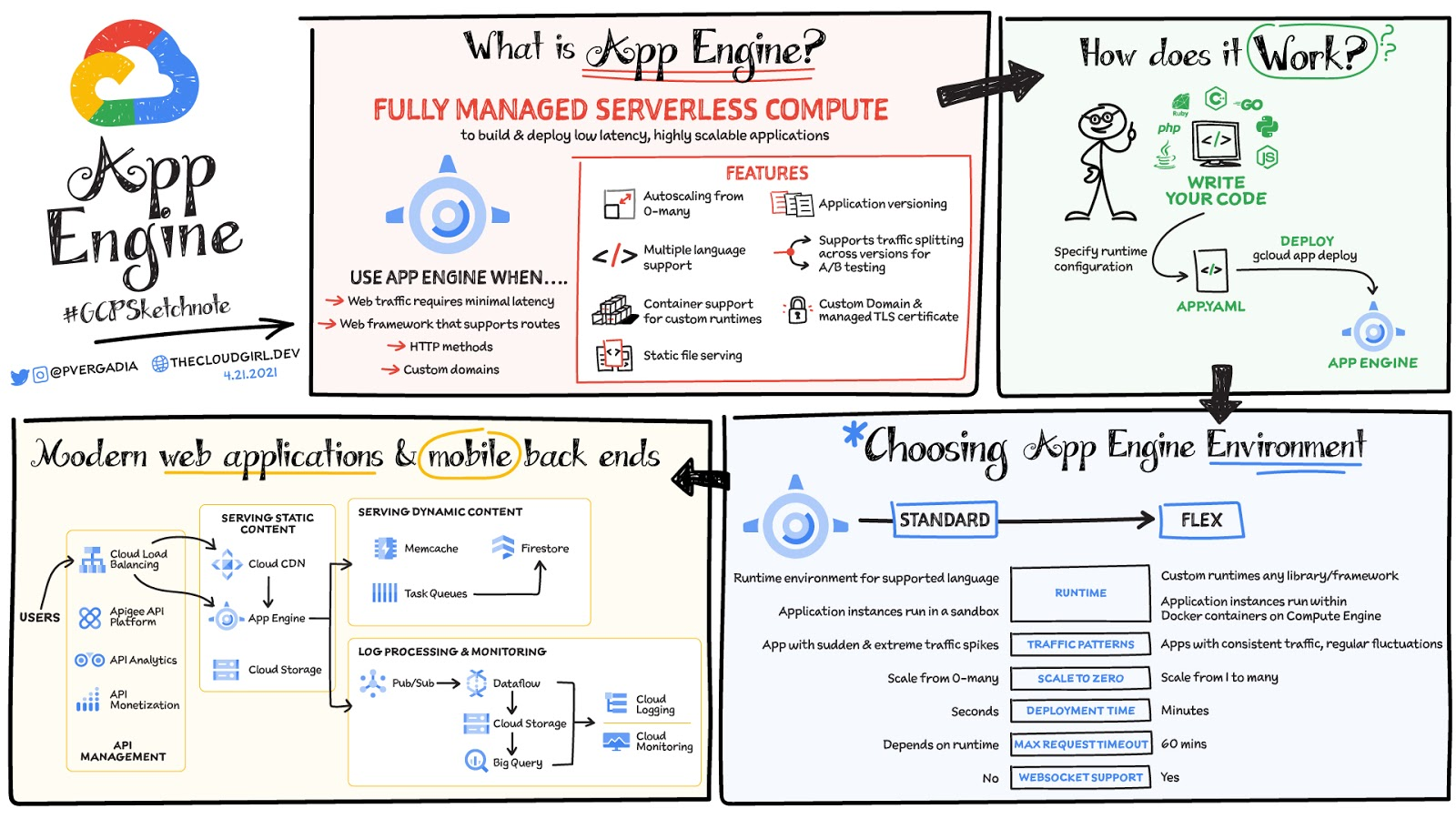
App Engine is a fully managed serverless compute option in Google Cloud that you can use to build and deploy low-latency, highly scalable applications. App Engine makes it easy to host and run your applications. It scales them from zero to planet scale without you having to manage infrastructure. App Engine is recommended for a wide variety of applications including web traffic that requires low-latency responses, web frameworks that support routes, HTTP methods, and APIs.
Environments
App Engine offers two environments; here’s how to choose one for your application:
- App Engine Standard – Supports specific runtime environments where applications run in a sandbox. It is ideal for apps with sudden and extreme traffic spikes because it can scale from zero to many requests as needed. Applications deploy in a matter of seconds. If your required runtime is supported and it’s an HTTP application, then App Engine Standard is the way to go.
- App Engine Flex – Is open and flexible and supports custom runtimes because the application instances run within Docker containers on Compute Engine. It is ideal for apps with consistent traffic and regular fluctuations because the instances scale from one to many. Along with HTTP applications it also supports applications requiring WebSockets. The max request timeout is 60 minutes.
How does it work
No matter which App Engine environment you choose, the app creation and deployment process is the same. First write your code, next specify the app.yaml file with runtime configuration, and finally deploy the app on App Engine using a single command: gcloud app deploy.
Notable features
- Developer friendly – A fully managed environment lets you focus on code while App Engine manages infrastructure.
- Fast responses – App Engine integrates seamlessly with Memorystore for Redis enabling distributed in-memory data cache for your apps.
- Powerful application diagnostics – Cloud Monitoring and Cloud Logging help monitor the health and performance of your app and Cloud Debugger and Error Reporting help diagnose and fix bugs quickly.
- Application versioning – Easily host different versions of your app, and easily create development, test, staging, and production environments.
- Traffic splitting – Route incoming requests to different app versions for A/B tests incremental feature rollouts, and similar use cases.
- Application security – Helps safeguard your application by defining access rules with App Engine firewall and leverage managed SSL/TLS certificates by default on your custom domain at no additional cost.
Conclusion
Whether you need to build a modern web application or a scalable mobile backend App Engine has you covered. For a more in-depth look, check out the documentation. Click here for demos on how to use serverless technology and free hands-on training.https://www.youtube.com/embed/Xuf3J6SKVV0?enablejsapi=1&
For more #GCPSketchnote, follow the GitHub repo. For similar cloud content follow me on Twitter @pvergadia and keep an eye out on thecloudgirl.dev.
2,602 Uses of AI for Social Good, and What We Learned from Them

5266
Of your peers have already read this article.
12:30 Minutes
The most insightful time you'll spend today!
For the past few years, we’ve applied core Google AI research and engineering to projects with positive societal impact, including forecasting floods, protecting whales and predicting famine. Artificial intelligence has incredible potential to address big social, humanitarian and environmental problems, but in order to achieve this potential, it needs to be accessible to organizations already making strides in these areas. So, the Google AI Impact Challenge, which kicked off in October 2018, was our open call to organizations around the world to submit their ideas for how they could use AI to help address societal challenges.
“Accelerating social good with artificial intelligence” sheds light on the range of organizations using AI to address big problems. It also identifies several trends around the opportunities and challenges related to using AI for social good. Here are some of the things we learned—check out the report for more details.
AI is globally relevant
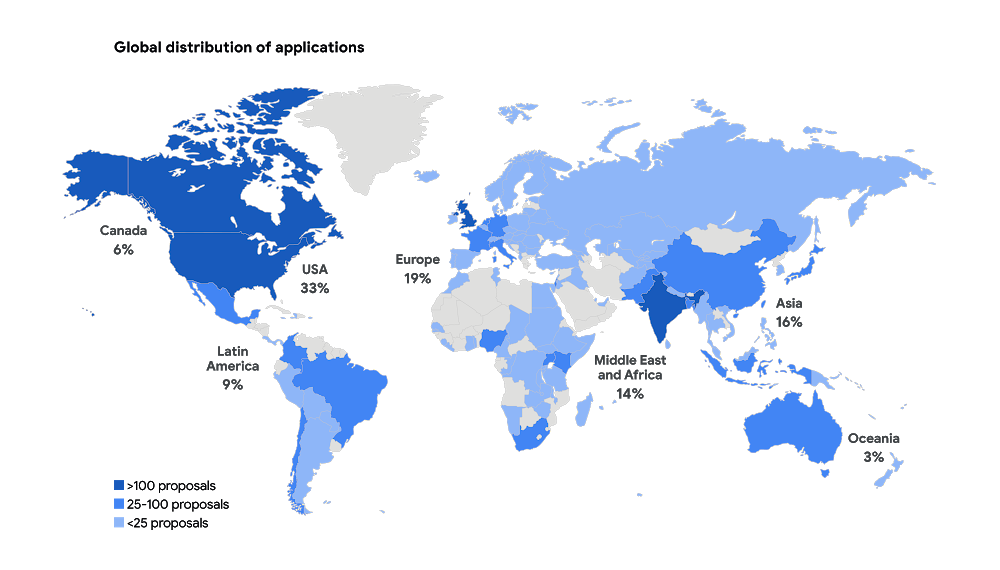
We received 2,602 applications from six continents and 119 countries, with projects addressing a wide range of issue areas, from education to the environment. Some of the applicants had experience with AI, but 55 percent of not-for-profit organizations and 40 percent of for-profit social enterprises reported no prior experience with AI.
Similar projects can benefit from shared resources
When we reviewed all the applications, we saw that many people are trying to tackle the same problems and are even using the same approaches to do so. For example, we received more than 30 applications proposing to use AI to identify and manage agricultural pests. The report includes a list of common project submissions, which will hopefully encourage people to collaborate and share resources with others working to solve similar problems.
You don’t need to be an expert to use AI for social good
AI is becoming more accessible as new machine learning libraries and other open-source tools, such as Tensorflow and ML Kit, reduce the technical expertise required to implement AI. Organizations no longer need someone with a deep background in AI, and they don’t have to start from scratch. More than 70 percent of submissions, across all sectors and organization types, used existing AI frameworks to tackle their proposed challenge.
Successful projects combine technical ability with sector expertise
Few organizations had both the social sector and AI technical expertise to successfully design and implement their projects from start to finish. The most comprehensive applications established partnerships between nonprofits with deep sector expertise, and academic institutions or technology companies with technical experience.
ML isn’t the only answer
Some problems can be addressed by using alternative methods to AI—and result in faster, simpler and cheaper execution. For example, several organizations proposed using machine learning to match underserved populations to legal knowledge and tools. While AI could be helpful, similar results could be achieved through a well-designed website. While we’ve seen the impact AI can have in solving big problems, you shouldn’t rule out more simple approaches as well.
Global momentum around AI for social good is growing—and many organizations are already using AI to address a wide array of societal challenges. As more social sector organizations recognize AI’s potential, we all have a role to play in supporting their work for a better world.
How Smart Parking Transformed into a Data-Intelligent Business

3744
Of your peers have already read this article.
2:30 Minutes
The most insightful time you'll spend today!
Google Cloud Results
- Reduced smart parking/smart city IoT installation and operational support effort by more than half
- Enabled development of a Smart Cloud IoT platform in just four months
- Democratised data access and use across the organisation
- Built core infrastructure in under 4 months
Smart Parking’s core product is a sensor-based system called SmartPark, used in environments such as shopping centres, airports, commercial parking operations, universities, and municipal streets.
Smart Parking has deployed over 50,000 sensors worldwide to support parking systems. It estimates at least 70% of production-scale and currently operating smart parking environments globally are using its technologies.
“Our products include ground sensors that use an advanced combination of infrared and magnetic technologies to reliably register a vehicle’s arrival and communicate to a gateway,” says Brian Granatir, Technical Team Lead, Smart Parking. This enables operators to gain live insights into parking environment usage and manage capacity. They can also provide automated guidance and signage to tell customers how many vacant spaces are available on each level of a parking structure or street area of a city.
Additional functionality enables parking operators to identify whether vehicles parked in limited-time spots have overstayed. The operators may notify inspectors who can undertake enforcement actions such as issuing infringement notices.
Another Smart Parking mobile product enables parking operators to photograph licence plates to identify vehicles that have overstayed. The business is also developing applications that enable users to view the number of parking spots available in nearby parking structures.
Smart Parking is extending its operations into smart city developments. The business views this as a natural progression as its parking systems establish a powerful common foundation from which to deliver many other services. “Parking is just part of a very complex ecosystem that requires sophisticated interoperability and generalised analytics,” John Heard, Chief Technology Officer, Smart Parking, explains.
“The biggest trend in the space is towards the Internet of Things (IoT)–the integration of a large number of generic and specialised devices,” Heard adds. “This has led us to shift from the idea of our devices being the centre of the universe. Instead, we put data intelligence at the core.”
In October 2016, Smart Parking decided to develop a SmartCloud platform that would enable cities to manage and react to information from a connected network of IoT devices. The business wanted to start by rolling out the platform based on an event-driven architecture that could connect any device that sends or receives a sequence of data events to existing Smart Parking customers.
The platform would enable Smart Parking to address a wide range of highly complex and interrelated interactions. “Internally, we use the example that if everyone leaves a parking structure at 3pm, what will be the impact on traffic?” Heard says. “So, how can we correlate multiple factors to answer a larger question?”
Heard’s team elected to deploy SmartCloud on Google Cloud Platform (GCP), due primarily to its support for sophisticated big data management and machine learning in a serverless architecture. Furthermore, Google technologies were proven to operate at scale and GCP had baked-in best practices that could manage internet-scale datasets in near real time.
“By running on Google, we were able to develop SmartCloud at an incredible pace,” Granatir says. “We built the core infrastructure in under four months.” Furthermore, GCP enables the SmartCloud platform to operate at metropolis scale, combining streams of distributed data to deliver an unprecedented view of the events and interactions taking place in a city.
Smart Parking now uses a wide range of GCP services to deliver SmartCloud. Google Cloud Dataflow provides processing and Google BigQuery provides management and analytics of big data. Google Cloud Pub/Sub provides real-time messaging and Google Cloud Functions enables a serverless environment to enable delivery of streaming data. Google Cloud IoT Core connects, manages, and ingests data from Smart Parking devices while Google Cloud Identity & Access Management enables Smart Parking to control access to information. Google Cloud Pub/Sub and Google Cloud Functions also support the event-driven architecture.
Installation time and operational burdens cut by at least half
Using Google Cloud IoT Core has cut Smart Parking’s parking and smart city system installation times by at least half and eliminated the need to build a registration system, a device authorisation system, and a feedback loop for each project. This delivers a streamlined and simpler methodology for site installations, which flows on to a dramatic decrease in the operational burdens involved in monitoring and maintaining deployments of all scales.
Using GCP has revolutionised Smart Parking’s software development processes. “We’re building and deploying systems at a speed I could never have imagined before Google Cloud Platform,” Granatir says. Furthermore, using GCP has made data accessible to anyone within the Smart Parking business, and this is being extended to customers via SmartCloud information services.
This democratised approach has already realised considerable benefits. “One of our project managers was experimenting with the Google Data Studio service for visualising data and was able to make a query about utilisation efficiency,” Heard adds. “We found that simply changing the maximum stay time by a small amount could hugely impact the percentage of parking utilisation and, therefore, throughput.
“This is an illustration of a significant insight by someone who simply had a hunch and quick access to mountains of live and accurate data.”
Transition to a data-intelligence company
Using GCP has enabled Smart Parking to chart a path from a sales and maintenance organisation to a smart cities data-intelligence company. “How? Simply by providing amazing services that focus on massive data volumes and sharing documentation that helps us leverage best practices,” Heard says. “Because of Google Cloud Platform and its pricing, we don’t walk in the shadow of giants, we ride on their shoulders.”
Smart Parking is now looking to further extend its use of Google services to add value to its smart parking and future smart city clients. “With Google Cloud Machine Learning Engine, we could gain the ability to identify trends across every customer parking site and make recommendations to operators,” Heard says. “For example, we could provide data-driven insight and advice to operators about how to adjust their parking spot time limits and guidance about how to transform throughput and convenience while increasing revenue.”
Heard concludes, “As a result of being able to dramatically decrease our traditional development burdens by using GCP, we now have a number of exciting new capabilities we have been able to bring in to our roadmap and expand the journey we are able to open up for our customers as well.”

4192
Of your peers have already downloaded this article
10:47 Minutes
The most insightful time you'll spend today!
The rapid growth in mobile, big data, and cloud technologies has profoundly changed market dynamics in every industry, driving the convergence of the digital and physical worlds, and changing customer behaviour. It’s an evolution that IT organizations struggle to keep up with. To succeed, a new approach is required; one that enables agile and web-scale innovation so that IT can meet evolving business requirements while enabling existing systems to continue running reliably, efficiently, and securely.
There’s a way to enable the stability of enterprises’ operational systems of record while also fostering the speed and agility necessary to create powerful new applications and services that serve customers, partners, and employees in a digital economy that’s moving at blinding speed.
Whether you think about this as bimodal IT, two-speed IT, or traditional IT/agile IT, this new approach recognizes the value of both the back-end operational systems and the fast-changing world of user engagement. Read this eBook to explore how two-speed IT can usher a new approach that recognizes the value of both the back-end operational systems and the fast-changing world of user engagement.

3699
Of your peers have already downloaded this article
8:45 Minutes
The most insightful time you'll spend today!
For most established businesses today, the disruptive start-up has emerged as the biggest and most intimidating competition. A start-up’s digital prowess and astounding ability to innovate and scale massively in weeks, for what takes conventional businesses quarters, is daunting. How does one compete with that?
To play in today’s digitally-connected world, companies need to be equipped to deliver apps and digital experiences at lightning speed. How do you leverage insights from your environment of customers, partners, suppliers, and, in many cases, stores, warehouses, and inventory and use all that data to deliver relevant products and services? How do you unlock the data from your slow-moving systems of record to build those apps and experiences at the speed and agility of the App Store?
Gartner calls it bi-modal IT: an approach that enables an organization to protect the back-end systems and also drive rapid innovation. Think of it as an enterprise gearbox that enables you to scale your interactions a million times . In this eBook we explore how businesses can implement an API tier to keep backend transaction systems humming as front-end digital interactions scale to billions of requests and interactions , way beyond what your systems were designed to do.
More Relevant Stories for Your Company

Manage Packages Using Artifact Registry in Google Cloud Functions with Private Dependencies
Late last year, we announced that Artifact Registry was going GA, allowing GCP customers to manage their packages within the same platform as they were being deployed. In this blogpost, we want to show you how to do exactly that with a private dependency. Private dependencies allow your packages to be




Case Study: How Texas’ Largest Grocery Chain Successfully Modernized its Legacy Mainframes
H-E-B, like many enterprises, is moving away from legacy mainframes in favor of microservices and public cloud infrastructure. With hundreds of applications powering their 100+ year-old grocery business (with more than 400 stores in Texas and Mexico), H-E-B needs to be confident that the platform they are building will provide

Apigee: Unlock Innovation by Managing APIs for SAP Workloads
Businesses migrating their SAP environments to Google Cloud do so for a number of reasons. Most cite the agility, scalability and security advantages of migrating SAP workloads to Google Cloud; many also focus on improved uptime and performance. At some point, most businesses also want to explore the idea that

Google Cloud expands availability of enterprise-ready generative AI
Generative AI continues to develop at a blistering pace, making it more important than ever that organizations have access to enterprise-ready capabilities to help them leverage this disruptive technology. Harnessing the power of decades of Google’s research, innovation, and investment in AI, Google Cloud continues to make generative AI available
