





2022 is a Big Year for the Gaming Industry!

3869
Of your peers have already read this article.
2:00 Minutes
The most insightful time you'll spend today!
Editor’s note: This post was originally published in TechPulse Belgium, where Jack Buser, Google Cloud’s Director of Game Industry Solutions, shared his trends for the industry this year.
The year 2022 will hold many surprises (with a few already dropping!), but there’s one near certainty: By this time next year there will be millions more gamers worldwide. It’s thanks to the industry’s little-noted technology growth drivers, which are getting stronger.
Games are no longer a niche hobby; it’s global, mainstream entertainment. There were 3.1 billion gamers worldwide in 2020. It’s estimated that by 2024 there will be another 500 million. With a global population of 7.7 billion, that’s nearly half the planet. Revenues in 2021 may reach $175 billion—likely more than movies, music, and books combined.
It’s a strength unique to the games industry, driven by the way its creators deploy new technology. Advances we see in everything from pricing and emerging markets, to backend computing and delivery suggests it will grow from here, on things like artificial intelligence and planet-scale networks.
Games forever, game better
It’s no surprise that videogames have become a huge business. Playing games is one of our deepest human expressions. There is a 4,500 year old board game that people still play, a testimony to the human love of testing cleverness, honing reactions, building trust, or just enlivening a day.
Video games do all that and for decades game makers have taken the most cutting-edge computing tech to make things better. We’ve seen electronic ping pong become shooting asteroids, to simple (yet iconic) 2D sprites evolve into believable, expressive 3D characters, all leading to today’s immersive worlds hosting tens of millions of players worldwide.
There’s more to come. I work at technology’s cutting edge for games, offering the world’s leading game creators access to powerful cloud computing, a low-latency global network, Machine Learning and AI, and much more. As usual, game innovators are taking up all these tools, building new narratives, new ways to play, new markets, and new jaw-dropping moments.
And game creators aren’t just thinking about players; they’re also thinking about viewers. More and more people are watching eSports, and creators are using the games medium to engage their viewers in increasingly immersive ways.
Streaming like never before
AI and ML are sharpening games and attracting new players in other ways. These technologies increasingly power everything from network performance to global player matching. The delicate but essential work of encouraging newcomers and discouraging bad actors, optimizing monetization, or building and scaling up new player environments.
Another important area we’re seeing cloud tools being put to use is in coordinating the workflows of global teams of developers. It’s not just a question of building faster anymore, but of collaborating and responding more effectively. The distributed work trends that featured so strongly during the pandemic had already featured in much of the game industry, increasingly it’s an industry standard. This will likely mean even faster and more diverse game development, addressing the needs of new markets where we’re seeing double-digit growth.
Tools like cloud streaming, 5G, and edge computing are likely to accelerate the use of Game Streaming, Augmented Reality, and other types of immersive gameplay. If my metaverse doesn’t have games, count me out! We’re looking at some exciting new developments in coming months with some major industry players. Stay tuned.
A big year for the games industry
As a premier provider of solutions, tools and services to games companies, our engineering job is complex and global. Fortunately, our mission is simple: Help game companies transform to meet new global opportunities with planet scale solutions. Technology has brought the gaming industry to astonishing heights, and is the perfect compliment to great storytelling and creative ingenuity.
As a decades-long industry veteran, I’ve never been more impressed with what technology can do for our industry. Looking past 2022, when we’ll see more compute, more AI, more AR, and more innovation around healthy and exciting game play, there is just one near certainty: More growth.
Insurer Uses Google Cloud AI to Battle Slow Growth: It Improves Sales by 5% in 8 Weeks

8845
Of your peers have already read this article.
7:30 Minutes
The most insightful time you'll spend today!
For a business to succeed in the long term, it needs to learn not just to adapt to inevitable change, but to harness it. South Africa-based PPS has been an insurance company since 1941 and today is the biggest mutual insurance provider in the country.
As a mutual company, PPS is owned by more than 200,000 members, making them shareholders. In recent years, PPS and other companies like it have been affected by a number of external factors.
“For one thing, technology platforms have brought in a new gig economy that has all kinds of implications for insurance,” says Avsharn Bachoo, CTO at PPS. “What we’ve been seeing is basically a disruption of the South African insurance industry. We chose to see that as an opportunity.”
“Our servers were at the end of their life cycle and we had to decide whether to refresh them or switch completely. To embrace the world of AI and machine learning effectively, we knew we needed a cloud-based infrastructure. We’ve found the answer in Google Cloud Platform.”
—Avsharn Bachoo, CTO, PPS
In early 2018, faced with an uncertain economic environment that was squeezing growth and profitability, PPS decided to transform itself from a traditional broker-based business into a digital insurance provider. A key pillar of this new strategy was to overhaul the company’s technology infrastructure. To turn the strategy into reality, Avsharn and his team chose Google Cloud Platform (GCP).
“Our servers were at the end of their life cycle and we had to decide whether to refresh them or switch completely,” says Avsharn. “To embrace the world of AI and machine learning (ML) effectively, we knew we needed a cloud-based infrastructure. We’ve found the answer in Google Cloud Platform.”
Power, speed, flexibility with Google Cloud Platform
Previously, PPS maintained an on-premises IT infrastructure, which worked for its traditional business but was unsuited for its new way of working. In early 2018, the company started working on new products for its members but this required large amounts of compute power that proved prohibitively expensive with on-premises servers. Even existing products were starting to require more than the infrastructure could deliver. Aging equipment meant that it’s testing and quality assurance environments bore little resemblance to the actual production environment.
“We had no pre-production environments at all,” says Avsharn, resulting in more work for developers after products had been released. Meanwhile, the capital required to buy and configure more servers for new projects meant fewer resources available for innovation, and left the company less able to react to changes in the market. PPS knew it had to find a cloud-based alternative.
Shortly after devising a new digital strategy, PPS engineers attended a training session on cloud infrastructure given by leading South African Google Cloud Partner Siatik. Impressed with the presentation, PPS engaged Siatik to help run a proof of concept for a cloud-based infrastructure, running on GCP. With on-site engineers and constant communication, Siatik formed a very close working relationship with PPS. “The team at Siatik was exemplary,” recalls Avsharn. “They were well-organized, with cutting-edge technical acumen and very creative solutions to our problems. They were real game-changers.”
“We wanted the platform to retrain its models in response to new data and improve its recommendations with more information. Normally this would be a manual process but Google Cloud ML Engine lets the models do this automatically.”
—Kimoon Kim, Lead Solution Architect and Data Engineer, Siatik
The proof of concept was successful, with GCP outperforming the existing infrastructure in terms of how it handled compute demands, databases, and storage.
“It’s the speed of GCP that really impresses us,” says Avsharn. PPS saw that GCP wasn’t just an opportunity to migrate its existing infrastructure to the cloud. With Siatik’s help, it redesigned its monolithic core architecture to one based around microservices using Google Kubernetes Engine (GKE). For data processing and storage, Cloud Dataflow and Cloud Datastore proved invaluable, while Stackdriver helped the IT team stay on top of logging and monitoring the system.
“Google Cloud makes migrations very easy,” says Brett St. Clair, CEO at Siatik. “It takes care of all the hard work with configurations and replications, so when we switch the machines on, everything is ready and working.”
The ease with which PPS migrated to GCP means that it can now tackle strategic goals much more quickly than before. The most ambitious of these is an AI-powered product recommendation platform. Information is collected from customers who opt in at a defined point in their journey, this database is queried using BigQuery, and the information is fed into the platform. The AI model then calculates the most appropriate products for each member, according to their personal history.
“Most of the product recommendation engines out there are based on clustering, where you’re offered products based on your peer groups,” explains Avsharn. “For the first time, we can make recommendations to members based on their individual preferences and historical behavior. That’s really powerful for us.”
Siatik helped PPS use TensorFlow and Cloud Machine Learning Engine to build the AI platform. For the engineers, these easy-to-use tools helped speed up the process considerably, allowing them to host the models locally without any fuss. Previously, it took one to three months to manually build the model and match an offer to a customer. With the AI platform, a match takes just a few minutes. Cloud ML Engine, in particular, helped the platform adapt to new information on the fly and easily make adjustments to its hyperparameters, that is, preset variables which define the model-training process.
“We wanted the platform to retrain its models in response to new data and improve its recommendations with more information,” says Kimoon Kim, Lead Solution Architect and Data Engineer at Siatik. “Normally this would be a manual process but Google Cloud ML Engine lets the models do this automatically.”
“Google Cloud helped us cancel out a lot of the noise around machine learning and AI. We don’t have to build new complicated algorithms or hire huge teams of data scientists to benefit. We just bring our data and use the right tools to focus on what’s really important.”
—Avsharn Bachoo, CTO, PPS
Harnessing artificial intelligence for real-world results
PPS deployed its new AI recommendation platform in December, 2018. Just a couple of months later, its impact was clear. “In around eight weeks, we saw a 5 percent growth in sales,” says Avsharn. “It’s been a direct result of building our recommendation platform with Google Cloud. We can offer the right products to the right members.”
For developers and engineers at PPS, working with Google Cloud gives them access to high performance technology and automation options with GKE. As a result, the infrastructure runs 70 percent faster than before with fewer cores and less memory. Developers can also work in mature testing environments, and for the first time, are able to build pre-production environments, leading to better quality products. More strategically, moving to a serverless, cloud-based infrastructure has helped PPS take control of its budget, moving away from intermittent, large capital spends to more manageable, project-to-project flows of operational expenditure. The company expects to see savings of around 50 percent, or $695,000.
“We have a lot more flexibility with our resources thanks to Google Cloud,” says Avsharn. “When we have a new idea, we don’t have to outlay new capital such as servers before we can even start working on it. We just spin up instances when we want and spin them back down when we’re done.”
With the AI platform deployed and working well, PPS is already looking at ways to improve it, including real-time updates and further automation. Soon, the company will integrate the platform with more sales campaigns for more effective targeting to boost sales even further. Meanwhile, it’s also experimenting with machine learning to spot patterns in data at scale for fraud analytics and risk assessment.
For PPS, working with Google Cloud has helped it transform quickly and effectively from disrupted to disruptor. The company is now looking to gain the same transformative effects by implementing G Suite for increased productivity and collaboration.
“Google Cloud helped us cancel out a lot of the noise around machine learning and AI,” says Avsharn. “We don’t have to build new complicated algorithms or hire huge teams of data scientists to benefit. We just bring our data and use the right tools to focus on what’s really important.”
Making Your Pictures Worth a Thousand Labels! (with Cloud Vision API)

1210
Of your peers have already read this article.
2:30 Minutes
The most insightful time you'll spend today!
In this post, I’ll be showing some amazing ways the Vision API can extract meaning from your images – keep reading, or jump directly into a tutorial using Python, Node.js, Go, or Java! This tutorial can be completed at no cost within the Google Cloud Free Tier.
They say a picture is worth a thousand words. But how do you make those words available and useful? Around the world, we are generating more images than ever before, and it’s no surprise that businesses are turning to image recognition technology to help meet the immense opportunities created with this growing set of data.
Cloud Vision API is a powerful tool that enables you to perform a variety of tasks including label detection, text recognition, and object tracking on your image data. Whether it’s identifying products in a retail store, analyzing social media posts for brand mentions, or scanning through millions of images to find a specific object, the Cloud Vision API can help businesses automate their image analysis workflows and gain valuable insights from their visual data. To protect privacy, and help you build responsibly, the Cloud Vision API offers features to limit personal identification, such as person blur, which hides identifiable features.
Let’s explore a few of the key features of the Cloud Vision API.
Detect famous landmarks
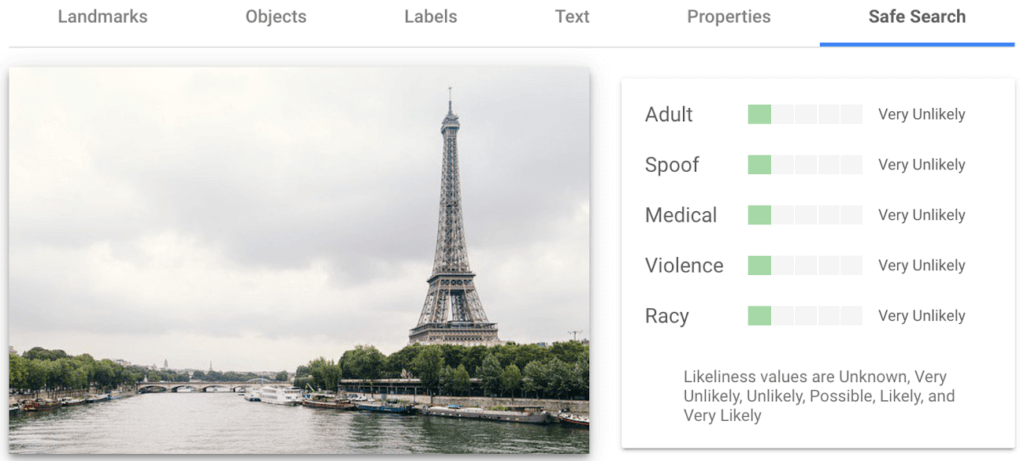
Landmark detection allows you to analyze images to identify specific landmarks such as buildings, natural features, and other recognizable locations. Cloud Vision API recognizes landmarks and provides information about them, including their name, location, and other relevant details. Perhaps you are trying to identify the landmarks in images shared by customers as part of social campaigns, or want to build a mobile app that provides information to tourists on famous landmarks.
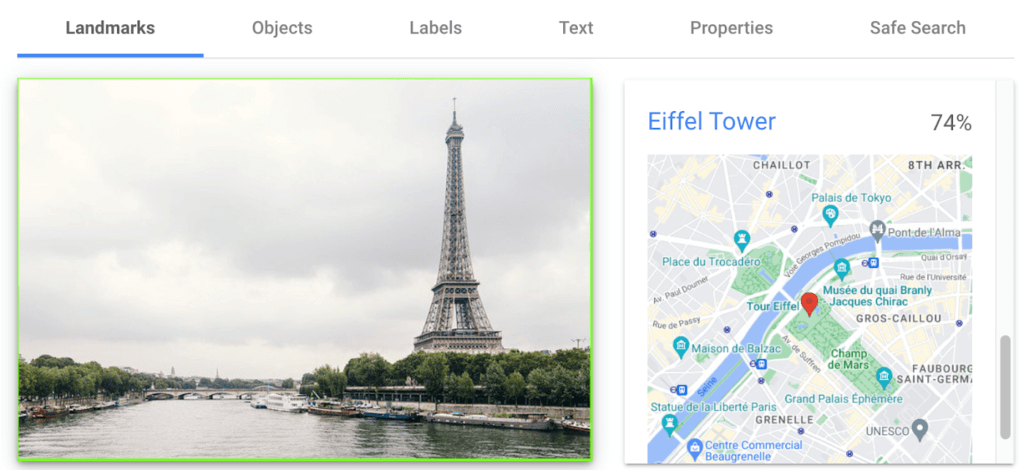
In the below left-hand side image, Cloud Vision API has detected the Eiffel Tower, shown in the visualized response. Not shown in this visualization here, but also detected, were Pont de Bir-Hakeim (the bridge) and Champs de Mars (the park in front of the Eiffel Tower).
Detect objects and label images
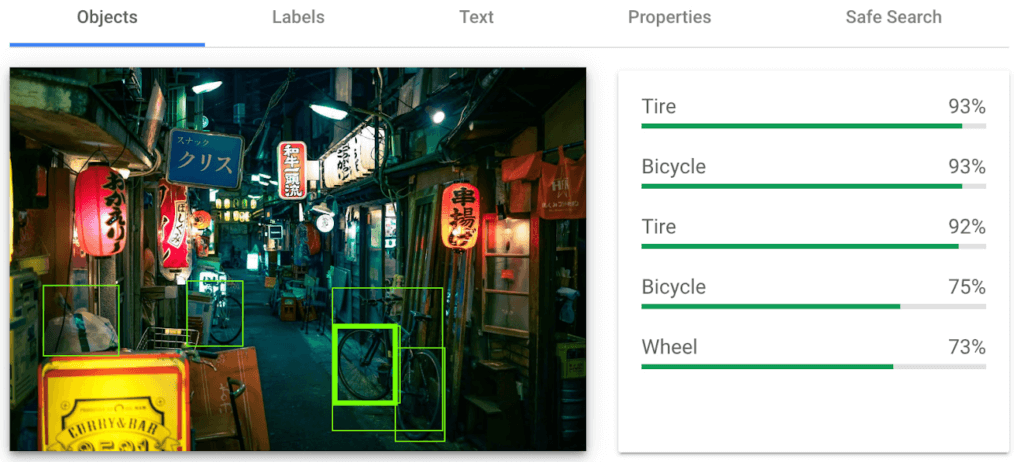
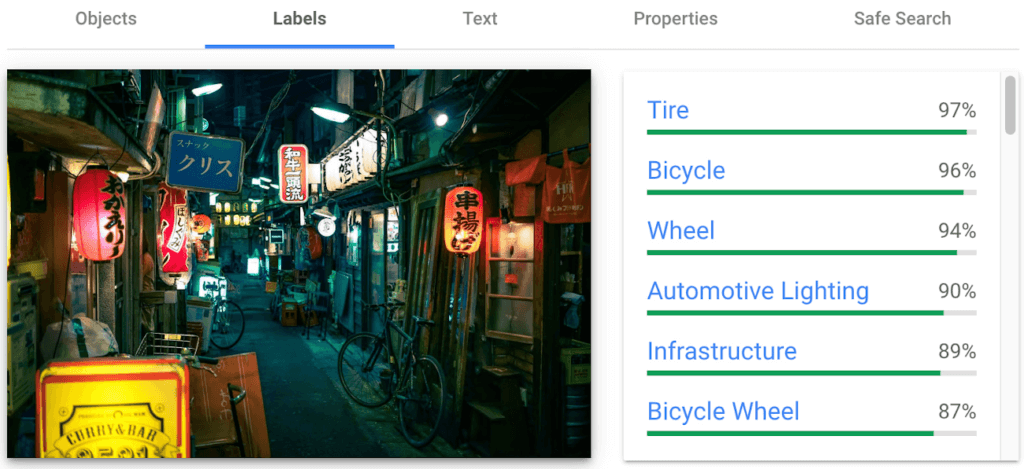
Object detection and labels are two related features that enable you to identify and classify objects within an image. Object detection detects and locates objects within an image, and provides information such as the position, size, and orientation of each object. Labels, on the other hand, provide a general classification of the content within an image.
Object detection has practical applications in many industries such as self-driving vehicles (where it’s critical), retail, manufacturing and more, while labels can be used to help classify and organize large collections of images, or to categorize and filter content.
You can see the similarities and differences in the responses provided by the object detection and labeling features in this image taken in Setagaya.
Detect text
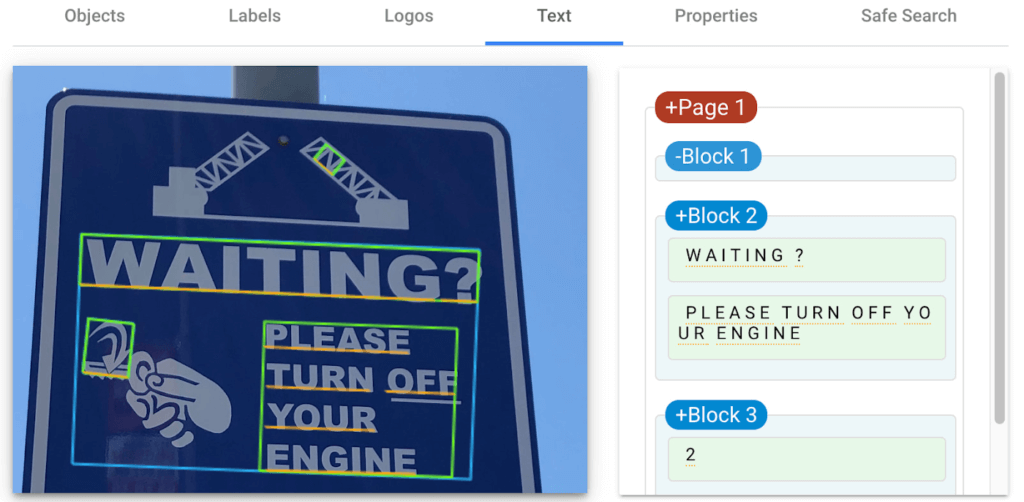
Cloud Vision API detects and extracts text from any image, even if it’s handwritten or in different languages. Once it detects text, the API can provide information about the position, orientation, and size of each text element, as well as individual words, and their bounding boxes.
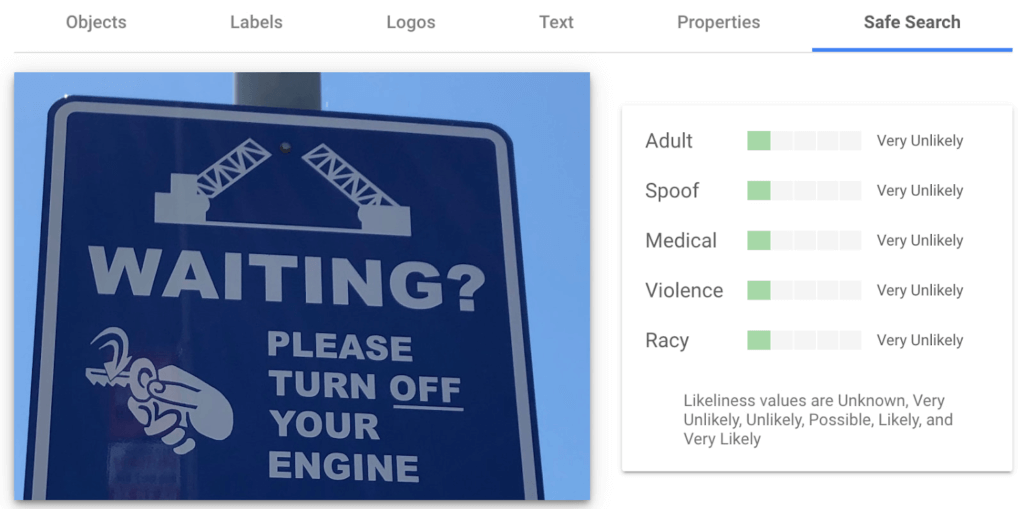
In this image of a traffic sign, Cloud Vision API has detected the text and provided it in the response.
Detect explicit content
Cloud Vision API can automatically identify and flag explicit or inappropriate content within an image using five categories: adult, spoof, medical, violence, and racy. The API provides a score that indicates the likelihood for each category in the image, which you can use to set thresholds in your application and decide how to handle those that exceed them. This feature is particularly useful for filtering or moderating user-generated content.
Luckily for the images I shared here, each category has been deemed “very unlikely” to be present. Phew!

Next Steps
These are just a few features of the Cloud Vision API and how it can help your business with automating image analysis workflows and gaining valuable insights from your visual data.
Head to the interactive walkthrough tutorials in Python, Node.js, Go, and Java to see step-by-step how to access the API and learn more about all the features that you can integrate into your own applications! Again, this tutorial can be completed at no cost within the Google Cloud Free Tier.
Lending DocAI Shortens Borrowers’ Journey on Roostify

11823
Of your peers have already read this article.
3:00 Minutes
The most insightful time you'll spend today!
The home lending journey entails processing an immense number of documents daily from hundreds of thousands of borrowers. Currently, home lending document processing relies on some outdated digital models and a high dependency on manual labor, resulting in slow processing times and higher origination costs. Scaling a business that sorts through millions of documents daily, while increasing efficacy and accuracy, is no small feat. When it comes to applying for a mortgage loan, consumers expect a digital experience that’s as good as the in-person one. Roostify simplifies the home lending journey for lenders and their customers.
No time to spare: Overcoming document processing challenges with AI
Roostify provides enterprise cloud applications for mortgage and home lenders. In order to empower its customers to deliver a better, more personalized lending experience, they needed to automate and scale their in-house document parsing functionality.
As a key component of its document intelligence service, Roostify is leveraging Google Cloud’s Lending DocAI machine learning platform to automate processing documents required during a home loan application process, such as tax returns or bank statements with multi-language support. This partnership delivers data capture at scale, enabling Roostify customers to automatically identify document types from the uploaded file and to extract relevant entities such as wages, tax liabilities, names, and ID numbers for further processing, and make things move faster in the cumbersome lending process.
Roostify’s solutions leverage Google Cloud’s Lending DocAI, which is built on the recently announced Document AI platform, a unified console for document processing. Customers can easily create and customize all the specialized parsers (e.g., mortgage lending documents and tax returns parsers) on the platform without the need to perform additional data mapping or training. All Google Cloud’s specialized parsers are fine-tuned to achieve industry-leading accuracy, helping customers and partners confidently unlock insights from documents with machine learning. Learn more about the solution from the GA launch blog and the overview video.
Integrating Lending DocAI’s intelligent document processing capabilities into the Roostify platform means more innovation for their customers and tangible results: faster loan processing times, fewer document intake errors, and lower origination costs. Additional support in Google Lending DAI for other languages and more documents like global Know Your Customer (KYC) documents or payroll reports is in the near future.
Full integration of AI solutions
Working together with Roostify’s platform team, we were able to help them solve their document processing challenge through integration of various GCP products such as Lending DocAI (LDAI), Data Loss Prevention (DLP) for redacting sensitive data, BigQuery for data warehousing and analytics, and Firestore for API status. To make it very safe and secure, all data was encrypted end-to-end at Rest and in Transit. LDAI won’t require any training data to process. It is an easy plug and play API.
Here is a sneak peek in the high level deployment architecture for LDAI in Roostify environment:

Here are the steps for processing data:
- Receives document processing request from the client.
- API Function directs requests to the pre-processing service. For Async requests a processing ID is generated and returned to the caller.
- Pre-processing service sends the request for further processing (Long/short PDF conversion), calling other microservices and receives back the responses. Any error in the response received is then sent to the response processing service.
- If the response is synchronous, the pre-processing service directs it to the LDAI Invoker service.
- If the response is asynchronous, the pre-processing service feeds it into the Cloud Pub/Sub service.
- Cloud Pub/Sub service feeds the response back to the LDAI Invoker service.
- LDAI Invoker service routes the request to the Google LDAI API for classification if there are multiple pages in the document.
- Document will be split based on LDAI response and then saved in a GCS bucket for temporary storage.
- LDAI entity interface for single page processing and then LDAI Invoker sends LDAI results to LDAI Response Processing
- If a request is a synchronous request the LDAI Response Processor sends results to the API Function so that it can complete the synchronous call and respond to the rConnect caller.
- If the request is an asynchronous request the LDAI Response Processor will respond to the caller’s webhook and complete the transaction.
- Finally, Data stored in the GCP bucket will be deleted.
All the responses that come from the LDAI API can optionally feed into BigQuery via the Response Processor, after parsing it through Data Loss Prevention (DLP) API to redact the PII/sensitive information. Throughout the processing of both asynchronous and synchronous requests all transactions are logged using Cloud Logging. For asynchronous transactions, the state is maintained throughout the process using Cloud Firestore.
Roostify currently uses this technology to power two different solutions: Roostify Document Intelligence and Roostify Beyond™. Roostify Document Intelligence is a real-time document capture, classification, and data extraction solution built for home lenders. It ingests documents uploaded by borrowers and loan officers, identifies the relevant documents, and extracts and classifies key information. Roostify Document Intelligence is available as a standalone API service to any home lender with any digital lending infrastructure already in place.
Roostify Beyond™ is a robust suite of AI-powered solutions that enables home lenders to create intelligent experiences from start to close. It combines powerful data, insightful analytics, and meaningful visualization to streamline the underwriting process. Roostify Beyond™ is currently available only to Roostify customers as part of an Early Adopter program and will be rolled out to the market later this year.


Through this partnership, Roostify has enabled its customers to adopt a data-first approach to their home lending processes, which will lead to improved user experiences and significantly reduced loan processing times.
Fast track end-to-end deployment with Google Cloud AI Services (AIS)
Google AIS (Professional Services Organization), in collaboration with our partner Quantiphi, helped Roostify deploy this system into production and fast-tracked the development multifold to generate the final business value.
The partnership between Google Cloud and Roostify is just one of the latest examples of how we’re providing AI-powered solutions to solve business problems.
Gyfted: Finding the Right Man for the Job Using Google Cloud AI/ML Tools

2564
Of your peers have already read this article.
2:00 Minutes
The most insightful time you'll spend today!
It’s no secret that many organizations and job seekers find the hiring process exhausting. It can be time consuming, costly, and somewhat risky for both parties. Those are just some of the experiences we wanted to change when we started Gyfted, a pre-vetted talent marketplace for people who complete tech training or degree programs and are looking for the right career move. At the same time, we’re helping businesses save time and improve recruiting outcomes with our automated candidate screening and sourcing tools.
Our vision is clear: To take a candidate through one structured hiring process, and then put them in front of thousands of companies. It’s similar to the common app system in higher education. Sounds simple, but it is a herculean technical and UX task. To succeed we had to combine advanced psychometric testing, machine learning, the latest in behavioral design, and develop the highest quality structured, relational dataset to represent candidate and manager profiles and preferences on our network. Fortunately, we were cofounded by world-leading experts in these areas including Dr. Michal Kosinski, one of the world’s top computational psychologists, and Adam Szefer, a gifted young technologist. We’ve been joined by a group of equally talented employees, most of whom work remotely in Poland, US, Switzerland, UK, Israel, and Ukraine.
The influence of dating platforms and matching
When seeking inspiration, we were influenced by the success of dating platforms, especially Bumble with its focus on commitment. These platforms have done a great job using design to match people together.
We like to think we’re doing the same for recruiters and candidates in terms of not only role and culture fit matching, but also through a fundamental feature of Gyfted, which is that our job-seekers are anonymous. This helps recruiters meet one of their goals today, which is to minimize bias in the hiring process and enable objective, diversity-oriented recruiting.
Another of our unique selling points is that we conduct candidate screening that is gamified and automated, with a structured interview, where the interview remains with the candidate’s profile. We roughly estimate that just for the 15 million open jobs on LinkedIn, if companies fill in 50% of those via external recruiting, and conduct a screening interview with 10 candidates per job filled at $50/hour paid to an employee to do the screening, that’s $3.75 billion and 75 million hours in direct costs. This is on top of applying for jobs, selecting CVs, and coordinating the process, which takes an even bigger financial and time toll on both applicants and recruiters. Instead, it would be better to take one interview for 1000 companies. The impact of what we want to achieve with our vision is enormous.
We also offer career discovery and career search tools for job candidates. This includes free, personalized feedback for every job-seeker. Right now, we’re aiming the service at students, bootcamp graduates and juniors, helping them to land jobs in tech and the creative industry at large. Next, we’ll expand into mid and senior roles. In the long run we want to reshape how recruiting happens through a common app that saves everyone in the market significant time and resources, helping people find jobs not only faster, but jobs that truly fit them.
Developing advanced AI applications with Google Cloud
We obtained our original funding from angel and institutional investors, and we were selected into the Fall 2021 batch of StartX, the non-profit start-up accelerator and founder community associated with Stanford University. But like most startups our budgets are tight, and we need to find ways to operate as efficiently as possible, especially when building out our technology stack and developer environment.
That’s where Google Cloud comes in. It’s a lot more affordable and flexible than competing solutions, and our developers love it. We use Google App Engine for the hosting and development of our applications giving us enormous flexibility. Vertex AI enables us to build, deploy, and scale machine learning models faster, within a unified artificial intelligence platform. On top of that we use Google Vertex AI Workbench as the development environment for the data science workflow, which allows us to have everything that we need to host and develop innovative AI-based applications.
BigQuery, Google Cloud’s serverless data warehouse, is another stand-out solution for us. We use it to crunch big data from all our systems and the UX is very intuitive and easy to use, allowing us to use it across the business and get insights from a wide range of employees, not just technical experts.
Above all, Google Cloud helps us solve the main platform challenges facing Gyfted including scalability and identity management, so we are perfectly positioned for growth. Right now, we handle about 2 million candidate interactions, a volume we expect to grow exponentially. As that number grows, we rely on Google Cloud to help us scale securely and with reliability.
Eliminating bias from the hiring process
Our technology partners have also been integral to helping us get to an advanced stage of our beta program. MongoDB on Google Cloud takes the data burden off our teams and reduces time to value of our applications. We can stay nimble and can scale database capacity at the push of a button.
Our collaboration with the Google team has been fantastic. Our Startup Success Manager is an expert when it comes to Google Cloud solutions, and he also understands our business from his own experience as an entrepreneur and an investor. It’s great to have an internal point of contact who can help us navigate all of Google’s resources.
I’d also stress the extent to which Google Cloud values align with ours. For example, a key benefit for our customers is the ability to strip unconscious bias out of the hiring process. Google Cloud tools support this commitment to diversity, especially when we are building out our AI models.
On a team level, we also appreciate the support that Google Cloud has shown through its Google Support Fund for Start-ups in Ukraine. This has helped many Ukrainian businesses to continue to operate at a very challenging time, including startups with remote, distributed teams in Poland where most of us stem from.
If I had to sum up Google Cloud and our collaboration with Google for Startups in a phrase, I’d say that it adds enormous value to our business while removing much of the risk when scaling up a start-up. We’ve seen the addition of many new tools and features in the past two years and our Google mentors are always looking at the best way these can be integrated with Gyfted’s own roadmap. That means that we can continue to transform recruiting and hiring processes with the support of one of the world’s most advanced tech companies as a strategic growth partner.

If you want to learn more about how Google Cloud can help your startup, visit our page here to get more information about our program, and sign up for our communications to get a look at our community activities, digital events, special offers, and more.

5205
Of your peers have already downloaded this article
2:30 Minutes
The most insightful time you'll spend today!
For as long as business intelligence (BI) has been around, visualization tools have played an important role in helping analysts and decision-makers quickly get insights from data.
In our current era of big data analytics, that premise still holds. To provide an integrated platform for building BI dashboards on top of big data, GCP offers the combination of Google BigQuery, a cloud-native data warehouse that helps you analyze petabytes of data quickly, and Google Data Studio, a free tool that helps you quickly create beautiful reports.
First, imagine that you work for an online retailer that bases important decisions on customer interaction data in the form of large amounts (multiple TBs) of usage logs stored as date-partitioned tables in a BigQuery dataset called usage. To get business value out of that data as quickly as possible, you want to build a dashboard for analysts that will provide visualizations of trends and patterns in your data.
The good news is that a connector is available that lets you query data stored in BigQuery directly from Data Studio.
Learn how to build a BI dashboard with Data Studio as the front end, and powered by BigQuery on the back end (with some help from Google App Engine for added efficiency). Download this how-to now.
More Relevant Stories for Your Company

Next-Level Search: Discover the Game-Changing Capabilities of Enterprise Search on Gen App Builder
In our conversations with customers, few generative AI use cases have driven as much enthusiasm as generative search. Leaders at enterprises know the limits of traditional enterprise search, with queries producing a list of links based on pattern matching, and significant manual investigation required to find the more relevant answers. In generative



The True Story of How HotStar Broke a World-Record–Thanks to Firebase and Google BigQuery
Hotstar, India’s largest video streaming platform with 150 million monthly active users around the world, provides live-streaming of TV shows, movies, sports, and news on the go. By using a combination of Firebase products together, Hotstar safely rolled out new features to its watch screen during a major live-streaming event


Eli Lilly’s Custom-built Translation Service Leverages Google’s Translation Engine
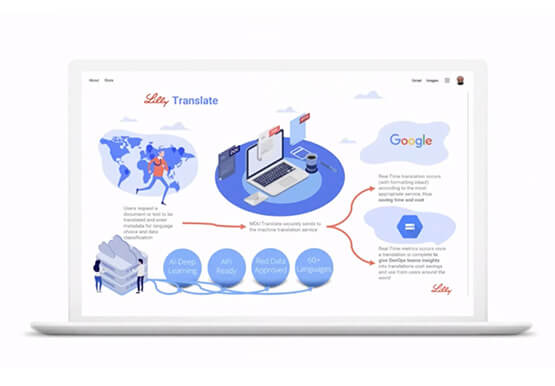
Eli Lilly leverages Google Cloud's machine translation to globalize content to serve their multilingual employees. Watch the video to learn how the healthcare company built an in-house solution powered by Google Cloud APIs to address the challenge of translating multilingual content at scale. Also explore Google's innovations and investments into

Start Delivering Business Results with the Three AI Agents
When it comes to the adoption of artificial intelligence (AI), we have reached a tipping point. Technologies that were once accessible to only a few are now broadly available. This has led to an explosion in AI investment. However, according to research firm McKinsey, for AI to make a sizable
