





3182
Of your peers have already watched this video.
26:27 Minutes
The most insightful time you'll spend today!
Redefining the approach to mobile security
When it comes to mobile security, everyone assumes open means unsecure.
There are three terms that people often confuse: vulnerability, malware, and exploit.
A vulnerability is really nothing more than a software flaw that is potentially exposed, where there is a possibility of it being attacked. It doesn’t mean it will ever be attacked and it doesn’t mean it will ever be exposed.
Malware is software–again, it’s software–that is designed to disrupt, damage, or gain unauthorized access to a computer system.
An exploit is also software and it’s designed to take advantage of a vulnerability. And in most cases, it’s designed to typically do malicious things, such as install malware.
So, a vulnerability does not equal an exploit. A vulnerability is a chance.
Discover how to debunk these security myths and learn how the latest multi-layered security protections, encompassing software, and hardware and application levels now leverage the power of machine learning to protect your device fleet. Mark Burr, an Android expert, shares the latest on enterprise security innovations, backed by third-party validation.
Security Talks: Addressing the Toughest SOC Challenges with SolarWinds, Chrome, Zero Trust, and More

2522
Of your peers have already read this article.
1:30 Minutes
The most insightful time you'll spend today!
Security operations teams are facing a “perfect storm” of challenges from nation-state actors turning their attention to financial crime, to rising uncertainty and potential complexities because of rapidly advancing cloud migration and IoT adoption, to the long-lamented skills shortage.
Now imagine having to face this trifecta without visibility into your IT and security infrastructure because scale and cost concerns have impeded your ability to ingest and monitor critical telemetry. To help organizations rethink threat detection and broader security team efforts, we showcased at this month’s Google Cloud Security Talks a keynote on why DEI is a cybersecurity imperative, Mandiant’s review of lessons for organizations two years after SolarWinds, how Google Chrome already helps protect your business (and what more you can make do with it,) how best to encourage your organization to pursue Zero Trust, and three key ways in which Chronicle Security Operations can help your organization scale threat detection and actionable outcomes. These include:
1. Operationalizing threat intelligence
Harnessing the power of threat intelligence to acquire context, prioritize risk, and act on detections requires more than just ingesting a set of indicator of compromise (IOC) feeds. Threat intelligence must have breadth and depth of coverage to provide custom details on the tools, tactics, and procedures of threat actors. Explore why part of the “magic” behind Google Cloud’s security is the sheer scale of threat intelligence we can share with our customers.
2. Driving detection as code
We want to enable organizations that are more advanced in their cybersecurity maturity to build their own custom detections and rules, which means offering our customers a powerful detection-authoring platform. Chronicle Security Operations can help analysts build specific detections around, for example, known bad files or a specific registry key change. We also demonstrated how to create more complex detections, such as flagging process execution patterns or crafting a suspicious-behavior trigger from a specific activity sequence.
3. Leveraging curated detections
With curated detections, which we announced in August, we are putting the power of Google Cloud’s intelligence in the hands of security operations teams everywhere. Our detections offer actionable, ready-to-use threat detection content curated, built, and maintained by Google Cloud Threat Intelligence (GCTI) researchers. These detection sets cover a wide variety of threats for your network and beyond, including attacks such as ransomware, remote-access tools (RAT), infostealers, data exfiltration, and suspicious activity.
You can watch all nine of our Security Talks recorded sessions here, and keep an eye out for our next Security Talks, coming in March 2023.
DueDil Chooses Apigee to Leverage APIs for Customers’ Risk Monitoring with Better Insights

4842
Of your peers have already read this article.
1:30 Minutes
The most insightful time you'll spend today!
As their name reflects, DueDil provides due diligence services ranging from customer-specific risk evaluations and selections to customer onboarding and real-time risk monitoring for leading financial services, high-growth tech and insurance companies. Founded in 2009, the company helps more than 3,000 enterprise users from over 400 clients to not only understand with whom they’re doing business, but to do so with increased efficiency and in compliance with regulatory requirements.
Due diligence services have evolved in recent years, both because of new regulations and new technologies supplanting legacy systems and processes, many of which relied until recently on pen-and-paper workflows or exhaustive spreadsheet work. DueDil knew this technology transformation represented an opportunity to replace manual processes with automation–but it also recognized a second opportunity: to not merely process data but also activate it by connecting information in disparate IT systems and generating data-driven insights delivered at scale.
To capitalize on this opportunity, the company built its Business Information Graph, or B.I.G., a platform that maps approximately 300 million connections among companies. B.I.G. ingests billions of data points, and is refreshed multiple times per day, to surface unique insights about business’s relationships, such as fraud risks. The results that B.I.G. drives often speak for themselves: some DueDil customers onboard partners up to 80% faster, perform risk verification up to 18 times faster, and reduce time spent on manual portfolio checks by up to 80%.
What powers all of this transformation? Application Programming Interfaces (APIs).
“From a go-to-market standpoint, our product is an API,” said Denis Dorval, DueDil COO, in a recent webcast, explaining that customers can directly tap B.I.G.’s resources for themselves, and build atop them for their own needs, via DueDil’s API.
Choosing an API management platform to deliver fast, secure, and scalable APIs
To execute on their vision of connecting B2B ecosystems for better insights and efficiency, DueDil looked for a cloud provider that could fulfill several specific criteria. They needed robust management for the APIs with which their internal developers leverage different systems for new use cases and process automations, as well as for the productized API they offer to customers. They needed sophisticated analytics and abundant processing power to crunch through billions of data points. And, they needed enterprise-grade security, scalability, and agility to underpin it all. Last but not least, the company prioritized a smooth transition; DueDil did not want the user experience to suffer as it switched providers.
“The stability of Google Cloud’s Apigee API management platform and the strength of its services stood out”, said DueDil’s Engineering Manager, Robert Cicero.
“Apigee is a resilient and agile platform, fulfilling our need to build APIs quickly, safely, and at scale,” he remarked, noting that he appreciated that many of Apigee’s API security defense tools and policies work out-of-the-box. For instance, Apigee’s JSON threat detection policies, custom policies, and authentication and authorization processes can be deployed instantly and add minimal latency, meaning DueDil can stop security threats before they enter its network while still avoiding the risk of service lags.
Today, DueDil has five internal services that facilitate business due diligence, all exposed via Apigee. They also use Apigee’s monetization feature to drive API consumption. This said, because DueDil’s go-to-market strategy is fast-paced and client-oriented, they most often use Apigee to rapidly prototype APIs for their clients, so they can understand what a specific API would look like and how it would behave. This allows DueDil, its partners, and its customers to spend more time delivering value from insights rather than getting bogged down in building backend systems.
Moreover, Apigee made it simpler to also connect to other Google Cloud services, such as BigQuery, Google Data Studio, and Google Cloud Storage. Apigee acts as a central nervous system among systems, giving DueDil not only the ability to connect systems and automate processes but also insight and visibility into how its B.I.G. services are being used by partners and customers.
Plus, added Cicero, “the migration to Apigee was seamless, with arguably our biggest win being that no one knew that we had switched API management providers to Apigee.”
Leveraging APIs to provide self-service while enforcing security and governance policies
Moving forward, DueDil plans to leverage Apigee to give staff members and clients more privileges, visibility, and opportunity to create and edit apps in a self-service manner, without needing to rely on an IT department or endure long approvals processes. Harnessing APIs to open up B.I.G. and other capabilities to more teams across the company will also allow DueDil to move faster and include more people in the innovation process. Leveraging Apigee API management capabilities, DueDil also intends to dive deeper and experiment with other Google Cloud products and services, including Cloud Function, Cloud Pub/Sub, and more.
“At the end of the day, every company goes about due diligence a little differently. The only way that we at DueDil are able to provide something that is configurable and dynamic to diverse businesses is if we use platforms that can adapt, too,” said Cicero. “Apigee gives us the agility required to create and deliver for a wide variety of businesses.”
Google Cloud, today, works across banking, capitalmarkets, insurance, and payments worldwide to solve their most challenging problems. Click here to learn more about how Google Cloud Apigee API management can help you design, secure, analyze, and scale APIs anywhere with visibility and control. To try Apigee API management for free, click here.
Google Cloud & Siemplify Join Forces to Empower Companies to Manage Threat Responses Better

2980
Of your peers have already read this article.
1:30 Minutes
The most insightful time you'll spend today!
At Google Cloud, we are committed to advancing invisible security and democratizing security operations for every organization. Today, we’re proud to share the next step in this journey with the acquisition of Siemplify, a leading security orchestration, automation and response (SOAR) provider. Siemplify shares our vision in this space, and will join Google Cloud’s security team to help companies better manage their threat response.
In a time when cyberattacks are rapidly growing in both frequency and sophistication, there’s never been a better time to bring these two companies together. We both share the belief that security analysts need to be able to solve more incidents with greater complexity while requiring less effort and less specialized knowledge. With Siemplify, we will change the rules on how organizations hunt, detect, and respond to threats.
Providing a proven SOAR capability unified with Chronicle’s innovative approach to security analytics is an important step forward in our vision. Building an intuitive, efficient security operations workflow around planet-scale security telemetry will further realize Google Cloud’s vision of a modern threat management stack that empowers customers to go beyond typical security event and information management (SIEM) and extended detection and response (XDR) tooling, enabling better detection and response at the speed and scale of modern environments.
“We’re excited to join Google Cloud and build on the success we’ve had in the market helping companies address growing security threats,” said Amos Stern, CEO at Siemplify. “Together with Chronicle’s rich security analytics and threat intelligence, we can truly help security professionals transform the security operations center to defend against today’s threats.”
The Siemplify platform is an intuitive workbench that enables security teams to both manage risk better and reduce the cost of addressing threats. Siemplify allows Security Operation Center analysts to manage their operations from end-to-end, respond to cyber threats with speed and precision, and get smarter with every analyst interaction. The technology also helps improve SOC performance by reducing caseloads, raising analyst productivity, and creating better visibility across workflows.
We plan to invest in SOAR capabilities with Siemplify’s cloud services as our foundation and the team’s talent leading the way. Our intention is to integrate Siemplify’s capabilities into Chronicle in ways that help enterprises modernize and automate their security operations.
We’re looking forward to welcoming the Siemplify team to Google Cloud and working with them to help security operations teams accomplish so much more in defense of their organizations. You can read Siemplify CEO Amos Stern’s blog for more on this exciting news.
3343
Of your peers have already watched this video.
3:30 Minutes
The most insightful time you'll spend today!
How to Retrace the Steps of a Potential Phishing Attack with Threat Analytics
The majority of cyber attacks begin with phishing emails and websites. Attackers use many tricks, including by leveraging enterprise brand assets, such as company names and logos, to develop phishing websites that appear authentic and lure internet users to enter valuable information such as user names and passwords.
Experts say that today’s CISOs need to treat a potential phishing email like a crime scene. We need to use the evidence that we have to carry out the investigation. A common phishing email will sound like this: “Hello! Your security software has expired. Please click this link to renew it.”
This is where Google’s Backstory makes an entry. Find out how it can help trace the steps of what happened to conduct a thorough threat analysis of your network.
Securing apps using Anthos Service Mesh

3988
Of your peers have already read this article.
1:30 Minutes
The most insightful time you'll spend today!
Hi there! I’m David Challoner from Access Site Reliability Engineering (SRE), here with Anthony Bushong from Developer Relations to talk about how Corp Eng is adopting Anthos Service Mesh internally at Google.
Corp Eng is Google’s take on “Enterprise IT”. A big part of the Corp Eng mission is running the first and third party software that powers internal business processes – from legal and finance to floor planning and even the app hosting our cafe menus – all with the same security or production standards as any of Google’s first party applications.
Googlers need to access these applications, which sometimes then need to access other applications or other Google Cloud services. This traffic can cross different trust boundaries which can trigger different policies.
Access SRE runs the systems that mediate this access, and we implemented Anthos Service Mesh as part of our solution to secure the way Googlers access these applications.
But why?
You can probably tell, but the applications Corp Eng is responsible for have disparate requirements. This often means that certain applications are tied to disparate infrastructure due to legal, business or technical reasons – which can be challenging when those infrastructures work and operate differently.
Enter Anthos. Google Cloud built Anthos to provide a consistent platform interface unifying the experience of working with apps on these varying underlying infrastructures, with the Kubernetes API at its foundation.
So when searching for the right tool to build a common authorization framework to mediate access to CorpEng services, we turned to Anthos – specifically Anthos Service Mesh, powered by the open-source project, Istio. Whether these services were deployed in Google Cloud, in Corp Eng data centers, or at the edge onsite at actual Google campuses, Anthos Service Mesh delivered a consistent means for us to program secure connectivity.
To frame the impact ASM had on our organization, it’s helpful to introduce the roles of the folks who manage and use it:
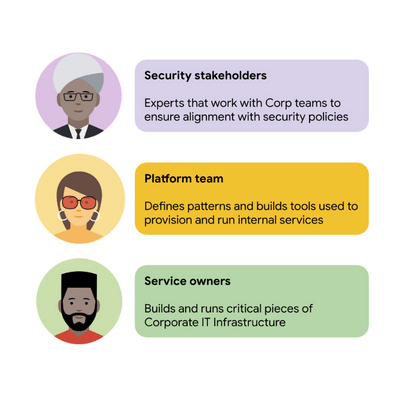
For security stakeholders, ASM provides an extensible policy enforcement point running next to each application capable of provisioning a certificate based on the identity of the workload and enforcing mandatory fine-grained application-aware access controls.
For platform operators, ASM is delivered as a managed product, which reduces operational overhead by providing out-of-the-box release channels, maintenance windows, and a published Service Level Objective(SLO).
For service owners, ASM enables the decoupling of their applications from networking concerns, while also providing features like rate limiting, load shedding, request tracing, monitoring, and more. Features like these were typically only available for applications that ran on Borg, Google’s first-party cluster manager that ultimately inspired the creation of Kubernetes.
In sum, we were able to secure access to a plethora of different services with minimal operational overhead, all while providing service owners granular traffic control.
Let’s see what this looks like in practice!
The architecture
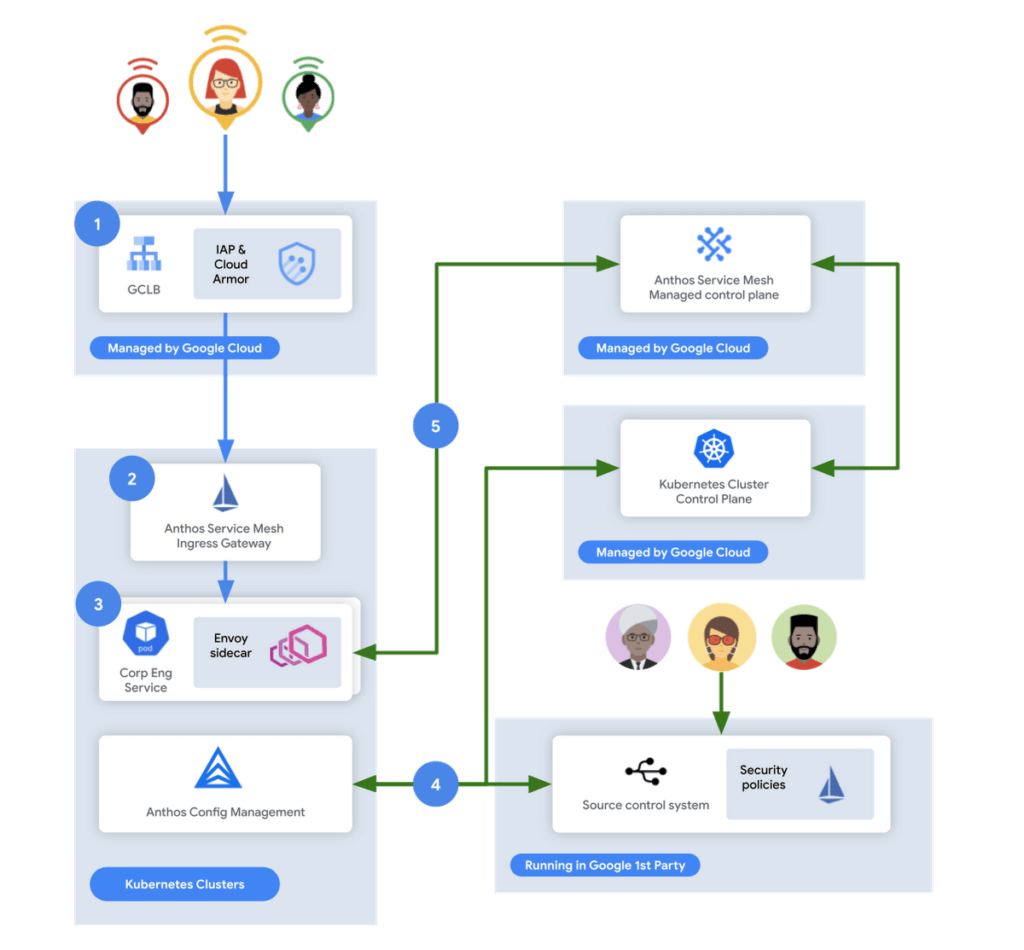
In this flow, user access first reaches the Google Cloud Global Load Balancer [1], configured with Identity Aware Proxy (IAP) and Cloud Armor. IAP is the publicly available implementation of Google’s internal philosophy of BeyondCorp, providing an authentication layer that works from untrusted networks without the need for a VPN.
Once a user is authenticated, their request then flows to the Ingress Gateway provided by Anthos Service Mesh [2]. This provides additional checks that traffic flows to services only when the request has come through IAP, while also enforcing mutual TLS (mTLS) between the Anthos Service Mesh Gateway to the Corp services owned by various teams.
Finally, additional policies are enforced by the sidecar running in every single service Pod [3]. Policies are pulled from source control using Anthos Config Management[4], and are propagated to all sidecars by the managed control plane provided by Anthos Service Mesh[5].
Managing the mesh
If you’re not familiar with how Istio works, it follows the pattern of a control plane and a data plane. We talked a little bit about the data plane – it is made up of the sidecar containers running alongside all of our service Pods. The control plane, however, is what’s responsible for updating these sidecars with the policies we want to enforce:
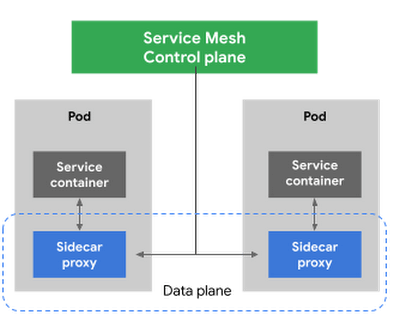
Figure 3 – High-level architecture for Istio
Thus, it is critical for us to ensure that the control plane is healthy. This is where Anthos Service Mesh gives our platform owners a huge advantage with its support for a fully-managed control plane. To provision cloud resources, like many other companies, our organization uses Terraform, the popular open-source infrastructure as code project. This gave us a declarative and familiar means for provisioning the Anthos Service Mesh control plane.
First, you enable the managed control plane feature for GKE by creating the google_gke_hub_feature resource below using Terraform.
resource "google_gke_hub_feature" "feature_asm" {
name = "servicemesh"
location = "global"
provider = google-beta
}
Keep in mind that at publication time, this is only available via the google-bet provider in Terraform.
Once created, we then provision a ControlPlaneRevision custom resource in a GKE cluster to spin up a managed control plane for ASM in that cluster:
apiVersion: mesh.cloud.google.com/v1alpha1
kind: ControlPlaneRevision
metadata:

name: asm-managed

namespace: istio-system
spec:

type: managed_service

channel: regular
Using this custom resource, we are able to set the release channel for the ASM managed control plane. This allows for our platform team to define the pace of upgrades in accordance with our team’s needs.
In addition to managing the control plane, ASM also provides management functionality around the data plane to ensure each sidecar Envoy is kept up to date with the latest security updates and is compatible with the control plane – one less thing for service operators to worry about. It does this using Kubernetes Mutating Admission Webhooks and Namespace labels to modify our Pod workload definitions to inject the appropriate sidecar proxy version.
Syncing mandatory access policies
With the core Anthos Service Mesh components in place, our security practitioners can define consistent, mandatory security policies for every single GKE cluster, using Istio APIs.
For example, one policy is enforcing strict mTLS between Pods using automatically provisioned workload identity certificates. Earlier, we talked about how this is enforced between the Istio Gateway; that same policy enforces mTLS between all Pods in our cluster.

Another policy we implement is denying all egress traffic by default, requiring service teams to explicitly declare their outbound dependencies. The following is an example of using an Istio Service Entry to allow granular access to a specific external service – in this case, Google. This helps prevent unintended access to external services.
apiVersion: networking.istio.io/v1alpha3

kind: ServiceEntry
metadata:

name: google
spec:

hosts:
  - www.google.com

ports:
  - number: 443

name: https

protocol: HTTPS

resolution: DNS

location: MESH_EXTERNAL
EOF
These policies are automatically synced to all service mesh namespaces in each cluster using Anthos Config Management. By using our internal source control system as a source of truth, Anthos Config Management can sync and reconcile policies across all of our GKE clusters, ensuring that these policies are in place for every single one of our services. You can find more details about our implementation of Anthos Config Management here.
With this in place, our team plans on eventually migrating away from security automation that operates solely based on explicit IP, port and protocol policies.
Integration with Identity-aware Proxy
The publicly available version of the BeyondCorp proxy used by CorpEng is called Identity-aware Proxy (IAP), which offers an integration with Anthos Service Mesh. IAP allows you to authenticate users trying to access your services and apply Context-Aware-Access policies. This integration comes with two main benefits:
- Ensuring that user traffic to services in the service mesh only come through Identity-aware Proxy
- Enforcing Context-aware access (CAA) trust levels for devices, defined by multiple device signals we collect
Identity-aware Proxy allows us to capture this information in a Request Context Token (RCToken), which is a JSON Web Token (JWT) created by Identity-aware Proxy that can be verified by ASM. IAP inserts this JWT into the Ingress-Authorization header. Using Istio Authorization Policies similar to the following policy, any requests without this JWT are denied:
apiVersion: security.istio.io/v1beta1
kind: AuthorizationPolicy
metadata:
name: iap-gateway-require-jwt
namespace: istio-system
spec:
selector:
matchLabels:
app: istio-iap-ingressgateway
action: DENY
rules:
- from:
- source:
notRequestPrincipals: ["*"]
Here is an example policy that requires a fullyTrustedDevice access level – this might be a device in your organization that is known to be corporate-owned, fully-updated, and running an IT-approved configuration :
apiVersion: security.istio.io/v1beta1
kind: AuthorizationPolicy
metadata:
  name: require-fully-trusted-device
  namespace: fooService
spec:
  selector:
    matchLabels:
      app: fooService
  action: ALLOW
  rules:
  - from:
    - source:
       requestPrincipals: ["*"]
    when:
    - key: request.auth.claims[google.access_levels]
      values: ["accessPolicies/$orgId/accessLevels/fullyTrustedDevice"]
This allows our security team to not only secure service to service communications, or outbound calls from services, but also specifically require incoming requests come from trusted devices and authenticated users using a trusted device.
Enabling service teams
As an SRE, one of our priorities is ensuring Service-level indicators (SLIs), SLOs, and Service-level agreements (SLAs) exist for services. Anthos Service Mesh helps us empower service owners to do this for their services, as it exposes horizontal request metrics like latency and availability to all services in the mesh.
Before Anthos Service Mesh, each application had to export these separately (if at all). With ASM service owners can easily define their Service’s SLOs in the cloud console or via terraform using these horizontally exported metrics. This then allows us to integrate SLOs into our higher-level service definitions so we can enable SLO monitoring and alerting by default. You can see the SRE book for more details on SLOs and Error budgets.
The takeaway
ASM is a powerful tool that enterprises can use to modernize their IT infrastructure. It provides:
- A shared environment-agnostic enforcement point to manage security policy
- A unified way to provision identities, describe application dependencies
This also enables previously unheard of operational capabilities such as distributed tracing or incremental canary rollouts – which were difficult to find in the typical enterprise application landscape.
Because it can be incrementally adopted and composed with existing authorization systems to close gaps – barriers to adoption are low and we recommend you start evaluating it today!
More Relevant Stories for Your Company

Deep Dive into Google Cloud’s Security Track at the Next 21
In every industry, in every part of the world, cybersecurity concerns continue to grow in the wake of attacks on critical infrastructure and the software supply chain. Governments and businesses of all sizes recognize that they must do more to protect their employees, customers and citizens. But doing more of
Security in the Cloud: Google’s Answer
Protecting a global network against persistent and constantly evolving cyber threats is one of the most important challenges faced by Google Cloud. So, how does Google’s global network protects seven different global businesses, each with over 1 billion customers, including popular Google services such as Google Search, YouTube, Maps, and


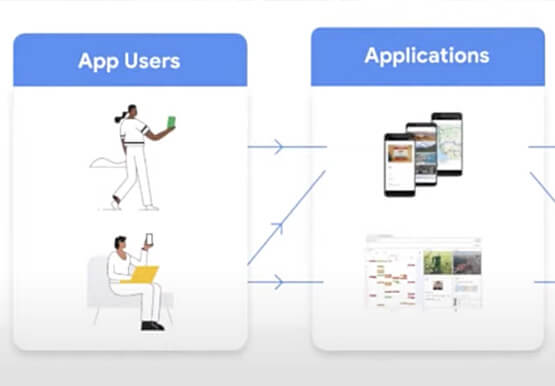

AppSheet: Reduce Shadow IT and Accelerate Development of Enterprise-grade Apps
Google Cloud findings suggest that nearly 40 percent of organizations' investments are consumed by shadow IT and can be a detractor to the adoption of cutting-edge tools and solutions. Also, about 51 percent of the surveyed executives are of the opinion that the inability to adapt to digital transformation trends

Embracing Confidential Computing: Secure Your Data in the Cloud
As one of the most trusted cloud platform providers, Google is committed to providing our clients secure and reliable environments for their workloads. Google believes the future of computing will increasingly shift to private, encrypted services where users can be confident that their data is not being exposed to cloud
