





3022
Of your peers have already watched this video.
18:00 Minutes
The most insightful time you'll spend today!
Driving Business Transformation in Financial Services Using Google Cloud and AI/ML
These are challenging times with financial services institutions navigating the pandemic.
Interest rates are an all-time low, and customer expectations are changing with the shift to digital. For example, digital banking has increased from 63 in 2019 to 72 percent today. Then regulatory requirements are evolving and compliance costs are increasing. Also, the financial services industry as a whole is facing new and creative types of fraud.
In this video, Tom Shane, Product Manager – Google Cloud and Michael Baldwin, Head of Product – Financial Services, Google Cloud – Google Cloud, uncover three areas where they see AI helping to unlock business transformation in financial services.
Find out how AI can help reimagine the customer experience, how financial institutions are looking for ways to use data and analytics to transform how they detect and manage risk, and how financial institutions are asking Google Cloud experts for a best-in-class AI platforms so that they can build their own AI-powered solutions to solve their most critical business problems.
Advance Your Cloud Career: Seven New No-Cost Generative AI Training Courses

1173
Of your peers have already read this article.
4:30 Minutes
The most insightful time you'll spend today!
Editor’s note: This blog has been updated since it originally published to reflect the total number of generative AI courses that have become available since the publish date.
An AI/ML (artificial intelligence/machine learning) career path can be a great specialty area within the cloud—and one of the most accessible! Because this area is constantly developing, most recently with the rise of generative AI, I want to share some recommendations to help you chart a sustainable career as AI/ML continues to evolve.
Generative AI falls under the overall category of AI and offers a new and exciting way of interacting with information, brands, and other people. Let’s talk about how these disciplines work together and about materials available to help you upskill in these areas.
To this end, we are happy to announce a new set of generative AI training content available at no cost. So, whether you are just getting started or already have a more advanced role, read on to find ways to help reach your desired position.
ML compared to AI
While the terms ML and AI are often used interchangeably, there are distinct differences. AI is an umbrella concept wherein machines are taught to perform tasks normally associated with human intelligence, such as decision-making and language interaction. ML is a subset of AI dedicated to taking data from the past and training algorithms to create models that can perform highly complex tasks without being explicitly programmed. It’s the basis for most forms of AI that people interact with, like virtual assistants, music recommendations, and chatbots.
Data engineers and ML engineers work with data scientists to get insights from data. They are needed to create software models and get clear results, and develop deployable applications. These skilled roles are needed in every industry!
Change the world for the better with generative AI
I recently wrote about four key pillars of technology trends expected in the next decade, including the role of AI/ML in the cloud environment as one of those pillars, and how you can bridge the skills gap and build your career.
Generative AI is a new type of ML that has made a lot of headlines recently. Research from CIO Dive finds that seven in 10 executives say their companies are investigating or exploring generative AI. Now is a great time to become an expert, while we are at the cusp of this technology becoming more widely adopted.
To get to generative AI, we need to talk first about deep learning. Deep learning is a subset of ML that uses artificial neural networks to process more complex patterns than traditional ML. Generative AI sits still further down the funnel, as a subset of deep learning that typically involves the Transformer architecture. Essentially, it’s a type of AI that can map long-range dependencies and patterns in large training sets, then use what it learns to produce new content, including text, imagery, audio, and synthetic data.
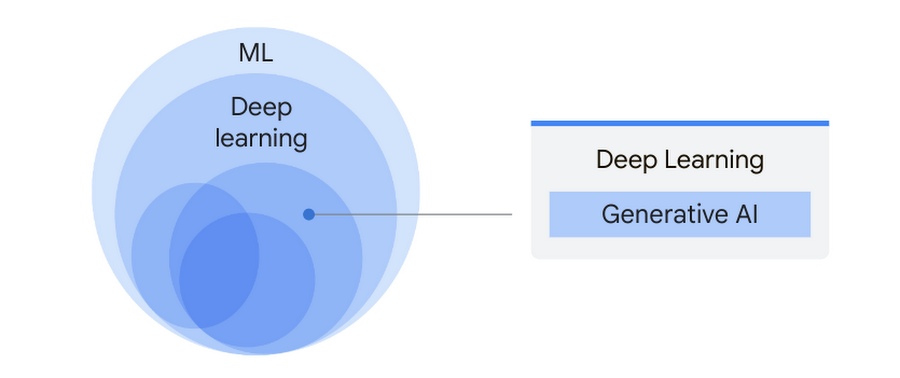
Generative AI relies on large models, such as large language models (LLMs) that can classify and generate text, answer questions, and summarize documents. For more detail about how this works, check out the video below from Google I/O 2023, which features great information from Dr. Gwendolyn Stripling, Artificial Intelligence Technical Curriculum Developer for Google Cloud.
How Google is offering generative AI
Here at Google, we’ve been heavily invested for decades in research and innovation aimed at helping businesses, governments, and developers maximize the potential of AI. Our vision is to empower builders, innovators, developers, and doers to use AI in unique, responsible, productive ways.
To deliver on this, we recently announced a variety of solutions to bring generative AI into our offerings, beginning with Generative AI support on Vertex AI and Gen App Builder.
Vertex AI is Google Cloud’s ML platform for training and deploying ML models and AI applications. With Generative AI support on Vertex AI, data science teams and developers can access foundation models from both Google and other sources, helping them to quickly build, customize, and deploy models for their own use cases.
As part of generative AI support on Vertex AI, Model Garden and Generative AI Studio are now in preview, including access to PaLM 2 for Text and Chat and Embeddings API for Text, while other features and services are available to select trusted testers. If you’d like early access to Google Cloud’s AI products, join the waitlist here.
We announced our latest PaLM model in production at I/O 2023: PaLM 2. Today, it powers more than 25 products! Additionally, we’ve fine-tuned PaLM 2 for specific use cases, including security and medical domains. You’ve probably also heard of Bard, our experiment for conversational AI, which is fully running on PaLM 2.
Our Gen App Builder aims to make customer, partner, and employee interactions more effective and helpful. With it, developers — even those with limited data science expertise — can quickly create bots, chat apps, digital assistants, custom search engines, and more. Gen App Builder even makes it possible to create some generative AI apps without any coding skills.
Now, let’s bring these products to life! Not sure exactly the use case or in need of a little inspiration? Check out this blog from Google Cloud CEO Thomas Kurian to see how customers and partners in the ecosystem are bringing ideas to life with generative AI. And watch this video to see generative AI in action!
Build your AI/ML skills and validate your knowledge to grow your career
There is a lot of excitement around generative AI—it’s truly a brand new path to consider for your AI/ML career! Check out my recommendations below for training options for AI/ML roles. These will help you gain critical skills as generative AI becomes more widely available.
*NEW* training materials, specific to generative AI technologies
Generative AI Learning Path – no cost training
- [Course] Introduction to Generative AI (1 day)
- [Course] Introduction to Large Language Models (1 day)
- [Course] Attention Mechanism (1 day)
- [Course] Transformer Models and BERT Model (1 day)
- [Course] Introduction to Image Generation (1 day)
- [Course] Create Image Captioning Models (1 day)
- [Course] Encoder-Decoder Architecture (1 day)
Additional AI/ML training – varying learning credits required to complete on Google Cloud Skills Boost
Introductory level
- [Course with completion badge] How Google Does Machine Learning (1 day)
- [Course with completion badge] MLOps: Getting Started (1 day)
- [Skill badge] Get started with TensorFlow on Google Cloud (8 hours)
- [Skill badge] Perform foundational ML, AI and data tasks in Google Cloud (7 hours)
- [Course with completion badge] Language, Speech, Text, and Translation with Google Cloud APIs (5 hours)
Intermediate/Multi-level
- [Learning Path] Machine Learning Engineer (Collection of 15 video courses and labs)
- [Skill badge] Build and Deploy Machine Learning Solutions on Vertex AI (1 day)
Advanced
- [Training + certification exam] Google Cloud Professional ML Engineer Certification (varied time)
- [Skill badge] Machine Learning with TensorFlow in Vertex AI (90 minutes)
- [Course with completion badge] Natural Language Processing in Google Cloud (1 day)
You can also catch up on hands-on demos in our most recent Cloud OnBoard: From Data to AI with BigQuery and Vertex AI. In it, we guide you through all steps of the data-to-AI solution.
Coming up on June 29, we are hosting Getting Started with Vertex Generative AI as part of Innovators Live. Register now!
I also encourage you to consider an Innovators Plus subscription. You get access to over 700 labs, skill badges and courses (including many that are specific to AI/ML), a certification exam voucher, and up to $1,000 in Google Cloud credits. You’ll also get access to live learning events and technical briefings with Google Cloud experts, plus 1:1 consultations (talk with us about your upcoming generative AI project!). It’s a $1,500 package for only $299. Learn more!

6805
Of your peers have already downloaded this article
3:08 Minutes
The most insightful time you'll spend today!
Reach the Right Customers
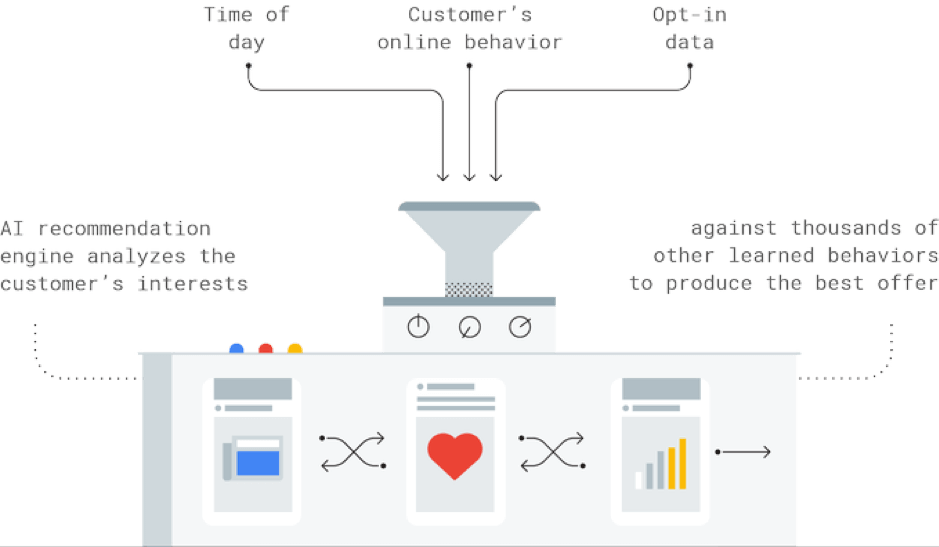
How can AI help you target customers who are looking for products like yours?
The challenge: This customer wants to buy the best cat food for her pets.

How AI Works
The Result
A targeted offer for a discount on luxury cat food is shown to the customer.

Predict What Customers Want
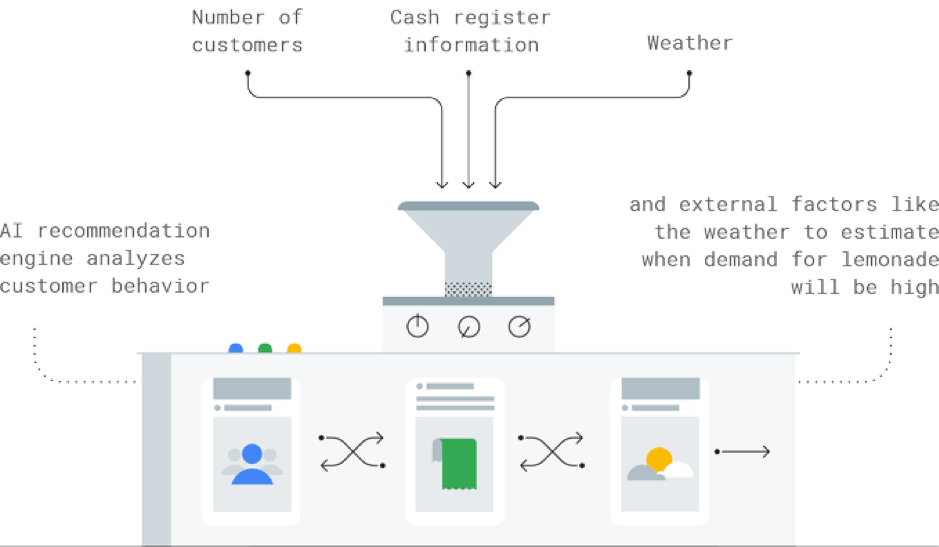
How can AI help you stay one step ahead when customer demand is uncertain?
The challenge: This lemonade seller isn’t sure how much lemonade he’ll need in the week ahead.

How AI Works
The Result
The seller makes just the right amount of lemonade to satisfy his customers and earn a juicy profit.

Keep Your Customers
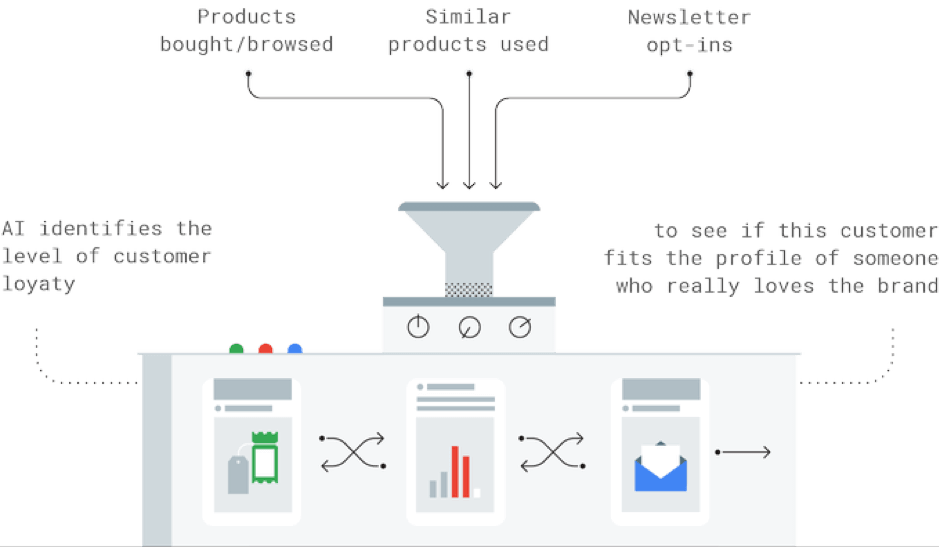
Your next job is retaining your customers. How can AI deliver campaigns that drive loyalty?
The challenge: This customer has bought products from a fitness brand. But can that brand ensure she becomes a loyal fan?

How AI Works
The Result
The brand delivers personalized offers that entice the customer to add to her sportswear collection — at exclusive discounts, too.

Google Cloud and Climate Engine Collaborate to Support Climate Action in Public Sector

4829
Of your peers have already read this article.
1:30 Minutes
The most insightful time you'll spend today!
While there is uncertainty about how much the climate will change in the future, we know it won’t look like the past. Extreme weather events will increase in frequency and severity; the world will continue to warm, and the cost of climate change will increase.
Government plays a vital role in understanding and responding to these changes quickly. Achieving this improved response time will require data insights to ensure informed decision-making—from local to global scales. The challenge is not only urgent; it’s one of the world’s biggest “big data” problems.
Fortunately, new technologies to help us monitor the Earth are proliferating. Thousands of satellites take millions of images of the planet every day. Sensors generate data about temperature, precipitation, wind, soil conditions, and more—as frequently as every second. We have more information about the planet’s systems than at any other time in history. And the data will only continue to grow. The problem is not the lack of data–it is harnessing this data to drive insights for decision makers to tackle climate change. That’s why Google Cloud has partnered with Climate Engine.
How Climate Engine and Google Cloud enable greater climate resilience
Climate Engine is a scientist-led company that works with Google to accelerate and scale the use of Google Earth Engine’s world-class geospatial capacities (in addition to those of Google Cloud Storage and BigQuery, among other tools) in support of climate action in the public sector. Powered by Google Cloud’s infrastructure, Google Earth Engine (GEE) combines a multi-petabyte catalog of satellite imagery and geospatial datasets with planetary-scale analysis capabilities, enabling scientists, researchers, and developers to detect changes, map trends, and quantify differences on the Earth’s surface.
With cloud-based technologies, we can leverage massive computing at a scale that generates actionable insights from Earth-based data. These insights help us better manage resources, understand risks, predict changes, and respond to disasters as we meet the challenge of climate change. Geospatial AI combines the power of artificial intelligence (AI) and machine learning (ML) with geospatial analysis. Google Cloud’s Geospatial AI solutions provide departments and agencies with a centralized system to collect, process, and deliver Earth-based data into decision-making contexts.
Climate Engine and Google Cloud provide specialists with the opportunity to go back in time and see how our landscapes have changed due to changes in climate and other human activities over the past few decades. Years of data can now be quantitatively analyzed and visualized in a matter of a few seconds, enabling government agencies to fulfill their mandates by drawing invaluable insights into how landscapes are changing, what physical and natural assets are at risk, and where the opportunities are for reducing emissions and increasing carbon sequestration.
“This is game changing for natural resource managers and scientists at public institutions at all levels of government,” says Dr. Daniel McEvoy, regional climatologist, at the Desert Research Institute & Western Regional Climate Center, Nevada System of Higher Education.https://www.youtube.com/embed/aPGsi8bd_Zk?enablejsapi=1&
Use cases for geospatial climate information systems
The use cases for this technology are as varied as the climate challenges themselves. These include monitoring, predicting, and analyzing the risks of extreme weather events like floods, wildfire, drought, extreme heat, wind, and other climate hazards. Use cases also include tracking changes in ecosystems, disease vectors, water availability and quality, soil health, growing seasons, air pollution, and more. These use cases are some of the ways that Google Cloud and Climate Engine can help the public sector deliver on government mandates. These provide insights that are helpful for a wide range of departments, and that can be applied in spatial and temporal scales that are meaningful for governments to take action.
“Our planet is changing at a rate that we have never experienced,” says Forrest Melton of the NASA Western Water Applications Office. To respond to these changes, we must understand what is happening across a wide range of environmental variables and at geospatial scales that range from local to global. We now have access to more data about the planet than ever before. The big challenge is converting data into actionable insights and then rapidly integrating these insights into decision-making systems. Climate Engine and Google Cloud help resolve this problem through innovative analytical tools and effective use of cloud computing.”
Climate change carries an existential risk to our current and future stability and security. Together, we are working to provide transformational technologies that help meet that risk and build a safer, more resilient future for all of us.
Learn more about Google Cloud’s environmental initiatives here and here.
3425
Of your peers have already watched this video.
3:53 Minutes
The most insightful time you'll spend today!
How Good Are Google’s Vision, Speech, Translation and Natural Language ML APIs?
Many companies want to be able to adopt machine learning and artificial intelligence quickly into their businesses.
But it isn’t always straight-forward and easy. Custom building the models and setting up and maintaining the infrastructure required for an AI project is time-consuming.
That is where Google’s machine learning APIs come into play.
These ready-to-go ML APIs for vision, speech, translation and natural language can be deployed almost immediately. Imagine being able to tell the state of mind of customers who walk into a store (vision API). Or being able to bridge, easily, India’s significant local language challenges (translation API).
In this short video, you’ll see how easy it is to access—and how accurate—Google’s machine learning APIs for vision, speech, translation and natural language processing.
Watch it now and find new ways to improve your business!
Google Cloud expands availability of enterprise-ready generative AI

1088
Of your peers have already read this article.
1:30 Minutes
The most insightful time you'll spend today!
Generative AI continues to develop at a blistering pace, making it more important than ever that organizations have access to enterprise-ready capabilities to help them leverage this disruptive technology.
Harnessing the power of decades of Google’s research, innovation, and investment in AI, Google Cloud continues to make generative AI available with baked-in security, data governance, and scalability across the board.
To this end, last month, we announced the general availability of Generative AI support on Vertex AI, giving our customers the ability to access powerful foundation models from Google Research and tools for customizing and applying them.
Today we are announcing the general availability (GA) of four important foundation models for Vertex AI. These include Imagen, PaLM 2 for Chat, Codey, and Chirp. For each of these models, organizations can access APIs on Model Garden and do prompt design and tuning on Generative AI Studio.
- Imagen includes four key features:
- Image generation for creating studio-grade images at scale
- Image editing to edit generated or existing images via text prompts
- Image captioning for creating captions of images at scale
- Visual Question & Answering (VQA) for interacting with, analyzing, and explaining images
- PaLM 2 for Chat follows the general availability of PaLM 2 for Text in June
- Codey supports code generation, completion, and code chat
- Chirp supports multilingual Speech AI
We’re also announcing Multimodal Embeddings API in preview, which lets customers combine the power of Vertex AI’s generative AI models with their proprietary data, to generate embeddings, or interchangeable vector representations, of their text and image data. These capabilities can enable data science teams to deliver a variety of downstream tasks such as image classification, content recommendations, and visual search.
In this blog post, we’ll explore what your organization can do with these powerful models and how Vertex AI provides the enterprise-ready capabilities you can use to get up and running with generative AI.
Helping to drive enterprise value from Generative AI models
Powerful models are the foundation of generative AI, but the software, tools, and infrastructure that surround these models are equally important for enterprise adoption. Organizations face challenges not only accessing these models, but also integrating AI while maintaining protection over intellectual property, adhering to regulations around data security and privacy, and ensuring models and applications are safe to use. Many organizations also want to use generative AI without incurring large costs or managing huge clusters.
We help address these challenges head-on with Vertex AI’s platform capabilities for scalable application integration, purpose-built AI infrastructure, secure and private data customization, and responsible use of this technology.
Let’s see how each of these pillars can help your organization.
Access models to build production-ready generative applications
Vertex AI can make it easy to access foundation models, as today’s model announcements attest. While models are an inextricable part of generative AI, the software that helps enterprises use this technology is equally important—which is why Vertex AI also offers a range of tools for tuning, deploying, monitoring, and maintaining models, so you can build differentiated applications using your own data.
Turning to today’s announcements, in May we announced Imagen, our foundation model for image generation. Now, we are excited to announce Imagen is generally available with an allowlist (i.e., approved access via your sales representative), letting onboarded customers start using image generation and editing capabilities. Visual Q&A and Captioning for production workloads are also generally available for all customers. Visual Q&A provides new ways to engage with image-based data like retail products or image libraries. This new capability can give you answers to questions about an image, helping you analyze large amounts of data quickly, and it can even help the visually impaired understand images or graphs that they wouldn’t be able to otherwise. Captioning, meanwhile, can make it easy to generate relevant descriptions for your images. Captions can help with indexing and searching, as well as assigning image descriptions to product listings on eCommerce websites.
“Imagen is beginning to power key capabilities within Omni, Omnicom’s open operating system, that will enable 17,000+ trained and certified users to create audience-driven customized images in minutes. Imagen has been instrumental in offering a scalable platform for image generation and customization. Integrating it into our platform allows us to expand the scope of audience-powered creative inspiration, at a scale that wasn’t previously possible,” said Art Schram, Annalect Chief Product Officer at Omnicom. “We’re starting to adopt the latest features like styles and fine tuning, and engineering data-driven prompts. We look forward to continuing to provide our users relevant visual inspiration in a responsible way.”
“The latest improvements in Imagen’s product preservation capabilities are a perfect match for Typeface’s focus on personalized AI for brands,” explained Vishal Sood, Head of Product at Typeface. “By combining Google Vertex AI’s Imagen with Typeface’s brand-personalized AI, we are able to help enterprises to create 10x personalized content in a fraction of time.”
Google Shopping recently built an application called Product Studio using Imagen on Vertex AI. Product Studio can enable merchants to create rich product images quickly and easily, at a fraction of the time it takes to do professional product photo shoots. “We’re excited about the feedback we’re getting from merchants in our early pilots, who say that Product Studio, which leverages Imagen on Vertex AI, helps them generate and publish lifestyle product photos directly to their product catalogs,” says Jeff Harrell, Google’s Senior Director of Product Management for Merchant Shopping.
Announced in May, PaLM 2 is a family of models that power dozens of Google products, including Bard and Duet AI in Google Cloud. With the PaLM 2 for Chat model, now generally available, you can leverage Google’s PaLM’s variety of abilities for multi-turn chat applications, such as shopping assistants, customer support agents, and more.
ThoughtSpot, provider of a widely-adopted business intelligence platform, is using PaLM 2 to build a new feature in ThoughtSpot for Google Sheets called “AI Explain,” which can instantly generate explanations of charts, visuals, and anomalies, and will launch new conversational AI and ML-enabled predictive forecasting capabilities into its analytics platform.
With Codey, your organization’s developers can accelerate a wide variety of coding tasks, helping to empower them to work efficiently and close skills gaps. The model enables not only code completion and code generation capabilities, but also chat to help with debugging, documentation, learning new concepts, and more. Since launching in preview in May, we’ve added additional programming languages including Go, Google Standard SQL, Java, Javascript, Python, and Typescript. We’ve also improved the quality of code responses and increased serving capacity, enabling your developers with the right tools to enter the era of generative engineering.
“Security and privacy are key to incorporating AI into the software development lifecycle,” said David DeSanto, Chief Product Officer at GitLab. “GitLab leverages Vertex AI to deliver new, AI-powered features with a privacy-first approach, including the ability to run our own models and leverage Codey foundation models built on top of PaLM 2. The GitLab DevSecOps platform empowers organizations to harness the benefits of AI for faster software delivery, while ensuring their data, intellectual property, and source code are protected.”
Originally released in May in preview, Chirp is a version of our 2 billion-parameter speech model, which was trained on millions of hours of audio and supports over 100 languages. Chirp achieves 98% accuracy on English and relative improvement of up to 300% in languages with less than 10 million speakers. Whether the use case involves customer support, transcriptions, or voice control, Chirp can help your organization communicate with customers and constituents inclusively, by engaging audiences in their native languages.
Last but not least, our Multimodal Embeddings API, now in preview, can unlock an array of new applications, such as image and text-based recommendations, by enabling the processing of text and images interchangeably. This capability complements our Text Embeddings API, which became generally available in June, and remains a recommended choice for those with fully text-based use cases. Multimodal Embeddings API makes it possible to categorize images and text together and can be crucial for use cases like retail recommendation systems that can provide relevant outputs from both images of products and text descriptions.
Match generative AI with infrastructure
Beyond access to models and tools for building generative AI apps, you need infrastructure to make sure your apps can scale and reliably perform — ideally without running into daunting compute costs or management overhead that distracts your technical talent from building innovative products. Google Cloud offers the choice and power to run smaller models running finite tasks at the lowest latency levels, as well as to run large models capable of cutting-edge experiments.
As our large language model customers are looking to scale up their projects and applications using our models, they often need assurances that their requests will be serviced with acceptable performance. This is especially critical for delivering real-time applications where customer service is paramount. Starting in August, Vertex AI will support provisioned, dedicated generative AI capacity that can deliver guaranteed throughput. This feature can be especially beneficial to customers who have a high volume of sustained workloads.
Leverage generative AI while protecting data and privacy
One capability enabled by Google Cloud is the ability to customize models using your own data. Vertex AI can help customers keep their data protected, secure, and private. When a company tunes a foundation model in Vertex AI, private data, model outputs, and prompts can be kept private, and they are never used in the foundation model training corpus. We recently published a whitepaper, “Adaptation of Large Foundation Models,” which outlines how we help protect customer data.
Auditability and compliance are essential to helping ensure the security and privacy of customer data. We also engage in comprehensive GDPR privacy efforts, including our transparency commitments for customer data usage and the support for our customer’s Data Protection Impact Assessments (DPIAs). Now, we’re excited to support HIPAA compliance for many of our generally available models on Vertex AI, so that healthcare and life science customers with whom we have a Business Associate Agreement can run workloads with Protected Health Information (PHI) data on Google Cloud.
Innovate responsibly
Our AI Principles put beneficial use, user safety, and avoidance of harms above business outcomes and are embedded in how we develop our AI products. We’ve conducted extensive reviews on our generative AI products to identify potential risks and have developed guardrails to mitigate these impacts. For example, to address concerns around safety, we’ve implemented safety filters for bias, toxicity, and other harmful content. We also equip our customers with the tools they need to help reduce risk within their applications and provide recommendations to help navigate responsible AI.
Bring the power of generative AI to your organization
With both a wide selection of foundation models and extensive, enterprise-grade platform capabilities, Vertex AI continues to unlock ways for your business or organization to access foundation models, tune them on your proprietary data, and leverage them for differentiated apps and digital experiences. To take the next step, visit our product page or reach out to our sales representatives to gain access to our latest capabilities.
More Relevant Stories for Your Company

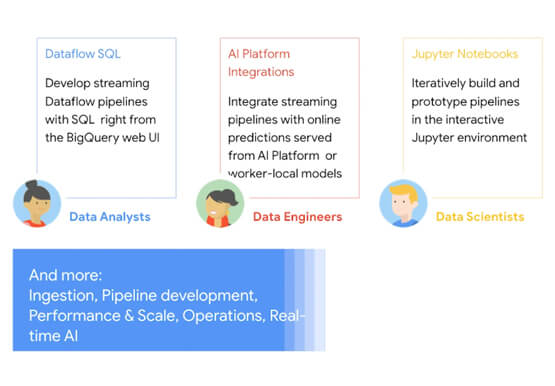
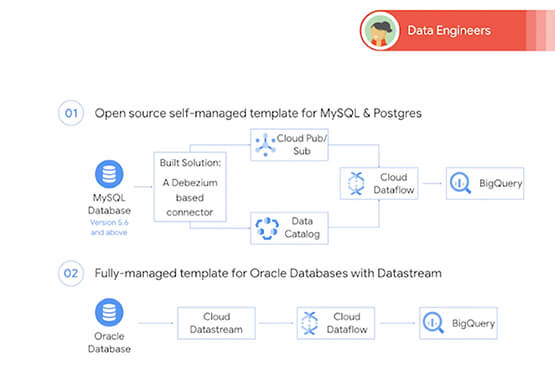

Easy Access to Stream Analytics with Google Cloud
By 2025, more than a quarter of the data created in the global datasphere will be real-time in nature. “This is important because in the real-time world, “the window of opportunity diminishes and goes away really fast. You want to be able to respond to your customer needs, their asks,

Discover Gen App Builder: Transform Search and Conversational Experiences Through Generative AI
If you’ve been exploring recently-launched consumer generative AI tools like Bard and thinking about how to build similar experiences for your business, Generative AI App Builder, or Gen App Builder for short, is here to get you started.Gen App Builder is part of Google Cloud’s recently announced generative AI offerings and lets developers,

NLP in Healthcare Can Unlock Clinical Insights beyond Typical Data Format Barriers
Aches and pains. What, if anything, is the difference between those? And do you know a “myocardial infarction” from a “heart attack”? What about an “MI”? Is that shorthand, or part of the address of a hospital in Michigan? For people, it can be easy to understand the distinctions and

Everything You Want to Know About Google Cloud’s AI-Enabled Talent Solution: From What It Is to How to Use it
First, What is Google Cloud Talent Solution? Cloud Talent Solution is a service that brings machine learning to the job search experience, returning high quality results to job seekers far beyond the limitations of typical keyword-based methods. Once integrated with your job content, Cloud Talent Solution automatically detects and infers
