





Everything You Want to Know About Google Cloud’s AI-Enabled Talent Solution: From What It Is to How to Use it

3541
Of your peers have already read this article.
6:30 Minutes
The most insightful time you'll spend today!
First, What is Google Cloud Talent Solution?
Cloud Talent Solution is a service that brings machine learning to the job search experience, returning high quality results to job seekers far beyond the limitations of typical keyword-based methods. Once integrated with your job content, Cloud Talent Solution automatically detects and infers various kinds of data, such as related titles, seniority, and industry.
Show Me How it Works
Try it online now.
Show Me an Example of Who’s Using It
There’s a number of enterprises leveraging this service. Here are a few easy-to-watch examples
Watch how FedEx Ground Employs Google Cloud Talent Solution
Read how Johnson & Johnson is Reimagining Recruiting with Jibe and Google
How Much Does it Cost?
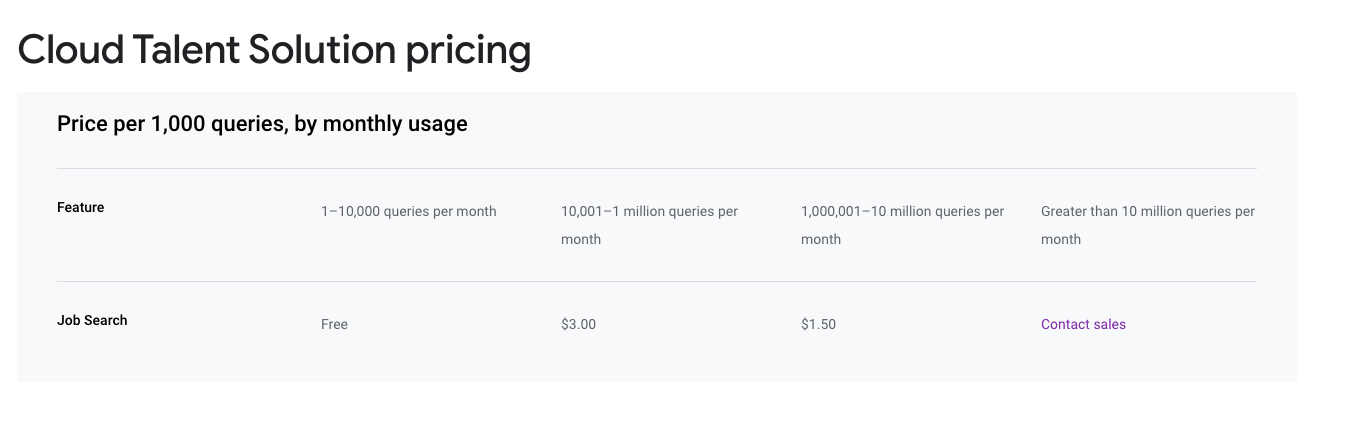
Ok, Let’s See How it Works
How Generative AI is Reshaping the Telecom Sector

1124
Of your peers have already read this article.
5:30 Minutes
The most insightful time you'll spend today!
Communication service providers (CSPs) are at an inflection point. From stagnating revenues, to network strain in meeting the demands of 5G, to challenges in delivering innovative customer experiences, there’s enormous pressure on the telecommunications industry to transform.
Over the past few years, CSPs around the globe have turned to artificial intelligence (AI) to address some of these challenges, but the lion’s share of an operator’s operational expenses are still spent on infrastructure and data management. This has limited their ability to capitalize on core data assets and develop differentiated customer experiences that meet individual needs.
Enter generative AI, a type of machine intelligence that’s received enormous attention as of late. We’ve all marveled over its ability to generate text that reads like it was written by a person, to create new images, and to build even musical scores. It’s a riveting addition to the AI toolset — and one that complements machine learning (ML) and its ability to identify patterns to make predictions, spot efficiencies, or interpret large data sets.
But while there’s a lot of hype around generative AI, at Google Cloud we view it through a much more practical lens for the telecommunications industry. Generative AI can accelerate the transformation already underway, with its potential to streamline many of the tools and processes that CSPs engage with daily, bringing a new level of natural interaction between people and computers, and enabling machines to be programmed to carry out an action with a spoken request, and respond in natural, interactive ways.
Generative AI builds on existing Google Cloud data, AI, and ML services. For example, Contact Center AI, with human-like interactions between callers and computers, has been successfully adopted by CSPs for many years, increasing the satisfaction of both customers and call center workers. As we add generative AI to this technology, CSPs and their customers will see even greater capabilities and impact, for example, virtual agents that not only provide helpful information, but also let customers make payments and execute other transactions. With generative AI, CSPs will be able to harness customer call summaries to better understand customer sentiment and identify cross-sell and up-sell opportunities. CSPs could also easily and quickly build and deploy virtual agents informed by customer conversations that enable more innovative and personalized customer interactions. And that’s just the start.
Three key areas
The contact center is just one of the areas where practical and generative AI will help drive new value. When reflecting on the key challenges facing CSPs today, three areas in particular stand out where generative AI may be transformative:
- Personalized experiences: In addition to further improvements in customer call center interactions, generative AI can deliver improved personalization in ecommerce interactions — a big factor in helping customers sort through their choices of phones and calling plans. Personalization is also important for lowering churn, offering relevant new services, and managing the customer lifecycle. For example, generative AI could enable CSPs to produce marketing campaign content customized for select themes, and target individual customers with customized text and images.
- Autonomous networks: Generative AI will also help to pave the way for autonomous networks by connecting multiple complex AI/ML models used across network planning and operations with large language models (LLMs) that can understand network behaviors and create action plans in areas including network capacity planning and performance. For example, generative AI will enable CSPs to train models with customer experience and sentiment data to build better prediction capabilities. Importantly, the customer data sets used to tune these models are not public, but curated internal customer data — significantly enhancing privacy, factuality, and relevance, while protecting intellectual property. In addition, generative AI will be able to help network planning and design, which requires high levels of reporting and analysis.
- Streamlined operations: Both operations center uptime and field service efficiency are crucial for managing costs and improving customer satisfaction. In particular, applying generative AI to field service devices can speed up diagnostics and analysis, and can even help with installation, parts, and troubleshooting, and minimizing the number of times companies have to send out trucks and improve field-service training. Generative AI will also provide a productivity boost to IT development processes, enabling code generation and troubleshooting to deliver reliable software products and services.
Data security and reliability
An under-discussed area in generative AI is the importance of data quality and data security in building and training the LLMs that power the technology. Many CSPs are rightly concerned about intellectual property leaking both into and out of LLMs, risking the security of their systems and their intellectual property. We’ve long offered industry-leading data security and privacy technologies, and with generative AI integrated with Vertex AI, we can ensure all data is secured within the CSP’s environment.
Meanwhile, to ensure that their LLMs generate accurate information, CSPs are building out scenarios and use cases for training on smaller, controlled amounts of their own data, sometimes accompanied by highly trusted sources from partners and others. Google Cloud also provides tools including Prompt Engineering, Tuning, and Reinforcement Learning from Human Feedback to further ensure data factuality and reliability. This will likely result in the first generative AI applications targeted to smaller, high-impact problems, like optimizing network topologies.
The human element
Of course, people are critical to the success of generative AI, whether that means solving problems in call centers, field service workers combining AI information with their own knowhow, marketing and creative teams brainstorming with generative AI to make new presentations and marketing materials, or operations engineers augmenting and approving an AI suggestion. We’ve built a lot of amazing technology to help augment what people cannot do: synthesize millions, if not billions, of records and sources to help energize new workflows and productivity.
Telecommunications is a fast-changing industry that is tech savvy and hungry to learn and deploy the best possible new technologies, and that includes generative AI. Each meeting with a CSP inspires new ideas, sparks more use cases, and leads to more industry-changing initiatives. It’s exciting to see this pace of change, and we are only just getting started.
We look forward to showing you more soon as we deep dive into some of the exciting CSP industry use cases in upcoming blog posts. We also invite you to find out more about how Google Cloud is partnering with CSPs around the world to deliver a holistic cloud transformation.
5774
Of your peers have already watched this video.
4:50 Minutes
The most insightful time you'll spend today!
Google had Enough of Flooding in India. Here’s What It Did About It
Over the last century, floods have become the most common and deadly natural disaster on the planet.
Many countries currently lack effective early warning systems and alerts. Today, 20 percent of flood fatalities occur in India.
To help, Google sent a team to study the Ghaghara River, near Patna.
“In India, where we’re running our first pilot program, the government has thousands of people who measure water levels, every hour, in rivers across India, with what is effectively very long measuring sticks. They are called stream gauges. This allows them to know whether the river will overflow and flood. But it doesn’t yet allow them to understand exactly what areas are going to be affected, what neighborhoods, or even what villages,” says Sella Nevo, Tech Lead, Google Flood Forecasting.
“The big technical question was: Do we have enough information to try to do forecasting that would be accurate enough to make a difference?” says Yossi Matias, VP of Engineering and Crisis Response Lead, Google.
This is their incredible story. It includes collecting thousands of satellite images and generating hundreds of thousands of simulations of how a river could possibly behave.
4413
Of your peers have already watched this video.
31:30 Minutes
The most insightful time you'll spend today!
Smart analytics: Deep dive on roadmap
Data across organizations is growing and that organizations need a very strong analytics platform to leverage this data create insights and make real-time decisions on top of this data.
That’s driving the advent of three large trends. First is the convergence of data lakes and data warehouses, that’s enable organizations to maximize the value of their data.
Second, is the growing phenomena of real-time decision-making which is forcing enterprises to think of how they can support the needs of batch processing and streaming data.
Finally, there is the rise of artificial intelligence and machine learning, which allows enterprises to leverage their data and create competitive differentiation.
With this background, Sudhir Hasbe, Director of Product Management, Data Analytics, Google Cloud, walks us through Google Cloud’s smart analytics offerings—and what’s new.
He takes us on a tour through the technical value of Google Cloud’s smart analytics platform end-to-end. He provides a comprehensive overview and demos what’s new and what’s next in Google Cloud’s smart analytics portfolio across products like BigQuery, Dataflow, Dataproc, Data Fusion, PubSub, Data Catalog, Dataprep, and Looker.

ESG Report: Economic Advantages of Google BigQuery OnDemand Serverless Analytics
DOWNLOAD WHITEPAPER5899
Of your peers have already downloaded this article
10:30 Minutes
The most insightful time you'll spend today!
Traditional big data solutions require a significant upfront investment, ongoing maintenance of hardware and software, and manual provisioning to match compute and storage resources with demand. Google’s serverless analytics warehouse does away with all that extra work, helping businesses focus on what matters most: getting value from their data.
Enterprise Strategy Group (ESG), which examined the economic value propositions of Google BigQuery and alternative big data solutions, reports that BigQuery enables organizations to:
- Save up to 88 percent on data warehousing over a three-year period
- Achieve a faster time to value by getting up and running quickly
- Empower more employees to become citizen data scientists
Eliminate maintenance tasks so teams can spend more time gaining insights
Download the complete report to learn more.
Smooth AI Adoption for Companies involves Three Principled Phases!

4086
Of your peers have already read this article.
4:00 Minutes
The most insightful time you'll spend today!
Business leaders see much in Artificial Intelligence, including new ways to save money, serve customers, and figure out what to build. What’s often tougher is deciding how to engage. That’s understandable, since getting into AI often raises questions about costs, data integrity, project length, and similar issues of planning and execution.
For CIOs concerned with the deployment and use of IT at their companies, these are critical issues. Here is one way to think about this complexity, by breaking it down into three different areas; Early Automation, Learning and working, and System Views.
First, a bit of good news and myth dispelling for readers who think AI is some far off promise, still in the labs and not safe for work. The reality is that AI is very much here, and almost everyone in your workplace is using it every day. People work with AI when they use Google Search, Photos, the autocomplete feature in Docs, live translation in Pixel phones, and many other areas. It is in the products of many other companies too.
“IDC reports that the market for AI software, hardware and services is expected to break the $500 billion mark in 2023.”
Additionally, it’s increasingly clear that AI can be adapted as a virtuous process, not just a one-off purchase (though there is much to recommend that.) During a recent Alphabet earnings call, CEO Sundar Pichai noted that “investments in AI will be key” to its near-term strategy, with new techniques that make it faster and easier to train and build AI for a number of uses. Additionally, the company is offering AI-driven “insights, new tools, and automation” to its advertising clients. The striking thing in this was the way that developing AI in one area could lead to growth in many others.
So, how does an IT leader foster a growth process like this for their stakeholders? By leading people through the well-established stages of Awareness, Learning, and Extension. Here’s what I mean.
Awareness: Early Automation
Consumer-facing AI is particularly strong in communications functions like voice recognition, translation, and writing tips. It’s similar in business uses: One of the most effective early instances of AI in the workplace has been Contact Center AI (CCAI), which manages basic customer communications, automatically answering common questions and prioritizing calls that require human assistance. It is doing what automation has always done best, automating the rote stuff and leaving the higher-value imaginative activity to people. It has been used by governments, retailers, telecommunications companies, and others, in a wide variety of use cases.
These and similar language-centric products, like DocAI for extracting information from things like invoices, receipts, or AI that extracts information from business contracts, have a number of benefits. For one, the investment is relatively easy to control, unlike with a research project leading to a formal launch. The payoff is also clearer. In the case of contact centers, in particular, the automation relieves stress, wins loyalty and slows disaffection in a high-turnover area. In both cases, successful results build allies in the business, who can testify to the earlier benefits when it’s time to take on something more complex.
Perhaps best of all, creating interest in basic AI services for business, right now, means people become engaged in learning more, since they see the early benefits and wonder what else might be done.
Learning: The Human Factor
The Natural Language Processing (NLP) that goes into these ready made, “out of the box” AI products can, not surprisingly, be used on much more sophisticated levels. Twitter, for example, processes 400 billion different events in real time, and its staff queries this trove using advanced NLP, answering questions and improving customer experiences.
There is clearly an enormous gap between Call Center AI and processing Twitter’s 400 billion events per day, but it’s not noticed enough how quickly that gap is closing. Look at how many products, partners, and training resources have emerged in the past few years. The gap makes sense, insofar as both the means of AI (like large data sets, good algorithms, and sufficient computing) and the value of AI, are new.
Increasingly, as AI is incorporated into standard enterprise tools like spreadsheets and analytic tools, easier to use AI becomes a skill within reach for many (even as the advanced end becomes more complex, meaning this ease of use process will continue for some time.)
It’s so new that AI skills demand isn’t met by conventional education means, creating lots of good opportunities for both nonstandard skills training, and in-house learning in the workforce. Companies offering AI skills training could well gain a competitive advantage and retain staff better.
Extension: Building System Views
When a new technology lands and gains in popularity, people seek to find new uses for it, or build connections among its different uses. Networked computing is one example, but think also of the way cars were soon followed by trucks and fire engines, or the way the data services on wireless phones soon morphed into the App Economy. If something is useful, people look for ways to grow it.
How will AI grow? My colleague Dominik Wee recently wrote about ways that AI will soon change supply chains, change product design, and improve sustainability. Most interestingly, he talked about how customers in manufacturing were realizing savings and gaining insights when once separate quality control data was combined with system wide views of the quality process.
There are several reasons to think AI will promote many such system views. For one thing, successful AI promotes the collection of data from more places, at greater frequency, since that leads to insight (and the cost of data collection is dropping.) Additionally, AI is good at spotting patterns and interactions that are not currently known. As well, AI is used in prediction and scenario planning, which leads to better understanding of how large-scale systems interact.
This comes at a time when we have more ways of seeing the world, from satellites, sensors, social media, and much more. We have more awareness of interactions, and a demand to understand them, in everything from the supply chain crisis, to human rights and sourcing regulations, or in the business realities of partnering, and serving customers in all sorts of ways, online and in the physical world.
Whether by coincidence or design, the Age of AI is also an age when organizations see themselves more accurately with a rich web of connections, with their choices and actions having more resonance than ever. That awareness is both a competitive tool, and a call to greater responsibility, potentially affording more customer loyalty and a more satisfied workforce for those who get it right.
That transformation won’t happen everywhere overnight, but it seems to be happening at all sorts of companies. And the trend for AI to assist, to be studied and grown, and to provide a richer understanding of the world, is happening every time someone touches this technology, at whatever level they need.
More Relevant Stories for Your Company

The Future of Language Processing: Google Cloud’s Enhanced NLP Models
Natural language understanding (NLU) is getting increasingly better at solving complex problems and these language breakthroughs are creating big waves in Artificial Intelligence. For example, new language models are enabling Everyday Robots to create more helpful robots that can break down user instructions and have even enabled people to generate imaginative visuals from

Google Cloud’s AI Adoption Framework
Companies everywhere are seeking to leverage the power of AI. And rightly so. The smart applications of AI enable organizations to improve, to scale, and to accelerate the decision-making process across most business functions, so as to work both more efficiently and more effectively. It can also open up new

Google AppSheet Leads the Low-code Development Platform Market for Business Developers: Forrester
We’re excited to share the news that leading global research and advisory firm Forrester Research has named Google AppSheet a Leader in the recently released report The Forrester Wave™: Low-code Platforms for Business Developers, Q4 2021. It’s our treasured community of business developers—those closest to the challenges that line-of-business apps can

How TapClicks’ Google Cloud Migration Makes Life Easy for Marketers
Editor’s note: In this blog post we learn how TapClicks migrated to Google Cloud to offer their marketing customers a unified platform for data management, operations, insights, and analysis. TapClicks is a smart marketing cloud, powered by data, that unifies our customer’s marketing. By choosing to migrate our core applications last
