





If You Don’t Have These Features in Your Cloud, You’re Missing the Mark on Security

3300
Of your peers have already read this article.
6:00 Minutes
The most insightful time you'll spend today!
At Google Cloud, we work tirelessly to give our customers increased levels of control and visibility over their data. We’ve come out with new capabilities for data encryption, network security, security analytics, and user protection designed to deliver on that promise.
External Key Manager: Store and manage encryption keys outside of Google Cloud
We give enterprises a broad range of encryption options so you can appropriately balance risk, control, security, and operational complexity when protecting your cloud workloads.
Google Cloud encrypts customer data at-rest by default and offers customers multiple options to control and manage their encryption keys. Today, we’re pleased to announce the next level of control with our new External Key Manager. Coming soon to beta, External Key Manager works with Cloud KMS and lets you encrypt data in BigQuery and Compute Engine with encryption keys stored and managed in a third-party key management system deployed outside Google’s infrastructure. External Key Manager allows you to maintain separation between your data at-rest and your encryption keys while still leveraging the power of cloud for compute and analytics.
To make this new service easy to implement, we are working with five industry-leading key management vendors: Equinix, Fortanix, Ionic, Thales and Unbound.
Key Access Justifications: Decide when and why your data can be decrypted
We believe that trust in the cloud is created through transparency. Google Cloud led the industry in providing meaningful transparency into provider access to customer data, and now we’re extending that transparency to use of encryption keys. Key Access Justifications is a new feature that will work with External Key Manager. It provides a detailed justification each time one of your keys is requested to decrypt data, along with a mechanism for you to explicitly approve or deny providing the key using an automated policy that you set.
Using External Key Manager and Key Access Justifications together, you can deny Google the ability to decrypt your data for any reason. As a result, you are the ultimate arbiter of access to your data–a level of control not available from any other cloud provider. Key Access Justifications is coming soon to alpha for BigQuery, and Compute Engine/Persistent Disk and covers the transition from data-at-rest to data-in-use. Customers interested in becoming early adopters can sign up here.
These new encryption innovations complement other recently released encryption options:
- Customer-managed encryption keys for Cloud SQL, now generally available (GA)
- Customer managed encryption keys for GKE persistent disks, a beta feature for Google Kubernetes Engine (GKE)
- Application layer secrets encryption in GKE, a GA feature which enables envelope encryption for your Kubernetes secrets
- Key import for Cloud HSM, a GA feature which lets users generate and use their own keys with Google Cloud’s managed HSM service
- Cloud HSM availability in all Google Cloud regions and multi-regions (with the exception of global multi-region)
All these updates offer you more control over how your data is protected.
Defend against internet threats
When you stand up applications on Google Cloud, you benefit from DDoS and web attack protection at Google scale. Google Cloud Armor works with our global Cloud Load Balancing infrastructure and provides always-on attack detection and mitigation so you can run your business without interruption.
Today, we’re pleased to announce the beta of Cloud Armor’s new web application firewall (WAF) capabilities to help protect applications against targeted and distributed internet threats. You can now configure Cloud Armor policies with geo-based access controls, pre-configured WAF application protection rules to mitigate OWASP Top 10 risks, and a custom rules language to create custom Layer-7 filtering policies.
Cloud Armor also now integrates with Cloud Security Command Center (Cloud SCC), notifying customers of suspicious application traffic patterns directly in the Cloud SCC dashboard.
Collect and inspect network traffic at scale
As networks grow in complexity, monitoring traffic helps you manage performance and security. In public cloud environments however, capturing network traffic reliably at scale for monitoring has been a challenge.
Our new Packet Mirroring service, now in beta, allows you to collect and inspect network traffic for Compute Engine and GKE; it’s available for all machine types in all of our regions. With this service, you can use third-party tools to more proactively detect threats, better respond to intrusions with signature-based attack detection, and better identify zero-day attacks with anomaly detection. For more, watch this video.
We’ve built an ecosystem of partners so you can use Packet Mirroring with third-party tools of your choice, including products from Awake Security, Check Point, Cisco, Corelight, cPacket Networks, ExtraHop Networks, Flowmon, Ixia by Keysight, Netscout, and Palo Alto Networks.
Protect G Suite and Cloud Identity users
Google’s Advanced Protection Program is our strongest protection for users at risk of targeted attacks. In the enterprise, this includes IT administrators and executives. Today, the Advanced Protection Program is starting to roll out to G Suite and Cloud Identity customers. With the Advanced Protection Program for the enterprise, we’ll enforce a specific set of policies for enrolled users including security key enforcement, blocking access to untrusted apps and enhanced scanning for email threats. Learn more.
We’re also introducing app access control, helping you reduce the risk of data loss by limiting access to G Suite APIs to third-party apps you trust. You can also more easily manage and restrict which Google APIs are available for use by third-party and customer-owned apps, and see which apps are verified by Google. Learn more.
Benefit from unique Google threat intelligence in Cloud Security Command Center
We continue to build products that help our customers benefit from the techniques we’ve developed to defend Google. Whether you are using Cloud Security Command Center to improve your security posture on GCP, or Chronicle Backstory to monitor your data on premise or in other clouds, we’re packaging threat detection and prevention capabilities that are available only from Google, and giving them to you.
Event Threat Detection, now in beta, helps you detect threats targeting your cloud resources using logs, so you can send incidents to your SIEM (Security Information and Event Management system) for further investigation. Event Threat Detection relies on Google threat intelligence to help you spot and stop threats before they result in business damage or loss.
Security Health Analytics helps you prevent incidents by identifying potential misconfigurations and compliance violations in your GCP resources and suggesting appropriate corrective action.
As we continue to innovate and simplify security management on GCP, Event Threat Detection and Security Health Analytics will be bundled in a Premium Edition of Cloud Security Command Center with other new capabilities that help you meet industry compliance requirements, catch web application vulnerabilities, detect compromised VMs, and discover other threats. The Premium Edition will give you a comprehensive, easy-to-deploy set of tools to protect your cloud resources. To learn more about how to use Cloud Security Command Center, check out our recent video series.
Chronicle: security analytics wherever your apps are deployed
Chronicle’s Backstory product was designed by former Google security professionals to enable anyone to use the types of techniques we use to detect threats and investigate security incidents. It brings world-class strengths in data analytics to your security data, privately and easily.
Many organizations leverage a mix of on-prem environments and multiple clouds to run their applications, making it difficult to collect and store security telemetry from various systems and tie individual events together for analysis. Backstory, our flagship offering for hybrid security analytics, offers you this level of intelligence. With just a few clicks, in minutes, you can aggregate and analyze your security telemetry wherever your apps may run, and where they might run in the future.
4 Cloud Security Trends to Watch Out for in 2022

3383
Of your peers have already read this article.
1:30 Minutes
The most insightful time you'll spend today!
When it comes to cloud security, 2022 will be the year that the past catches up with the future. Trends that businesses have been ignoring for too long will force organizations large and small to confront and control their security debt.
That’s according to Google Cloud’s own cybersecurity experts, who have identified four security trends that organizations need to watch out for—and get ahead of. We have predictions on what to expect in the coming year from MK Palmore, director of the Office of the CISO; Brian Roddy, vice president of engineering for Cloud Security; Tim Dierks, engineering director for data protection; and Panos Mavrommatis and Vikram Makhija, senior directors of security engineering for Google Cloud.
Supply chain shenanigans
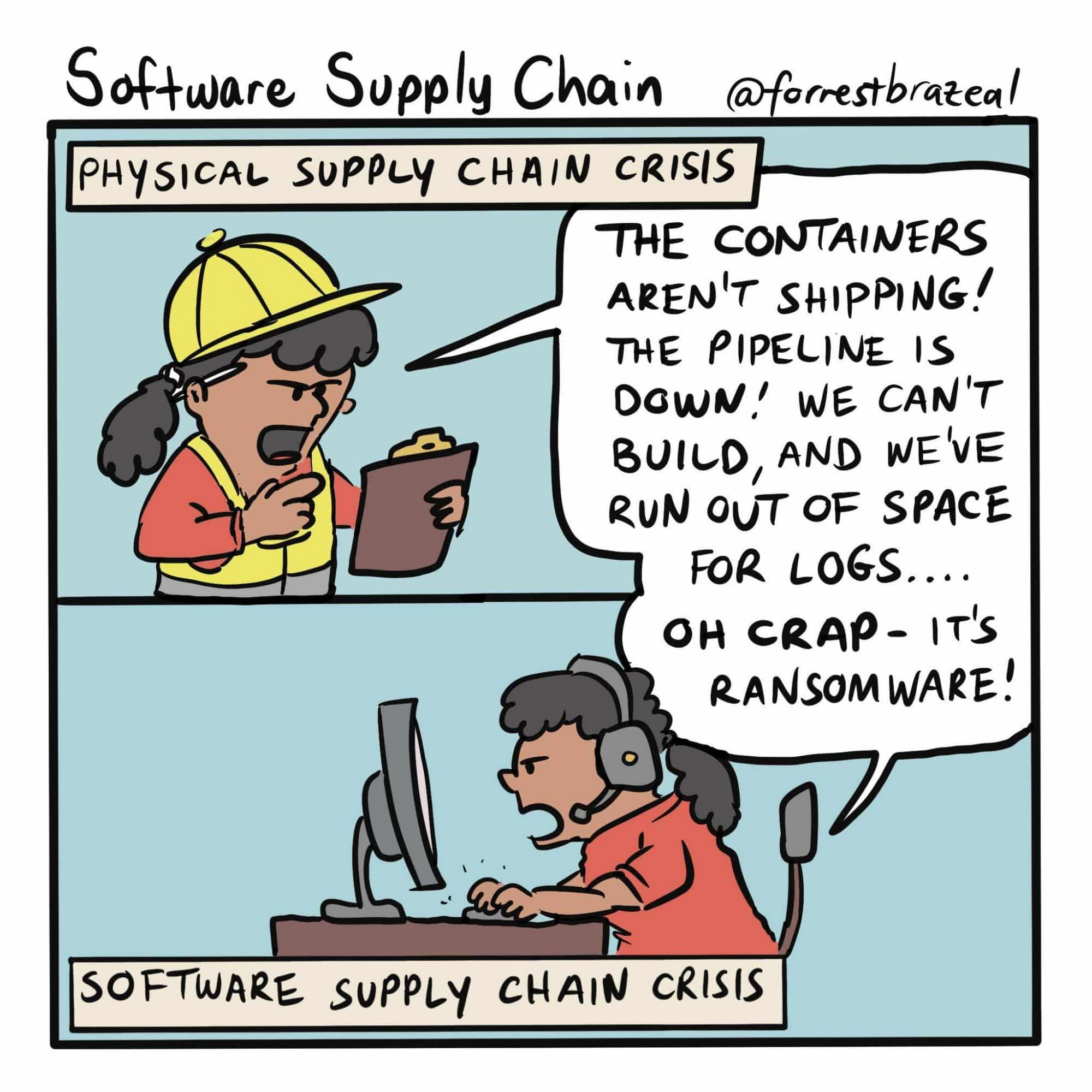
“We will see continued asymmetric attacks from adversaries as they exploit supply chains and other previously ‘trusted’ third-party entities,” says Palmore.
Supply-chain problems in cloud computing should be easily solvable, right? Software versions and any vulnerabilities they contain should be trackable and patchable, but the reality of fixing software is that “just patch it” is hard to execute—just look at the challenges posed by the Log4j 2 vulnerability. Supply chain is such a huge problem that President Biden addressed it in an Executive Order in May 2021. Customers can expect the issue to be top of mind at Google Cloud.
Not exactly many happy returns (to the office)
“Return to office around the world will drive changes as office infrastructure has not been invested in for a year and a half while the focus has been on remote users. This likely will drive a short-term boom in traditional on-prem security, but it will be the last boom for that as people adapt their remote, zero-trust style strategies to a more modern on-prem approach,” says Roddy.
The misconception that on-prem infrastructure is categorically more secure than cloud is driven by the desire to have physical access to servers and backups so that only the organization which owns the data controls it and has access to it, even in cases of a catastrophic failure or successful cyberattack. In the early years of cloud computing, that may even have been true. But the conditions that drove the myth of on-prem security primacy changed years ago, and the needs driving secure cloud infrastructure help ensure that cloud stays more secure.
Paying down your security debt
“While there’s all the new hotness of cutting-edge concerns, many enterprises still carry security risks and security debt from not yet fully adopting controls which have been broadly accepted as important for years. For example, loads of companies are still not using phishing-resistant two-factor authentication such as FIDO keys,” says Dierks.
Authentication keys such as those made by Yubico and Google’s own Titan Security key support the zero-trust security principles that require user identities to be authenticated, authorized, and then continuously validated before they can access applications and data. Strong authentication is such an important part of contemporary user security that even weaker forms of it that rely on text messages are significantly more secure than not using it at all. That said, why use a less-secure standard when you can reduce risks to your data and bottom line even further by requiring a phishing-resistant hardware key?
Dierks stresses another challenging but important part of eliminating security debt: using social connections to encourage best security practices. “It’s important for CISOs to use their business relationships to emphasize the importance of baseline controls [such as 2FA] for their partners. Enterprises have close relationships that attackers can leverage, so it’s critical that partners hold each other accountable to maintain high security.”
KYD (Know Your Data)
The impact of a data breach can harm organizations as they currently are as well as far into the future. Current tough-to-crack encryption standards protecting data could become easier to decode in the years ahead, so even if cybercriminals can’t access stolen data now there’s no guarantee that paradigm will hold. This means it’s crucially important that organizations understand what data they’re storing, how they’re storing it, and where they’re storing it, say Mavrommatis and Makhija.
“You can’t secure what you don’t know about, and not all data breaches are equal. Stolen machine logs are not as bad as customer data. But how many security teams know the difference? So you have to crawl your own data to automatically classify and discover where sensitive data lives,” they say.
Makhija adds that the shared fate model requires the cloud providers and cloud customers to have a mutual understanding of the quantitative risks each faces. “Shared fate models will pick up significantly in 2022,” he says, as more organizations move to the cloud, and those already using cloud infrastructure improve their security postures.
“To date, there’s been a disparate set of tools for understanding your posture. It’s difficult for third-party tools to stitch together what cloud services should be providing from the start,” he says.
What you can do to make your organization more secure
One cloud security trend that’s ever-present is the ever-increasing importance of keeping cloud deployments secure. As cloud infrastructure becomes more commonplace across businesses and industries of all sizes, it will continue to grow as an attractive target for cybercriminals and other threat actors.
- Because enterprise data has expanded exponentially, the ability to identify and detect threats have become increasingly challenging. To better secure the enterprise software supply chain, use advanced threat detection and analysis tools—especially those designed to catch anomalies.
- The faster that organizations adopt a zero-trust architecture, the more secure the new normal can be. Zero trust helps limit the blast radius of any potential intrusion, while maximizing new enterprise access expectations. Part of adopting zero trust means many end-users can abandon legacy technology like VPNs, but the benefits of segmentation and context-aware access for both identity and device will make all the difference for large scale enterprises. When coupled with a full zero-trust approach and the use of a zero-trust maturity model for improvement, organizations will be better positioned to manage their digital risks.
- Security debt can come in many forms and one critical payoff that needs to be made is for organizations to migrate en masse to hardware two-factor authentication keys. They make user accounts significantly more resistant to takeovers, and are much harder to circumvent than two-factor authentication over SMS.
- It’s past time to get to know your data, and a bouquet of flowers and a bottle of red wine won’t help. There are third-party tools that can do this, but for Google Cloud customers who use BigQuery there’s automatic Data Loss Prevention. It continuously monitors existing tables and profiles new ones; it can be customized for selected folders or projects, or for an entire organization; and it generates data profiles in the same geographic region as the original data.
Understanding and managing the security challenges of cloud infrastructure helps maximize its benefits, and makes for a safer security landscape in 2022—and beyond.
5 ways a SOAR solution improves SOC analyst onboarding

3034
Of your peers have already read this article.
2:30 Minutes
The most insightful time you'll spend today!
Editor’s note: This blog was originally published by Siemplify on Feb. 19, 2021.
The number of unfilled cybersecurity jobs stretches into the millions, and a critical part of the problem is the length of time it takes to backfill a position.
Industry group ISACA has found that the average cybersecurity position lies vacant for up to six months. Some positions, like security analyst, are difficult to find suitable candidates for thanks to workplace challenges such as lack of management support and burnout.
As the old phrase goes, time is money. So when organizations are fortunate enough to fill a position with the appropriate talent, they want to be able to make up for lost time as quickly as possible. This is especially true for roles in the security operations center, a setting notorious for needing staff to field never-ending alerts generated by an often-disparate collection of security tools.
Training new analysts can be a daunting task. They need time to get acquainted with the SOC’s technology stack and processes. Without documentation, they often ask senior analysts for guidance. This can create distractions and consume time.
A reliance on community knowledge—undocumented, not widely-known information within an organization—creates inconsistency within the SOC that contributes to longer ramp-up times for new analysts. Undocumented processes, combined with security tools that don’t talk to each other, typically mean a SOC will need to spend nearly 100 hours—the equivalent of 2 1/2 weeks—getting a single new analyst up to speed.
Enter automation. Throughout an analyst’s career in the SOC, a security orchestration, automation, and response (SOAR) solution can be their best friend, helping expedite routine tasks and liberating them to perform more exciting work. But the technology can also allow even the most junior analysts to have an auspicious onboarding experience—hitting the ground running on day one, acclimated to their new environment, and feeling comfortable about and confident in their future.
Here are five ways a SOAR solution can, among many other activities, aid in analyst onboarding
1) The SOAR solution deploys automated playbooks
The average SOC receives large numbers of alerts per day, and many will be false positives. That amounts to a lot of dead-ends for analysts to chase and leaves little time to investigate legitimate anomalous network activity. The sheer volume of alerts has even prompted some analysts to turn off high-alert features on detection tools, potentially causing teams to miss something important.
SOAR helps analysts hurdle these roadblocks by allowing teams to create custom, automated playbooks, workflows that equalize resources and knowledge across the SOC, and help maintain consistency in the face of new hires and staff turnover. And if analysts should need to create or edit any of the steps in these playbooks, the optimal SOAR solution will enable them to do this without knowledge of specific coding or query languages, acumen that a novice analyst may lack.
2) The SOAR solution groups related alerts
As multiple alerts from different security tools are generated, some SOAR solutions allow you to automatically consolidate and group these alerts into one cohesive interface. This is what is known as taking a threat-centric approach to investigations, with the SOAR looking for contextual relationships in the alerts and, if identified, grouping these alerts into a single case. Having the ability to work more manageable and focused cases right off the bat will help ensure a smoother transition for new analysts.
3) The SOAR solution pieces together the security stack
https://www.siemplify.co/getstartedFrom next-generation firewalls to SIEM to endpoint detection and response, the security stack in any given organization can be vast and complex. No incoming analyst has reasonable time to familiarize themselves with every tool living within the stack—or to manually tap into these different tools to obtain the appropriate context to apply to alerts. A SOAR solution alleviates this challenge by delivering context-rich data that can be analyzed in one central platform, eliminating the need for multiple consoles for alert triage, investigation and remediation. Plus, with a SOAR solution, there is no need for the SOC to directly touch a detection tool that another group may manage.
4) The SOAR solution streamlines collaboration to enable easy escalation and information sharing
Often the SOC is not capable of responding to every threat, meaning other departments, such as networking, critical ops, or change management need to be involved. In addition, executive personnel are likely interested in security trends happening within the organization. Because not every group communicates in the same way—or consumes information in the same way—breakdowns can occur, and frustrations can mount, especially for a new analyst. A SOAR solution can even the playing field by automatically generating instructions, updates, or reports from the SOC to other teams, and vice versa. SOAR is also a useful solution for collaborating within the SOC team as well, especially in the age of remote and hybrid work.
5) The SOAR solution prevents analysts from quickly burning out.
There is a reason why the SOC has obtained the dubious acronym of “sleeping on chair.” Life in this environment can be a tedious, mental grind, prompting certain inhabitants to literally fall asleep from boredom.
SOAR solutions can counter this tedium in two notable ways. They can prevent analysts from having to stare at a multitude of monitors while working long shifts. They can also free analysts to work on more strategic and thought-provoking assignments, which can help improve the company’s overall security posture—and ensure a new entrant to the SOC doesn’t lose steam immediately.
To learn more about SOAR from Siemplify, now part of Google Cloud SecOps suite, including how to download the free community edition, visit siemplify.co/GetStarted.
Security Talks: Addressing the Toughest SOC Challenges with SolarWinds, Chrome, Zero Trust, and More

2519
Of your peers have already read this article.
1:30 Minutes
The most insightful time you'll spend today!
Security operations teams are facing a “perfect storm” of challenges from nation-state actors turning their attention to financial crime, to rising uncertainty and potential complexities because of rapidly advancing cloud migration and IoT adoption, to the long-lamented skills shortage.
Now imagine having to face this trifecta without visibility into your IT and security infrastructure because scale and cost concerns have impeded your ability to ingest and monitor critical telemetry. To help organizations rethink threat detection and broader security team efforts, we showcased at this month’s Google Cloud Security Talks a keynote on why DEI is a cybersecurity imperative, Mandiant’s review of lessons for organizations two years after SolarWinds, how Google Chrome already helps protect your business (and what more you can make do with it,) how best to encourage your organization to pursue Zero Trust, and three key ways in which Chronicle Security Operations can help your organization scale threat detection and actionable outcomes. These include:
1. Operationalizing threat intelligence
Harnessing the power of threat intelligence to acquire context, prioritize risk, and act on detections requires more than just ingesting a set of indicator of compromise (IOC) feeds. Threat intelligence must have breadth and depth of coverage to provide custom details on the tools, tactics, and procedures of threat actors. Explore why part of the “magic” behind Google Cloud’s security is the sheer scale of threat intelligence we can share with our customers.
2. Driving detection as code
We want to enable organizations that are more advanced in their cybersecurity maturity to build their own custom detections and rules, which means offering our customers a powerful detection-authoring platform. Chronicle Security Operations can help analysts build specific detections around, for example, known bad files or a specific registry key change. We also demonstrated how to create more complex detections, such as flagging process execution patterns or crafting a suspicious-behavior trigger from a specific activity sequence.
3. Leveraging curated detections
With curated detections, which we announced in August, we are putting the power of Google Cloud’s intelligence in the hands of security operations teams everywhere. Our detections offer actionable, ready-to-use threat detection content curated, built, and maintained by Google Cloud Threat Intelligence (GCTI) researchers. These detection sets cover a wide variety of threats for your network and beyond, including attacks such as ransomware, remote-access tools (RAT), infostealers, data exfiltration, and suspicious activity.
You can watch all nine of our Security Talks recorded sessions here, and keep an eye out for our next Security Talks, coming in March 2023.
Towards Superior Cybersecurity: How SLSA and SBOM Help Build a Resilient Healthcare Industry

2943
Of your peers have already read this article.
3:30 Minutes
The most insightful time you'll spend today!
Taking prescription medication at the direction of anyone other than a trained physician is very risky—and the same could be said for selecting technology used to run a hospital, to manage a drug manufacturing facility and, increasingly, to treat a patient for a medical condition.
To pick the right medication, physicians need to carefully consider its ingredients, the therapeutic value they collectively provide, and the patient’s condition. Healthcare cybersecurity leaders similarly need to know what goes into the technology their organization’s use to manage patient medical records, manufacture compound drugs, and treat patients in order to keep them safe from cybersecurity threats.
Just like prescription medication, careful vetting and selection of the technology is required to ensure patient safety and establish visibility and awareness into the technology modern healthcare depends on to create a resilient healthcare system.
In this and our next blog, we focus on two topics critical to building resilience – software bill of materials (SBOM) and Google’s Supply chain Levels for Software Artifacts (SLSA) framework – and how to use them to make technology safe. Securing the software supply chain, or where the software we depend comes from, is a critical security priority for defenders and something Google is committed to helping organizations do.
Diving deeper into the technology we rely on
Cybersecurity priorities for securing healthcare systems usually focus only on protecting sensitive healthcare information, like Protected Health Information (PHI). Maintaining the privacy of patient records is an important objective and securing data and systems plays a big role in this regard.
Healthcare system leadership and other decision makers often depend on cybersecurity experts to select technologies and service providers that can meet regulatory rules for protecting data as a first (and sometimes only) priority. Trust is often placed on the reputations and compliance programs of the vendors who manufacture the technology they buy without much further inspection. Decision makers need to approach every key healthcare and life science technology or service provider choice as a high-risk, high-consequence decision, but few healthcare organizations have the skills, resources, and time to “go deep” in vetting the security built into the technology they buy before it enters a care setting.
Vetting needs to include penetrating analysis of all aspects of software and hardware, their architecture and engineering quality, the provenance of all parts that they’re made of, and assessing each component for risk. Doing this can sometimes require deep technical skills and advanced knowledge of medical equipment threats that may not be easy to acquire. Instead of making additional investments to help secure their networks and systems, many organizations choose simpler paths.
The failure to properly assess technological susceptibility to risk has exposed healthcare organizations and their patients to a variety of safety and security issues that may have been preventable. PTC (formerly Parametric Technology Corporation, which makes medical device software) disclosed seven vulnerabilities in March that impacted equipment used for robotic radiosurgery. In October 2019, the VxWorks Urgent 11 series of vulnerabilities was announced, affecting more than 1 billion connected devices, many used throughout healthcare and life sciences. More examples of medical devices and software found to have vulnerable components can be found on the FDAs cybersecurity website and in its recall database.
How a physician understands, selects, and prescribes medication parallels how we address these concerns when selecting technology. Recent FDA guidance suggests manufacturers must soon provide increased levels of visibility into the technologies they market and sell in the healthcare industry. Here’s where the SBOM, a key visibility mechanism, comes in.
What SBOMs do well, and how Google is helping make them better
The National Telecommunications and Information Administration defines the SBOM as a “nested inventory for software, a list of ingredients that make up software components.”
The concept of a SBOM appears to have found its start in enabling software makers back in the 1990s, although it originally stems from ideas popularized by visionary engineer and professor W. Edwards Deming. SBOM as a concept has advanced since then, with multiple standards for generating and sharing them now in use.
Thanks to the continued focus on improving and using SBOMs, we expect it will be much easier for defenders to use SBOMs to track software and its components, where they come from, what security vulnerabilities they contain, and equip protectors with their ability to stop those vulnerabilities from being exploited, at scale, and before they impact patient care.
“Software bills of materials help to bridge the knowledge gap created by running unknown, unpatched software and components as too many healthcare organizations currently do,” says Dan Walsh, chief information security officer at VillageMD, a tech-driven primary-care provider. “For security leaders, SBOM should be an extension of their asset inventory and management capability, regardless of whether that software was bought or built. At VillageMD, we are asking our vendors that store, transmit, receive or process PHI for an SBOM as part of our third-party vendor assessment program.”
Today’s SBOMs are most often basic text files generated by a software developer when the creation of software is complete and a product is assembled (or application is created from source code.) The text file contains information about the product’s software components and subcomponents, where those components and subcomponents came from, and who owns them. But unlike a recipe used to make a pharmaceutical, for example, an SBOM also tracks the software versions of components and subcomponents. SBOMs often capture:
- Supplier Name
- Component Name
- Version of the Component
- Other Unique Identifiers
- Dependency Relationship
- Author of SBOM Data
- Timestamp
Here’s the format of a SBOM generated using the SPDX v2.2.1 standard:
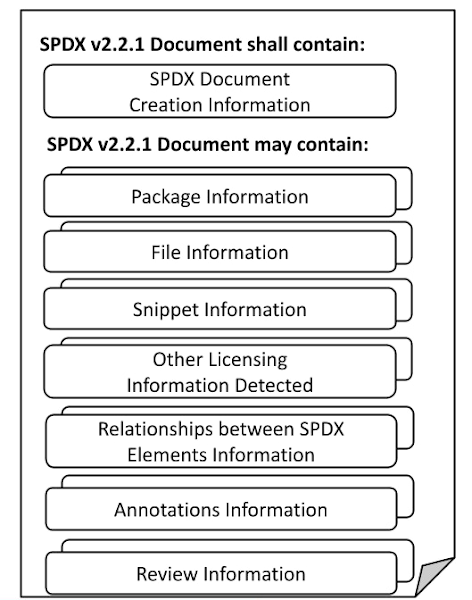
Technology producers, decision makers, and operators in any industry can use this information to deeply understand the risks the products pose to patients and the health system. An SBOM, for example, can show a reader if the software used on a medical device is merely out of date, or vulnerable to a cyber attack that could affect its safe use.
Google sponsors a number of initiatives focused on securing the software supply chain, including how to use SBOMs, through our work with U.S. government agencies, the Open Source Security Foundation, and Linux Foundation, including a project focused on building and distributing SBOMs. Learn about the SPDX project and Cyclone DX, read the ISO/IEC 5962:2021 standard (for SPDX), ISO ISO/IEC 19770-2:2015 (for SWID; another artifact that provides a SBOM), and other training resources from the Linux Foundation.
As an additional measure, healthcare organizations which use SBOM need to make sure they can trust that the SBOMs they rely on haven’t been changed since the manufacturer produced it. To defend against this, software makers can cryptographically sign their SBOMs making it easier to identify if a SBOM has been maliciously altered since it was first published.
While U.S. Executive Order 14028 created a federal mandate for the SBOM, and although many organizations have begun to incorporate that mandate into their software production workflows, many issues and roadblocks remain unresolved. At Google, we think the use of SBOM will help organization’s gain important visibility into the technologies that are entering our healthcare facilities and enable defenders to more capably protect both patient safety and patient data privacy.
Digging into the SLSA
We believe resilient organizations have resilient software supply chains. Sadly no single mechanism, like SBOM, can achieve this outcome. It’s why we created the SLSA framework, and services like Assured Open Source Software. SLSA was developed following Google’s own practices for securing its software supply chain.
SLSA is guidance for securing software supply chains using a set of incremental, enforceable security guidelines that can automatically create auditable metadata. This metadata will then result in a “SLSA certification” to a particular package or build platform. It’s a verifiable way to assure consumers that the software they use hasn’t been tampered with, something which doesn’t exist broadly today. We’ve recently explained more about how the SLSA works in blog posts on SLSA basics and more in-depth SLSA details.
Similarly, Assured Open Source Software gives organizations the ability to use the same regularly tested and secured software packages Google uses to build its software. Used in combination with a SBOM, technology makers can build reliable, safe, and verifiable products. Most technology buyers, such as those who run your local healthcare system, can use those same mechanisms to gain visibility into a technologies’ safety and fitness for use.
Where do we go from here?
Visibility into the components that make up the technology we use to care for patients is critically necessary. We can’t build a resilient healthcare system if our only priority is privacy of data. We must add resilience and safety to the list of our top priorities. Gaining deep visibility into the technology that decorates health system networks is a critical shift we must make. SBOM and SLSA help us make this shift. But remember, it’s not one or the other. As Dan Walsh from VillageMD says, the SBOM has a way to go:.
“It won’t solve all of your problems,” he cautions, but adds that when used correctly, “SBOM will help you improve visibility into the software that runs on the critical systems that keep societies safe and we’re excited to see it get traction.”
But when complemented with SLSA and topics we’ll cover next, such as a Vulnerability eXploitability Exchange (VEX), we are on a path to greater resilience.
Introducing New Capabilities for Secure Transformations

2750
Of your peers have already read this article.
2:30 Minutes
The most insightful time you'll spend today!
Organizations large and small are realizing that digital transformation and the changing threat landscape require a grounds up effort to transform security. At Google Cloud, we continue to invest in our vision of invisible security where advanced capabilities are engineered into our platforms, operations are simplified, and stronger security outcomes can be achieved.
We made five major security announcements at Google Cloud Next:
- Introducing Chronicle Security Operations, to help detect, investigate, and respond to cyberthreats with the speed, scale, and intelligence of Google
- Introducing Confidential Space, to help unlock the value of secure data collaboration
- Advancing digital sovereignty on Europe’s terms, to address growing demand for cloud solutions with high levels of control, transparency, and sovereignty
- Introducing Software Delivery Shield, to help improve software supply chain security
- New and expanded Google Cloud partnerships with leaders across the security ecosystem
Today at Next ‘22, we’re introducing additional new security products, partnerships, and solutions across security analytics, anti-fraud measures, device security, Zero Trust, and open source software security to help our customers around the world address their most pressing security challenges.
Our Assured Open Source Software service, which we announced earlier this year, is now available in Preview. Assured OSS enables enterprise and public sector users of open source software to easily incorporate the same trusted OSS packages that Google uses into their own developer workflows. You can sign up for the Preview of Assured OSS here.
Security teams must continually measure and manage risk in their cloud environments. Earlier this year we acquired Foreseeti, a startup focused on attack simulation and risk quantification. We’re excited to announce that the integration of Foreseeti’s groundbreaking technology, which can help teams understand their exposure and prioritize contextualized vulnerability findings, will be coming to Security Command Center in Preview in Q4. Security Command Center will use Forseeti’s advanced attack path simulations to help you apply targeted remediations before attackers can take advantage of high-risk vulnerabilities.
To help organizations better manage risks in their online channels, reCAPTCHA Enterprise and Signifyd will partner to bring to market a joint anti-fraud and abuse solution. This solution will combine the behavioral analysis capabilities of reCAPTCHA Enterprise with the anti-fraud capabilities of Signifyd to help enterprises reduce abuse, account takeovers, and payment fraud.
We continue to invest in new initiatives with our BeyondCorp Alliance partners. Palo Alto Networks customers can now pair Prisma Access with BeyondCorp Enterprise Essentials to help secure private and SaaS app access while mitigating internet threats across managed and unmanaged devices with a secure enterprise browsing experience.
We now package best practices and implementation experience for our customers in Zero Trust Advisory solutions. Our Cybersecurity Action Team and select partners can help guide you through the Zero Trust journey with exploratory workshops, architecture reviews, customized recommendations, and implementation support.
Google Cloud Armor, which was instrumental in stopping the largest Layer 7 DDoS attack to date, was named a Strong Performer in The Forrester Wave™: Web Application Firewalls, Q3 2022. This is our debut in the WAF Wave, and it’s encouraging to see the recognition for the product in this market segment.
Google Workspace has received several security updates and advances. They bring data loss prevention (DLP) to Google Chat to help prevent sensitive information leaks, new Trust rules for Google Drive for more granular control of internal and external sharing, and Client-side encryption (CSE) in Gmail and Google Calendar to help address a broad range of data sovereignty and compliance requirements. You can learn more in our Workspace blog.
Learn more at Google Cloud Next
Our growing team at Google Cloud Security remains focused on delivering solutions that can make governments and enterprises safer with Google, in our trusted cloud and through products that bring our security capabilities to on-premises environments and other clouds. Learn more about these announcements and capabilities by attending the Security sessions at Google Cloud Next all this week and on-demand soon after.
More Relevant Stories for Your Company

Best Kept Security Secrets: How Assured Workloads Accelerates Security
Digital transformation is now a strategic imperative for organizations across every industry. For governments and regulated businesses, moving services to the cloud poses a unique set of challenges. As a vital enabler of transformation, the cloud can unlock innovation and help keep pace with the accelerating pace of digital business.

Ubuntu Pro Images Now Available on Google Cloud
Today, we’re pleased to announce the general availability of Ubuntu Pro images on Google Cloud, providing customers with an improved Ubuntu experience, expanded security coverage, and integration with critical Google Cloud features. In partnership with Canonical, we’re making it even easier for customers that have fully embraced open source to ensure

Conversations on Government Security with Dmitri Alperovitch, CrowdStrike’s Founder and Former CTO
As I was preparing for my fireside chat with Dmitri Alperovitch, Founder and Former CTO of CrowdStrike and Executive Chairman of the Silverado Policy Accelerator, for the Google Cloud Government Security Summit taking place on Tuesday, July 20th, I was reflecting about recent developments in cybersecurity, Zero Trust best practices – including aspects

Partnering for Stronger Security: Google and Mandiant Join Forces
Over the past two decades, Google has innovated to build some of the largest and most secure computing systems in the world. This scale requires us to deliver pioneering approaches to cloud security, which we pass on to our Google Cloud customers. We are committed to solving hard security problems
