





How to Modernize Your Apps with Migrate to Anthos

3389
Of your peers have already read this article.
3:10 Minutes
The most insightful time you'll spend today!
In a perfect cloud world, you would host all your applications in containers running on Kubernetes and Istio, benefitting from the portability and improved resource utilization of containers, plus a robust orchestration platform with advanced application management, networking, and security functionality. This is easy to do if you’re developing a new application, but it can be hard for existing applications to take advantage of those capabilities.
Many of the applications that you may want to move to the cloud have been around a long time, and you may not have the application-specific knowledge that would be required to rewrite them to be more cloud-native—or it would be incredibly time-consuming to do so.
Another option is to lift-and-shift to a virtual machine (VM) hosting platform like Compute Engine, but that means you still need to maintain the VMs. Even if you’re not able to fully modernize an existing app, it would still be great to get some of the benefits of containers and Kubernetes.
What is Migrate for Anthos?
Enter Migrate for Anthos, a fast and easy way to modernize your existing applications with a service that encapsulates them in a container. Moving your physical servers or existing VMs into Kubernetes containers gives you crucial portability and resource utilization benefits without having to rewrite the underlying application.
Since Migrate for Anthos is built for Google Kubernetes Engine (GKE), you also automatically capture the scaling and flexibility benefits of a managed Kubernetes environment in the cloud. Migrate for Anthos recently became generally available.
Converting an application with Migrate for Anthos happens in two phases. First, it creates a generic container wrapper around your application that makes it seem like it is still running in a full VM environment. Then, you launch Migrate for Anthos software on your Kubernetes cluster that runs the containerized application.
You can find more details about this in the documentation and in our blog post: Migrating from Compute Engine to Kubernetes Engine with Migrate for Anthos.
As the name suggests, Migrate for Anthos works with Anthos GKE. However, you can also use Migrate for Anthos with only GKE—all it requires is your application and a GKE cluster running the Migrate for Anthos software.
Getting started with Migrate for Anthos
Migrate for Anthos works with a variety of workloads, but not all. It’s particularly adept at migrating legacy applications, stand-alone applications, and monolithic applications. As you start the modernization process, here are some questions to ask to determine whether to use Migrate for Anthos with your applications:
1. Should this app be in the cloud?
By its nature, the cloud may not be able to support some characteristics of your on-prem environment, such as geography and legal compliance. The best way to find out whether the cloud will work for each of your applications is to plan out a full migration. That will allow you to identify groups of applications that can benefit from cloud offerings such as a global network and ease of resizing resources. After that, try out a proof of concept by testing the apps in the cloud to see if it fits your business needs.
2. Should this app be in Kubernetes?
Containerizing an application simplifies workload administration, improves scalability (both up and down), and increases host utilization. Kubernetes orchestrates the containers and GKE handles node upgrades, while add-ons like Istio let you manage network and security policies independently of your application.
With those advantages, it’s easy to think that containers are always the right way to go, but there are some cases where it may make sense to stick with VMs. Strict hardware requirements, specialized kernel modules, and license constraints may be harder to run with containers, negating their advantages.
3. Should this app migration use Migrate for Anthos?
Migrating your apps or workloads to the cloud isn’t just about shifting where the compute resources run; it’s also an opportunity to modernize them with containers. Using Migrate for Anthos (or Migrate for Compute Engine) gives you the ability to get your workloads in the cloud quickly, with minimal upfront downtime that’s easy to plan for.
However, even if you use the Migrate for Anthos wrapper, your application is still the same application. The benefits of the modern platform may not outweigh a legacy application and a rewrite may be the only way to meet your business needs. There are also some specific services from your VM that may not work with Migrate for Anthos, for example licensing requirements.
Migrate for Anthos can also be the first step in a larger migration effort. Once you’ve migrated the application to GKE, you can gradually break up a monolithic app into microservices by manually rewriting parts. Spreading out the migration effort gets you in the cloud sooner, giving you more time to modernize.
Next steps
A successful modernization starts with creating a full migration plan, testing the workloads, and monitoring them. You can experience the benefits of modernization with Migrate for Anthos by picking a small workload and trying it out for yourself!
Dataflow Guarantees 50+% Increase in Developer Productivity and Infrastructure Cost Savings: Read More

8392
Of your peers have already read this article.
3:00 Minutes
The most insightful time you'll spend today!
In our conversations with technology leaders about data-driven transformation using Google Data Cloud – industry’s leading unified data and AI solution – , one important topic is incorporating continuous intelligence to move from answering questions such as “What has happened? to questions like “What is happening?” and “What might happen?”. The core to this evolution is the need for an underlying data processing that not only provides powerful real-time capabilities for events happening close to origination, but also brings together existing data sources under one unified data platform to enable organizations to draw insights and take actions holistically. Dataflow, Google’s cloud-native data processing and streaming analytics platform, is a key component of any modern data and AI architecture and data transformation journey, along with BigQuery, Google’s internet-scale warehouse with built-in streaming, BI engine and ML; Pub/Sub, a global no-ops event delivery service; and Looker, a modern BI and embedded analytics platform. One of the key evaluation factors is potential economic value of Dataflow to their organization, particularly in the context of engaging other stakeholders is key for many of the leaders that we engage with. So we commissioned Forrester Consulting to conduct a comprehensive study on the impact that Dataflow had on their organization by interviewing actual customers .
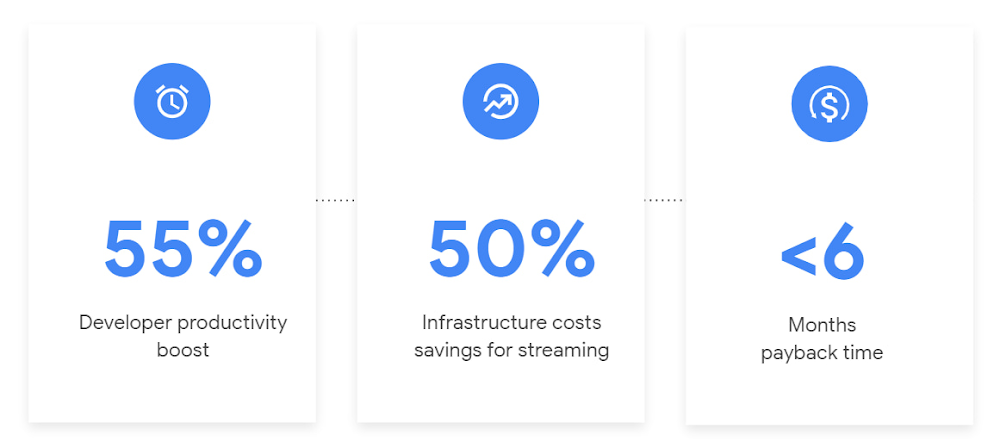
Today we’re excited to share our commissioned study conducted by Forrester Consulting, the Total Economic Impact™ of Google Cloud Dataflow, which allows data leaders to understand and quantify the benefits of Dataflow, and use cases it enables. Forrester conducted interviews with Dataflow customers to evaluate the benefits, costs, and risks of investing in Dataflow across an organization. Based on their interviews, Forrester identified major financial benefits across four different areas: business growth, infrastructure cost savings, data engineer productivity, and administration efficiency. In fact, Forrester found that customers adopting Dataflow can achieve a 55% boost in developer productivity and a 50% reduction in infrastructure costs. In fact, Forrester projects that customers adopting Dataflow can achieve a range of up to 171% Return on Investment (ROI) and a less than six months payback period. Customers can now use figures in the report to compute their own Return on Investment (ROI) and payback period.
“Dataflow is integral to accelerating time-to-market, decreasing time-to-production, reducing time to figure out how to use data for use cases, focusing time on value-add tasks, streamlining ingestion, and reducing total cost of ownership.” – Lead technical architect, CPG
Let’s take a deeper look at the ways that Forrester found that Dataflow can help you achieve your goals and unlock your business potential.
Benefit #1: Increase data engineer productivity by 55%
Developers can choose among a variety of programming languages to define and execute data workflows. Dataflow also seamlessly integrates with other Google Cloud Platform and open source technologies to maximize value and applicability to a wide variety of use cases. Dataflow streamlined workflows with code reusability,dynamic templates, and the simplicity of a managed service. Engineers trusted pipelines to run correctly and adhere to governance. Data engineers avoided laborious issue-monitoring and remediation tasks that were common in the legacy environments such as poor performance, lack of availability, and failed jobs. Teams valued the language flexibility and open source base.
“Dataflow provided us with ETL replacement that opened limitless potential use cases and enabled us to do smarter data enhancement while data remains in motion.” — Director of data projects, financial services
Benefit #2: Reduce infrastructure costs by up-to 50% for batch and streaming workloads
Dataflow’s serverless autoscaling and discrete control of job needs, scheduling, and regions eliminated overhead and optimized technology spending. Consolidating global data processing solutions to Dataflow further eliminated excess costs while ensuring performance, resilience, and governance across environments. Dataflow’s unified streaming and batch data platform gives organizations the flexibility to define either workload in the same programming model, run it on the same infrastructure, and manage it from a single operational management tool.
“Our costs with our cloud data platform using Dataflow are just a fraction of the costs we faced before. Now we only pay for cloud infrastructure consumption because the open source base helps us avoid licensing costs. We spend about $120,000 per year with Dataflow, but we’d be spending millions with our old technologies.” – Lead technical architect, CPG
Benefit #3: Increase top-line revenue by improving customer experience and retention with payback time of < 6 months
Streaming analytics is an essential capability in today’s digital world to gain real-time actionable insights. Likewise, organizations must also have flexible, high- performance batch environments to analyze historical data for building machine learning models, business intelligence, and advanced analytics. Dataflow enabled real-time streaming use cases, improved data enrichment, encouraged data exploration,improved performance and resiliency, reduced errors, increased trust, and eliminated barriers to scale. As a result, organizations provided customers with more accurate, relevant, and in-the-moment data-backed services and insights — boosting customer experience, creating new revenue streams, and improving acquisition, retention, and enrichment.
“It’s already been proven that we are getting more business [with Dataflow] because we can turn around results faster for customers.” – VP of technology, financial services technology
“When we provide data to our customers and partners with Dataflow, we are much more confident in those numbers and can provide accurate data within a minute. Our customers and partners have taken note and commented on this. It’s reduced complaints and prevented churn.” – Senior software engineer, media
Other benefits
Eliminated administrative overhead and toil
As a cloud-native managed service, all administration tasks such as provisioning, scaling, and updates are automatically handled by Google Cloud. Teams no longer need to manage servers and related software for legacy data processing solutions. Admins also streamlined processes for setting up data sources, adding pipelines, and enforcing governance.
Saved business operations costs for support teams and data end users
Dataflow improved the speed, quality, reliability, and ease of access to data for insights for general business users, saving time and empowering users to drive better data-backed outcomes. It also reduced support inquiry volume while automating manual job creation.
What’s next?
Download the Forrester Total Economic Impact study today to dive deep into the economic impact Dataflow can deliver your organization. We would love to partner with you to explore the potential Dataflow can unlock in your teams. Please reach out to our sales team to start a conversation about your data transformation with Google Cloud.
Pizza Hut India: Increasing Customer Coverage and Delivering Pizzas on Time

4975
Of your peers have already read this article.
3:30 Minutes
The most insightful time you'll spend today!
A subsidiary of United States-headquartered corporation Yum! Brands, Pizza Hut prides itself on serving more pizzas than any other pizza business. Founded in 1958, Pizza Hut operates 18,000 restaurants in over 100 countries. In the Indian subcontinent, Pizza Hut and franchise partners Devyani International and Sapphire Foods India operate more than 500 pizza restaurants, including 430 in India itself.
Yum! Brands aims to increase the number of Pizza Hut restaurants in India to 700 by 2022 and has nominated the country as one of the keys to its future growth. The business also operates the KFC and Taco Bell brands in India.
“Globally we are the number one pizza chain in the world based on store count and we aim to be the single biggest pizza brand in India,” says Prashant Gaur, Chief Brand and Customer Officer, Pizza Hut India Subcontinent.
Google Cloud Results
- Maximizes customer coverage and helps ensure riders deliver pizzas to customers within required timeframes
- Onboards new stores to delivery in half a day, rather than the one month required previously
- Meets tech-savvy customer demands to interact across new social media messaging channels
- Launch of live tracking delivers superior customer experience, driving positive word of mouth and repeat business
Pizza Hut launched initially in the country in the late 1990s as a dine-in restaurant brand. However, with changing customer needs, Pizza Hut soon included delivery and takeaway to provide customers with the best tasting pizzas whenever and wherever they wanted them. “Pizza is always at the center of the experience, whether through delivery, dine-in, or takeaway,” says Gaur. “Convenience is key in allowing people to access our products.”
Manual processes
While the business had long shifted into a model that featured delivery and takeaway options, it still used some manual processes. For example, some restaurants used manual listings of customer addresses to manage delivery, which ended up excluding some customers and compromising the brand. In other cases it could take the business up to a week to create a trade zone – a delivery zone assigned to a restaurant – for each new outlet, delaying the commencement of delivery services and costing the business money.
In addition, Pizza Hut India identified an opportunity to more closely track whether pizzas were being delivered within targeted timeframes.
“In some cases, we were using a manual, self-reporting mechanism that provided information about the number of orders that reached consumers less than 30 minutes after an order was placed,” explains Ashish Agarwal, Director, Technology and eCommerce, Pizza Hut India Subcontinent. “We wanted to objectively track and verify delivery times.”
Manual order tracking and execution also limited the number of orders that could be processed effectively during demand peaks. Further, customers could not monitor the status of their pizza orders, including estimated time of arrival.
“Millennial consumers expect products and services to be available when and where they want them. Our focus is to retain the heritage of the brand, which is the dine-in environment, legendary service, and great assets in terms of our stores, while responding to this demand,” adds Gaur.
Pizza Hut India also needed improved analytics in order to identify where the best returns could be achieved by opening new restaurants; how to improve the customer experience; and operate more efficiently.
The business decided to implement a transformation program underpinned by two imperatives: the need to deliver operational efficiencies and scale faster by accelerating the opening of new stores, and the need to give consumers the option of connecting with the brand using the most convenient channel.
A ground-breaking initiative
Pizza Hut India evaluated potential technology partners that could help deliver the program and decided to partner with digital consulting services company MediaAgility, and use Google Maps Platform and Google Cloud Platform services.
“Our journey with MediaAgility and Google incorporated two key initiatives that had a specific impact on our brand and consumers,” says Gaur. “The first of these initiatives was the launch of a feature that enabled consumers and our business to track delivery riders in real time.”
This initiative was ground-breaking for a business that had, until recent years, focused on establishing itself as a restaurant brand. However, with delivery an increasingly important part of its revenue mix, Pizza Hut India decided to build customer engagement through the channel. “By allowing customers to track delivery riders in real time, we could improve engagement – but more importantly give them control,” says Gaur.
During the evaluation, MediaAgility demonstrated Google Maps Platform to Pizza Hut India. “We loved Google Maps Platform as its accuracy and value was proven by consumers using Google Maps for their day-to-day needs,” says Agarwal.
Pizza Hut India conducted brainstorming sessions with MediaAgility and its franchise partners to develop its strategy and complete the implementation. The business then completed several proofs of concept to determine how best to deploy and adapt the technology to some operational processes. “We submitted some data points to our franchise partners and our Pizza Hut brand operations team, and they determined which option to adopt,” says Agarwal.
Google Maps Platform powers delivery
MediaAgility, Pizza Hut India, and the franchise partners then completed a three-month implementation that included onboarding all existing restaurants and new restaurants to the delivery platform based on Google Maps Platform and on Google Cloud Platform.
Pizza Hut India now uses Distance Matrix API through Google Maps Platform to provide travel time and distance based on recommended routes between origins and destinations. This service helps provide delivery riders’ estimated time of arrival to customers.
Directions Service calculates directions by communicating with the Google Maps API Directions Service, which receives direction requests and returns efficient paths based on travel time and factors such as distance and number of turns. This service provides a view of the delivery rider’s position relative to the customer’s location.
Through the Nearest Roads service included in Roads API, Pizza Hut India obtains individual road segments for given GPS coordinates, while Snap to Roads provides the best-fit road geometry for given GPS coordinates.
The business employs Maps Javascript API to customize maps with dedicated content and imagery for websites and mobile devices – showing a map view to store managers and customers – and uses Maps SDK for Android to add maps based on Google Maps to its applications.
Google Cloud Platform runs the delivery platform
Pizza Hut India is running its delivery platform on a Google Cloud Platform architecture that comprises App Engine to run its web applications; virtual machine instances provided through Compute Engine; Cloud Datastore to run a NoSQL document database; Firebase to develop and run its mobile applications; Cloud Storage to store data; and a BigQuery analytics data warehouse.
Realizing goals
With Google Maps Platform and Google Cloud Platform, Pizza Hut India and its franchise partners are realizing the goals of the transformation program.
Rather than take up to seven days to manually map trade zones for stores, Pizza Hut India uses Google Maps Platform to create and update them as required. “After we started working with MediaAgility and Google, we digitized those maps and created trade zones – zones within which Pizza Hut India restaurants will deliver – based on estimated travel times during the busiest time of the week,” says Gaur. “This minimizes the risk of late deliveries.
“The other benefit was reduced time to activate new stores,” he adds. “If you are launching 100 stores per year, this becomes a big, big task. Now we can bring new stores into the market much more quickly.”
With MediaAgility and Google Maps Platform, the business can also help ensure newly built establishments – such as blocks of flats – are captured within trade zones, allowing stores to deliver to residents.
Delivery accounts for increased transactions
Pizza Hut India now automatically allocate orders to delivery riders using a rider tracking application on their mobile phones. When a rider starts his or her journey, Google Maps Platform enables point-by-point tracking by consumers and store managers. The Pizza Hut India delivery operations team monitors delivery performance through a real-time dashboard.
Pizza Hut India is meeting customer expectations of live, map-based streaming of delivery status on their devices – enhancing customer experience and loyalty, and adding accountability to the process. The business is reaping the rewards of its investment, with delivery now a large slice of its overall offering. “We have taken significant strides in the past three to four years to change our customers’ online ordering experience, and the last-mile delivery experience to the customers’ homes,” says Gaur.
Launching delivery tracking has also had a dramatic impact on Pizza Hut India’s internal key performance indicators. “The proportion of calls to our call center that are following up on an order, as opposed to placing an order, has fallen dramatically,” says Gaur.
Advanced analytics
Further, Pizza Hut India is running advanced analysis of data in the BigQuery data warehouse, enabling the business to determine which restaurants are doing well, which deliveries may be delayed, and what locations are most promising to open a new store. These insights enable the business to boost productivity, expand effectively, and operate more efficiently.
The business can now onboard new stores to delivery in half a day, rather than the month required previously. “The process enabled by Google Cloud and MediaAgility is also delivering significant operational cost savings as well as helping us open and grow new stores quickly,” says Agarwal.
“MediaAgility acted as our development partner across the project, helping us deploy everything from zones to rider tracking,” he says. “It’s been with us from the strategy discussion through the implementation and stabilization phases.”
Chatbot in development
MediaAgility has also helped Pizza Hut India create a chatbot using the Dialogflow development suite for creating conversational interfaces. “This project is about giving millennials and other customers one more channel to reach out and connect to the brand,” explains Agarwal.
Pizza Hut India is now ideally placed to continue growing and position itself as a brand of choice for tech-savvy consumers. “We’re extremely pleased with the contribution of all the parties involved in this project and look forward to continue transforming our business to meet the demands of the digital age,” says Agarwal.
While Gaur acknowledges it is difficult to predict change over the next two to five years, he believes delivery is likely to become more prominent in Pizza Hut India’s combination of offerings. “When we began our online journey in 2016, we predicted delivery would be about 25 percent of the mix by 2020,” he says. “With Google and MediaAgility, I think it will keep growing.”
Google’s Default Messaging Apps for AT&T Android Users Ensure Richer Conversations

5554
Of your peers have already read this article.
1:30 Minutes
The most insightful time you'll spend today!
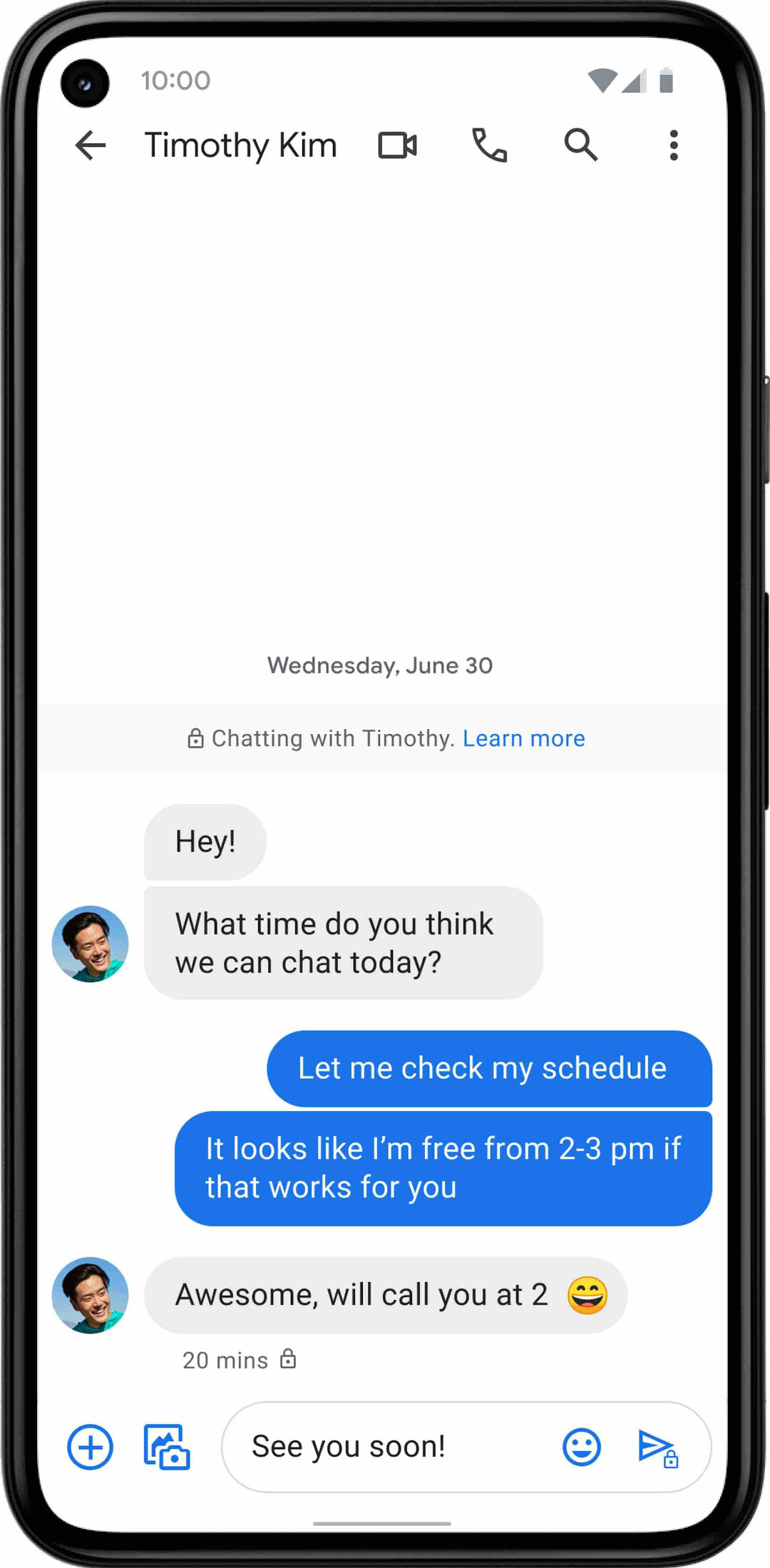
Today, we’re announcing that we’re working with AT&T to establish Messages by Google as the default messaging application for all AT&T customers in the United States using Android phones. The collaboration aims to help accelerate the industry toward global Rich Communication Services (RCS) coverage and interoperability to offer a consistent, secure, and enhanced messaging experience for all Android users around the world.
“Many AT&T customers have enjoyed the advantages of RCS for years when texting with friends and family,” said David Christopher, executive vice president and general manager – AT&T Mobility. “We look forward to working closely with Google to extend these benefits to even more of our customers as they enjoy richer conversations with others around the world.”
Working together, AT&T and Google will continue the momentum to upgrade SMS with enhanced messaging features offered in Messages, which includes the support of chat features based on the open RCS standard. With Messages as the default messaging application, all AT&T customers using Android devices will get enhanced features so they can:
- Share full-resolution pictures from a recent event or vacation
- Send a higher-quality video of that soccer goal and the celebration that followed
- Know when someone is replying to a text
- Send and receive messages over Wi-Fi or data
- Participate in group chats where it’s easy to add someone else to the conversation, or let someone leave, without starting a brand new thread

In addition to these features, we’re also rolling out end-to-end encryption for one-on-one RCS conversations between people using Messages and people who have chat features enabled.
For years, we’ve been working with the mobile industry and device makers to bring enhanced and secure messaging to everyone on Android. Today’s announcement—that AT&T customers using Android devices will soon be able to enjoy these features by default—is a major step forward.
A French News Company’s Web Modernization Journey with Cloud Run

3493
Of your peers have already read this article.
1:30 Minutes
The most insightful time you'll spend today!
Editor’s note: Today’s post documents the solution to a problem of how to scale website infrastructure as it moves from on-prem to the cloud. It is the result of collaboration between technical teams of Les Echos Le Parisien Annonces (a division of Groupe Les Echos, subsidiary company of LVMH) and Google in the spirit of finding the best tool for the job together.
All technology starts aging from the first day you set it up, and over time becomes in need of some renewal. At Les Echos Le Parisien Annonces (a division of Groupe Les Echos, subsidiary company of LVMH), we complement the main site (“publication annonce légale”) with a number of local market sites for different regions within metropolitan France, as well as French readers in territories across the world. Each local market site offers a variety of services and content, which are served by a set of CMS-driven sites.
Historically these sites were served from dedicated on-prem infrastructure. As the number of sites grew, vertical scaling was used to increase the capacity of the machine. Over time, this approach presented challenges. First, each new site involved modifying multiple shared configurations, and modifying several monolithic parts of the architecture. Because all the sites shared parts of the serving stack, an issue that developed for one site could take down all of the sites. The reliability of the serving path was not able to reach the availability we and our customers expected. Les Echos and Google put their heads together to solve this with a new serverless deployment pattern where each new site can be quickly and independently launched.
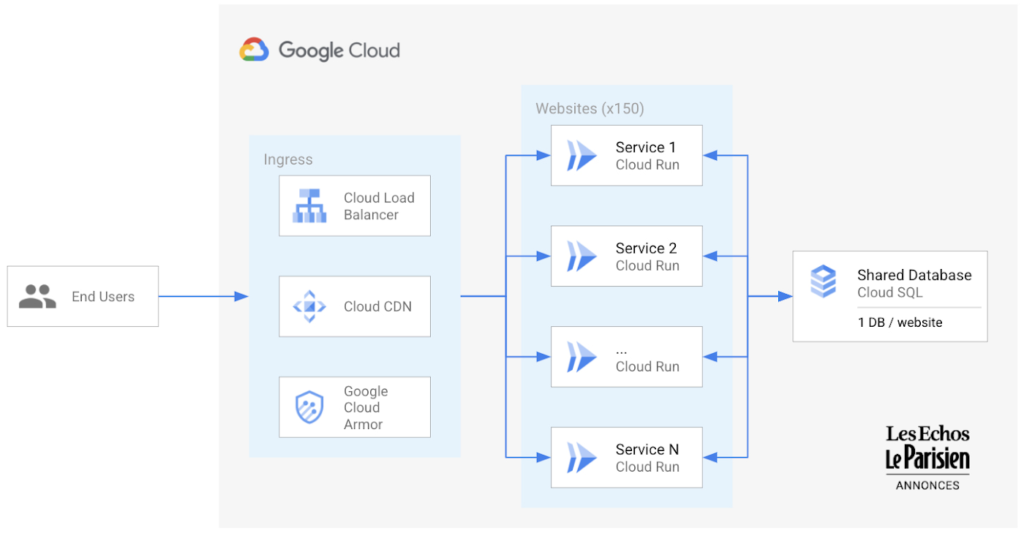
Each site, running a conventional PHP CMS solution, is now containerized and deployed as its own Cloud Run service with an independent configuration and database. This means each site scales vertically, including down to zero at times of day when that locale is quiet. Because Cloud Run is available across GCP regions, we can deploy sites closest to the market we want to reach. To further enhance our customer experience, each of these sites is run behind Cloud Global Load Balancing with Cloud Armor and Cloud CDN, providing extra security and performance. The initial pilot of 30 sites has performed well, and the remainder of the 150 current sites are now being migrated. Adding new sites has gone from taking hours to minutes. This allows Les Echos to quickly explore new opportunities in markets that previously would have taken much longer to assess and qualify for investing in a new site.
Adopting this serverless approach has been a successful step in the modernization journey to Google Cloud, allowing us to use containers to take existing software and both re-architect and re-platform to support growth while reducing toil.
How to Modernize Your Apps with Migrate to Anthos
3390
Of your peers have already read this article.
3:10 Minutes
The most insightful time you'll spend today!
In a perfect cloud world, you would host all your applications in containers running on Kubernetes and Istio, benefitting from the portability and improved resource utilization of containers, plus a robust orchestration platform with advanced application management, networking, and security functionality. This is easy to do if you’re developing a new application, but it can be hard for existing applications to take advantage of those capabilities.
Many of the applications that you may want to move to the cloud have been around a long time, and you may not have the application-specific knowledge that would be required to rewrite them to be more cloud-native—or it would be incredibly time-consuming to do so.
Another option is to lift-and-shift to a virtual machine (VM) hosting platform like Compute Engine, but that means you still need to maintain the VMs. Even if you’re not able to fully modernize an existing app, it would still be great to get some of the benefits of containers and Kubernetes.
What is Migrate for Anthos?
Enter Migrate for Anthos, a fast and easy way to modernize your existing applications with a service that encapsulates them in a container. Moving your physical servers or existing VMs into Kubernetes containers gives you crucial portability and resource utilization benefits without having to rewrite the underlying application.
Since Migrate for Anthos is built for Google Kubernetes Engine (GKE), you also automatically capture the scaling and flexibility benefits of a managed Kubernetes environment in the cloud. Migrate for Anthos recently became generally available.
Converting an application with Migrate for Anthos happens in two phases. First, it creates a generic container wrapper around your application that makes it seem like it is still running in a full VM environment. Then, you launch Migrate for Anthos software on your Kubernetes cluster that runs the containerized application.
You can find more details about this in the documentation and in our blog post: Migrating from Compute Engine to Kubernetes Engine with Migrate for Anthos.
As the name suggests, Migrate for Anthos works with Anthos GKE. However, you can also use Migrate for Anthos with only GKE—all it requires is your application and a GKE cluster running the Migrate for Anthos software.
Getting started with Migrate for Anthos
Migrate for Anthos works with a variety of workloads, but not all. It’s particularly adept at migrating legacy applications, stand-alone applications, and monolithic applications. As you start the modernization process, here are some questions to ask to determine whether to use Migrate for Anthos with your applications:
1. Should this app be in the cloud?
By its nature, the cloud may not be able to support some characteristics of your on-prem environment, such as geography and legal compliance. The best way to find out whether the cloud will work for each of your applications is to plan out a full migration. That will allow you to identify groups of applications that can benefit from cloud offerings such as a global network and ease of resizing resources. After that, try out a proof of concept by testing the apps in the cloud to see if it fits your business needs.
2. Should this app be in Kubernetes?
Containerizing an application simplifies workload administration, improves scalability (both up and down), and increases host utilization. Kubernetes orchestrates the containers and GKE handles node upgrades, while add-ons like Istio let you manage network and security policies independently of your application.
With those advantages, it’s easy to think that containers are always the right way to go, but there are some cases where it may make sense to stick with VMs. Strict hardware requirements, specialized kernel modules, and license constraints may be harder to run with containers, negating their advantages.
3. Should this app migration use Migrate for Anthos?
Migrating your apps or workloads to the cloud isn’t just about shifting where the compute resources run; it’s also an opportunity to modernize them with containers. Using Migrate for Anthos (or Migrate for Compute Engine) gives you the ability to get your workloads in the cloud quickly, with minimal upfront downtime that’s easy to plan for.
However, even if you use the Migrate for Anthos wrapper, your application is still the same application. The benefits of the modern platform may not outweigh a legacy application and a rewrite may be the only way to meet your business needs. There are also some specific services from your VM that may not work with Migrate for Anthos, for example licensing requirements.
Migrate for Anthos can also be the first step in a larger migration effort. Once you’ve migrated the application to GKE, you can gradually break up a monolithic app into microservices by manually rewriting parts. Spreading out the migration effort gets you in the cloud sooner, giving you more time to modernize.
Next steps
A successful modernization starts with creating a full migration plan, testing the workloads, and monitoring them. You can experience the benefits of modernization with Migrate for Anthos by picking a small workload and trying it out for yourself!
More Relevant Stories for Your Company

How APIs are Helping Malaysia’s Largest Investment Company Innovate Quickly
Permodalan Nasional Berhad (PNB) is one of Malaysia’s largest investment institutions with more than RM300 billion ($71 milion) in assets under management. Through our wholly-owned company, Amanah Saham Nasional Berhad (ASNB), we manage 14 funds with a total value of RM235.74 billion ($56.34 million) as of Dec. 31, 2018. To expand

A 100-year Old Business’ Digital Evolution with Apigee API Management
Editor’s note: James Fairweather, chief innovation officer at Pitney Bowes, has played a key role in modernizing the product offerings at this century-old global provider of innovative shipping solutions for businesses of all sizes. In today’s post, he discusses some key challenges the Pitney Bowes team overcame during its digital transformation,

Business Evolution with API Ecosystems
During uncertain times, ecosystem partnerships that leverage APIs have proven to help companies scale and address gaps in their businesses. Apigee customers, like CHAMP Cargosystems, have pursued API-first ecosystem models to enter adjacent markets, create new customer interaction models, and rapidly grow their brand reach and partner ecosystems. As a

Building a Software Delivery Platform with Anthos
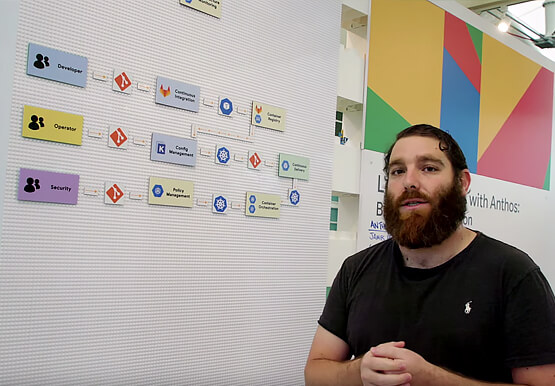
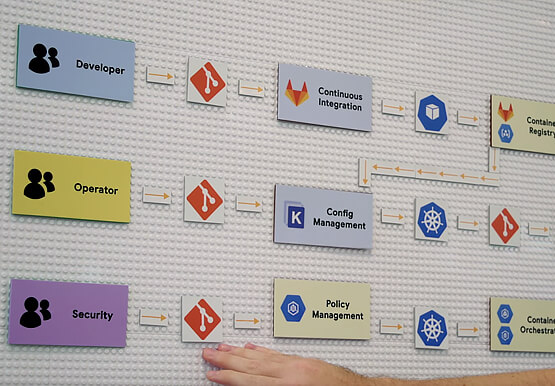
Understand the architecture of a GitOps based CI/CD pipeline. In a CI/CD pipeline, there are three different personas -- developers, operators, and security engineers. This demo includes common developer, operator, and security engineer tasks to show how the patterns can improve your company’s software delivery performance.
