





3617
Of your peers have already watched this video.
6:20 Minutes
The most insightful time you'll spend today!
Why Apigee: Customers Explain How this API Platform Boosts their Business
Apigee customers Expedia, Equinix, Morningstar, Swisscom, Vantiv, Telstra, Fox Broadcasting company, Laterooms.com and partners, SAP and Accenture share why they joined forces with the intelligent API management platform company.
Apigee is helping customers execute businesses commerce with other partners, securely expose assets to external developer communities, secure APIs throughout the digital value chains, open up new revenue streams and do much more.
Here is A Quick Glance at Who Said What
“Through our partnership with Apigee we have been able to create some really amazing implementations using our APIs to commerce with other partners and other types of content interactions in the marketplace and so far, the response in the market has been outstanding,” says Brad Jaehn, VP, Product GoGo.
“Businesses cannot afford to be on an island. It really is all about the interconnections among businesses. And when you are talking about sharing digital assets, you really are talking about APIs. Apigee is essential to provide a way for sharing of APIs, sharing of those assets between those companies,” says Garrett Vargas, Senior Director of Technology, Expedia.
“We mainly choose Apigee for three reasons. One is their experience in the enterprise market. They could really handle big data amounts for big enterprise customers. Second, their experience in telecom and third they really helped us to securely expose our telecom assets to the external developer community,” Heinz Herren, Head of IT.
“One of the primary reasons we selected Apigee was because it could secure APIs throughout the digital value chain. It offered us access control, authentication control, even versioning of APIs so that our customers are selecting the right APIs. It protects them and their assets as well as our assets, backend systems, and processes. Apigee allowed us to do this not only securely but very quickly. So, we are excited to partner with Apigee on the Equinix cloud exchange,” says Brian Lillie, CIO, Equinix.
“We all talk about user experience. It’s the end thing in Silicon Valley. But what about DevX. Vantiv wants to provide clean, open and standard APIs. To the Apigee powered Vantiv platform, enables our community of developers to innovate much faster. rather than having them discover capabilities by various other providers of commerce services, this one-stop shop Vantiv platform powered by Apigee give a clean, open and standard API layer for all commerce services to our developers,” says Navneet Singh, Senior VP, Product, Vantiv.
Watch this short video to know what else Apigee customers and partners are saying about the platform.
3481
Of your peers have already watched this video.
2:00 Minutes
The most insightful time you'll spend today!
Leveraging Intelligent Behavior Detection to Protect User Sensitive APIs
Malicious actors are out there, and APIs are their new target. External threats could be attacking your APIs as you read this, and your business might not even know it.
Attacks can come in the form of software applications that run automated tasks and they are everywhere. A growing percentage of a company’s traffic is generated by bots. In some cases, they compose as much as 50 percent of an organization’s traffic.
When these are used with malicious intent these software programs can be used to trigger dangerous attacks. It can lead to information scraping and account abuse. They can also probe for API weaknesses and skew analytics. Such attacks are adaptive and can easily blend in with normal traffic. Without a dedicated API security solution, your APIs could be breached creating serious problems for your brand reputation and customer loyalty.
This is where Apigee Sense comes in. Apigee is the only solution purpose-built for APIs. It collects, analyzes, detects and mitigates API attacks. Apigee Sense algorithms are built from analyzing metadata gathered from a billion daily API calls.
Watch this two-minute video to learn how to protect your APIs against malicious actors.
Google Cloud Helped Digitec Galaxus Personalize Over 2 Million Newsletters in a Week

8301
Of your peers have already read this article.
3:00 Minutes
The most insightful time you'll spend today!
Digitec Galaxus AG is the biggest online retailer in Switzerland, operating two online stores: Digitec, Switzerland’s online market leader for consumer electronics and media products, and Galaxus, the largest Swiss online shop with a steadily growing range of consistently low-priced products for almost all daily needs.
Known for its efficient, personalized shopping experiences, it’s clear that Digitec Galaxus understands what it takes to deliver a platform that is interesting and relevant to customers every time they shop.
The problem: Personalizing decisions for every situation
Digitec Galaxus already had established an engine to help them personalize experiences for shoppers when they reached out to Google Cloud. They had multiple recommendation systems in place and were also extensive early adopters of Recommendations AI, which already enabled them to offer personalized content in places like their homepages, product detail pages, and their newsletter.
But those same systems sometimes made it difficult to understand how best to combine and optimize to create the most personalized experiences for their shoppers. Their requirements were threefold:
- Personalization: They have over 12 recommenders they can display on the app, however they would like to contextualize this and choose different recommenders (which in turn select the items) for different users. Furthermore they would like to exploit existing trends as well as experiment with new ones.
- Latency: They would like to ensure that the solution is architected so that the ranked list of recommenders can be retrieved with sub 50 ms latency.
- End-to-end easy to maintain & generalizable/modular architecture: Digitec wanted the solution to be architected using an easy to maintain, open source stack, complete with all MLops capabilities required to train and use contextual bandits models. It was also important to them that it is built in a modular fashion such that it can be adapted easily to other use cases which have in mind such as recommendations on the homepage, Smartags and more .
To improve, they asked us to help them implement a machine learning (ML) contextual bandit based recommender system on Google Cloud taking all the above factors into consideration to take their personalization to the next level.
Contextual bandits algorithms are a simplified form of reinforcement learning and help aid real-world decision making by factoring in additional information about the visitor (context) to help learn what is most engaging for each individual. They also excel at exploiting trends which work well, as well as exploring new untested trends which can yield potentially even better results. For instance, imagine that you are personalizing a homepage image where you could show a comfy living room couch or pet supplies.
Without a contextual bandit algorithm, one of these images would be shown to someone at random without considering information you may have observed about them during previous visits. Contextual bandits enable businesses to consider outside context, such as previously visited pages or other purchases, and then observe the final outcome (a click on the image) to help determine what works best.
Creating a personalization system with contextual bandits
While Digitec Galaxus heavily personalizes their website homepages, they are very very sensitive and also require more cross-team collaboration to update and make changes.
Together with the Digitec Galaxus team, we decided to narrow the scope and focus on building a contextual bandit personalization system for the newsletter first. The digitec Galaxus team has complete control over newsletter decisions and testing various ML experiments on a newsletter would have less chance of adverse revenue impact than a website homepage.
The main goal was to architect a system that could be easily ported over to the homepage and other services offered by Digitec with minimal adaptations. It would also need to satisfy the functional and non-functional requirements of the homepage as well as other internal use cases.
Below is a diagram of how the newsletter’s personalization recommendation system works:

- The system is given some context features about the newsletter subscriber such as their purchase history and demographics. Features are sometimes referred to as variables or attributes, and can vary widely depending on what data is being analyzed.
- The contextual bandit model trains recommendations using those context features and 12 available recommenders (potential actions).
- The model then calculates which action is most likely to enhance the chance of reward (a user clicking in the newsletter) and also minimize the problem (an unsubscribe).
Calculating whether a click was a newsletter or an unsubscribe enabled the system to optimize for increasing clicks and avoid showing non-relevant content to the user (click-bait). This enabled Digitec Galaxus to exploit popular trends while also exploring potentially better-performing trends.
How Google Cloud helps
The newsletter context-driven personalization system was built on Google Cloud architecture using the ML recommendation training and prediction solutions available within our ecosystem.
Below is a diagram of the high-level architecture used:
The architecture covers three phases of generating context-driven ML predictions, including:
ML Development: Designing and building the ML models and pipeline
Vertex Notebooks are used as data science environments for experimentation and prototyping. Notebooks are also used to implement model training, scoring components, and pipelines. The source code is version controlled in Github. A continuous integration (CI) pipeline is set up to automatically run unit tests, build pipeline components, and store the container images to Cloud Container Registry.
ML Training: Large-scale training and storing of ML models
The training pipeline is executed on Vertex Pipelines. In essence, the pipeline trains the model using new training data extracted from BigQuery and produces a trained, validated contextual bandit model stored in the model registry. In our system, the model registry is a curated Cloud Storage.
The training pipeline uses Dataflow for large scale data extraction, validation, processing, and model evaluation, and Vertex Training for large-scale distributed training of the model. AI Platform Pipelines also stores artifacts, the output of training models, produced by the various pipeline steps to Cloud Storage. Information about these artifacts are then stored in an ML metadata database in Cloud SQL. To learn more about how to build a Continuous Training Pipeline, read the documentation guide.
ML Serving: Deploying new algorithms and experiments in production
The training pipeline uses batch prediction to generate many predictions at once using AI Platform Pipelines, allowing Digitec Galaxus to score large data sets. Once the predictions are produced, they are stored in Cloud Datastore for consumption. The pipeline uses the most recent contextual bandit model in the model registry to evaluate the inference dataset in BigQuery and give a ranked list of the best newsletters for each user, and persist it in Datastore. A Cloud Function is provided as a REST/HTTP endpoint to retrieve the precomputed predictions from Datastore.
All components of the code and architecture are modular and easy to use, which means they can be adapted and tweaked to several other use cases within the company as well.
Better newsletter predictions for millions
The newsletter prediction system was first deployed in production in February, and Digitec Galaxus has been using it to personalize over 2 million newsletters a week for subscribers. The results have been impressive, 50% higher than our baseline. However, the collaboration is still ongoing to improve the results even more.
“Working at this level in direct exchange with Google’s machine learning experts is a unique opportunity for us. The use of contextual bandits in the targeting of our recommendations enables us to pursue completely new approaches in personalization by also personalizing the delivery of the respective recommender to the user. We have already achieved good results in our newsletter in initial experiments and are now working on extending the approach to the entire newsletter by including more contextual data about the bandits arms. Furthermore, as a next step, we intend to apply the system to our online store as well, in order to provide our users with an even more personalized experience. To build this scalable solution, we are using Google’s open source tools such as TFX and TF Agents, as well as Google Cloud Services such as Compute Engine, Cloud Machine Learning Engine, Kubernetes Engine and Cloud Dataflow.”—Christian Sager, Product Owner, Personalization ( Digitec Galaxus)
Since the existing architecture and system is also dynamic, it will automatically adapt to new behaviours, trends, and users. As a result, Digitec Galaxus plans to re-use the same components and extend the existing system to help them improve the personalization of their homepage and other current use cases they have within the company. Beyond clicks and user engagement, the system’s flexibility also allows for future optimization of other criteria. It’s a very exciting time and we can’t wait to see what they build next!
How Experian Transformed its Business by Using APIs

3751
Of your peers have already read this article.
3:00 Minutes
The most insightful time you'll spend today!
Chances are, when you think of Experian you think of a traditional credit bureau that provides credit reports. But Experian has transformed into a true technology and software provider. We gather, analyze, and process data in ways that other companies just can’t. Businesses use this data to make smarter decisions about credit and lending, as well as to prevent identity fraud and crime. We’re also able to use this data to help individuals take financial control of their own lives and access all kinds of financial services with products like Experian Boost.
Transforming data delivery, transforming the enterprise
A big part of our digital transformation has been based on our API program. We approached APIs with a concrete goal in mind. We knew exactly how we wanted to transform the business, and we had a set plan to achieve that. For us, this meant establishing an API center of excellence as a first step. It’s sole purpose was to enable the business units to create their APIs quickly and correctly, then apply them properly. We then went out to the business units one by one so that we could train them to build their APIs in a customer-friendly way. We taught them the entire API process of building, giving access to developers internally and externally.
This approach is fundamentally different from previous ones. As far back as the 1990s, our customers connected to us via software applications installed on their systems. As technologies evolved, our services to customers evolved, and we began supporting XML-based transactions and custom integrations with our partners. Some of these integrations actually included VPNs rather than going through HTTP connections. We did custom database schemas, one-off processes, and all kinds of custom development.
This meant that we had a team just for our IT system processes. This team kept growing as Experian continued to acquire new companies. Each acquisition brought a new way of doing integrations and business. We had a real challenge in standardizing development practices, which led to a lot of isolated environments inside the company. We had disparate data repositories and non-standard client conductivity, which hampered innovation.
Responding to customer demand for APIs
When we first started, we had some concrete goals. We wanted to grow our ecosystem, develop a massive reach for transaction and content distribution, power a new business model, and drive innovation. Basically, we wanted to use APIs to transform our business into a platform, and we wanted to build an ecosystem that leveraged this API platform to develop new solutions.
Our leadership also understood the importance of delivering information to our customers in the way they wanted to consume it. Our customers had told us that they didn’t want software, they just wanted access to the data—and APIs are the easiest, most secure way to grant that access.
The Apigee API management platform as an enterprise solution
We knew we needed an API management platform to enable this step forward. In addition to the documentation and discoverability, we also wanted a place to create APIs fast, and where we could get visibility into usage and other metrics. The Apigee API management platform from Google Cloud offered all of this, and more. From the robust feature set to advanced security to the developer portal to analytics – Apigee provides us everything we need to run an enterprise-class API program.
Now that we have our API program up and running, integrations no longer take months. In some cases, it’s just a matter of minutes or seconds. Customers can simply look at our documentation on how to invoke APIs and begin consuming data in seconds. We started with this new model in our three largest markets: North America, the United Kingdom and Brazil. Later, we rolled it out to Singapore and Australia, while deploying an on-premises platform for some of our North American business units that needed to provide their APIs internally only. Next, we went to EMEA. At this point, we’ve deployed Apigee company-wide, giving us a flexible deployment model that maintains a centralized platform and processes.
We continue to evangelize the program today, and we recently conducted a workshop with the Apigee team to train our EMEA business unit and get them onboarded to the platform. They were able to start developing API proxies right away, and they’re set to go into production with as many as nine of them. We also went live with three developer portals, which we call API hubs, in North America, the United Kingdom, and Brazil.
As we expand, we don’t want to keep building up different developer portals for each region because then we’re going to have too many. Alternatively, we plan to combine them into a single global developer portal that will allow users to select geographies of interest where they’ll be presented with relevant information.
Experian continues to evolve the types of products and services we offer. Thanks to Apigee, we have the flexibility, security, and technology to keep innovating and providing value to our business and our customers.

3946
Of your peers have already downloaded this article
6.00 Minutes
The most insightful time you'll spend today!
Choosing ROI criteria that drive smart decisions about digital investments is necessary to win in the app economy. But according to an Apigee Institute survey of IT and Marketing executives, there is a wide gap between what corporate leaders believe are the best ROI metrics and what are actually used in most enterprises today. Those who move first to bridge the gap will be able to move further and faster towards digital transformation and market leadership.
This special report drills down on patterns and practices for digital ROI that drive more confident decision making and stronger results based on empirical analysis of 200 large companies. Read the report to understand how you can drive decisions about digital investments to the next level of actionability and strengthen digital capabilities by building stronger organizational alignment. The report explores how top performing digital businesses evaluate and make decisions about digital investments using data analytics, by deploying apps, and operating APIs.
New Map Customization Features for Enhanced User Experiences

5559
Of your peers have already read this article.
1:30 Minutes
The most insightful time you'll spend today!
A customized map can be key to delivering a frictionless experience that engages users and sets you apart in users’ minds–whether you’re a real estate company fine-tuning points of interest (POIs) on a map to help buyers decide where to live, or a regional pharmacy styling a map to ensure your locations stand out from the competition. That’s why we’ve focused on empowering you with these capabilities through features like POI density and POI filtering controls, zoom level customization, and even industry-optimized map styles. But we’re not done helping you take your map to the next level. Today, we’re making two updates generally available—a new Maps SDK for Android and the extension of Cloud-based maps styling features to our Android and iOS SDKs. Together they enhance the native mobile map experience and make it easier for you to deliver consistent, optimized maps across all your platforms. We’ll also give you an early look at additional features that we’re working on.
Update your Maps SDKs for Android for an enhanced user experience
Developers around the world depend on the Maps SDK for Android to power critical experiences like helping drivers make a delivery or helping retailers visually confirm an order’s shipping address. With consumers spending an increasing amount of time in apps, it’s more important than ever that mobile experiences meet the high consumer expectations that come with essential, everyday use.
Today we released version 18.0.0 of the Maps SDK for Android, which delivers an enhanced map experience to app users, thanks to a new renderer. The new renderer introduces optimizations to our tile serving and rendering architecture, reducing payload size. This can help to reduce network load, on-device processing, and memory consumption for a more stable and smoother end-user experience. You’ll also see specific improvements with map labels. Now more fluid and clearly positioned, they pave the way for future marker management features. We’ve also enhanced overall gesture handling for better animations and smoother panning and zooming.
Because the Maps SDK for Android continues to be distributed as part of the Google Play services SDK, you can upgrade to v18.0.0 along with all its improvements with no increase to your APK size.
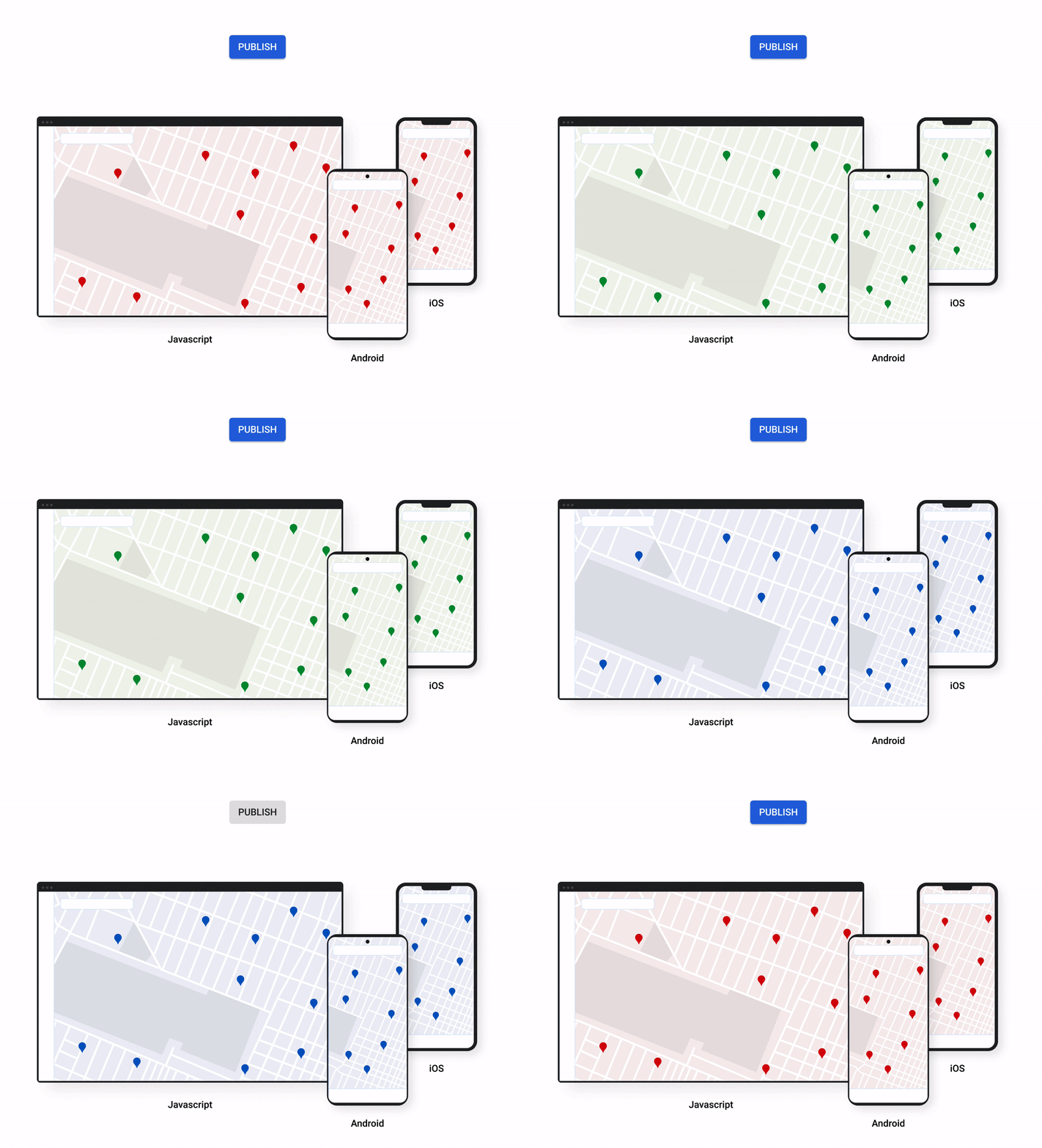
A consistent cross-platform maps experience with Cloud-based maps styling for mobile
Earlier this year at Google I/O, we announced the general availability of Cloud-based maps styling for JavaScript. Since then customers have used the richer customization capabilities and efficient cloud-enhanced deployment workflow to power millions of mapping experiences, from a curated interactive map of Munich to fun virtual Easter egg hunts hosted by Cadbury. Starting today, Cloud-based maps styling features are supported in the GA versions of our Maps SDK for Android (v18+) and Maps SDK for iOS (V5.0+).
Cloud-based maps styling moves map customization code off the client and into the cloud–where it can be easily modified to use new features or test new configurations. This decoupling of client code and customization code makes it easy to manage a single branded and optimized style across any number of apps across all supported platforms. It also makes it possible to simultaneously publish changes to a map style across platforms and install bases with the click of a button. Cloud-based maps styling is the foundation for a growing set of new customization features including POI filtering and POI boosting, zoom level customization, landmarks, and commercial corridor styling.

Mobile developers can now take advantage of Cloud-based maps styling features and simple cross-platform customizations for their Dynamic Maps by creating a MapID in Google Cloud Console and using it within their Maps SDK for Android or Maps SDK for iOS. Dynamic maps loaded with a Map ID via our Maps SDK for Android or Maps SDK for iOS will be billed to the same SKU as Maps JavaScript API (Dynamic Maps) and covered under the same $200 monthly credit and volume pricing. Developers can upgrade to the new Maps SDK for Android and continue using client-styled maps for no charge as they always have.
Additional capabilities we’re working on¹
We know you have a range of map customization needs to engage your users with differentiated experiences. We’re working on developing more Cloud-based maps styling features–focused on marker capabilities, map elements, and data-driven styling–to help you do just that. We’re working on a new set of markers capabilities, easier pin customizations, marker collision management, performance optimizations, and the ability to build custom marker elements that you can use to quickly deploy deeply customized, highly optimized marker-driven experiences. For those seeking greater detail in their maps, we’re working on expanding the availability and customization of detailed street maps to even more cities. We’re also working on features to make it easier to programmatically style map elements by exposing new APIs to enable things like the simple creation of choropleths by styling Google geographical boundaries based on your data.
This is just a peek into what we’re excited to be building for our developer community. While we’re working hard to bring these additional features to life, visit our website to learn more and our developer documentation to start customizing and enhancing your mobile maps.
¹Product capabilities, timeframes, and features are subject to change.
More Relevant Stories for Your Company

What’s New in Retail: Bits from Google Cloud’s Retail & Consumer Goods Summit
Today we’re hosting our Retail & Consumer Goods Summit, a digital event dedicated to helping leading retailers and brands digitally transform their business. For me, this is a personally exciting moment, as I see tremendous opportunities for those companies that choose to focus on their customers and leverage technology to elevate

Without an API Product Owner, Your APIs Have a Limited Lifespan
Product teams often serve as the nexus between all organizational units within a company, ensuring that a specific line of business follows a clear roadmap and that cross-functional alignment drives success. At their most empowered, product owners are like miniature CEOs for each offering within a company. Unfortunately, in today’s

Four Simple Steps to SRE Implementation
A few months ago, we wrote about how the first step to implementing Site Reliability Engineering (SRE) in an organization is getting leadership on board. So, let’s assume that you’ve gone ahead and done that. Now what? What are some concrete steps you can take to get the SRE ball rolling?
Managed containers: An enterprise standard at Colgate-Palmolive
Kubernetes is an increasingly key part of the application deployment strategies at large organizations, and one of the most recommended options for the teams we work with. An idea brought to life at Google, organizations throughout the world use containers and Kubernetes on-premises, in Google Cloud, or in a multi-cloud
