





Mambu’s Journey: Modernizing Core Banking with Google Cloud

932
Of your peers have already read this article.
3:30 Minutes
The most insightful time you'll spend today!
When our founders began Mambu in 2011, their goal was to bring the latest digital technologies to the banking and finance world. Banking, in particular, is an industry built on decades of deep legacy technology. So initially, Mambu was embraced by microfinance — 100 organizations in 26 countries in just the first two years.
Since then, acceptance of modernizing core banking services by using composable, cloud technologies has grown across financial services institutions (FSIs). We now service top-tier banks, fintech startups, and other finance organizations across six continents, helping them deliver flexible, personalized, customer-centric banking products and services that their customers can depend upon.
One of the main reasons we’ve been able to scale the Mambu composable banking platform across the globe and at our current pace is our partnership with Google Cloud. The decision to move forward with Google Cloud happened for several reasons.
1. Flexibility and openness. Many FSIs are on hybrid and multicloud technology stacks, as they may still be transitioning from legacy systems, or have data residency requirements that have led them to use different clouds in different regions. Mambu meets customers wherever they are in their cloud journeys. We support interoperability without vendor lock-in. This need for openness, as well as the scalability benefits, led Mambu to evolve our platform on Google Kubernetes Engine (GKE). Many customers use open-source Kubernetes because, this common foundation can help streamline integration, speed up time to market, and reduce development. Just as important, the Google Cloud open cloud approach matches our company values.
2. Security and data residency. For customers in highly regulated finance industries, security isn’t just top of mind, it’s the No. 1 requirement. In addition to Google Cloud’s secure infrastructure, external audit certifications, and encryption, its wide array of regions has allowed us to expand into more countries, where we serve banks that must meet local data residency requirements. For example, Google Cloud’s Jakarta Cloud Region, has allowed us to support Bank Jago in Indonesia as it brings more financial inclusion to the unbanked in that country.
3. Availability. It’s critical for banks to maintain basic financial functionality, like accepting deposits and serving cash, even amid a service disruption. We needed a cloud partner with impeccable redundancy, failover, and disaster recovery capabilities.
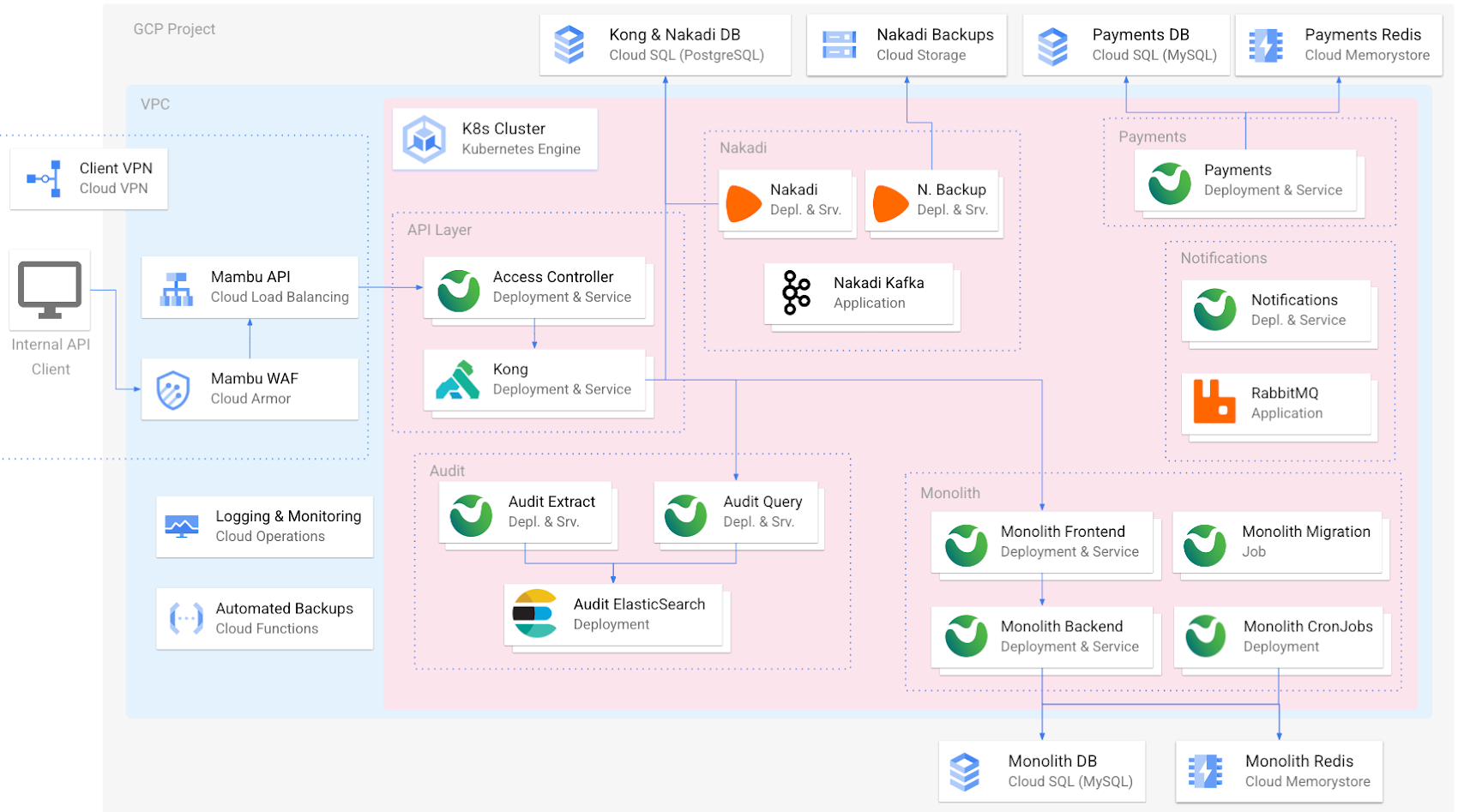
In addition to GKE, the Mambu platform uses several other Google Cloud services for specific functions, including Cloud Armor, Cloud Load Balancing, Cloud VPN, Cloud Memorystore, and Google Cloud Operations.
Another important reason we chose to partner with Google Cloud was its expansive ecosystem and commitment to innovation. We are midway into a three-year journey to modernize our own technology stack to meet customer needs.
Building a roadmap with Google Cloud
Our customers need a core banking technology platform that will grow with them as they bring to market innovative services built on the latest technology advances. For Mambu to be that platform, we need a cloud partner that supports and scales with our growth. While we originally built our cloud architecture on GKE and Compute Engine (among a few other Google Cloud services), we’re now looking to a serverless future where we can scale more easily and leverage managed services within Google Cloud and its partner ecosystem to focus on our core offerings.
These are just some of the modernization and customer-led innovations that we’re cooking up:
- More workloads in GKE: Like many companies, our cloud transformation is a work in progress. While much of our codebase is in GKE, we’re continuing to break up some larger pieces of code into microservices to increase agility and velocity, enabling us to make consistent updates to discrete areas of our platform without affecting the whole. GKE is the leader for orchestrating microservices at scale and continues to be a natural fit.
- Native BigQuery integration: Mambu customers collect a tremendous amount of data within the platform that can be used for analytics, personalization, and other use cases. We’re planning to create a seamless integration for feeding core banking data from Mambu into BigQuery so that customers can better leverage their valuable data.
- CloudSQL vs. self-managed MySQL: We have almost completed migrating from our own MySQL instances to managed Cloud SQL databases, which will open up new opportunities to implement customer-centric solutions such as BigQuery integration.
- A serverless future with Cloud Run: Compute Engine is working well for Mambu, providing the flexibility to choose the virtual machines that best balance performance and cost needs. As we seek even more time and cost efficiencies, we believe the elastic scalability of a serverless architecture built on Cloud Run will get us there, and we’re considering going serverless in the future. Doing so would abstract infrastructure for simpler management, while allowing us to fire up containers to meet our customers’ high transactions-per-second needs, spin them down when not needed, and pay only when they run. It would also boost security: Without long-running compute, there are no patches or fixes, and each new instance is isolated and fresh by default.
These are just a handful of examples of the ways we want to best leverage Google Cloud services to simplify how we manage our tech stack, as well as continue to bolster security, scalability, and performance. There are many other ideas we’re exploring: using Dataproc and Datastream to support the specific data needs of Islamic banking, Cloud Functions so that customers can run their own queries against Mambu, and AI-enabled features.
At Mambu, our mission is to empower our customers to deliver great modern financial experiences easily to everyone around the world. Every time Google Cloud opens a new data center, we can enter a new market. Every time we move to a new-to-us managed service via the Google Cloud Marketplace, we free up time to build new ways to deliver customer-centric banking solutions. And so, we look forward to continuing this partnership with Google Cloud well into the future.
Digital Maturity in Higher Ed Tied to Improvements in Students’ Journey: Study

5136
Of your peers have already read this article.
3:00 Minutes
The most insightful time you'll spend today!
Why Higher Ed Needs to Go All-in on Digital
In the wake of the COVID-19 pandemic, the majority of students within the 18-24-year-old demographic now expect hybrid learning environments–even once we are beyond the pandemic. And a vast number of adult learners are seeking options that accommodate their work and family lives now that it’s clear that effective learning can indeed occur virtually. Implementing cloud technologies and achieving digital maturity within higher education will enable institutions to be innovative and responsive to evolving student preferences, while being prepared for future disruptions.
The state of digital maturity
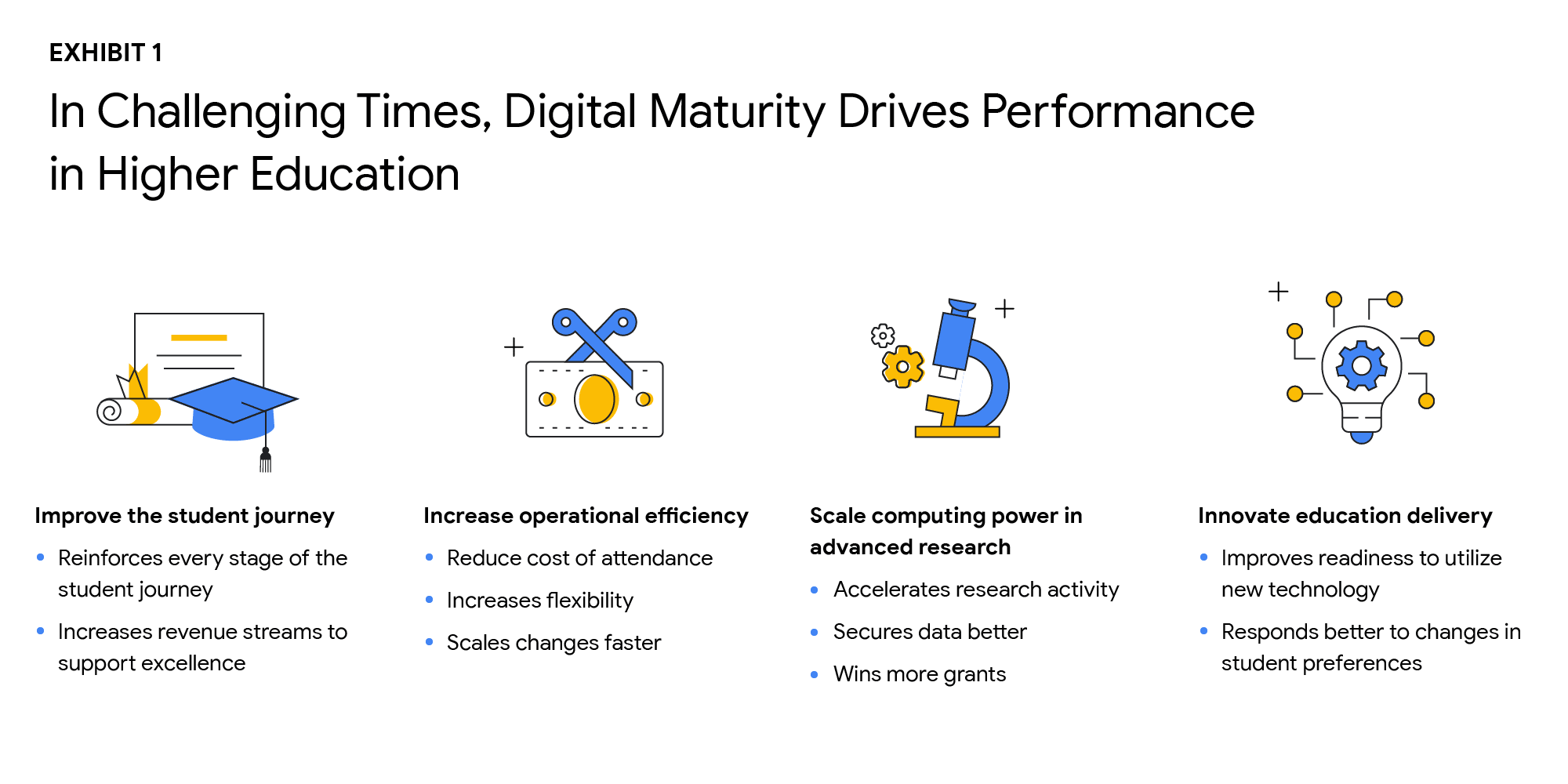
In February and March 2021, Boston Consulting Group (BCG), in partnership with Google, surveyed U.S. higher education leaders on their views of the state of digital maturity in the higher education sector. This survey found that institutional and technology leaders strongly agreed that moving legacy IT systems to the cloud, centralizing and integrating data, and increasing the use of advanced analytics is necessary to make a successful digital transformation, and ultimately achieve digital maturity.
But what is digital maturity? Digital maturity—a measure of an organization’s ability to create value through digital delivery—focuses on three areas of technological advancement that drive large-scale innovation:
- Using cloud infrastructure
- Expanding access to data
- Using that data to improve processes through advanced analytics, such as Artificial Intelligence and Machine Learning (AI/ML)
Although university leaders agree on prioritizing digital maturity, more than 55% said they considered their schools to be “digital performers” or “digital leaders.” However, only 25% of tech leaders at these universities stated that their schools regularly use data analytics. As with corporations and governments, higher education institutions face barriers to technological innovation, such as:
- Competing priorities to meet step-change goals and decentralized decision making
- Budget constraints
- Cultural resistance to change
- Tech staff skillset gaps
Still, leaders understand that the way to overcome institutional inertia is with a strong, goal-oriented vision of what is best for the institution overall. Although only a handful of schools have reached digital maturity as we define it, others can learn a great deal from their examples. Here are the top takeaways from higher education leaders who successfully transformed their institutions:
Digital solutions can improve the student journey in many ways
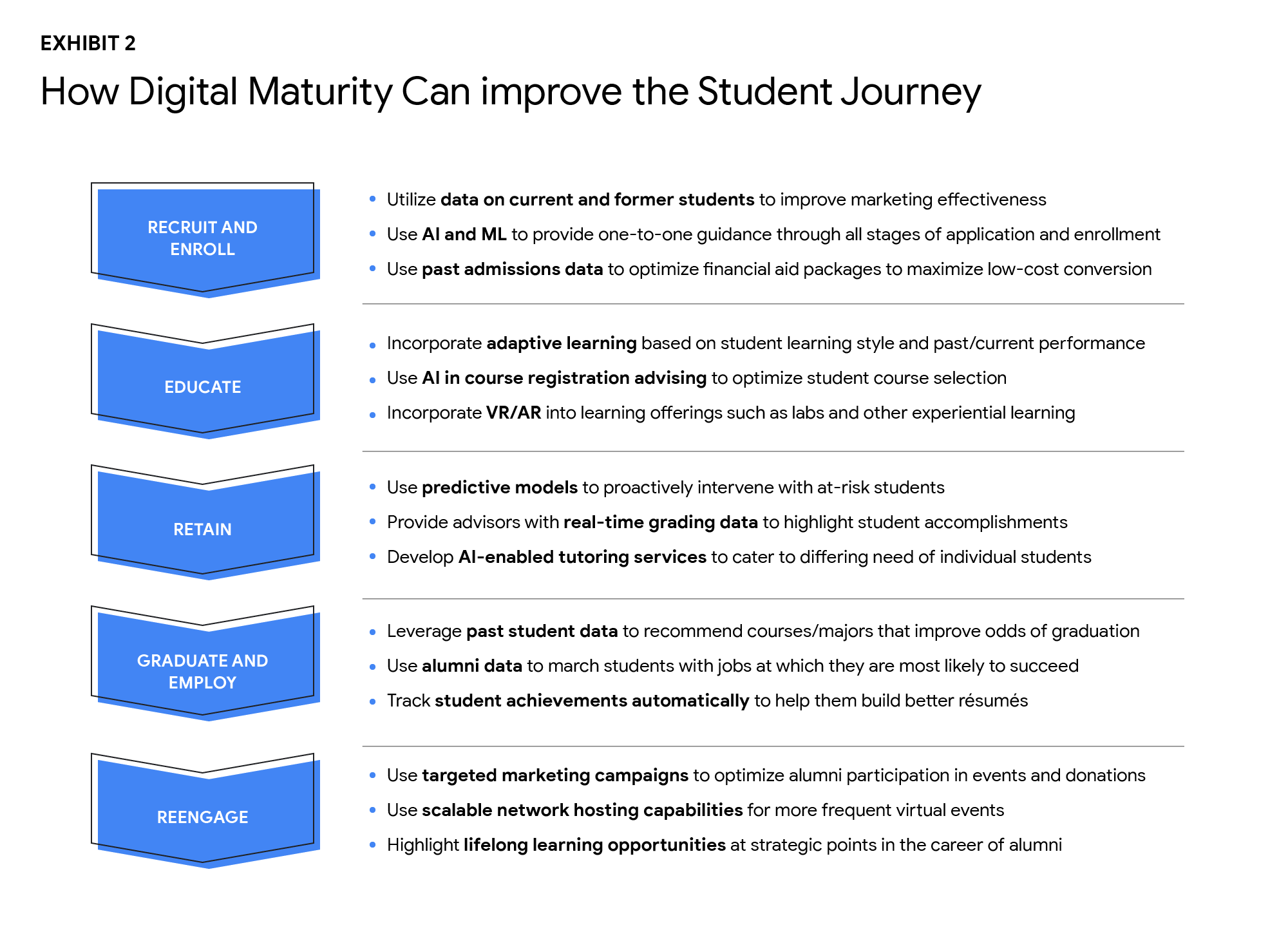
As digital capabilities hold the key to dealing effectively with declining enrollment and rising costs, higher ed leaders identified four goals that are critical to improving performance:
- Improve the student journey
- Increase operational efficiency
- Scale computing power in advanced research
- Innovate education delivery
The research found that technology investments can help enhance the student journey in the recruiting and retention of students, improving digital education delivery, government funding, and donations from alumni. Digital maturity can make institutions more agile and efficient in delivering education that aligns with the changing societal norms, evolving student preferences, and future disruptions. Survey participants shared that they plan to increase the use of the cloud by more than 50% over the next three years. By shifting legacy IT systems to the cloud, institutions can increase scalability, lower the cost of ownership, and improve operational agility, while offering a more secure, long-term data storage solution.
Cloud-native software-as-a-service (SaaS) solutions provide an excellent platform for centralizing data. However, institutions that attempt to “lift and shift” their legacy systems to the cloud may encounter challenges to achieving measurable improvements in data integration and cost reduction. Higher ed leaders must realize that centralizing data and transitioning to the cloud do not happen simultaneously.
Leaders who are able to articulate a strong vision and commitment will experience a more successful technology transformation. By linking their vision to specific needs, such as more effective recruiting, leaders will find their technology investments will have a more substantial return. University presidents should base their decisions about which systems to move, when, and how on desired performance outcomes.
Big visions become a reality with small steps. Small pilot projects are an excellent way to start the journey toward digital maturity. Small steps toward a significant transformation can reduce resistance to change, build positive momentum, and produce better student outcomes. Read the full report here. If you’d like to talk to a Google Cloud expert, get in touch.
8413
Of your peers have already watched this video.
21:00 Minutes
The most insightful time you'll spend today!
Journey to Transformation and Modernization with Google’s Distributed Cloud
Google Cloud has been leading the way of helping businesses make most from their cloud investments to drive digital transformation through modern application platforms that cater to today’s customer needs. Watch the video from the Next ’21 to explore three areas where companies are supported by Google Cloud throughout their cloud evolution journey–cloud migration and modernization, extension of services and engineering practices to hybrid and multicloud environments, and delivery of high performance with planet scale distributed infrastructure. Also, learn how Google Cloud is equipped for more complex and unique use cases, from datacenter to the edge. Hear the strategies and customer stories that can help your business modernize people, processes, and applications to fully leverage Google’s distributed cloud!
3937
Of your peers have already watched this video.
40:00 Minutes
The most insightful time you'll spend today!
Attention CFOs: How to Save Money on the Cloud
Cutting down on wastage, saving cost, and having a better control are some of the key priorities of organizations when it comes to the cloud. According to the 2018 State of the Cloud report by Rightscale, 35% of customer cloud spend is wasted, 58% of users cite cost savings as their top focus, and 76% consider spend control to be a challenge.
No wonder, customers are constantly looking to control costs and get the most capability out of every cloud dollar spent by their organizations.
Google Cloud’s simple, flexible, and fair pricing principles ensure that customers end up saving a lot more when they use Google Cloud and pay only for what they use and nothing more. Automatic discounts, recommendations, and smart tools to monitor and control usage, ensure that customers are treated fairly.
Watch this webinar to find out how you can save even more money on the cloud.
A Year of Going Carbon-free! Google’s Road to Sustainability Looks Promising

3739
Of your peers have already read this article.
2:00 Minutes
The most insightful time you'll spend today!
Last year, we announced our most ambitious sustainability goal yet: to operate everywhere on 24/7 carbon-free energy by 2030. We’ve set this goal to ensure that Google Cloud continues to be the cleanest cloud in the industry, and to show that full-scale decarbonization of electricity use is possible.
Since setting our target, we’ve made tremendous progress in how we track, buy, and use electricity; advocate for clean energy policies; and support the development of new technologies to help us reach this goal. And we’ve done it all while maintaining a commitment to transparency that we hope will make it easier for other organizations wishing to fully decarbonize their operations as well.
In the spirit of transparency, today we’re releasing the 2020 carbon-free energy percentages (CFE%) for all Google data centers, as well as overall progress on the road to our 2030 goal: In 2020, Google achieved 67% round-the-clock carbon free energy across all its data centers, up from 61% in 2019. In other words, of all the electricity consumed by Google data centers in 2020, two-thirds of it was matched with local, carbon-free sources on an hourly basis.
Though we saw a significant jump in global CFE% in 2020, we expect the numbers to vary from year to year. Ultimately, CFE% is dependent on the amount of new clean energy that comes online in a given year; we may even occasionally see short-term drops in the numbers. What’s most important is that we continue to maintain a long-term trajectory toward our 2030 goal. With meaningful progress in clean energy policy, technologies, and transactional models, we believe 24/7 carbon-free energy is achievable.
Tracking these numbers also allows us to give Google Cloud customers greater control in their own sustainability efforts. Earlier this year we announced Google Cloud Region Picker, a system that helps our customers assess factors like cost, speed, and CFE% as they choose where to run their applications.
To outline some of the events that have helped us get to 67% CFE%, we’ve developed an animation that shows every hour of electricity use in 2020, at all our Google data centers around the world.
Visualizing clean energy: every hour, every day, everywhere
Imagining what every hour in a year looks like is hard enough (there are 8,760 of them, in case you’re wondering). With 23 data centers and 25 cloud regions around the world, we’re aiming to source clean energy for over 200,000 operational hours each year.
https://youtube.com/watch?v=f9ecEokcFlk%3Fenablejsapi%3D1%26
The “A year in carbon-free energy” animation points out significant projects that came online in 2020 to bring our data centers closer to operating entirely on round-the-clock carbon-free energy. It also reflects an unparalleled level of transparency about our carbon-free energy data, showing hour-by-hour where we need to develop new clean energy projects, advocate for policy changes, and in some cases, look to new technologies that can help fill in the gaps left by variable renewable resources.
In the animation, you’ll notice sites with a lot of green at midday (e.g. in Chile or the U.S. Southeast) – a sign that solar is making a big contribution. Other data centers, such as our facilities in the U.S. Midwest, rely more heavily on wind power and are subject to seasonal fluctuations in wind speed.
Preventing the worst impacts of climate change will require decarbonizing the world’s electric grids, as fast as possible. Google is committed to doing as much as possible to clear a path for others and drive collective action to achieve this goal. We’re thrilled to be in good company as we move, together, toward a carbon-free future.
Making Weather Predictions Easy with Weather Research and Forecasting (WRF) Models on Google Cloud!

3580
Of your peers have already read this article.
6:00 Minutes
The most insightful time you'll spend today!
Weather forecasting and climate modeling are two of the world’s most computationally complex and demanding tasks. Further, they’re extremely time-sensitive and in high demand — everyone from weekend travelers to large-scale industrial farming operators wants up-to-date weather predictions. To provide timely and meaningful predictions, weather forecasters usually rely on high performance computing (HPC) clusters hosted in an on-premises data center. These on-prem HPC systems require significant capital investment and have high long-term operational costs. They consume a lot of electricity, have largely fixed configurations, and the underlying computer hardware is replaced infrequently.
Using the cloud instead offers increased flexibility, constantly refreshed hardware, high reliability, geo-distributed compute and networking, and a “pay for what you use” pricing model. Ultimately, cloud computing allows forecasters and climate modelers to provide timely and accurate results on a flexible platform using the latest hardware and software systems, in a cost effective manner. This is a big shift compared with traditional approaches to weather forecasting, and can appear challenging. To help, weather forecasters can now run the Weather Research and Forecasting (WRF) modeling system easily on Google Cloud using the new WRF VM image from Fluid Numerics, and achieve the performance of an on-premises supercomputer for a fraction of the price. With this solution, weather forecasters can get a WRF simulation up and running on Google Cloud in less than an hour!
A closer look at WRF
Weather Research and Forecasting (WRF) is a popular open-source numerical weather prediction modeling system used by both researchers and operational organizations. While WRF is primarily used for weather and climate simulation, teams have extended it to support interactions with chemistry, forest fire modeling, and other use cases. WRF development began in the late 1990s through a collaboration between the National Center for Atmospheric Research (NCAR), National Oceanic and Atmospheric Administration (NOAA), U.S. Air Force, Naval Research Laboratory, University of Oklahoma, and the Federal Aviation Administration. The WRF community comprises more than 48,000 users spanning over 160 countries, with the shared goal of supporting atmospheric research and operational forecasting.
The Google Cloud WRF image is built using Google’s MPI best practices for HPC, with the exception that hyperthreading is not disabled by default, and is easily integrated with other HPC solutions on Google Cloud, including SchedMD’s Slurm-GCP. Normally, installing WRF and its dependencies is a time consuming process. With these new WRF VM images, deploying a scalable HPC cluster with WRF v4.2 pre-installed is quick and easy with our Codelab. OpenMPI 4.0.2 was used throughout this work. Google has had good success with Intel MPI, and we intend to study whether further performance gains can be achieved in this context.
Optimizing WRF
Determining the optimal architecture and build settings for performance and cost was a key part of the process in developing the WRF images. We evaluated how to select the ideal compiler, right CPU platform, and the best file system for handling file IO, so you don’t have to. As a test case for assessing performance, we used the CONUS 2.5km benchmark.
Below, the CONUS 2.5km runtime and cost figure shows the run time required for simulating WRF over a two-hour forecast using 480 MPI ranks (a way of numbering processes) for different machine types available on Google Cloud. For each machine type, we’re showing the lowest measured run time from a suite of tests that varied compiler, compiler optimizations, and task affinity.
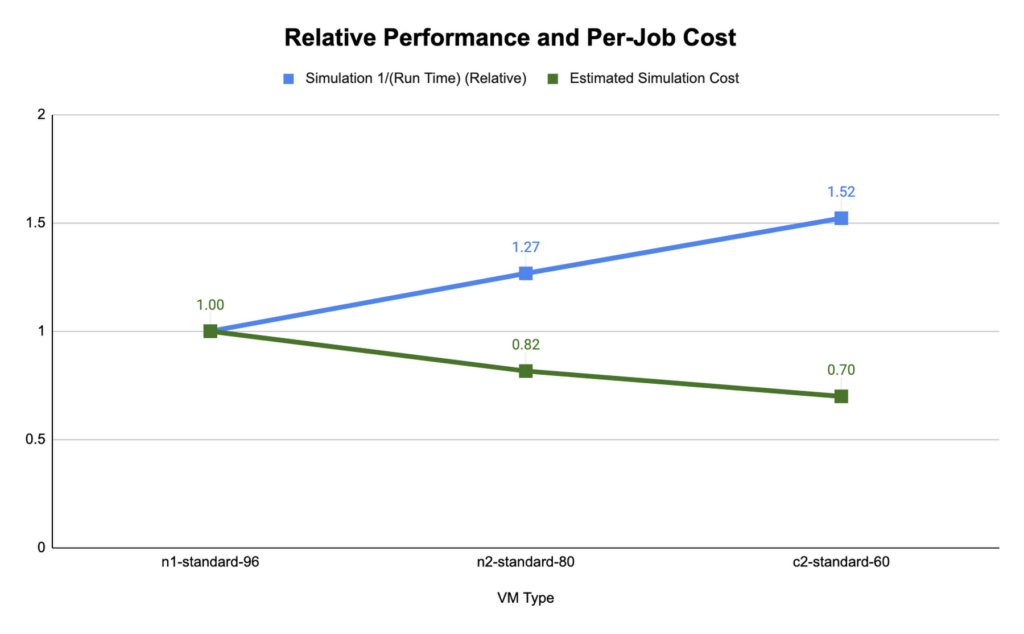
We found that compute-optimized c2 instances provided the shortest run time. The Slurm job scheduler allows you to map the MPI tasks to compute hardware using task affinity flags. When optimizing the runtime and cost for each machine type, we compared using srun –map-by core –bind-to core to launch WRF, which maps each MPI process to a physical core (two vCPU per MPI rank), and srun –map-by thread –bind-to thread, which maps each MPI process to a single vCPU. Mapping by core and binding MPI ranks to cores is akin to disabling hyperthreading.
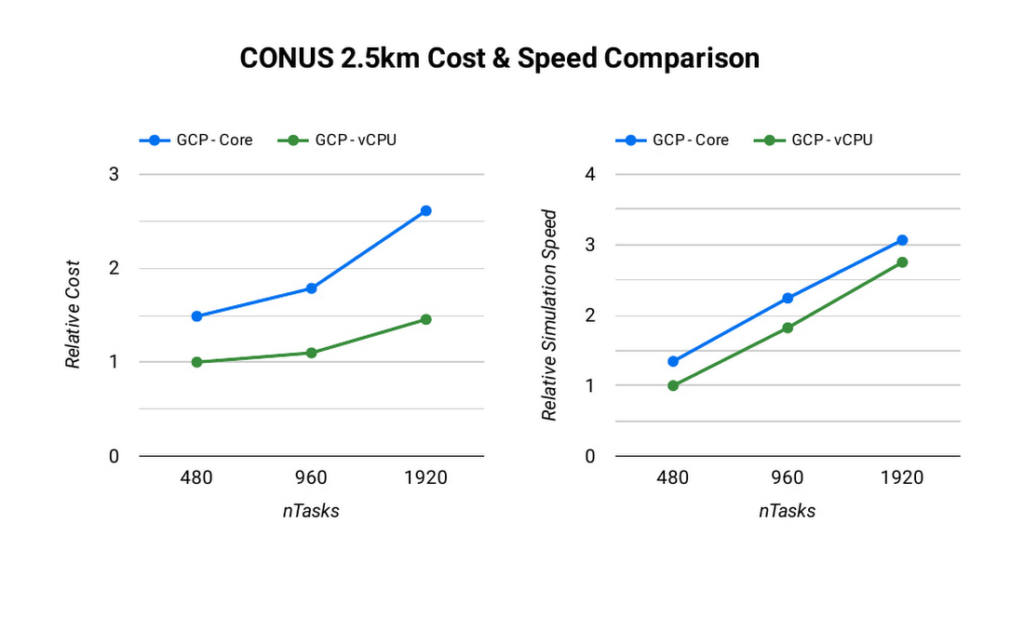
The ideal simulation cost and runtime for CONUS 2.5km for each platform is found when each MPI rank is subscribed to each vCPU. When binding to vCPUs, half as many compute resources are needed when compared to binding to physical cores lowering the per-second cost for the simulation. For CONUS 2.5km, we also found that although mapping MPI ranks to cores results in reduced runtime for the same number of MPI ranks, the performance gains are not significant enough to outweigh the cost savings. For this reason, the WRF-GCP solution does not disable hyperthreading by default.
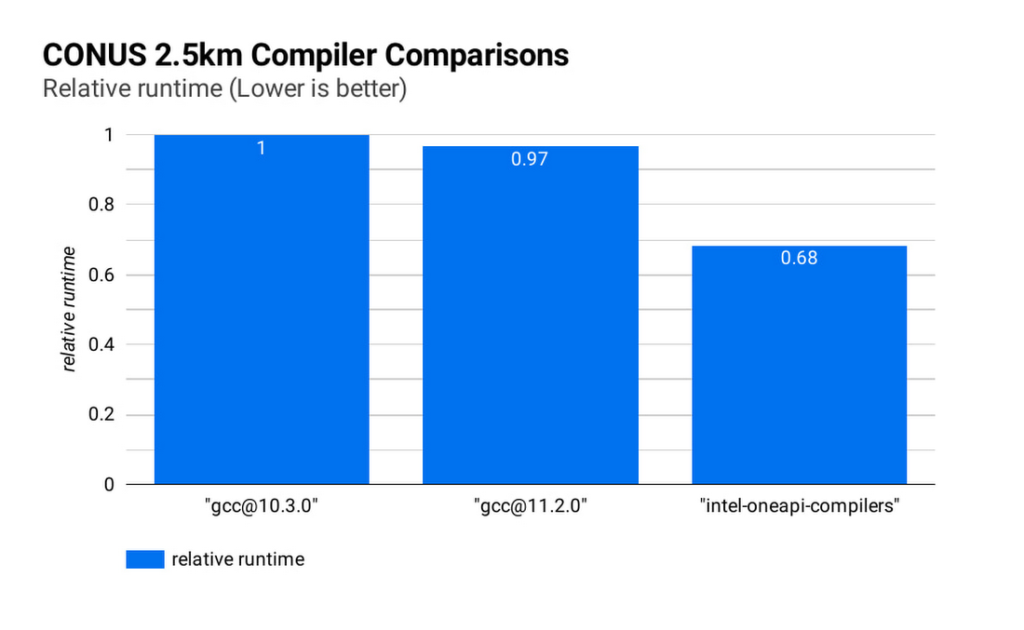
Runtime and simulation cost can be further reduced by selecting an ideal compiler: the figure below (CONUS 2.5km Compiler Comparisons) shows the simulation runtime for the WRF CONUS 2.5km benchmark on eight c2-standard-60 instances, using GCC 10.30, GCC 11.2.0 and the Intel® OneAPI® compilers (v2021.2.0). In all cases, WRF is built using level 3 compiler optimizations and Cascade Lake target architecture flags. By compiling WRF with the Intel® OneAPI® compilers, the WRF simulation runs about 47% faster than the GCC builds, and at about 68% of the cost, on the same hardware. We’ve used OpenMPI 4.0.2 with each of the compilers as the MPI implementation in this work. With other applications, Google has seen good performance with Intel MPI 2018, and we intend to investigate performance comparisons with this and other MPI implementations.
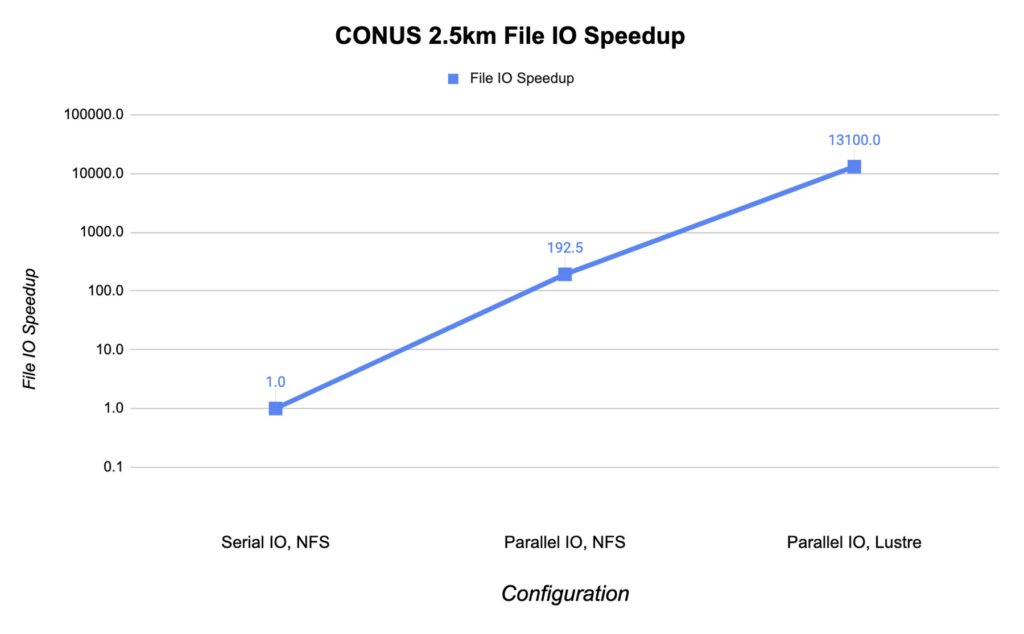
File IO in WRF can become a significant bottleneck as the number of MPI ranks increases. Obtaining the optimal file IO performance requires using parallel file IO in WRF and leveraging a parallel file system such as Lustre.
Below, we show the speedup in file IO activities relative to serial IO on an NFS file system. For this example, we are running the CONUS 2.5km benchmark on c2-standard-60 instances with 960 MPI ranks. By changing WRF’s file IO strategy to parallel IO, we accelerate file IO time by a factor of 60.
We further speed up IO and reduce simulation costs by using a Lustre parallel file system deployed from open-source Lustre Terraform infrastructure-as-code from Fluid Numerics. Lustre is also available with support from DDN’s EXAScaler solution in the Google Cloud Marketplace. In this case, we use four n2-standard-16 instances for the Lustre Object Storage Server (OSS) instances, each with 3TB of Local SSD. The Lustre Metadata Server (MDS) is an n2-standard-16 instance with a 1TB PD-SSD disk. After mounting the Lustre file system to the cluster, we set the Lustre stripe count to 4 so that file IO can be distributed across the four OSS instances. By switching to the Lustre file system for IO, we speed up file IO by an additional factor of 193, which is orders of magnitude faster than a single NFS server with serial IO.
Adding compute resources and increasing the number of MPI ranks reduces the simulation run time. Ideally, with perfect linear scaling, doubling the number of MPI ranks would cut the simulation time in half. However, adding MPI ranks also increases communication overhead, which can increase the cost per simulation. The communication overhead is due to the increased amount of communication necessitated by splitting the problem more finely across more machines.
To assess the scalability of WRF for the CONUS 2.5km benchmark, we can execute a series of model forecasts where we successively double the number of MPI ranks. Below, we show two- hour forecasts on the c2-standard-60 instances with the Lustre file system, varying the number of MPI ranks from 480 to 1920. In all of these runs, MPI ranks are bound to vCPUs so that the number of vCPUs dedicated to each simulation increases with the increase in MPI ranks. While many HPC workloads run best with simultaneous multithreading (SMT) disabled, we find the best performance for CONUS 2.5km with SMT enabled. Thus, the number of MPI ranks in our runs equals the total number of vCPUs.
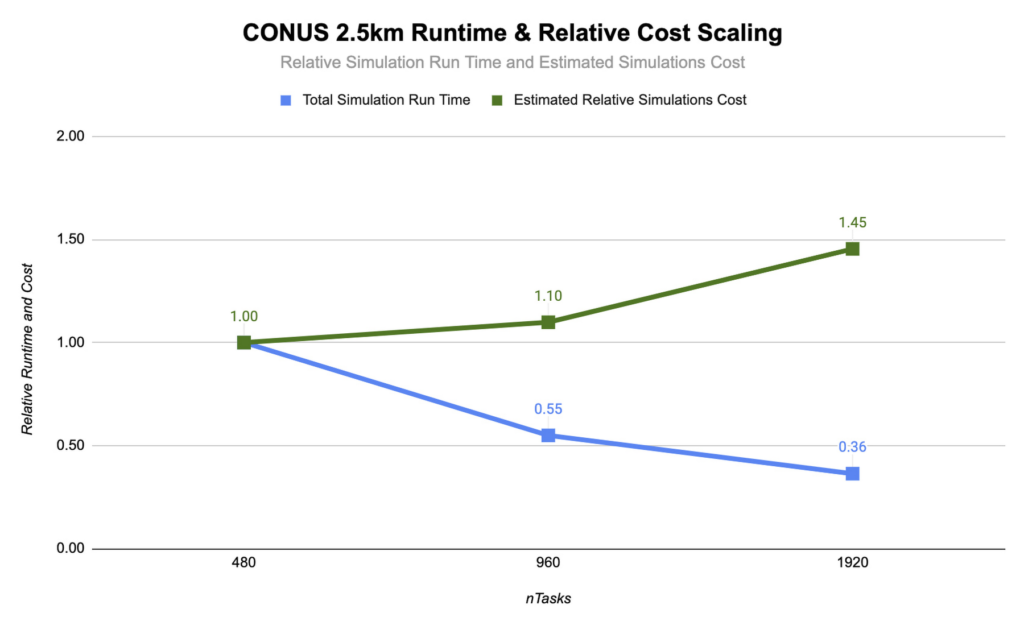
As you can see, the CONUS 2.5km Runtime & Cost Scaling figure shows that the run time (blue bars) decreases as the number of MPI ranks and the amount of compute resources increases, at least up to 1920 ranks. When transitioning from 480 to 960 MPI ranks, the run time drops, yielding a speedup of about 1.8x. Doubling again to 1920 MPI ranks, though, we obtained an additional speedup of just 1.5x. This declining trend in the speedup with increasing MPI ranks is a signature of MPI overhead, which increases with more MPI ranks.
Determining your best fit
Most tightly-coupled MPI applications such as WRF exhibit this kind of scaling behavior, where scaling efficiency decreases with increasing MPI ranks. This makes assessing cost-scaling alongside performance-scaling critical when considering Total Cost of Ownership (TCO). Thankfully, per-second billing on Google Cloud makes this kind of analysis a little bit easier. As shown above, a second doubling of the count from 960 cores to 1920 cores can provide an additional 1.5x speedup, but at a 32% higher cost. In some circumstances, this faster turnaround may be needed and worth the extra cost.
If you want to get started with WRF quickly and experiment with the CONUS 2.5km benchmark, we’ve encapsulated this deployment in Terraform scripts and prepared an accompanying codelab.
You can learn more about Google Cloud’s high performance computing offerings at https://cloud.google.com/hpc, and you can find out more about Google’s partner Fluid Numerics at https://www.fluidnumerics.com.
More Relevant Stories for Your Company

30 Guides to Ease Your Cloud Migration Journey
Getting started with your migration One of the challenges with cloud migration is that you’re solving a puzzle with multiple pieces. In addition to a number of workloads you could migrate, you’re also solving for challenges you’re facing, the use cases driving you to migrate, and the benefits you’re looking to gain.


A Quick Guide to Cloud Monitoring
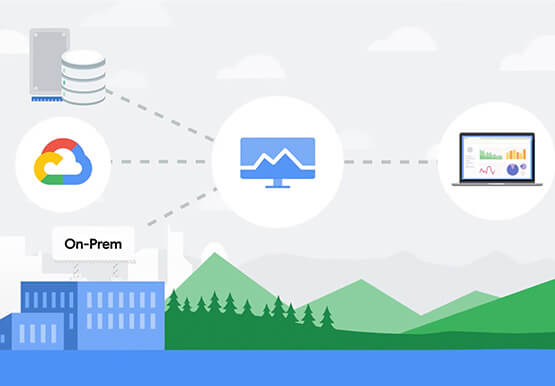
Cloud Monitoring is a tool that allows you to gain visibility into the performance, availability, and health of your applications and infrastructure. In this video, we show you what Cloud Monitoring is and how you can use it to custom define service-level objectives (SLOs), monitor application metrics, and the overall

The Power of Two: Best Practices for Mergers & Acquisitions on Google Cloud
Congratulations! Your company just acquired or merged with another organization, beginning an important new chapter in its history. But like with many business deals, the devil is in the details — particularly when it comes to integrating the two companies’ cloud domains and organizations. In this blog post, we look

Lending DocAI Shortens Borrowers’ Journey on Roostify
The home lending journey entails processing an immense number of documents daily from hundreds of thousands of borrowers. Currently, home lending document processing relies on some outdated digital models and a high dependency on manual labor, resulting in slow processing times and higher origination costs. Scaling a business that sorts
