





Beany’s Cloud-Based Accounting Solutions Transform Small Business Finance

1815
Of your peers have already read this article.
2:30 Minutes
The most insightful time you'll spend today!
Many people start a small business that aligns with their passions, but soon discover the day-to-day running of a business is very different than anticipated. Dealing with accounting, finance, and other daily activities can quickly overwhelm even the most promising of new businesses.
Recognizing the unique challenges facing small businesses, we founded Beany. With our personalized accounting platform, small business owners can relax knowing that we will look after all their compliance and advisory needs. Business owners who use Beany also benefit because they end up freeing more time to focus on what they enjoy and do best—likely the main reasons they started their business in the first place. We prepare financial statements, minimize tax and keep an eye that our clients are paying the right amount at the right time. We also advise on business purchase and sale, valuations and forecasting for banks. In fact, we do everything that a business owner needs from their accountant, including a help desk filled with domain experts to provide free & unlimited advice and support.
As we expand our team, we’ll continue to introduce new solutions, services, and integrations that make it even easier for small businesses to prioritize business planning, balance budgets, and keep up with ever-changing tax laws. We also plan to launch Beany in new markets and extend our global footprint beyond New Zealand, Australia, and the UK.
Migrating and scaling Beany
Beany was initially developed and hosted on a virtual private server (VPS) with limited capabilities. As our subscriber base grew, we realized we needed a more scalable, secure solution to eliminate downtime and deliver a reliable customer experience. We also understood it would be challenging for our small engineering team to cost-effectively test and deploy new features without a more agile development environment.
With that in mind, we chose the secure-by-design infrastructure of Google Cloud to power Beany and help us scale our innovative accounting platform. We now use Compute Engine to cost-effectively create virtual machines (VMs) that automatically select optimal amounts of processing and memory.
In addition, we encrypt, store, and archive everything on highly secure Cloud Storage, leveraging a combination of solid-state drives (SSDs) and hard disk drives (HDDs) for hot, nearline, and coldline data. With Cloud Storage, we can replicate data between regions in under 15 minutes to enable rapid recovery and business continuity. This has been really useful moving images to data centers on the other side of the planet quickly as we primarily operate out of Sydney and London.
We also connect, create, and collaborate on Google Workspace using Google Gmail, Docs, Calendar, and Meet. Beany smoothly integrates with Google Sheets to provide live reporting from our application direct to our sales, marketing and support staff. It also makes sharing account data with our accounting clients easy and secure.
Analyzing financial data with Google Cloud AI and machine learning
Joining the Google for Startups Cloud Program gave us immediate access to Google Cloud credits which we use to cost-effectively trial and deploy additional Google Cloud solutions. We continue to evaluate Cloud Code which will help our developers more efficiently create, deploy, and integrate applications directly on Google Cloud. We’re also exploring how Google Cloud AI and machine learning products such as Vertex AI and AutoML can further revolutionize accounting with advanced financial analyses and end-to-end automation of business processes.
We can’t wait to see what we accomplish next as we grow our team and introduce new services and solutions that enable small businesses to streamline operations, lower costs, and increase profits. It’s exciting to help small business owners manage accounting and financial planning so they can spend more time doing what they love and realize their business vision.

Beany team members
If you want to learn more about how Google Cloud can help your startup, visit our page here to get more information about our program, and sign up for our communications to get a look at our community activities, digital events, special offers, and more.
Reducing Data Costs by 80% with Google Cloud: Inshorts’ Success in the Indian Mobile News Market

2798
Of your peers have already read this article.
3:30 Minutes
The most insightful time you'll spend today!
About inshorts
Mobile news platform inshorts condenses the latest national and international news into 60-word briefs in English and Hindi. With 10 million downloads so far, it’s expanding to cater to millions more on-the-go Indians reading news on mobile devices.

Across India, hundreds of millions of people turn to their smartphones for news that will enhance their lives and help them achieve their goals. According to Professor Rasmus Kleis Nielsen, Director of the Reuters Institute for the Study of Journalism: “The past few years have seen explosive growth in mobile internet access, and the rapid move to digital media will have profound implications for the practice of journalism, the business of news, media institutions, and thus by extension political and public life in India.” The Institute reports that Indians with internet access have risen from 100 million to 500 million in the past decade alone. The report identifies India’s news industry as “a mobile-first market,” with 66% of Indians citing smartphones as the device they most frequently use to access online news.
Seeing an opportunity to meet the growing need for news on the go, inshorts developed a mobile news platform for Indians on the move who want to stay informed but don’t have time to read long articles. The inshorts solution condenses news, from politics to cricket, into briefs of under 60 words and has been well received, with 10 million downloads since launching in 2013.
To keep the attention of its always-on news consumers and attract more users for continued growth, inshorts knows it must continuously evolve and improve its platform. The company turned to Google Cloud in 2016 in order to free its developers from time-consuming infrastructure maintenance tasks and enable them to focus on creating innovative applications instead. It was also looking for powerful yet cost-effective data and scaling tools to reach more remote corners of India and found this in Google Cloud.
“There’s a new wave of 300 to 400 million first time mobile users projected for India,” says Manish Bisht, Head of Technology at inshorts. “We want to capture those users, and Google Cloud is helping us succeed.”
Freeing up resources for new solutions
By migrating to Google Cloud, inshorts has been able to free up its development team to experiment with new ideas, without worrying about backend management or costs. The company worked with cloud consultancy Searce, a Google Cloud Premier Partner, to define the best solutions for achieving its goals. Searce partners with clients to help them scale their business by leveraging Cloud, AI/ML, and data analytics while reducing the operational IT infrastructure spend. Because it specializes in AI/ML, Anthos, and Cloud Search, inshorts chose it as the ideal partner for futurifying its business on Google Cloud. According to Manish, the Searce team was focused not only on helping inshorts to migrate and adopt a on-demand computing mindset, but helping it to decrease monthly costs as well. “There’s always a positive push from Searce, to help us move forward, and to really put our company’s priorities first,” he says.
Through the application development solutions of Firebase, for example, inshorts is able to test new features in a rapidly shifting market. The product’s ease-of-use and built-in data analytics mean that inshorts can now allocate its developer resources more efficiently across multiple projects, instead of needing an entire team to focus on one project. Product cycles are now just one week long, instead of one month, and each backend and frontend developer in the team of four is able to focus on a separate project, meaning that more work gets done in a shorter time.
Dataflow, which enables real-time data processing, has been a major factor in allowing inshorts to instantly recommend content to users. Previously, the company had managed its own instances, first manually recording what users were doing and later pushing out recommendations. That all changed with Dataflow. “Dataflow freed a lot of our development and instance management time, because we can process data in real time now,” says Manish. “And that means giving users what they want instantly.”
Perhaps one of the biggest time savings came from using Dataproc, which released the inshorts team from the task of managing clusters. “We simply moved to Dataproc, provisioned the machines, and let Google Cloud take over all the management for us,” says Manish. “This one change translated into labor savings of up to six hours a day.”
Where costs are concerned, inshorts is happy to report that Google Cloud has led to not just time savings, but monetary savings as well. The company had begun its cloud journey with a leading provider, but soon found that data analytics services were driving up costs. Meanwhile, the service required high levels of technical expertise to manage the growing infrastructure, which meant it needed to hire a DevOps expert. After switching to Google Cloud products such as Google Kubernetes Engine (GKE), Cloud Deployment Manager, and Cloud Build, inshorts has now reduced most of its DevOps burden.
“At the time, we were spending around USD100,000 per month in data analysis and data-related fields alone. We had to pursue a cost optimization drive,” recalls Manish. “We had no idea how much we would save just by migrating to Google Cloud. We brought down our costs for the entire infrastructure to around USD20,000 per month.”
The company now uses BigQuery with Looker Studio to analyze and predict its tech expenditure. With Looker Studio, it can easily visualize infrastructure costs and break them down by team, services, and project stakeholders.
Processing millions of images quickly, delivering news instantly
inshorts cites the move to GKE as one of its most important moves. “At one point, we were processing a quarter of a million images per day. Because images are uploaded by our users, traffic is unpredictable; planning the exact amount of compute needed in a given moment is almost impossible. Load balancing itself was no longer enough,” shares Manish. “Google Kubernetes Engine makes life easier for our developers, reducing the need for them to be ever present, and giving them a tool that’s easy to work with.”
The inshorts team moved to GKE primarily to gain this ease of use, where its team can now push a few configurations, then spin up clusters, tell them how to handle the load and what kind of machines to provision, and manage resources effectively. The team has reduced its dependency on DevOps since there’s no need for developers to worry about what size of machines they need for their applications. “The size of machine needed depends on the specific job, and with Google Kubernetes Engine it’s very easy to accommodate a whole range of jobs. We simply optimize our resources, scaling up or down as needed,” says Manish.
As inshorts’ platform becomes more feature-rich and sophisticated, it is taking advantage of the global network of Google Cloud. With its data center in the United States, the platform had begun to experience latency of about 600ms, too great a lag in an age of instant news. Because Google Cloud has regional data centers around the world, inshorts was able to simply move its data center closer to home, bringing down average latency to 100 ms. “We achieved significant app performance improvements thanks to being able to migrate our data center,” says Manish. “The loading was faster; everything was faster.”
Mapping the future with localized news
Being able to develop features even faster is enabling inshorts to pursue its goal of expanding into every corner of India. To capture the wave of new mobile consumers, inshorts realizes that it needs to start by finding out exactly where they are. Using Google Maps Platform, the company has launched a location-based social video app called Public, which offers news that’s highly localized to specific Indian communities and relevant to what they want to read.
As a developing nation, India’s mapping landscape is constantly changing. There were 722 administrative regions when inshorts began its work, but by 2018, 10 new districts had been added to this number. Because Public serves rural and suburban audiences, it’s crucial that it can stay on top of these rapid and sometimes confusing changes. According to Manish, Google Maps Platform not only offers granular geo-location through the Geolocation API but adapts to mapping changes in near real time. It’s a capability that inshorts is harnessing to make the Public app into its next success. “The app is experiencing tremendous growth in the tier two and three cities,” shares Manish, “In the short span of six months, it has already become the category’s number-one ranked app on the Google Play store.”
Tell us your challenge. We’re here to help.
4891
Of your peers have already watched this video.
1:30 Minutes
The most insightful time you'll spend today!
Accelerate Your Digital Transformation Through a Modern Infrastructure
Learn about the latest advancements to Google Cloud Platform’s unique infrastructure to accelerate enterprise workloads and build planet scalable solutions. Hear how Google Cloud’s infrastructure enables you to solve problems faster, more securely, and at greater scale.
See how Google Cloud is accelerating the support for enterprise workloads like SAP, VMware, and Windows and augmenting new capabilities to better protect and secure your workloads. Discover how Google Cloud enables businesses to build high-scale applications with global scale and reach.
5322
Of your peers have already watched this video.
1:30 Minutes
The most insightful time you'll spend today!
Why Enterprises Should Choose Google Cloud for their SAP Workloads
Change is a constant for SAP customers. Now more than ever, SAP customers need solutions that provide them business agility, rock solid availability and security and true economic value.
Learn how Google Cloud can guide your SAP journey to the cloud with simple and no cost migrations, powerful infrastructure and innovation technologies that you can take advantage of today.
Hear from SAP customers who have deployed on Google Cloud and the game changing results they are realizing.
AI in Manufacturing Already A Mainstream: Google Cloud Study

5674
Of your peers have already read this article.
3:00 Minutes
The most insightful time you'll spend today!
While the promise of artificial intelligence transforming the manufacturing industry is not new, long-ongoing experimentation hasn’t yet led to widespread business benefits. Manufacturers remain in “pilot purgatory,” as Gartner reports that only 21% of companies in the industry have active AI initiatives in production.
However, new research from Google Cloud reveals that the COVID-19 pandemic may have spurred a significant increase in the use of AI and other digital enablers among manufacturers. According to our data—which polled more than 1,000 senior manufacturing executives across seven countries—76% have turned to digital enablers and disruptive technologies due to the pandemic such as data and analytics, cloud, and artificial intelligence (AI). And 66% of manufacturers who use AI in their day-to-day operations report that their reliance on AI is increasing.

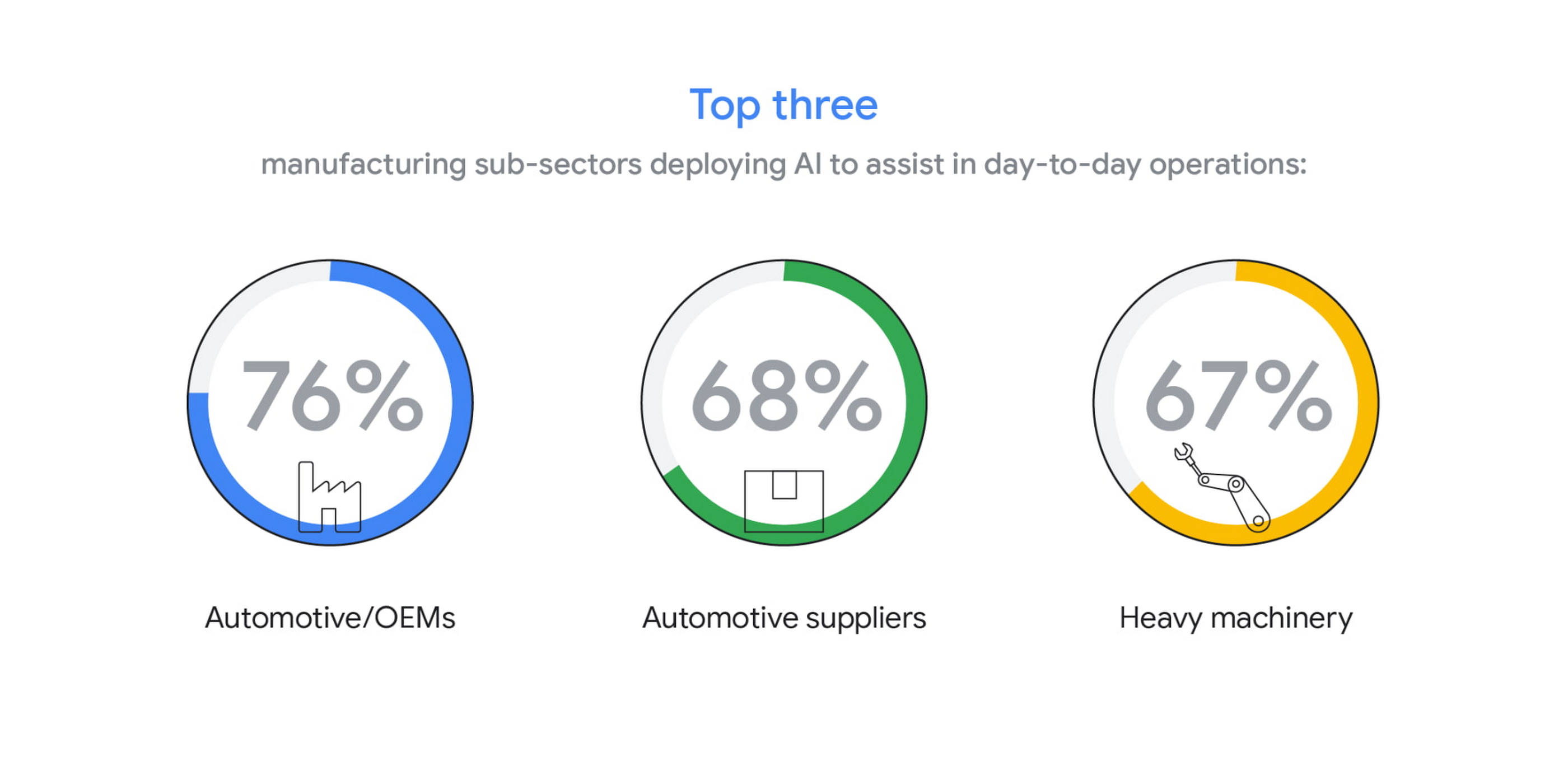
The top three sub-sectors deploying AI to assist in day-to-day operations are automotive/OEMs (76%), automotive suppliers (68%), and heavy machinery (67%).
In fact, Bryan Goodman, Director of Artificial Intelligence and Cloud, Ford Global Data & Insight and Analytics shares, “Our new relationship with Google will supercharge our efforts to democratize AI across our business, from the plant floor to vehicles to dealerships. We used to count the number of AI and machine learning projects at Ford. Now it’s so commonplace that it’s like asking how many people are using math. This includes an AI ecosystem that is fueled by data, and that powers a ‘digital network flywheel.’”
Moving from edge cases to mainstream business needs
Why are manufacturers now turning to AI in increasing numbers? Our research shows that companies who currently use AI in day-to-day operations are looking for assistance with business continuity (38%), helping make employees more efficient (38%), and to be helpful for employees overall (34%). It’s clear that AI/ML technology can augment manufacturing employees’ efforts, whether by providing prescriptive analytics like real-time guidance and training, flagging safety hazards, or detecting potential defects on the assembly line.

In terms of specific AI use cases called out by the research, two main areas emerged: quality control and supply chain optimization. In the quality control category, 39% of surveyed manufacturers who use AI in their day-to-day operations use it for quality inspection and 35% for product and/or production line quality checks. At Google Cloud, we often speak with manufacturers about AI for visual inspection of finished products. Using AI vision, production line workers can spend less time on repetitive product inspections and can instead focus on more complex tasks, such as root cause analysis.
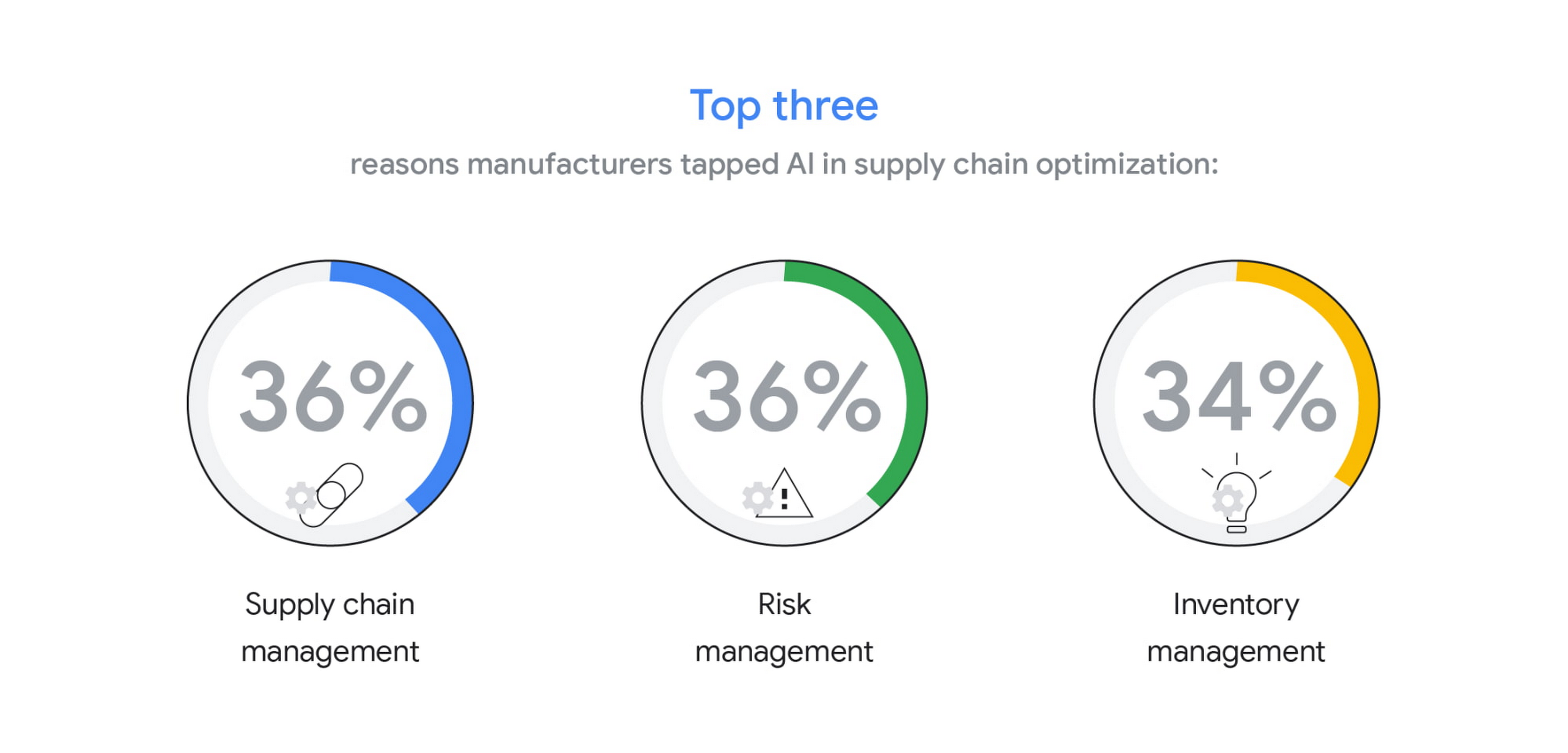
In the supply chain optimization category, manufacturers said they tapped AI for supply chain management (36%), risk management (36%), and inventory management (34%).
In our day-to-day work, we’re seeing many manufacturers rethink their supply chains and operating models to better accommodate for the increased volatility that has been brought about by the pandemic and support the secular trend of consumers asking for increasingly individualized products. We’ll share more on deglobalization in the third installment of our manufacturing insights series.
AI use differs by geography, but not for the reasons you may think
The extent to which AI is already being used today varies quite strongly between geographies, according to our research. While 80% and 79% of manufacturers in Italy and Germany respectively report using AI in day-to-day operations, that percentage plummets in the United States (64%), Japan (50%) and Korea (39%).

It’s tempting to state this disparity is due to an “AI talent gap.” Although the most common barrier, just a quarter (23%) of manufacturers surveyed believe they don’t have the talent to properly leverage AI. Cost, too, does not appear to be a roadblock (21% of those surveyed). Rather, from our observations, the missing link appears to be having the right technology platform and tools to manage a production-grade AI pipeline. This is obviously the focus of our efforts and others in the space, as we believe the cloud can truly help the industry make a step change.
Looking ahead: The Golden Age of AI for manufacturing
The key to widespread adoption of AI lies in its ease of deployment and use. As AI becomes more pervasive in solving real-world problems for manufacturers, we see the industry moving away from “pilot purgatory” to the “golden age of AI.” The manufacturing industry is no stranger to innovation, from the days of mass production, to lean manufacturing, six sigma and, more recently, enterprise resource planning. AI promises to bring even more innovation to the forefront.
To learn more about these findings and more, download our infographic here and our full report here.
Research methodology
The survey was conducted online by The Harris Poll on behalf of Google Cloud, from October 15 – November 4, 2020, among 1,154 senior manufacturing executives in France (n=150), Germany (n=200), Italy (n=154), Japan (n=150), South Korea (n=150), the UK (n=150), and the U.S. (n=200) who are employed full-time at a company with more than 500 employees, and who work in the manufacturing industry with a title of director level or higher. The data in each country were weighted by number of employees to bring them into line with actual company size proportions in the population. A global post-weight was applied to ensure equal weight of each country in the global total.
Know Your Org’s Carbon Emission Per Workload with Active Assist

3440
Of your peers have already read this article.
3:00 Minutes
The most insightful time you'll spend today!
Last year, we analyzed the aggregate data from all customers across Google Cloud, and found over 600,000 gross kgCO2e in seemingly idle projects that could be cleaned up or reclaimed — which would have a similar impact to planting almost 10,000 trees1. Today, we’re making it easy for you to identify if any of those idle workloads are yours, with new Active Assist sustainability recommendations.
Active Assist is a part of Google Cloud’s AIOps solution that uses data, intelligence, and machine learning to reduce cloud complexity and administrative toil. Under the Active Assist portfolio, we have products and tools like Policy Intelligence, Network Intelligence Center, Predictive Autoscaler, and a collection of Recommendations for various Google Cloud services — all focused on helping you achieve your operational goals. Today, we are broadening the scope of Active Assist to help you achieve your sustainability targets and reduce the carbon footprint of your workloads.
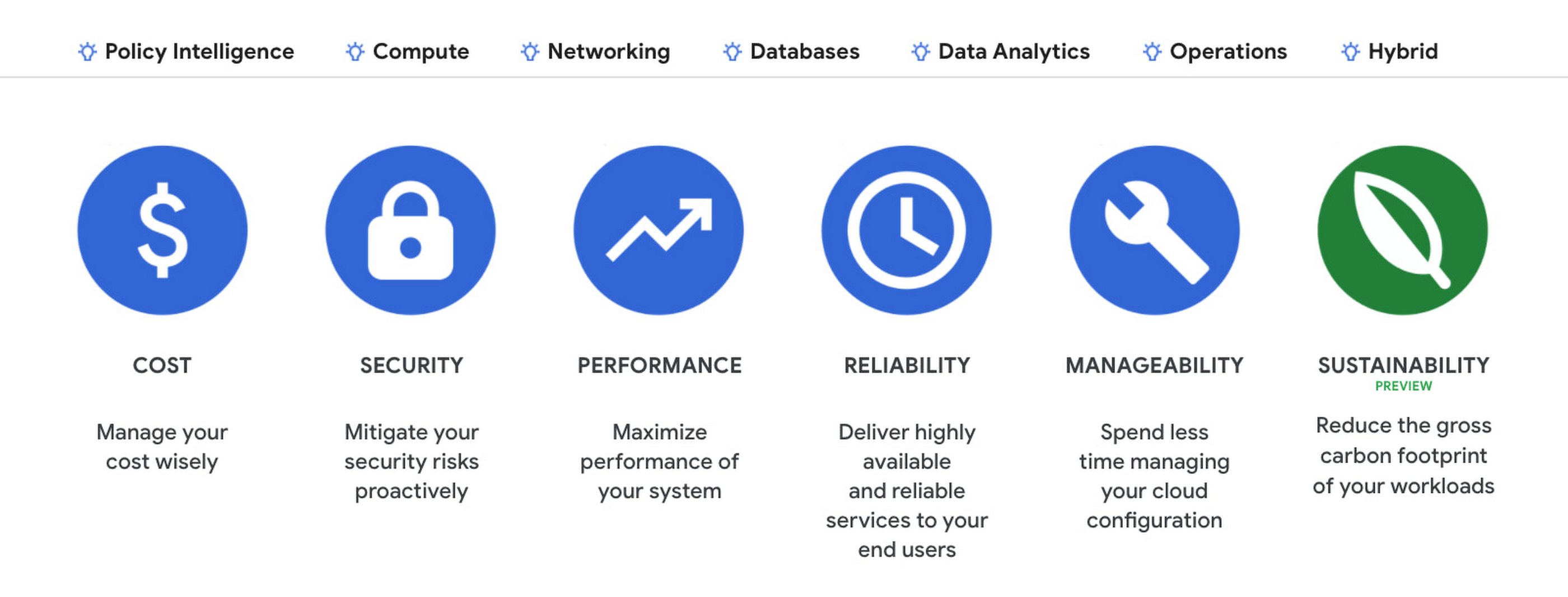
The carbon emissions associated with your cloud infrastructure can be a big part of your overall environmental footprint. Choosing to run on Google Cloud is a great first step — we’ve matched the energy used by our data centers with 100% renewable energy since 2017, and are committed to running our operations on carbon-free energy 24/7 by 2030. But once you’re running on Google Cloud, if you want to reduce the gross carbon emissions of your workload you can take action to optimize your usage.
Assessing the gross carbon impact of unattended projects
You can now estimate the gross carbon emissions you’ll save by removing these idle projects with Active Assist Unattended Project Recommender, which provides rich utilization insights for all the projects in your organization, and uses machine learning to identify ones that are idle and most likely unattended. The data points Active Assist surfaces as a part of its utilization insights now include the carbonFootprintDailyKgCO2 field, which allows you to estimate carbon emissions associated with any given project. Recommendations also estimate the impact of removing an idle project in terms of kilograms of CO2 reduced per month. The capability is available via the Recommender API, Recommendation Hub, the Carbon Footprint dashboard, and BigQuery export of recommendations, making it easy for you to integrate with your company’s existing tools and workflows.

Introducing the Carbon Sense suite
Increasing the sustainability of digital applications and infrastructure is a priority for 90% of global IT leaders2, and we’ll be continuing to invest across a number of product areas in Google Cloud, including AIOps features like Active Assist’s recommendations, to help you make progress towards your sustainability goals. To make it easy for you to find and consume these new features, we’re bundling our existing and future product work into the Carbon Sense suite — a collection of features that makes it easy to accurately report your carbon emissions, and reduce them. Active Assist joins products like Carbon Footprint, which provides you with the ability to understand and measure the gross carbon emissions of your Google Cloud usage, and our low-carbon signals, which help users choose cleaner regions to run their workloads, in the Carbon Sense suite. Stay tuned for more updates on Carbon Sense in the coming months.
Getting started with sustainability recommendations
To get started with Active Assist sustainability recommendations, check the Carbon Footprint dashboard and Recommendation Hub to review projects that may be idle and assess the carbon emissions associated with them. See recommendations in Google Cloud Console.
To view the recommendations, you will need IAM permissions for Unattended Project Recommender itself and permissions to view resources in a given organization.
You can also automatically export the recommendations from your Organization to BigQuery and then investigate any idle projects with DataStudio or Looker. Or, you can use Connected Sheets to use Google Workspace Sheets to interact with the data stored in BigQuery without having to write SQL queries.
As with any other Recommender, you can choose to opt out of data processing for your organization or your projects at any time by disabling the appropriate data groups in the Transparency & Control tab under Privacy & Security settings.
We hope you use Unattended Project Recommender to reduce the carbon footprint associated with your idle cloud resources, and can’t wait to hear your feedback and thoughts about this feature! Please feel free to reach us at active-assist-feedback@google.com. We also invite you to sign up for our Active Assist Trusted Tester Group if you would like to get early access to new features as they are developed.
1. https://www.epa.gov/energy/greenhouse-gas-equivalencies-calculator
2. https://inthecloud.withgoogle.com/it-leaders-research-21/sustainability-dl-cd.html
More Relevant Stories for Your Company

Impact of Cloud FinOps on Your Business Can be Measured with Five Key Metrics!
Value of Establishing a Baseline for Metrics As organizations continue to leverage cloud investments to drive their business growth and top line revenue, business, finance, and technology executives need to become increasingly connected in their efforts to deliver strong business outcomes. More than ever before, executives need to quantify the

Attract Investor Funding by Harnessing the Power of Cloud Operations, Billing, and Customer Care
More and more startups are choosing to build their business on Google Cloud, and if yours is one of them — welcome! And even though Google Cloud is easy to use, there’s still a lot to learn, starting with how to create and activate your account, and how to create projects, folders,

Giving Customers More Choice: Google Cloud’s New Product and Pricing Options
Over the past several years, Google Cloud has made significant investments in our infrastructure product portfolio. We launched new Tau T2D VMs, which deliver 42% better price-performance vs. other leading cloud providers. We upgraded Cloud Storage to offer more flexibility to support customers’ enterprise and analytics workloads, with dual-region buckets

Tencent Africa Cuts Cost and Improves Stability with Google Cloud
As one of Africa’s leading technology companies, Tencent Africa is responsible for WeChat operations on the continent. WeChat Africa has successfully launched a number of features including the WeChat Wallet, a mobile payment service for smartphones, which enables seamless and secure transactions for friends to send money to one another,
