





The {$persona} Survival Guide: A Roadmap for Successful Transformation

2460
Of your peers have already read this article.
1:30 Minutes
The most insightful time you'll spend today!
Part of being a security leader whose organization is taking on a digital transformation is preparing for hard questions – and complex answers – on how to implement a transformation strategy.
In our previous CISO Survival Guide blog, we discussed how financial services organizations can more securely move to the cloud. We examined how to organize and think about the digital transformation challenges facing the highly-regulated financial services industry, including the benefits of the Organization, Operation, and Technology (OOT) approach, as well as embracing new processes like continuous delivery and required cultural shifts.
As part of Google Cloud’s commitment to shared fate, today we offer tips on how to ask the right questions that can help create the conversations that lead to better transformation outcomes for your organization. While there often is more than one right answer, a thoughtful, methodical approach to asking targeted questions and maintaining an open mind about the answers you hear back can help achieve your desired result. These questions are designed to help you figure out where to start and where to end your organization’s security transformation. By asking the following questions, CISOs and business leaders can develop a constructive, focused dialogue which can help determine the proper balance between implementing security controls and fine-tuning the risk tolerance set by the executive management and the board of directors.
To start the conversation, begin by asking:
- What defines our organization’s culture?
- How can we best integrate the culture with our security goals?
CISOs should ask business leaders:
- What makes a successful transformation?
- What are the key goals of the transformation?
- What data is (most) valuable?
- What data can be retired, reclassified, or migrated?
- What losses can we afford to take and still function?
- What is the real risk that the organization is willing to accept?
Business leaders should ask CISOs and the security team:
- What are the best practices for protecting our valuable data?
- What is the business impact of implementing those controls?
- What are the top threats that we need to address?
CISOs and business leaders should ask:
- Which threats are no longer as important?
- Where could we potentially use spending for more cost-effective controls such as firewalls and antivirus software?
- What benefits do we get from refactoring our applications?
- Are we really transforming, or lifting and shifting?
- How should we perform identity and access management to meet our business objectives?
- What are the core controls needed to ensure enterprise-level performance for the first workloads?
CISOs and risk teams should ask:
- How can we use the restructuring of an existing body of code to streamline security functions?
- How should we monitor our security posture to ensure we are aligned with our risk appetite?
Business and technical teams should ask:
- What’s our backup plan?
- What do we do if that fails?
Practical advice and the realities of operational transformation
Some organizations have been working in the cloud for more than a decade and have already addressed many operational procedures, sometimes with painful lessons learned along the way. If you’ve been operating in the cloud securely for that long, we recognize that there’s a lot to be gained from understanding your approaches to culture, operational expertise, and technology.
However, there are still many organizations that have not thought through how they will operate in a cloud environment until it’s almost ready – and at that point, it might be too late. If you can’t detail how a cloud environment will operate before its launch, how will you know who should be responsible for maintaining it?
Who are the critical stakeholders, along with those responsible for engineering and maintaining specific systems, who should be identified at the start of the transformation? There are likely several groups of stakeholders, such as those aligned with operations for transformation, and those focused on control design for cloud aligned with operations.
If you don’t have the operators involved in the design phase, you’re destined to create clever security controls with very little practical value because those tasked with day-to-day maintenance most likely won’t have the expertise or training to effectively operate these controls.
This is complicated by the fact that many organizations are struggling to recruit and retain resources with the right skills to operate in the cloud. We believe that training current employees to learn new cloud skills, and giving them the time away from other responsibilities, can help build skilled, diverse cloud security teams.
If your organization continually experiences high turnover in security leadership and skilled staff, it’s up to you to navigate your culture to ensure greater consistency. You can, of course, choose to supplement internal knowledge with trusted partners – however, that’s an expensive strategy for ongoing operational cost.
We met recently with a security organization that turns over skilled staff and leadership every two to three years. This rate of churn results in a continual resetting of security goals. This particular team joked that it’s like “Groundhog Day” as they constantly re-evaluate their best security approaches yet make no meaningful progress. This is not a model to emulate.
Many security controls fail not because they are improperly engineered, but because the people who use them – your security team – are improperly trained and insufficiently motivated. This is especially true for teams with high turnover rates and other organizational misalignments. A security control that blocks 100% of attacks might be engineered correctly, but if you can’t efficiently operate it, the effectiveness of the control will plummet to zero over time. Worse, it then becomes a liability because you incorrectly assume you have a functioning control.
In our next blog, we will highlight several proven approaches that we believe can help guide your security team through your organization’s digital transformation.
To learn more now, check out:
Cloud KMS with Cloud Storage: Better Performance for High-intensity Workloads

3279
Of your peers have already read this article.
2:30 Minutes
The most insightful time you'll spend today!
Encryption is critical for securing sensitive data while it is stored and transits the cloud. Today, Cloud Storage encrypts data server-side with standard Google-managed encryption keys by default, and can also encrypt data with customer-managed encryption keys that are stored and managed by Cloud Key Management Service (Cloud KMS).
While customers have been able to secure their data on Cloud Storage with Cloud KMS keys for some time, we are always updating our encryption offerings to deliver better performance, lower costs and more capabilities that support critical business workloads. In this post, we’ll discuss some of our latest developments in this space—in particular, performance improvements for high-intensity workloads and support for customer-managed encryption keys (CMEK) for object composition.
Why use Cloud KMS with Cloud Storage?
Cloud KMS enables you to centrally manage your keys in a fast and scalable way that helps to meet your security and compliance needs. Cloud KMS generates customer-managed encryption keys (CMEK) which act as an additional layer of protection on top of Google’s default encryption keys. You can set these keys on a Cloud Storage bucket as a default key, and can easily manage key rotation, replacement or disabling right within Cloud KMS.
In addition to software-based CMEKs, Cloud Storage also supports hardware-based CMEKs hosted in hardware security modules that are FIPS 140-2 Level 3 validated as part of our Cloud HSM service. These enable you to protect your most sensitive workloads without needing to manage HSM cluster operations yourself.
Improving KMS performance for high-intensity workloads
While Cloud HSM is often used to protect the most sensitive data for a customer, especially for those in healthcare and financial services industries, the default quota limits for cryptographic operations on Cloud HSM keys may cause performance bottlenecks for customers aiming to run high-intensity workloads when using Cloud Storage, such as analytics workloads on Hadoop.
We are making improvements to the Cloud KMS request behaviour on Cloud Storage that more effectively batches requests to Cloud KMS to reduce request bandwidth and drive down KMS billing. Identical Cloud KMS requests from Cloud Storage will be batched together for newly written objects and across all supported encryption modes in Cloud KMS, including software-backed customer-managed encryption keys. As a result of these changes, when you are using Cloud KMS you may notice faster encrypt, read and write operations for new data, deduplicated Cloud KMS audit logs and lower overall Cloud KMS charges. Customers running high-intensity workloads should see a significant reduction in throughput to KMS, leading to a reduction in KMS cryptographic operation billing costs for all types of KMS keys, as well as enabling customers to scale the throughput of their HSM-encrypted workloads.
Newly written objects encrypted with Cloud KMS will leverage these changes, whether they are encrypted using software-backed or HSM-backed CMEKs, and no configuration change is needed. If you are looking to use Cloud KMS with Cloud Storage, check out the Cloud KMS page to learn more, especially for setting up a hardware-backed HSM.
Supporting Cloud KMS for object composition
Object composition in Cloud Storage is widely used today for different types of applications, from stitching video segments together for a replay to uploading large datasets for analytics workloads. As more and more customers are leveraging Cloud Storage for these applications, we are expanding object composition capabilities to be flexible across different encryption modes.
Object composition is now supported for customer-managed encryption keys in addition to Google-managed encryption keys and customer-supplied encryption keys. This allows you to manage your own encryption keys while performing object composition for business-critical needs such as compiling sensitive financial datasets.
To compose objects that are encrypted with customer-managed encryption keys, specify the resource name of the Cloud KMS key for encrypting the composed object as a query parameter in the compose request. For the JSON API, construct the following HTTP request, while specifying the Cloud KMS key resource name for the query parameter kmsKeyName.
POST https://storage.googleapis.com/storage/v1/b/bucket/o/destinationObject/compose
For the XML API, specify the Cloud KMS key resource name for the request header x-goog-encryption-kms-key-name. You can also specify a Cloud KMS key when using gsutil to perform object composition. Check out our documentation to try out object composition, or to start composing objects encrypted with customer-managed encryption keys.
Get started with better encryption
Being deliberate about encryption is critical for securing your sensitive data on Cloud Storage. Whether you are composing objects or running analytics workloads, leveraging the latest encryption offerings will deliver faster performance, better security and improved workload scalability. We’re always evolving our encryption products to meet your needs and help you achieve your business goals. To get started with encryption on Cloud Storage, check out our documentation to learn more.
Fully-managed-zero-trust Security Solution, Traffic Director Integrated with CA Service

4977
Of your peers have already read this article.
1:30 Minutes
The most insightful time you'll spend today!
We created Traffic Director to bring to you a fully managed service mesh product that includes load balancing, traffic management and service discovery. And now, we’re happy to announce the availability of a fully-managed zero-trust security solution using Traffic Director with Google Kubernetes Engine (GKE) and Certificate Authority (CA) Service.
When platform administrators and security professionals think about modernizing their applications with a forward-looking security posture, they look for “zero-trust” security. This security posture is based on few fundamental blocks:
- A means of allocating and asserting service identity (for example, using X.509 certificates)
- Mutual authentication (mTLS) or server authentication (TLS)
- Encryption for all traffic flows (TLS encryption)
- Authorization checks and minimal privileges
- Infrastructure to make all of the above manageable and reliable
Traffic Director does this by integrating with CA Service, a highly available private CA which issues private certificates expressing service identities, and provides a managed mTLS certificate infrastructure with full certificate lifecycle management. Together, these solve both certificate issuance and CA rotation complexities.
With Traffic Director managing your service-to-service security, you can now enjoy end-to-end encryption, service-level authentication and granular authorization policies for your service mesh.

With this new capability, you can now:
- Implement mutual TLS (mTLS) and TLS between your services, including certificate lifecycle management. Communications within your mesh are authenticated and encrypted.
- Enable identity-based authorization, as well as authorization based on other parameters (such as the request method). These concepts underpin role-based access controls (RBAC) and enable you to take a “least privileges” stance where only authorized services can communicate with each other based on ALLOW/DENY rules.
mTLS is supported whether you’re using Envoy or proxyless gRPC for your service mesh. Authorization support for proxyless gRPC is coming later this year. Check out our documentation to learn more and get started with Envoy or proxyless gRPC.
Google Cloud to Implement European Commission’s New Privacy Clauses to Safeguard Cross-border Data Transfer
2963
Of your peers have already read this article.
1:30 Minutes
The most insightful time you'll spend today!
The European Commission (EC) has recently published new Standard Contractual Clauses (SCCs, also known as Model Contractual Clauses) to help safeguard European personal data. Following the applicable transition period, these new SCCs will replace the SCCs previously adopted by the EC. Google Cloud plans to incorporate the new SCCs into our contracts to help protect our customers’ data and meet the requirements of European privacy legislation.
Like the previous SCCs, these clauses can be used to facilitate lawful transfers of data under certain conditions. By imposing various contractual obligations, SCCs allow personal data subject to the EU’s General Data Protection Regulation (GDPR) to flow to recipients outside the European Economic Area (EEA). The GDPR is an important piece of EU privacy legislation that became applicable in 2018. It requires appropriate safeguards for EEA personal data moving from the EEA to any non-EEA countries that do not meet the EU ‘adequacy’ standard for privacy protection.
Google Cloud’s industry-leading controls, contractual commitments, and accountability tools have helped organizations across Europe meet stringent data protection regulatory requirements for years. We have provided customers with SCCs since 2012. In 2017, EU Data Protection Authorities confirmed that Google Cloud’s contractual commitments met the legal requirements for transfers of data from the EU to the rest of the world under EU Data Protection Directive 95/46/EC. Google Cloud remains committed to protecting the privacy of our customers and their users, and to helping thems address EU regulatory obligations.
To learn more about how Google Cloud can help organizations with their compliance efforts, visit our Cloud Compliance resource center.
8430
Of your peers have already watched this video.
21:00 Minutes
The most insightful time you'll spend today!
Journey to Transformation and Modernization with Google’s Distributed Cloud
Google Cloud has been leading the way of helping businesses make most from their cloud investments to drive digital transformation through modern application platforms that cater to today’s customer needs. Watch the video from the Next ’21 to explore three areas where companies are supported by Google Cloud throughout their cloud evolution journey–cloud migration and modernization, extension of services and engineering practices to hybrid and multicloud environments, and delivery of high performance with planet scale distributed infrastructure. Also, learn how Google Cloud is equipped for more complex and unique use cases, from datacenter to the edge. Hear the strategies and customer stories that can help your business modernize people, processes, and applications to fully leverage Google’s distributed cloud!
Deep Dive into Google Cloud’s Security Track at the Next 21

3046
Of your peers have already read this article.
4:30 Minutes
The most insightful time you'll spend today!
In every industry, in every part of the world, cybersecurity concerns continue to grow in the wake of attacks on critical infrastructure and the software supply chain. Governments and businesses of all sizes recognize that they must do more to protect their employees, customers and citizens.
But doing more of the same, like putting security band-aids on legacy infrastructure, is no longer helpful or productive. We need an enduring commitment, in products, people and monetary terms, to drive meaningful improvements in our collective security posture. Google recently announced a $10 billion investment to advance the security of governments around the world, and by extension, help enterprises and organizations to do the same.
Over the past year, Google Cloud has been delivering on our vision of Invisible Security for our customers, where capabilities are continuously engineered into both our trusted cloud platform and market-leading products to bring the best of Google’s security to wherever your IT assets are. But being a provider of best-in-class technology is not enough. We want to share our expertise to help organizations with their security transformation and offer even more ways to accelerate these essential improvements. This week, at Google Cloud Next ‘21, we’re sharing the first of what will be many more steps in advancing these efforts.
Introducing our Cybersecurity Action Team
While access to the latest, most advanced security technology is important, the expertise of what it will take to become resilient in the face of today’s risk and threat environment is foundational.
Today, we’re announcing the formation of the Google Cybersecurity Action Team. The Google Cybersecurity Action Team marshals experts from across Google to form what we believe will be the world’s premier security advisory team. It has a singular mission to support the security and digital transformation of governments, critical infrastructure, enterprises and small businesses.
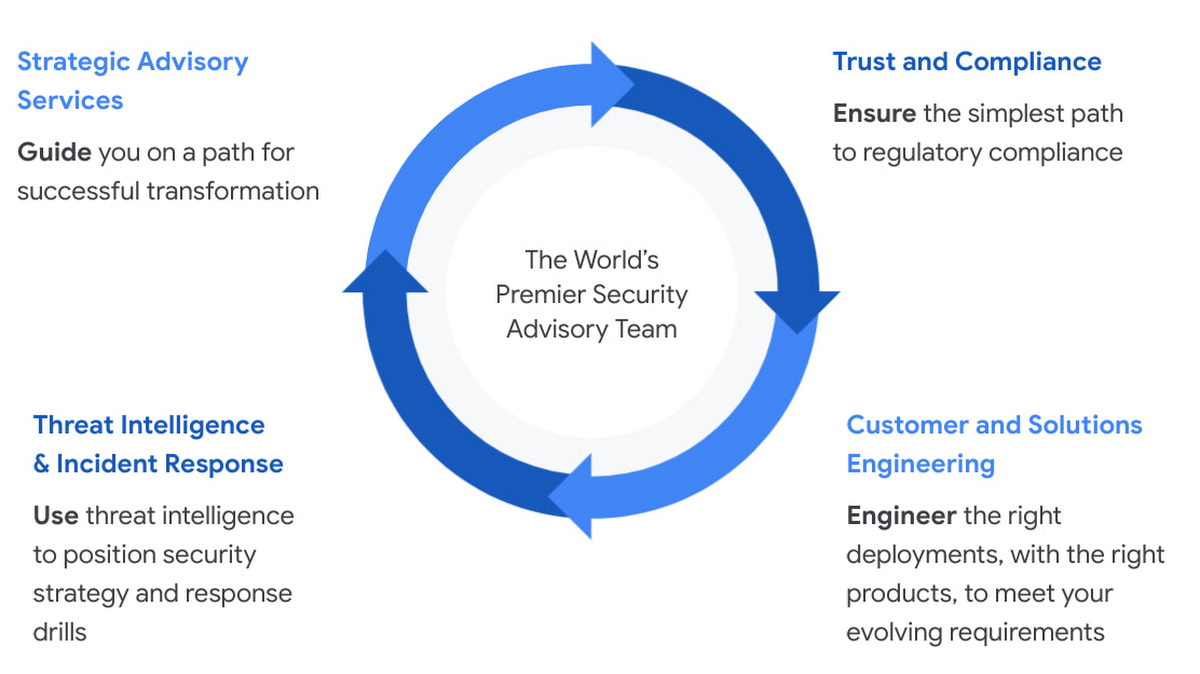
Building on existing security solutions engineering efforts, today the Google Cybersecurity Action Team announced a security and resilience framework that delivers a roadmap for a comprehensive security management program aligned with the National Institute of Standards and Technology’s Cybersecurity Framework using cloud technologies from Google Cloud and our partners.
“Google Cloud has been a critical partner in the BBVA security journey, helping us protect our customers’ sensitive and proprietary data with modern frameworks like zero trust and secure-by-default products like Google Workspace,” said Alvaro Garrido, Chief Security Officer at BBVA. “We look forward to the strategic services and guidance the Google Cybersecurity Action Team will deliver as we continue on our security transformation.”
Learn more about the Cybersecurity Action Team here.
Announcing a safer way to work
Bringing you the expertise and hands-on guidance to help with your security transformation is just one valuable step. We recognize that too many organizations can’t wait any longer to begin their modernization efforts – they need a new baseline, and they need it now.
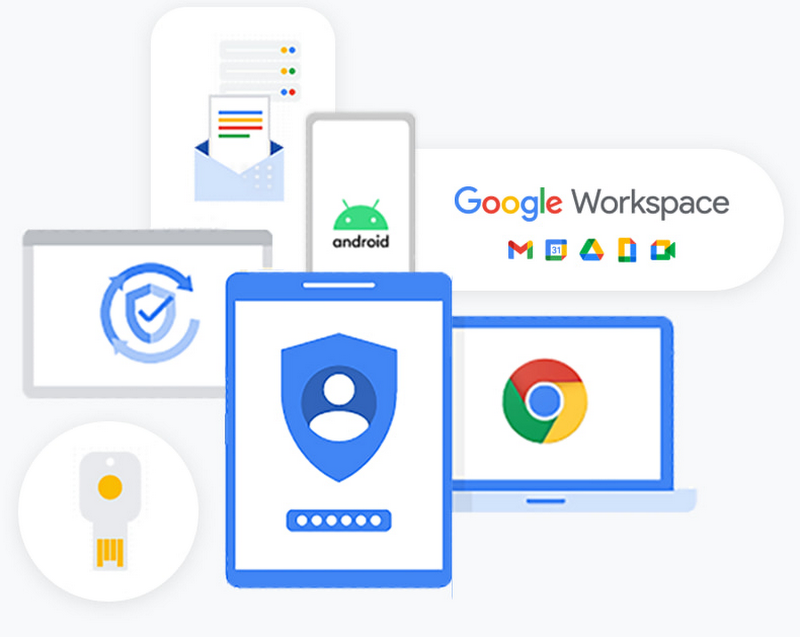
That’s why today, we’re announcing the launch of our Google Work Safer offering, designed to help organizations, their employees, and partners collaborate and communicate securely and privately in today’s hybrid work environment. Work Safer provides companies with access to best-in-class security for email, meetings, messages, documents, and more. It uniquely brings together the cloud-native, zero-trust solutions of Google Workspace with BeyondCorp Enterprise for secure access with integrated threat and data protection. For customers who want secure devices, Work Safer includes Pixel phones managed with Android Enterprise, Chrome Enterprise Upgrade, and HP Chromebooks. Customers can also leverage Google’s Titan Security Keys for account protection, reCAPTCHA Enterprise for website fraud prevention, Chronicle for security analytics, and a variety of migration services for a seamless transition.
The program is designed to meet the needs of all organizations, including small businesses, enterprises and public sector institutions, many of which are reliant on legacy technology and often lack expertise to fully address rising security challenges associated with hybrid work. To learn more, visit our Work Safer homepage.
Advancing our trusted cloud with new security capabilities
Above all, security has been and continues to be the cornerstone of our product strategy. There are three critical areas where Google Cloud’s capabilities can make a meaningful difference for any business’ or government’s digital security transformation:
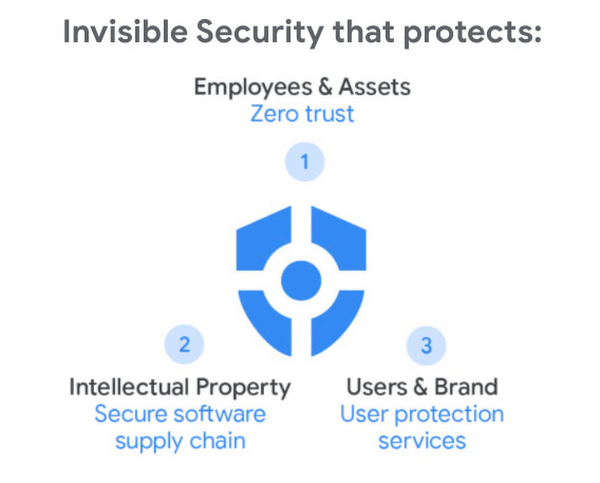
At Next’ 21, we’re introducing new security products and partnerships that will enable you to:
- Protect your employees with new zero trust access capabilities: We’re delivering new features that expand the surface area for our zero trust access solution, BeyondCorp Enterprise, to cover all your apps – both modern and legacy. The new client connector, now in preview, enables identity and context-aware access to non-web applications running in Google Cloud and non-Google Cloud environments. We are also making it easier for admins to diagnose access failure, triage events, and unblock users with the new Policy Troubleshooter feature. You can learn more about both of these new enhancements in the live BeyondCorp Enterprise demo on October 13.
- Improve your detection and response capabilities: We announced a new collaboration with Cybereason for Extended Detection and Response (XDR) across endpoints, networks, cloud and workspaces. The combination of these capabilities delivers a cloud-native XDR solution, Cybereason XDR powered by Chronicle, that automates prevention for common attacks, guides analysts through security operations and incident response, and enables threat hunting with precision at a pace never before achieved. We are also deepening the integration between Chronicle and Security Command Center (SCC) on GCP. New integrations in preview centralize alerts and investigative workflows across the two platforms, and enable threat-specific pivots by enriching SCC alerts with intelligence on associated threat actors and entities.
- Automate and bolster protection of your sensitive data: Automatic DLP, now in preview, is a prime example of how we are making Invisible Security a reality. It’s a game-changing capability that discovers and classifies sensitive data for all the BigQuery projects across your entire organization without you needing to do a single thing. We’re also introducing Ubiquitous Data Encryption, a solution which combines our generally available Confidential Computing, External Key Management, and Cloud Storage products to seamlessly encrypt data as it’s sent to the cloud. Using your External Key Management solution, data can now only be decrypted and run in a confidential VM environment, greatly limiting potential exposure.
- Protect your IP and implement a zero trust software supply chain: Today, we’re building on our zero trust software supply chain with new launches. Cloud Build is SLSA Level -1 compliant by default, with scripted builds and available provenance. With the new Build Integrity feature, Cloud Build automatically generates a verifiable build manifest that includes a signed certificate describing the sources that went into the build, the hashes of artifacts used, and other parameters. Additionally, Binary Authorization’s integration with Cloud Build makes it easy to set up deploy-time constraints. You can also now easily pair Binary Authorization with Cloud Run to ensure only trusted images make it to production. These integrations are now generally available.
- Protect your users and brand: We recently announced the preview of Cloud Armor Bot Management, which integrates Cloud Armor and reCAPTCHA Enterprise. You can enable protection without any server-side changes to your applications, and because detection and enforcement happens in-line, at the edge of Google’s network, you can mitigate threats before they have a chance to impact your applications, whether they run on GCP, on premise, or in a hybrid or multicloud deployment.
- Ensure secure collaboration: Today, Google Workspace is also introducing new security features. Client-side encryption for Google Meet, in beta, gives customers direct control of encryption keys and the identity service used to access keys. Data Loss Prevention (DLP) for Google Chat, in beta, helps prevent sensitive information from leaking outside of your organization. Check out the blog post from Google Workspace to learn more.
As we head into three days of great content and engagements from our security and technology teams across Google Cloud at Next ‘21, we want to leave you with this: You are not alone on your security journey. Our goal is to ensure that every day, you are making your organization safer because you have partnered with us. Please make sure to watch our security experts, customers, and partners in our track sessions to go deep on the topics and products that matter most to you.
More Relevant Stories for Your Company

How One Company Improved Security Significantly–Without Increasing Staff
Quanta Services is the leading specialty contractor with the largest and highly-skilled trained workforce in North America. It provides fully-integrated solutions for the electric power pipeline industrial and telecommunications industries the company's geographic footprint which includes North America Latin America and Australia. It’s network of companies ensures world-class execution with

How to overcome the 5 most common SecOps challenges
The success of the modern security operations center, despite the infusion of automation, machine learning, and artificial intelligence, remains heavily dependent on people. This is largely due to the vast amounts of data a security operations center must ingest—a product of an ever-expanding attack surface and the borderless enterprise brought

Google Cloud is Every Retailer’s Most Trusted Cloud
Whether they were ready for it or not, the COVID-19 pandemic transformed many retailers into digital businesses. Retailers made huge investments into commerce technologies, customer experience tools, sales and fulfillment technology, and improving digital experiences to continue providing their goods and services to their customers. Now, more than a year




Why Enterprises Should Choose Google Cloud for their SAP Workloads
Change is a constant for SAP customers. Now more than ever, SAP customers need solutions that provide them business agility, rock solid availability and security and true economic value. Learn how Google Cloud can guide your SAP journey to the cloud with simple and no cost migrations, powerful infrastructure and
