





Expanding Google Cloud Ready – Sustainability Program with 12 New Partners

2826
Of your peers have already read this article.
2:00 Minutes
The most insightful time you'll spend today!
We introduced the Google Cloud Ready – Sustainability designation earlier this year to showcase those partners committed to help global businesses and governments accelerate their sustainability programs. These partners build solutions that enhance the capabilities and ease the adoption of powerful Google Cloud technologies, such as Google Earth Engine and BigQuery, allowing customers to leverage data-rich solutions that help reduce their carbon footprints.
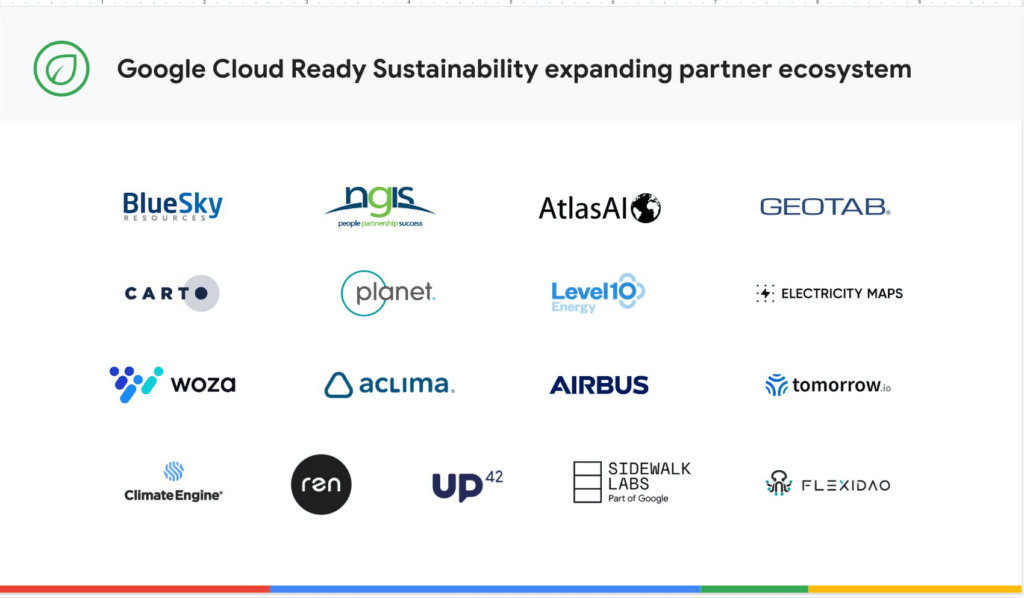
Today, we’re pleased to announce growth of the Google Cloud Ready – Sustainability program, with 12 new partners joining the initiative and bringing their climate, ESG, and sustainability platforms to Google Cloud. These partners include:
Aclima is pioneering an entirely new way to diagnose the health of our air and track climate-changing pollution. Powered by its network of roving and stationary sensors, Aclima measures air pollution and greenhouse gasses at unprecedented scales and with block-by-block resolution.
Sustainability at Airbus means uniting and safeguarding the world in a safe, ethical, and socially and environmentally responsible way. Airbus has a comprehensive sustainability strategy built on four core commitments, which guide the company’s approach to the way it does business and how it designs its products and services: Lead the journey toward clean aerospace, respect human rights and foster inclusion, build the business on the foundation of safety and quality, and exemplify business integrity.
Atlas AI is a predictive analytics platform that analyzes, monitors, and forecasts regions of growth, vulnerability, and opportunity around the world to offer insight into where organizations can grow most successfully, and where investment can boost historically underserved communities. Atlas AI’s platform has been used to expand water and sanitation infrastructure, promote new electrification, target community health services, and broaden internet access in countries across Sub-Saharan Africa and South Asia.
BlueSky Resources makes sense of sensors from both public and private sources by harmonizing inputs from ground, aerial and space based inputs. Expertise in atmospheric science and cloud technology allows BlueSky to provide understanding and insights related to the correlation of emissions insights to assets and activities. This powerful combination of data, climate science and delivery of insights is enabling focused sustainability impact across clients in various industries including energy, waste management, industry and natural resource management.
Electricity Maps provides companies with actionable data quantifying the carbon intensity and origin of electricity. This data is available on an hourly basis across 50+ countries and more than 160 regions. Electricity Maps’ mission is to organize the world’s electricity data to drive the transition toward a truly decarbonized electricity system.
FlexiDAO is a global climate tech company based in the Netherlands and Spain. The company works closely with other critical stakeholders to co-create the international standard around energy-related emissions compliance. Thanks to FlexiDAO’s end-to-end 24/7 Carbon-free Energy platform, companies can quantify and confidently showcase their contribution to society’s decarbonization.
LevelTen Energy helps organizations achieve carbon-free energy usage targets (on an annual and 24/7 basis) by delivering access to the world’s largest clean energy marketplace, and the software, data, analytics, and expertise required for efficient transactions. The LevelTen Platform connects energy buyers and over 40 sustainability advisors with more than 1,800 carbon-free energy projects in 24 countries across North America and Europe.
Ren is a SaaS platform built on Google Cloud that enables companies with global supply chains to source the cleanest energy possible. Despite using country-sized amounts of energy, most companies have no idea how to transition to renewables due to complex financial, technical, and logistical challenges. Ren unlocks cost savings, provides the cleanest energy possible, and ensures companies meet their carbon commitments on time.
Sidewalk Labs, an urban innovation unit in Google, builds products to radically improve quality of life in cities for all. Delve is a product that helps real estate teams design more sustainable buildings and neighborhood blocks, faster. Mesa automates building controls to deliver savings and comfort to commercial building owners and tenants. With these products and others, Sidewalk Labs helps commercial real estate developers, building owners and city planners make more sustainable choices for the built environment that are better for communities and the planet.
Tomorrow.io is The World’s Weather and Climate Security Platform, helping countries, businesses, and individuals manage their weather and climate security challenges. The platform is fully customizable to any industry impacted by the weather. Customers around the world use Tomorrow.io to dramatically improve operational efficiency. Tomorrow.io was built from the ground up to help teams prepare for the business impact of weather by automating decision-making and enabling climate adaptation at scale.
UP42 is a geospatial developer platform and marketplace bringing together industry-leading data and ready-to-use processing algorithms. The platform enables organizations to build, run, and scale geospatial products. With the ability to choose from a wide range of high-resolution commercial and open satellite data, aerial, weather, and others, solution providers can apply best-in-class machine learning and/or processing modules to gain valuable geospatial insights and streamline their processes.
Woza is a sustainable innovation platform that leverages deep geospatial knowledge and existing best-in-class technologies to develop a new generation of streamlined analytics workflows focused on sustainability. Companies in agri-food, energy, and public sector are partnering with Woza to accelerate their journey to Industry 4.0.
Adding expertise to accelerate sustainability use cases
New partners in the initiative join our existing Google Cloud Ready – Sustainability partners like Carto, Climate Engine, Geotab, NGIS, and Planet Labs PBC bringing a wealth of industry knowledge, offering solutions for sustainability challenges ranging from first-mile sustainable sourcing and spatial finance to fleet electrification and rich geospatial visualizations.
CARTO is the world’s leading Location Intelligence platform, enabling organizations to use spatial data and analysis for more efficient delivery routes, better behavioral marketing, strategic store placements, and much more. The company’s solutions extend the geospatial capabilities available in BigQuery, while leveraging the near limitless scalability that Google Cloud provides. When it comes to sustainability, CARTO’s platform is trusted by a wide range of organizations, including Greenpeace, Vizzuality, Litterati, Indigo, WWF, the Marine Conservation Institute, The World Bank, and the Institute for Sustainable Cities.
Climate Engine leverages data from Google Earth Engine and other ecosystem partners to help organizations improve their climate change-related risk planning in areas such as water use, agriculture, storm risk, and wildfire spread. By linking the economy and the environment, organizations can understand how environmental risks are affecting their markets and discover opportunities to reduce their emissions and potential supply chain or operational disruptions from climate-related events.
Geotab is advancing security, connecting commercial vehicles to the cloud, and providing data-driven analytics to help customers better manage their fleets. Processing billions of data points daily, Geotab helps businesses improve and optimize fleet productivity, enhance safety, and achieve sustainability goals and stronger compliance.
Geospatial solutions provider NGIS built a SaaS-based first-mile sustainable sourcing solution called TraceMark using Google Cloud’s geospatial platform and technologies from other ecosystem partners. Several global CPG firms have already used TraceMark to modernize their geospatial workflows and help facilitate the use of space-based data for supply chain sustainability transformation.
Planet Labs PBC operates the largest fleet of Earth imaging satellites in history, with approximately 200 satellites in orbit. Planet’s mission is to image the whole earth’s landmass every day to make global change visible, accessible, and actionable. As a Public Benefit Corporation, Planet’s Public Benefit Purpose is to accelerate humanity toward a more sustainable, secure, and prosperous world by illuminating environmental and social change.
How the Google Cloud Ready – Sustainability program works
If you are a Google Cloud partner with sustainability solutions and expertise to share, the Google Cloud Ready – Sustainability program is open for applications. Entry into the program requires that the partner solution delivers quantifiable results for climate mitigation, adaptation, or reporting needs. To apply for the Google Cloud Ready – Sustainability designation, the solution must:
- Be available on Google Cloud
- Address ESG risk, and assist customers in achieving ESG targets and/or support typical ESG goal frameworks, such as the United Nations’ SDGs
- Demonstrate repeatability
- Meet minimum Google Cloud application development best practices, including security, performance, scalability, availability, and carbon footprint reporting for available services
- Have Google Cloud Carbon Footprint Reporting enabled
- Have at least one public customer case study available.
The selection process begins with an evaluation of the solution. If a partner meets the above criteria, Google Cloud provides a suggested roadmap for tier progression within the program and then issues a formal acknowledgement of participation in the Google Cloud Ready – Sustainability program. Together, Google Cloud sustainability partners can deliver platforms that are helping businesses and governments accelerate progress aligned to their environmental goals.
Google Cloud will showcase the validated solutions on the Google Cloud Partner Directory Listing, Google Cloud Ready Sustainability Partner Advantage page, and — if applicable — via the Google Cloud Marketplace. We hope to help customers better understand how these technologies can help them meet their ESG goals, find the right solution for their particular challenge, and implement a solution faster.
Prospective partners can visit the Partner Portal to learn more about the Google Cloud Ready – Sustainability program or complete an application.
30 Guides to Ease Your Cloud Migration Journey

4399
Of your peers have already read this article.
1:30 Minutes
The most insightful time you'll spend today!
Getting started with your migration
One of the challenges with cloud migration is that you’re solving a puzzle with multiple pieces. In addition to a number of workloads you could migrate, you’re also solving for challenges you’re facing, the use cases driving you to migrate, and the benefits you’re looking to gain. Each organization’s puzzle will likely get solved in their own unique way, but thankfully there is plenty of guidance on how you can migrate common workloads in successful ways.
In addition to working directly with our Rapid Assessment and Migration Program (RAMP), we also offer a plethora of self-service guides to help you succeed! Some of these guides, which we’ll cover below, are designed to help you identify the best ways to migrate, which include meeting common organizational goals like minimizing time and risk during your migration, identifying the most enterprise-grade infrastructure for your workloads, picking a cloud that aligns with your organization’s sustainability goals, and more:
- Get started with this cloud migration guide and checklist
- Key considerations for building a migration factory to Google Cloud
- Understanding the cloud migration strategies at your disposal
- Understanding how to migrate key enterprise workloads to Google Cloud
Which workloads are you moving?
In addition to the guides above which help you through your end-to-end migration, it’s also important to understand the specific workloads you’ve got on-premises (or in other clouds). Each workload has their own unique nuances — what works for one might not work perfectly for another. This is where leveraging the expertise of our RAMP team is crucial, and why we have lots of migration guides for specific workloads and end-states. For each workload, we’re highlighting a few guides that we think could be most helpful, but you can also click each topic to learn more or find more guides.
- Modernization path for .NET applications on Google Cloud
- Managed Service for Microsoft Active Directory is GA
- Migrating Microsoft workloads to Google Cloud yields results
- Migrate, scale, and innovate at speed
- Boost Retail Intelligence and Agility in the Cloud
- Retire your tech debt: Move vSphere 5.5+ to Google Cloud VMware Engine
- Financial Services Spotlight: Elevating agility and security in the cloud
- Curious about Google Cloud Bare Metal Solution? Start here
- Getting Started with Google Cloud’s Bare Metal Solution
- Guide – Bring new life to your databases with an Oracle migration
- SAP on Google Cloud: Migration strategies
- Run your SAP workloads on Google Cloud Bare Metal Solution
- eBook – Google Cloud for SAP: The enterprise cloud for business agility, insights, and innovation
- How to transfer your data to Google Cloud
- An Overview of the Transfer Appliance
- Migration to Google Cloud: Transferring your large datasets
- Transferring data from Amazon S3 to Cloud Storage using VPC Service Controls and Storage Transfer Service
- Overview of Database Migration Service
- Database migration: Concepts and principles (Part 1)
- Database migration: Concepts and principles (Part 2)
- Database cloud migrations made easy for PostgreSQL, MySQL
- Migrating data warehouses to BigQuery: Introduction and overview
- Oracle to BigQuery migration
- Amazon Redshift to BigQuery migration guide
- IBM Netezza to BigQuery migration guide
- Teradata to BigQuery migration guide
Take the next step
When it comes to migration, we’re committed to meet every organization where they are. We fully understand the nuances and challenges of cloud migration, and at Google Cloud we have one singular goal: to help you realize true business value through your cloud migrations.
Visit our Migration Architecture Center to find even more guides to use during your migration, or if you’re looking to dive a little deeper into planning, sign up for a free discovery and assessment of your existing IT landscape.
Hike: Processing Analytics Queries 20X Faster with Google Cloud Platform

5605
Of your peers have already read this article.
2:30 Minutes
The most insightful time you'll spend today!
After a seamless migration to Google Cloud Platform with CloudCover and Google Cloud Professional Services, Hike has reduced its costs by 20% and processed analytics queries 20 times faster than with its previous cloud provider. The business is also using AI and machine learning to enhance the experience provided by a new sticker-based messaging app, Hike Sticker Chat.
India is a market of opportunity for businesses that provide messaging apps to consumers. With more than 1.3 billion people, the country is the second most populous in the world. However, global messaging app providers face a robust market challenge from Hike, a home-grown internet and technology startup. Launched in 2012, Hike provides innovative products such as Hike Messenger and more recently the AI- and machine-learning-enabled Hike Sticker Chat, a service that enables young people in the country to express themselves through digital stickers.
The business says it understands the people of India and communication like no one else, while its mission is to reduce individuals’ dependency on the keyboard. To do this, Hike is building one of the largest repositories of AI and machine-learning-enabled stickers for Hike Sticker Chat. This messaging platform is, according to Hike, the only product of its type that enables conversations through stickers covering more than 40 languages and local dialects.
Google Cloud Results
- Processes analytics queries 20X faster than previously
- Doubles compute throughput
- Uses Google Cloud Machine Learning Engine managed, distributed capabilities to train complex models on TensorFlow that provide delightful local sticker recommendations through Hike Sticker Chat
Founded by Kavin Bharti Mittal, the Delhi-based venture is backed by SoftBank, Tencent, Tiger Global, Foxconn, and Bharti. To date, Hike has raised $261 million in funding. In August 2016, Hike raised its Series D round of funding, led by Tencent and Foxconn, at a valuation of $1.4 billion. The business is one of the fastest Indian startups to achieve Unicorn status, doing so in less than four years.
Hike started operations on a multinational cloud service. However, as user numbers and usage grew, the business began exploring options to improve performance and stability, reduce costs, and cut administration loads. In particular, Hike wanted to reduce latency between cloud data centers.
Focus on product development
“We aimed to move away from a technology stack with single points of failure to a horizontally scaled, highly reliable, distributed systems and managed services environment that enabled us to focus on product development rather than operations,” says Aditya Gupta, Director, Engineering, Hike.
Hike then began exploring the opportunities presented by Google Cloud Platform. The business held a number of executive-level meetings with Google to understand the capabilities, roadmap, and track record of the cloud service. It then decided to proceed with a proof of concept with Google Cloud Premier Partner CloudCover.
The proof of concept revealed that when Cloud Load Balancing was operating, latency between the Google Cloud data center in Taiwan and Delhi, India, was less than the latency between the incumbent cloud provider’s data center and Delhi. Further, compute throughput was up to two times greater on Compute Engine than on the equivalent service, while Hike could complete more then 1 million connections on Compute Engine – up from 500,000 connections on the incumbent service.
Migrate to GCP
The success of the exercise prompted Hike to migrate its messaging app to Google Cloud Platform. “We chose Google Cloud Platform because of its very broad set of services and features,” explains Gupta. “In addition, Google’s innovation mindset and the richness of the partnership would allow us to be onboarded quickly to machine learning services such as Cloud Machine Learning Engine.”
The business called on Google Cloud Professional Services (Technical Account Management) to help ensure a seamless lift-and-shift migration over two months. Google Cloud Professional Services initially undertook a technical infrastructure kickoff to establish a foundation for architecture requirements such as identity and access management and security.
Google Cloud Professional Services team delivers smooth migration
Google Cloud Professional Services worked closely with Hike to map out and deliver the Google Cloud Platform architecture that would deliver the greatest value to the business. The Professional Services team also worked with Hike to resolve product and support queries quickly; provided project background for product and support teams; and organized project meetings and early adopter program access.
In addition, Professional Services team members worked on site at least once a week, coordinated external support during critical migration periods, and coordinated teams in five countries for a single, 17-hour migration marathon. Over 60 days, the business migrated 7,000 processor cores, running virtual machine instances used for messaging infrastructure and analytics, to Google Cloud Platform.
Throughout the exercise, Google Cloud Professional Services worked with CloudCover to educate the customers’ technology teams to achieve proficiency with Google Cloud Platform. The teams soon built up skills and knowledge of best practices and began applying them to the Google Cloud Platform environment.
The Hike Google Cloud Platform architecture comprises virtual machine instances running in Compute Engine; Cloud Storage for unified object storage; networking; a BigQuery analytics data warehouse; Cloud Dataflow to transform and enrich data; Cloud Load Balancing to distribute workloads to maximize efficiency; and Cloud Dataproc to run Hadoop clusters.
Hike is also stepping up its AI & machine learning capabilities. It uses Google Cloud Machine Learning Engine managed, distributed computing capabilities to train complex models on TensorFlow. This powers key use cases such as delightful local sticker recommendations on Hike Sticker Chat. Hike is also investing heavily on AI and machine learning research.
Hike has achieved a range of benefits from its Google Cloud Platform deployment. As well as reduced latency, improved compute throughput, and increased connection handling, Google Cloud Platform managed services have enabled the business to reduce the time and effort required to administer core infrastructure, with the saved resources allocated to improving its messaging product.
“Managed services are beginning to reduce our operational overheads,” says Gupta. “For example, managed instance groups and Cloud Load Balancing are reducing our instance count and costs, thereby reducing involvement from DevOps and developer teams.”
Google Cloud Platform 20% cheaper
Gupta and his team have calculated that running for three years on Google Cloud Platform will cost, including the cost of migration, 20 percent less than on its previous platform. BigQuery is processing queries 20 times faster than a similar service offered by the previous provider, while storing 125TB of data and streaming 1.5TB of data daily. Furthermore, Hike’s analytics pipeline costs 80 percent less than in its previous environment.
“Google Cloud Platform has played an important role in enabling us to continue to innovate and realize our mission of reducing dependency on the keyboard,” says Gupta.
Know the Leaders of Google Cloud Public Sector Community

5030
Of your peers have already read this article.
1:30 Minutes
The most insightful time you'll spend today!
At Google Cloud, being a strategic partner is part of our DNA. Whether it’s listening closely to our customers, helping to build team skills for innovation or simply being there (since we know the cloud is 24/7), we get excited about working hands-on with customers to deliver new solutions.
As we look to solve decades-old challenges with new technologies in workforce productivity, cybersecurity, and artificial intelligence/machine learning, we know that we are only as good as the people behind the technology. Today, we’re proud to spotlight a few of the inspiring folks behind Google Cloud Public Sector and celebrate their recognition in the industry.
Melissa Adamson, Head of Government Channels at Google Cloud, has been named to the highly respected Women of the Channel list for 2021. This annual list recognizes the unique strengths, leadership and achievements of female leaders in the IT channel. The women honored this year pushed forward with comprehensive business plans, marketing initiatives and innovative ideas to support their partners and customers.
Melissa was brought on to build the Public Sector channel from scratch. The initial focus was building the channel for the US government team and has since expanded to include education, Canada and Latin America.
Having a career background at both Microsoft and Accenture, Melissa leveraged her extensive professional network to build the organic partnerships needed to accelerate the Public Sector partner ecosystem. This helped her drive two key wins (US Postal Service and PTO) and personally recruit top cloud partners in the industry. Melissa loves card games and is learning a new language.
Todd Schoeder, Director of Global Public Sector Digital Strategy, was recently featured in the “Top 20 Cloud Executives to Watch in 2021” by Wash Exec. Recognized for his work in helping customers navigate through the impact of COVID-19 and developing innovative solutions to meet mission challenges, he says: “New partnerships are required to solve for the problems of the future. Challenges that were previously thought of as insurmountable, too risky or expensive, are actually quite the opposite — as long as you have the right partner that is working in your best interest with you.”
Josh Marcuse, Head of Strategy & Innovation, received his second Wash100 Award for leading a digital transformation team that works to drive the development of public sector solutions, including cyber defense, smart cities, and public health.
Josh has launched services to support collaborative team operations including Workspace for Government and an artificial intelligence-based customer service platform to support remote work needs. His work also includes leading Google Cloud’s partnerships with organizations to improve data sharing in the public health community, contact tracing activities, and supporting research efforts across national laboratories.
Like Melissa, Josh was brought on to build a new team dedicated to strategy and innovation. This team’s purpose is to bring an intense focus to public sector mission outcomes and the public servants who own them. Josh spent a decade pushing digital modernization and workforce transformation at the U.S. Department of Defense, and co-founded the Federal Innovation Council at the Partnership for Public Service, and now brings that domain expertise to supporting government workers who are driving digital transformation.
Join us in celebrating these folks for their leadership and contributions!
Largest Beauty Retailer in the US Powers Digital Transformation with Google Cloud Smart Analytics

9285
Of your peers have already read this article.
3:15 Minutes
The most insightful time you'll spend today!
Digital technology offers increasing flexibility and choice to consumers. As a result, the retail industry is dramatically shifting toward more tailored and personalized experiences for shoppers, and businesses are rethinking how they deliver value to customers.
This couldn’t be more true for the beauty retailing industry where leading companies are turning to digital technology to create customized shopping experiences.
At Google Cloud, we’re particularly excited about our work with Ulta Beauty, the largest beauty retailer in the United States with more than 1196 stores in all 50 states, and how the company is using Google Cloud technology solutions to power personalization and redefine beauty retailing.
Established in 1990, Ulta Beauty has had incredible success as a company, and as customers become more discerning and curious about their purchases, the company is finding new ways to meet their changing needs.
Recently, leaders at Ulta Beauty recognized a huge opportunity to complement and enhance the shopping experience by helping beauty enthusiasts navigate through more than 500 brands and 25,000 products carried in their stores and online channel.
They decided to leverage the data from Ulta Beauty’s successful Ultamate Rewards loyalty program to create and offer more unique and personalized user experiences.
With more than 30 million members generating data through sales, transactions, product reviews, and social media engagement, Ulta Beauty’s Loyalty Program creates a comprehensive data set, and the company sought the right technology partner to help organize, analyze and transform that data into valuable insights for its customers.
Ulta Beauty’s leaders knew they had an opportunity to leverage data analytics and machine learning to reach customers in new ways, enhance the guest experience, and continue to grow their active loyalty member base. After considering a number of cloud providers, they chose to expand their existing partnership with Google Cloud.
“Google Cloud listened to our needs and worked in tandem with our engineering team to address our challenges,” said Michelle Pacynski, vice president of digital innovation at Ulta Beauty. “The ease of working with the Google Cloud team and their breadth of experience made the decision a no-brainer, laying the foundation for a great partnership.”
In 2019, Ulta Beauty announced it was working with Google Cloud Platform to unify and organize its data, using:
- BigQuery to perform data analysis and generate dynamic content, personalized product recommendations, and event-based messages for customers.
- Cloud Storage to provide highly available, secure, resilient and cost-effective access to data across the entire enterprise.
- Compute Engine for the high-performance scalability needed to grow with customer demand while painlessly migrating existing applications to the cloud.
- Anthos to build a hybrid cloud foundation that allows their applications to take advantage of all this data, combining the power and flexibility of GKE with the ability to leverage their existing investment in secure infrastructure on-premises.
Our partnership with Ulta Beauty has enabled increased engagement with customers in store and online, and the creation of new tools and capabilities, including a new Virtual Beauty Advisor tool to deliver tailored recommendations and help shoppers choose the right products, and a Customer Conversation Platform that’s enabling deeper connections with guests, ultimately driving customer loyalty.
“It’s been a really efficient process so far due in part to the ease of working with the Google team,” said Michelle Pacynski, vice president of digital innovation at Ulta Beauty. “They’re experienced, approachable, and their can-do style makes for a great partnership. They listened to our needs and worked in tandem with our engineering team, figuring things out, and getting it done.”
5661
Of your peers have already downloaded this article
5:30 Minutes
The most insightful time you'll spend today!
Public cloud, big data, and AI technologies offer competitive advantages and cost savings for capital markets firms ready to make the transition. This paper discusses the three phases capital markets firms go through in transitioning to public cloud, and the workloads, benefits, and cultural changes that characterize the three phases:
Infrastructure Optimizers: The first step on the public cloud journey, where firms focus on migrating specific workloads to save costs.
Cautious Strategists: Firms build on the success of their first public cloud migrations, and begin to change the way they develop technology to increase cost savings and start taking advantage of capabilities only available on public cloud.
Transformative Innovators: Firms shift to a fully public cloud-enabled mentality, and fully leverage the flexibility and agility of the public cloud to build industry-changing solutions and attract top IT talent.
Additionally, we reveal the five things that capital markets innovators who have advanced to the transformation phase do well in their adoption of cloud, big data, and AI technologies across the front, middle, and back office functions.
More Relevant Stories for Your Company

Cloud FinOps Breaks Down Gaps in Finance, Tech and Business Teams, Accelerating Digital Transformation!
Accelerating digital transformation Digital transformation is what propels businesses and industries forward. Organizations of all sizes—from startups to global enterprises—focus on digital transformation not only to make scaled improvements, but also to drive significant change and fully embrace the digital age. The pandemic has jump started and pushed many organizations

Johnson & Johnson Increases it’s Ability to Find Highly Qualified Staffers for Business Critical Roles by 41% with Easy-to-Use AI
Job seekers can often feel lost or disconnected—like the right opportunity is out there, but they don’t know where or how to look. Employers face a similar challenge when trying to attract the right candidates. Many companies, especially large enterprises, face a talent shortage across a range of critical roles. For global

HarbourBridge Schema Assistant Allows Quick, Bulk Migration to Cloud Spanner
Today we’re announcing the HarbourBridge Schema Assistant, which provides a guided schema-design workflow for migrating from MySQL or PostgreSQL to Spanner. HarbourBridge imports dump files (from mysqldump or pg_dump) or directly connects to your source database, and converts the source database schema to an equivalent Spanner schema. The new Schema Assistant
How Google Cloud’s Scalable Data Storage and High Compute Resources Fuel Investment Research
Investment management is a heavily data-driven industry—portfolio managers and investment researchers require a large number of data sources to guide them in shaping their investment strategies. New cloud capabilities and technologies enable investment managers to process data faster than ever before and iterate on ideas quickly to fuel innovation in
