





Google Cloud is a Leader in Q1 2022’s Public Cloud Container Platform: Forrester

3241
Of your peers have already read this article.
2:00 Minutes
The most insightful time you'll spend today!
We’re thrilled to share the news that leading global research and advisory firm Forrester Research has named Google Cloud a Leader in the recently published report The Forrester WaveTM: Public Cloud Container Platforms, Q1 2022. Forrester evaluated the container and cloud-native offerings of a select group of top public cloud container platform vendors across 29 comprehensive criteria.
We are proud that Forrester evaluated the strength and cohesion of our offerings, including Google Kubernetes Engine (GKE), Cloud Run, Anthos, Cloud Build, Cloud Deploy, Cloud Code and more, writing that, “Google Cloud is the best fit for firms that want extensive cutting-edge cloud-native capabilities for distributed workloads spanning public cloud, private cloud, and multicloud environments.”
Google Cloud received the highest possible scores in the criteria of service and application catalogs, microservice development support, service mesh support, serverless and FaaS support, DevOps automation, container image support, control plane configuration, hybrid cloud support, container networking, product vision, supporting products and services, market approach, revenue, and breadth of offering. We also achieved the highest score in the Strategy category of all the vendors evaluated.
Google Cloud is all-in on containers and cloud native
The cloud-native tools and technologies created by Google Cloud are already powering the most innovative, scalable and secure apps around the world, from the most exciting digital natives to the most important enterprise industry leaders. Why? Cloud native means building and running modern apps that intentionally take advantage of the global scale, pervasive automation, elastic infrastructure, and secure resiliency of the public cloud.
For enterprises, cloud native in practice means using containers, Kubernetes, serverless, and DevOps automation to build amazing customer-facing apps quickly, to modernize existing business-critical apps safely, and to operate them all on cost-efficient, powerful, and secure cloud infrastructure globally.Over the past decade, Google Cloud’s technology innovation has fueled various domains of the cloud native ecosystem, such as Kubernetes and Go languages as the foundation, Istio for service mesh, Kubeflow for machine learning, Knative for serverless, and Tekton for CI/CD. Long-term investment and practices in cloud-native power its superior product vision and excellent supporting products and services.
The Forrester Wave: Public Cloud Container Platforms, Q1 2022
Dedicated to simplicity, speed, and scale for your modern apps
Our mission is to create, integrate, scale, and secure the best open source and commercial cloud-native technologies – backed by a consistent cloud control plane – so you can spend more time dreaming of ways to delight your customers and less time building and operating platforms. We are committed to leading in cloud-native open source communities and making containers and Kubernetes accessible to everyone, from everywhere.
Here are a few recent highlights across our container services and tools, aimed at helping you build and modernize your most important apps with cloud native:
The most scalable fully managed Kubernetes service, Google Kubernetes Engine (GKE), achieved an overall solution score of 92 out of 100 in Gartner’s Solution Scorecard. In 2021, we introduced GKE Autopilot, a fully managed, security-hardened Kubernetes service optimized for production workloads. This unique mode of operation allows you to focus on your workloads while Google manages your cluster infrastructure. There’s nothing else like it. Then, we made GKE apps even faster with GKE image streaming. With proven scalability to 15K nodes in a single cluster and innovations such as four-way autoscaling, node auto-upgrades, integrated logging and metrics, cost optimization insights, native backup and restore, and multi-instance GPUs to accelerate machine learning workloads, GKE remains the best choice in managed Kubernetes services.
With Cloud Run, we expanded the range of users who benefit from containers to those who don’t know much about them. Introduced in 2019, Cloud Run combines the serverless attributes of autoscaling and developer experience with the flexibility of containers. Developers can use any language, runtime or binary, and deploy code using buildpacks to automatically build container images from source without worrying about provisioning machines and clusters. Cloud Run goes beyond FaaS and beyond earlier generations of serverless computing. Cloud Run runs more legacy workloads, integrates with Cloud Build for secure and compliant builds, offers deeper cost controls and billing flexibility, and encourages portability. We added support for social feeds, collaborative editing, and multiplayer games that use bidirectional streaming. Minimum instances reduce cold-start delays so you can run more latency-sensitive applications. And recently, we launched support for network file systems, allowing developers to share and persist data between multiple containers and services.
Anthos is at the heart of the Google Distributed Cloud, a portfolio of software and hardware solutions announced in 2021 that extend Google’s container platform services to the data center and the edge. Anthos is how we extend GKE to wherever you need cloud-native apps. Manage clusters on-premises on bare metal and VMware-virtualized servers, on AWS and Azure, and at the edge – all with a Google Cloud-backed control plane for consistent, automated operations at scale. We added a hosted service for configuration management to keep all your clusters in sync, and trimmed our installation footprint and streamlined cluster management with a new multi-cloud API that enables you to use a single API for full lifecycle management of Anthos Kubernetes clusters in AWS or Azure.
Finally, since no public cloud container platform is complete without powerful DevOps tools, we expanded our CI/CD offerings to make your developers even more productive, wherever they build and deploy cloud native apps. Use Cloud Code and Cloud Shell as your go-to cloud-native IDEs. Cloud Build is a fully managed serverless DevOps automation platform for use cases spanning CI/CD, Infrastructure-as-Code, AI/MLOps, and more, across infrastructure GKE, Cloud Run, Cloud Functions and more. Google Cloud Deploy is a fully managed continuous delivery service that provides one-click release promotion and roll-backs, built-in metrics, and out-of-the-box security. Artifact Registry and Container Analysis provide managed artifact repositories, vulnerability scanning, and help secure the software supply chain.Google Cloud has a solid cloud-native innovation roadmap, targeting simplicity at scale for enterprise clients.
The Forrester Wave: Public Cloud Container Platforms, Q1 2022
We are delighted and humbled to be recognized as a Leader in public cloud container platforms by Forrester. Grab your copy of The Forrester WaveTM: Public Cloud Container Platforms, Q1 2022 today and let us know how we can help you build and modernize your most important apps how you want and where you want.
Apigee and Vision API: ICICI Prudential Life Insurance’s Journey of Speeding Document Processing

5543
Of your peers have already read this article.
2:00 Minutes
The most insightful time you'll spend today!
Google Cloud results
- Helps enable instant document approval with optical character recognition by Vision API
- Processes 100,000 documents in 20 minutes with automated document processing product Recognic, powered by Vision API and Apigee
- Helps increase the number of applications processed by 30% within the same timeframe
The insurance landscape in India has seen significant changes in recent years with the adoption of new technology. As one of the major insurance providers in the country, ICICI Prudential Life Insurance has aimed to lead in this transformation journey. “There has been a data explosion across India over the past few years, together with a high mobile penetration rate. Today, about 60% of our customers approach us via mobile, for example, which was certainly not the case before,” says Alpesh Karnik, SVP, IT, at ICICI Life Insurance.
Consumer expectations have also evolved, with easier access to information and online services. “Consumers today are more informed on the importance of investing in insurance products, so there’s much more of a pull factor when it comes to sales, but they also want to be able to get these products quickly and easily,” adds Alpesh. To meet the demands of these consumers, ICICI Prudential Life Insurance realized it needed to make its processes even faster and more efficient. Looking to upgrade its infrastructure, the company turned to Google Cloud.
“The biggest benefit of using Recognic and Vision API is that it eliminates the initial waiting time, which can result in drop-offs. Now customers can know immediately whether their documents are sufficient, or if they need to revise or submit any others.”—Alpesh Karnik, SVP, IT, ICICI Prudential Life Insurance
Serving customers better by speeding up processes with Google Cloud
ICICI Prudential Life Insurance’s distributors were already using tablets to input customer data faster and more efficiently, but many of the company’s solutions still required a team at the back end to manually sift through documents for approval. This meant that customers needed to wait five or six hours, or sometimes until the next working day, to know if their documents were approved or needed revision.
That all changed after partnering with Google Cloud Premier Partner Searce to take advantage of its AI/ML powered automated document processing product Recognic, which is built on Google Cloud. Developed using the optical character recognition (OCR) capabilities of Cloud Vision, Recognic reads, understands, and validates documents at scale, enabling organizations that handle massive amounts of paperwork to digitize these documents and then accurately store and index them.
“Google Cloud has cut down the middle- and back-office work, leading to a 30% increase in the number of applications we can process in the same time span without the need for additional resources.”—Alpesh Karnik, SVP, IT, ICICI Prudential Life Insurance
“In the case of ICICI Prudential, the biggest benefit of using Recognic and Vision API is that it eliminates the initial waiting time, which can result in drop-offs. Now customers can know immediately whether their documents are sufficient, or if they need to revise or submit any others,” Alpesh adds.
Alpesh explains that if the details on the application form match the documents provided, the case doesn’t need to go to the underwriter for further checks and can go directly to policy issuance. “Google Cloud has cut down the middle- and back-office work, leading to a 30% increase in the number of applications we can process in the same time span without the need for additional resources.”
ICICI Prudential Life Insurance is also working with Searce to build deep learning models into Recognic so that it can overcome template barriers and input data from a variety of forms. This is particularly helpful for financial and medical documents underwriting because unlike a passport or driving license, financial documents have a higher structural complexity.
As customer data becomes more important in the work of ICICI Prudential Life Insurance, so does protecting it, and the company is taking every measure to safeguard the security and privacy of its customers’ information. “Details of customers’ contactability are automatically removed by Google Cloud after processing is complete. This step in the workflow gives us the confidence that data is not stored at any level of the optical character recognition process,” says Alpesh.
Partnering with the right teams for dedicated support
In achieving the best solution for its business goals, ICICI Prudential Life Insurance recognizes the importance of its decision to work with partners that truly understand the insurance business. “There are many intricacies involved in this business, and it’s clear that both Google Cloud and Searce really took the time to understand our underwriting processes before coming up with a solution,” says Alpesh. He adds that during the implementation process, all findings were well documented and queries were responded to quickly.
“We didn’t want to take any shortcuts deploying Recognic, but at the same time, we didn’t want to draw out the implementation process. The excellent support from both Google Cloud and Searce throughout the journey was reassuring for us as they were always thinking ahead.”
Future-proofing the organization through machine learning and AI
In the coming years, Alpesh foresees the insurance industry to be even more agile than it is today. “I doubt elaborate processes such as underwriting or operations checks will need to be done manually in the future. Everything will be done through machine learning and AI.” In light of this, ICICI Prudential Life Insurance is doing everything it can to prepare, as customers’ expectations are set to keep evolving. “We have to be prepared for the future, and I believe that with Google Cloud, we can do it.”

About ICICI Prudential Life Insurance
ICICI Prudential Life Insurance aims to lead the Indian insurance field through quality products and a hassle-free claim settlement experience. A customer-centric company, it offers long-term savings and protection plans to meet customers’ needs at every stage of life.Industries: Financial Services & InsuranceLocation: India

About Searce
Searce is a niche cloud consulting business with futuristic tech in its DNA, focused on “realizing the Next in the Now” for its clients. Specializing in cloud data engineering, AI/ML, and ad
Partnering for a Healthier Tomorrow: Device Connect for Fitbit

2875
Of your peers have already read this article.
3:30 Minutes
The most insightful time you'll spend today!
Healthcare is at the beginning of a fundamental transformation to become more patient-centered and data-driven than ever before. We now have better access to healthcare, thanks to improved virtual care, while wearables and other tools have dramatically increased our ability to take control of our own health and wellness.
Healthcare alone generates as much as 30% of the world’s data and much of this will come from the Internet of Medical Things (IoMT) and consumer wearable devices. Gaining insights from wearable data can be challenging, however, due to the lack of a common data standard for health devices resulting in different data types and formats. So what do we do with all this data, and how do we make it most useful?
Today, Fitbit Health Solutions and Google Cloud are introducing Device Connect for Fitbit, which empowers healthcare and life sciences enterprises with accelerated analytics and insights to help people live healthier lives. Fitbit data from their consenting users is made available through the Fitbit Web API, providing users with control over what data they choose to share and ensuring secure data storage and protection. Unlocking actionable insights about patients can help support management of chronic conditions, help drive population health impact, and advance clinical research to help transform lives.
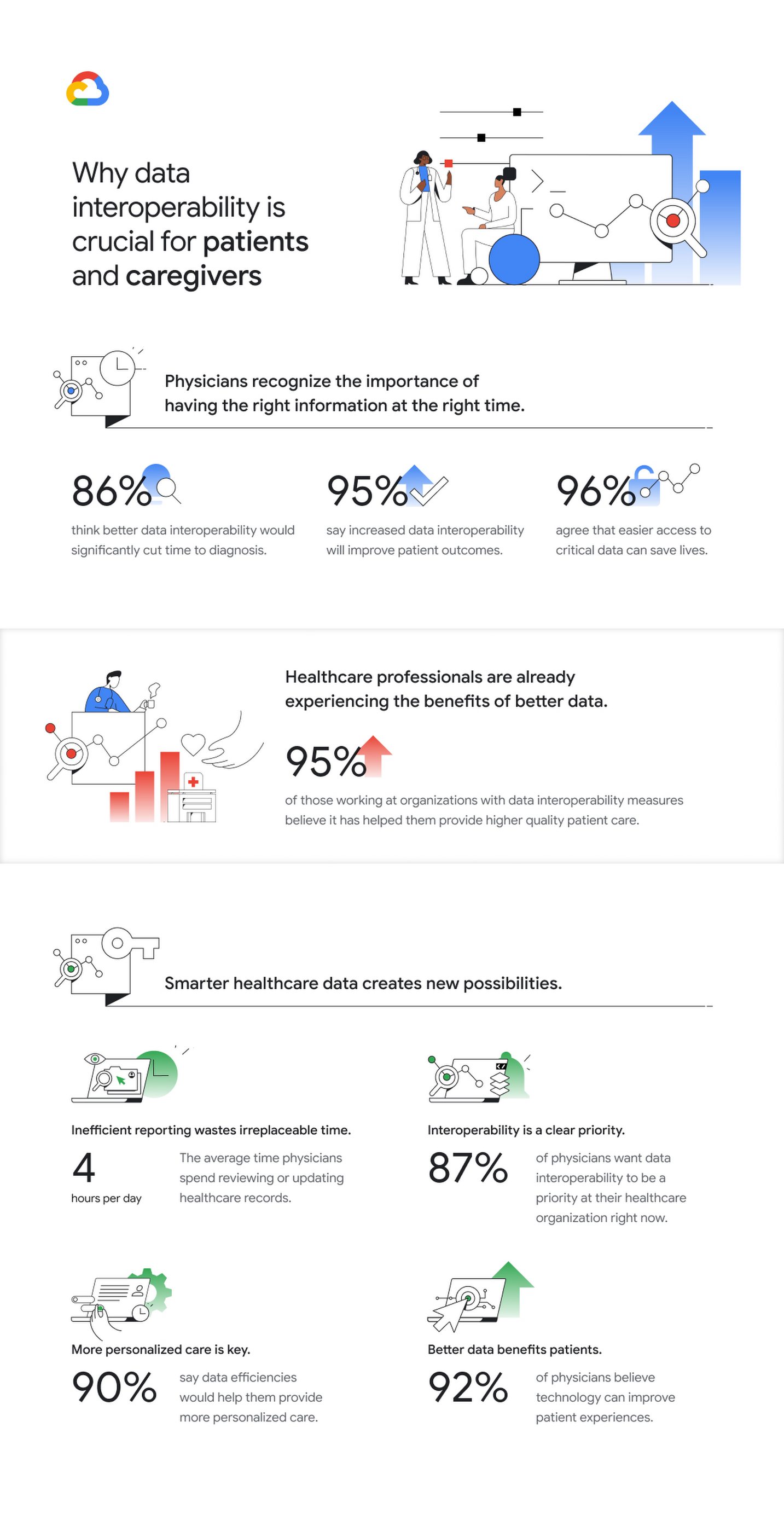
With this solution, healthcare organizations will be increasingly able to gain a more holistic view of their patients outside of clinical care settings. These insights can enhance understanding of patient behaviors and trends while at home, enabling healthcare and life science organizations to better support care teams, researchers, and patients themselves. Based on a recent Harris poll, more than 9 in 10 physicians (92%) believe technology can have a positive impact on improving patient experiences, and 96% agree that easier access to critical information may help save someone’s life.
Help people live healthier lives
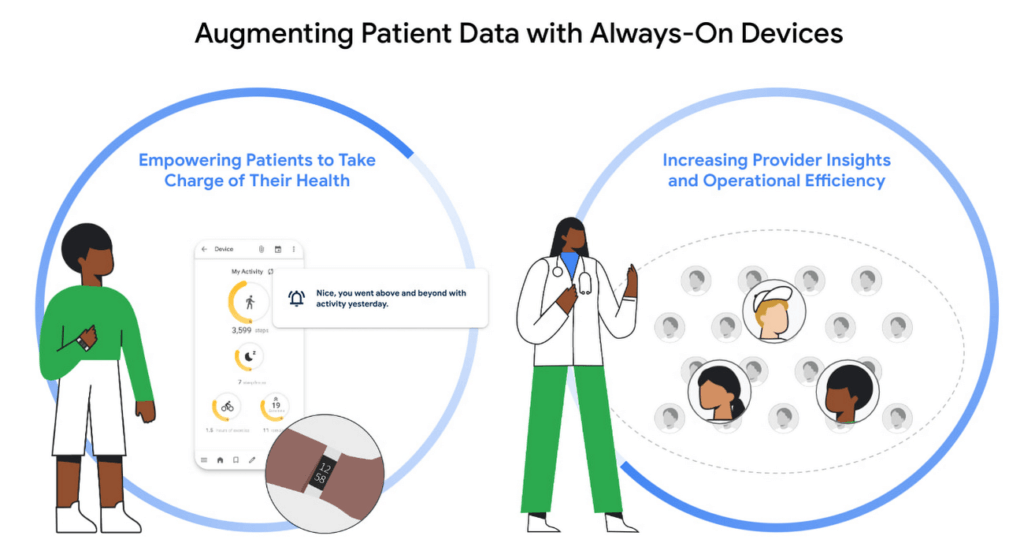
This new solution can support care teams and empower patients to live healthier lives in several critical ways:
- Pre- and post-surgery: Supporting the patient journey before and after surgery can lead to higher patient engagement and more successful outcomes.1 However, many organizations lack a holistic view of patients. Fitbit tracks multiple behavioral metrics of interest, including activity level, sleep, weight and stress, and can provide visibility and new insights for care teams to what’s happening with patients outside of the hospital.
- Chronic condition management: For people living with diabetes, maintaining their blood glucose levels within an acceptable range is a constant concern. It’s just one of countless examples, from heart diseases to high blood pressure, where care teams want to promote healthy behaviors and habits to improve outcomes. Better understanding how lifestyle factors may impact disease indicators such as blood glucose levels can enable organizations to deliver more personalized care and tools to support healthy lifestyle changes.
- Population health: Supporting better management of community health outcomes with a focus on preventive care can help reduce the likelihood of getting a chronic disease and improve quality of life.2 Fitbit users can choose to share their data with organizations that deliver lifestyle behavior change programs aimed at both prevention and management of chronic or acute conditions.
- Clinical research: Clinical trials depend on rich patient data. Collection in a physician’s office captures a snapshot of the participant’s data at one point in time and doesn’t necessarily account for daily lifestyle variables. Fitbit, used in more than 1,500 published studies–more than any other wearable device–can enrich clinical trial endpoints with new insights from longitudinal lifestyle data, which can help improve patient retention and compliance with study protocols.
- Health equity: Addressing healthcare disparities is a priority across the healthcare ecosystem. Analyzing a variety of datasets, such as demographic and social determinants of health (SDOH) alongside Fitbit data has the potential to provide organizations and researchers with new insights regarding disparities that may exist across populations—such as obesity disparities that exist among children in low-income families, or increased risk of complications among Black women related to pregnancy and childbirth. Learn more about Fitbit’s commitment to health equity research here.
Accelerate time to insight
Gaining a more holistic view of the patient can better support people on their health and wellness journeys, identify potential health issues earlier, and provide clinicians with actionable insights to help increase care team efficiency. Device Connect for Fitbit addresses data interoperability to “make the invisible visible” for organizations, providing users with consent management and control over their data. Leveraging world-class Google Cloud technologies, Device Connect for Fitbit offers several pre-built components that help make Fitbit data accessible, interoperable and useful—with security and privacy as foundational features.
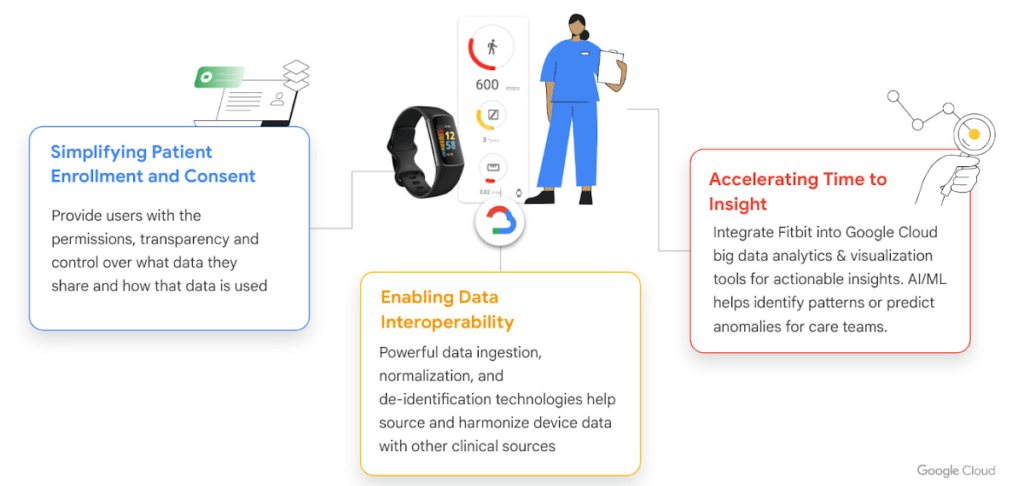
- Enrollment & consent app for web and mobile: The pre-built patient enrollment and consent app enables organizations to provide their users with the permissions, transparency, and frictionless experience they expect. For example, users have control over what data they share and how that data is used.
- Data connector: Device Connect for Fitbit offers an open-source data connector3, with automated data normalization and integration with Google Cloud BigQuery for advanced analytics. Our data connector can support emerging standards like Open mHealth and enables interoperability with clinical data when used with Cloud Healthcare API for cohort building and AI training pipelines.
- Pre-built analytics dashboard: The pre-built Looker interactive visualization dashboard can be easily customized for different clinical settings and use cases to provide faster time to insights.
- AI and machine learning tools: Use AutoML Tables to build advanced models directly from BigQuery or build custom models with 80% fewer lines of code required using Vertex AI—the groundbreaking ML tools that power Google, developed by Google Research.
Google Cloud’s ecosystem of delivery partners will provide expert implementation of services for Device Connect for Fitbit to help customers deploy at scale, and includes BlueVector AI, CitiusTech, Deloitte, and Omnigen.
Potential to help predict and prevent disease
The Hague’s Haga Teaching Hospital in the Netherlands is one of the first organizations to use Device Connect for Fitbit. The solution is helping the organization support a new study on early identification and prevention of vascular disease.
“Collaborating with Google Cloud allows us to do our research, with the help of data analytics and AI, on a much greater scale,” cardiologist Dr. Ivo van der Bilt said. “Being able to leverage the new solution makes it easier than ever to gain the insights that will make this trial a success. Health is a precious commodity. You realize that all the more if you are struck down by an illness. If you can prevent it or catch it in time so that it can be treated, you have gained a great deal.”
Fitbit innovation continues
Since becoming part of the Google family in January 2021, Fitbit has continued to help people around the world live healthier, more active lives and to introduce innovative devices and features, including FDA clearance for the new PPG AFib algorithm for irregular heart rhythm detection, released in April of this year. Fitbit metrics including activity, sleep, breathing rate, cardio fitness score (Vo2 Max), heart rate variability, weight, nutrition, SP02 and more will be accessible through Device Connect Fitbit. Google’s interactions with Fitbit are subject to strict legal requirements, including with respect to how Google accesses and handles relevant Fitbit health and wellness data. You can find details on these obligations here.
We look forward to empowering our customers to create more patient-centered, data-driven healthcare. Read more about Haga Teaching Hospital’s work to predict heart disease on the Google Cloud blog, and visit cloud.google.com/device-connect to learn more about Device Connect for Fitbit.
- Harris Poll
- CDC
- Device Connect for Fitbit is built on the Fitbit Web API and data available from consenting users is the same as that made available for third parties through the Fitbit Web API, and enables the enterprise customer services through Google Cloud.

3921
Of your peers have already downloaded this article
5:30 Minutes
The most insightful time you'll spend today!
The 2019 Accelerate State of DevOps Report confirms analyst reports that DevOps is crossing the chasm with the proportion of elite performers almost tripling compared to last year.
The report finds that delivering software quickly, reliably, and safely is at the heart of technology transformation and organizational performance. The report also finds that there’s a right way to handle the change approval process, and it leads to improvements in speed and stability and reductions in burnout.
Download this report and get:
- Insights on how to achieve elite performance in software development and delivery so you can deliver more value to your customers and stakeholders.
- Role of cloud computing in driving technology and organizational performance, with guidance on how to improve your use of the cloud.
- Smart ways to improve productivity and how the highest performers scale DevOps to maximize success.
How This Leading Trading Company Uses APIs to Build Fintech Apps Quickly and Cost-Effectively

4608
Of your peers have already read this article.
5:10 Minutes
The most insightful time you'll spend today!
Tradier uses the Apigee API management platform from Google to abstract the legacy complexities of capital markets so that developers can build FinTech applications in an agile, nimble, and quick fashion at minimal cost. The company embodies the evolution of what cloud technology can enable in the form of an API-first business delivered as a service.
The rise of API-powered FinTech
Historically, companies that wanted to build systems, applications, or services to interact with the stock market would have to build an entire brokerage operation from scratch. This would include data infrastructure, compliance infrastructure, and storage capabilities. It could take years and massive capital expense to accomplish everything that was required to be ready to serve customers.
Tradier provides this infrastructure as an API-based service so that the same companies can launch investor applications in as little as a few weeks. This democratized access means that FinTech innovation can come from anywhere, giving the same opportunities to create new products to everyone, from enterprise customers to startups.
“Financial markets are becoming fundamentally decentralized and unbundled,” says Dan Raju, co-founder, CEO, and chairman at Tradier. “The services that large legacy banks and brokerage firms used to offer are being supplanted by Tradier’s microservices and APIs, which power innovation.”
More than 200 companies use Tradier to develop and launch new products, or to add new features and functions that they traditionally would not have offered in existing products. With a large and diverse user base, Tradier faced the challenge of managing its partners in way that helps ensure it can grant credentials, track, monitor, and report in an efficient and equitable manner.
At the same time, the company recognized the inherent value of its partners for their power to leverage Tradier APIs to innovate. Tradier’s fundamental market disruption is the partner ecosystem, where the company is engaged along with its partners to deliver value to the entire ecosystem in the form of new products and services.
Embracing an API-powered ecosystem
Tradier has moved beyond providing great APIs toward engaging its ecosystem. If a customer wants a specific dataset, the company doesn’t automatically build a new product. Instead, Tradier looks to the ecosystem to build the product. With this approach, Tradier has taken its capabilities and multiplied them by hundreds.
“The fundamental difference between thinking about an API ecosystem versus an API product is the difference between being a participant who’s enabling innovation and not just a company delivering a set of technical capabilities,” Raju says.
Tradier takes an outside-in approach toward engaging its API ecosystem. Constantly listening to participants and helping to enable and empower them to create value is fundamental to the company’s business model. Rather than simply focusing on building new capabilities on its own, Tradier listens to what functionalities customers need and facilitates development. In many cases, the ecosystem generates the requested product organically rather than Tradier needing to do it.
“I love APIs because they allow you to empower others to create value. The concept of empowering others to create value along with you is what is the most satisfying, and the most fascinating, thing about APIs,” says Raju.
Delivering value at scale
Tradier handles between 500 million to 1 billion API calls and a billion dollars in transactions a month, and all of them run through the Apigee API management platform. Apigee’s last mile forms the single layer that manages Tradier’s infrastructure, including security, analytics, developer interactions, and execution. The company also uses Apigee to comply with an array of regulatory reporting, mandated by Tradier’s status as a FINRA (Financial Industry Regulatory Authority)-regulated entity.
“Apigee is integral to the Tradier offering. They have been great partners and have always collaborated and enabled us to innovate at a pace that helped Tradier attract developers and innovative companies. We see tremendous potential in the synergy of Apigee and Google as it brings to the market a vast extended capability set based on the Google Cloud Platform.”
Tradier is an API-centric ecosystem that delivers value to an entire set of players where the nucleus is the Apigee API management suite, which helps deliver, innovate, publish, manage, monitor, and secure the ecosystem on a day-to-day basis. Simplicity combined with product evangelism is the key to success in the API space, Raju says.
Tradier’s capabilities to innovate, iterate, and travel the journey with its customers, partners, and developers has yielded many rewards. The company’s long history of working with Apigee has enabled it to assemble a set of people and resources for creating engagement, as well as to create a winning set of APIs for delivering FinTech capabilities.
Considering the transformative future
Looking toward a future in which the financial services industry will experience ongoing disruption, Raju predicts that Tradier will continue to leverage APIs to lead the way.
“I think traditional banks are under attack. They are being replaced by a set of nimble, agile players that are offering a lot of new functionality to customers. This is forcing banks to think about how they can digitize their products through APIs so that they can provide the same functionalities as newer players.”
With companies like Tradier and others offering functionality that used to be in-house and exposing it outside, traditional brokerage firms are also being forced to rethink their model. Raju believes that this line of thinking also extends to the Blockchain.
“Exposing Blockchain-like capabilities through APIs is going to be a disruptive influence, and it will be critical for companies to think about how APIs, and more importantly Blockchain, can create value for us.”
Building Unique Customer Experiences with Speed & Scale: Sprinklr & Google Cloud

8234
Of your peers have already read this article.
2:00 Minutes
The most insightful time you'll spend today!
Enterprises are increasingly seeking out technologies that help them create unique experiences for customers with speed and at scale. At the same time, customers want flexibility when deciding where to manage their enterprise data, particularly when it comes to business-critical applications.
That’s why I’m thrilled that Sprinklr, the unified customer experience management (Unified-CXM) platform for modern enterprises, has partnered with Google Cloud to accelerate its go-to-market strategy and grow awareness among our joint customers. Sprinklr will work closely with our global salesforce, benefitting from our deep relationships with enterprises that have chosen to build on Google Cloud.
Akin to Google Cloud’s mission to accelerate every organization’s ability to digitally transform their business through data-powered innovation, Sprinklr’s primary objective is to empower the world’s largest and most loved brands to make their customers happier by listening, learning, and taking action through insights. With this strategic partnership now in place, Sprinklr and Google Cloud will go-to-market together with the end-customer as our sole focus.
Traditionally, brands have adopted point solutions to manage segments of the customer journey. In isolation, these may work — but they rarely work collaboratively, even when vendors build “Frankenstacks” of disconnected products. These solutions can’t deliver a 360° view of the customer, and often reinforce departmental silos. All of which creates point-solution chaos.
Sprinklr’s approach is fundamentally different and is the way out of the aforementioned point-solution chaos. As the first platform purpose-built for unified customer experience management (Unified-CXM) and trusted by the enterprise, Sprinklr’s industry-leading AI and powerful Care, Marketing, Research, and Engagement solutions enable the world’s top brands to learn about their customers, understand the marketplace, and reach, engage, and serve customers on all channels to drive business growth.
Sprinklr was built from the ground up as a platform-first solution, designed to evolve and grow with the rapid expansion of digital channels and applications. The results? Faster innovation. Stronger performance. And a future-proof strategy for customer engagement on an enterprise scale.
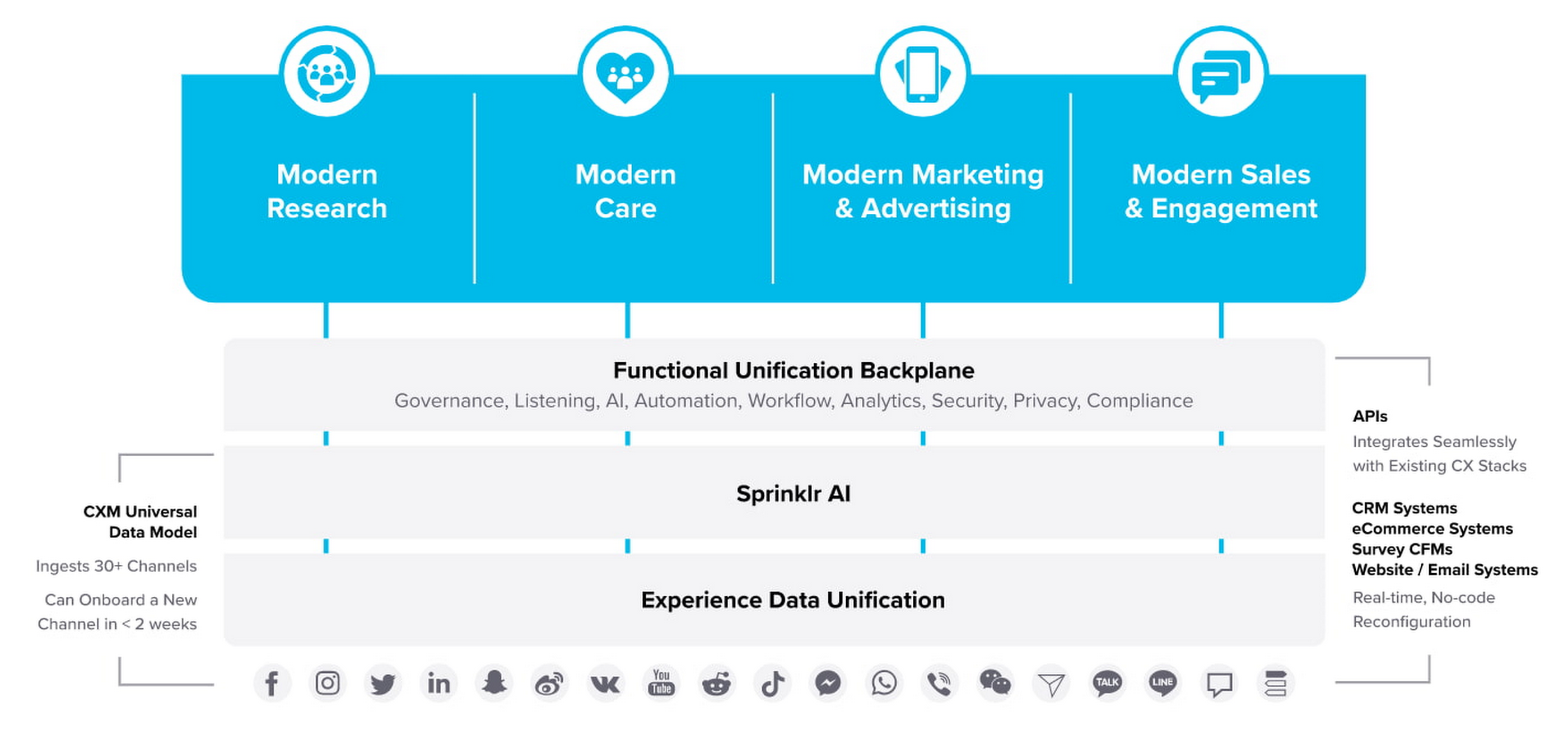
“Sprinklr works with large, global companies that want flexibility when deciding where to manage their enterprise data and consider our platform a business-critical application,” said Doug Balut, Senior Vice President of Global Alliances, Sprinklr. “Giving our customers the opportunity to manage Sprinklr on Google Cloud empowers them to create engaging customer experiences while maintaining the high security, scalability, and performance they need to run their business.”
To learn more about this exciting partnership and the challenges we jointly solve for customers, check out the recent conversation between Google Cloud’s VP of Marketing, Sarah Kennedy, and Sprinklr’s Chief Experience Officer, Grad Conn. Or read the press release on the partnership.
More Relevant Stories for Your Company

AL/ML and Data Products Delivered through Google Cloud Makes them Leader of Gartner 2022 Magic Quadrant
Gartner® named Google as a Leader in the 2022 Magic Quadrant™ for Cloud AI Developer Services report. This evaluation covered Google’s language, vision and structured data products including AutoML, all of which we deliver through Google Cloud. We believe this recognition is a reflection of the confidence and satisfaction that

Four Simple Steps to SRE Implementation
A few months ago, we wrote about how the first step to implementing Site Reliability Engineering (SRE) in an organization is getting leadership on board. So, let’s assume that you’ve gone ahead and done that. Now what? What are some concrete steps you can take to get the SRE ball rolling?




Building a Powerful Digital Payments Solution
See how the Payeezy business platform, which enables merchants to establish and grow their eCommerce business, was set up and how it works. The platform enables the exposure of First Data services, processes, and data to partners. The Payeezy API provides all the tools partners need to set up payments


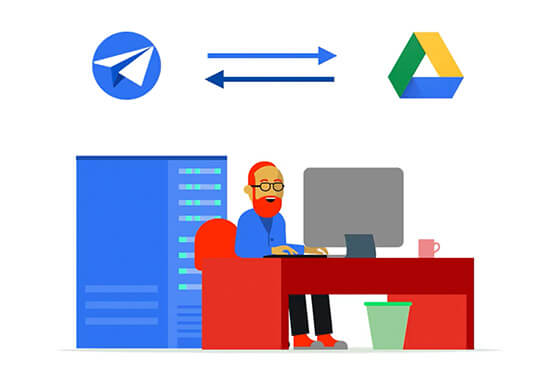
Simplified Document Processing with AppSheet Automation
Move over legacy, time-consuming systems and processes to update data from documents and invoices into disparate data systems. AppSheet integrates no-code development with Google Cloud's state-of-the-art Document AI to automate the data extraction and validation from invoices, documents, receipts, etc. You can end all 'guesstimates' and rely on the accuracy
